A few kilometres beyond the ancient walls of Bukhara, where the desert city gives way to gardens, stands a palace with one of the loveliest names in Central Asia: Sitorai Mokhi-Khosa, usually translated as the Palace of the Moon and the Stars. It was the summer residence of the last emirs of Bukhara, a cool green retreat away from the dust and heat of the old town, and it is one of the strangest and most charming buildings you will find anywhere on the Silk Road.
Strange, because it is two worlds fused into one. Walk through its gates and you pass, sometimes within a single room, from the deep tradition of Bukharan craftsmanship, all carved white plaster and painted ceilings, into the imported world of nineteenth-century Russia and Europe, with its mirrors, chandeliers, tiled stoves, and heavy furniture. The emirs who built it wanted the best of both, and their craftsmen gave it to them in a blend that should not work and yet somehow enchants.
The palace is also a monument to an ending. It was completed in the last years of an ancient monarchy, and within a short time of its finest rooms being decorated, the emirate was swept away and its final ruler was fleeing across the mountains. To wander through Sitorai Mokhi-Khosa today is to walk through the last dream of the emirs of Bukhara, a dream of moonlight and stars, mirrors and peacocks, frozen at the moment the old order fell. In the sections that follow you will get to know that dream, room by room.

In This Article
- The Palace of the Moon and the Stars
- The Last Emirs of Bukhara
- Where Bukhara Met St Petersburg
- Through the Gates and Into the Gardens
- The White Hall and Its Mirror of Plaster
- Ceilings of Gold and Rooms of Colour
- Mirrors, Stoves, and Imperial Taste
- The Harem, the Pool, and the Peacocks
- A Museum of Bukharan Art
- The Emir Who Fled Across the Mountains
- Gardens, Pools, and the Spirit of a Summer Palace
- The Palace on Film
- Visiting Sitorai Mokhi-Khosa
The Palace of the Moon and the Stars
The name alone tells you something about the spirit of the place. Sitorai Mokhi-Khosa is usually rendered as the Palace of the Moon and the Stars, or the Star and Moon-like Palace, and tradition links it to a beloved of one of the emirs, so that the whole complex becomes a kind of romantic gesture written in brick, plaster, and garden. Whether or not the story is literally true, it suits a building that feels made for pleasure rather than power.
It sits a short distance north of Bukhara, out where the emirs could escape the crowded, walled old city for something greener and quieter. Bukhara itself is one of the great historic cities of the Islamic world, a dense maze of mosques, madrasas, and covered bazaars baked by the Central Asian sun. The summer palace was the antidote to all that intensity, a place of shaded courts, cool halls, pools, and gardens where the ruler and his household could breathe.
The idea of a summer residence outside the capital was not new; rulers across the region had long kept country retreats. What makes this one special is the moment it was built and the taste of the men who built it. By the late nineteenth and early twentieth centuries, Bukhara had fallen under the influence of the Russian Empire, and its emirs travelled, saw St Petersburg and other cities, and came home wanting to bring some of that world back with them.
So the Palace of the Moon and the Stars became a meeting point of imaginations: the old Persianate world of Bukhara, with its poetry of gardens and its dazzling craft traditions, and the newer world of imperial Russia, with its palaces and salons. The result is a place that is unmistakably Central Asian and yet full of surprises, a building whose very name promises enchantment and whose rooms, remarkably, deliver it.
The Last Emirs of Bukhara
To understand the palace you need to meet the men it was built for: the emirs of the Manghit dynasty, who ruled the Emirate of Bukhara through the eighteenth, nineteenth, and early twentieth centuries. By the time the summer palace took its final form, Bukhara was a protectorate of the Russian Empire, its emirs still reigning in great splendour at home but bound by treaty to the power in the north. It was a comfortable, gilded, and ultimately precarious position.
The palace is associated above all with the last two emirs, Abdulahad Khan and his son Said Alim Khan, who between them shaped the residence into what survives today. Alim Khan, the final emir, had been educated in Russia, spoke the language of the imperial court, and moved between the world of Bukharan tradition and that of St Petersburg. His famous colour portrait, taken by an early Russian photographer, shows a richly robed monarch who was also a modern subject of an empire.
These were rulers of enormous personal wealth, presiding over a state whose economy rested on trade, agriculture, and the labour of its people, and whose court preserved elaborate ceremony and hierarchy. The summer palace was an expression of that wealth and of the emirs’ desire to be seen as sophisticated monarchs, at ease with the latest fashions of Europe while remaining the guardians of a proud Islamic and Persianate heritage.
But they reigned in the twilight of their world. The Russian Empire that overshadowed them would soon collapse into revolution, and the new power that rose from that collapse had no place for emirs. The men who commissioned the palace’s most beautiful rooms were, though they may not fully have known it, decorating the last chambers of a monarchy running out of time. That knowledge gives every gilded ceiling here a faint undertone of melancholy.
It is worth pausing on that famous photograph of Alim Khan, one of the earliest colour images of any Central Asian ruler. In it the emir sits in a robe of shimmering blue, hand on sword, gazing steadily at a camera operated by a visitor from the empire that would soon help end his reign. The image, like the palace, freezes a moment of confident splendour on the very edge of collapse, and it is hard to look at either without a sense of what was about to come.
Where Bukhara Met St Petersburg
The construction of Sitorai Mokhi-Khosa is a story of deliberate cultural fusion. The emirs wanted a palace that combined the finest local craftsmanship with the styles and comforts they had admired in Russia, and they went about it methodically. It is said that Bukharan master builders were sent north to study Russian architecture and decoration, so that they could return and blend what they had learned with their own inherited skills.
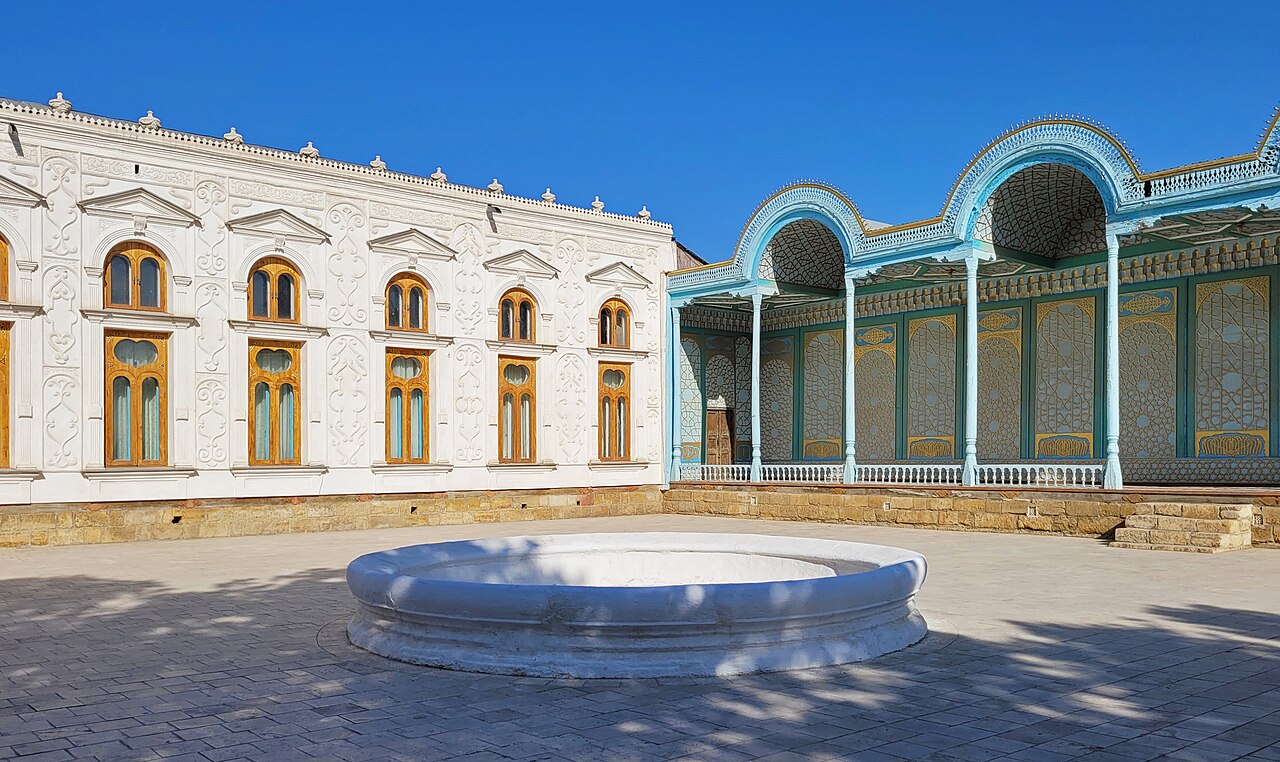
The result is a complex built over several phases, with older and newer sections, in which traditional Central Asian forms sit alongside frankly European ones. You find domes and carved plaster and painted timber ceilings of purely Bukharan character, and then, close by, rooms arranged and furnished in a manner that would not look out of place in a Russian country house, complete with tiled heating stoves and imported fittings.
This was not clumsy imitation but a confident act of taste. The emirs and their craftsmen chose what they wanted from each tradition and combined them on their own terms. Russian and European materials, glass, mirrors, ceramics, ironwork, were brought in at great expense, while the decorative genius of Bukhara, above all its plaster carving and painting, was lavished on the interiors. Local and imported hands worked on the same buildings.
To modern eyes the mixture can seem almost surreal, this collision of minaret-country craft with imperial salon style, but it perfectly captures the position of Bukhara at the time: an ancient Islamic monarchy absorbed into a European empire, proud of its own heritage yet hungry for the prestige of the wider world. The palace is that historical moment made visible, a building where two civilizations were persuaded, room by room, to share a roof.
Through the Gates and Into the Gardens
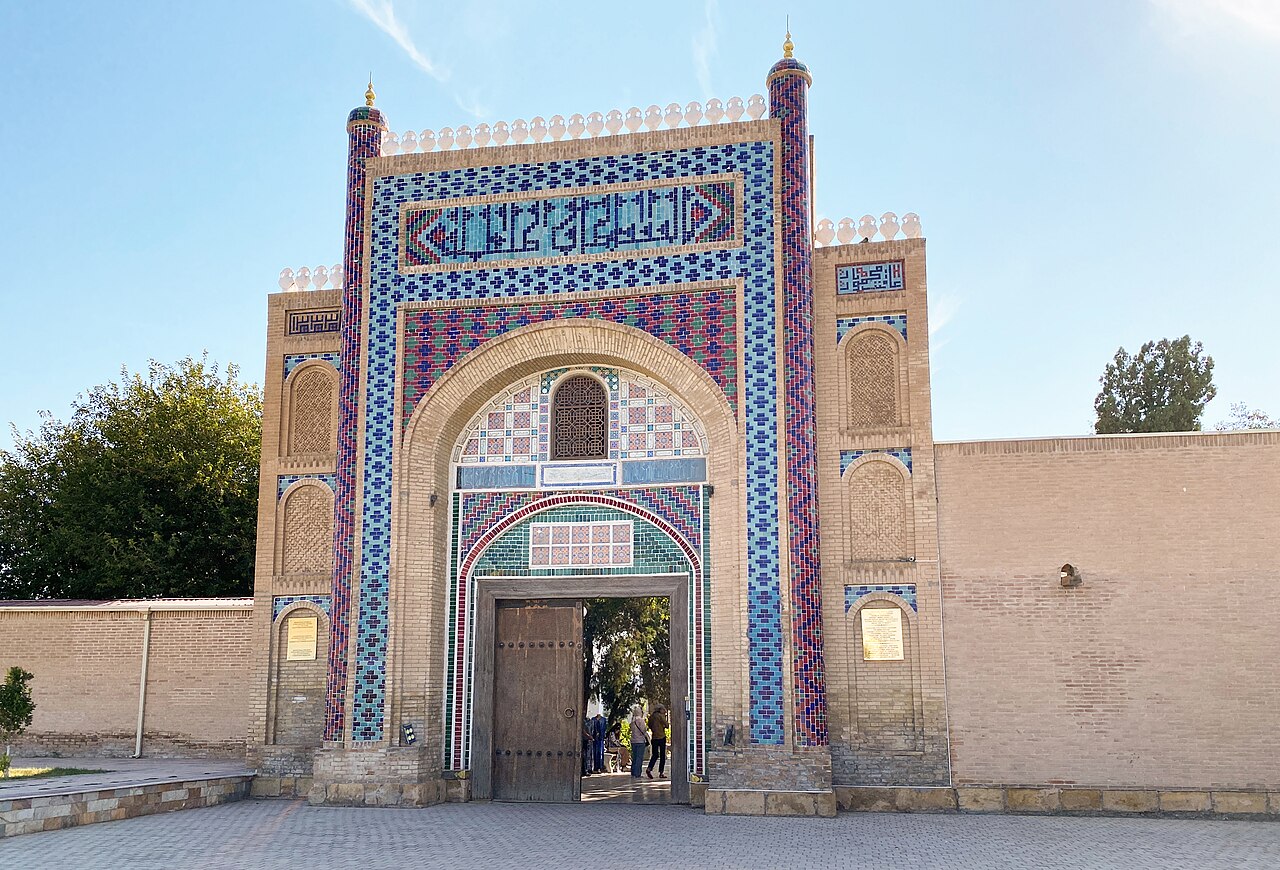
Arriving at the palace, you pass first through its entrance and gateway, an introduction that sets the tone for everything within. The gate is worked in the characteristic manner of the region, with patterned brick, carved and painted detail, and the play of geometry and colour that Central Asian builders had perfected over centuries. It is a threshold designed, like the great doorways of Bukhara’s monuments, to prepare you for what lies beyond.

Once inside, the complex opens into a series of courtyards, buildings, and garden spaces rather than a single monolithic block. This is characteristic of palace-building in the region, where life was organised around courts and pavilions, with different areas for reception, for private life, for the household and the harem. Moving between them, under the trees and past the pools, you feel the palace as a small world rather than one grand statement.
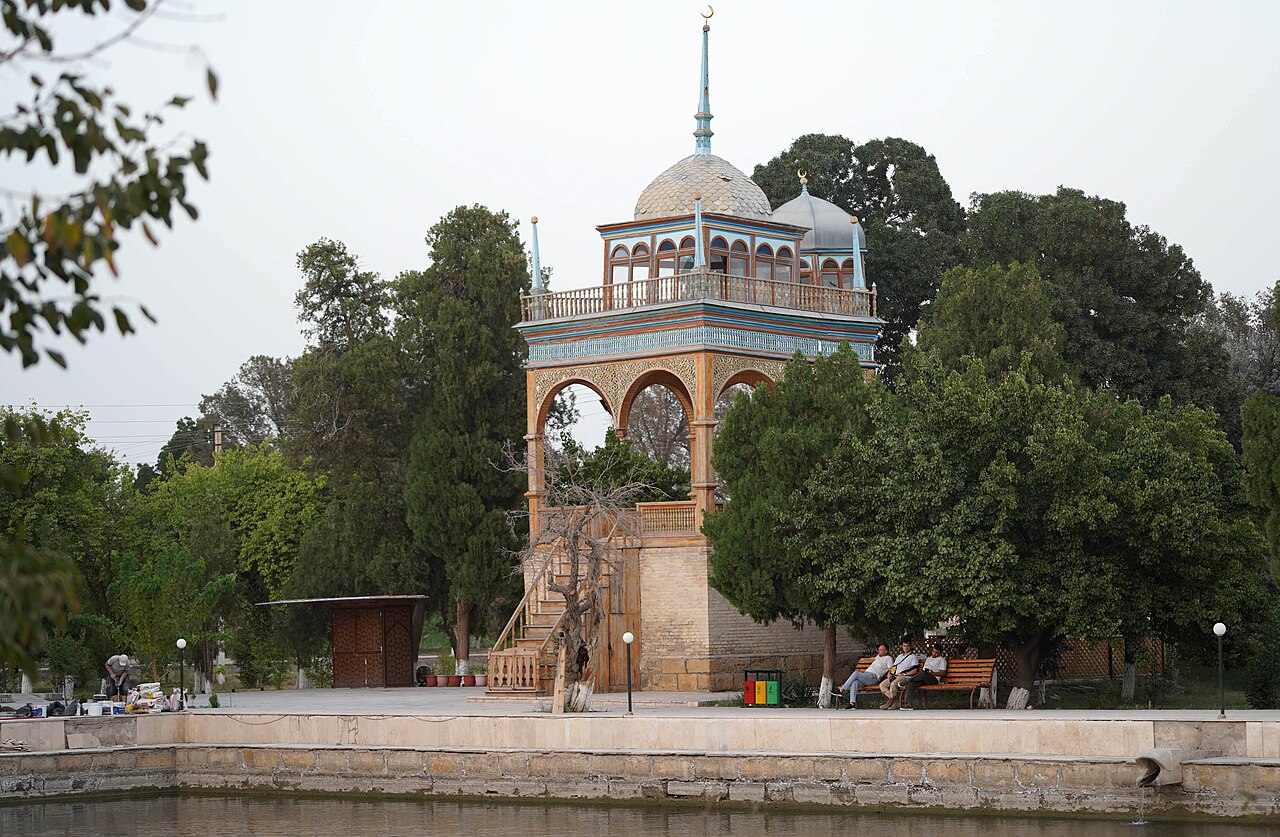
The gardens are essential, not incidental. In the hot, dry climate of Bukhara, greenery and water were the ultimate luxuries, and the whole point of a summer residence was to command them. Shaded walks, planted courts, and pools turned the palace into an oasis, a place where the harshness of the surrounding land was held at bay and the emir could enjoy cool air and the sound of water. Peacocks, famously, strutted among it all.
This arrangement of gate, court, garden, and pavilion is one of the oldest ideas in the architecture of the Persianate world, the notion of the garden as a foretaste of paradise. At Sitorai Mokhi-Khosa it is given a late, luxurious, and slightly eclectic form, but the underlying vision is ancient: to make, within walls, a green and watered world more perfect than the one outside.
The White Hall and Its Mirror of Plaster
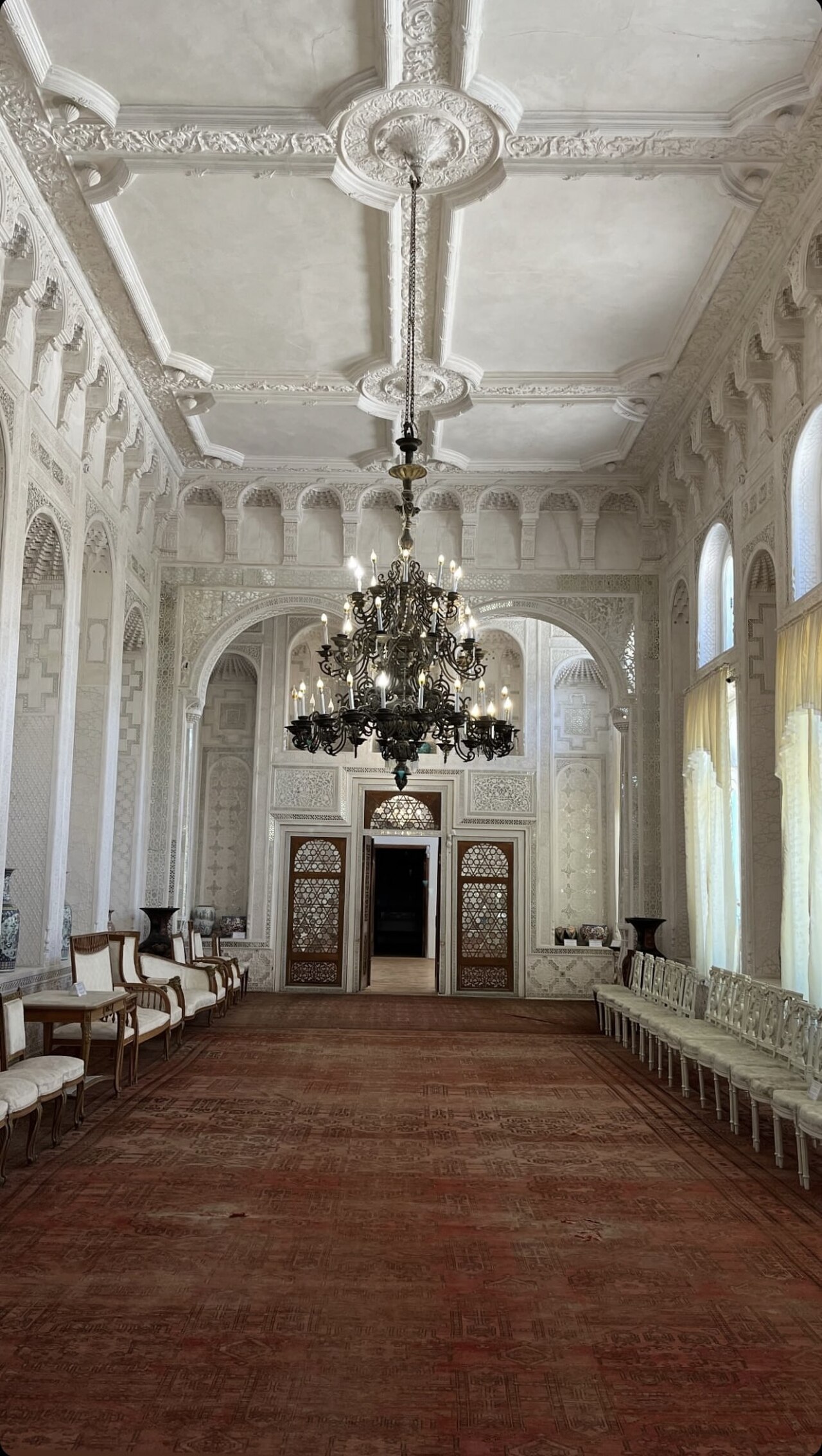
If the palace has a single unforgettable room, it is the White Hall, the Oq Uy, and it is the work above all of one man: the great Bukharan master craftsman Usto Shirin Muradov, whose name is remembered with pride in Uzbekistan. The hall is a dazzling composition in white carved ganch, the fine local plaster, worked into an intricate lace of ornament and set against mirror-work so that the whole room seems to glow and multiply the light.

The technique is extraordinary. Ganch can be carved when partly set into crisp, deep relief, and here it has been used to cover walls and surfaces with a shimmering skin of pattern, geometric and floral, endlessly repeating and interlocking. Small pieces of mirror set among the carving catch and scatter the light, so that the White Hall does not simply reflect brightness but seems to breathe it, a room that feels lit from within even on a dull day.
It is said that the master worked for years on this hall, and the care is evident in every square metre. There is a purity to the White Hall, an absence of colour that throws all the emphasis onto form and light, that sets it apart from the more richly painted rooms elsewhere in the palace. To stand in it is to understand why the plaster-carvers of Bukhara were among the most admired craftsmen of the entire region.
The White Hall is also a reminder that the true wealth of the palace lay not only in imported luxuries but in inherited skill. No amount of Russian glass or European furniture could have produced this room; it came out of a deep local tradition of decorative art, passed from master to apprentice over generations. In the Oq Uy that tradition reached one of its final and most brilliant flowerings, just as the world that sustained it was about to end.
Guides like to point out how the room changes as you move through it. Step to one side and the mirror fragments throw the carved white ornament back at you from a dozen angles; the pattern seems to shift and deepen, never quite resolving into something you can hold. It is a deliberate effect, an architecture of dazzle, and it shows how completely the Bukharan masters understood that light itself could be a building material, to be caught, broken, and multiplied for the delight of whoever stood beneath it.
Ceilings of Gold and Rooms of Colour
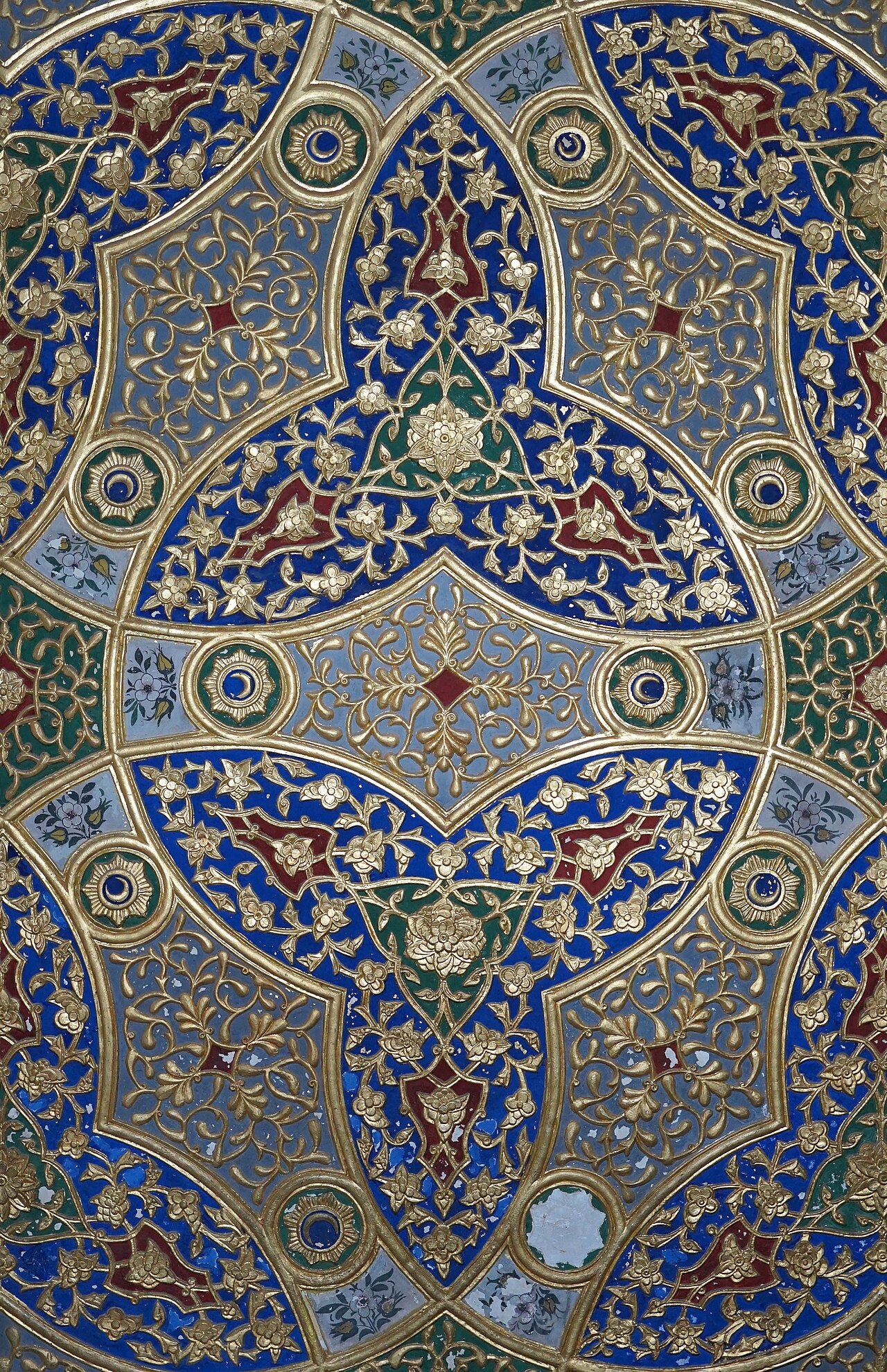
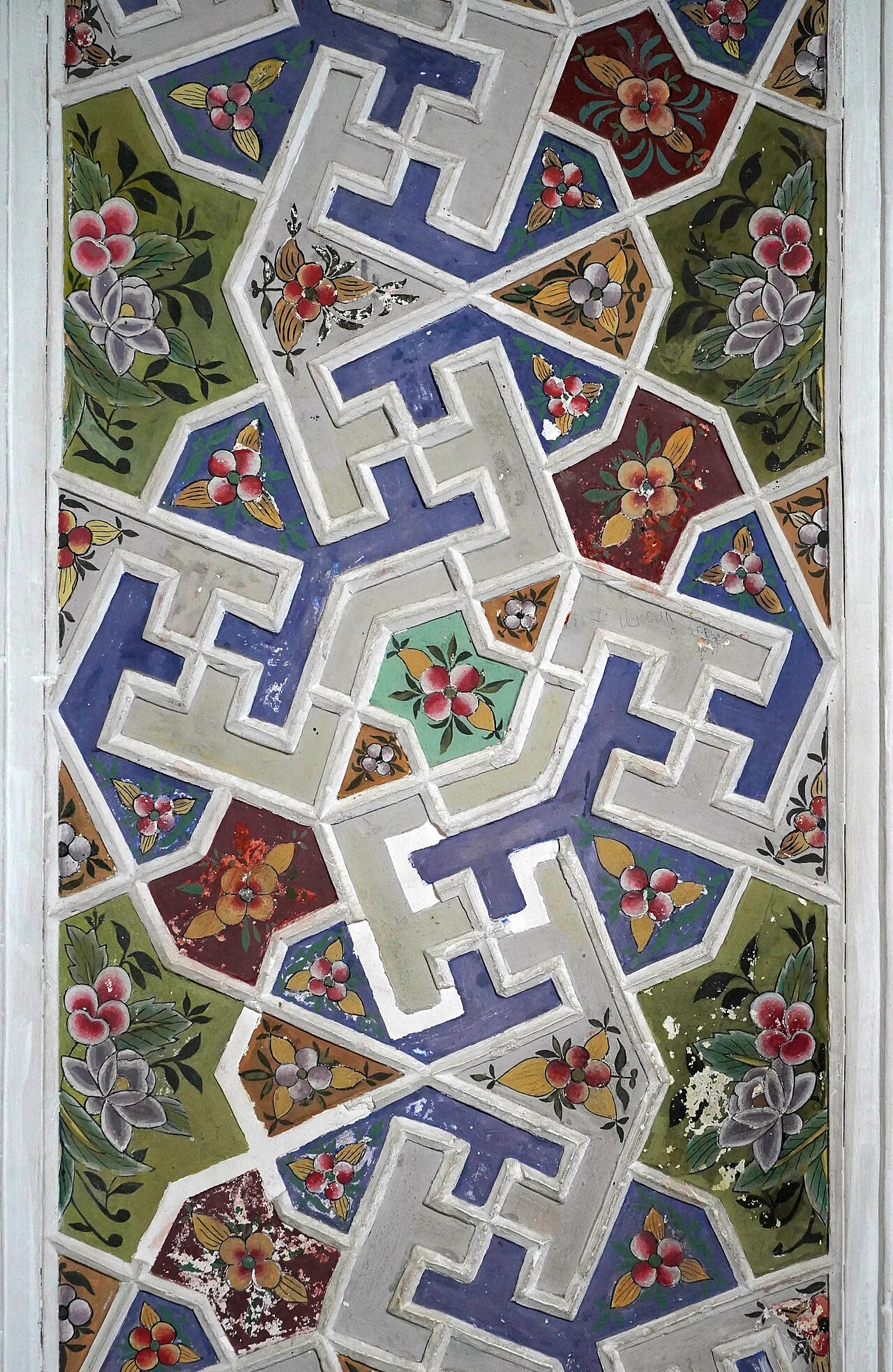
Beyond the White Hall, the palace unfolds a whole repertoire of decoration, and much of it is anything but restrained. Where the Oq Uy is a study in white, other rooms blaze with colour and gold. Ceilings are painted and gilded in rich patterns, walls are worked in coloured ganch and paint, and doorways, niches, and panels are framed in ornament, so that scarcely a surface is left plain.
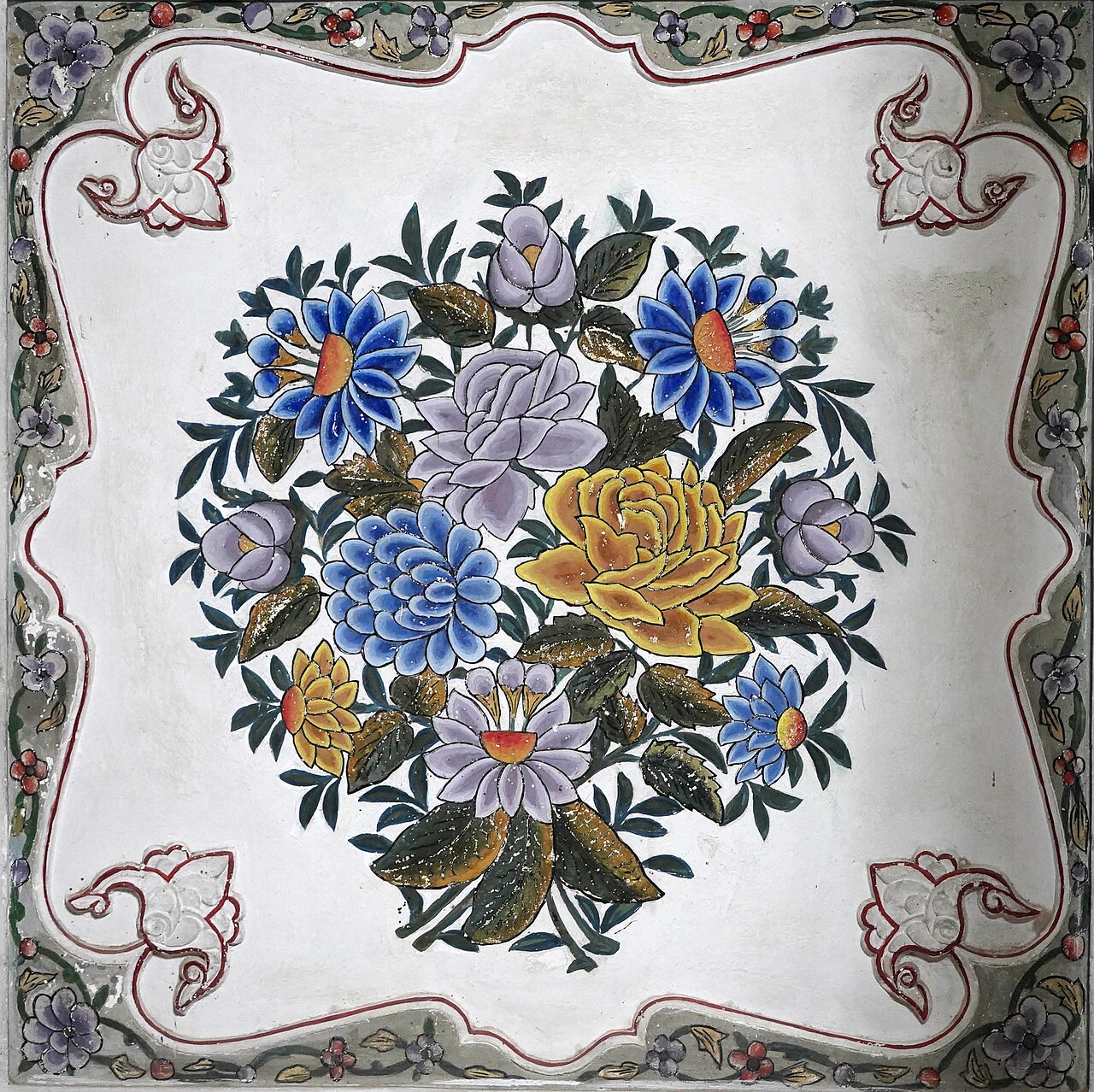
The decorative vocabulary is the classic one of the region: dense floral and vegetal designs, geometric interlace, and bands of ornament, executed with a love of pattern that fills every available space. Gold leaf and bright pigments give many of the rooms a jewel-box intensity, a deliberate opulence meant to overwhelm and delight visitors and to display the resources and taste of the emir.
What is striking is the variety. The palace is not decorated to a single scheme but room by room, so that moving through it is like turning the pages of a sample book of Bukharan and eclectic ornament: here a painted timber ceiling, there a mirror hall, elsewhere a chamber arranged around imported furniture and a tiled stove. Each space has its own character, and part of the pleasure of a visit is discovering them one by one.
All of this ornament served a purpose beyond mere beauty. In a monarchy where display was a language of power, the richness of the emir’s rooms proclaimed his status and the sophistication of his court. To be received amid such splendour was to be reminded of the wealth and cultivation of Bukhara, and the decoration of the palace was, in that sense, a form of statecraft conducted in gold leaf and carved plaster.
Mirrors, Stoves, and Imperial Taste
Threaded through all this Central Asian craft is the unmistakable presence of imperial Russia and Europe, and it is one of the palace’s chief delights. The emirs filled certain rooms with imported luxuries: large mirrors, glittering chandeliers, European and Russian furniture, decorative ceramics, and the tall tiled stoves used to heat rooms in the Russian manner, objects that must have seemed as exotic in Bukhara as the Bukharan craft would have seemed in St Petersburg.
These imported pieces were not hidden away but proudly displayed, often in rooms whose walls and ceilings were pure Bukharan work, so that the two traditions confront each other directly. A European clock or a Russian vase stands beneath a carved and painted ceiling; a tiled stove warms a room framed in local ornament. The effect is a kind of visual conversation between two worlds that had, in this period, been thrown together by empire.
Among the treasures the palace is known for are its collections of fine ceramics and glass, including pieces gathered from far afield, reflecting the emirs’ role as wealthy collectors as well as rulers. Gifts, purchases, and diplomatic exchanges brought objects from Russia, Europe, China, and beyond into the palace, turning parts of it into a showcase of the emir’s reach and connections.
For the visitor, this blend is what makes Sitorai Mokhi-Khosa so memorable. It would be remarkable enough as a pure example of late Bukharan palace art, but the injection of imperial Russian taste turns it into something rarer: a document, in furniture and fittings, of a specific and fleeting historical situation, the last years of an ancient emirate living in the shadow, and under the spell, of a European empire.
The Harem, the Pool, and the Peacocks
Like other courts of its kind, the palace included a harem, the private domain of the emir’s household, and the stories attached to it are among the most often repeated by guides and visitors. Here, away from the public and ceremonial parts of the complex, was the world of the women of the court, with its own buildings, courts, and garden, screened from outside eyes and governed by its own rhythms and rules.

The most famous tale concerns a pool set within the grounds, where, it is said, the women of the harem would bathe while the emir watched from a raised pavilion or balcony above. According to the popular legend, he would toss an apple to signal his choice among them. Such stories should be treated with caution, as the kind of romantic embroidery that clings to every royal harem, but they capture the atmosphere of luxury and seclusion that the palace was designed to provide.
Around the pools and gardens strutted peacocks, birds long associated with royal pleasure grounds across Asia, their beauty and their cries part of the sensory world of the summer palace. Water, greenery, birdsong, shade: these were the ingredients of paradise as the region imagined it, assembled here for the enjoyment of the emir and his household during the scorching Bukharan summers.
Behind the romance, of course, lay a real and often constrained world for the people who lived in the harem, and it is worth remembering the human reality beneath the picturesque legends. But as a piece of the palace’s design, the harem and its gardens show how completely Sitorai Mokhi-Khosa was conceived as a place of retreat and delight, a private paradise walled off from the desert and the demands of rule alike.
A Museum of Bukharan Art
After the fall of the emirate, the palace found a new role that suits it well: it became a museum, and today it houses collections of the decorative and applied arts of Bukhara and the wider region. The rooms that once displayed the emir’s wealth now display the artistic heritage of his land, so that the building and its contents reinforce one another, the setting itself being one of the finest exhibits.
Among the treasures shown here are the famous embroidered textiles of the region, above all the suzani, large decorative hangings worked in brilliant silk thread with bold floral and medallion designs. These embroideries are one of the glories of Central Asian craft, made traditionally by women and carrying deep associations with marriage, household, and blessing, and seeing them in the emir’s palace places them in a fittingly splendid frame.
The collections also include the robes and costumes of the court, with the heavy gold-embroidered garments and richly patterned silk ikat fabrics for which Bukhara was renowned, as well as metalwork, ceramics, woodwork, and other crafts. Together they offer a rich survey of the material culture of the emirate, the everyday and ceremonial arts that filled a world now vanished.
In this way the palace has become a keeper of memory. The monarchy it was built to serve is long gone, but the crafts it patronised live on in its halls, studied and admired by visitors from around the world. There is a fittingness to it: a building made by the finest artisans of Bukhara now devoted to preserving and honouring exactly that artistic tradition, keeping alive the skills that gave the palace its beauty in the first place.
The Emir Who Fled Across the Mountains
The splendour of Sitorai Mokhi-Khosa is haunted by the speed of its ending. In 1920, only a short time after the palace’s finest rooms had been completed, the forces of the new Soviet power, advancing after the Russian Revolution, moved against Bukhara. The old emirate, for all its wealth and ceremony, could not withstand the assault, and the ancient monarchy that had ruled the city for generations came suddenly to an end.
The last emir, Said Alim Khan, fled. He escaped eastward and eventually crossed into Afghanistan, where he lived out his days in exile, the final ruler of a line that stretched back through centuries of Central Asian history. The palace he had helped to perfect was left behind, its gilded ceilings and mirror halls emptied of the court that had given them meaning, taken over by the new order.
It is a poignant thought as you walk the rooms today. Some of the very decoration you admire was among the last work commissioned by a monarchy that had, at that moment, only a few years left. The palace was, in effect, finished just in time to be lost, a summer dream completed on the eve of the storm that would sweep its owners away forever.
That closeness of beauty and catastrophe is part of what makes the place so affecting. Sitorai Mokhi-Khosa is not a ruin; it survived, and it dazzles. But it is a survivor from a world that ended abruptly, a palace whose builders never grew old in it, and whose last master saw it only briefly before fleeing across the mountains into a lifetime of exile. To visit is to stand in the beautiful, slightly ghostly aftermath of that fall.
Gardens, Pools, and the Spirit of a Summer Palace
For all its history, Sitorai Mokhi-Khosa remains, at heart, a garden palace, and its grounds are essential to understanding it. The complex is set among trees, courts, and water, laid out so that the buildings and the greenery belong to a single composition. In the fierce heat of a Bukharan summer, these shaded, watered spaces were the whole reason the palace existed, and even now they give the place much of its charm.
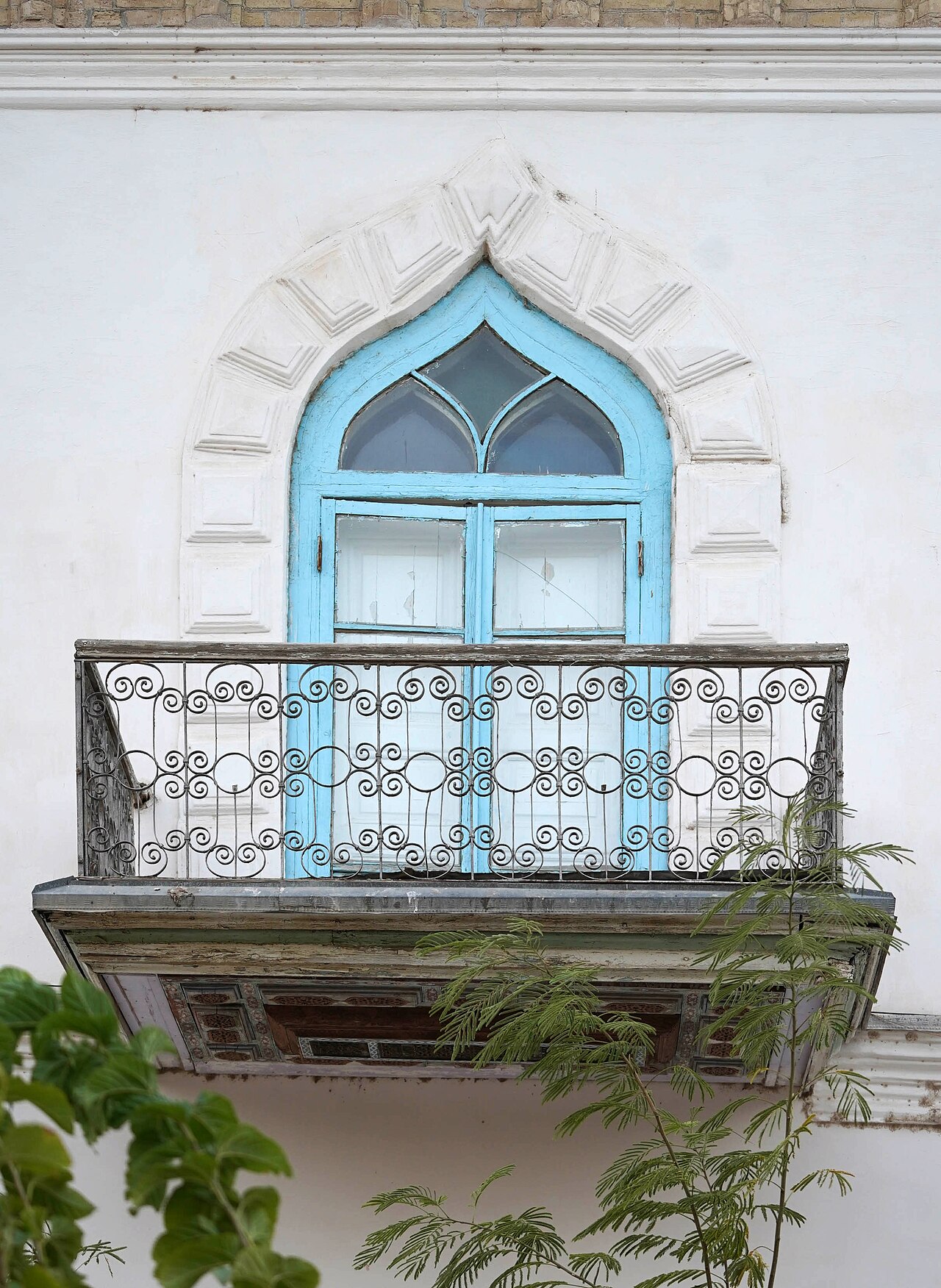
Pools and channels bring the coolness and the reflective play of water into the design, echoing the ancient regional ideal of the garden as an image of paradise. Around them, planted courts and walks offer shade and calm, a deliberate contrast to the sun-baked landscape beyond the walls. This is architecture that understands its climate intimately and answers it with green and water rather than fighting it with sheer mass.
The peacocks that once belonged to the emir’s pleasure grounds have their descendants and echoes in the atmosphere of the place, and the gardens still carry the memory of a court at leisure. It is easy, wandering them, to picture the summers the palace was built for: the household escaping the old city, the sound of water, the birds, the cool interiors waiting behind carved and painted walls.
These grounds tie the whole ensemble together. Without them, the palace would be merely a collection of decorated rooms; with them, it becomes a complete vision of the good life as the emirs imagined it, a walled paradise of shade, water, beauty, and ease. In the gardens of Sitorai Mokhi-Khosa the deepest purpose of the summer palace, simple bodily and spiritual refreshment, is still perfectly legible.
The Palace on Film
So much of Sitorai Mokhi-Khosa lives in effects that photographs struggle to catch: the way the White Hall multiplies light in its mirrors, the glow of gilded ceilings, the coolness of the garden courts. The short film below offers a moving tour of the palace and its rooms, letting you feel the spaces and the play of light in a way that still images, however lovely, can only hint at.

If you are planning to include Bukhara on a journey through Central Asia, watching a tour like this beforehand helps you know what to look for: the White Hall, the painted rooms, the mix of Bukharan and Russian decoration, the gardens and pools. Arriving with that sense in mind lets you slow down and savour the details rather than being merely dazzled by the whole.
And if Bukhara is, for now, a distant dream, the film is a fine way to visit in imagination. Let it play, and picture yourself stepping out of the desert light into the shimmering White Hall, or walking beneath the trees past the pools where peacocks once wandered, in the last summer palace of the emirs of Bukhara.
Visiting Sitorai Mokhi-Khosa
For travellers, the palace is one of the essential sights around Bukhara, and it makes a natural complement to the monuments of the old city. It lies a short distance outside the historic centre, easily reached as a half-day excursion, and rewards the trip with an experience quite different from the mosques and madrasas of the town: intimate, eclectic, and full of surprises rather than austere and monumental.
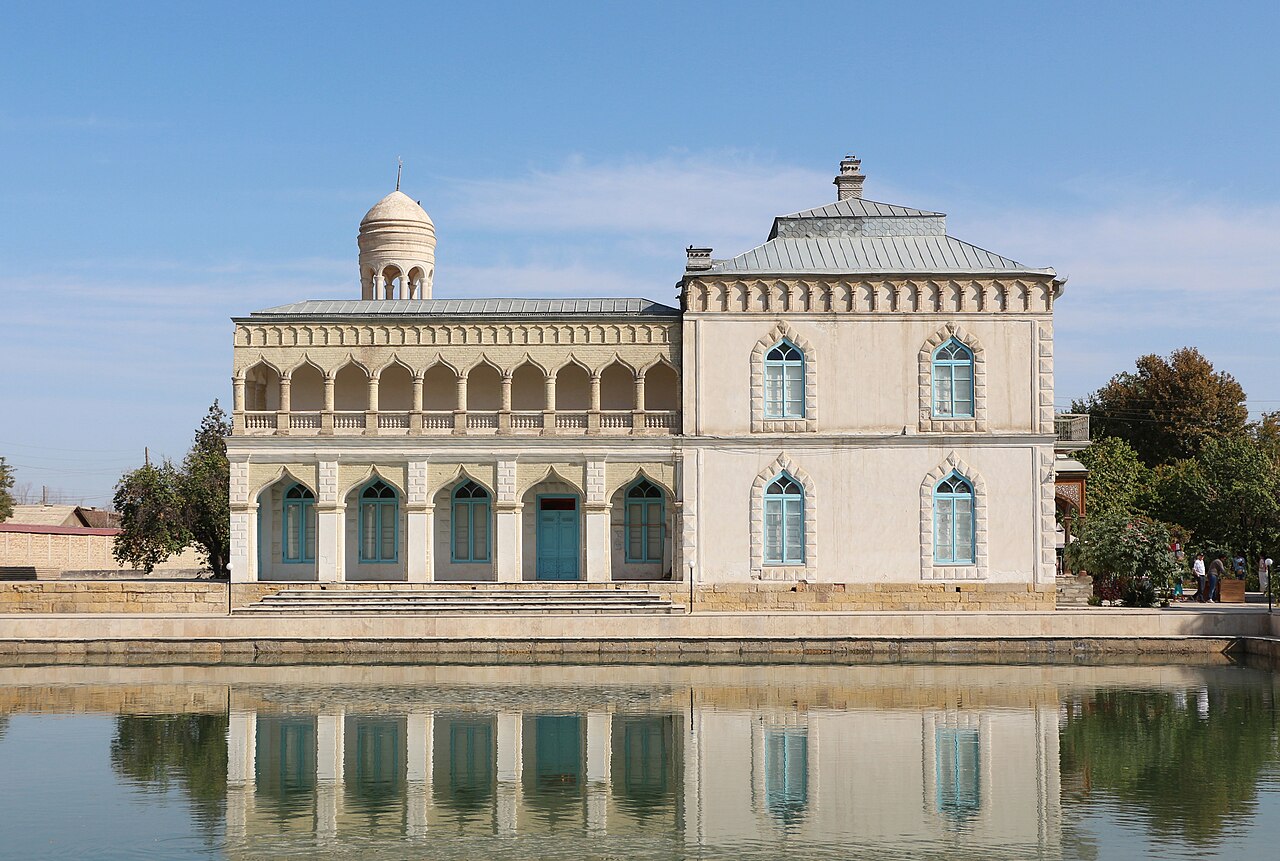
Inside, take your time with the interiors, which are the real reason to come. Seek out the White Hall and let your eyes adjust to its shimmering plaster and mirrors; look up at the painted and gilded ceilings; notice the odd, delightful collisions of Bukharan craft and imported Russian and European taste. The museum collections of textiles, costumes, and applied arts add another rich layer, so allow more time than you might expect.
As at any historic site, treat the palace and its contents with care, follow local guidance about what may be entered or photographed, and remember that the fragile decoration you are admiring is more than a century old and irreplaceable. Combine the visit with the great sights of Bukhara itself, and you will come away with a rounded picture of this remarkable Silk Road city and its last rulers.
However you come to it, let the Palace of the Moon and the Stars work its particular spell. Few places capture so vividly the meeting of civilizations, the height of a craft tradition, and the poignancy of a vanished monarchy, all within a single garden enclosure. It is a beautiful, slightly melancholy dream of a palace, and to walk through it is to touch the last summer of the emirs of Bukhara.
Try, if you can, to visit when the light is kind, in the softer hours of morning or late afternoon, when the sun slants through the windows and the White Hall does its finest work.
Palaces Nearby
If the last summer palace of the emirs has moved you, these two other courts of vanished monarchies belong on the same journey.
- The House of Wonders That Astonished the Zanzibar Coast — the sultans’ ceremonial palace on the Stone Town seafront.
- The Bogd Khan Palace and the Last God-King of Mongolia — the winter residence of Mongolia’s theocratic monarch.
You May Like
Konopiste the Bohemian Castle of a Doomed Archduke