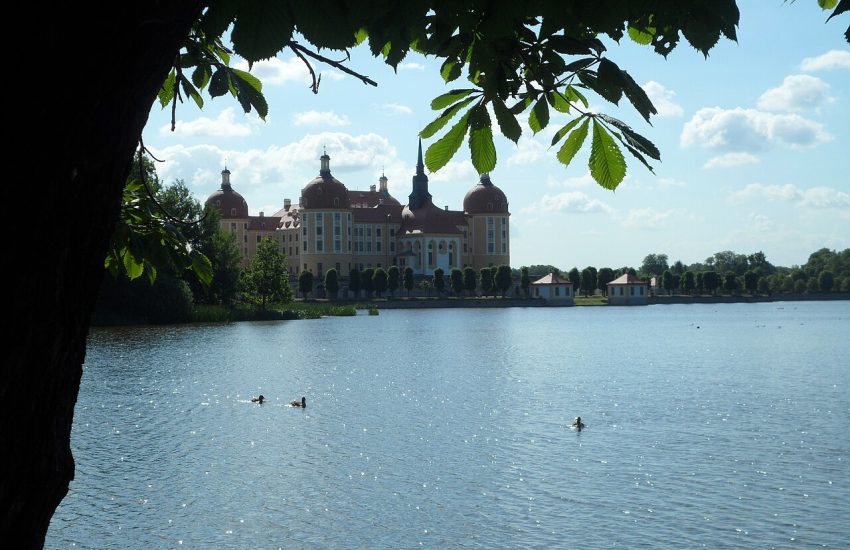
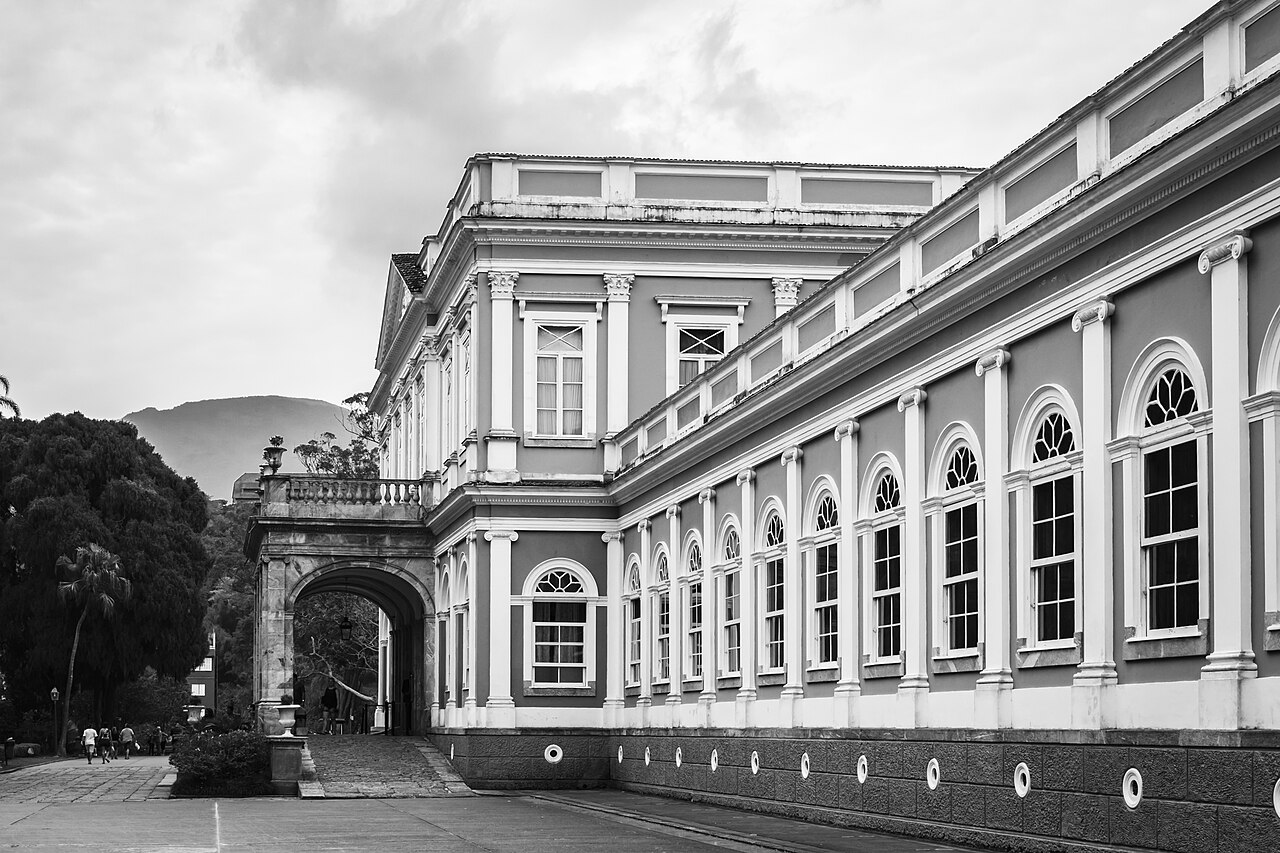
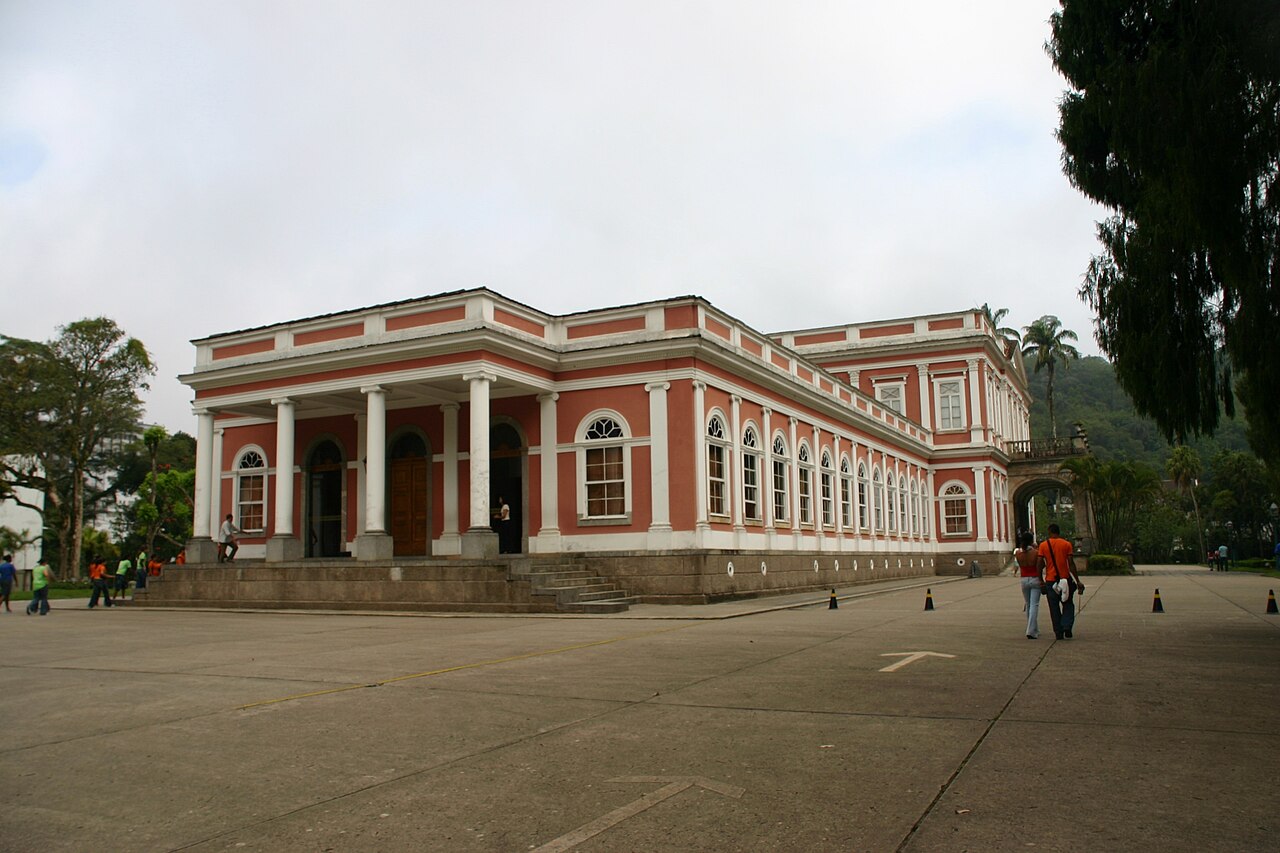
In the green mountains above Rio de Janeiro, in the cool and elegant town of Petropolis, stands a pink-and-white neoclassical palace that once served as the summer home of an emperor. This was the favourite retreat of Dom Pedro II, the second and last emperor of Brazil, and today it is the Imperial Museum, one of the most visited and best loved museums in the country. It is a place where the whole story of Brazil’s monarchy is gathered under one graceful roof.
Brazil is the great exception in the history of the Americas: a land that, almost alone in the New World, was for most of the nineteenth century a monarchy, an empire ruled by the House of Braganza, with its own emperors, court, and crown jewels. Petropolis was the mountain resort where that court escaped the tropical heat of the capital, and this palace was the heart of it, the place where Pedro II read, worked, received his ministers, and lived the private life of a monarch.
Walk its rooms today, in the soft felt slippers visitors are given to protect the gleaming floors, and you move through the intimate world of a vanished empire: the glittering imperial crown, the throne, the golden pen with which slavery was abolished, the coaches, the portraits, the personal keepsakes of a cultured and tragic ruler. In the sections that follow you will get to know the palace, the emperor, and the empire whose memory it so beautifully keeps.

In This Article
- A Pink Palace in the Mountains
- The Town the Emperor Built for Summer
- The Scholar Emperor
- Building the Summer Residence
- Elegant Rooms and Formal Gardens
- The Crown of an Empire
- The Golden Pen That Freed the Enslaved
- The House of Braganza in Brazil
- Coaches, Keepsakes, and the Texture of a Reign
- The Fall of the Empire
- From Palace to Beloved Museum
- The Palace on Film
- Visiting the Imperial Museum
A Pink Palace in the Mountains
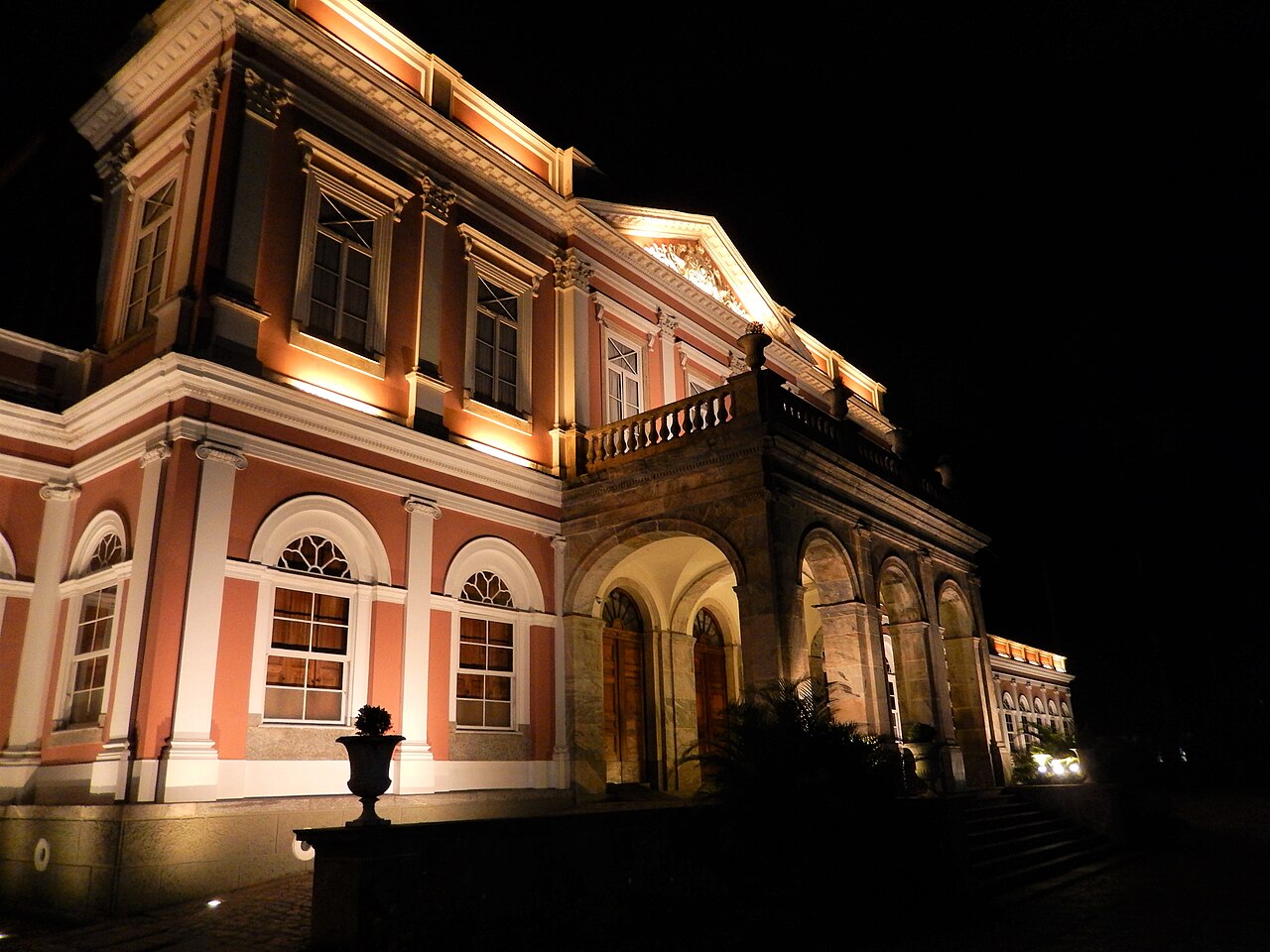
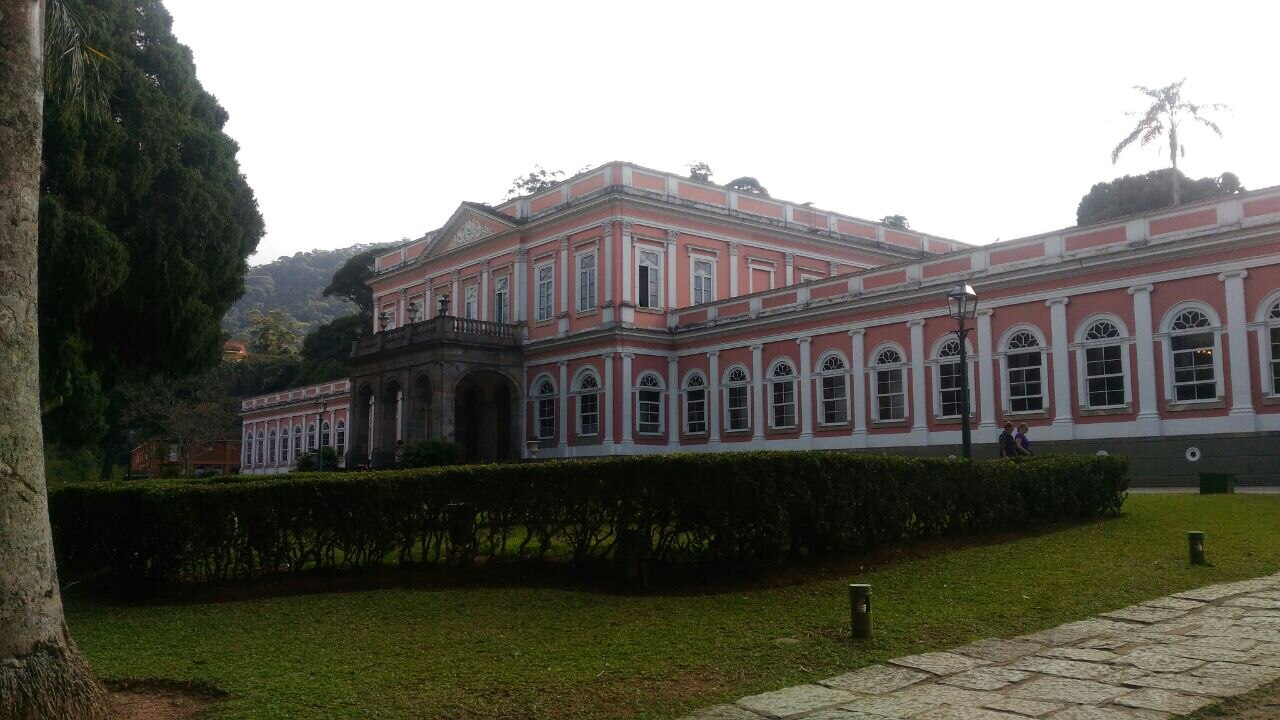
Arriving at the Imperial Museum, you might at first mistake it for a particularly graceful country mansion rather than the residence of an emperor. It is a restrained, elegant neoclassical building, painted in soft tones, set among beautifully kept French-style gardens with fountains and clipped hedges, in the middle of a town that still carries an air of nineteenth-century refinement. There is nothing overbearing about it; its dignity is quiet.

That restraint is part of its charm and its meaning. This was a summer palace, a place of relative ease and privacy, not a great state residence built to overawe. Pedro II, the emperor who loved it best, was himself a man of modest personal tastes and serious intellectual interests, and the house reflects him: comfortable, cultivated, and human in scale, more the home of a learned gentleman than the pile of a despot.
The setting completes the picture. Petropolis sits high enough in the mountains to enjoy a cool, fresh climate, a welcome escape from the heat and humidity of Rio de Janeiro on the coast below, and the town grew up around the imperial presence as a fashionable resort. The palace, its gardens, and the surrounding streets of elegant villas and tree-lined avenues form a single genteel world, and the museum is its jewel.
Today the building gleams, immaculately restored and maintained, its rooms furnished as they might have been in the emperor’s day and filled with the treasures of the monarchy. To step from the bright gardens into its cool interior is to step directly into the lost world of imperial Brazil, preserved here with a care and completeness that few other royal residences can match.
The Town the Emperor Built for Summer
The palace cannot be separated from the town around it, for the two grew up together. Petropolis, whose name honours the emperor Pedro, was developed in the middle of the nineteenth century as an imperial summer retreat in the mountains, a place where the ruler and his court could escape the fierce heat of the lowland capital during the hottest months. The palace was the anchor of the whole enterprise.

The mountains above Rio offered a cooler, healthier climate, and the emperor’s decision to build his summer residence there drew the court, the wealthy, and the fashionable after him. The town was laid out with a European elegance, with canals, gardens, and handsome villas, and became a genteel resort where high society passed the summer near the person of the monarch. It remains a graceful, distinctive place to this day.
This pattern, of a ruler retreating from a hot or crowded capital to a cooler resort, is a familiar one in the history of monarchy around the world, but in Brazil it produced something particular: an entire refined mountain town shaped by the imperial presence. Petropolis became, in effect, the summer capital of the empire, where much of the real business of the court was conducted during the season.
For the visitor, this means the palace comes with a ready-made setting. To wander Petropolis is to explore the world the empire made, and the Imperial Museum sits at its centre as the reason the whole town exists. Understanding the palace as the heart of an imperial resort, rather than as an isolated monument, is the key to appreciating both.
There is a lovely logic to the way the town and the palace depend on each other. The emperor came for the cool air, the court followed the emperor, and a whole town of villas, gardens, and avenues grew up to serve them. Even now, long after the last emperor, Petropolis keeps the imperial atmosphere it was born with, so that arriving there feels like entering a nineteenth-century idea of elegance that has somehow survived intact.
The Scholar Emperor
At the centre of the palace’s story is Dom Pedro II, the second and last emperor of Brazil, one of the most intriguing monarchs of the nineteenth century. He came to the throne as a child and reigned for nearly half a century, presiding over a long period of stability and growth, and he was, by temperament, less a warrior or an autocrat than a scholar who happened to wear a crown.

Pedro II was famously learned and curious, with a deep interest in the sciences, literature, languages, and the arts. He corresponded with scientists and thinkers, promoted education and culture, and was more at home among books and ideas than among the trappings of power. Contemporaries and later historians often portrayed him as a wise, moderate, and conscientious ruler, devoted to the welfare and advancement of his country.
This intellectual seriousness gives the palace much of its character. It was the home of a man who valued knowledge and refinement, and the museum preserves the personal world of a cultivated monarch: his books, his interests, his measured way of life. The contrast with the more flamboyant courts of other lands is striking; here was an emperor whose grandeur lay in his mind as much as in his regalia.
His reign, however, ended in sorrow. For all his virtues, or perhaps partly because of the very moderation that made him reluctant to cling to power, Pedro II was overthrown by a republican movement, and he died in exile far from the country he had served so long. The palace at Petropolis, so bound up with his happiest days, thus carries also the melancholy of his fall, a note that deepens its beauty.
What set him apart from most monarchs of his time was his genuine humility about power. He is often quoted, in spirit if not always in exact words, as caring more for being a good citizen and a useful man than for the pomp of his office, and the palace bears that out at every turn: it is the home of someone who would rather have been remembered as a teacher or a scientist than as a ruler, and who wore his crown lightly even as he wore it long.
Building the Summer Residence
The palace was built over a span of years in the middle of the nineteenth century, rising in the new mountain town as the permanent summer residence of the emperor. Designed in a refined neoclassical style, it was conceived not as a fortress or a vast state palace but as an elegant and comfortable home suited to the informal, restorative purpose of a summer retreat, while still befitting the dignity of a monarch.

Its construction was part of the larger project of creating Petropolis itself, and the building took shape as the town grew around it. The neoclassical design, with its clean lines, balanced proportions, and understated ornament, reflected the tastes of the age and the personality of the emperor, favouring harmony and restraint over ostentation. The result was a residence of quiet distinction rather than overwhelming grandeur.
Around the palace were laid out formal gardens in the French manner, with geometric beds, paths, fountains, and fine trees, extending the elegance of the building into the landscape and providing a setting for leisurely walks and the pleasures of summer. The relationship between house and garden is central to the charm of the place, the one flowing naturally into the other.
Over the decades of the empire, the palace served as the beloved summer home of the imperial family, accumulating the furnishings, art, and personal possessions that fill the museum today. When the monarchy fell, the building eventually passed through various uses before being restored and dedicated as the Imperial Museum, its fabric preserved as one of the finest examples of imperial-era architecture in Brazil.
Elegant Rooms and Formal Gardens
Inside, the palace unfolds as a series of elegant rooms arranged for the life of a cultivated court at leisure. Reception rooms, the emperor’s and empress’s apartments, halls for music and gatherings, and the working spaces of the monarch are furnished with period pieces, chandeliers, fine woodwork, and works of art, recreating the atmosphere of the imperial household during its summers in the mountains.

The famous felt slippers visitors slip over their shoes to cross the polished floors are more than a quaint custom; they are a sign of how carefully the interiors are preserved. Gliding through the rooms in them, you see the gleaming parquet, the carefully arranged furniture, and the accumulated treasures of the monarchy displayed in the very setting for which they were made, an unusually intimate way to experience a royal residence.
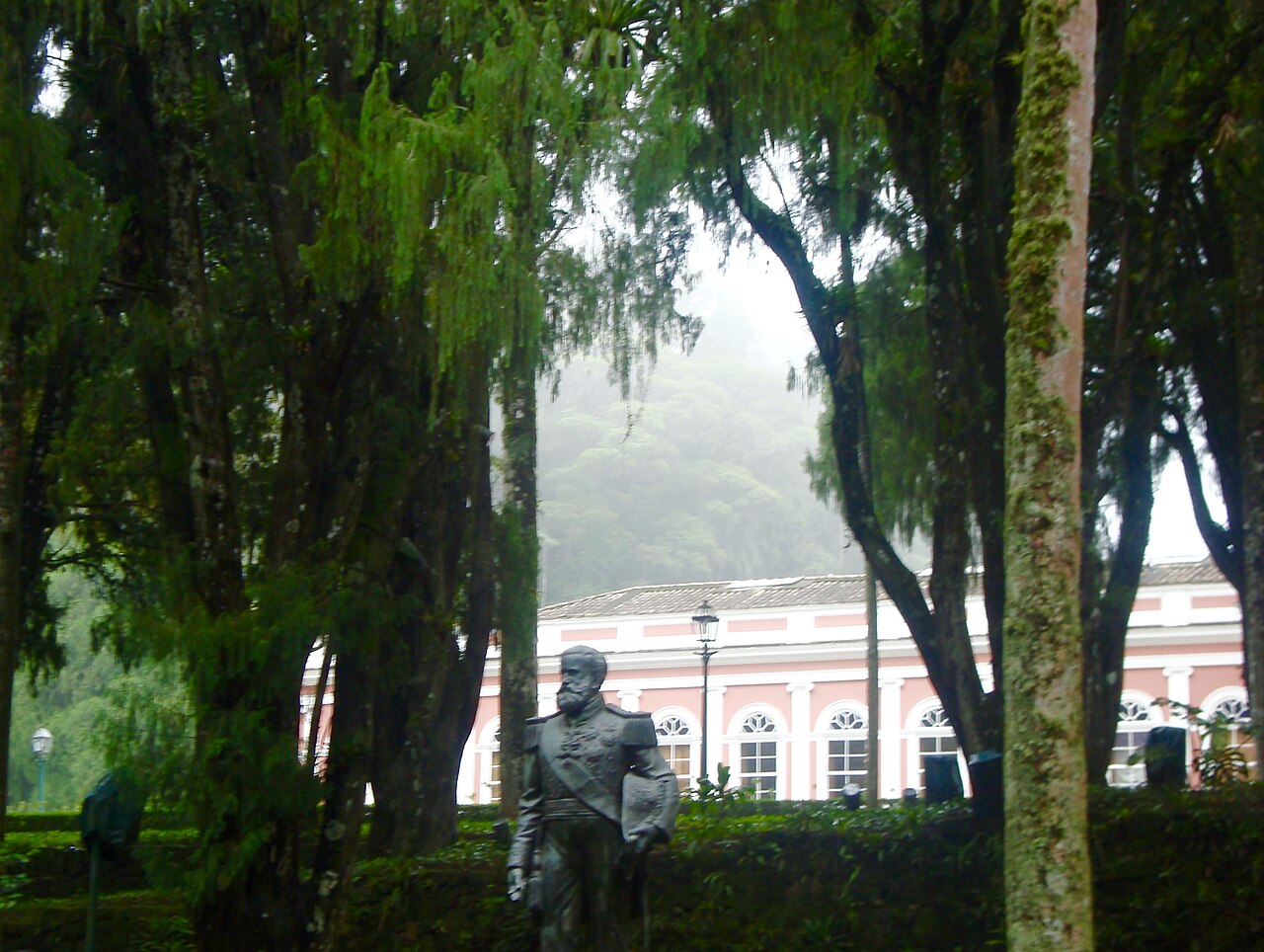
The gardens, laid out in the formal French style, are an essential part of the experience. Their geometric beds, gravel walks, fountains, and mature trees frame the palace and offer a graceful space to stroll, and a bust of the emperor stands among the greenery, presiding still over the grounds he loved. The interplay of the neoclassical building and the ordered garden gives the whole ensemble its serene, harmonious character.
What strikes many visitors is how liveable it all feels. This is not a cold monument but a home, richly furnished and human in scale, where one can easily imagine a family passing its summers. That intimacy, combined with the quality of the collections, is what makes the Imperial Museum so beloved, a palace that invites you in rather than holding you at a distance.
Room follows room in an unhurried rhythm, each opening onto the next and onto glimpses of the gardens beyond, so that light and greenery are never far away. It is architecture that soothes rather than impresses, exactly suited to a summer house where the point was rest, reading, and family, and it explains why the emperor loved this place above his grander residences.
The Crown of an Empire
Among the treasures the palace guards, none is more dazzling than the crown jewels of the Brazilian empire, and above all the magnificent imperial crown of Pedro II. Encrusted with diamonds and pearls and worked in gold, the crown is one of the great surviving pieces of royal regalia in the Americas, a glittering symbol of a monarchy that, uniquely in the New World, endured for most of the nineteenth century.
To see the crown displayed in the museum is to be reminded that Brazil really was an empire, with all the ceremony and symbolism that the word implies. Alongside it the museum preserves other regalia and treasures of the monarchy, the objects used in the great state occasions of the reign, from thrones and ceremonial pieces to the insignia of imperial power, gathered here as the material memory of the throne.
These objects carry a special weight because the monarchy they represent is gone. Where the regalia of surviving European monarchies are still in use, Brazil’s crown jewels are relics of a vanished order, preserved and admired but never again to be worn in earnest. That gives them a poignancy as well as a splendour, the treasures of an empire that history brought to an end.
For many visitors, the sight of the imperial crown is the emotional climax of a visit. It concentrates in a single brilliant object the whole strange and fascinating fact of the Brazilian empire, a monarchy in the heart of the republican Americas, and it anchors the museum’s collections in the highest symbolism of the state the palace once served.
Look closely and the craftsmanship rewards the attention, the careful setting of each stone, the balance of gold and gem, the workmanship of a piece made to be seen at the most solemn moments of the reign. It was regalia for a New World empire that wished to stand comparison with the oldest thrones of Europe, and in its quiet brilliance it still makes that claim.
The Golden Pen That Freed the Enslaved
Perhaps the most historically charged object in the entire museum is a pen, for it was with a golden pen that slavery was abolished in Brazil. In 1888 the law known as the Lei Aurea, the Golden Law, ended slavery in the country, and the museum preserves the very pen associated with the signing of that act, one of the most significant moments in Brazilian history.
Brazil had been one of the largest slaveholding societies in the Americas, and the abolition of slavery was a transformation of the deepest importance, the culmination of a long struggle. The act was signed by Princess Isabel, the emperor’s daughter, who was acting as regent at the time, and her name is forever linked to that decisive step, celebrated by many as a moment of liberation.
To stand before the golden pen is to be reminded that the palace and its collections are bound up not only with splendour but with the great moral questions of the age. The end of slavery reshaped Brazilian society, and its close association with the imperial family is part of the complex legacy of the monarchy, which presided over both the institution of slavery and, at last, its abolition.
The abolition also had political consequences that touched the throne itself, for the upheaval of the period contributed to the tensions that would soon bring the monarchy down. The golden pen, then, sits at a hinge of history: it marks a great step forward for human freedom and, at the same time, points toward the fall of the empire that is the palace’s own story.
It is striking to see so world-changing an act embodied in so modest an object. A pen, a sheet of paper, a signature, and the legal end of slavery in the last country of the Americas to abolish it: the museum lets you stand before that instrument and feel the enormous human weight it carries, the hopes fulfilled and the long injustice finally, formally closed.
The House of Braganza in Brazil
The palace is above all a family home, and the family in question was the Brazilian branch of the House of Braganza, the dynasty that ruled the empire from its founding until its fall. The museum brings this family vividly to life through portraits, personal possessions, and the arrangement of the private apartments, allowing visitors to encounter the emperors and their relatives as people, not just as names in a history book.

The story of the dynasty in Brazil is a remarkable one, beginning when the Portuguese royal house transferred itself across the Atlantic during the upheavals in Europe, and continuing through the establishment of an independent Brazilian empire and the long reign of Pedro II. The museum’s collections trace this arc, preserving the material culture of a monarchy that gave the vast country a focus and a continuity through a turbulent century.
Family life shaped the palace. Here the imperial family passed its summers, and the intimate scale of the rooms and the personal nature of many of the objects, from keepsakes to everyday possessions, reflect the domestic side of monarchy. The princesses, the emperor’s daughters, and the wider family are present throughout, giving the museum a warmth that balances the grandeur of the regalia.
Understanding the palace as the home of a dynasty helps make sense of the whole. The crown and the coaches speak of the public face of the monarchy; the private apartments and family portraits speak of the people who bore it. Together they tell the story of the Braganzas in Brazil, from their transatlantic beginnings to the sudden end of their reign, all preserved within these elegant mountain walls.
Coaches, Keepsakes, and the Texture of a Reign
Beyond the crown and the great historical objects, the museum is rich in the smaller things that give a vanished world its texture. Among the most impressive are the ceremonial coaches of the imperial household, grand carriages used to convey the emperor and his family on state occasions, displayed as reminders of the pageantry that surrounded the throne even in a monarchy known for its relative simplicity.

The collections also include a wealth of personal possessions: furniture, clothing, jewellery, works of art, documents, and the countless everyday objects of imperial life. These items let visitors feel the daily reality of the court, the things the emperor and his family used, wore, and treasured, and they make the past tangible in a way that grand state pieces alone cannot.
Because Pedro II was a man of wide interests, the museum also reflects his intellectual world, with reminders of his engagement with science, learning, and the arts. The palace was the home of a monarch who valued knowledge, and the collections preserve something of that curious, cultivated mind, from books to the fruits of his many enthusiasms.
All these objects together make the Imperial Museum far more than a display of treasures. They reconstruct a whole way of life, the summers of an imperial family in their mountain palace, the ceremony and the intimacy, the grandeur and the humanity. It is this completeness, the sense of a world preserved rather than a few relics saved, that gives the museum its special richness.
The Fall of the Empire
The world the palace preserves came to an end suddenly. In 1889, a republican movement, supported by elements of the military and by discontent among various groups, overthrew the monarchy in a swift and largely bloodless coup, proclaiming Brazil a republic and bringing to a close the long reign of Pedro II and the empire itself. After nearly seven decades, the Brazilian monarchy simply ceased to be.
The aged emperor, by then a revered but weary figure, did not resist. He and the imperial family were sent into exile, crossing the Atlantic to Europe, and Pedro II spent his final period abroad, dying in Paris not long after the fall of his throne. The scholar emperor who had reigned for almost fifty years ended his life far from the country and the mountain palace he had loved, a poignant close to a long and dignified reign.
The abruptness of the change is part of what makes the palace so affecting. The rooms and treasures preserved here belonged to a monarchy that seemed, in its long stability, almost permanent, and yet it vanished within days. The Imperial Museum holds the material world of that empire as it was on the eve of its disappearance, a complete and sudden fossil of a way of life.
In time, the remains of the emperor and empress were brought back to Brazil and eventually laid to rest with honour, a sign of the enduring affection many Brazilians retained for the last emperor. The monarchy did not return, but its memory was cherished, and nowhere is that memory kept more lovingly than in the summer palace at Petropolis, now the museum of the empire that once was.
There is a quiet irony in the emperor’s fate. A ruler so moderate, so uninterested in personal power, was deposed with little of the drama that attends the fall of tyrants, almost as if the age itself had simply moved on and left the throne behind. The palace at Petropolis, full of his books and his summers, feels like the natural refuge of exactly such a man, which is part of why his exile and death abroad strike visitors as so undeserved and sad.
From Palace to Beloved Museum
After the fall of the monarchy and a period in which the building served other purposes, the former summer palace was restored and dedicated as the Imperial Museum in the twentieth century, gathering together the treasures, furnishings, and memory of the empire in the very setting where so much of imperial life had unfolded. It quickly became one of the most cherished museums in Brazil.

The decision to make the museum in the palace itself, rather than in some purpose-built hall, was inspired. It means that the collections are seen in context, the crown, the coaches, the portraits, and the personal effects displayed within the rooms and gardens for which they were made, so that the building and its contents illuminate one another. The result is an unusually vivid and intimate encounter with the past.
The famous felt slippers, the immaculate floors, the carefully recreated rooms, and the beautifully kept gardens all reflect the care with which the museum is maintained. It is a place that takes its role as keeper of the imperial memory seriously, and that care is felt by every visitor who glides through its rooms, at once a museum and a preserved home.
Today the Imperial Museum draws large numbers of visitors, both Brazilian and foreign, who come to encounter the story of their country’s unique monarchy and to enjoy the beauty of the palace and its setting. It stands as the great monument to the empire of Brazil, a graceful mountain palace that has become the nation’s window onto its imperial past.
Generations of Brazilian schoolchildren have made the trip here, and for many it is their first encounter with the surprising fact that their republic was once an empire. That role, as a place where a nation meets its own past, gives the museum a significance beyond its beauty and its treasures.
The Palace on Film
The elegance of the Imperial Museum, the gleam of its floors, the sparkle of the crown, the calm of its gardens, is best appreciated in motion, and the short film below offers a tour that brings the palace and its treasures to life. Watching it alongside the images in this article helps you picture the rooms and their contents as a living whole.
If you are planning to visit Petropolis, a video like this is a fine way to prepare, helping you recognise the main rooms and the highlights of the collection so that you can savour them in person rather than simply passing through. It also sets the palace in the wider story of the Brazilian empire, giving depth to what you will see.
And if Brazil is not on your near horizon, the film lets you visit the summer palace of the emperors from afar. Let it play, and imagine yourself sliding across those polished floors in felt slippers, from the glittering crown to the golden pen, through the preserved world of the last empire of the Americas.
Visiting the Imperial Museum
For travellers, the Imperial Museum is the highlight of Petropolis and one of the great cultural sights within easy reach of Rio de Janeiro. The town lies a scenic drive up into the mountains from the coast, and the palace, with its gardens and collections, can be enjoyed in a relaxed half-day, ideally combined with a wander through the elegant streets and other historic buildings of the town.
Inside, remember the felt slippers, provided to protect the floors, and take your time with the collections: the imperial crown and regalia, the golden pen of abolition, the coaches, and the intimate apartments of the imperial family. Allow time, too, for the formal gardens, where the bust of the emperor presides and where the relationship between palace and landscape is best appreciated.
As at any fine museum and historic house, treat the rooms and their contents with care, follow the guidance about photography and access, and consider a guided tour or good background reading to bring the history alive, for the objects here are bound up with some of the most important events in Brazil’s past. The cool mountain climate makes a visit pleasant in most seasons.
However you come to it, the Imperial Museum offers something rare: a nearly complete window into a vanished monarchy, preserved in its own beloved summer palace. To walk its rooms is to meet the scholar emperor and his family, to touch the great moments of their reign, and to understand why Brazil remembers its imperial past with such enduring affection.
Palaces Nearby
If Brazil’s scholar emperor has caught your interest, these two other nineteenth-century thrones, each far from Europe, make natural companions.
- Sans-Souci, the Mountain Palace of the Slave Who Became King of Haiti — Henri Christophe’s baroque palace in the Haitian mountains.
- Manhyia Palace and the Enduring Throne of the Asante — the living court of the Asante kings in Kumasi.
You May Like
Konopiste the Bohemian Castle of a Doomed Archduke