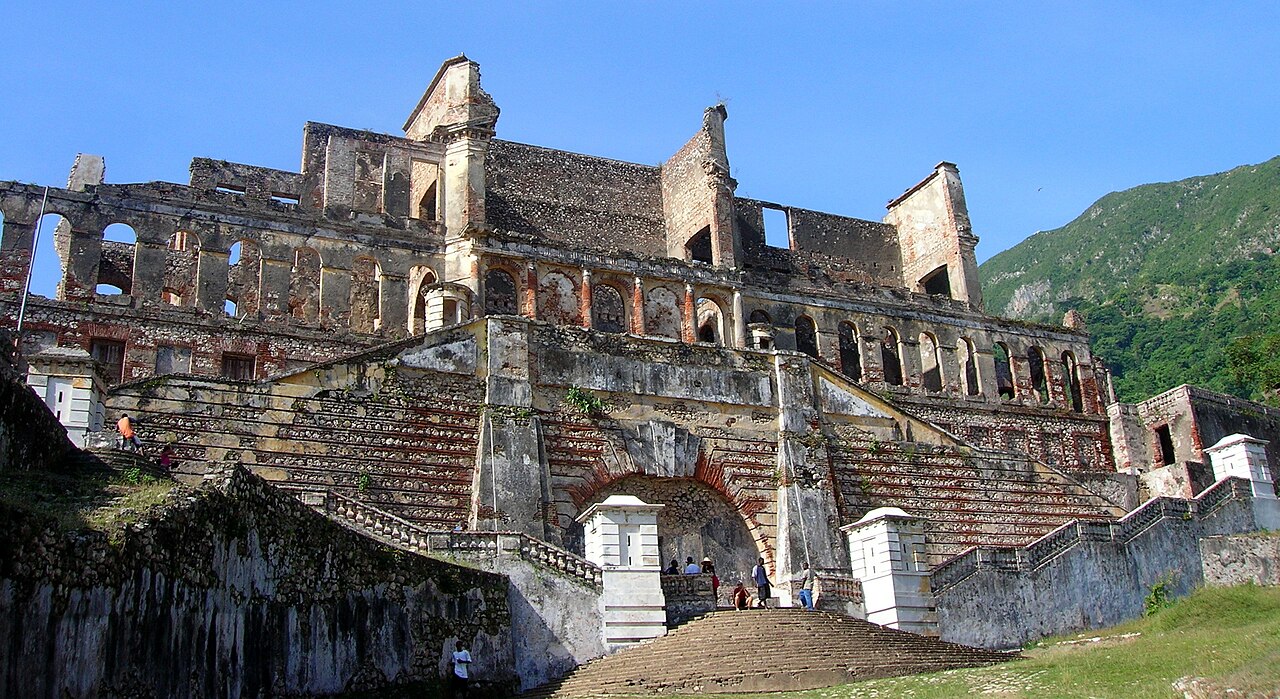
High in the mountains of northern Haiti, above the little town of Milot, stand the ruins of one of the most extraordinary palaces ever built in the Americas. Its great stone staircase still climbs toward a shattered facade; grass grows where marble floors once shone; and behind it the green hills rise toward a fortress on a distant peak. This is Sans-Souci, the palace of Henri Christophe, the former slave who made himself King of Haiti, and it is a monument unlike any other in the world.
Sans-Souci was built to astonish, a baroque royal residence meant to rival the palaces of Europe and to prove, to a world that had enslaved millions of Africans, that a Black kingdom could match anything the old powers had made. For a few brief years it was the dazzling seat of a court complete with kings, queens, dukes, and counts, set in terraced gardens cooled by an ingenious system of running water, watched over by the vast mountaintop citadel its king had raised for its defence.
And then it fell, as suddenly and completely as it had risen. Its king died by his own hand, his kingdom dissolved, and an earthquake reduced the palace to the romantic ruin you see today. Yet Sans-Souci is far from empty of meaning. It is a UNESCO World Heritage monument and, for Haiti and for people of African descent everywhere, a powerful symbol of freedom won and sovereignty asserted. In the sections that follow you will meet the king, the palace, and the remarkable story they share.
In This Article
- A Ruined Palace in the Haitian Hills
- The Slave Who Became a King
- Building a Kingdom in Stone
- Baroque Splendour in the Caribbean
- Terraced Gardens and a River Made to Serve a King
- The Royal Chapel and Its Dome
- A King, a Queen, and a Nobility of the Free
- The Fortress on the Mountain
- A Monument to Freedom
- The King’s Last Days
- Earthquake, Ruin, and World Heritage
- The Story on Film
- Visiting Sans-Souci Today
A Ruined Palace in the Haitian Hills
To come upon Sans-Souci is to be startled. After the drive up from the coastal plain into the hills of northern Haiti, past the town of Milot, the ruins rise before you with a grandeur that feels almost impossible in so remote a setting: a monumental stair, the tall shell of a great house, terraces stepping up the hillside, and the green mountains crowding close behind. It looks, at first glance, like a fragment of Europe transported to the Caribbean.

That impression is exactly what its builder intended, and yet the place is profoundly of its own soil. This was the heart of a kingdom born from the only successful large-scale slave revolt in history, a state founded by people who had thrown off bondage and colonial rule and meant to hold their freedom by force and by splendour alike. The palace is a Caribbean creation wearing European dress, and the tension between the two is part of its power.
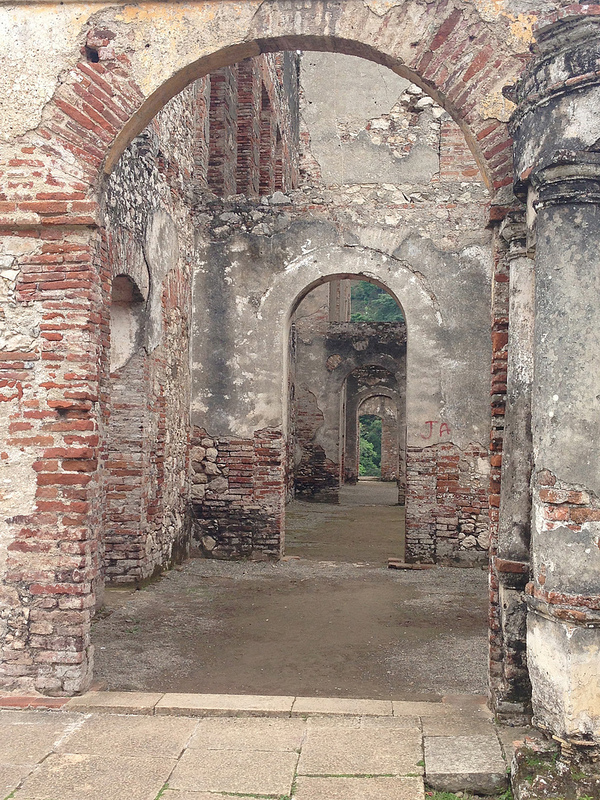
Today the palace is a ruin, roofless and open to the sky, its grand rooms reduced to walls and its gardens to green terraces, but the scale is still overwhelming. You climb the same broad stairway that once led to a royal audience, stand where a court in fine clothes once gathered, and look out over the landscape a king once ruled. Few ruins anywhere combine such beauty, such ambition, and such a startling history.
And always, behind and above, there is the mountain. Sans-Souci does not stand alone but as the lower half of a single vast royal project, linked to the great fortress of the Citadelle on the peak beyond. Together they form a World Heritage site and a national symbol, and to visit the palace is to begin a story that climbs, quite literally, toward the clouds.
The Slave Who Became a King
The palace cannot be understood apart from the man who built it, Henri Christophe, one of the most remarkable figures of his age. Born into slavery in the Caribbean, he rose during the upheavals of the Haitian Revolution, the great uprising through which the enslaved people of the French colony of Saint-Domingue overthrew their masters and, after years of brutal war, won their freedom and founded the independent nation of Haiti.
Christophe was a leading general in that struggle, and when the young country split into rival states he took power in the north. In 1811 he did something audacious: he had himself crowned king, taking the title Henri I, and set about building a monarchy complete with a royal court, a nobility of his own creation, coronation regalia, and palaces to match. It was a deliberate strategy, a claim that Haiti was not a mere rebel province but a sovereign kingdom worthy of respect.
He was, by every account, a man of enormous energy, ambition, and force of will, determined to build a strong, prosperous, and disciplined state that no European power would dare to re-enslave. He founded schools, promoted agriculture, commissioned grand architecture, and sought to create the institutions of a modern kingdom. His methods, however, were harsh, and his drive to build came at a heavy cost to the people whose labour made it possible.
Sans-Souci was the jewel of his creation, the principal royal residence of his kingdom and the stage on which his court performed its splendour. In it he tried to make visible, in stone and gold and ceremony, the astonishing fact of his existence: a formerly enslaved man ruling as a crowned king in a nation of the free. Everything about the palace was meant to declare that fact to Haiti and to the world.
He remains a genuinely divisive figure, admired for his vision, his discipline, and his determination to secure Haiti’s freedom, and criticised for the severity with which he pursued those aims. Both judgements can be true at once, and the palace holds both: it is at the same time a glorious assertion of liberty and a monument raised on hard, often forced, labour. To stand in it is to feel the whole difficulty and grandeur of the man.
Building a Kingdom in Stone
Sans-Souci was raised in a remarkably short span in the early nineteenth century, rising over just a few years to become the finest of the many residences Christophe built across his kingdom. Its construction was a huge undertaking, drawing on the resources of the state and the labour of large numbers of workers to erect, in a mountainous and recently war-torn land, a palace of a scale and refinement to rival those of Europe.
That labour is part of the palace’s difficult history. To build his kingdom and defend it, Christophe maintained a strict system of compelled agricultural and construction work, a regime that pressed the population hard in the name of national strength and survival. The grandeur of Sans-Souci and the might of the nearby Citadelle were purchased with enormous human effort, and any honest account of their beauty must reckon with the burden their building placed on ordinary Haitians.
The choice of site, in the hills at Milot, was deliberate. It set the royal residence away from the vulnerable coast, in a defensible interior close to the mountain where the great fortress would guard the whole project, and in a cooler, greener setting than the hot lowlands. The palace and the Citadelle were conceived together, a linked complex of residence and stronghold expressing both the splendour and the insecurity of a kingdom that expected, at any time, to have to fight for its life.
When it was complete, Sans-Souci was a wonder. Contemporaries compared it to the great palaces of the old world, and it was fitted out with fine materials, elegant rooms, and every mark of royal luxury. For a brief time it fulfilled its purpose completely, standing as living proof that the free Black kingdom of the north could build on a scale and to a standard that no one could dismiss.
Baroque Splendour in the Caribbean
Architecturally, Sans-Souci was a grand exercise in the European baroque and neoclassical taste of its time, adapted to its Caribbean setting. The palace presented a monumental facade approached by a sweeping ceremonial staircase, with ranks of windows, fine stonework, and the symmetry and grandeur that marked the royal architecture of Europe. It was designed to impress arriving visitors with the dignity and sophistication of the kingdom.
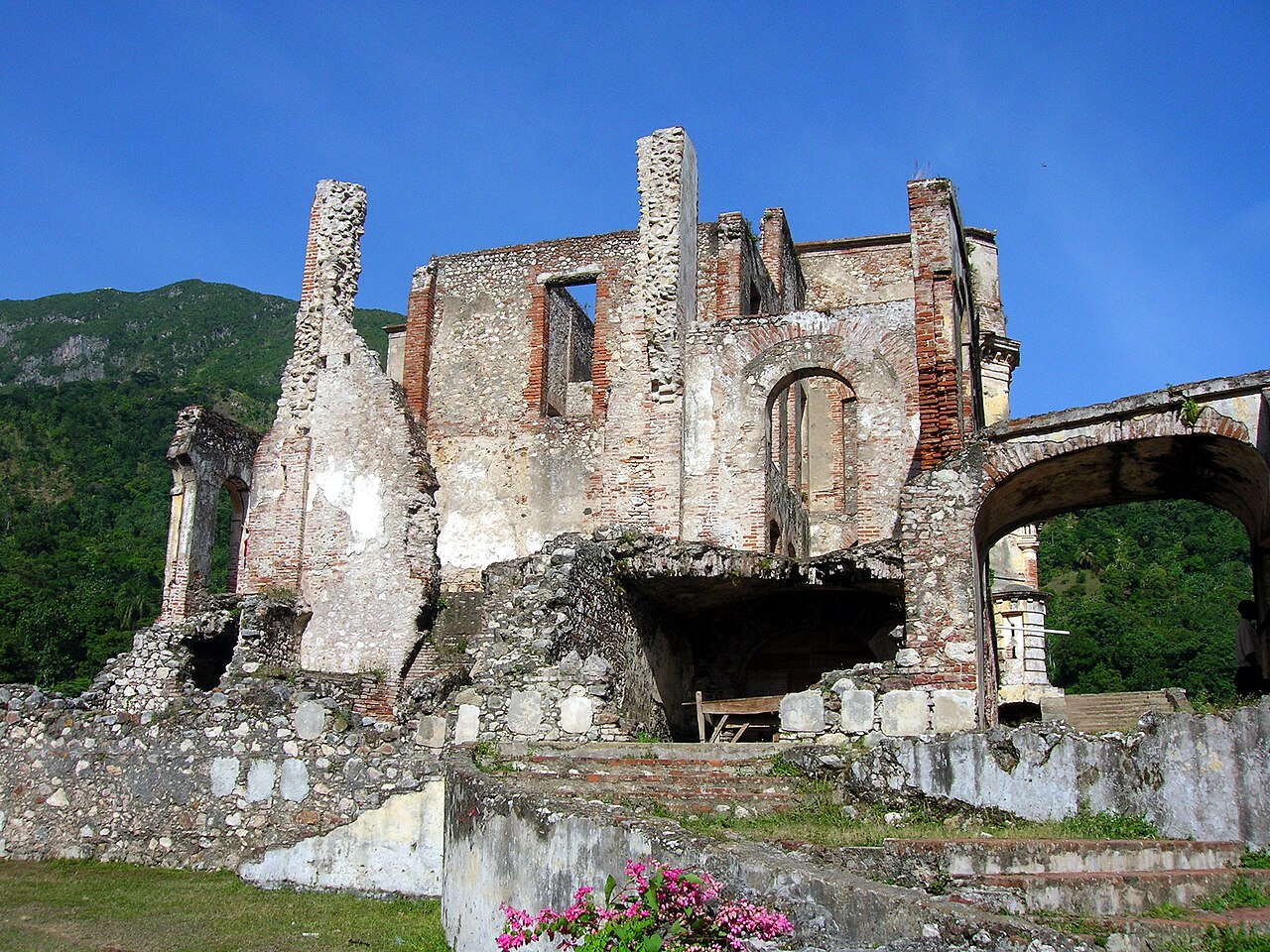
Inside, before its ruin, the palace contained the full apparatus of a royal residence: reception rooms and audience halls, royal apartments, spaces for the court and the business of the kingdom, all finished with a richness meant to match the great houses of the age. Fine materials were brought in at great expense, and the rooms were arranged and decorated to stage the ceremony of a crowned monarchy.
The name itself signalled the ambition. Sans-Souci, meaning without care or carefree, echoed the famous palace of that name built by Frederick the Great of Prussia, aligning Christophe’s residence with the enlightened royal architecture of Europe. Whether as homage or as bold appropriation, the choice placed the Haitian palace in dialogue with the grandest names of the old world, insisting on its equal standing.
Yet for all its European vocabulary, the palace belonged to its place. It was built by Haitian hands, from local stone, in a Haitian landscape, to serve a Haitian king, and its whole meaning depended on that context. The baroque splendour was not imitation for its own sake but a language chosen to make a point: that the free people of Haiti could master the forms of European power and turn them to their own sovereign ends.
Terraced Gardens and a River Made to Serve a King
Among the most admired features of Sans-Souci were its gardens and its waterworks, which turned the hillside into a stepped landscape of terraces, walks, and greenery around the royal residence. In the manner of the great garden palaces of Europe, the grounds were laid out to complement the architecture, providing a setting of order and beauty that extended the grandeur of the building out into the land.
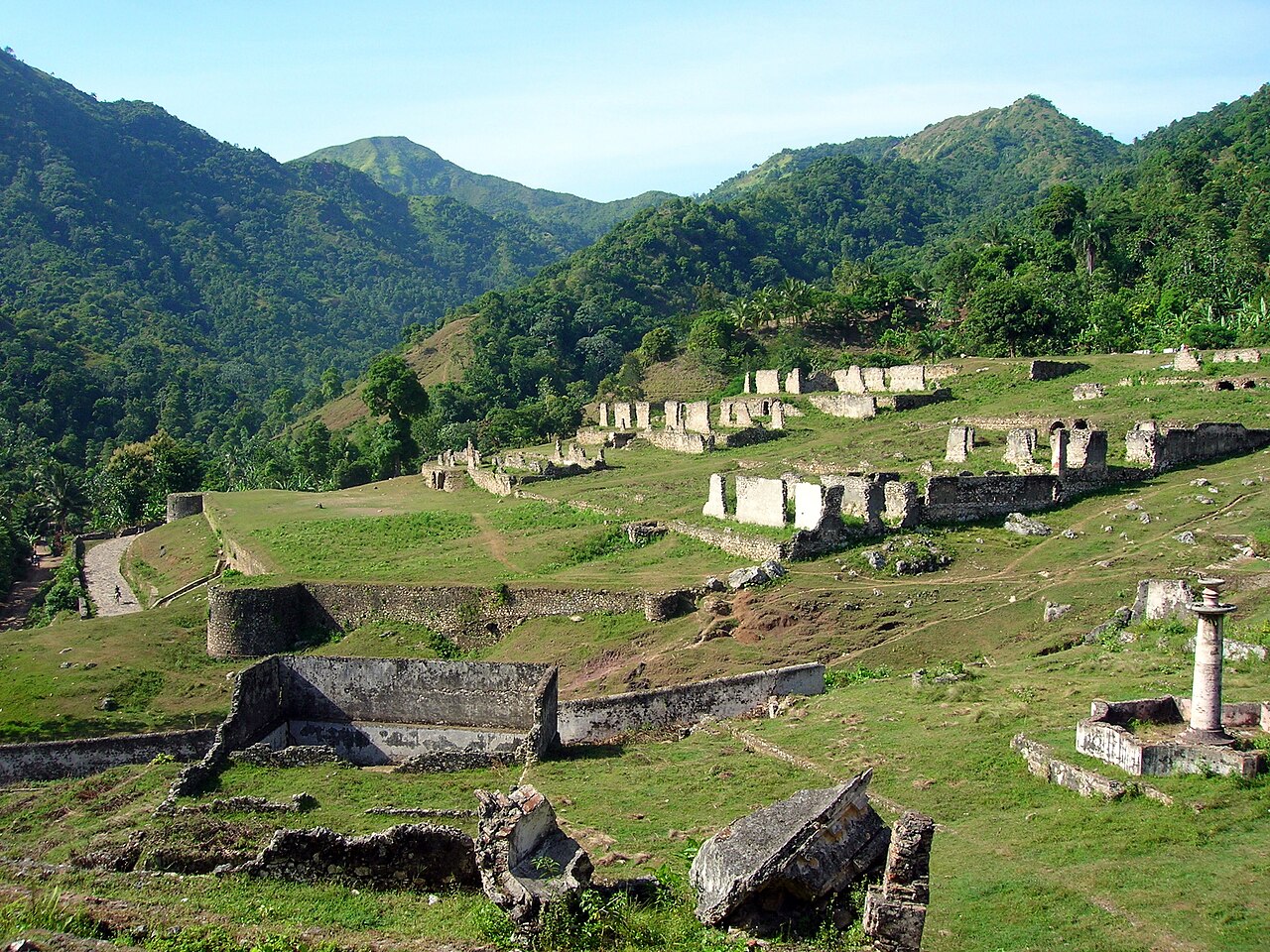
The most ingenious touch was the way water was used. A stream was channelled and directed to serve the palace, and it is often recounted that water was made to run beneath parts of the building to cool them, an early form of climate control that speaks to the sophistication of the design. In the heat of the Caribbean, this harnessing of running water for comfort and for the pleasure of fountains and pools was a mark of real engineering ambition.
Water in such a setting was more than practical; it was a display of mastery. To bend a mountain stream to the service of a palace, to cool royal rooms and feed ornamental waters, was to demonstrate command over nature itself, exactly the kind of statement a king building a new monarchy wished to make. The gardens and waterworks were part of the argument the whole palace was making about power and capability.
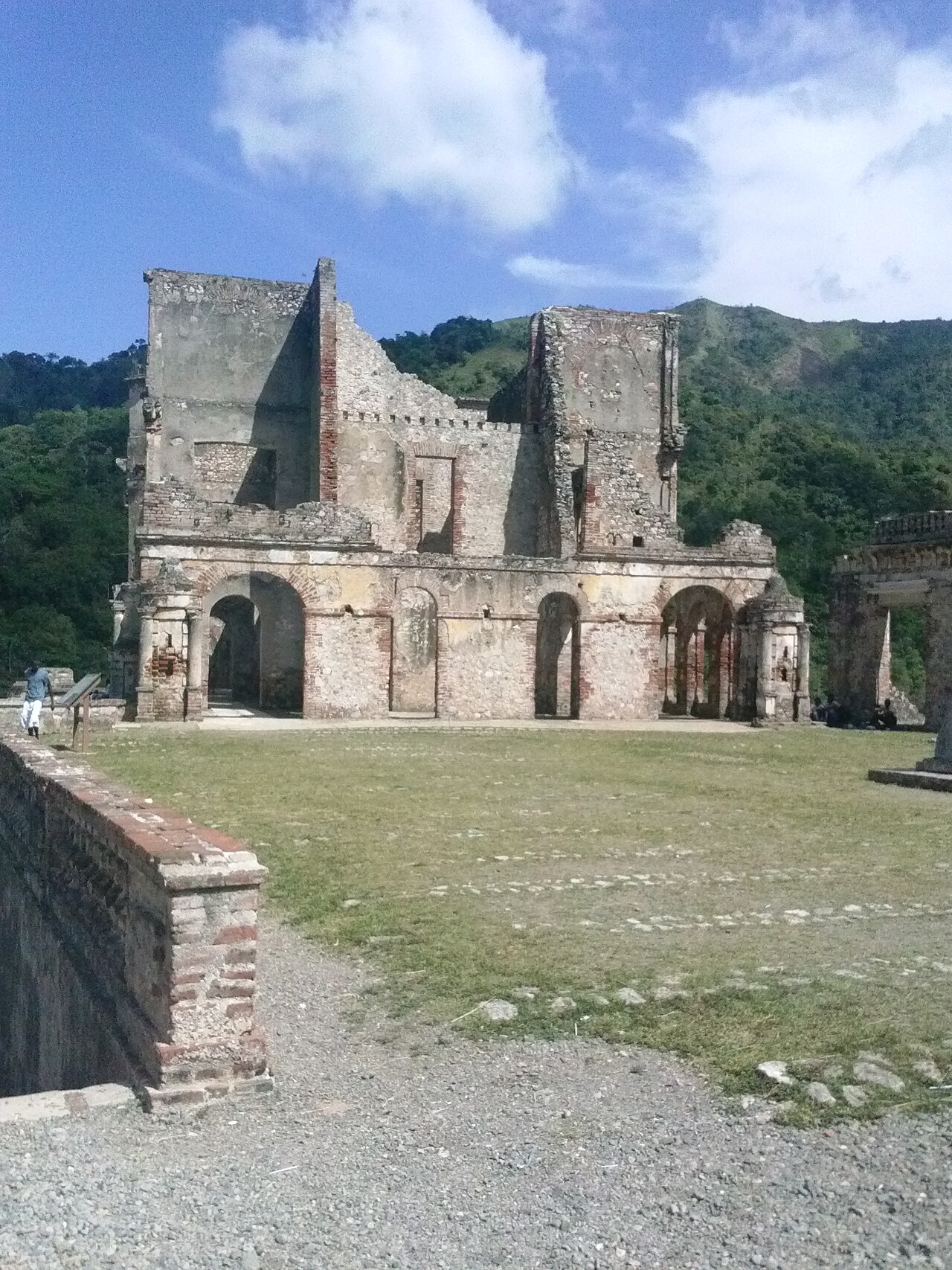
Today the gardens survive as green terraces stepping up the hillside among the ruins, their planting gone but their shape still legible. Walking them, you can sense how the palace was meant to sit within a designed landscape, a composition of building, terrace, and water that once made Sans-Souci not just a house but a whole ordered world, a paradise of state carved into the Haitian hills.
It is worth pausing on the sheer audacity of the idea. In the years just after a revolution, in a mountainous corner of a young and threatened country, engineers and labourers contrived to divert a river and thread it through and around a palace for cooling and display. That ambition, the refusal to accept that such refinements belonged only to the old world, runs through every part of Sans-Souci, and the waterworks are among its clearest expressions.
The Royal Chapel and Its Dome
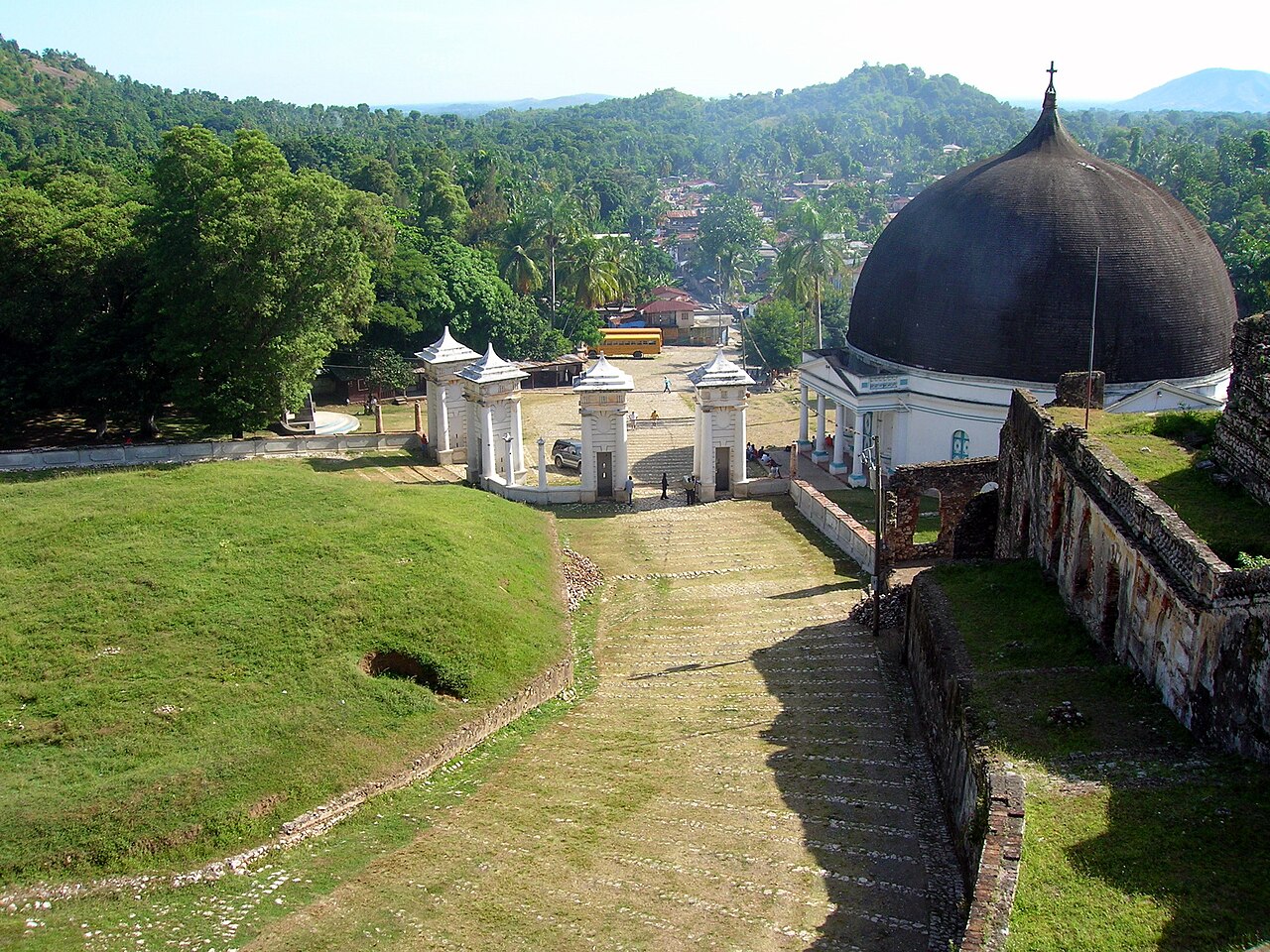
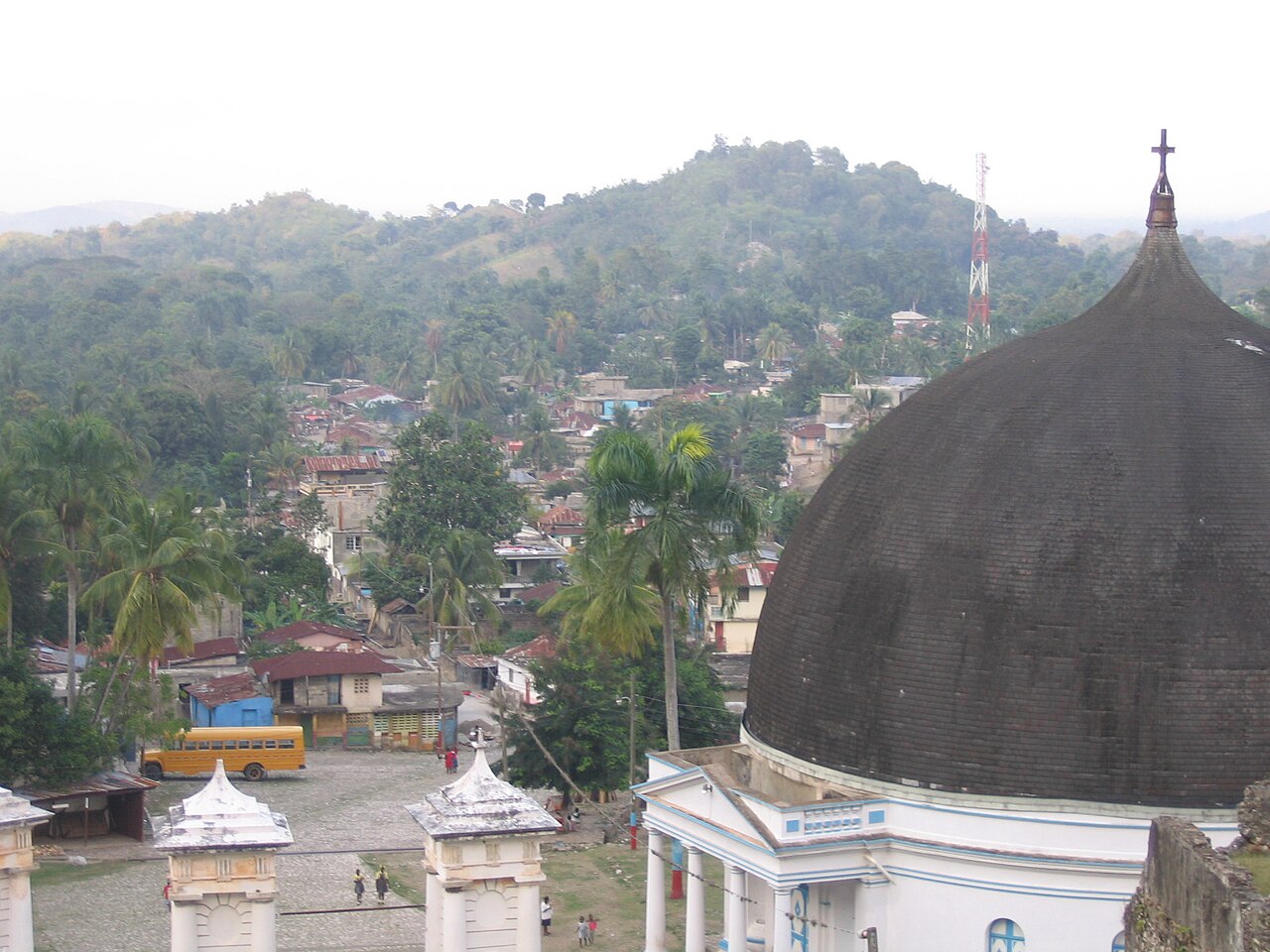
One of the most striking surviving elements of the site is the royal chapel, a domed church associated with the palace complex that served the religious needs of the king and his court. Its rounded dome, rising near the palace, gives the ruins one of their most memorable silhouettes and points to the role of religion in the ceremony and legitimacy of Christophe’s monarchy.

A crowned king in the European mould needed the sanction and splendour of the church, and the chapel provided the setting for the religious dimension of royal life, from worship to the great ceremonies that marked a reign. Its architecture, like that of the palace, drew on European models, the domed church being a form freighted with associations of grandeur and permanence, and it anchored the spiritual authority of the new kingdom.
The chapel is bound up with the very end of Christophe’s story, for it is closely associated with the drama of his death and burial, and it remains a place heavy with the memory of the king. To stand before it is to be reminded that Sans-Souci was not only a residence but a complete royal world, with its sacred as well as its secular spaces, all serving the single project of making a kingdom real.
That the chapel survives, its dome still rising above the ruins, gives the site a focal point and a sense of continuity. Where so much of the palace is roofless and open, the church endures as a more complete structure, a reminder of the faith and ceremony that once filled the complex and of the king who built it all and whose story ended in its shadow.
A King, a Queen, and a Nobility of the Free
One of the boldest of Christophe’s creations was his court. Having crowned himself king, he built around his throne a full royal establishment, complete with a queen, royal children, and, most strikingly, an entire hereditary nobility, dukes, counts, barons, and knights, drawn from the ranks of a people only recently freed from slavery. It was an act of extraordinary symbolic daring.

To create a Black nobility, with titles and estates and coats of arms, was to answer directly the ideology of slavery, which had denied that Africans could hold rank, dignity, or honour. By raising his followers to lordships and surrounding himself with the ceremony of a European court, Christophe insisted on the full humanity and nobility of his people, staging at Sans-Souci a living refutation of the racial hierarchy of the age.
The court had its own splendour: fine dress, elaborate etiquette, honours and orders, and the whole choreography of monarchy, all performed in the halls and gardens of the palace. Visitors from abroad, including Europeans, were received amid this grandeur and often left astonished, their assumptions unsettled by the sight of a dignified and sophisticated Black royal court functioning in the Caribbean.
Whatever one makes of the wisdom of building a monarchy on such foundations, and it was and remains debated, the court of Sans-Souci was a remarkable historical statement. It declared that freedom meant not merely the absence of chains but the full possession of every form of human dignity and power, up to and including a crown. The palace was the theatre in which that declaration was performed, day after day, for the few years the kingdom lasted.
The Fortress on the Mountain
Sans-Souci does not stand alone. Rising on a peak a short distance away is its companion and protector, the Citadelle Laferriere, one of the largest fortresses in the Americas and the crowning work of Christophe’s reign. Built to guard the newly independent kingdom against any attempt by France to return and re-impose slavery, it is a colossal stronghold perched high in the mountains, and together with the palace it forms a single World Heritage complex.
The scale of the Citadelle is staggering. Its massive stone walls, batteries of cannon, and vast interior spaces were designed to withstand a siege and to shelter the king, his court, and a garrison in the event of invasion. Building it on such a peak, and hauling the guns and materials up the mountain, was one of the great engineering feats of the era, and it stands as a monument to both the determination and the harshness of Christophe’s rule.
The fortress and the palace express the two faces of the kingdom. Sans-Souci was splendour, ceremony, and the arts of peace; the Citadelle was defence, vigilance, and the readiness for war. The free kingdom of the north knew that its independence was not secure, that the powers that had grown rich on slavery might try to reclaim their lost colony, and so it built beauty and might side by side, the palace below and the fortress above.
For visitors today, the two are experienced together, and the journey from the ruins of Sans-Souci up toward the Citadelle is one of the great travel experiences of the Caribbean. The fortress, never attacked, still broods over the landscape, a symbol of a freedom defended by force, while the palace at its foot speaks of the civilization that freedom was meant to protect. Neither can be fully understood without the other.
The Citadelle was never attacked, and the invasion it was built to repel never came, so its guns have stood silent on the peak for two centuries. There is something both triumphant and poignant in that: a fortress of such colossal effort, built against a fear that shaped the whole kingdom, now a peaceful monument gazing out over the country whose freedom it was meant to guarantee.
A Monument to Freedom
Beyond its beauty and its drama, Sans-Souci carries a meaning that reaches far past Haiti. It was built by and for a people who had done what the world said could not be done: enslaved Africans who rose up, defeated their enslavers and a great colonial power, and founded a free and independent nation. The palace is one of the most tangible monuments to that achievement, the first successful large-scale emancipation of its kind in modern history.
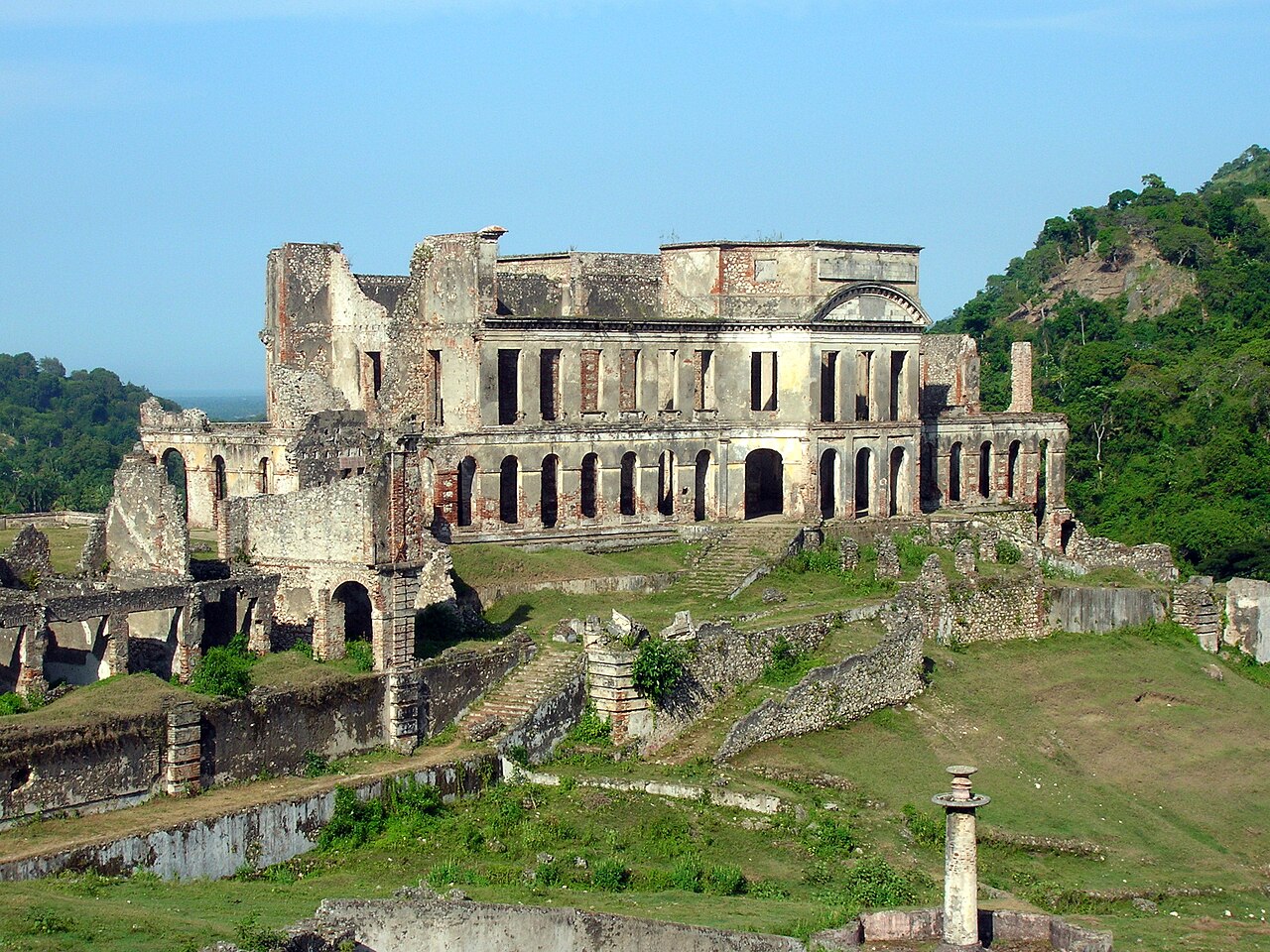
In an age when slavery was still legal and profitable across much of the Americas, the very existence of a free Black kingdom, with its king, its court, its palaces, and its fortress, was a challenge and an inspiration. Sans-Souci made that challenge visible in stone, declaring that a people freed from bondage could build states and civilizations as grand as any. For people of African descent everywhere, it became a powerful symbol of possibility.
That symbolism is why the site matters so much today. It is not merely a picturesque ruin but a place of memory, honoured as part of the heritage of Haiti and of the wider story of the struggle against slavery and for human dignity. Its recognition as a World Heritage site reflects an understanding that what happened here belongs to the history of all humanity, not to Haiti alone.
To walk the ruins with this in mind changes them. The broken walls and grassy terraces are not just the remains of one king’s ambition but the trace of a world-historical assertion of freedom. Sans-Souci stands, even in ruin, as a reminder of what people will build when they have claimed their own liberty, and of the price and the glory that such claims can carry.
Visitors often remark that the ruins feel less mournful than defiant. Even broken, the palace insists on its point, that it was here, that it was built, that it rivalled anything Europe had raised, and that the people who made it were free.
The King’s Last Days
The splendour of Sans-Souci was matched by the abruptness of its end. Christophe’s reign, for all its energy, grew increasingly harsh, and the burden of his labour regime and the discontent it bred eroded his support. When, in 1820, he was struck by illness, said to have been a stroke that left him partly paralysed, his authority began to crumble, and revolt stirred among his soldiers and his people.
Facing the collapse of his power and unwilling to be taken by his enemies, the king chose his own end. According to the enduring tradition, Henri Christophe shot himself at Sans-Souci, and legend holds that he did so with a silver bullet, a detail that has attached itself forever to his memory. Whatever the precise truth, the king who had built a palace to rival Europe’s died by his own hand within its walls, his great project unravelling around him.
His death brought the swift end of his kingdom. The northern monarchy did not survive him; the court he had created dissolved, the nobility lost their titles, and Haiti moved on into a different and republican future. The dream of a Black kingdom in the mould of Europe’s, staged so brilliantly at Sans-Souci, ended almost as suddenly as it had begun, leaving the palace behind as its monument.
There is a dark and much-debated undercurrent to the palace’s very name, for some link Sans Souci to a rival leader of that name whom Christophe is said to have had killed during the struggles for power, so that the palace’s carefree title carries, for some, a shadow of that earlier death. Whatever the truth, the story of Christophe’s own end lends the ruins their air of tragic grandeur, a splendour built and lost within a single short reign.
Earthquake, Ruin, and World Heritage
After the fall of the kingdom, Sans-Souci was left to its fate, and that fate was sealed by nature. A powerful earthquake in the mid-nineteenth century struck the region and severely damaged the abandoned palace, and it was never restored to its former state. Left roofless and broken, it gradually became the majestic ruin that visitors encounter today, its grandeur now mingled with the melancholy of decay.

Yet ruin has given the palace a different kind of power. Stripped of its roofs and furnishings, open to the sky and softened by greenery, Sans-Souci has the romantic, elegiac beauty of a great structure returning slowly toward the landscape. The bones of its architecture, the monumental stair, the standing walls, the domed chapel, remain legible, so that the imagination can still rebuild the splendour that was lost.
In the twentieth century the palace, together with the Citadelle and the surrounding area, was recognised for its outstanding value and inscribed as a World Heritage site within a national historic park. That status affirms the importance of the place not only to Haiti but to the world, and it brings with it the responsibility to protect and conserve the fragile ruins for future generations.
Preservation is a continuing challenge in a country that has faced great hardships, but the significance of the site ensures that it remains cared for and cherished. Sans-Souci endures as one of Haiti’s proudest monuments, a ruin that has outlived its king, his kingdom, and the earthquake that broke it, standing still in its mountain setting as a witness to an extraordinary chapter of history.
The Story on Film
The tale of Henri Christophe and his palace is so dramatic that it almost demands to be told aloud, and the short film below does exactly that, recounting the rise and fall of the first and last king of Haiti in a way that brings the ruins of Sans-Souci vividly to life. Watching it alongside the images in this article helps knit the stones and the story together.

If you are considering a journey to northern Haiti, or simply want to understand what you are looking at, a video like this is a fine companion. It sets the palace in the sweep of the Haitian Revolution and the founding of the nation, so that the ruins become not just beautiful stones but the setting of one of history’s most remarkable careers.
And if Haiti lies beyond your travels for now, the film offers a way to encounter this astonishing story from afar. Let it play, and picture the palace as it once was, gleaming in the hills, the seat of a king who had been a slave, before you return to the ruins as they stand today.
Visiting Sans-Souci Today
For the traveller, Sans-Souci is the great historic sight of northern Haiti, usually visited together with the Citadelle as part of a single unforgettable excursion from the nearby city or from the town of Milot at the palace’s foot. The palace ruins can be explored on foot, climbing the grand staircase and wandering among the walls, terraces, and the domed chapel, before continuing up toward the mountain fortress beyond.

A visit rewards a little preparation and the right frame of mind. Conditions for travel in Haiti can vary, so it is wise to seek current local advice and to arrange the trip, and especially the ascent to the Citadelle, with knowledgeable local guides, who can also bring the history alive as you go. Sensible footwear, sun protection, and water are essential for what is a hilly and often hot excursion.
Above all, come with respect for what the place represents. These are not merely scenic ruins but a monument to freedom, to a people’s self-liberation and to a bold, tragic experiment in sovereignty. Treat the site and the local community with the seriousness the history deserves, and take the time to absorb the meaning as well as the beauty of what you are seeing.
However you come to it, Sans-Souci will stay with you. Few places so vividly unite grandeur, tragedy, and significance: the ruined palace of a king who had been a slave, set in green mountains beneath a mighty fortress, standing as a lasting witness to the birth of the first free Black nation of the modern world. To visit is to touch a story that belongs to all of humanity.
Palaces Nearby
If the story of Haiti’s king has drawn you in, these two other nineteenth-century thrones, raised far from Europe, make fitting companions.
- The Summer Palace of Petropolis and Brazil’s Last Emperor — the mountain retreat of Emperor Dom Pedro II.
- Manhyia Palace and the Enduring Throne of the Asante — the living court of the Asante kings in Kumasi.
You May Like
Konopiste the Bohemian Castle of a Doomed Archduke