In this article
- A monastery you cannot walk into
- The saint, the serpent, and the founding legend
- The nine saints who built a church
- The oldest standing church in Ethiopia
- What the Ethiopian church is, and why it is unlike any other
- A faith older than most of Europe
- Why it matters to an Ethiopian believer
- No women, no easy way up
- Life on top of the mountain
- The kingdom of Aksum behind it all
- A land of rock-hewn holiness
- The feasts that fill the Ethiopian year
- A treasure house on a rock
- If you attempt the climb
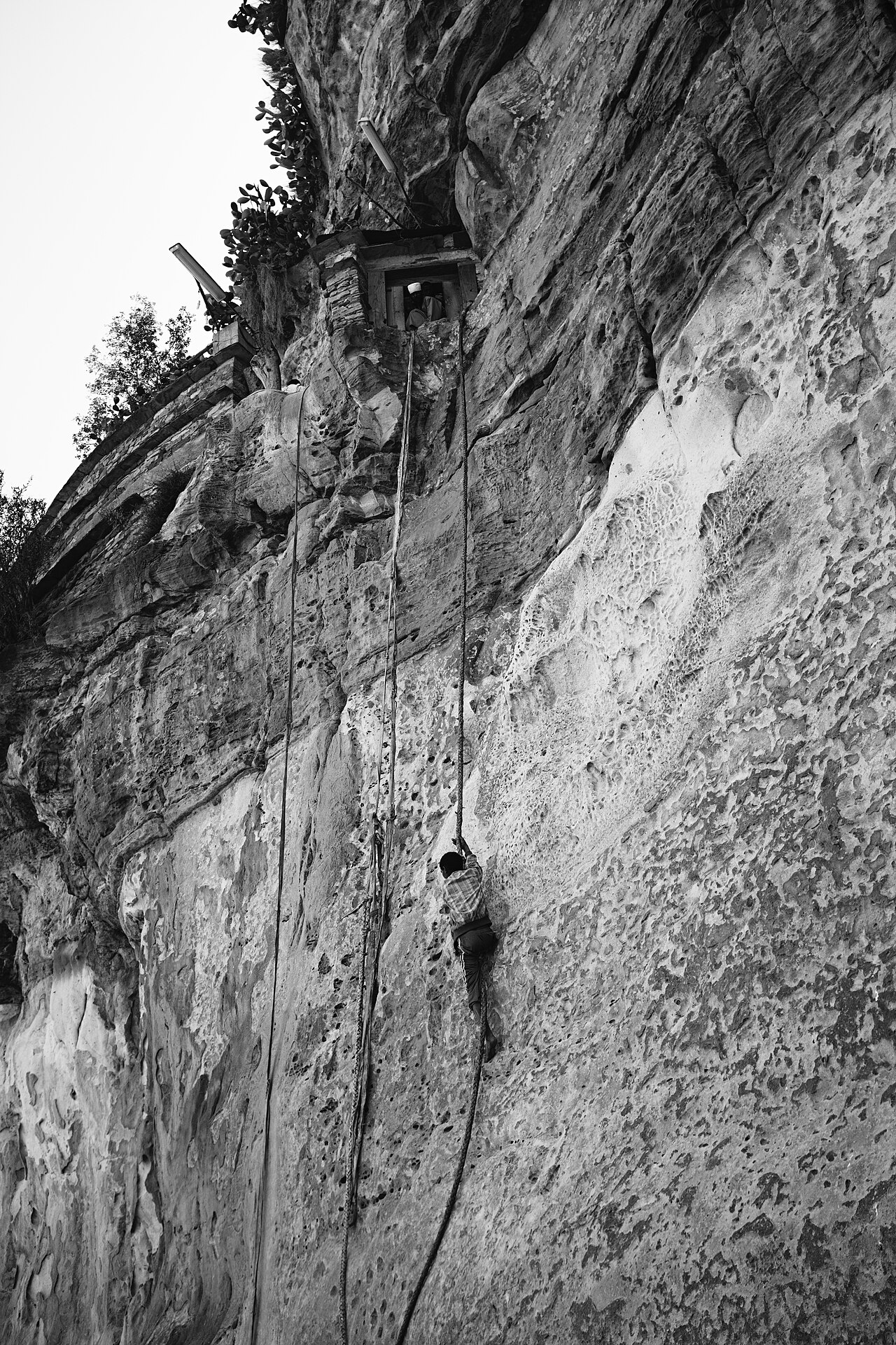
There is a mountain in the far north of Ethiopia, in the high stony country of Tigray, that rises from the surrounding land as a flat-topped table of rock with sheer cliffs falling away on every side. On top of it, invisible from below, sits one of the oldest and most revered monasteries in all of Christianity, a place of churches and cells and gardens perched on the summit of an island in the sky. And here is the astonishing part: there is no path to the top. To reach the monastery of Debre Damo, you must climb a cliff, hauling yourself up some fifteen metres of vertical rock with a leather rope, trusting your weight to the strong arms of a monk above and a strap of hide that has been the only way in and out for some fifteen hundred years.
It is one of the most extraordinary holy places on earth, and one of the least known outside Ethiopia. While pilgrims crowd the famous shrines of Europe and the Holy Land, this ancient monastery sits in remote silence on its cliff, guarded by its own inaccessibility, home to a community of monks who have kept the faith on this rock since the age when the Roman Empire was still pagan in much of its extent. To climb the rope to Debre Damo is to enter a world that has changed almost nothing in a millennium and a half, a survival from the very dawn of Christianity preserved by the simple, brutal fact that almost no one can get up there.
This is the story of that monastery on the mountain, of the saint who is said to have been carried to its summit by a serpent, of the ancient and singular church of Ethiopia that guards it, and of what it takes, in body and in faith, to reach the top.
A monastery you cannot walk into
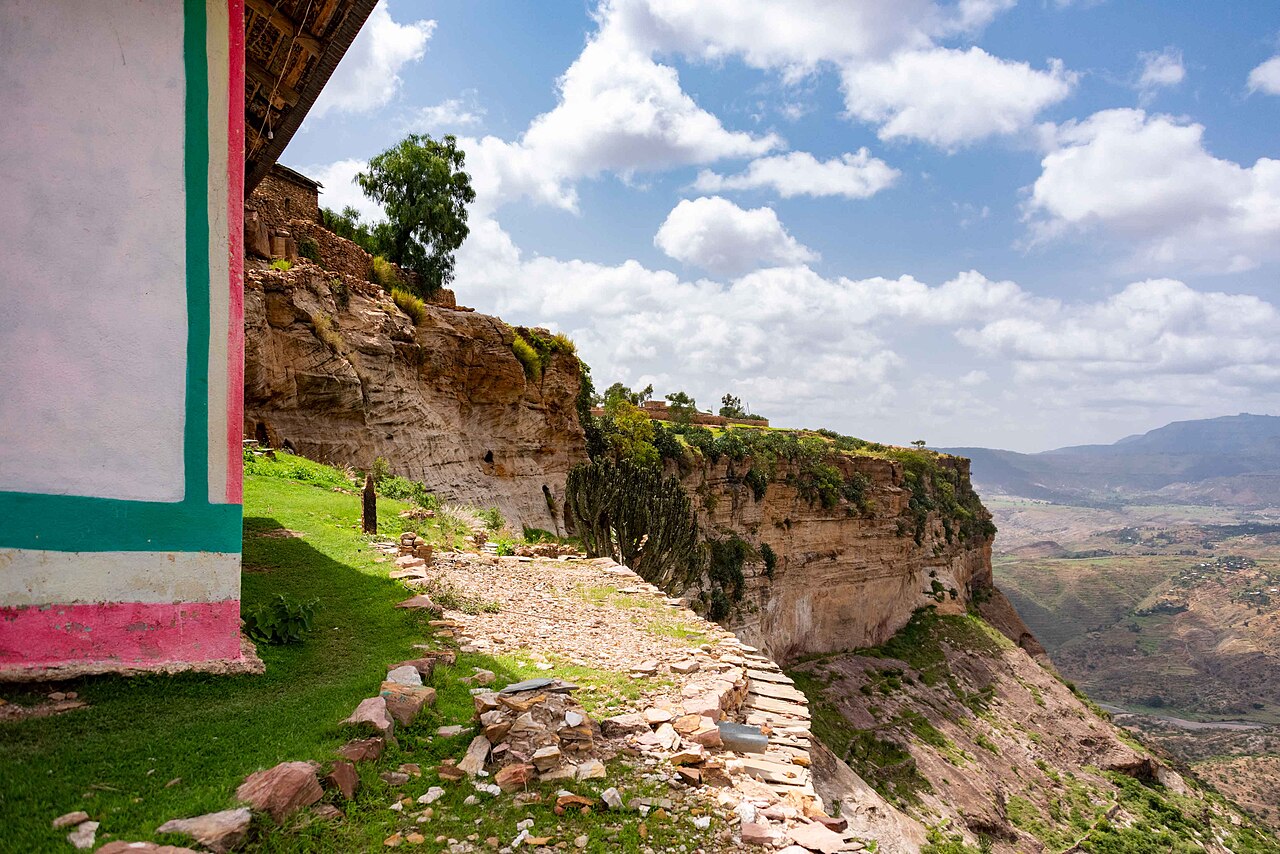
Debre Damo sits on an amba, the Ethiopian word for one of the flat-topped mountains that rise so dramatically from the highlands of Tigray, their tops as level as tables and their sides plunging away in cliffs. The summit is a substantial plateau, large enough to hold the whole monastic settlement, its churches, the monks dwellings, cisterns to catch the precious rain, and fields and animals that make the community largely self-sufficient. But the only way up is the cliff.
The climb is the thing everyone remembers. There is no staircase, no path, no easier route around the back; the mountain is sheer on every side, and access is by a single point where a rope of plaited leather hangs down the rock face. The visitor ties the rope around the waist, finds what holds the cliff offers for hands and feet, and climbs, while above a monk braces and hauls on the rope to take the weight. Supplies, and in former times everything and everyone that ever reached the top, came up the same way. This is not a tourist gimmick. It is, and always has been, the genuine and only entrance to the monastery, and it is the reason Debre Damo has survived so completely intact: an enemy, a raider, an army could not simply march in. The mountain defended itself, and the rope could always be pulled up.
The saint, the serpent, and the founding legend
How, then, did the first monk ever reach the summit, if the only way up is a rope let down from the top? The tradition answers with one of the most charming founding legends in Christendom. The monastery is associated with a saint named Abuna Aregawi, one of the holy men who brought monasticism to Ethiopia, and the story tells that when he wished to ascend the unclimbable mountain, God sent a great serpent which lowered its tail from the summit and drew the saint safely to the top.
It is a legend that captures perfectly the character of the place: a holy mountain so set apart from the ordinary world that only divine intervention could open it, a summit reachable not by human effort alone but by the help of heaven. Images of the saint being lifted by the serpent are beloved in Ethiopian sacred art, and the story is told and retold to every pilgrim who makes the climb. Whatever one makes of the serpent, the deeper truth it expresses is real enough: that this is a place deliberately removed from the world, a height that one does not simply stroll up to but must be, in some sense, drawn up to, leaving the ordinary earth decisively below.
The nine saints who built a church
Abuna Aregawi was, according to Ethiopian tradition, one of a group known as the Nine Saints, holy men who came to Ethiopia from the eastern Roman world in roughly the late fifth and early sixth centuries and who played a central role in spreading Christianity into the countryside and establishing monastic life. Ethiopia had already become officially Christian considerably earlier, in the fourth century, when the kingdom of Aksum, the great trading power that then ruled this region, adopted the faith, making it one of the very first kingdoms anywhere in the world to become Christian, around the same time as the Roman Empire itself.
The Nine Saints came a little later, in the period after that first royal conversion, and their work was to deepen and spread the new religion, translating the scriptures, founding monasteries, and rooting Christianity in the life of the common people. Debre Damo, founded by Aregawi on its impregnable mountain, became one of the most important of these early monastic centres, a powerhouse of the faith in the Aksumite kingdom and a model for Ethiopian monasticism ever after. So the monastery stands at the very foundations of Ethiopian Christianity, linked to the saints who built the church in the countryside and to the ancient kingdom that first embraced the faith.
The oldest standing church in Ethiopia
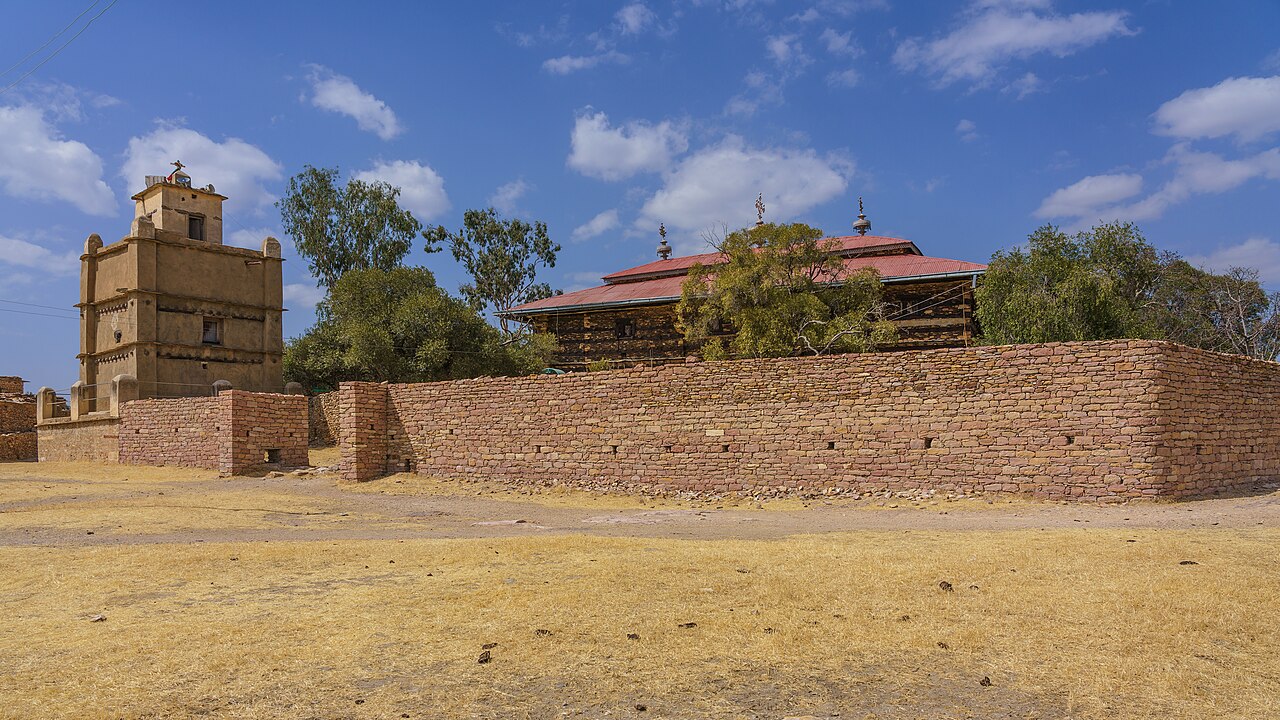
The great prize on the summit is the main church of the monastery, which is widely regarded as the oldest existing church building in Ethiopia and one of the oldest in the whole of Africa, a structure reaching back, at least in its origins, to the Aksumite period some fifteen centuries ago. It is built in the distinctive Aksumite architectural style, with walls of stone and timber laid in alternating courses, and woodwork of carved beams and panels that has survived, in part, from deep antiquity, making it a rare and precious witness to the building methods of a vanished kingdom.
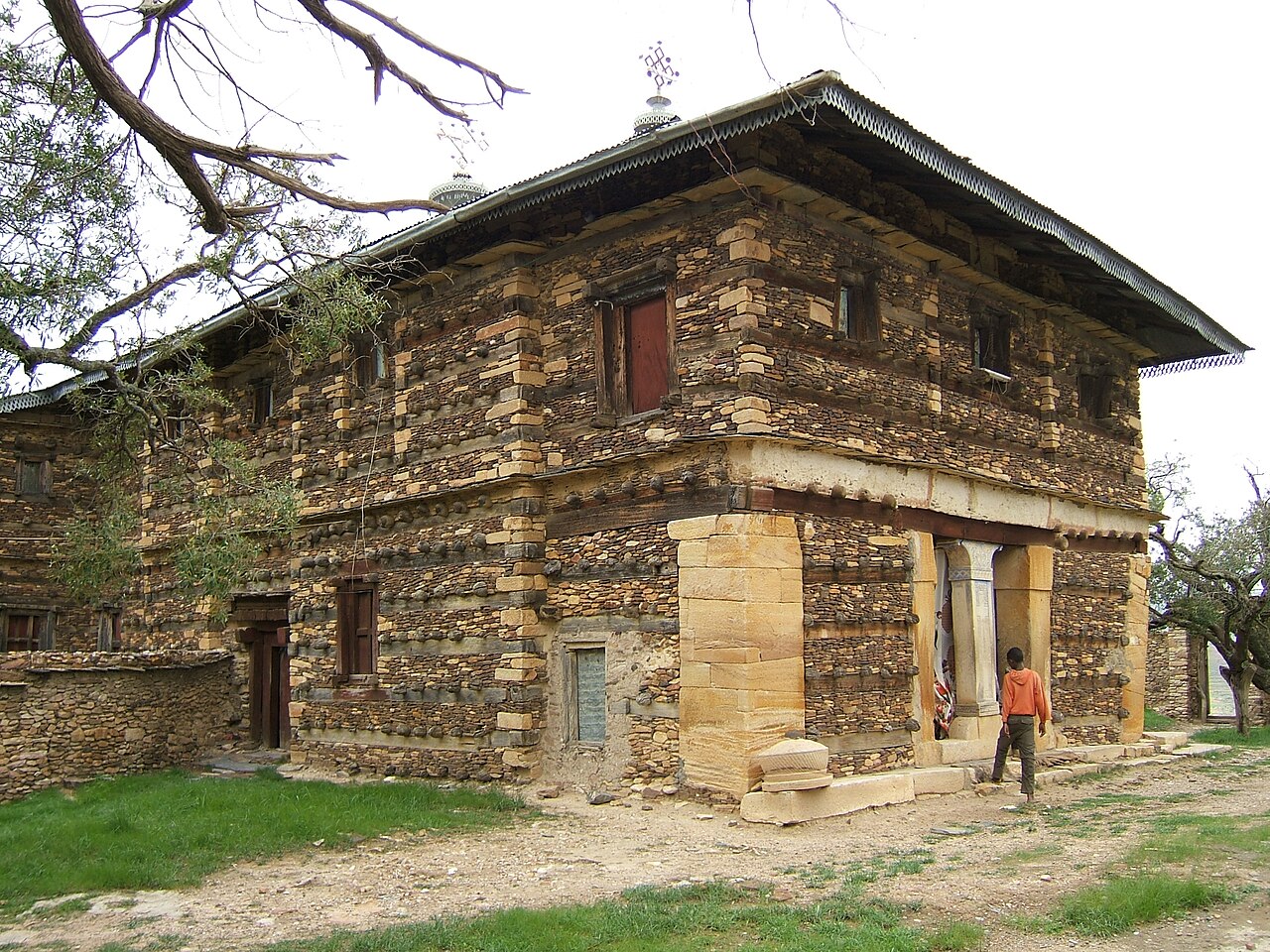
That such an ancient building survives at all is, once again, a gift of the mountain. Down in the accessible lowlands, the churches of the Aksumite age were destroyed and rebuilt many times over the turbulent centuries; up on the unreachable summit of Debre Damo, protected by the cliffs, the old church endured. Its carved wooden ceilings and ancient beams are studied by scholars as some of the only surviving examples of Aksumite construction, a direct physical link to the architecture of one of the great early civilizations of Africa. To worship in it is to stand inside a building that has sheltered Christian prayer since the faith was young, preserved almost by accident on its island of rock.
What the Ethiopian church is, and why it is unlike any other
To understand Debre Damo you have to understand the Ethiopian Orthodox Tewahedo Church, one of the most distinctive and ancient forms of Christianity in the world, and quite unlike anything a Western Christian is likely to have encountered. It is, first of all, ancient: one of the oldest national churches anywhere, rooted in that fourth-century conversion of the kingdom of Aksum, with an unbroken history of some seventeen centuries. And it is singular, having developed over those long centuries in relative isolation in the Ethiopian highlands, producing a Christianity rich in features found nowhere else.
The Ethiopian church belongs, like the Coptic church of Egypt with which it is historically linked, to the family of Oriental Orthodox churches that separated from the rest of Christianity after the Council of Chalcedon in the fifth century, long before the splits that produced Catholic, Eastern Orthodox, and Protestant. But it went its own way to an extraordinary degree. It preserves practices the rest of Christianity abandoned or never had: it observes a form of the Jewish Sabbath alongside Sunday, follows dietary laws reminiscent of the Hebrew scriptures, practices circumcision, and, most famously, claims to possess the original Ark of the Covenant, guarded in a church in the nearby holy city of Aksum, with a replica, the tabot, kept in the sanctuary of every Ethiopian church as the focus of its holiness. Its scriptures, written in the ancient liturgical language of Geez, include books found in no other Bible. It is, in short, a Christianity all its own, and Debre Damo is one of its most venerable strongholds.
A faith older than most of Europe
It is worth pausing on just how old this Christianity is, because it overturns the assumptions many people carry. We tend to think of Christianity spreading outward from Europe to the rest of the world, a Western religion carried abroad by missionaries and empires. But Ethiopia was Christian centuries before most of Europe. When the kingdom of Aksum adopted the faith in the fourth century, much of northern and eastern Europe was still firmly pagan and would remain so for hundreds of years. The Ethiopians were keeping the Christian faith, building churches, and translating the scriptures into Geez while the ancestors of many European Christians were still worshipping the old gods of the forest.
This deep antiquity gives Ethiopian Christianity a dignity and a confidence rooted in the knowledge that it is not a borrowed or imported faith but one of the original branches of the Christian tree, as old as almost any in existence. The monasteries of Tigray, Debre Damo foremost among the most ancient, are the living roots of that tradition, communities that have kept the lamp burning continuously since the very first centuries of the faith. To visit one is to be reminded that Christianity has always been a global religion, with some of its oldest and deepest roots not in Europe at all but here, in the highlands of the Horn of Africa.
Why it matters to an Ethiopian believer
For an Ethiopian Orthodox Christian, Debre Damo is hallowed ground, one of the great holy mountains of a faith that loves holy mountains. The monastery is associated with the foundational saints of Ethiopian Christianity, it holds the oldest church in the land, and its very inaccessibility marks it as a place uniquely set apart for God. To make the climb, for a devout Ethiopian, is a genuine pilgrimage, an ascent toward holiness that demands real effort and even a little courage, and that is part of its meaning. The hard climb is itself a kind of prayer, a leaving behind of the ordinary world to enter a sacred space lifted above it.
Monasticism stands at the very heart of Ethiopian Christianity in a way that has faded in much of the modern West, and the monks of places like Debre Damo are deeply revered figures, holy men whose lives of prayer, fasting, and seclusion are seen as the spiritual backbone of the whole church. The monastery has also been, across the centuries, a centre of learning and of the copying of sacred manuscripts, a guardian of the religious culture of the nation. In Ethiopian tradition such mountain monasteries also served, at times, other striking purposes; ambas like Debre Damo were used in the past as secure places to keep royal princes or treasures safe, the same impregnability that protected the monks serving the needs of kings. All of this gathers around the rock to make it one of the most venerable sites in a country full of ancient holiness.
No women, no easy way up
Two hard facts shape any visit to Debre Damo, and honesty requires stating them plainly. The first is the climb, already described: there is genuinely no way up but the rope and the cliff, an ascent of some fifteen metres of rock that demands a head for heights and a reasonable level of fitness and nerve. A monk above lowers a strong leather rope, which is tied around the climber, and the ascent is made with the monk hauling from above and the climber scrambling on the rock; it is safer than it sounds, having been done by countless pilgrims for centuries, but it is not for the faint-hearted, and there is simply no alternative route for those who cannot manage it.
The second fact is that Debre Damo, like a number of the most traditional Orthodox monasteries, admits only men. Women are not permitted to make the climb or enter the monastery, a rule of long standing in this strand of monastic tradition, paralleled most famously at the monastic republic of Mount Athos in Greece. For female travellers this is a real limitation and, for some, a disappointment or a frustration, and it is best to know it before making the long journey to the foot of the mountain. The custom is ancient and deeply held within the tradition, and whatever one thinks of it, it governs access to the summit absolutely. These two restrictions, the cliff and the rule, mean that Debre Damo remains, even in an age of mass travel, a genuinely difficult and exclusive place to reach, which is precisely how it has stayed so perfectly preserved.
Life on top of the mountain
Those who do make it to the summit find a whole small world laid out on top of the rock. The plateau is surprisingly large and surprisingly green in season, with the monastery buildings, the ancient church and others, scattered across it among the dwellings of the monks, cisterns hewn to catch and store the rainwater on which life depends, and fields and grazing for animals. The community is largely self-sufficient, a self-contained settlement living its own rhythm of prayer and work high above the surrounding country, much as it has for fifteen hundred years.
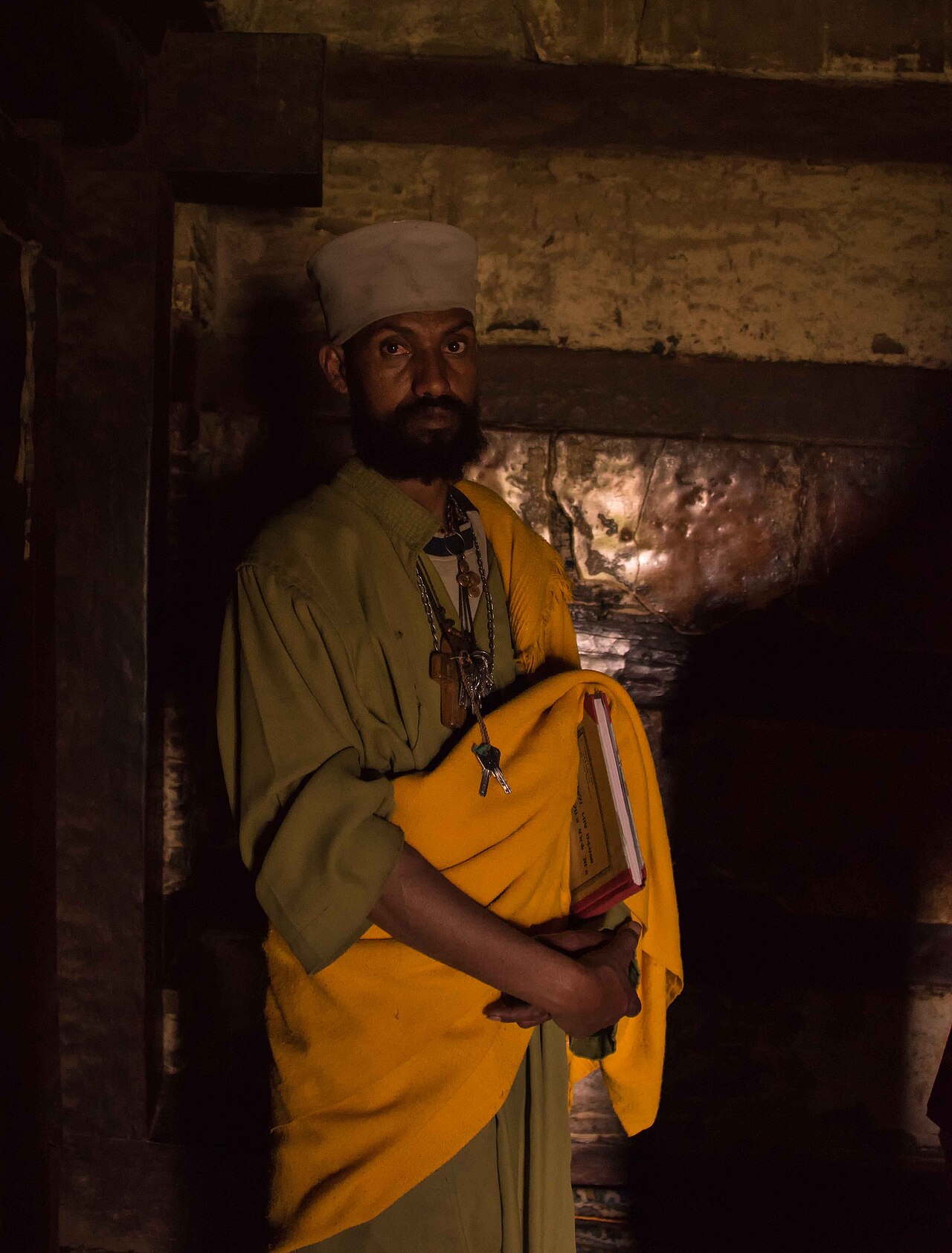
The monks keep the ancient round of Ethiopian Orthodox worship, the long chanted services in Geez, the fasts that fill so much of the Ethiopian calendar, the daily labour of maintaining their mountain home. From the summit the views across the highlands of Tigray are immense, ridge beyond ridge of the great Ethiopian uplands stretching to the horizon, the world spread out far below the cliffs. There is a profound stillness to the place, the silence of a height that the noise of the modern world has never reached, broken only by chant and wind and the bleating of goats. It is, by every account of those who have climbed up, one of the most genuinely otherworldly places a traveller can reach, a fragment of the sixth century surviving whole into our own time.
The kingdom of Aksum behind it all
Standing behind Debre Damo, like a great shadow, is the kingdom of Aksum, one of the most powerful and least remembered civilizations of the ancient world, and you cannot really grasp the monastery without it. In the early Christian centuries Aksum was a major power, a trading empire that controlled the commerce of the Red Sea, minted its own coinage in gold, silver, and bronze, raised the towering carved stone obelisks that still stand in the city of Aksum, and traded with the Roman world, with Arabia, and as far as India. It was, by the reckoning of some ancient writers, counted among the great kingdoms of its age.
It was this kingdom that adopted Christianity in the fourth century, when its king was converted, making Aksum one of the earliest Christian states anywhere on earth and planting the faith in the Ethiopian highlands where it has flourished ever since. The architecture of Debre Damo oldest church, with its alternating layers of stone and timber and its carved wooden beams, is Aksumite architecture, a direct survival of the building style of that lost empire, which makes the church one of the most important physical witnesses to Aksumite civilization still standing. The monastery is thus not only a holy place but a relic of a vanished superpower, a piece of one of Africa great early kingdoms preserved on its mountaintop.
When the power of Aksum eventually faded, its religion did not. The faith outlived the empire that had embraced it, carried forward by exactly the kind of monastic communities that Debre Damo represents, until it became the deep and enduring foundation of Ethiopian identity that it remains today. To climb to the monastery is, in a sense, to climb back into the world of Aksum, to touch the architecture, the faith, and the spirit of a kingdom that flourished when Rome still ruled the Mediterranean.
A land of rock-hewn holiness
Debre Damo does not stand alone in its drama; it is part of a whole landscape of astonishing sacred architecture that makes northern Ethiopia one of the wonders of the Christian world. The region of Tigray and the highlands around it are studded with churches carved or built into the most improbable places: churches hewn entirely out of solid rock, churches perched on cliff ledges reachable only by terrifying climbs, churches hidden in caves and gorges, an entire tradition of building sanctuaries where it seems impossible that any sanctuary could be.
Most famous of all are the rock-hewn churches of Lalibela, further south, where a medieval king is said to have created a new Jerusalem by carving whole churches down into the living rock, complete with windows, doors, columns, and roofs, all cut from a single mass of stone. But the Tigray highlands around Debre Damo have their own remarkable family of rock churches, many of them clinging to clifftops and reached by climbs nearly as hair-raising as the rope of Debre Damo itself, hidden away in a landscape of canyons and flat-topped mountains. Together they form one of the densest concentrations of dramatic sacred architecture anywhere on earth.
This whole tradition of building the holy into the most inaccessible and astonishing places tells you something about Ethiopian Christianity itself: its love of the high and the hidden, its instinct that the sacred belongs in places set dramatically apart from ordinary life, its readiness to pour extraordinary effort into reaching toward heaven. Debre Damo, on its unclimbable mountain, is one of the purest expressions of that instinct, and to understand it as part of this larger landscape of rock-hewn and cliff-top holiness is to see it not as an isolated curiosity but as the crowning example of one of the great architectural and spiritual traditions of the Christian world.
The feasts that fill the Ethiopian year
The life of a monastery like Debre Damo is governed by the rhythm of the Ethiopian Orthodox calendar, and that calendar is one of the most distinctive features of this singular church. Ethiopia keeps its own ancient reckoning of time, a calendar of thirteen months that runs some years behind the one most of the world uses, so that the monks on the mountain celebrate the great Christian feasts on their own dates, in their own season, according to a count of years that makes Ethiopia, charmingly, always a little younger than the rest of the world.
The year is shaped above all by fasting, and the Ethiopian church fasts more rigorously and more often than almost any other Christian tradition, with the devout abstaining from all animal products for well over half the days of the year, through the long fasts before the great feasts and on the regular fast days of each week. For the monks, the discipline is stricter still. Against this background of fasting, the feasts blaze out all the more brightly: the celebration of Christmas in its Ethiopian season, the great festival of Timket commemorating the baptism of Christ, when replicas of the Ark are carried in procession amid crowds of white-robed worshippers, and the many saints days, including the feasts of the founding saints so dear to a monastery like this one.
On its mountaintop, the community keeps these feasts and fasts as it has for fifteen centuries, the chanted liturgy in Geez rising on feast days, the long austerities observed in between. The chant itself, accompanied by the drum and the sistrum and the prayer staff, performed in a tradition that Ethiopians trace to an ancient saint who is said to have received the music of the church in a vision, is unlike any other Christian music on earth, and to hear it drift across the summit of Debre Damo on a holy day is to hear a sound that has scarcely changed since the dawn of Ethiopian Christianity. It is the heartbeat of the place, the audible sign of a faith that has kept its own time, in every sense, for longer than almost any other on earth.
A treasure house on a rock
The isolation that preserved the buildings preserved their contents too, and Debre Damo is a repository of ancient treasures. Over the centuries the monastery accumulated a remarkable collection of illuminated manuscripts, written and painted by hand in Geez on parchment, some of great antiquity, along with crosses, sacred vessels, and other liturgical treasures, all kept safe on the unreachable summit while the lowlands were ravaged again and again. For scholars of Ethiopian Christianity, of Aksumite history, and of the art of the manuscript, the monastery is a precious archive, holding witnesses to the religious culture of the nation that have survived nowhere else.
This role as a guardian of treasures is common to many of Ethiopia great monasteries, which served as the libraries and archives of a civilization, the places where the sacred books were copied, illuminated, and preserved through the centuries. The combination of the ancient building, the old manuscripts, and the unbroken community of monks makes Debre Damo not just a holy place but a living museum of one of the world oldest Christian cultures, a treasure house that has kept its riches safe by the simple expedient of being almost impossible to plunder. The rope that keeps out the casual visitor kept out the raider too, and so the treasures remain.
If you attempt the climb
Debre Damo lies in the Tigray region of northern Ethiopia, reached by a long journey through the highlands, and it is genuinely remote and, at times, affected by the wider troubles that have touched that part of the country, so anyone contemplating a visit should take careful, current advice about safety and access before setting out. Assuming the way is open, reaching the foot of the mountain is itself an expedition, and then comes the climb, the rope, the cliff, the strong arms of the monk above. Only men may go up; women may come to the base but can go no further.
For those who can make the climb, the rewards are extraordinary, but they come wrapped in real effort and require the right spirit. This is a working monastery and a place of deep holiness, not an adventure park, and the climb, thrilling as it is, is the gateway to a sacred space that deserves reverence. Dress and behave with the modesty and respect due to one of the most ancient Christian communities on earth. And when you stand at last on the summit, having hauled yourself up the same cliff that pilgrims have climbed for fifteen centuries, take a long moment to absorb where you are: on top of a mountain in the Horn of Africa, in a monastery older than almost any church in Europe, among monks who keep a faith that was ancient before most of the world had heard the Christian story at all. There are not many places left on earth where you can step so completely out of your own century, and fewer still that ask you to climb a rope to get there. Debre Damo is one of them, and there is nothing else quite like it.


