In this article
- A Protestant Rome on a lake
- The cathedral that changed sides
- The Frenchman who ended up running a city
- What Calvin taught, and why it spread so far
- The academy and the city of refuge
- Why Geneva matters to the Reformed world
- The divide it deepened, and the world it shaped
- Switzerland other reformer, before Calvin
- From city of God to city of the world
- The great wall of the Reformers
- The psalms they sang instead of hymns
- A stripped-down kind of holiness
- If you visit
Geneva today is a city of banks and diplomats, of international organizations and discreet wealth, sitting in elegant calm at the foot of its lake where the Rhone flows out toward France. It is one of the most comfortable and cosmopolitan cities in the world, and a visitor wandering its lakeside promenades and luxury shopfronts might never guess that this was once one of the most intensely religious places on earth, a city that called itself, with no small pride, a Protestant Rome. Yet for a few extraordinary decades in the sixteenth century, Geneva was the headquarters of a movement that would reshape Christianity across continents, the home base of a French theologian named John Calvin, whose ideas radiated out from this small city to remake churches and societies as far away as Scotland, the Netherlands, and the founding colonies of America.
If Wittenberg was where the Reformation began, Geneva was where one of its most powerful streams was organized, disciplined, and sent out to conquer the world. The Protestantism that flowed from here, the Reformed or Calvinist tradition, became the spiritual ancestor of the Presbyterian, Reformed, and Congregationalist churches, shaped the Puritans who sailed to New England, and left its mark on the very character of whole nations. To understand modern Geneva you have to look past the banks to the great cathedral on the hill and the stern stone Reformers carved into the city wall, and to recover the memory of the years when this lakeside town tried to become a city of God.
This is the story of that city, of the formidable man who made it the capital of his movement, of the ideas that went out from it to change the world, and of why a place now famous for watches and diplomacy was once the beating heart of one of the great religious revolutions in history.
A Protestant Rome on a lake
The phrase Protestant Rome was not modest, and it was not meant to be. Just as the Catholic world looked to Rome as its centre, the headquarters of its faith and the seat of its authority, so the growing Reformed movement of the sixteenth century came to look to Geneva. From across Europe, men came to study at the feet of Calvin and his colleagues, to learn the new theology and the new way of ordering a church and a city, and then went home to plant it in their own lands. Geneva became a school, a model, and a refuge all at once, the place that exported a version of the Reformation to a continent.
What made this all the more remarkable is that Geneva was tiny. This was not a great capital or a mighty kingdom but a small independent city-state, recently freed from its old overlords and feeling its way as a self-governing republic. That such a place could become the centre of a worldwide religious movement was due almost entirely to one man and the institutions he built there. Geneva punched so far above its weight that its name became synonymous with a whole branch of Christianity, and to this day the city wears that history as one of its deepest identities, beneath the modern gloss of wealth and internationalism.
The cathedral that changed sides
At the highest point of Geneva old town stands the Cathedral of Saint Pierre, Saint Peter, and its story captures the whole drama of the Reformation in stone. It is a great medieval cathedral, begun in the twelfth century, built over many generations in the Gothic style, with a curious neoclassical facade of columns added much later that gives it an oddly templelike front. For centuries it was a Catholic cathedral, filled with altars, images, statues, and all the rich apparatus of medieval worship, the spiritual centre of a Catholic city.
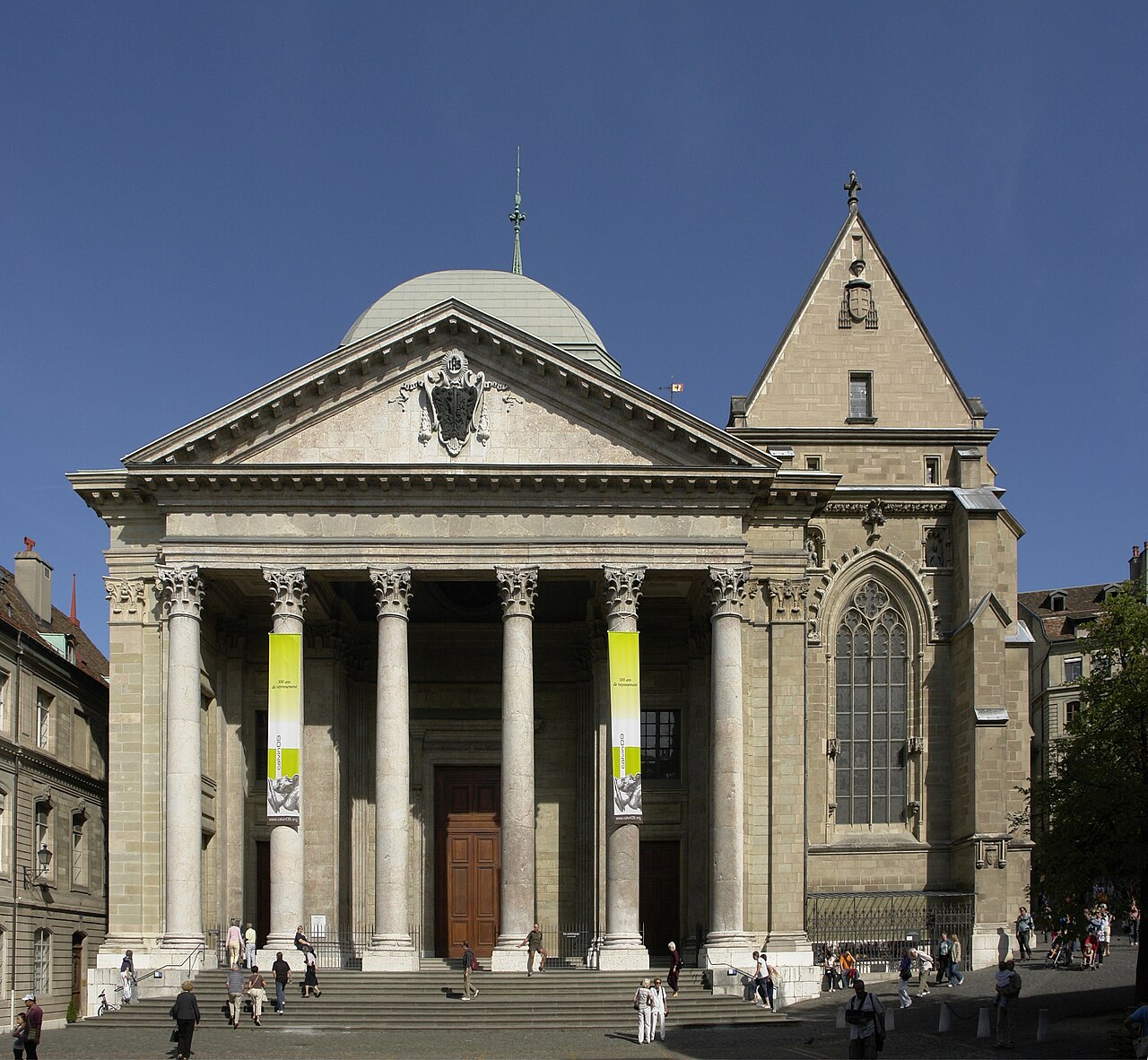
Then, in the fifteen-thirties, Geneva embraced the Reformation, and the cathedral changed sides. In a wave of reforming zeal the images and altars were stripped out, the statues removed, the rich decoration whitewashed away, and the great building was transformed into a Protestant church, plain and austere, fit for the new worship centred on the preaching of the word rather than the ceremonies of the old religion. This is the church visitors see today: a vast Gothic space, magnificent in its bones but stripped of its medieval ornament, its bare stone speaking eloquently of the Reformation conviction that the glory of God was to be found in his word rather than in golden images. And here, in this stripped cathedral, Calvin preached, week after week, year after year, his sermons pouring out the theology that would travel across the world. A plain wooden chair said to be his still stands inside, a humble relic of an unhumble influence.
The Frenchman who ended up running a city
John Calvin was not a native of Geneva, nor did he ever quite intend to rule it. He was a Frenchman, born in 1509, a generation younger than Luther, a brilliant scholar trained in law and the humanist learning of his day, who underwent a conversion to the reforming cause and was forced to flee France as the authorities cracked down on Protestants. He was passing through Geneva, meaning only to stay a night, when a fiery local reformer named Guillaume Farel confronted him and, in effect, browbeat him into staying to help organize the city newly reformed church, warning him that God would curse his studies if he refused so plain a call to duty. Calvin, intimidated and convinced, stayed.
What followed was a stormy partnership between the theologian and the city that lasted, with one interruption when he was expelled for a few years, until his death in 1564. Calvin never held the office of a ruler; he was, for most of his time there, simply a pastor and teacher, not even a citizen until late in life. Yet through the force of his intellect, his preaching, and the institutions he built, he came to exert an extraordinary influence over the life of Geneva, shaping not only its church but its laws, its morals, its schools, and its public discipline. The city became a kind of laboratory in which Calvin tried to build a community ordered entirely according to his understanding of the word of God, a holy commonwealth that would be a light to the nations, and the experiment, for all its severity, drew admirers from across Europe.
What Calvin taught, and why it spread so far
Calvin shared the core convictions of the wider Reformation, justification by faith, the supreme authority of the Bible, the rejection of the Pope, but he gave them a systematic, rigorous, and immensely influential shape. His great work, the Institutes of the Christian Religion, was a comprehensive and brilliantly organized presentation of the whole of Protestant theology, written and rewritten over his lifetime, and it became the most important theological textbook of the Reformed tradition, studied for centuries and translated into many languages. Where Luther was a volcano of inspiration, Calvin was a master architect, building the new faith into a coherent and powerful system.

The teaching most associated with his name is the doctrine of predestination, the conviction that God, in his sovereignty, has from eternity chosen those who will be saved, and that salvation rests entirely on God will and grace rather than on any human merit or choice. This emphasis on the absolute sovereignty of God over all things gave Calvinism its characteristic seriousness and its sense of every life and every moment standing under the direct gaze and government of God. Calvin also developed a distinctive way of organizing the church, governed not by bishops but by assemblies of pastors and elders, a system that would become the model for the Presbyterian and Reformed churches. It was this combination, a complete theology, a model of church government, and a vision of a disciplined godly society, that made Geneva so exportable. Reformers from other lands could come, learn the whole system, and carry it home as a working blueprint, and that is exactly what they did.
The academy and the city of refuge
Two things above all made Geneva the engine of international Calvinism: its academy and its refugees. In 1559 Calvin founded the Geneva Academy, a school to train pastors and scholars in the Reformed faith, and it became one of the great seedbeds of the movement, drawing students from across Protestant Europe who came to be educated and then returned home to lead churches in their own countries. The academy turned Geneva into a kind of university of the Reformation, a place that manufactured ministers and missionaries for the cause and sent them out by the hundreds.
At the same time, Geneva became a city of refuge for Protestants fleeing persecution elsewhere, especially from France, Italy, and the British Isles. These religious exiles poured into the small city, swelling its population, and while they were there they absorbed its Calvinist faith and its model of a reformed community. When circumstances allowed them to return home, or to move on, they carried Geneva religion with them. The most famous example is the Scotsman John Knox, who spent time in Geneva, called it the most perfect school of Christ since the days of the apostles, and went home to lead the Reformation in Scotland along thoroughly Calvinist lines, founding the Presbyterian tradition that would shape Scottish life for centuries and travel onward to the wider world. Through its academy and its refugees, this one small city seeded the Reformed faith across a continent and, eventually, across an ocean.
Why Geneva matters to the Reformed world
For the worldwide family of Reformed and Presbyterian Christians, Geneva holds a place something like a spiritual capital, the city where their particular branch of Protestantism took its definitive shape. The churches that trace their heritage to Calvin work, the Presbyterian churches of Scotland and beyond, the Reformed churches of the Netherlands and Switzerland and Hungary, the Congregationalist and Puritan strands that shaped early America, all look back to Geneva as the place where their theology and their way of being church were forged.
This is a vast inheritance. Calvinism shaped the Puritans who founded the New England colonies and stamped their character deeply on the culture of the United States; it shaped the Afrikaner and Dutch settlers of South Africa; it shaped Scotland, Northern Ireland, parts of Switzerland, the Netherlands, Hungary, and many other lands. Some historians have argued, famously, that the Calvinist ethic of disciplined work, thrift, and sober self-examination helped to shape the very spirit of modern capitalism and the culture of the modern West, though that claim is much debated. Whatever one makes of such grand theories, there is no doubt that the religion organized in this small lakeside city went on to influence the history of nations far away, and for the many millions who belong to its spiritual descendants, Geneva is the place where it all came together.
The divide it deepened, and the world it shaped
The Reformation begun at Wittenberg and organized at Geneva permanently divided Western Christianity, and the Reformed tradition added its own distinct character to the Protestant side of that divide. Like all Protestants, Calvinists rejected the authority of the Pope, the doctrine that salvation could be earned, the veneration of saints and images, and much of the medieval sacramental system, holding instead to salvation by grace through faith and to the supreme authority of scripture. But the Reformed tradition went further than the Lutherans in some respects, stripping worship down to a greater plainness, removing images and much ceremony, and emphasizing the absolute sovereignty of God and the disciplined ordering of the whole of life under his rule.
Geneva under Calvin also became famous, and to some infamous, for the strictness of its moral discipline, with church and civic authorities together regulating behaviour, punishing vice, and enforcing a sober godliness that admirers saw as holiness and critics saw as harshness. The darkest stain on this record is the execution of the heretic Michael Servetus, burned at Geneva with Calvin support for denying core Christian doctrines, an act that has been debated and lamented ever since and that reminds us how far the age was from modern ideas of religious freedom, on all sides of the divide. The history of Geneva, like the history of the whole Reformation, is a mixture of soaring religious vision and the hard, sometimes cruel realities of a violent and intolerant age. To visit thoughtfully is to hold both in view: the grandeur of the religious achievement and the human cost that came with it.
Switzerland other reformer, before Calvin
Calvin gets the glory in Geneva, but he was not the first to bring the Reformation to Switzerland, and the fuller story reaches back a little earlier and a little to the east. In the German-speaking Swiss city of Zurich, a priest named Huldrych Zwingli had launched his own reformation in the fifteen-twenties, independently of Luther and at almost the same time, preaching against the abuses of the old church, stripping the images from the churches of Zurich, and reshaping its worship along plain reforming lines. Zwingli was, in a sense, the founding father of the Swiss Reformation, and his work prepared the ground that Calvin would later cultivate so spectacularly in Geneva.
The Swiss reformers did not always agree, even among themselves or with Luther; there were sharp and consequential disputes, most famously over the meaning of the bread and wine in communion, which divided the Swiss reformers from the Lutherans and prevented the Protestant movement from ever uniting into a single church. Zwingli himself died on a battlefield in 1531, killed in one of the wars between Switzerland Catholic and Protestant cantons, a reminder of how violently contested the Reformation was even within the small space of the Swiss confederation. After his death, the leadership of the Swiss Reformed movement passed in time to Geneva and to Calvin, who built on the Zwinglian foundation and gave the Reformed tradition the systematic theology and international reach that would carry it around the world.
So Geneva achievement rested on earlier Swiss foundations, and the Reformed tradition that went out to the world was a Swiss creation in the broadest sense, born in Zurich, perfected in Geneva, a product of these small Alpine republics with their fierce independence and their readiness to govern their own churches. It is worth remembering Zwingli when standing in Geneva, for the city triumph was the culmination of a Swiss reforming impulse that he, as much as anyone, set in motion.
From city of God to city of the world
There is a striking continuity, often overlooked, between the Geneva of Calvin and the Geneva of today, between the Protestant Rome and the modern city of international institutions. It is no accident, many have felt, that the city which once tried to be a model community ordered for the good of all, a refuge for the persecuted, a centre that sent its ideals out to the world, should later become the home of the Red Cross, of a great wave of international organizations, and of so much of the machinery of global diplomacy and humanitarian work.
The Red Cross was founded in Geneva in the nineteenth century by a man from a Genevan Protestant family, and the city went on to host the League of Nations and then a major centre of the United Nations, along with a dense cluster of humanitarian and international bodies. Some historians and Genevans see in this a kind of secular afterlife of the city old religious vocation: the Calvinist ideals of moral seriousness, disciplined service, refuge for the oppressed, and responsibility for the wider world, transmuted over the centuries from an explicitly religious mission into a humanitarian and international one. The city of God became, in a sense, a city of conscience for the whole world.
Whether or not one accepts that neat genealogy, the resonance is hard to miss. Geneva has been, across very different eras, a city that took itself seriously as a centre with a mission to the world, a place where ideals were organized and sent outward, a refuge for those fleeing persecution. The banks and the diplomats of the modern city are the latest layer over a place that, five centuries ago, tried to remake Christianity and very nearly remade the Western world in the process. To visit Geneva with this history in mind is to see the prosperous modern city as the surface of something much older and stranger, a lakeside town that once burned with the conviction that it could be a light to the nations, and whose long shadow still shapes the way it sees itself today.
The great wall of the Reformers
The single most striking monument to this history in modern Geneva is the great Reformation Wall, set into the old city ramparts in a park below the cathedral. It is an enormous stone monument, built in the early twentieth century, dominated by four towering statues of the leading figures of the Reformed Reformation: Calvin himself, his Geneva colleague Theodore Beza, the fiery Farel who had bullied him into staying, and the Scottish reformer John Knox, standing shoulder to shoulder in their austere preacher robes, Bibles in hand, gazing sternly out over the park.

Flanking these central figures, the wall carries statues and inscriptions commemorating other heroes of Calvinism from across the world, figures who carried the Reformed faith into many lands, along with key dates, texts, and emblems of the movement. The whole monument is a deliberate celebration of Geneva role as the international capital of Reformed Protestantism, a stone hall of fame for the men who built and spread the tradition. Standing before it, beneath the colossal robed figures of the Reformers, you feel the seriousness and the reach of what went out from this city, and the pride with which Geneva, centuries later, still claims that heritage. It is, in its severe way, as much a monument to a worldwide movement as any cathedral.
The psalms they sang instead of hymns
One of the most beautiful and least known legacies to come out of Calvin Geneva was a way of singing. The Reformed tradition, in its determination to base everything on scripture, was wary even of hymns of human composition, and Calvin promoted instead the singing of the Psalms of the Bible, set to simple, dignified melodies that the whole congregation could sing together in their own language. The result was the Genevan Psalter, a complete collection of the biblical psalms turned into metrical verse and matched to tunes, produced in Geneva over a number of years and destined to become one of the treasures of Protestant worship.
This was a quietly radical idea. In the medieval church, music had often been the preserve of trained choirs and clergy, sung in Latin that ordinary people could not understand. Calvin Geneva put the song of worship back into the mouths of the whole congregation, in their own tongue, drawn straight from the Bible, sung in unison without elaborate harmony or instruments so that nothing would distract from the words. The plainness was the point; the beauty was meant to serve the meaning, not to overwhelm it. For generations of Reformed Christians, these psalm tunes became the very sound of their faith, carried wherever the tradition spread, sung in Scottish kirks and Dutch churches and the meeting houses of New England.
Some of those melodies have outlived the controversies that produced them and entered the common treasury of Western music; tunes born in Calvin Geneva are still sung in churches of many kinds today, often by people who have no idea of their stern origin. It is a gentle irony that a movement so suspicious of beauty in worship produced music of such lasting loveliness, and a reminder that the austerity of the Reformed tradition was never simply a poverty but a discipline, a stripping away of the inessential in the conviction that what remained, the word of God sung plainly by his people, was beauty enough. To know this is to hear the bare stone of Saint Pierre differently, and to imagine it filled, as it once was, with the unaccompanied voices of a whole city singing the psalms.

A stripped-down kind of holiness
There is a deep paradox in visiting Geneva as a holy place, and it is the same paradox that haunts Protestant sites everywhere, only sharper here. The Reformed tradition, of all the streams of Christianity, was the most suspicious of holy places, holy images, and the whole idea of sacred sites and pilgrimage. Calvinism stripped the cathedrals bare, smashed the statues, whitewashed the walls, and insisted that God was to be found not in special places or sacred objects but in his word and in the hearts of believers anywhere. A great Calvinist church is defined precisely by what it lacks, the images, the relics, the ornament that fill a Catholic or Orthodox shrine.
And yet Geneva has become, in spite of itself, a place of pilgrimage of a kind, drawing Reformed Christians from around the world who come to stand in Calvin cathedral, to sit perhaps in his plain wooden chair, to gaze up at the Reformers on the wall, and to feel their connection to the source of their tradition. The holiness on offer here is austere and intellectual, a reverence not for sacred stones or miraculous images but for ideas, for conscience, for the word, for the men who risked everything to reform the church as they understood the Bible to demand. It is a strange thing, a pilgrimage to the headquarters of a movement that disapproved of pilgrimage, and thoughtful visitors feel the irony. But the pull is real, and the stripped stone of Saint Pierre, in its very emptiness, preaches the Reformed message as powerfully as any golden shrine preaches its own.
If you visit
Geneva sits at the western tip of its lake, easily reached and easy to explore, and the Reformation sites cluster in and around the charming old town that climbs the hill above the lakeshore. The Cathedral of Saint Pierre is the heart of it: climb up through the old streets to the great church, walk its austere Gothic interior, see Calvin chair, and if your legs are willing, climb the towers for one of the finest views in the city, out over the rooftops to the lake and the mountains beyond. Beneath the cathedral, an archaeological site preserves the layers of earlier churches and Roman remains on which it was built, a reminder of how deep the Christian history of this spot runs.
From the cathedral it is a short walk down to the Reformation Wall in its park, where the giant Reformers keep their stone vigil, and nearby is the International Museum of the Reformation, which tells the whole story of the movement and Geneva place in it with care and depth. Together these sites make a coherent and moving pilgrimage through the history of Reformed Christianity, and they can comfortably fill a day. Come, if you can, with some sense of the story behind the stones, because Geneva, like Wittenberg, rewards understanding far more than mere sightseeing; the austere cathedral and the stern statues mean little without the knowledge of the world-shaking ideas they commemorate. And as you walk the prosperous, polished streets of the modern city, try to hold in mind the other Geneva that once existed here, the intense, disciplined, world-changing city of God that a refugee French theologian built on the shore of this lake, and that sent its faith out to remake the world. The banks and the diplomats came later. First there was the word, preached from a bare cathedral on a hill, and it travelled further than anyone could have dreamed.


