- A Monastery Glued to a Cliff
- Where It Hides in the Pontic Mountains
- The Founding Legend and a Wandering Icon
- Centuries of Emperors and Sultans
- The Rock Church and Its Painted Walls
- The Frescoes That Cover Everything
- What It Meant to the Pontic Greeks
- An Orthodox Heart in the East
- The Great Exodus and a Buried Icon
- Between a Museum and a Shrine
- The Day the Liturgy Returns
- What Visitors Find on the Climb
- Saint Luke and the Power of the Icon
- Daily Monastic Life on the Cliff
- The Sacred Spring in the Rock
- A Symbol for a Scattered People
- The Art That Survived Against the Odds
- If You Go: Practical Notes
Some buildings sit on the land. Sumela seems to hang from it. Carved into a sheer cliff in the green, mist-wrapped mountains behind the Black Sea coast of northeastern Turkey, this old Greek Orthodox monastery looks, from across the valley, almost impossible: a long pale facade pressed against bare rock hundreds of metres up, with a forest falling away beneath it and clouds drifting through the gorge below. People have been climbing to it for the better part of sixteen centuries, and it still has the power to stop a visitor in their tracks.
For most of its life Sumela was not a curiosity but a living centre of faith, one of the most revered shrines of the Orthodox world in this corner of the earth. It was dedicated to the Virgin Mary, and a single dark icon of her, wrapped in legend, sat at its heart and drew pilgrims up the mountain for generation after generation. To understand Sumela you have to hold two things together: the astonishing place, and the long devotion that made it matter.

Photo: Bjorn Christian Torrissen, Wikimedia Commons (CC BY-SA 3.0)
A Monastery Glued to a Cliff
The first sight of Sumela is the one nobody forgets. From the opposite side of the valley the monastery appears as a band of pale building stretched along the cliff, with the dark mouth of the original cave church set into the rock behind it. There is no comfortable shelf of land here, no gentle approach. The monastery was built into and onto the precipice itself, its rooms and chapels and galleries fitted to the contours of the stone like a swallow nest under an eave.
To reach it has always meant effort. The path climbs through dense forest, switching back and forth up the slope, until the trees thin and the wall of the monastery rises suddenly above. That climb is part of the experience, and it always has been. Pilgrimage to Sumela was never meant to be easy; the difficulty of the ascent was bound up with the sense that you were leaving the ordinary world behind and rising toward something holy.
Once inside, the monastery turns out to be far larger than it looks from a distance, a warren of courtyards, cells, kitchens, a library, guest rooms and chapels, all wrapped around the central rock church. For centuries this was a self-contained world, home to monks who lived out their days in prayer suspended between the forest and the sky.
Where It Hides in the Pontic Mountains
Sumela lies in the Pontic Mountains inland from Trabzon, the old port city on the Black Sea that the Greeks knew as Trebizond. This is a wet, green, dramatic landscape, very different from the dry interior of Anatolia. Clouds catch on the peaks, rivers tumble through deep valleys, and the slopes are thick with forest. It is a region that feels secret, folded away from the main routes, and that hiddenness was part of why a monastery took root here.

Photo: BSRF, Wikimedia Commons (CC BY-SA 4.0)
The setting was not accidental. Mountains and caves had long attracted Christian hermits seeking solitude, and a remote cliff high above a gorge offered exactly the isolation a contemplative life required. At the same time the nearness of Trebizond, a wealthy and important Christian city for much of the medieval period, meant the monastery was never entirely cut off. Pilgrims, patrons and protectors could reach it, and its fame could spread.
That balance, remote enough for holiness and connected enough for survival, runs through the whole story of Sumela. It was a place apart that the world nonetheless knew about and cherished.
The Founding Legend and a Wandering Icon
The traditional story of Sumela founding reaches back to the late fourth century and centres on a miraculous icon of the Virgin Mary. According to the legend, this image, said to have been painted by the Evangelist Luke himself, travelled in mysterious fashion to these mountains, and two monks following a vision were led to the very cave where it had come to rest. There, on the cliff, they founded the monastery to house and honour it.
Like many founding legends, this one tells a deeper truth than a literal history. It expresses the conviction that the site was chosen not by men but by heaven, that the Mother of God herself had marked this rock as her own. For the pilgrims who later climbed the mountain, the dark icon in the cave church was not merely old and beautiful. It was the reason the whole place existed, a tangible link to the Virgin and, through the tradition of Saint Luke, to the apostolic age itself.
Whatever the precise origins, a monastic community was established here in the early Christian centuries, and it endured through one of the longest continuous spans of any monastery in the region, shaped and reshaped by the many powers that rose and fell around it.
Centuries of Emperors and Sultans
Sumela rose to its greatest glory under the Empire of Trebizond, a Greek state that flourished along this stretch of the Black Sea coast in the later medieval period. The emperors of Trebizond became great patrons of the monastery, endowing it with land and treasure and confirming its privileges. Under their protection Sumela grew rich and renowned, its icon famous far beyond the mountains.
When that Greek empire finally fell and the region passed under Ottoman rule, Sumela did not disappear. Remarkably, the new Muslim rulers also extended their protection to the monastery, issuing decrees that confirmed its rights and shielded its monks. For centuries it continued as a working Orthodox community under Ottoman sovereignty, a striking example of a Christian holy place preserved across a profound change of rulers.
This long continuity, from Byzantine emperors through Ottoman sultans, is part of what gives Sumela its weight. Few sites carried their devotion intact across so many centuries and so many shifts of power, and the monastery accumulated layers of history, patronage and art the whole way through.
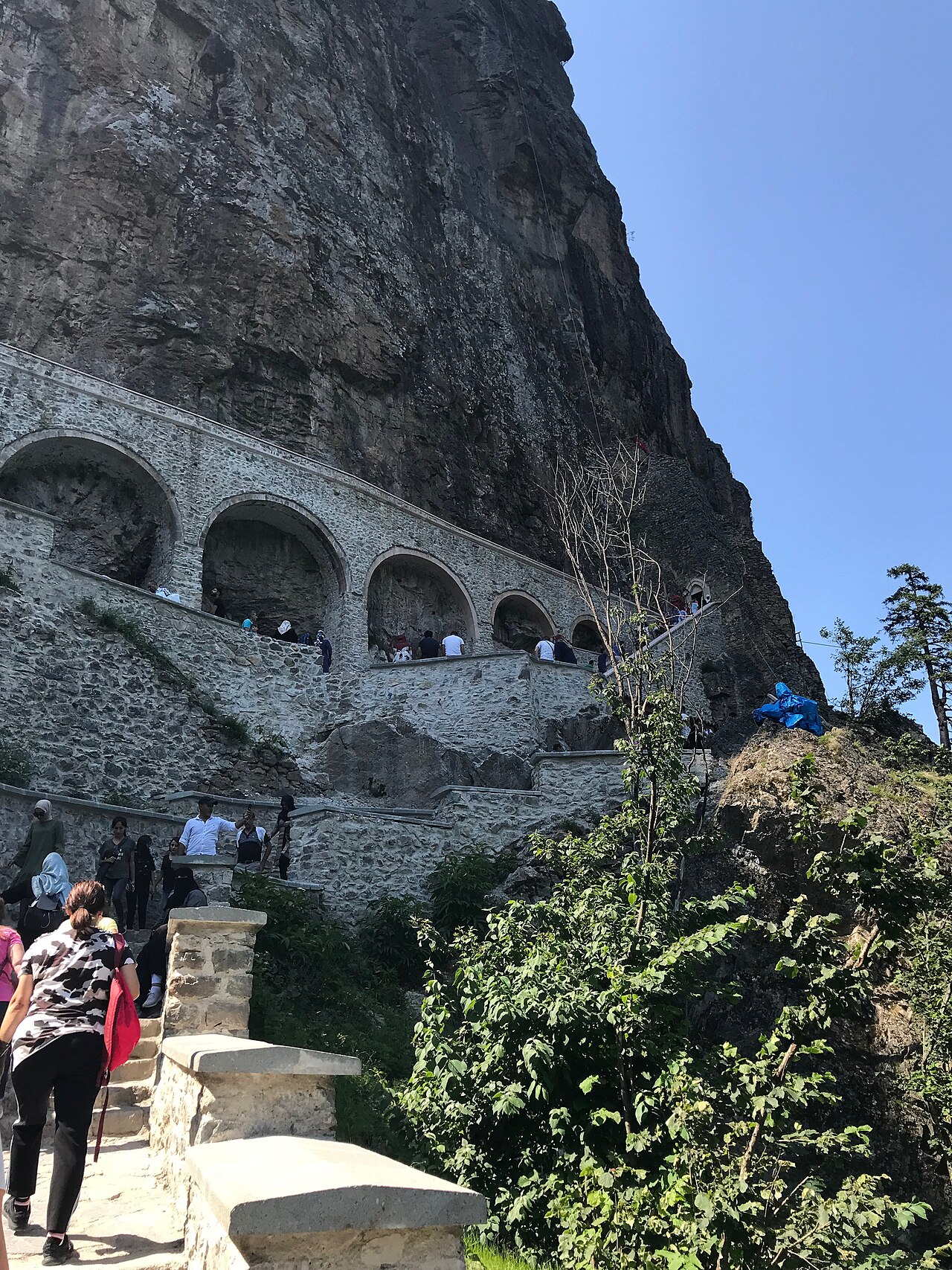
Photo: BSRF, Wikimedia Commons (CC BY-SA 4.0)
The Rock Church and Its Painted Walls
At the heart of Sumela is the original cave, the rock church, the holiest space of the whole complex and the spot where the founding icon was said to have rested. It is a natural cavern in the cliff, closed off with masonry and turned into a chapel, and its rough rock ceiling sets it apart from any ordinary church. To step into it is to feel the mountain itself enclosing the sacred.
Around this core the monastery expanded over the centuries, but the cave remained its spiritual centre of gravity. Everything else, the cells and courtyards and galleries, existed to serve and surround this one holy hollow in the rock. It is a vivid expression of an old Christian instinct: that caves and mountains, the wild edges of the world, are places where heaven draws near.
What makes the rock church and the surrounding chapels truly extraordinary, though, is what covers their walls. Sumela is, above all, a place of paint.
The Frescoes That Cover Everything
The walls of Sumela, inside and out, are covered in frescoes. Generations of painters covered the rock church and the surrounding surfaces with scenes from the Bible, images of Christ and the Virgin, ranks of saints and prophets, and the great events of the Christian story, layer upon layer across the centuries. Even the outer rock face was painted, so that the cliff itself became a canvas of sacred images open to the mountain air.

Photo: Ihsan Deniz Kilicoglu, Wikimedia Commons (CC BY-SA 3.0)
These paintings are a treasury of Orthodox religious art, and walking among them is overwhelming in the best sense, an immersion in colour and story on every side. They are also, sadly, scarred. Over the long years of abandonment many of the frescoes suffered from weather, neglect and the carved graffiti of visitors who could not resist scratching their names across the holy faces. Restoration work has tried to stabilise and recover what remains.
Even damaged, the frescoes do their old work. They turn the bare rock into a vision of heaven, surrounding anyone who enters with the whole sweep of the Christian story told in image. For the monks and pilgrims of the past, these walls were not decoration. They were a way of standing, however briefly, inside the world the paintings depicted.
What It Meant to the Pontic Greeks
For one community above all, Sumela was the beating heart of their faith: the Pontic Greeks, the Greek-speaking Orthodox Christians who had lived along this Black Sea coast for thousands of years. To them the monastery was not a distant marvel but their own great shrine, the place where their devotion to the Virgin Mary found its fullest home. The icon of the Panagia, the All-Holy one, was theirs in a deeply personal way.
Pilgrimage to Sumela was woven into the life of this community. Families climbed the mountain for the great feast of the Virgin, prayed before the icon, lit candles in the cave, and carried their hopes and griefs up to her. The monastery was a fixed point in the Pontic Greek world, a place that gathered up the identity and faith of a whole people and held it on a cliff above the forest.
That is why the later history of Sumela is so poignant. Its fate became bound up with the fate of the community that loved it, and when that community was uprooted, the monastery fell silent.
An Orthodox Heart in the East
Sumela belongs unmistakably to the Eastern Orthodox tradition, and understanding that tradition helps explain the place. Orthodoxy holds the veneration of icons at the very centre of its worship, regarding sacred images as windows through which the faithful encounter the holy. A monastery built around a single miraculous icon of the Virgin, its walls saturated with frescoes, is Orthodoxy made visible in stone and paint.
The monastic life lived here, too, was thoroughly Orthodox, shaped by the long Eastern traditions of contemplative prayer, fasting and liturgy that reach back to the desert fathers of the early church. Sumela was part of a vast network of Orthodox monasteries that stretched across the Byzantine world, sharing a common spiritual language with great centres like Mount Athos.
For Western Christians, Catholic or Protestant, Sumela offers a window onto this other half of the Christian story, the Eastern church with its icons, its incense, its monks and its deep devotion to the Mother of God. It is a reminder of how varied and ancient the Christian world is, and how much of its richness lies in the East.
The Great Exodus and a Buried Icon
The long life of Sumela as a living monastery came to an end in the early twentieth century, amid the upheavals that reshaped this whole region. In the population exchanges and displacements of that era, the Pontic Greek community was uprooted from its ancient homeland, and the monks, with them, had to leave the mountain that had been their home for so many centuries.
One detail of that departure has become legendary. Before they left, the monks are said to have hidden their most precious possessions, including the holy icon of the Virgin, burying them for safekeeping in the hope of an eventual return. Years later, the story goes, the icon was recovered and carried out to a new home among the exiled community, where a new monastery dedicated to the same Panagia of Sumela was eventually founded in their place of refuge.
So the devotion did not die when the monastery emptied. It travelled with the people, and the name and the icon of Sumela live on far from the original cliff, carried in the hearts of the descendants of those who once climbed the mountain.
Between a Museum and a Shrine
After the monks left, Sumela stood empty for decades, exposed to weather, looting and decay. In time its extraordinary value was recognised, and it was preserved and opened as a site of cultural heritage, drawing visitors from around the world who come to marvel at the cliff, the architecture and the surviving frescoes. Major restoration efforts have worked to repair the damage of the empty years and make the monastery safe for the crowds who climb to it.
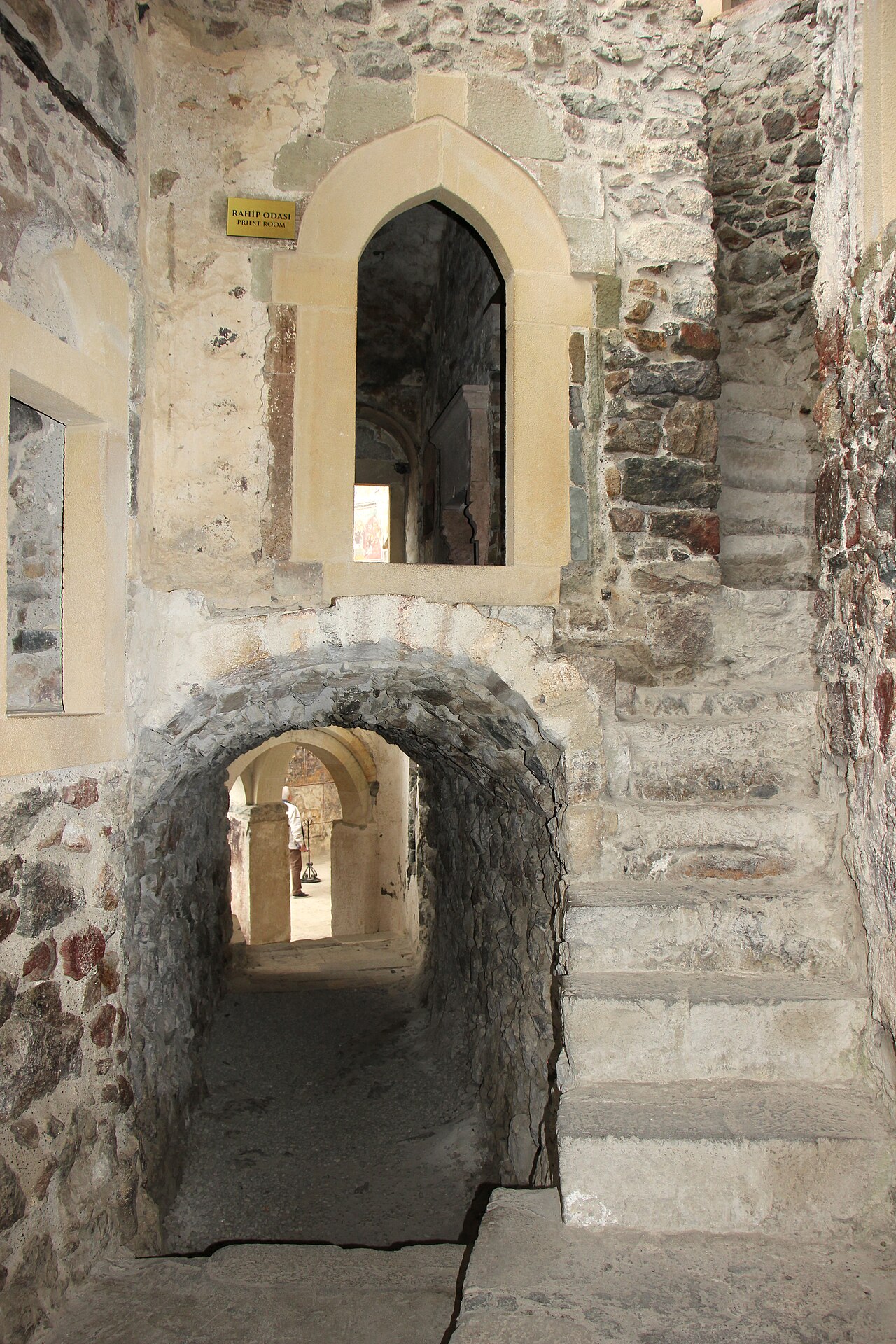
Photo: Sailko, Wikimedia Commons (CC BY 3.0)
This has given Sumela a double identity that it carries to this day. It is, officially, a museum and a monument, one of the most visited sights of the Turkish Black Sea region. But for many who come, especially the descendants of the Pontic Greeks and Orthodox pilgrims from around the world, it remains first and foremost a shrine, a holy place whose sanctity did not end when the last monk walked down the mountain.
That tension, between the monastery as heritage attraction and the monastery as living holy site, gives any visit a particular charge. The crowds and the cameras are real, but so is the prayer that still rises here when the faithful return.
The Day the Liturgy Returns
In recent times something moving has happened at Sumela. On certain occasions, above all around the great August feast of the Dormition of the Virgin Mary, the Orthodox liturgy has been permitted to return to the rock church, and pilgrims have once again climbed the mountain to pray where their ancestors prayed. After the long silence, the old chants have sounded again under the painted rock.
For the Pontic Greek diaspora scattered around the world, these occasions carry an enormous emotional weight. To stand again in the cave church, to venerate the Virgin in the place that was the heart of their peoples faith, is a homecoming across generations and across the rupture of exile. Many who attend describe it through tears.
These returns of the liturgy turn Sumela, however briefly, back into what it always was: not a ruin to be photographed but a living shrine where heaven and earth are felt to meet. They are a reminder that the deepest meaning of the place was never in its stones alone, but in the faith that the stones were built to serve.
What Visitors Find on the Climb
For the ordinary traveller who comes to Sumela today, the experience begins long before the monastery itself. The drive up into the mountains from the coast, through forest and mist and tumbling water, is beautiful in its own right, and the final approach on foot through the trees builds the anticipation. Then the monastery appears on its cliff, and the first sight is worth every step.
Inside, visitors wander the courtyards and galleries, peer into the rock church with its frescoes, and look out from the monastery over the vast green gorge below. The combination of dizzying setting, ancient architecture and battered but glorious painting makes Sumela one of the most memorable places in the whole region. Even visitors with no particular religious interest tend to come away quietened by it.
And for those who do come with faith, or with a sense of the history of the Pontic Greeks, the visit carries a deeper note. To stand in the cave where a community poured out its devotion to the Virgin for sixteen centuries is to feel the long reach of that love, still present in the painted rock long after the monks went down the mountain.
Saint Luke and the Power of the Icon
The tradition that the founding icon of Sumela was painted by the Evangelist Luke is worth dwelling on, because it sits at the centre of why the place mattered so much. In Eastern Christianity, Saint Luke is honoured not only as a Gospel writer but as the first iconographer, the one who, the tradition holds, painted the earliest images of the Virgin Mary from life. Icons attributed to him carried an aura of unmatched authority, as if they preserved the very features of the Mother of God.
To possess such an icon was, for a monastery, to possess something beyond price: a direct, tangible link back to the apostolic age and to Mary herself. It transformed Sumela from one mountain shrine among many into a place of the first rank, a destination worth any hardship to reach. Pilgrims did not climb the cliff merely to admire a painting. They climbed to come into the presence of an image believed to carry a unique grace.
This helps explain the intensity of devotion that gathered around Sumela across the centuries, and the care with which the monks guarded the icon, even carrying it away to safety when they finally had to abandon the mountain. The whole monastery was, in a sense, a magnificent reliquary built to house and honour a single sacred image.
Daily Monastic Life on the Cliff
It is easy, looking at Sumela as a spectacular ruin, to forget that for most of its history it was simply home to a community of monks going about an ordinary, demanding daily round. Life on the cliff was governed by the rhythms of Orthodox monasticism: long hours of prayer and chanting in the church, periods of work, the keeping of fasts, and the reading of scripture and the writings of the fathers in the monastery library.
The practical challenges of such a setting were considerable. Food, water and supplies had to be managed in a place clinging to bare rock, far above the valley floor. The monks maintained kitchens, store rooms, guest quarters for pilgrims, and all the apparatus of a self-sustaining community, fitted ingeniously into the contours of the cliff. Visitors today who wander the courtyards and cells are walking through the remains of what was, for centuries, a fully functioning small world.
This ordinary, hidden life of prayer is the true foundation of Sumela holiness. The frescoes and the famous icon catch the eye, but the deeper sanctity of the place was built up day by day, year by year, by generations of monks who gave their whole lives to prayer in this remote and beautiful spot. That long accumulation of devotion is something a visitor senses even without knowing the details.
The Sacred Spring in the Rock
Like many ancient holy sites, Sumela is associated with water that flows from the living rock, and this spring has long been treated as a blessing in its own right. Water seeping and dripping from the cliff has both shaped the monastery, contributing over the centuries to the wear of the frescoes, and given pilgrims something to gather and carry away as a holy memento of their ascent.
The pairing of a sacred spring with a mountain shrine is an old and widespread pattern in Christian devotion, echoing countless sites where pilgrims seek healing or blessing from water connected to a saint or to the Virgin. At Sumela the spring deepened the sense that the very substance of the mountain, its rock and its water alike, was caught up in the holiness of the place.
For those who climbed all the way to the monastery, drinking or collecting this water was a small physical act that bound them to the site and to the Virgin honoured there. It is one more way in which Sumela engaged not just the mind and the eye but the whole body of the pilgrim, who arrived footsore from the climb and left carrying a little of the mountain holiness home.
A Symbol for a Scattered People
In the century since the Pontic Greeks left their homeland, Sumela has become something more than a monastery; it has become a symbol. For the scattered descendants of that community, spread across many countries, the image of the monastery on its cliff stands for everything that was lost in the uprooting: a homeland, a way of life, an ancient faith rooted in a particular landscape. To see a picture of Sumela is, for many of them, to feel the ache of that lost world.
This is why the occasional return of the liturgy to the rock church carries such emotional force, and why the new monastery founded in the place of exile, dedicated to the same Panagia of Sumela and home to the rescued icon, has become a focus for the whole diaspora. The devotion that once filled the cliff did not vanish; it was transplanted, and it continues to bind a scattered people together across borders and generations.
So Sumela now lives a double life. There is the physical monastery on its Turkish cliff, preserved as heritage and occasionally filled again with prayer, and there is the Sumela of memory and longing carried in the hearts of an exiled community. Both are real, and both are part of what makes this one of the most quietly powerful holy places in the Orthodox world.
The Art That Survived Against the Odds
It is worth pausing on the simple fact that anything at all survives at Sumela. A cliff-face monastery, abandoned for decades in a wet mountain climate, exposed to frost, damp, falling rock and the hands of looters and vandals, is about as vulnerable as a historic site can be. That the frescoes endure even in damaged form, that the architecture still stands fitted to its precipice, is something close to a small miracle of survival in its own right.
The paintings tell the whole arc of the Christian story, from the events of the Old Testament through the life of Christ to ranks of saints and the great feasts of the church, and they do so in the rich visual language of Byzantine and post-Byzantine art. For art historians they are a precious record of how Orthodox painting developed in this region across many centuries, layer over layer, hand after hand. For pilgrims they are simply the faces of heaven, looking down from the rock.
The damage they have suffered, especially the carved graffiti that scars so many of the figures, is a genuine tragedy, and it has made the careful restoration of recent years all the more important. But even battered, the frescoes retain their power to surround a visitor with the sacred. To stand in the rock church and look up at a painted Christ gazing down from the natural stone ceiling is to understand, in a single glance, what sixteen centuries of devotion built in this improbable place.
If You Go: Practical Notes
Sumela sits inland from Trabzon, and most visitors reach it by road up into the Pontic Mountains, a journey that is itself part of the pleasure. The site has at times had access restrictions during restoration work, and arrangements can change, so it is wise to check current conditions before setting out. The final approach involves walking and climbing, so reasonable footwear and a little fitness help.
The mountain weather is often wet and misty, which is part of the atmosphere but means it pays to be prepared for cloud and rain even in summer. Inside, visitors are asked to treat the frescoes and the rock church with respect; the scars of past graffiti are a sad reminder of what carelessness can do to an irreplaceable place. Quiet and care are the right spirit in which to move through it.
However you come to Sumela, as a pilgrim, a lover of art, or simply a traveller chasing an extraordinary view, it tends to lodge itself in the memory. There is something about a monastery built into a cliff, wrapped in cloud, covered in the faces of saints, that speaks to a very old human longing to climb toward heaven. Sumela has been answering that longing for sixteen hundred years, and it answers it still.


