In this article
- A monastery on the brink of a chasm
- The flight across the gorge
- Stones raised in the ninth century
- A university in the mountains
- The swinging pillar and its secret
- What the Armenian church is, the first Christian nation
- A faith that is also a nation
- Why Tatev matters to an Armenian
- How the Armenian church differs from the rest
- The carved crosses of stone
- A seat of power and resistance
- The gorge, the springs, and the hermitage below
- Inside the walls on the cliff
- If you go
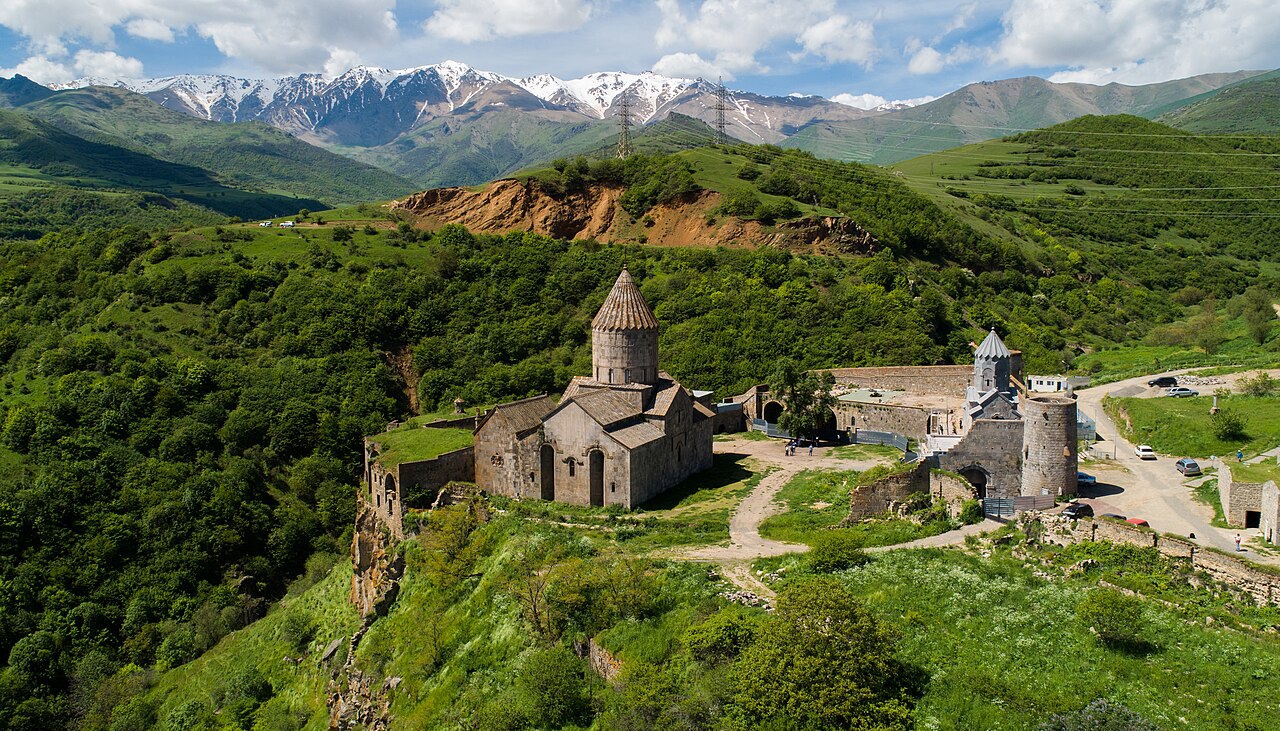
In the far south of Armenia, in the rugged province of Syunik, the land is torn by a tremendous gorge, a great green chasm carved by a river far below. And on the very lip of that gorge, on a spur of rock with the land falling sheer away beside it, stands one of the most magnificent monasteries of the medieval Christian world. Tatev is its name, and for a thousand years it has clung to its precipice, a fortress of stone and faith above the abyss, once one of the most important religious, political, and intellectual centres in all of Armenia, and still one of the most breathtaking sights in a country full of ancient holiness.
To reach it, today, you can do something almost magical: you can fly. Strung across the gorge is the longest passenger cableway in the world, a feat of modern engineering poetically named the Wings of Tatev, which carries visitors soaring over the chasm and the river and the old villages below, depositing them at the gates of a monastery that medieval pilgrims could reach only by long and arduous mountain roads. The combination is unforgettable: a flight through the air across a vast gorge to a thousand-year-old sanctuary on the brink of a cliff. But the cable car is only the latest chapter in a very old story, and the real wonder of Tatev lies in what it was, and what it has meant to the Armenian people, across more than a millennium.
This is the story of that monastery on the edge of the gorge, of the medieval university that made it a powerhouse of learning, of the ancient and singular Armenian church that built it, and of the extraordinary cableway that now carries pilgrims and travellers across the void to its gates.
A monastery on the brink of a chasm
The setting is everything at Tatev, and no description quite prepares you for it. The monastery occupies a basalt plateau on the edge of the deep gorge of the Vorotan river, with the land dropping away dramatically beside its walls, so that the buildings seem to balance on the very brink of the world. The position was chosen, as so often with these mountain monasteries, for defence and for seclusion: a site on a cliff edge, hard to approach and easy to fortify, set apart from the ordinary world by the sheer drama of its geography. The monastery is itself fortified, ringed by walls, a self-contained settlement of churches, chapels, dwellings, and service buildings that could withstand a siege.
From the edge of the complex the views plunge away across the gorge and the mountains of Syunik, an immense and rugged landscape of southern Armenia, a region that has always been a frontier, fought over, invaded, and defended across the centuries. Tatev sat at the heart of this contested country and became, in the Middle Ages, far more than a place of prayer: it was a stronghold, a centre of power, a focus of resistance, and a beacon of learning, all perched together on its cliff above the river. To stand at its walls and look out over the gorge is to understand at once why men built here, and why the place gathered such importance: it commands its world, lifted up above it on its spur of rock, magnificent and almost unassailable.
The flight across the gorge
For most of its history, reaching Tatev meant a hard journey along winding mountain roads down into the gorge and up the other side, a trip that could take hours and discouraged all but the determined. Then, in 2010, the monastery gained a spectacular new approach. The Wings of Tatev, a reversible aerial cableway strung across the gorge, opened as the longest non-stop double-track passenger cable car in the world, a distinction recognized by the record books, carrying passengers in a single soaring span of several kilometres from the village of Halidzor across the chasm to the monastery.
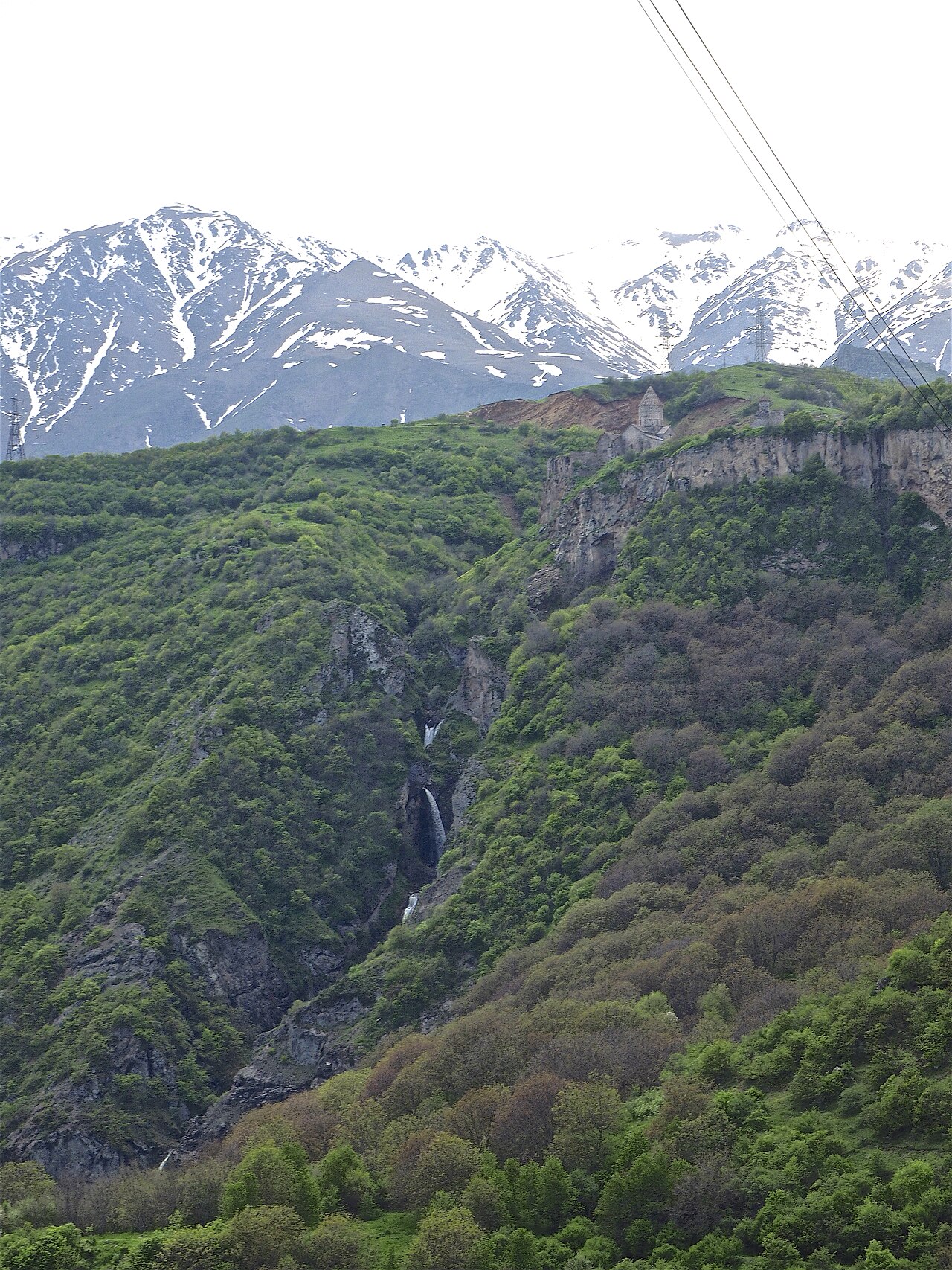
The ride is an experience in itself, a smooth glide high above the deep green gorge, the river a thread far below, the old villages and terraced fields spread out beneath, the monastery growing slowly larger on its distant cliff until you arrive, as if borne on wings, at its gates. The cableway was built to make the remote monastery accessible and to bring life and visitors back to a region that had suffered depopulation and hardship, and it has succeeded handsomely, transforming Tatev from a hard-to-reach ruin into one of Armenia premier destinations. There is something fitting, even poetic, in approaching this cliff-edge sanctuary through the air; the name Wings of Tatev evokes an old legend of the place, and the flight across the void feels like a worthy modern prelude to the ancient wonder waiting on the far side.
Stones raised in the ninth century
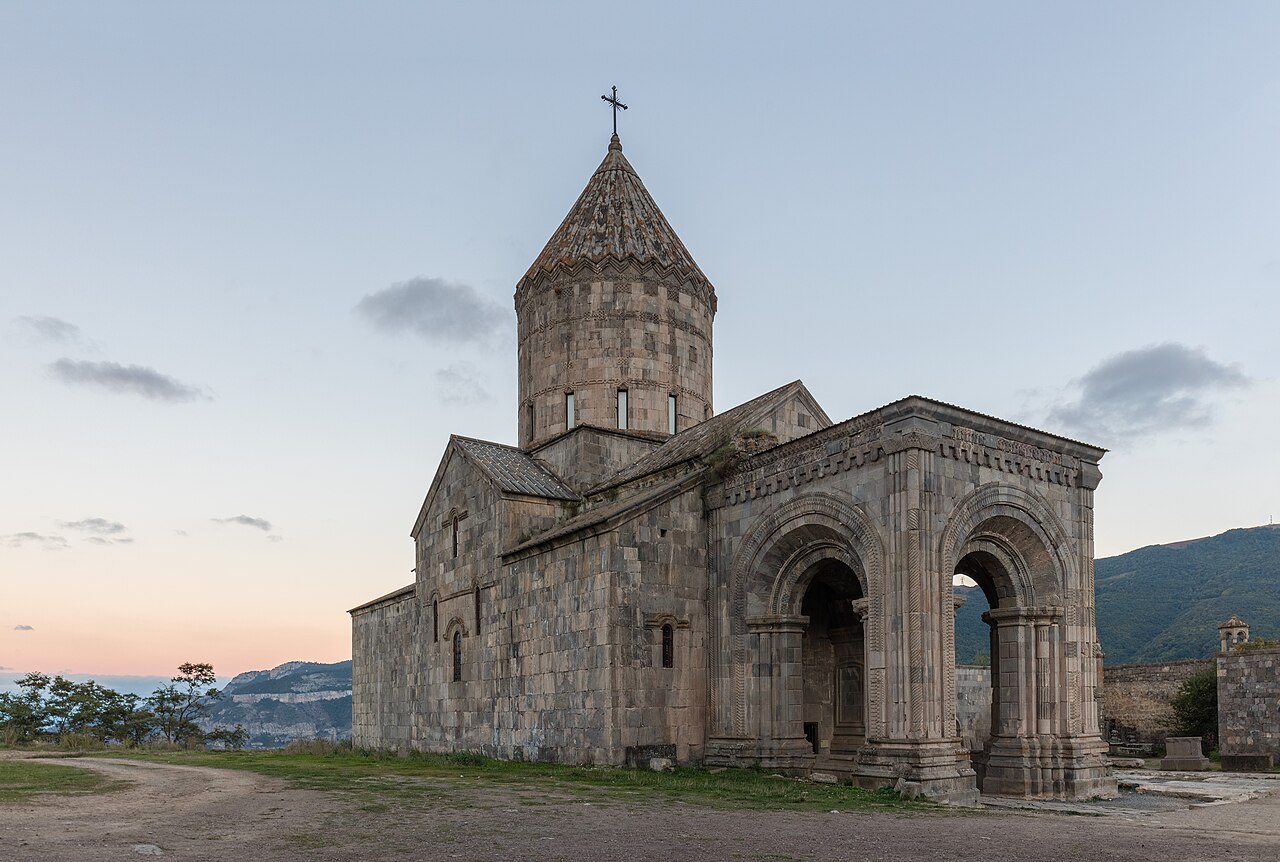
There has been a religious site at Tatev since deep antiquity, but the great monastery as we know it took shape in the ninth and tenth centuries, when the region was ruled by Armenian princes of the house that governed Syunik, and the monastery rose under their patronage to become the spiritual and political centre of the principality. The principal church, dedicated to Saints Peter and Paul, was built in the late ninth century and remains the heart of the complex, a classic example of medieval Armenian church architecture with its characteristic forms, its conical dome, and its austere, powerful stonework.

Medieval Armenian architecture is one of the glories of the Christian East, a tradition of building in stone with a distinctive vocabulary of forms, pointed domes on drums, intricately carved stone crosses, and a profound sense of solidity and proportion, and Tatev is one of its masterpieces. Over the centuries more was added, other churches and chapels, a refectory, a library, the dwellings of the monks, and the defensive walls, until the monastery grew into the substantial fortified complex that survives today. It suffered, as everything in this region suffered, from invasions, earthquakes, and the turning fortunes of war, and it has been damaged and repaired many times. But its medieval core endures, a thousand years of Armenian Christian building standing on the edge of the gorge.
A university in the mountains
What truly set Tatev apart, and what gives it a special glory in Armenian memory, was not only its architecture or its power but its learning. In the late Middle Ages, particularly in the fourteenth and early fifteenth centuries, Tatev became the seat of one of the most important centres of higher learning in the medieval Armenian world, the University of Tatev, a renowned school of theology, philosophy, science, and the arts that drew students and scholars and made the monastery a beacon of intellectual life.
This was no mere monastic school for training a few monks. The University of Tatev was a genuine centre of advanced scholarship, where leading Armenian thinkers taught and wrote, where manuscripts were copied and illuminated in a famous scriptorium, where theology and philosophy were debated at the highest level, and where the sciences and the arts of the age were cultivated. It produced distinguished scholars and defended Armenian religious and cultural identity at a time of great pressure, and it stands in Armenian history as one of the supreme achievements of the nation medieval civilization, a university on a cliff edge in the mountains, keeping the lamp of learning burning in a hard age. That a remote monastery in southern Armenia should have been one of the great universities of its world tells you how much these monasteries were, for the Armenians, the very heart of their civilization, and Tatev wears that distinction as one of its deepest honours.
The swinging pillar and its secret
Among the wonders of Tatev is a strange and ingenious monument that has fascinated visitors for centuries: a tall pillar standing in the monastery grounds, topped with a carved stone cross, which was built so cunningly that it could sway and rock on its base. This swinging pillar, an extraordinary piece of medieval engineering raised over a thousand years ago, is said to have moved in response to tremors in the earth and to other forces, oscillating and then settling back upright, a feat that puzzled and amazed all who saw it.
Various explanations have been offered for how and why it was built, some practical, some symbolic; it may have served as an early indicator of earthquakes or approaching danger, a kind of medieval seismograph in stone, or it may have had a more purely religious and symbolic purpose, a monument to faith that seemed almost alive. Whatever its exact function, the swinging pillar of Tatev became one of the marvels of medieval Armenia, a testament to the sophistication of the builders who raised the whole monastery, and it remains one of the curiosities that pilgrims and visitors seek out, a reminder that the medieval masters who built on this cliff were not only artists and architects but engineers of real genius.
What the Armenian church is, the first Christian nation
To understand Tatev you have to understand the Armenian Apostolic Church, which has a claim that no other church on earth can quite match: Armenia was the first nation in the world to adopt Christianity as its state religion, traditionally dated to the year 301, when the Armenian king was converted by Saint Gregory the Illuminator. This was years before the Roman Empire itself embraced the faith, making Armenia the first officially Christian kingdom in history, and giving the Armenian church a foundational antiquity and a sense of primacy that runs through the whole of its identity.
The church calls itself Apostolic because it traces its origins to two of the apostles of Christ, Bartholomew and Thaddeus, believed to have preached the Gospel in Armenia in the first century, and it regards Saint Gregory the Illuminator as the great evangelizer who converted the nation in the early fourth century. Like the Coptic and Ethiopian churches, the Armenian church belongs to the family of Oriental Orthodox churches that parted from the rest of Christianity after the Council of Chalcedon in the fifth century, and it has gone its own way ever since, developing its own ancient liturgy, its own distinctive sacred architecture and art, its own alphabet created specifically to render the scriptures and the liturgy in Armenian, and a Christianity wholly its own. Tatev is one of the great strongholds of this faith, a monument to a Christianity older than almost any in the world.
A faith that is also a nation
For Armenians, the church is not one part of national life among others; it is bound up with the very survival of the nation itself. The Armenians are an ancient people who, for most of their history, have lived without an independent state of their own, their homeland fought over and divided among great empires, their people scattered across the world in one of history great diasporas, and through all of it the church was the thing that held them together. It preserved the language, the alphabet, the faith, and the memory of nationhood across centuries when there was no Armenian state to do so.
This fusion of faith and identity gives Armenian Christianity its particular intensity and its particular sorrow. The Armenians have suffered terribly across history, above all in the genocide of the early twentieth century, when much of the Armenian population of the Ottoman Empire was destroyed, a catastrophe that sits at the heart of the modern Armenian consciousness. Through suffering and dispersion, the church has been the keeper of Armenian identity, the institution that, more than any other, has answered the question of what it means to be Armenian. A monastery like Tatev, therefore, is not merely a beautiful old building; it is a piece of the soul of a people, a monument to their endurance, their faith, and their refusal to disappear from history. To Armenians, it belongs to the very definition of who they are.
Why Tatev matters to an Armenian
Among the many monasteries of Armenia, and the country is rich in them, Tatev holds a special place, both for its sheer magnificence and for its historical importance as a centre of power, faith, and learning. For an Armenian, to visit Tatev is to encounter one of the supreme achievements of the nation medieval civilization, a place where Armenian Christianity reached one of its highest points of architectural beauty, political importance, and intellectual brilliance. The great university that flourished here is a particular source of pride, evidence that in a hard and contested age, on a cliff edge in the southern mountains, Armenians built a centre of learning to rival the best of their world.
The monastery is also bound up with the long Armenian struggle to maintain their faith and identity in the face of invasion and domination. Standing on its frontier cliff in Syunik, Tatev was a bastion of Armenian Christianity in a region that changed hands many times, a place where the faith and culture of the nation were defended and preserved. For modern Armenians, in the homeland and across the worldwide diaspora, it is one of the great symbols of their heritage, a place that embodies the antiquity, the achievement, and the resilience of their people. The building of the Wings of Tatev cableway, bringing new life and visitors to the monastery and its region, has been embraced as a way of honouring and revitalizing this precious piece of the national patrimony, ensuring that Tatev remains not a forgotten ruin but a living centre of Armenian identity.
How the Armenian church differs from the rest
A visitor from a Western Christian background will find Armenian Christianity both deeply familiar and strikingly distinct, and Tatev is a good place to feel the difference. The Armenian Apostolic Church, as one of the Oriental Orthodox churches, separated from both the Catholic West and the Eastern Orthodox world many centuries ago, after the fifth-century Council of Chalcedon, and it predates by a millennium the divisions that produced Protestantism. It does not recognize the authority of the Pope, nor does it belong to the Eastern Orthodox communion of Greece and Russia; it is its own ancient and self-governing church, headed by its own patriarch-catholicos.
Its worship is rich and ancient, conducted in classical Armenian, centred on a beautiful and solemn liturgy, and its churches are filled not with statues, as in the Catholic West, but with the spare, powerful forms of Armenian sacred architecture and with the carved stone crosses, the khachkars, that are one of the glories of Armenian art, intricate crosses carved in stone with extraordinary delicacy, found across the Armenian landscape. The Armenian church shares with the other ancient Eastern churches a deep monasticism, a profound veneration of its saints and of the Mother of God, and a sense of holy places and holy objects that the Protestant Reformation set aside. For a Catholic, much will feel familiar in its forms though different in its details; for a Protestant, the whole sacramental and monastic world of a place like Tatev will feel ancient and foreign; for all visitors, it offers a glimpse of one of the oldest and most distinctive branches of the Christian faith, grown for seventeen centuries in the mountains of the Caucasus.
The carved crosses of stone
No account of Armenian Christianity, or of a monastery like Tatev, is complete without the khachkar, the carved stone cross that is perhaps the single most distinctive creation of Armenian sacred art. A khachkar is an upright slab of stone, carved in relief with a cross at its centre, surrounded by an intricate lacework of interlacing patterns, rosettes, vegetal motifs, and geometric designs of astonishing delicacy and complexity. No two are exactly alike, and the finest of them are masterpieces of stone carving, the work of master craftsmen who turned hard rock into something that seems almost woven.
These carved crosses are scattered across the entire Armenian landscape, standing in churchyards and on hillsides, marking graves, commemorating events, and serving as objects of devotion, and they are one of the deepest expressions of the Armenian Christian spirit. The art of carving them is so distinctive and so important to Armenian identity that it has been formally recognized as a treasure of world cultural heritage. At Tatev, as at Armenian holy places everywhere, the khachkars are part of the texture of the site, their crosses and their endless patterns embodying the marriage of faith and artistry that runs through the whole of Armenian Christianity.
There is a theology in these stones, a sense that the cross of Christ stands at the centre of a creation woven through with intricate beauty and order, and that to carve it with such loving complexity is itself an act of devotion. For Armenians, the khachkar is more than decoration; it is a national symbol, a marker of Armenian presence and faith wherever it stands, a small upright declaration in stone that here is holy ground and here are Christ people. To notice the carved crosses at Tatev, and to understand what they mean, is to come closer to the heart of the faith that built the monastery.
A seat of power and resistance
Tatev was never only a place of prayer and learning; it was also, for long stretches of its history, a centre of real political and economic power, and that worldly dimension is part of what made it so important. As the seat of the bishops of Syunik and the spiritual heart of the principality, the monastery accumulated vast estates, controlled numerous villages, and wielded considerable authority over the surrounding region, becoming one of the largest landholders and most powerful institutions in this part of Armenia. The bishop of Tatev was a great lord as well as a churchman, and the monastery was a power to be reckoned with in the affairs of the land.
This combination of spiritual and temporal power was characteristic of the great medieval monasteries everywhere, and it gave Tatev the resources to build on such a scale, to maintain its famous university, and to defend itself behind its walls. But it also made the monastery a target, and across the centuries Tatev was repeatedly attacked, plundered, and damaged by the various invaders who swept through the region, from medieval conquerors to later raiders, each drawn in part by the monastery wealth and importance. Time and again it was looted and partly destroyed, and time and again it was rebuilt and revived, its monks and patrons refusing to let the great sanctuary die.
Through all of this, Tatev served as a centre of Armenian resistance and endurance, a stronghold where the faith, the learning, and the identity of the nation were preserved through dark and dangerous times. Its very position on a frontier cliff in a much-contested borderland meant that it stood, for centuries, at the sharp edge of the Armenian struggle to survive, and its survival, battered but unbroken, into our own day is a small emblem of the survival of the Armenian people themselves. The wealth and power are long gone now, but the stones remain, and they remember a time when this monastery on the gorge was one of the great forces in the land.
The gorge, the springs, and the hermitage below
The monastery on its cliff is only the crowning piece of a whole sacred landscape, and those with time and energy can descend into the gorge to discover more. Far below the walls, in the depths of the Vorotan canyon, lie natural wonders and further holy places that have drawn pilgrims and travellers for centuries. There are mineral springs in the gorge, bubbling up from the earth, long regarded as having healing properties, and a remarkable natural rock formation, a great stone bridge carved by the river over ages, that the local people have always treated with a kind of reverence.
Down in the gorge, too, stands the smaller monastic site associated with Tatev, a hermitage where monks withdrew into even deeper solitude than the great monastery on the cliff above afforded, seeking God in the silence of the canyon. The relationship between the great fortified monastery on the heights and the quiet hermitage in the depths captures something essential about monastic life, the rhythm between community and solitude, between the powerful institution and the lone soul at prayer, both held within the same holy landscape. To explore the gorge beneath Tatev is to discover that the monastery on the cliff was the centre of a whole world of holiness that filled the canyon and the surrounding mountains.
All of this lies within a landscape of extraordinary natural beauty, the deep green gorge, the rushing river, the terraced fields and old stone villages, the mountains of Syunik rolling away to the horizon, that is itself one of the rewards of a journey to Tatev. The Wings of Tatev cableway gives a stunning aerial view of this whole sacred and natural landscape, but those who venture down into the gorge on foot or by road discover its wonders more intimately, and understand more fully why this dramatic country, where the land itself seems lifted up and torn open toward heaven, became one of the great centres of Armenian monasticism. The monastery and its setting are inseparable; together they make one of the most beautiful holy places in the entire Christian world.
Inside the walls on the cliff
Step through the gate and you enter the fortified world of the monastery, a complex of medieval buildings gathered on the plateau at the edge of the gorge. The great Church of Saints Peter and Paul dominates the site, its tall form and conical dome rising over the complex, its interior austere and powerful in the manner of medieval Armenian churches, once adorned with frescoes of which traces survive. Around it cluster smaller churches and chapels, the residential and service buildings of the monastic community, the remains of the famous scriptorium and school, and the swinging pillar with its carved cross.

The whole ensemble has the solid, defensive, self-contained character of a medieval monastery that had to be ready to withstand attack, its buildings of honey-coloured and grey stone weathered by a thousand years of mountain seasons. Everywhere there are the views, the land falling away to the gorge, the mountains of Syunik rolling to the horizon, the sense of standing at a great height on the edge of an immense landscape. It is a place that rewards slow wandering, moving from church to chapel, pausing at the walls to take in the views, absorbing the atmosphere of a sanctuary that has stood here, praying and teaching and enduring, since the ninth century. The restoration work of recent years, undertaken alongside the building of the cableway, has helped to consolidate and revive the monastery, so that the visitor today finds not a crumbling ruin but a noble survivor, cared for and once again full of life.
If you go
Tatev lies in the Syunik province of southern Armenia, a fair journey south from the capital Yerevan through increasingly dramatic mountain country, and for most visitors the approach is by way of the Wings of Tatev cableway, which departs from the village of Halidzor and carries you across the gorge to the monastery in a ride that is one of the highlights of any trip to Armenia. The cable car runs on a published schedule, and it is wise to check times and to be prepared for the possibility of queues in the busy season, but the flight across the gorge is well worth any wait.
Give yourself plenty of time at the monastery itself, for it deserves far more than a quick look; wander its churches and courtyards, seek out the swinging pillar, walk to the edge for the great views over the gorge, and let the long history of the place settle on you. Dress modestly, as befits an active religious site of deep importance to Armenians, and approach it with the respect due to one of the holiest and most significant monuments of an ancient Christian nation. And take a moment, as you stand on that cliff edge with the gorge falling away beside you and the mountains of Syunik all around, to think of what this place has been: a fortress, a seat of princes, one of the great universities of the medieval world, a stronghold of a faith older than almost any on earth, and the soul of a people who have endured more than most and refused, through it all, to be erased. The cable car that carries you here is a marvel of our own age, but the wonder it delivers you to was built by people a thousand years ago who knew, as you will know when you stand among their stones, exactly what it meant to reach toward heaven from the edge of the world.


