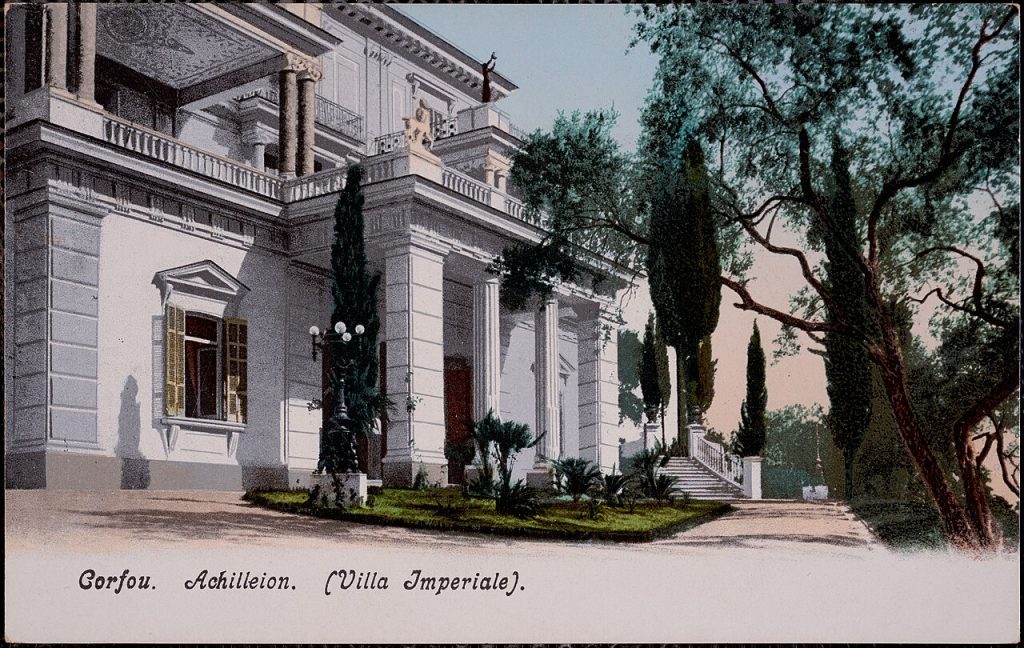
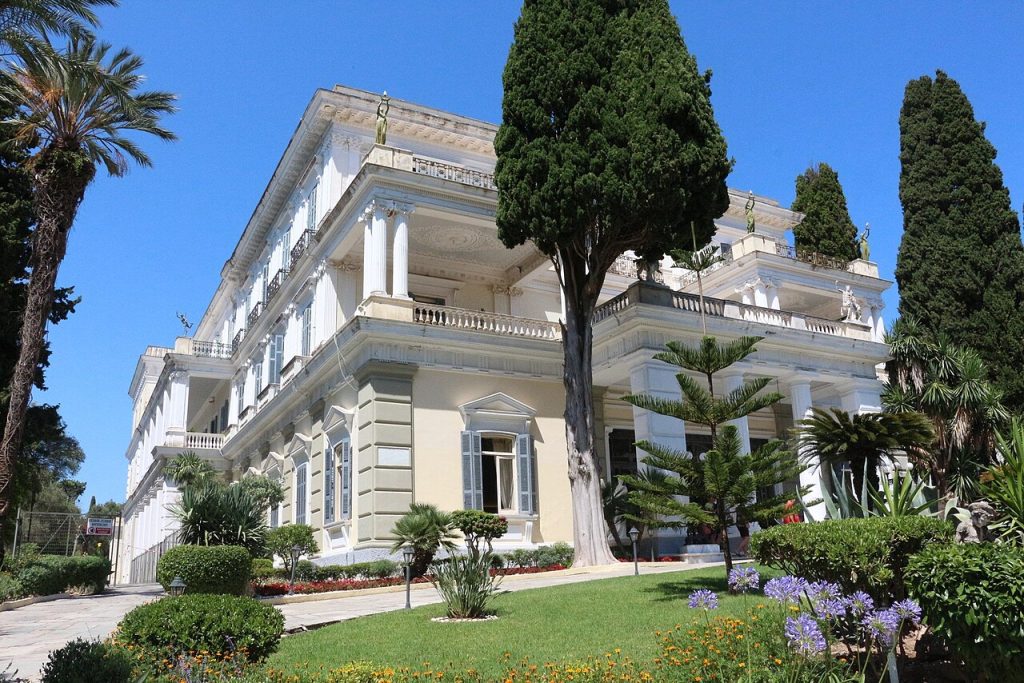
On a hillside above the east coast of Corfu, ten kilometres south of the town, among cypresses and olives with the sea and the mountains of Epirus beyond, stands a white villa in the Pompeian style with a terrace of columns, a garden of statues and a dying Achilles in marble at its centre. It is the Achilleion, built in 1890 and 1891 for Elisabeth of Austria, Sisi, the empress who hated Vienna, court life and her own fame, and who came here to be alone with her poetry, her Greek lessons and her grief for her son Rudolf, dead at Mayerling in 1889. She named the house for Achilles, whom she loved, she said, because he despised all kings and traditions and held the masses in contempt.
She came only a few times. In 1898 she was stabbed to death on a quay in Geneva by an anarchist, the house passed to her daughter and was sold in 1907 to Kaiser Wilhelm II of Germany, who loved it as much as she had and for opposite reasons: he came every spring with his court, dug for antiquities, held receptions on the terrace and replaced her dying Achilles with a triumphant one of his own, nine metres high, facing Germany. The First World War ended his visits, the palace became a hospital, a casino and a museum, and it is now the most visited monument on Corfu, a house that two of Europe’s most unhappy monarchs chose as their escape.
Walk up the drive with me from Gastouri, through the hall and the empress’s rooms to the terrace and the garden of Achilles, with Sisi, the Kaiser and the island in order. The contents are below.
In This Article
- A Hillside Above the Ionian Sea
- Elisabeth, the Empress Who Would Not Stay
- Why Corfu
- 1889: Mayerling and the Decision to Build
- 1890 to 1891: A Pompeian Villa by Raffaele Caritto
- Achilles, Heine and the Garden of Statues
- The Empress’s Rooms and the Staircase
- 1898: A File on a Geneva Quay
- 1907: The Kaiser Buys a Palace
- Spring Courts and the Triumphant Achilles
- Hospital, Casino and Bond Film
- The Museum Since 1994
- Two Monarchs, One Escape
- The Achilleion on Video
- Visiting the Achilleion Today
- Palaces Nearby
A Hillside Above the Ionian Sea
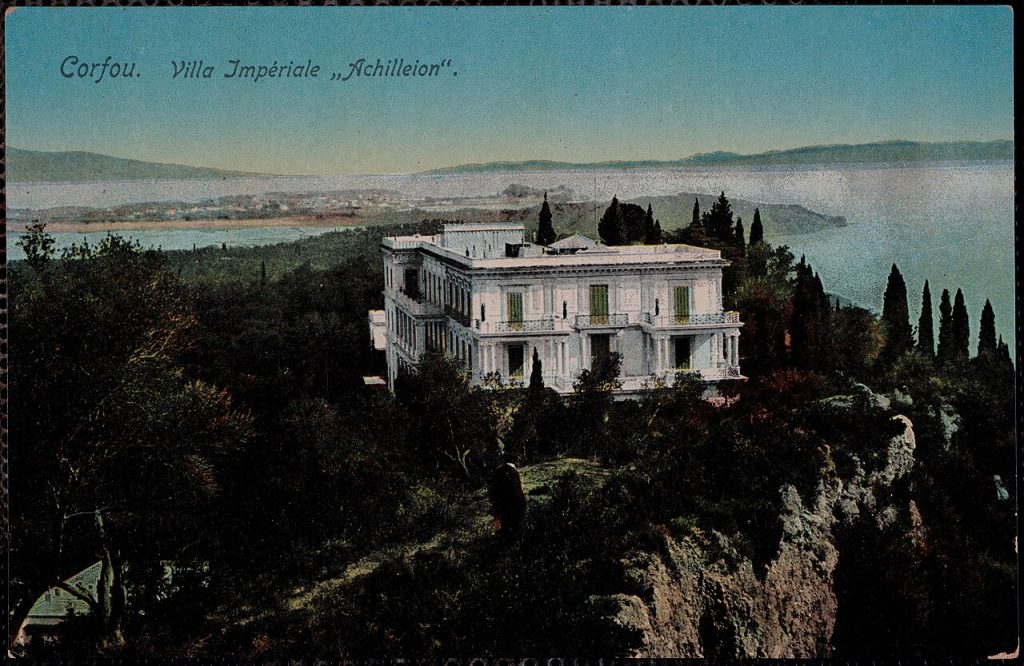
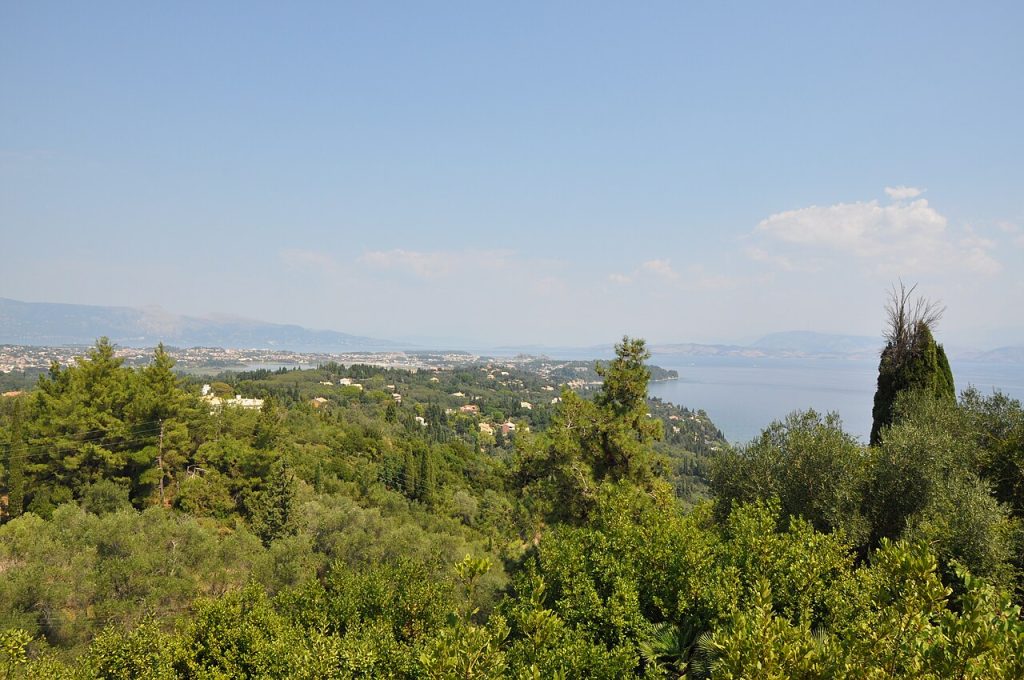
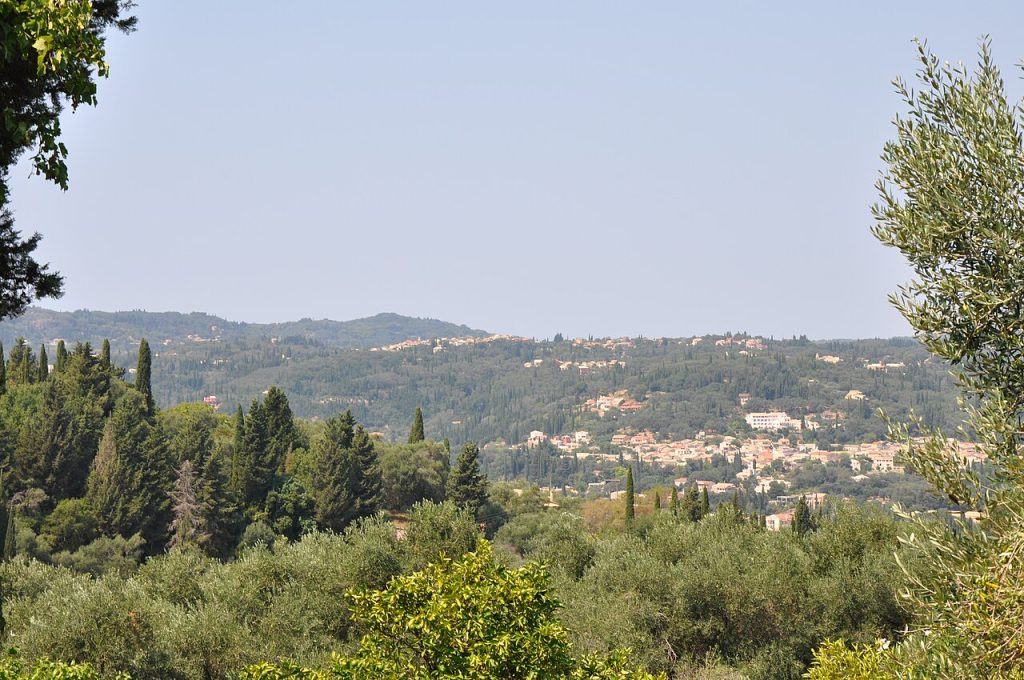
The village of Gastouri lies on the slope of a ridge that runs down the east coast of Corfu, among olive groves and cypresses, with the sea a kilometre below and the mainland of Epirus and Albania across the strait. The palace stands at the top of the village in a park that drops in terraces toward the sea, and from its upper terrace the view takes in Corfu town with its two fortresses to the north, the airport lagoon, the island of Vido and the whole blue strait to the mountains. Elisabeth chose the site for the view and for the solitude, and the drive from the town, which took her an hour by carriage, takes twenty minutes by bus.
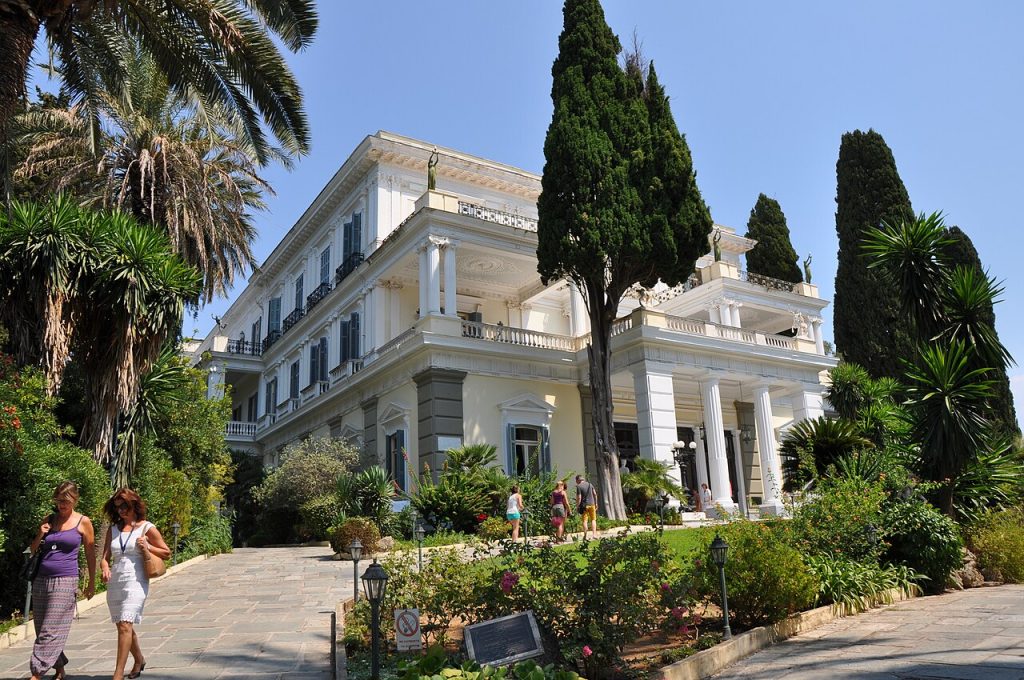
Now, stop here at the gate and look up the drive to the house. It is not large, three storeys of white stucco with a loggia and a tower-like stair block, and it is Italian rather than Greek in manner, a villa of the Bay of Naples transplanted to the Ionian. The empress wanted Pompeii, not the Parthenon.
Elisabeth, the Empress Who Would Not Stay
Elisabeth of Bavaria married her cousin Emperor Franz Joseph of Austria in 1854, at sixteen, and spent the next forty-four years escaping him, his mother, his court and the role of empress. She was famously beautiful, obsessively thin, a brilliant horsewoman, a reader of Heine and Shakespeare, a student of Hungarian and then Greek, and a traveller who was almost never in Vienna: she wintered in Madeira, Corfu, Madeira again, the Riviera, Algiers and Cairo, hunted in England and Ireland, walked for eight hours a day through the mountains and wrote melancholy verse in which she called herself a seagull with no home. Her marriage survived on letters; her husband loved her and let her go.
She first saw Corfu in 1861, on a convalescent voyage, and fell in love with the island, the sea and the Greek light. Thirty years later she would build here.
Why Corfu
Corfu suited Elisabeth for reasons that still hold. It was Greek, which fed her passion for Homer and the language; it was Venetian in its buildings and Italian in its manners, which made it comfortable; it had been British until 1864 and had good roads and a royal palace in the town where she could stay; and it was far from Vienna, from journalists and from the Habsburg family. She stayed in 1861 at the Mon Repos villa of the British high commissioners, then in 1885 and 1887 at the Villa Vraila at Gastouri, a house she rented from a Corfiot lawyer, and it was the Villa Vraila’s site, with its view and its olives, that she decided to buy.
Her Greek teachers, a succession of young Corfiots and Athenians who read Homer with her on her walks, became her closest companions in the last decade of her life, and the island’s dialect and legends entered her poems.
1889: Mayerling and the Decision to Build
On 30 January 1889 Elisabeth’s only son, Crown Prince Rudolf, shot his seventeen-year-old mistress Mary Vetsera and himself at the hunting lodge of Mayerling in the Vienna Woods. Elisabeth never recovered. She wore black for the rest of her life, withdrew entirely from public appearances, intensified her travelling and her writing and decided, that same year, to build the house on Corfu as a refuge where she could grieve in private. She bought the Villa Vraila and its land, commissioned an Italian architect and gave the house its name and its programme: it would be dedicated to Achilles, the hero who died young, as her son had.
The emperor paid. Franz Joseph, who never saw the house, complained about the cost and let her have it, as he let her have everything.
1890 to 1891: A Pompeian Villa by Raffaele Caritto
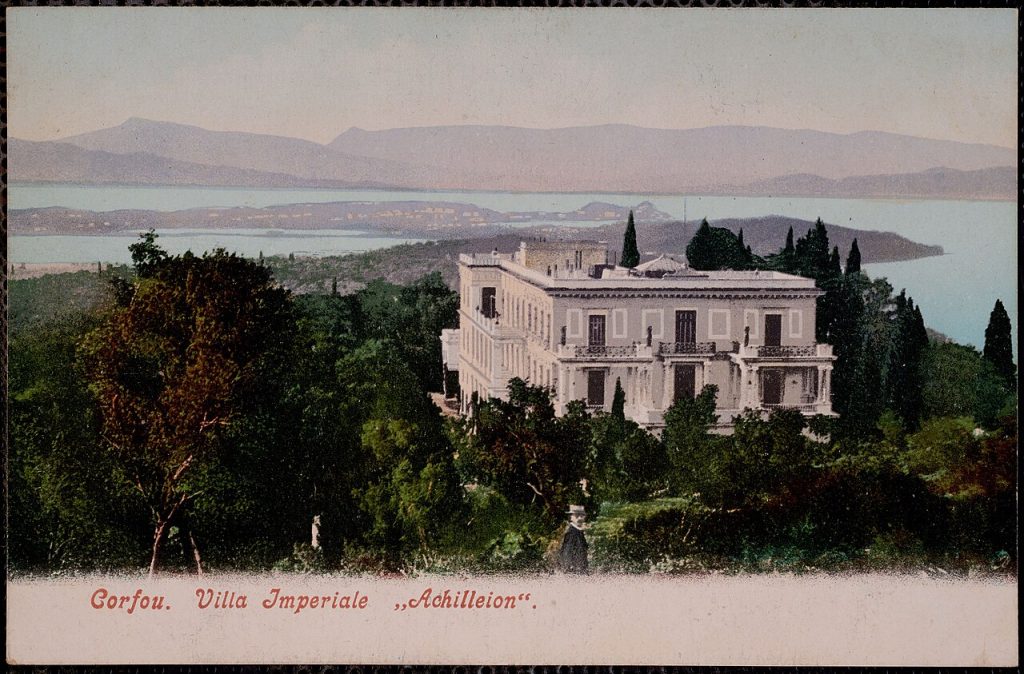
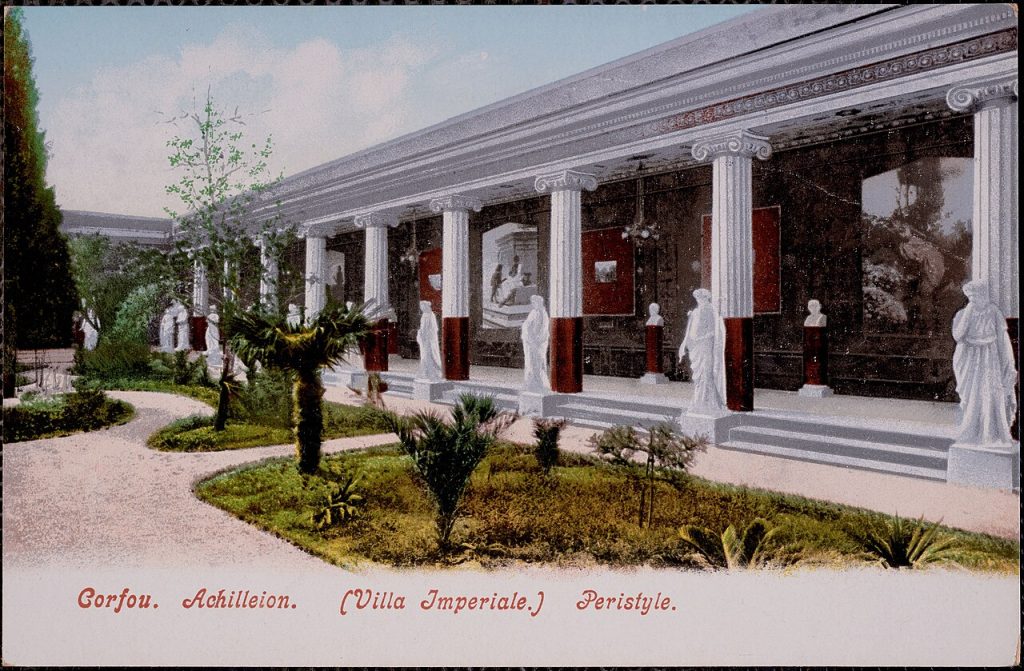
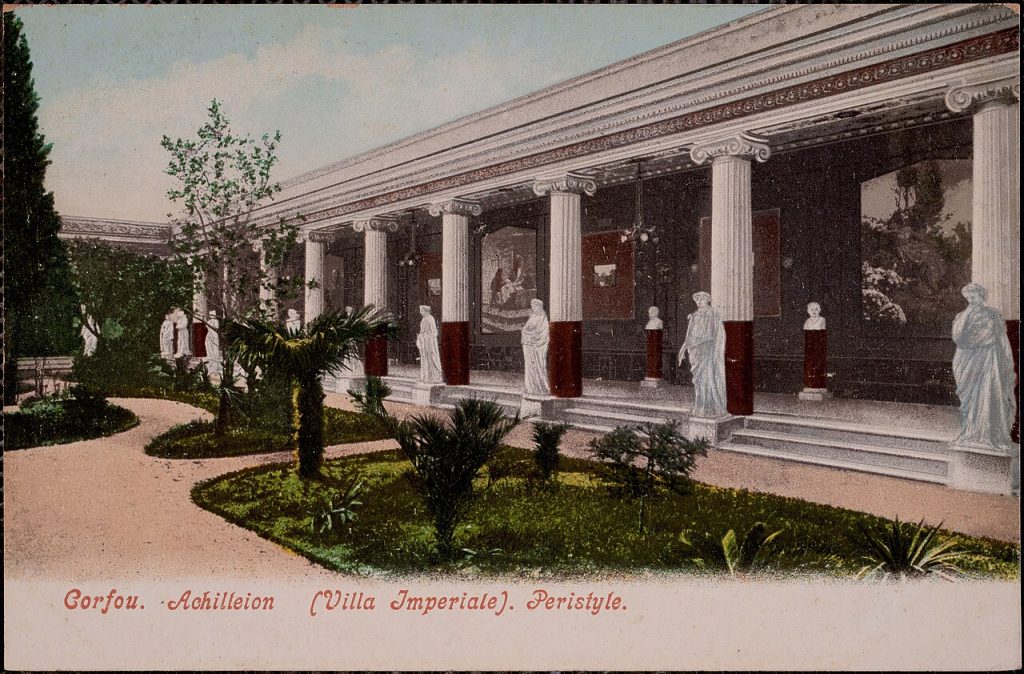
The architect was Raffaele Caritto of Naples, with the designer Antonio Landi, and they built between 1890 and 1891 a three-storey villa in the Pompeian manner: a central block with a loggia of Ionic columns on the garden front, a grand staircase, a hall painted with mythological frescoes, the empress’s apartments on the first floor and the ladies-in-waiting and staff above, with a chapel, a gymnasium where Elisabeth exercised every morning on rings and bars, and a terrace of columns and statues on the hillside. The frescoes, the marble and the furniture came from Italy, the sculptures from Vienna and Rome, and the house was finished and furnished within two years.
The style was the empress’s own: she had read about Pompeii and Herculaneum, she wanted a house that could have belonged to a Roman of Augustus’s time, and the result, with its painted walls, its peristyle and its views of the sea, is one of the most complete nineteenth-century evocations of the ancient Mediterranean villa. Now, stop here in the loggia and look at the capitals; the Ionic order is Greek, but the stucco and the colours are Naples.
Achilles, Heine and the Garden of Statues
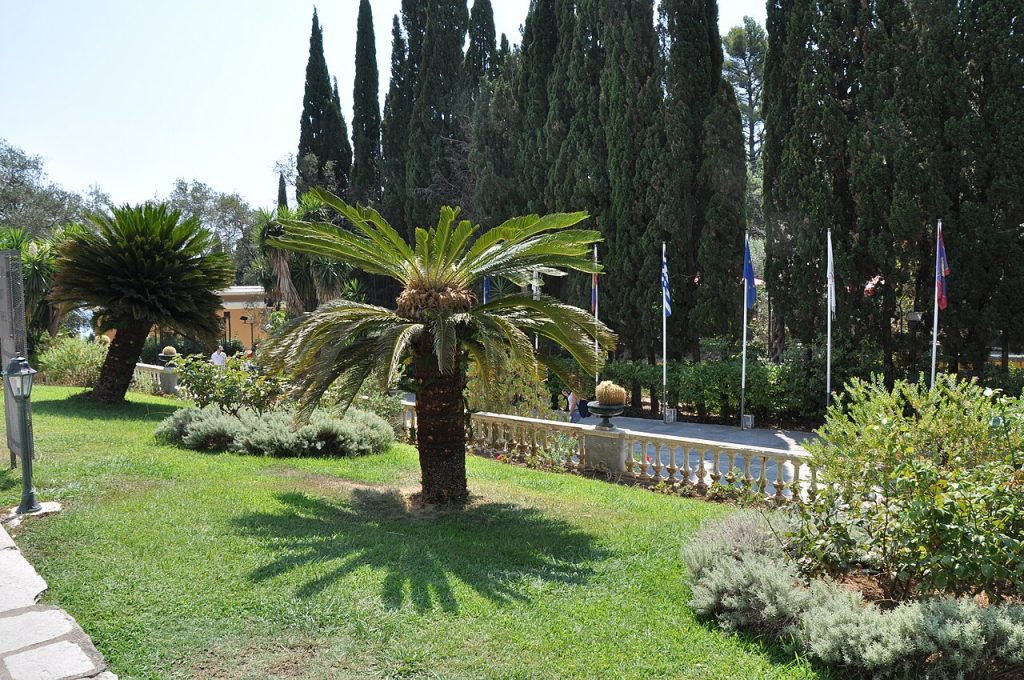
The garden is the house’s meaning. On the terrace below the loggia the empress placed the Dying Achilles of Ernst Herter, a Berlin sculptor, carved in 1884, a naked youth pulling the arrow from his heel with his face turned to the sky, which she had bought as the image of her dead son and of her own idea of beauty; around it she set the nine Muses, the Graces, Apollo, Hermes and a line of philosophers and poets, and in a corner of the garden a seated statue of Heinrich Heine, her favourite poet, whom she revered as a fellow exile and a mocker of kings. The garden was planted with palms, cypresses, roses and oleanders, and from every point it looked at the sea.
Elisabeth walked here with her Greek reader at dawn, exercised in the gymnasium, wrote in the afternoon and watched the sunset from the terrace. The house had been built for solitude, and for two years it gave it to her.
The Empress’s Rooms and the Staircase
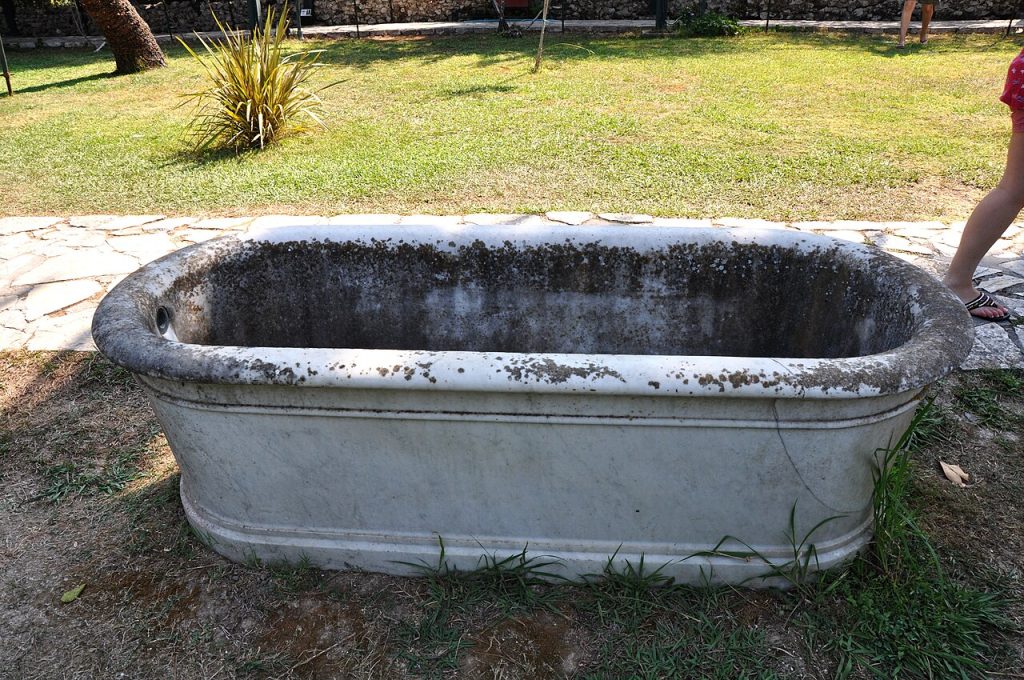
Inside, the hall and the staircase are the showpieces: a marble stair with bronze lamps rising under a painted ceiling to a landing dominated by Franz Matsch’s huge canvas of the Triumph of Achilles, the hero dragging Hector’s body behind his chariot before the walls of Troy, commissioned by Elisabeth in 1892. The empress’s apartments on the first floor, her bedroom, her study with the desk at which she wrote, her bathroom and her small chapel, are kept with their original furniture, and the ground-floor rooms, the dining room, the reception room and the Kaiser’s later study, hold the museum’s collection of portraits, personal objects and the empress’s own small altar to her son.
Look for Elisabeth’s portrait as a young empress with the diamond stars in her hair, the most famous image of her, and for the photographs of her at Gastouri in black, thin and veiled, walking the terrace. Now, stop here on the landing beneath Matsch’s Achilles and think of the woman who commissioned a picture of a corpse dragged in the dust for the stair of her holiday house.
1898: A File on a Geneva Quay
Elisabeth tired of the Achilleion almost as soon as it was finished. She came in 1891 and 1892, then rarely, said that the house had been a mistake and that she wanted to sell it, and spent her last years in hotels on the Riviera, in Switzerland and in Hungary, walking and travelling incognito with one lady-in-waiting. On 10 September 1898, on the quay at Geneva, walking to the lake steamer, she was stabbed in the heart with a sharpened file by Luigi Lucheni, an Italian anarchist who had wanted to kill a prince, any prince, and had read in the newspaper that the empress was in town. She walked on, collapsed on the boat and died within the hour, at sixty.
The Achilleion passed to her daughter Gisela and stood empty, with its statues and its frescoes, for nine years, while Franz Joseph, who had now lost his son and his wife, reigned on in Vienna.
1907: The Kaiser Buys a Palace
Kaiser Wilhelm II of Germany had visited Corfu in 1905 and been shown the empty palace, and in 1907 he bought it from Gisela for a modest sum and made it his spring residence. Wilhelm was everything Elisabeth was not, loud, public, theatrical and surrounded by people, and he filled the house with his court: he came every April for a month with the empress Augusta Victoria, his adjutants, his naval staff and a hundred servants, received the King of Greece and the diplomatic corps on the terrace, sailed in the strait on the Hohenzollern, rode through the villages and spent his mornings excavating the Temple of Artemis at Corfu town, where the famous Gorgon pediment was found in 1911 with his money.
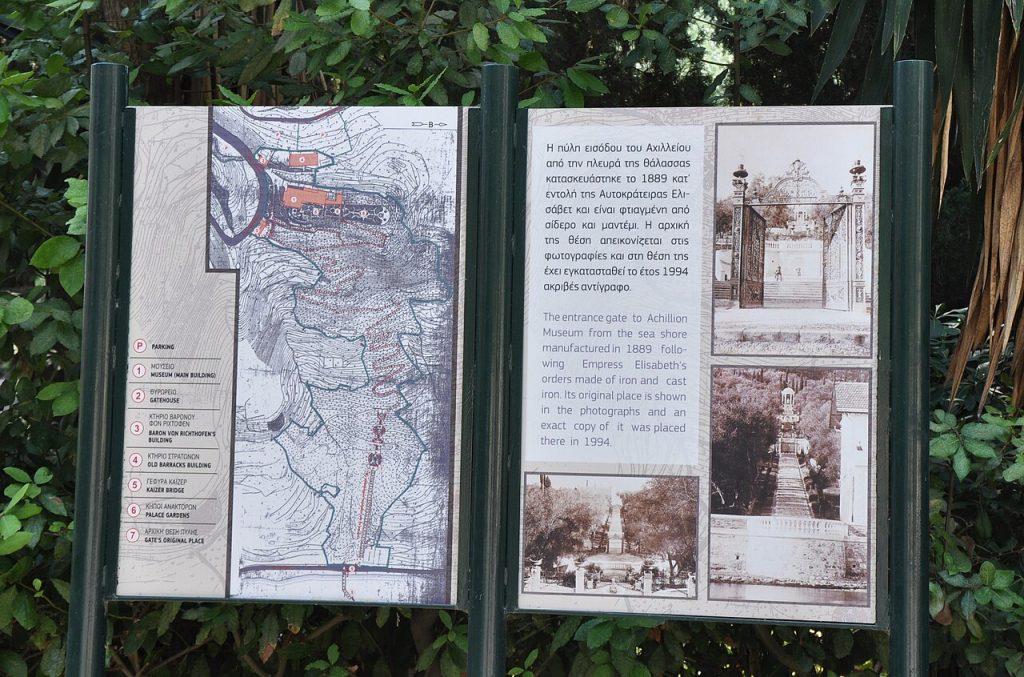
He also redecorated. He installed a saddle-shaped chair at Elisabeth’s desk so that he could write as if on horseback, hung the rooms with his own portraits and nautical pictures, built a bridge over the road to the sea so that he could walk to his yacht, and above all he dealt with Achilles.
Spring Courts and the Triumphant Achilles
Wilhelm found the Dying Achilles morbid and moved it to a lower terrace, and in its place at the end of the main garden he set up in 1910 a bronze Achilles Triumphant by Johannes Götz, nine metres high with its pedestal, the hero in full armour with spear and shield, facing north toward Germany, with the inscription To the greatest Greek from the greatest German, which the Greeks have long since removed. The two statues, the dying youth of the empress and the armed giant of the Kaiser, are the house’s two owners in bronze and marble, and every visitor compares them.
Wilhelm’s last visit was in the spring of 1914. In August the war began, Greece was neutral and then allied, the palace was sequestered and the Kaiser, who had promised to return, abdicated in November 1918 and lived out his life in a Dutch manor. Now, stop here at the foot of the triumphant Achilles and look at the direction of his gaze: he is still looking toward a Germany that no longer exists.
Hospital, Casino and Bond Film
From 1916 the Achilleion was a hospital for the French and Serbian armies based on Corfu, from 1919 the property of the Greek state, in the Second World War a hospital and then a headquarters for the Italian and German occupiers, and after 1945 a neglected state villa. In 1962 the Greek government leased it to a German company that turned the upper floors into a casino, which ran until 1992 and gave the palace its most famous film role: the casino and the terrace were used in the 1981 James Bond film For Your Eyes Only, and the Kaiser’s bridge, the Achilles statues and the staircase all appear. The casino paid for repairs but damaged the rooms, and its removal in 1992 opened the way for a museum.
The lease years also brought the first mass tourism to Corfu, and the Achilleion, on every coach itinerary, became the island’s most visited monument after the old town.
The Museum Since 1994
Since 1994 the Achilleion has been a museum of the Greek state, run by the Hellenic Tourism Organisation and since 2021 by the Ministry of Culture, with the ground and first floors restored, the empress’s apartments refurnished from inventories and photographs, the Kaiser’s study with the saddle chair returned and the frescoes, the staircase and Matsch’s painting cleaned. A major restoration of the building and the gardens was carried out between 2021 and 2024 with European funding, and the museum reopened with new displays on Elisabeth, Wilhelm and the island’s history. The palace also hosts concerts and, in 1994 and 2003, meetings of European Union heads of government.
The Achilleion receives several hundred thousand visitors a year, most of them from cruise ships and coaches, and the gardens and the terrace are crowded from ten to four in summer; the early morning, when the empress walked here, is still the time to see it as she meant it.
Two Monarchs, One Escape
The Achilleion is an unusual palace because its two owners made opposite uses of the same house: the empress built it to disappear, the Kaiser bought it to perform. Elisabeth’s rooms are small and private, her garden is a place for walking alone and her Achilles is dying; Wilhelm’s additions are public, his receptions filled the terrace and his Achilles is winning. The house holds both, and the island, which gave each of them the beauty they came for, has made both of them its own: Corfu sells Sisi on every postcard and keeps the Kaiser’s bridge as a landmark.
Now, stop here on the upper terrace at the end of the day, when the coaches have gone and the light turns the strait to silver, and consider what two of the most powerful people in Europe wanted from this hillside. It was the view, the silence and the sense of being far from home, and the hillside still provides them.
The Achilleion on Video
Visiting the Achilleion Today
The Achilleion is open daily year-round, with longer hours from April to October, and the ticket covers the palace’s two floors, the gardens and the terraces; audio guides and guided tours in English are available, and the restored museum has a café and shop. Allow ninety minutes, and come at opening time or after four in summer to avoid the cruise and coach crowds. Combine it with Mon Repos in Corfu town, the other royal villa on the island, and with a walk down from Gastouri to the Kaiser’s bridge on the coast road at Perama.
Gastouri is twenty minutes by car or the number 10 bus from Corfu town, and taxis and tours run from the port and the airport; Corfu is linked to Igoumenitsa on the mainland by ferry and to Sarandë in Albania by a thirty-minute boat, which makes Tirana a day’s journey. Here is the exact spot: The Achilleion on Google Maps.
Palaces Nearby
You May Like
Verdala Palace and San Anton as the Summer Houses of Malta’s Rulers