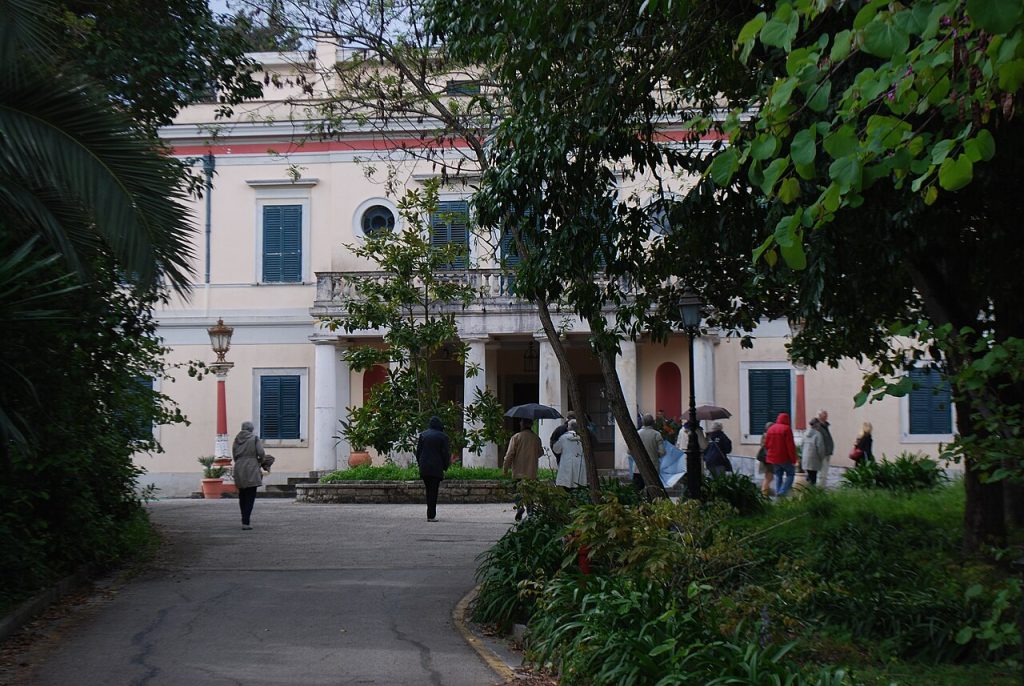
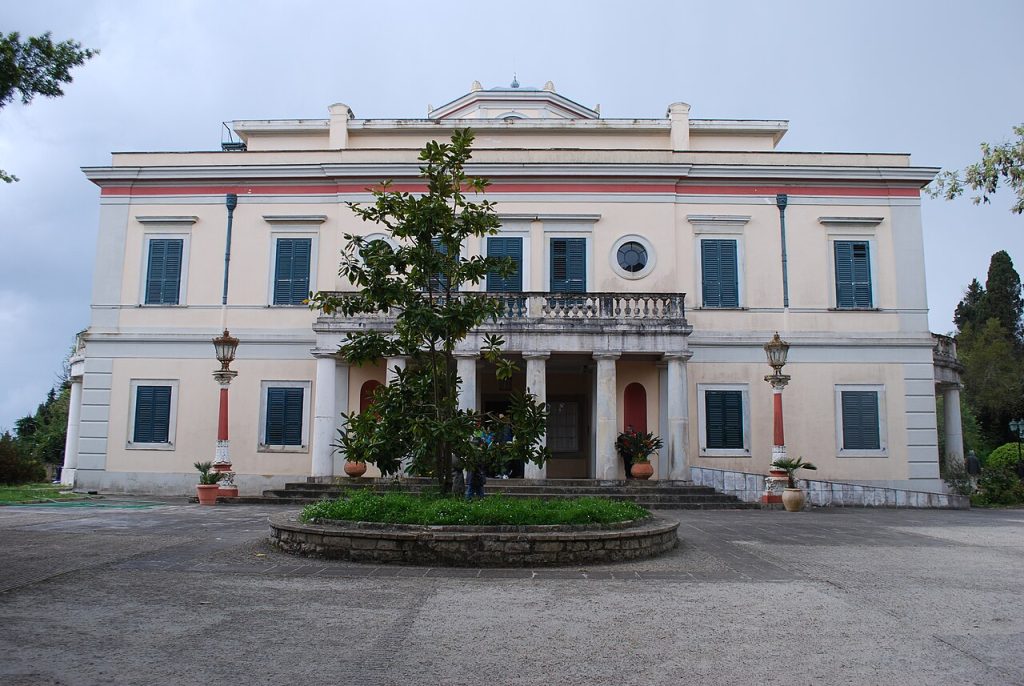
South of Corfu town, on the wooded peninsula of Kanoni that was the acropolis of the ancient city, a plain Neoclassical villa of two storeys stands in a park of cypresses, palms and the ruins of Greek temples, with the sea on three sides. It is Mon Repos, built in 1828 and 1831 by Sir Frederick Adam, the British Lord High Commissioner of the Ionian Islands, as a summer residence for his Corfiot wife, given to the King of Greece when Britain handed the islands over in 1864 and for a century the summer home of the Greek royal family. In June 1921 Princess Alice of Battenberg gave birth here to a son, on the dining-room table because it was the cleanest surface in the house: Philip, later Duke of Edinburgh and husband of Elizabeth II.
The villa has had the fortunes of the Greek monarchy. It was seized in 1924, returned in 1935, abandoned in 1967 when King Constantine II fled, fought over in the courts for thirty years and, since 2001, a museum of the ancient city of Palaiopolis and the park’s archaeology, with a few rooms on the royal family. The park, one of the most beautiful on the island, holds the temples of Hera and of Kardaki, the paths Empress Elisabeth walked before she built the Achilleion and the beach where the Greek princes swam.
Walk the park with me from the gate to the temples, through the villa and down to the sea, with the British, the Glücksburgs and the birth of a prince in order. The contents are below.
In This Article
- The Peninsula of the Ancient City
- Sir Frederick Adam and the British Years
- 1828 to 1831: A Regency Villa in Greece
- The Empress Elisabeth Stays
- 1864: A Gift to King George I
- Summers of the Greek Royal Family
- Prince Andrew and Princess Alice
- June 1921: A Prince on the Dining Table
- 1922 and 1924: Flight and Confiscation
- Return, War and the Last Summers
- 1967 to 2001: The Longest Property Case in Greece
- The Museum of Palaiopolis
- The Park, the Temples and the Sea
- Mon Repos on Video
- Visiting Mon Repos Today
- Palaces Nearby
The Peninsula of the Ancient City
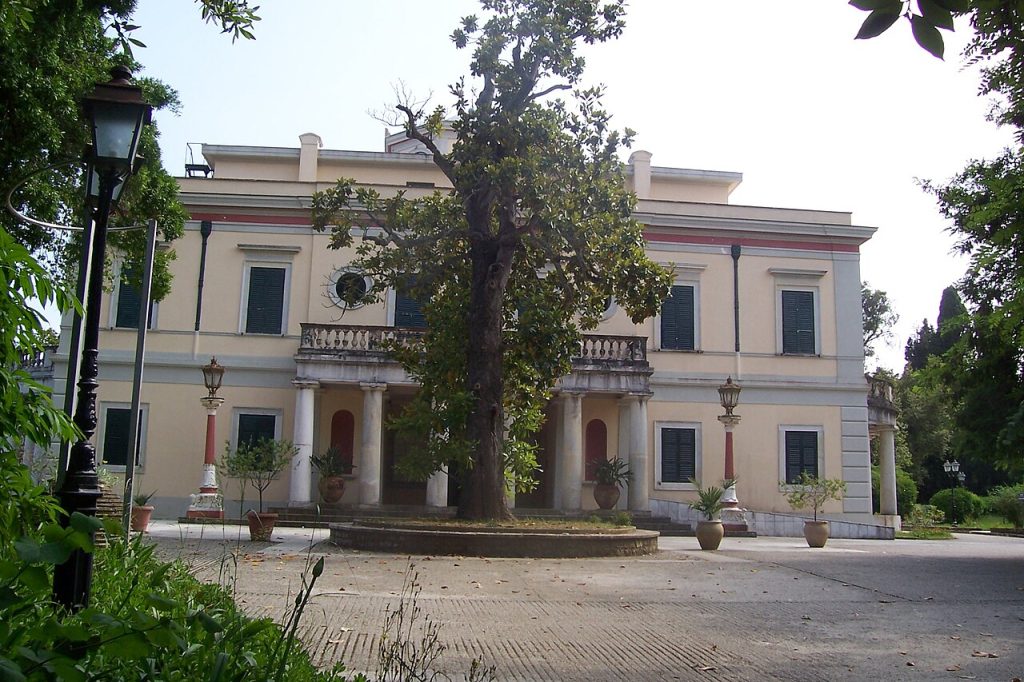
The Kanoni peninsula runs south from Corfu town between the sea and the lagoon of Chalkiopoulos, and it was the site of the ancient city of Corcyra, the Corinthian colony founded in 734 BC whose quarrel with its mother city started the Peloponnesian War. The ancient city’s temples, agora and harbours lie under the olive groves of the peninsula, and the Mon Repos park occupies the heart of it, with the temple of Hera at its centre, the temple of Kardaki on its slope above the sea and the remains of baths, walls and a Roman villa among the trees. The villa stands on a rise at the northern end of the park, looking east over the strait.
Now, stop here at the gate on the Palaiopolis road and look along the avenue of cypresses. The park is dense and green, more an English park than a Greek one, and that is its origin: it was planted by a British governor for his wife, in the years when Corfu was a British protectorate.
Sir Frederick Adam and the British Years
Britain held the Ionian Islands as a protectorate from 1815 to 1864, ruling them through a Lord High Commissioner who lived in the Palace of St Michael and St George in Corfu town, the grandest British building in the Mediterranean. The second commissioner, Sir Frederick Adam, a Scottish general who had fought at Waterloo, governed from 1824 to 1832, built roads, the aqueduct and the Ionian Academy, and married Nina Palatianou, a Corfiot widow of a noble family, whose influence over him scandalised the British colony. For her he built, at public expense, a summer villa on the peninsula south of the town, and the British community grumbled about it for a generation.
Adam left Corfu for Madras in 1832, and the villa passed to his successors as the commissioner’s summer residence, under the name Mon Repos, my rest, which one of them gave it.
1828 to 1831: A Regency Villa in Greece
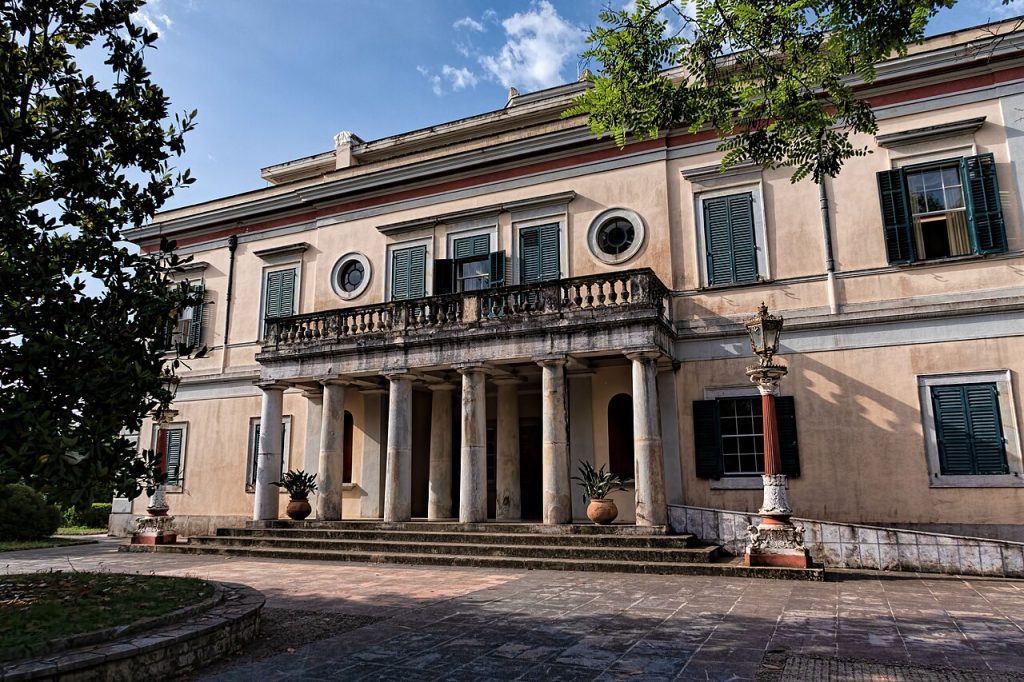
The villa was designed by Colonel George Whitmore of the Royal Engineers, who had built the Palace of St Michael and St George, and built between 1828 and 1831 as a two-storey house of stuccoed stone in the plain Regency manner, with a central block, a portico of Doric columns, a hall and staircase, drawing and dining rooms on the ground floor and bedrooms above, and a terrace on the garden front. It is English in plan and Greek in detail, which suited the British idea of the islands, and it was furnished from London. The park was laid out at the same time with avenues, lawns and exotic trees, and the ancient ruins on the site were preserved as ornaments.
The villa is not large, about twenty rooms, and it was always a summer house rather than a palace; its charm is the park and the sea, and the rooms were made for sitting out of the heat. Now, stop here under the portico and look at the proportions; this could be a villa in Cheltenham, except for the cypresses.
The Empress Elisabeth Stays
In the autumn of 1861 Empress Elisabeth of Austria, ill and fleeing Vienna, came to Corfu on the imperial yacht and stayed at Mon Repos as the guest of the last British commissioners, walking in the park, bathing in the sea below the villa and discovering the island she would return to for thirty years. Her physician declared her cured within weeks, and the emperor, alarmed by her absence, came himself to fetch her. The stay planted the idea of a Corfu refuge that became the Achilleion in 1890, and the paths of Mon Repos, which she walked every morning, were her first Greek landscape.
Three years later the British left, and the villa changed owners and nations.
1864: A Gift to King George I
In 1864 Britain ceded the Ionian Islands to Greece as a wedding present, in effect, for the new King George I, the Danish prince chosen by the powers for the Greek throne the year before, and Mon Repos was given to the king as his summer residence. George, who was seventeen when he became king and reigned for fifty years, loved Corfu, came every spring and summer with his Russian wife Olga and their eight children, and used the villa as a family retreat away from the formality of Athens. He enlarged the park, built a small chapel and bathing huts on the beach and planted the gardens with the trees that now fill them.
The king’s visits made Corfu a royal island, and the Achilleion, the Kaiser’s springs and the royal yachts in the harbour gave the town a season that lasted until 1914.
Summers of the Greek Royal Family
Mon Repos was the Greek royal family’s happiest house. The Glücksburgs, as the Danish dynasty was called, were an informal family who swam, sailed, played tennis and picnicked in the park, and the villa, with its small rooms and its lack of ceremony, was where they were most themselves. George’s sons, Constantine, George, Nicholas, Andrew and Christopher, grew up here in summer, and their children after them; Queen Olga ran the house with Russian warmth and Greek thrift; and the island’s society came for tea on the terrace. The chapel saw family baptisms, the beach the children’s first swims.
In 1913 King George was assassinated in Thessaloniki and the long reign ended; Constantine I succeeded, and the family’s troubles with Greek politics, which would empty Mon Repos three times in the century, began.
Prince Andrew and Princess Alice
King George gave Mon Repos to his fourth son, Prince Andrew, and Andrew and his wife, Princess Alice of Battenberg, Queen Victoria’s great-granddaughter, congenitally deaf and a lip-reader in four languages, made it their home from 1913, with their four daughters. Andrew was a cavalry officer who spent the First World War in exile with his brother Constantine and returned in 1920; Alice ran the house, the village school and the island’s charities and bore her fifth child here in the spring of 1921, while Andrew was with the army in Asia Minor.
The family was poor by royal standards, the house was run on a shoestring, the plumbing was primitive and the electricity unreliable, and the birth took place in the manner of the island.
June 1921: A Prince on the Dining Table
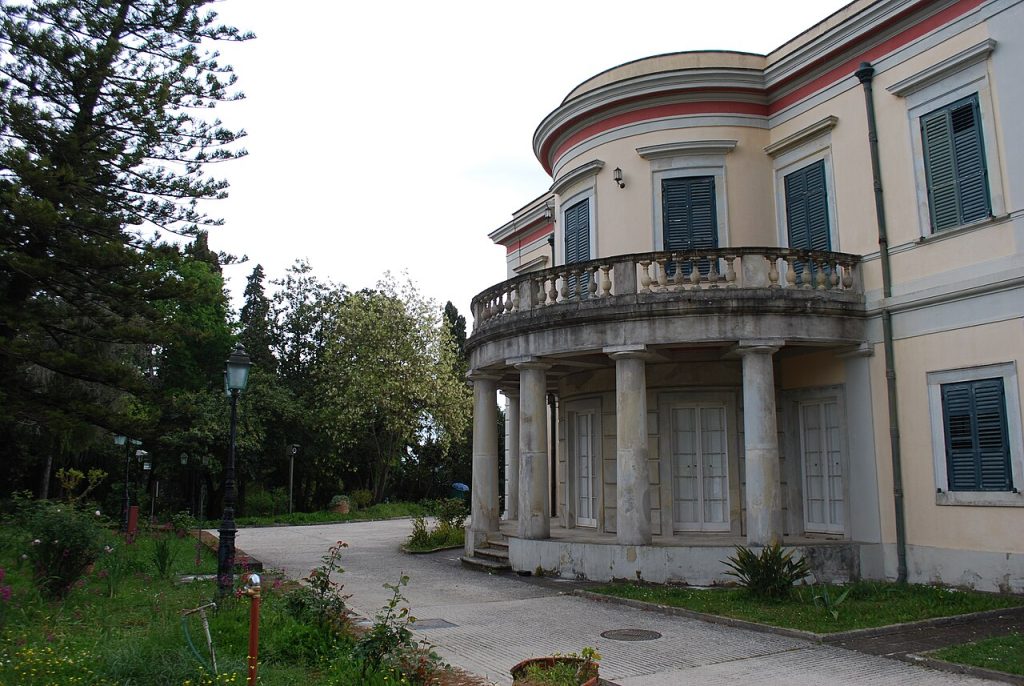
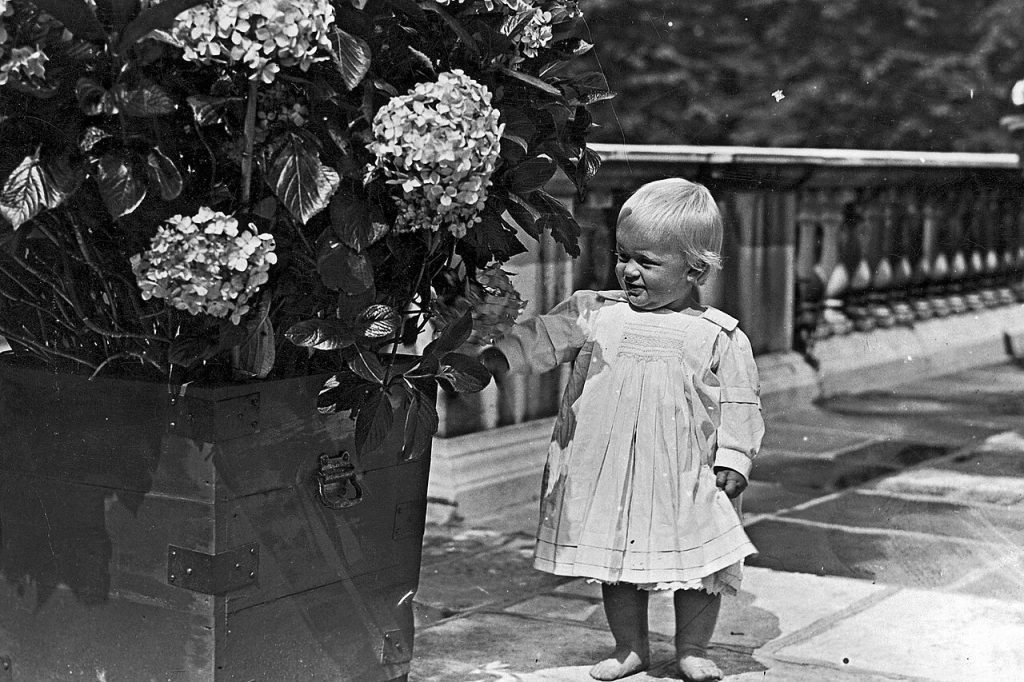
On 10 June 1921 Princess Alice gave birth to a son in the dining room of Mon Repos, on the table, because the local doctor judged it the most hygienic place in a house without a proper delivery room. The boy was christened Philip at the Orthodox church of St George in the old fortress, and he spent the first eighteen months of his life at the villa, carried about the park by his sisters and his English nanny. He was sixth in line to the Greek throne, a great-great-grandson of Queen Victoria and, in the way of the Glücksburgs, of Danish, Russian, German and British blood with hardly any Greek.
Now, stop here in the dining room and look at the table, or rather at the room, since the table itself has gone. The man who married the Queen of England and stood beside her for seventy years began here, in a borrowed summer house on a Greek island, with no money and a very uncertain country.
1922 and 1924: Flight and Confiscation
In September 1922 the Greek army was destroyed in Asia Minor, King Constantine was deposed and a revolutionary government in Athens tried the ministers and generals it blamed for the disaster. Six were shot. Prince Andrew, who had commanded a corps, was tried in December and sentenced to perpetual banishment, and King George V of Britain sent the cruiser HMS Calypso to Corfu to collect the family; they left Mon Repos on the night of 3 December 1922, with the eighteen-month-old Philip carried aboard in an orange crate as a cot. In 1924 Greece became a republic and the royal properties, Mon Repos among them, were confiscated by the state.
Andrew never lived in Greece again; Alice returned in the 1930s and spent the German occupation in Athens sheltering a Jewish family, for which she is honoured at Yad Vashem; Philip grew up in France, Germany and England and joined the Royal Navy.
Return, War and the Last Summers
The monarchy was restored by plebiscite in 1935, Mon Repos was returned to the crown and King George II, then Paul and Frederica, used it again for summers, repaired after the Italian and German occupation of Corfu in the Second World War, during which it was used by the occupiers and damaged. King Paul’s children, Constantine, Sophia and Irene, spent summers here in the 1950s, and in the early 1960s the villa was redecorated for the young King Constantine II and his Danish bride Anne-Marie. Philip, by now Duke of Edinburgh, revisited his birthplace more than once with the Queen on the royal yacht.
The last royal summer was 1967. In December that year Constantine II attempted a counter-coup against the colonels who had seized power in April, failed and left Greece; the junta took the royal estates, and in 1974, after the restoration of democracy, a referendum abolished the monarchy. Mon Repos was locked up with its contents and left to the weather.
1967 to 2001: The Longest Property Case in Greece
For a quarter of a century Mon Repos rotted. The state claimed it as public property, Constantine claimed it as private family property, the courts of Greece and then the European Court of Human Rights heard the case, and meanwhile the roof leaked, the furniture was looted, the park grew wild and the villa became a ruin behind a fence that every visitor to the Kardaki temple peered through. The municipality of Corfu took over the park in the 1990s and began to restore the grounds, and in 2000 the European Court ruled that the former king was entitled to compensation for the confiscated properties, which the Greek state paid in 2002, settling the title to Mon Repos on the state.
The settlement allowed the restoration that had been impossible while the ownership was disputed, and the villa was repaired and opened as a museum in 2001, with the archaeological service as its keeper.
The Museum of Palaiopolis
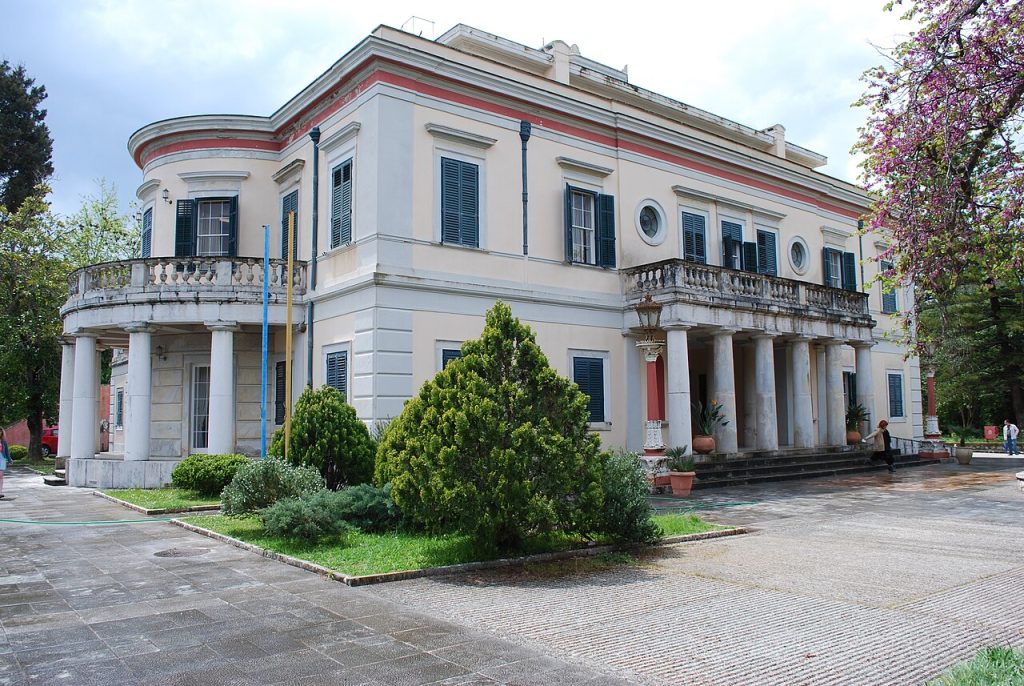
The Museum of Palaiopolis occupies the restored villa and tells the story of the ancient city of Corcyra whose ruins surround it: pottery, sculpture, coins and inscriptions from the temples, the agora and the cemeteries, with models of the city and the Kardaki temple, a room on the Roman and early Christian periods and the excavations in the park. One wing is devoted to the villa itself, with the British commissioners, the royal family, Elisabeth’s stay and Philip’s birth, with photographs, furniture recovered from the house and a reconstruction of the dining room. The exhibitions are modest and well made, and the house is the exhibit as much as the contents.
The museum also runs the archaeological park, where the temple of Hera, one of the largest Doric temples of the Greek west, the temple of Kardaki, the Roman baths and the early Christian basilica of Palaiopolis outside the gate can be visited on marked paths.
The Park, the Temples and the Sea
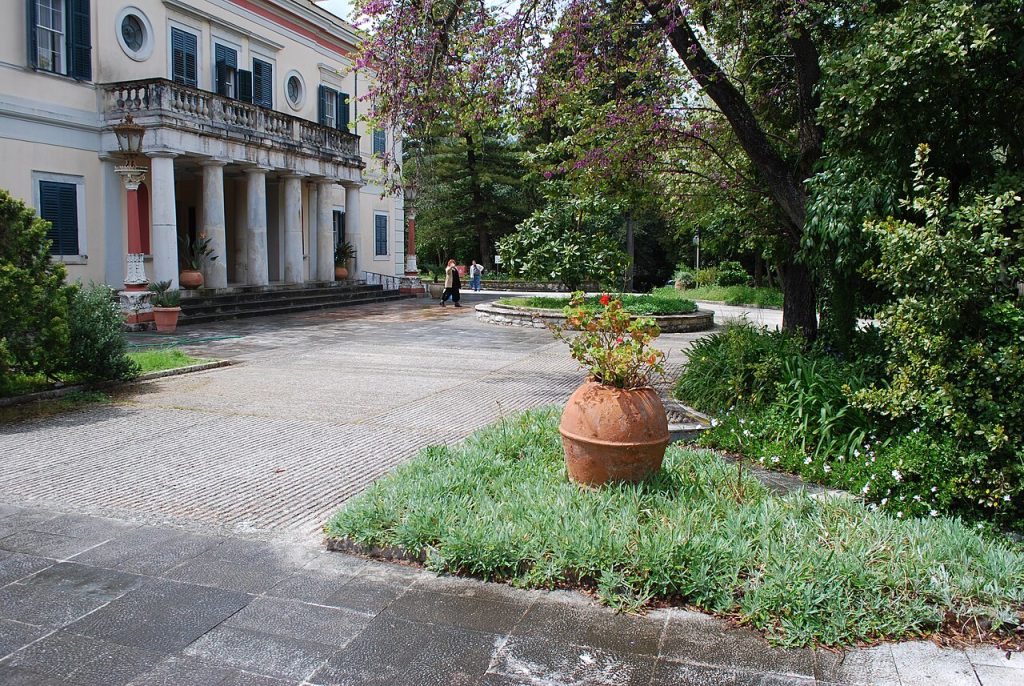
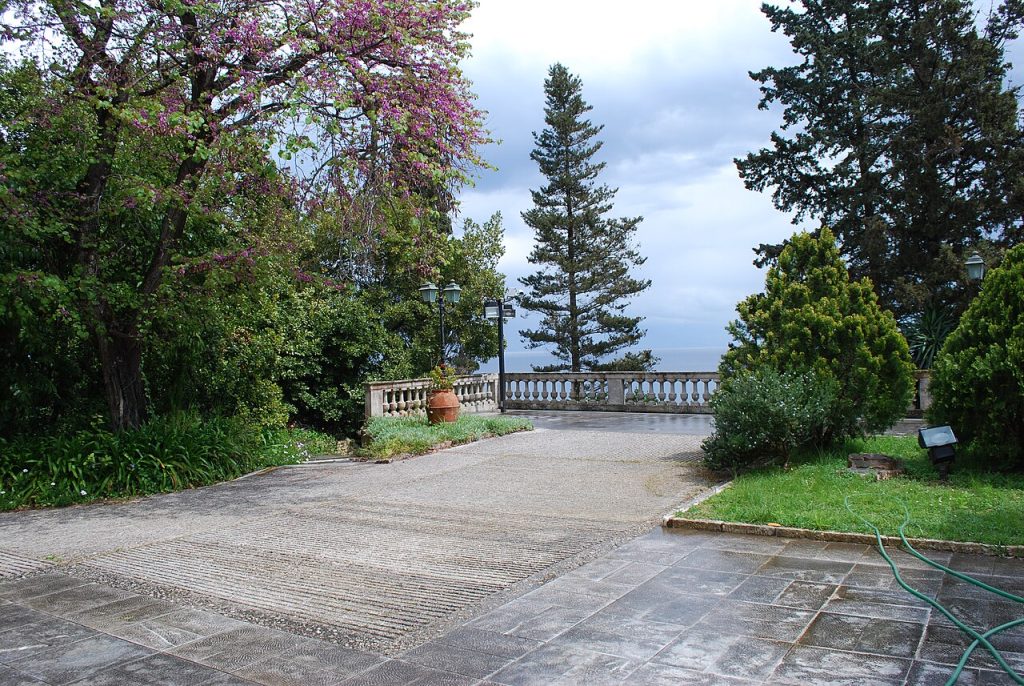
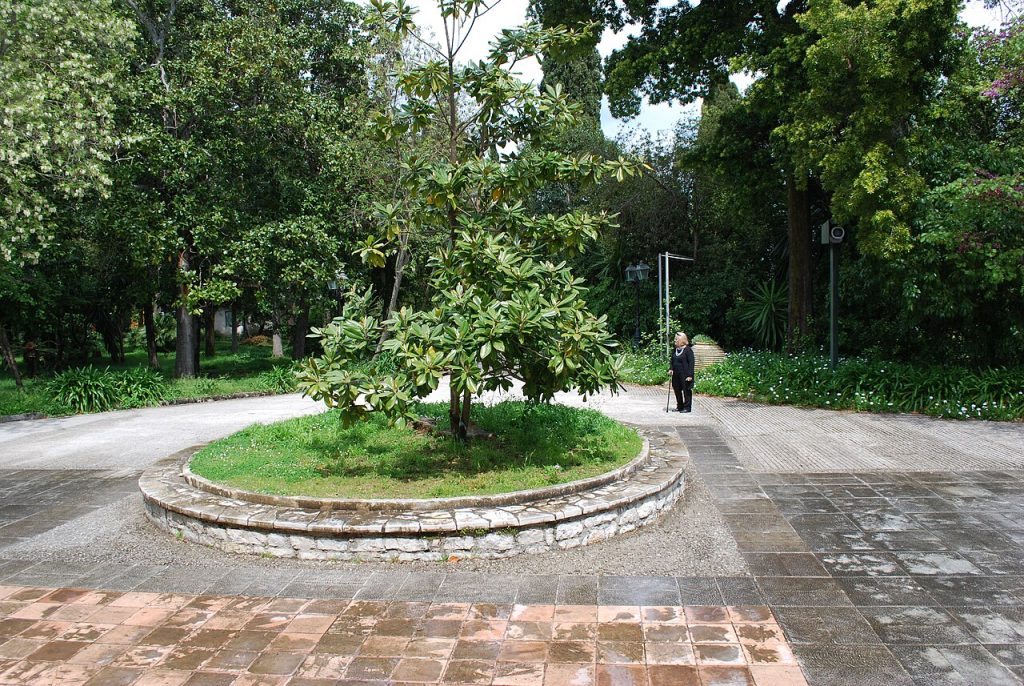
The park is the reason to come. Avenues of cypress and eucalyptus, groves of olive and oak, a palm walk, lawns around the villa and paths that descend through the ruins to the sea: the temple of Hera’s platform in a clearing, the little Doric temple of Kardaki of about 510 BC on its terrace above the water, with its unusual columns without a frieze, the Roman villa and, at the bottom, the beach and the royal bathing hut where the princes swam and where Corfiots now swim in summer. The park is open free of charge from dawn to dusk, and it is the quietest and greenest place within reach of the town.
Now, stop here at the Kardaki temple and look at the sea through the columns. The Corinthians built this when Corfu was a great naval power, the British planted the trees, the Greek kings swam below and a prince born in the house behind you became the longest-serving consort in British history. The hill has seen most of what the island has to tell.
Mon Repos on Video
Visiting Mon Repos Today
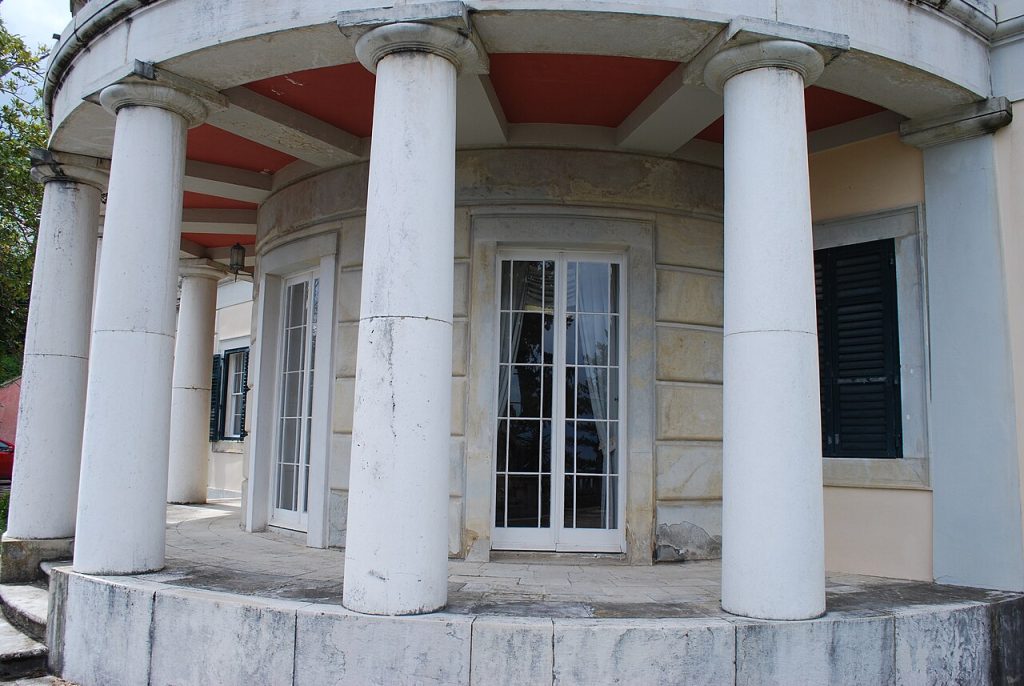
The Mon Repos park is open daily from early morning to sunset and is free; the Museum of Palaiopolis in the villa is open Wednesday to Monday, with a modest ticket, and shows the archaeological collection and the rooms on the royal family and Philip’s birth. Allow two hours for the park and the museum, and continue south along the peninsula to the Kanoni viewpoint over the monastery of Vlacherna and Mouse Island, Pontikonisi, the most photographed view on Corfu. The early Christian basilica of Palaiopolis is opposite the park gate.
Mon Repos is a thirty-minute walk south from Corfu old town along the coast past the Garitsa bay, or ten minutes by the number 2 bus or taxi; the Achilleion is fifteen minutes further south by road. Corfu airport is beside the Kanoni lagoon. Tatoi and the palaces of Athens are a short flight or a day’s drive and ferry away. Here is the exact spot: Mon Repos on Google Maps.
Palaces Nearby
You May Like
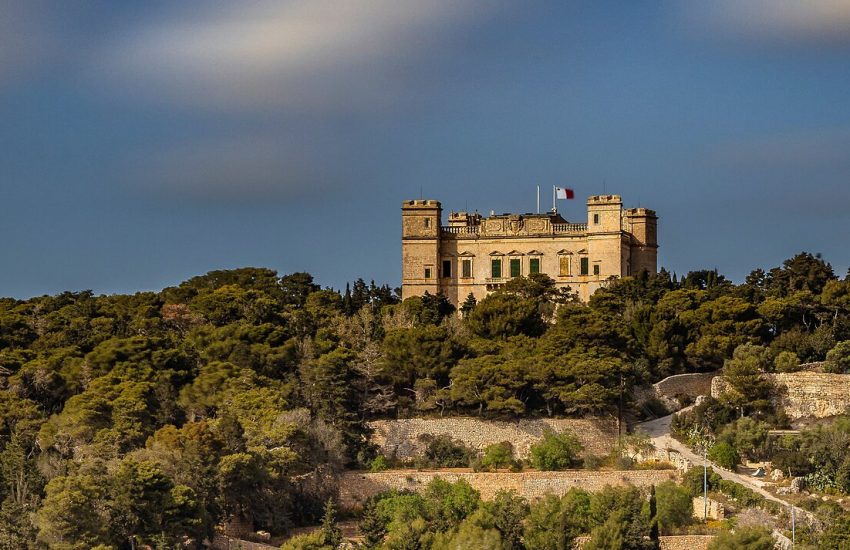
Verdala Palace and San Anton as the Summer Houses of Malta’s Rulers