There is a tiny object, no bigger than a fingernail and made mostly of refined sand, that quietly runs the modern world. It is the computer chip, and almost everything you touched today depended on one. Your phone, your car, your washing machine, the traffic lights on your commute, the bank that holds your money, the hospital that would treat you: all of them rest on these slivers of patterned silicon. In recent years, chips have leapt from the technology pages onto the front pages, becoming the subject of trade disputes, national security debates, and an artificial-intelligence boom. This article explains what these chips are, why they suddenly matter so much, and which companies hold the real power in this hidden industry.
Table of Contents
- What a chip actually is
- The shrinking that drove half a century of progress
- TSMC: the most important company you may never have noticed
- Nvidia: the accidental king of the AI boom
- Intel, AMD, Arm, and the rest of the cast
- ASML: the one company that makes the machines
- Why chips became a geopolitical flashpoint
- Where chip technology goes next
- Why this matters to you
- Closing thoughts
What a chip actually is
At its heart, a computer chip is a small slab of silicon onto which engineers have etched an unfathomable number of microscopic switches called transistors. Each transistor can be on or off, representing the ones and zeros that all digital information is built from. By wiring billions of these tiny switches together in clever patterns, you can build something that adds numbers, stores memory, displays an image, or runs an entire operating system. A modern advanced chip can hold tens of billions of transistors, each far smaller than a virus, in a space the size of a postage stamp.

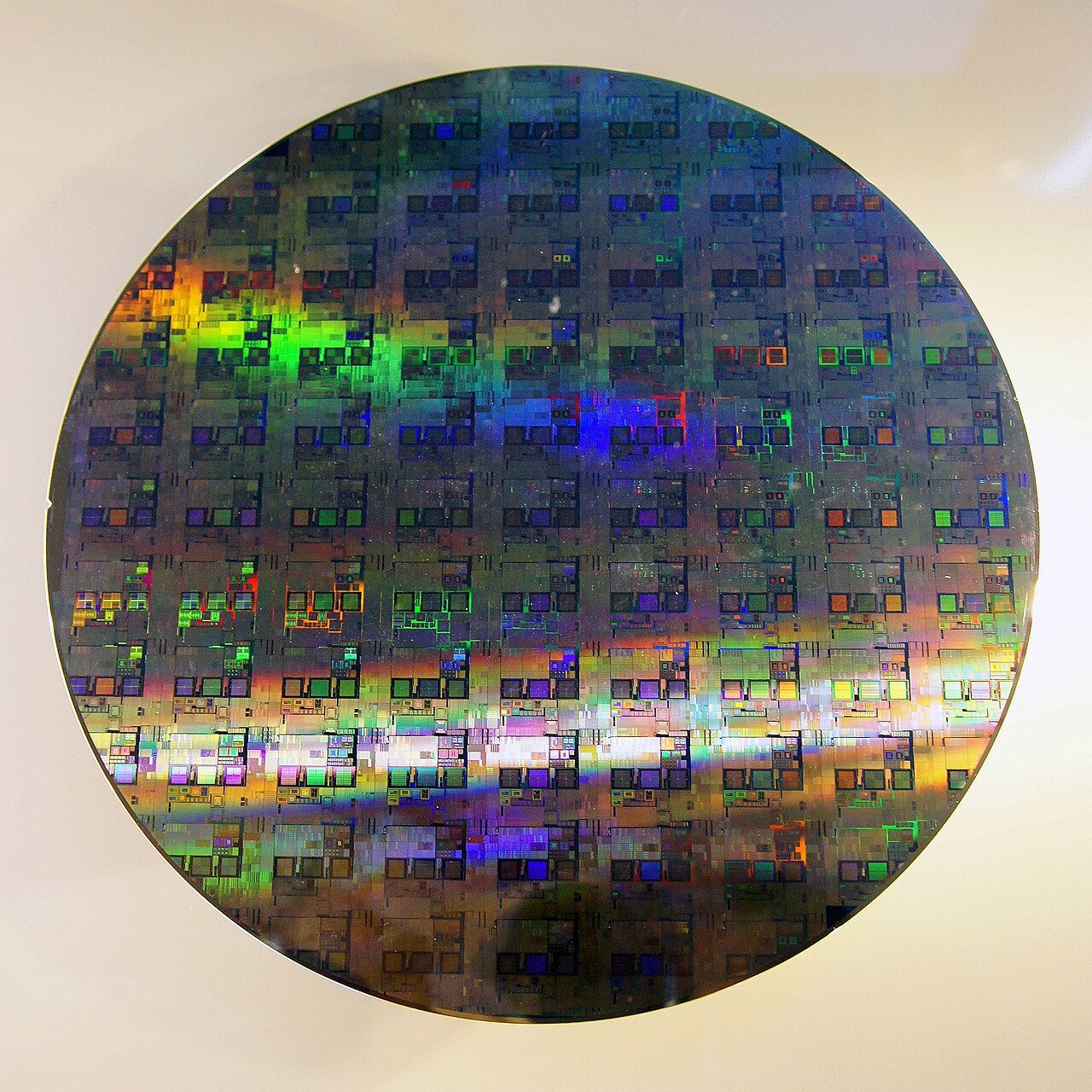
The raw material is astonishingly humble: silicon, refined from ordinary sand into crystals of extreme purity, then sliced into thin, mirror-smooth discs called wafers. On these wafers, the circuits are built up layer by layer through a process of almost unimaginable precision, printing patterns finer than the wavelength of visible light. The finished wafer is then cut into individual chips. That something so intricate can be made by the millions, and sold for a few dollars, is one of the quiet wonders of the modern age.
The shrinking that drove half a century of progress
For roughly five decades, the entire technology industry rode a single, remarkable trend: the number of transistors that engineers could pack into a given space roughly doubled every couple of years. This steady miniaturization, often described by a famous observation that became a self-fulfilling prophecy, is the engine behind nearly every digital marvel of the past half-century. Each shrink meant chips that were faster, cheaper, and more efficient, which is why the computer that filled a room became the phone in your pocket.

That breakneck pace has now slowed, because the features on the most advanced chips have become so small that they are approaching the size of individual atoms, where the ordinary rules of physics start to break down. But the industry has proven endlessly inventive. Rather than only shrinking flat circuits, engineers now build upward, stacking components in three dimensions, and they package several specialized chips together into a single module so they work as one. The era of easy shrinking is ending, but the era of clever engineering is very much alive.
TSMC: the most important company you may never have noticed
Here is a fact that surprises most people: many of the companies whose chips you rely on, including some of the most famous names in technology, do not actually manufacture those chips themselves. They design them, then hand the blueprints to a specialist factory to build. And the undisputed leader of that manufacturing business is a Taiwanese company, TSMC, which makes a huge share of the world most advanced chips for a long list of famous clients.

TSMC pioneered the idea of being a pure manufacturer that builds other companies designs without competing with them, and it executed that idea so well that it now sits at the very center of the global technology economy. Its most advanced factories are among the most sophisticated and expensive facilities ever built by humankind. This concentration of cutting-edge manufacturing in one company, on one island, is precisely why chips have become such a sensitive subject in global politics, a point we will return to.
Nvidia: the accidental king of the AI boom
For most of its history, Nvidia was known to gamers as the maker of the graphics cards that render video-game worlds. Those cards were designed to do a particular kind of math very fast and in parallel, crunching enormous numbers of simple calculations at once to draw images. It turned out, almost by happy accident, that this is exactly the kind of math that training artificial-intelligence systems requires. When the AI boom arrived, the world suddenly needed vast quantities of precisely the chips Nvidia had spent decades perfecting.

The result propelled Nvidia from a respected component maker into one of the most valuable companies in the world, as data centers everywhere raced to buy its chips to power the AI revolution. Just as important as its hardware is its software, a programming platform that became the standard tool for AI development and that competitors have found very hard to dislodge. Nvidia story is a perfect illustration of how a company can spend years building a capability for one purpose and then find itself perfectly positioned when the world changes around it.
Intel, AMD, Arm, and the rest of the cast
The chip world has many other important players. Intel was for decades the towering giant of the industry, designing and manufacturing its own processors, though it has stumbled in recent years and is now fighting hard to regain its lead while also trying to become a manufacturer for other companies. AMD staged one of technology great comebacks, rising from an afterthought to a serious rival in both processors and graphics. And then there is Arm, an unusual company that does not make chips at all but designs the fundamental blueprints that power almost every smartphone on earth, licensing them to others who build the actual silicon.

This division of labor is one of the most fascinating things about the industry. Some companies only design chips, some only manufacture them, some only license the underlying architecture, and some, increasingly few, try to do everything. This intricate web of specialists, spread across many countries, means that a single advanced chip might be designed in one country, built in another using machines from a third, with materials from a fourth, before being assembled into a device somewhere else entirely. It is one of the most complex and interdependent supply chains humanity has ever created.
ASML: the one company that makes the machines
Perhaps the most extraordinary choke point of all sits with a Dutch company called ASML. To print the unimaginably fine patterns on the most advanced chips, you need a particular kind of machine that uses an exotic form of light, and ASML is the only company in the world that makes them. Each machine is a marvel of engineering costing a fortune, assembled from hundreds of thousands of parts, and the most advanced chip factories simply cannot operate without them.
This gives a single mid-sized European company an astonishing degree of influence over the entire global technology industry. Whoever cannot buy these machines cannot make the most advanced chips, which is why control over them has become a powerful lever in international politics. It is a striking reminder that beneath the giants whose logos we know, the modern world rests on a surprisingly small number of irreplaceable specialists, each holding one essential piece of an enormous and fragile puzzle.
Why chips became a geopolitical flashpoint
Because chips power everything from smartphones to advanced weapons, and because the ability to make the most advanced ones is concentrated in so few hands and places, they have become a central issue in global politics. Nations have come to see chip-making capability as a matter of economic strength and national security, not just commerce. A shortage of chips a few years ago, which idled car factories around the world, drove home just how dependent modern economies are on this hidden industry, and how vulnerable that dependence makes them.
In response, governments around the world have launched enormous programs to build more chip factories within their own borders, hoping to reduce their reliance on a small number of distant suppliers. There are also restrictions designed to control which countries can access the most advanced chips and the machines that make them. The details are complex and the politics are delicate, but the underlying point is simple: the tiny chip has become one of the most strategically important objects on the planet, and the contest to control its supply will shape the coming decades.
Where chip technology goes next
With the old path of simply shrinking transistors reaching its limits, the industry is pursuing several new directions at once. Building chips upward in three dimensions and packaging multiple specialized chips together into one module is already delivering real gains. Designers are also creating chips tailored to specific tasks, such as dedicated blocks for artificial intelligence, rather than relying only on general-purpose processors. Further out, researchers are exploring entirely new materials and even radically different approaches to computing, though these remain mostly in the laboratory for now.
The honest picture is one of an industry that has repeatedly been declared to be hitting a wall, only to find a clever way around it each time. The pace of the old, easy gains has slowed, but the ingenuity of the engineers has not. The next decade of progress will likely come less from a single magic shrink and more from a hundred different refinements in design, materials, and packaging, all adding up to keep the remarkable march of computing power going a while longer.
Why this matters to you
You might wonder why any of this matters if you are not an engineer or an investor. The answer is that the health and direction of the chip industry quietly shapes the price, capability, and availability of nearly every electronic thing you buy. When chips are plentiful and advancing quickly, your devices get better and cheaper. When the supply is disrupted, prices rise and products vanish from shelves. The whole digital world you depend on rests on this foundation.
For the ordinary buyer, there is also a practical takeaway. When you compare two gadgets, the chip inside often matters more than any single headline feature, because it determines the real-world experience, from speed to battery life to how well the device handles new software. The brain of your device, more than its screen or its casing, decides how good it will feel to use and how long it will stay useful. The humble chip is worth understanding precisely because it is hiding inside everything.
Closing thoughts
The computer chip is the quiet protagonist of the modern age, a sliver of patterned silicon that powers civilization while almost nobody thinks about it. Behind it stands a cast of remarkable companies, each holding one irreplaceable piece: TSMC, which builds the most advanced chips; Nvidia, which rode its graphics expertise to the throne of the AI era; Arm, whose designs sit in nearly every phone; and ASML, whose unique machines make the whole thing possible. Together they form one of the most intricate and consequential industries humanity has ever built.
The next time you unlock your phone, start your car, or ask an AI a question, it is worth a moment of quiet appreciation for the tiny chip making it all happen, and for the vast, hidden, and surprisingly fragile global effort required to produce it. We live in a world run by these slivers of refined sand, and understanding them, even a little, is one of the best ways to understand the age we live in.