High in the central mountains of Western New Guinea, in the Indonesian province of Papua, a wide green valley opens between steep ridges and cloud-wrapped peaks. This is the Baliem Valley, and it is the homeland of the Dani, one of the largest and most widely known of the highland peoples of the island. For thousands of years they lived in near-total isolation from the outside world, tending gardens of sweet potato, raising pigs, and shaping a society built around kinship, exchange, and the rhythms of a fertile mountain basin. When outsiders first entered the valley in the twentieth century, they were astonished to find a dense farming population thriving in country that had been marked on maps as empty highland.
The story of the Dani is often reduced to dramatic images of feathered warriors and ceremonial battles, but their real achievement is quieter and more enduring. They are skilled farmers who turned the valley floor and its slopes into a productive landscape of ditched fields, and they built a culture in which pigs, gardens, and human relationships are woven into a single fabric of obligation and celebration. This article follows the Dani from their origins and language through their homeland, their traditional way of life, their society and beliefs, their crafts and food, and the sweeping changes that have reshaped their world in living memory.
Contents
- Origins and the Peopling of the Highlands
- The Name Dani and Who It Describes
- Language and the Voices of the Valley
- The Baliem Valley Homeland
- The Traditional Way of Life
- Society, Kinship, and Leadership
- Religion and the World of Spirits
- Traditions and Ceremonial Life
- Crafts and Everyday Making
- Food, Gardens, and the Sweet Potato
- Festivals and the Pig Feast
- History and Contact with the Outside World
- The Dani Today
Origins and the Peopling of the Highlands
The Dani are descendants of the ancient farming peoples who settled the central highlands of New Guinea in one of the earliest and most independent developments of agriculture anywhere in the world. Archaeological evidence from the highlands shows that people were draining wetlands and cultivating crops many thousands of years ago, long before contact with any outside civilization. The ancestors of the Dani were part of this deep highland tradition, adapting over countless generations to life in a cool, fertile mountain valley far from the coast.
Isolation shaped their history as much as agriculture did. The rugged terrain of ridges, gorges, and rivers made travel between valleys difficult, and each highland community developed its own dialect, customs, and alliances. The Baliem Valley, broad and comparatively flat, could support an unusually dense population, and the Dani grew into one of the most numerous highland groups. Their sense of belonging is tied not to a distant homeland but to this valley itself, which their ancestors cleared, ditched, and gardened.
Because writing was unknown, Dani history was carried in oral memory, in the names of clans and places, and in stories that explain how the first people came into the valley and learned to grow food and raise pigs. These accounts bind the living to the land and to the ancestors, and they frame the Dani not as newcomers but as people who have always been part of the mountain country they call home.
The very antiquity of highland farming gives the Dani a place among the world’s earliest agricultural societies, a distinction that reframes the valley not as a remote backwater but as a centre of independent human achievement whose roots reach back to the deep past.
The Name Dani and Who It Describes
The word Dani is itself an outsiders’ label rather than a name the people originally used for themselves. It came into wide use through neighbouring groups and early visitors, and it has since become the common term for the farming peoples of the Baliem Valley and the surrounding highlands. Within the group, people identify far more strongly with their clan, their confederation, and their home locality than with a single sweeping ethnic name.
Scholars sometimes divide the wider population into related groups such as the Western Dani and the peoples of the Grand Valley, reflecting real differences in dialect and custom across the mountain country. These distinctions matter greatly to the people themselves, for whom a neighbour from another valley may speak a noticeably different form of speech and follow slightly different practices even while sharing the same broad way of life.
Using the name Dani, then, is a convenience that groups together many communities who see themselves as distinct. It is useful for describing a shared highland culture, but it should not obscure the fact that the Dani world is made up of many local identities, each rooted in its own stretch of valley, its own ancestors, and its own web of alliances and rivalries.
For outsiders the single name offers a convenient handle, but among the people themselves the more meaningful questions are always which clan, which confederation, and which stretch of valley a person belongs to.

Language and the Voices of the Valley
The languages spoken by the Dani belong to the great family of Papuan tongues of the New Guinea highlands, a group entirely separate from the Austronesian languages found along many Pacific coasts. Highland speech is famous for its diversity, and even within the Dani world there are several distinct languages and many dialects, so that communities only a valley apart may need effort to understand one another fully.
These languages carry the detailed knowledge that valley life requires. They hold precise words for kinds of sweet potato, for stages in the growth of a garden, for the many roles a pig can play in exchange, and for the ties of kinship that bind households together. To speak the language well is to command this practical and social vocabulary, and elders who speak with skill and memory are valued as holders of the community’s knowledge.
In recent generations the national language of Indonesia has spread through schools, churches, markets, and administration, and many younger Dani are now bilingual. This opens doors to education and wider society, but it also places pressure on the local languages. Efforts to record and teach highland speech reflect a growing awareness that a language lost is a whole way of understanding the valley that vanishes with it.
Songs, chants, and the formal speech of ceremony carry an older and more elevated register of the language, preserving turns of phrase and knowledge that everyday conversation alone would gradually let slip away.

The Baliem Valley Homeland
The heart of the Dani world is the Baliem Valley, a broad basin lying at high elevation in the central ranges, drained by the Baliem River as it winds across the valley floor before plunging into deep gorges. Ringed by steep forested mountains that catch the passing clouds, the valley enjoys a cool climate and reliable rainfall that together make it one of the most productive stretches of country in the highlands.
On the valley floor and lower slopes the Dani have created an intricate farmed landscape. Fields are laid out with drainage ditches that carry away excess water and build up fertile beds, a technique refined over many centuries. Beyond the gardens rise slopes of grass and forest that supply timber, firewood, hunting grounds, and materials for building and craft, while the high ridges mark the boundaries between neighbouring groups.
This is not empty wilderness but a deeply humanized homeland, shaped by generations of labour. Every ditch, path, garden plot, and settlement carries the memory of the people who made it. For the Dani the valley is at once larder, workplace, battlefield of the past, and sacred ground, and their attachment to it runs far deeper than any line an outside map could draw.
Seasonal patterns of rain and mist govern the pace of work in the valley, and the Dani read the sky, the rivers, and the growth of their crops with the practiced attention of people whose survival has always depended on knowing their country intimately.

The Traditional Way of Life
Traditional Dani life revolved around the compound, a cluster of low round houses and longhouses enclosed by a fence and set among the gardens. The characteristic dwelling is the honai, a round hut with a thatched conical roof, warm and smoky inside, where people sleep close to a hearth against the chill of highland nights. Men and women traditionally slept in separate houses, with a cooking house and pig stalls completing the compound.
Daily work followed the demands of the gardens and the pigs. Women carried much of the burden of cultivation and of tending the pigs, moving to and from the fields with sturdy net bags slung from the forehead down the back, in which they carried produce, firewood, and even small children. Men cleared new ground, built and repaired fences and ditches, and handled matters of exchange, alliance, and, in the past, warfare.
Life was organized around a careful balance of gardens and pigs, of daily labour and periodic celebration. Wealth was measured largely in pigs and in the relationships that pigs made possible, and a household’s standing rose and fell with its ability to raise animals, host feasts, and meet its obligations to kin and allies. It was a demanding way of life, but one finely tuned to the possibilities of the valley.
The smoky interior of the honai, warmed by its hearth through the cold highland nights, was the setting for storytelling, instruction, and the quiet passing of knowledge from elders to the young, so that the house was a place of learning as much as of shelter.

Society, Kinship, and Leadership
Dani society is built from clans and larger confederations bound together by kinship, marriage, and alliance. A person belongs to a descent group that traces its links through the ancestors, and these groups are further divided into complementary halves that shape marriage and ceremony. Marriage typically links different groups, weaving a web of relationships and obligations across the valley.
Leadership traditionally rested not on inherited title but on achievement and influence. A man of standing, sometimes called a big man, earned his position through skill in gardening and pig raising, generosity in feasts, wisdom in counsel, and success in the alliances and disputes that shaped valley politics. Such leaders held sway by persuasion and reputation rather than by formal command, and their influence lasted only as long as they could sustain it.
Reciprocity is the thread running through Dani social life. Gifts of pigs, help with garden work, and support in disputes all create bonds that must eventually be answered in kind. To live well is to manage these obligations skilfully, giving and receiving in a way that builds a good name, strong alliances, and the security that comes from being embedded in a wide network of kin and neighbours.
Disputes over pigs, gardens, women, and old grievances were the stuff of valley politics, and the ability to mediate such quarrels, to broker peace, and to hold a fragile alliance together was among the highest skills a leader could possess.
Religion and the World of Spirits
Traditional Dani belief centred on the presence of ancestral spirits and unseen powers that share the world with the living. The spirits of the dead were understood to remain close and to influence the health, fortune, and safety of their descendants, so keeping right relations with them was a serious and constant concern. Much ritual life aimed at honouring the ancestors and ensuring their goodwill.
Pigs stood at the very heart of this spiritual economy. They were the principal offering in rituals, the means of settling obligations to the dead, and the currency of the great ceremonies that renewed alliances and marked important transitions. To sacrifice and share a pig was to feed both the living community and the relationship with the spirit world, binding the two together in a single act of exchange.
From the mid twentieth century Christian missions established a strong presence in the highlands, and today many Dani are Christians. Yet older understandings of ancestors, spirits, and the moral weight of exchange have not simply disappeared. For many people the new faith and the inherited sense of a living, watchful world coexist, blending in ways that continue to shape how life, death, and obligation are understood.
The moral weight given to exchange, in which a gift creates a debt that must one day be answered, gave Dani spiritual life a strongly practical character, binding belief tightly to the everyday obligations between the living and the dead.
Traditions and Ceremonial Life
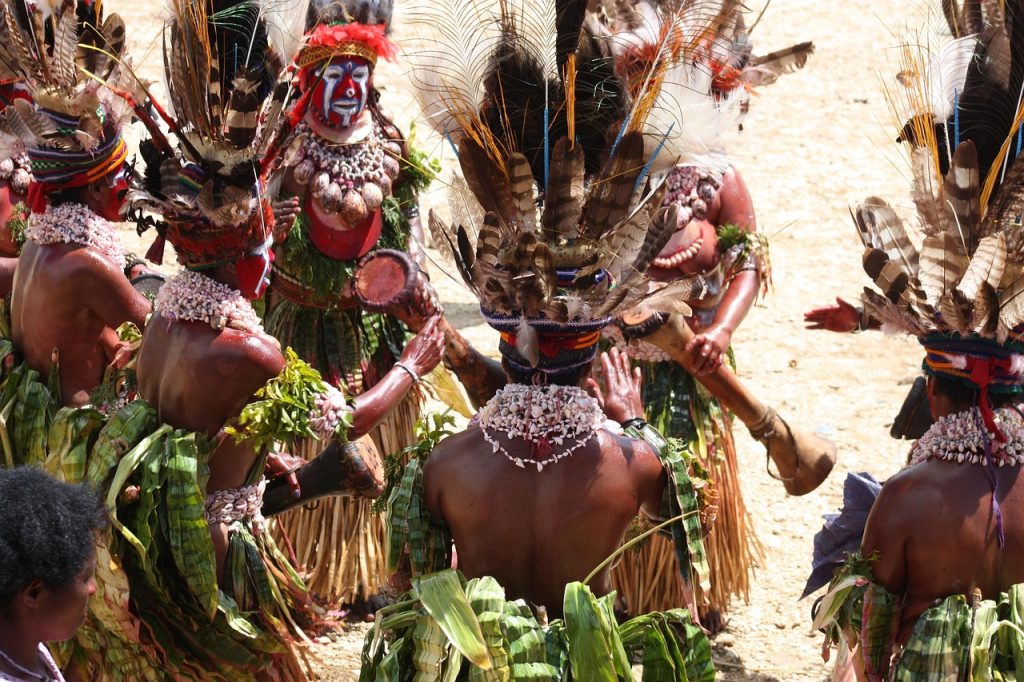
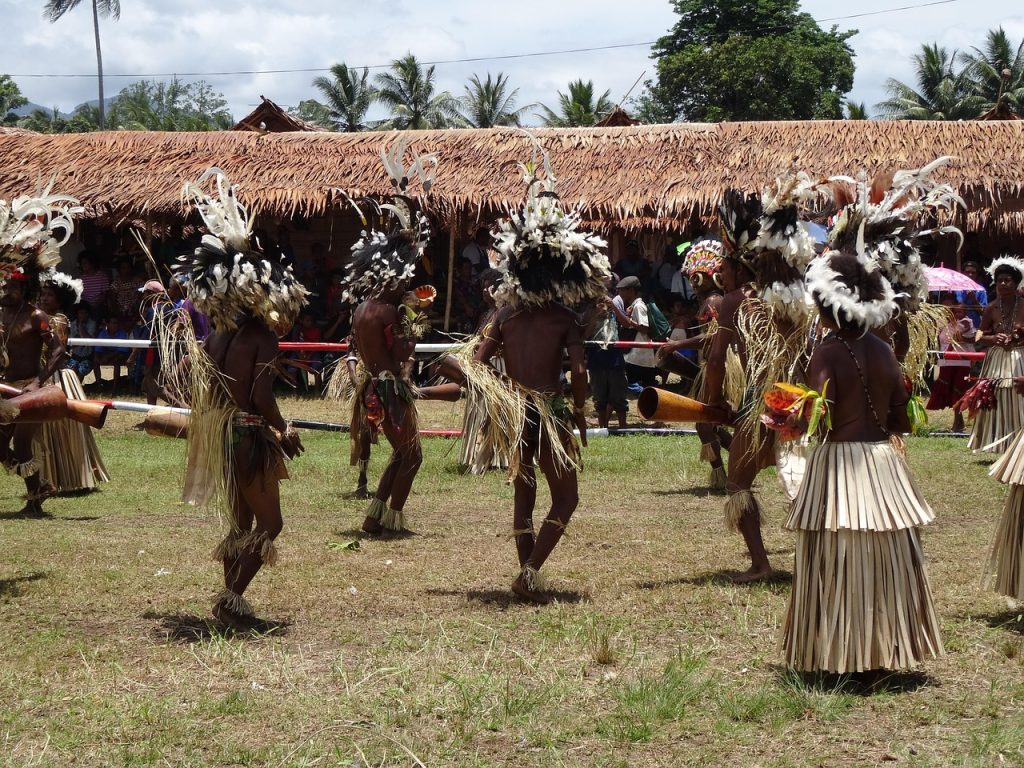
Ceremonial life among the Dani has long been marked by striking display. On important occasions people adorn themselves with feathers, shells, fibre ornaments, and bold patterns of body and face paint, transforming everyday appearance into something powerful and memorable. Such adornment signals the importance of the moment and the standing of those who take part, and it remains a vivid feature of major gatherings.
In the past, ritualized warfare between rival groups was a recurring element of highland life, less a matter of conquest than a way of answering grievances, avenging the dead, and maintaining the honour and boundaries of a confederation. These confrontations followed understood conventions and were bound up with the spirits and with cycles of exchange, though they could also bring real loss and long-running enmity between neighbours.
One of the most widely noted mourning customs was the amputation of a finger joint by some women to mark the grief of losing a close relative, a practice now largely of the past. Such traditions, whether of display, of conflict, or of mourning, expressed the intensity with which the Dani felt their bonds of kinship and the seriousness with which they treated loss, honour, and obligation.
The vividness of ceremonial display, with its feathers, shells, and painted skin, was never mere decoration but a language in itself, communicating identity, allegiance, mourning, or celebration to all who could read its signs.

Crafts and Everyday Making
Dani craft is above all practical, rooted in the materials of the valley and the needs of daily life. The most iconic object is the net bag, knotted from plant fibre and used to carry almost everything, from garden produce and firewood to piglets and infants. Made largely by women, these bags are strong, expandable, and often coloured, and they are as much a part of highland life as the gardens themselves.
Other everyday goods were shaped from wood, stone, bone, and fibre. Digging sticks and simple tools served the gardens, while stone tools once did the heavy work of clearing and building before metal became available. Personal ornaments were fashioned from shells traded up from distant coasts, from feathers, boar tusks, and seeds, each carrying meaning about wealth, status, and occasion.
Making was woven into social life rather than set apart as a specialist trade. Skills passed from one generation to the next through watching and doing, and the ability to produce a fine net bag, a well-made fence, or a striking set of ornaments was a valued part of being a capable adult. In this way craft expressed not only usefulness but also identity and belonging.
The knotted net bag, in particular, has become an emblem of highland identity recognized far beyond the valley, a humble object that carries within its looping fibres generations of skill, patience, and the unmistakable stamp of Dani womanhood.

Food, Gardens, and the Sweet Potato
The foundation of Dani life is the sweet potato, a crop so central that it shapes the whole rhythm of the valley. Grown in great variety across the ditched gardens, it feeds both people and pigs, and its reliable yield in the cool highland climate is what allowed such a dense population to flourish. Households recognize many named kinds, each suited to particular conditions and uses.
Alongside the sweet potato the Dani grow taro, yams, bananas, sugarcane, greens, and other vegetables, filling out a diet that is largely plant based in everyday life. Cooking is often done in an earth oven, where heated stones steam a mound of food wrapped in leaves, a method used both for family meals and, on a far larger scale, for the great feasts that mark important occasions.
Pork, by contrast, is not everyday fare but the food of celebration and obligation. Pigs are raised with great care and are eaten chiefly at feasts, when a community comes together to honour the dead, seal an alliance, or mark a marriage. The distinction between the daily abundance of the garden and the special richness of pork captures the two poles around which Dani food, and Dani life, revolve.
The earth oven, in which heated stones slowly steam layers of tubers, greens, and pork beneath a covering of leaves and grass, is itself a communal act, drawing many hands together in the preparation and the sharing of a single great meal.

Festivals and the Pig Feast
The great pig feast is the supreme celebration of Dani life, an event in which many pigs are killed, cooked in earth ovens, and distributed among kin and allies. Such feasts settle debts, renew relationships, and display the wealth and generosity of those who host them. They may be tied to mourning, to the reconciliation of former enemies, or to marriage, and they draw together whole networks of communities.
Around these feasts gather the full display of Dani ceremonial life: adornment with feathers and paint, dancing, singing, and the reaffirmation of alliances. The scale of a feast measures the standing of its hosts, for it takes years of patient pig raising and careful management of obligations to be able to give away so much at once. Generosity, more than possession, is what earns lasting respect.
In recent decades an annual cultural festival in the Baliem Valley has drawn visitors to witness performances of dance, mock battle, and display by groups from across the highlands. While shaped in part for tourism, this event also serves the Dani themselves as a stage for pride in their heritage, a chance to present their traditions to the wider world on their own terms.
Preparations for a major feast could stretch across seasons, as hosts accumulated the pigs, arranged the invitations, and marshalled the labour needed to feed and honour the crowds who would come, making the event as much a feat of organization as of generosity.

History and Contact with the Outside World
For most of their history the Dani lived beyond the reach of the outside world, unknown to distant states and untouched by the trade routes of the coasts. The turning point came in the twentieth century, when aerial exploration revealed the densely populated Baliem Valley to astonished outsiders who had assumed the interior was empty. The encounter opened the valley to missionaries, administrators, and researchers in quick succession.
Contact brought sweeping change. Missions introduced Christianity and worked to end warfare and certain customs, while colonial and later national administration drew the highlands into a wider political order. Steel tools, cloth, new crops, schools, and markets reshaped daily life, and the valley that had once been a self-contained world became a district within a modern state, subject to its laws and pressures.
The incorporation of the highlands into Indonesia has been marked by tension as well as change, and questions of land, resources, autonomy, and rights have shaped highland experience over the decades since contact. The Dani have navigated this transformation within living memory, moving from stone-tool gardening and ritual warfare to schools, churches, and cash in the space of only a few generations.
Within the span of a single lifetime, elders who were born into a world of stone tools and ritual battle have watched aircraft, roads, and schools arrive, a compression of change few societies anywhere have experienced so abruptly.

The Dani Today
Today the Dani remain firmly rooted in the Baliem Valley, still farming its sweet potato gardens and still raising the pigs that carry so much social meaning. Many aspects of the old way of life continue alongside the new: net bags are still carried, honai houses still stand in many compounds, and the pig feast still binds communities together, even as churches, schools, shops, and vehicles have become ordinary parts of the landscape.
Younger generations increasingly move between worlds, attending school, speaking the national language, and travelling to towns for work and trade, while remaining tied to their clans and their home valley. This double life brings opportunity but also strain, as families balance the pull of wider society against the desire to keep alive the languages, skills, and obligations that make someone fully Dani.
The challenges ahead are real, from pressures on land and language to the uncertainties of political and economic change. Yet the Dani carry into the future a powerful inheritance: a deep knowledge of their valley, a culture of exchange and celebration, and a strong sense of who they are. In tending their gardens and honouring their bonds, they continue to shape a highland world that is unmistakably their own.
In markets and mission stations, in schoolyards and along the roads that now thread the valley, one sees the everyday blending of old and new that defines contemporary Dani life, where a net bag and a mobile phone may be carried side by side.

Related Peoples of the Region
- Arrernte People of the Red Centre and Their Songlines Across the Desert
- Warlpiri People of the Tanami Desert and Their World of Sand and Story
- Pitjantjatjara People of the Western Desert and Their Sacred Heart at Uluru
- Noongar People of the Southwest and Their Country of Six Seasons
- Tiwi People of the Northern Islands and Their World Apart
- Palawa People of lutruwita and Their Remarkable Cultural Return
You May Like
The Damara, an Ancient People of Namibia


One thought on “Dani People of the Baliem Valley and Their Highland World of Pigs and Gardens”