In the great Western Desert of central Australia, where the red earth rolls toward a horizon broken only by ancient rock formations, live the Pitjantjatjara people, custodians of some of the most sacred country on the continent. Their homeland straddles the corner where the borders of the Northern Territory, South Australia, and Western Australia meet, an arid expanse that includes the towering monolith of Uluru, a place that holds profound spiritual meaning for them. Together with closely related groups they are often known as Anangu, a word in their language that simply means people or human beings, and they form one of the enduring desert cultures of Aboriginal Australia.
For countless generations the Pitjantjatjara have lived by an intricate body of law and story they call Tjukurpa, which binds together their beliefs, their relationships, and their responsibilities to the land. Far from being passive inhabitants of an empty desert, they have shaped and been shaped by a landscape they know with astonishing precision, reading its water, its food, and its sacred meaning in ways that sustained them through millennia. This article follows the Pitjantjatjara from their ancient origins through their language, homeland, society, spiritual life, art, food, and ceremony, and into the struggles and achievements that mark their world today.
Contents
- Origins and Deep Ancestry
- The Meaning of the Pitjantjatjara Name
- Language of the Western Desert
- Homeland Around Uluru
- The Old Way of Desert Living
- Society, Anangu and Kinship
- Tjukurpa and the Sacred Law
- Traditions and Sacred Country
- Dot Painting and Desert Craft
- Food from the Desert
- Ceremony, Inma and Song
- History and the Fight for Land
- The Pitjantjatjara People Today
Origins and Deep Ancestry
The Pitjantjatjara belong to the vast family of Western Desert peoples whose presence in central Australia reaches back many thousands of years into the deep human history of the continent. Aboriginal Australians are among the oldest continuous cultures on earth, and the desert groups adapted to one of the most demanding environments imaginable, developing knowledge and technology finely tuned to survival in a place of little water and extreme heat. The Pitjantjatjara are heirs to this ancient achievement.
Rather than describing their beginnings in terms of migration or dates, the Pitjantjatjara understand their origins through Tjukurpa, the creative law that tells how ancestral beings travelled the land and gave it form. These beings established the features of the country, the rules of proper conduct, and the ties between people and place that still govern life today. In this understanding, the people and their land came into being together and remain inseparable.
The Pitjantjatjara are part of a broad cultural bloc that includes closely related groups such as the Yankunytjatjara and Ngaanyatjarra, with whom they share language, ceremony, and marriage ties. These peoples move across a shared landscape of Dreaming tracks that ignore modern state borders, understanding themselves as branches of a single desert tradition. This web of relationship gave the desert peoples resilience and reach across enormous distances.
The desert environment demanded not only physical endurance but a vast intellectual inheritance, for survival depended on knowledge accumulated and refined across countless generations. Every child grew up learning to read the land, its water, its plants, and its animals, absorbing an education in which memory and story served as the library of the people. This inheritance, carried entirely in the mind and voice, allowed the Pitjantjatjara to flourish where survival might have seemed impossible.

The Meaning of the Pitjantjatjara Name
The name Pitjantjatjara derives from the way the group speaks their language, specifically from a particular word for the verb to come or to go used in their dialect. Neighbouring groups are named in a similar way, so that linguistic differences in a single common word became the basis for distinguishing one people from another. This reflects how central language is to identity among the Western Desert peoples.
Alongside this specific name, the Pitjantjatjara commonly refer to themselves and their relatives as Anangu, meaning person or human being, a term that emphasises shared humanity and common belonging rather than division. In many contexts, especially when dealing with outsiders, Anangu serves as the everyday word for the people of this desert region. The two names sit comfortably together, one marking a particular dialect group and the other a wider community.
Names carry great weight in Pitjantjatjara culture, where the naming of places, ancestors, and people links directly to Tjukurpa. To know the name of a site is often to know the story that made it and the responsibilities that come with it. This intimate bond between naming and meaning underscores how the Pitjantjatjara understand their identity as rooted in an inherited relationship with country.

Language of the Western Desert
The Pitjantjatjara language is a dialect of the wider Western Desert language, one of the largest and most vigorous Aboriginal language groups in Australia. It remains strong, spoken as a first language by children and adults across the desert communities, and it has become a language of instruction, media, and literature as well as of daily conversation. This vitality places it among the healthiest of all Indigenous Australian tongues.
Like its desert relatives, Pitjantjatjara carries a rich vocabulary for describing the land, its water sources, plants, and animals, along with a grammar that expresses the fine distinctions of kinship so central to social life. The language encodes an entire way of seeing the world, so that fluency involves not only words but the whole framework of relationships and obligations that structure Anangu society. Learning to speak properly is inseparable from learning to live properly.
Considerable effort has gone into supporting the language through bilingual education, dictionaries, and recordings, reflecting both community determination and wider recognition of its importance. Elders stress that the language is the vessel that carries Tjukurpa across generations, and that its survival is essential to the survival of the culture itself. For the Pitjantjatjara, keeping the language alive is a matter of keeping their world intact.
Radio programmes, films, and printed books in the language have all helped to reinforce its everyday use, giving younger generations pride in a tongue that ties them directly to their ancestors. In this way the Pitjantjatjara have shown that an Indigenous language can thrive in the modern world when its community is determined to keep it strong. Their success has drawn admiration from linguists and Indigenous communities elsewhere who look to their example.

Homeland Around Uluru
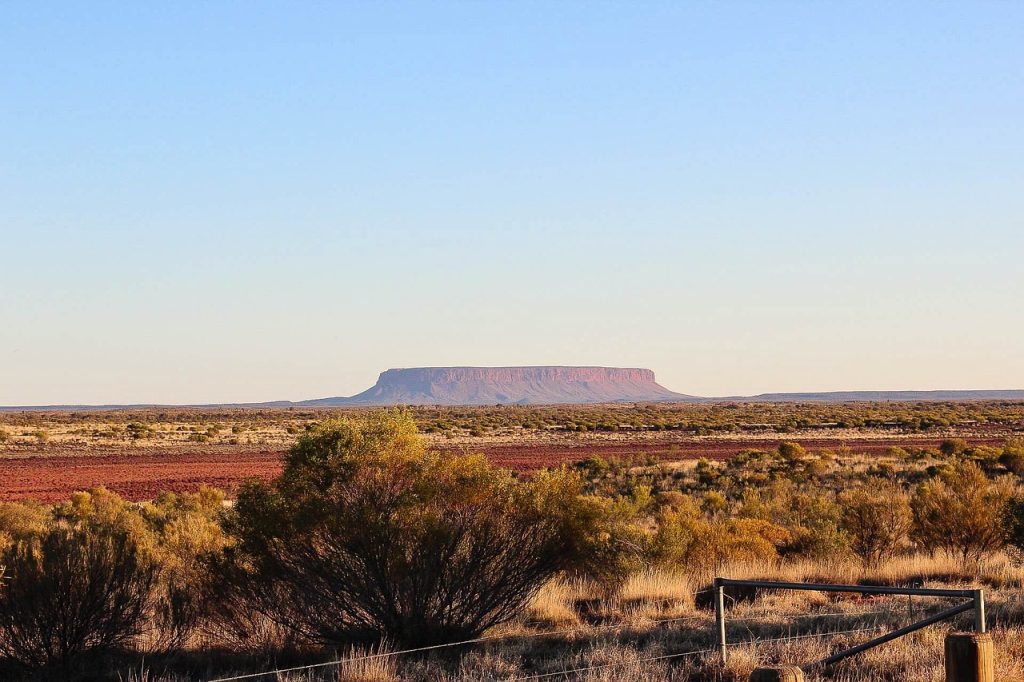
The Pitjantjatjara homeland lies in the Western Desert, a vast region of red sand plains, spinifex country, low ranges, and scattered rockholes that together form one of the driest inhabited landscapes on earth. At the heart of this country stands Uluru, the great sandstone monolith that rises abruptly from the surrounding plain, together with the domed rocks of nearby Kata Tjuta. These are not mere landmarks but deeply sacred places woven into the fabric of Tjukurpa.
Survival in this country depended on an exact knowledge of where water could be found, in soaks beneath the sand, in rockholes that held rain, and in clay pans that filled after storms. The distribution of these sources shaped the movement of families across the land and was remembered in the songs and stories that map the desert. To know the country was to know its water, and that knowledge was a matter of life and death.
The desert experiences fierce heat in summer and cold nights in winter, and its resources ebb and flow with rare rains that can transform the land almost overnight. The Pitjantjatjara timed their movements and gatherings to these rhythms, converging for ceremony when conditions were favourable and dispersing when they were not. Their homeland was a living system to which they belonged, not a backdrop against which they lived.
The great rock of Uluru changes colour dramatically through the day, glowing a deep red at sunrise and sunset in a spectacle that draws visitors from across the world. For the Pitjantjatjara, however, its significance has nothing to do with spectacle and everything to do with the stories held in its every feature. To stand before it with knowledge is to read an entire chapter of Tjukurpa written into stone.

The Old Way of Desert Living
Before sustained contact with Europeans, the Pitjantjatjara lived as mobile hunter-gatherers moving in small family groups across immense territories. They carried little, relying on knowledge rather than possessions, and built simple windbreaks and shelters wherever they camped. Their tools were few but perfectly suited to their needs, reflecting a material culture stripped to its essentials by the demands of a mobile desert life.
Daily survival rested on a division of labour in which men generally hunted larger game while women gathered the seeds, fruits, and small creatures that made up the bulk of the diet. Fire was central to their world, used for warmth, cooking, and signalling, and deployed to burn the country in ways that promoted new growth and made hunting easier. This deliberate management of the land through fire reflected an understanding of the desert as something to be tended.
Though they lived in small groups, the Pitjantjatjara were connected across great distances through trade, marriage, and shared ceremony. Valued goods and sacred objects moved along routes that linked distant peoples, and periodic gatherings brought families together to conduct ceremony and arrange marriages. The desert, seemingly so empty, was in truth threaded with relationships that spanned the interior of the continent.

Society, Anangu and Kinship
Pitjantjatjara society is ordered by a kinship system of great intricacy that assigns every person a defined place within a network of relationships governing marriage, behaviour, and obligation. These relationships determine who a person may marry, whom they must respect or avoid, and what duties they owe to relatives and to country. The system embraces not only people but the land and its creatures, weaving all into a single web of connection.
Within this structure, obligations of sharing and mutual support are paramount, ensuring that resources flow through the community according to the ties of kinship. The rules that govern such sharing are not casual customs but expressions of law, binding people together in a moral order that protected the vulnerable and maintained harmony. To act properly toward one’s relatives is, for the Anangu, the essence of living well.
Authority traditionally rested with senior men and women who held the deepest knowledge of Tjukurpa and ceremony, rather than with any single ruler. These elders guided the community, resolved disputes, and controlled the transmission of sacred knowledge through the stages of initiation. Their standing rested on wisdom and responsibility, earned across a lifetime of learning and service to the law.
The avoidance relationships built into the kinship system, such as the respectful distance maintained between certain relatives, are not arbitrary rules but expressions of a deep social logic that reduces conflict and orders daily interaction. Even the way people sit, speak, and share reflects this underlying structure. To an outsider the system can appear bewilderingly complex, yet to the Anangu it is simply the natural shape of a well ordered world.

Tjukurpa and the Sacred Law
At the centre of Pitjantjatjara life lies Tjukurpa, a concept sometimes rendered in English as the Dreaming but far richer than any single translation can convey. Tjukurpa is at once the account of creation, the body of law that governs conduct, and the living relationship between people, ancestors, and country. It explains how the world came to be and lays out the responsibilities that flow from that creation, binding past and present into one continuous reality.
The ancestral beings of Tjukurpa travelled across the land during the creative era, and their journeys are marked in the features of the country and remembered in song, story, and design. Uluru and Kata Tjuta are among the most powerful of these places, their every crevice and marking tied to events of the creative law. To move through the country with knowledge is to move through a landscape saturated with sacred meaning.
Tjukurpa is not confined to belief but shapes every aspect of daily life, from how food is shared to how country is cared for and how people treat one another. The proper performance of ceremony is understood as essential to keeping the land and its people healthy. In this worldview the Pitjantjatjara are custodians rather than owners, charged with maintaining a law laid down before human memory.

Traditions and Sacred Country
Sacred sites are the anchors of Pitjantjatjara tradition, each marking a place where an ancestral being acted during the creative era of Tjukurpa. Uluru itself is covered with such sites, its caves, cracks, and waterholes each carrying stories that belong to particular groups of custodians. These places are treated with the utmost care, and access to them and to the knowledge they hold is governed by strict rules.
The knowledge attached to sacred country is layered, with some stories shared openly for all to hear and others restricted to initiated men or women who have earned the right to receive them. This careful management protects the most powerful knowledge and ensures its responsible transmission. Photography and public discussion of certain sites are restricted out of respect for their sacred nature, a practice widely observed at Uluru today.
Keeping these traditions alive demands constant effort, for the songs, stories, and ceremonies tied to each place must be performed to remain strong. Elders work tirelessly to pass this knowledge to the young, aware that the survival of Tjukurpa depends on unbroken transmission. The persistence of these traditions in a rapidly changing world is a testament to the strength of Pitjantjatjara commitment to their law.
Dot Painting and Desert Craft
The Pitjantjatjara are part of the wider Western Desert art movement that transformed sacred designs into paintings admired around the world. Using patterns of dots and lines, artists depict the journeys of ancestral beings, the location of waterholes, and the events of Tjukurpa, mapping their country and their law onto canvas. What was once drawn in sand or painted on bodies for ceremony has become a powerful expression of identity and a source of livelihood.
Art centres across the desert communities support painters whose work reaches galleries and collectors internationally, allowing knowledge to be shared on the artists’ own terms while sustaining their families. Each painting rests on the artist’s right to depict particular stories, a right grounded in their connection to country through Tjukurpa. The art is thus never merely decorative but carries the weight of law and belonging.
Beyond painting, the Pitjantjatjara crafted the practical objects essential to desert life, including spears, spear-throwers, digging sticks, wooden carrying dishes, and finely made boomerangs. Many of these objects were decorated with meaningful designs, blending utility with cultural expression. The skills of making and decorating them were passed down through generations as part of the broader knowledge of living well in the desert.
The colours used in desert painting often derive from the natural ochres of the land itself, connecting each work directly to the country it depicts. Modern acrylics have expanded the palette, but the designs remain rooted in the ancient visual language of Tjukurpa. In this way tradition and innovation meet on the canvas, producing an art form that is at once very old and vividly alive.

Food from the Desert
To the untrained eye the Western Desert appears barren, but to the Pitjantjatjara it offered a varied larder for those with the knowledge to find it. Bush foods included seeds ground into flour and baked into cakes, fruits such as the bush tomato and quandong, edible roots, and the prized honey ants and witchetty grubs that provided rich sustenance. Women carried a detailed understanding of which plants ripened when and where.
Hunting supplied vital protein, with kangaroos, emus, goannas, and smaller reptiles and birds forming the core of the game taken across the country. Men tracked larger animals with extraordinary skill in reading the ground, while women and children gathered smaller creatures closer to camp. The taking, cooking, and sharing of food followed rules grounded in kinship and law, so that even the hunt was an expression of social order.
Food among the Pitjantjatjara was never a purely practical matter but was bound up with obligation and generosity. The distribution of game and gathered foods followed the ties of kinship, ensuring that the elderly and the young were provided for even in lean times. Sharing food properly was, and remains, one of the clearest expressions of what it means to live as Anangu.

Ceremony, Inma and Song
Ceremony is the living heart of Pitjantjatjara culture, the means by which Tjukurpa is renewed and the bonds between people and country kept strong. The word inma refers to the songs and ceremonies that recreate the journeys of ancestral beings, performed with song, dance, and body painting over hours or days. These gatherings are occasions of deep seriousness as well as joy, reunion, and the celebration of shared identity.
Song cycles lie at the core of inma, each song marking a stage in an ancestor’s travels across the land and, sung in sequence, recreating the creative acts of Tjukurpa. The precise transmission of these songs is a feat of memory and devotion, carried out by senior custodians who guard them and pass them on to those judged ready. Through song the desert is remembered and its law renewed.
Initiation ceremonies mark the passage of young people into adulthood and the gradual acquisition of sacred knowledge, surrounded by strict protocols that reflect the weight of what is conferred. These rites bind the generations together and confirm the standing of the initiated within the community. Through ceremony the Pitjantjatjara reaffirm their place as custodians of a country and a law entrusted to them in the creative era.
Women hold their own ceremonies and song cycles alongside those of the men, and the knowledge attached to each is carefully guarded and passed down within the appropriate lines. This division ensures that both men and women carry essential responsibilities for maintaining the law. Together their ceremonies form a complete whole, without which the country and the people could not remain healthy.

History and the Fight for Land
Sustained contact between the Pitjantjatjara and Europeans came relatively late, owing to the remoteness of their desert country, but when it arrived it brought profound disruption. Missionaries, pastoralists, and government policies drew people toward settlements and missions, and the twentieth century saw families pulled away from their traditional lands. The pressures of disease, dispossession, and cultural interference weighed heavily on desert life.
A particularly grievous chapter came in the 1950s and 1960s when parts of the Western Desert were used for British nuclear weapons testing, forcing Anangu from their country and exposing some to lasting harm. This episode remains a deep wound in the memory of the desert peoples and a stark example of the disregard they suffered. Yet through all this upheaval the Pitjantjatjara held fast to their language and their law.
The later twentieth century brought a historic turning point when the Pitjantjatjara and their neighbours won legal recognition of their land rights, culminating in the return of vast tracts of country to Anangu ownership. The handing back of Uluru to its traditional owners in 1985 stood as a landmark moment, followed by joint management of the surrounding national park. These achievements laid a foundation for the cultural strength the people maintain today.
The return of Uluru marked not an ending but a beginning, opening the way for the Pitjantjatjara to shape how their country would be cared for and how it would be presented to the world. Joint management arrangements gave traditional owners a decisive voice in decisions affecting their sacred sites. This model of shared stewardship has since been studied as an example of how Indigenous knowledge and national parks can work together.

The Pitjantjatjara People Today
Today the Pitjantjatjara live mainly on their own lands in the network of communities known as the Anangu Pitjantjatjara Yankunytjatjara Lands in South Australia and in adjoining areas, where they combine contemporary life with the ongoing obligations of Tjukurpa. Their language remains strong, their ceremonies are still performed, and their connection to country endures despite the challenges of remoteness and economic hardship. They stand among the most culturally resilient of Aboriginal peoples.
Uluru has become a powerful symbol of that resilience, and in recent years the traditional owners succeeded in ending the climbing of the rock out of respect for its sacred status, a decision honoured by visitors from around the world. Anangu now play a central role in managing their country and sharing selected aspects of their culture with those who come to learn. This blending of custodianship and cautious openness reflects their determination to protect what is sacred.
The Pitjantjatjara story is ultimately one of endurance, law, and an unbroken bond with the land. Having weathered dispossession, nuclear testing, and the pressures of the modern world, they have carried their knowledge into a new century and reclaimed much of their country on their own terms. For all who encounter them, the Pitjantjatjara offer a profound example of a people whose sacred heart still beats in the red centre of the continent.
Younger Anangu increasingly move between their communities and the wider society, taking up education and work while remaining anchored to their country and its law. Many have become advocates and leaders, representing their people in negotiations over land, culture, and the future. In doing so they demonstrate that the ancient traditions of the desert can adapt and endure without losing their essential meaning.

Related Peoples of the Region
- Bororo People of the Mato Grosso Savanna and Their Circle of the Dead
- Chiquitano People of the Bolivian Lowlands and Their Baroque Mission Legacy
- Movima People of the Beni Floodplains and Their Language Without Kin
- Yolngu People of Arnhem Land and Their Unbroken Law of Two Worlds
- Arrernte People of the Red Centre and Their Songlines Across the Desert
- Warlpiri People of the Tanami Desert and Their World of Sand and Story
You May Like
The Damara, an Ancient People of Namibia


3 thoughts on “Pitjantjatjara People of the Western Desert and Their Sacred Heart at Uluru”