The relationship between artificial neural networks and the biological ones inside our skulls used to be a one-line story: engineers borrowed a loose metaphor from the brain and ran with it. That story is now out of date. Over the past few years the link has become deeper, stranger, and far more two-directional. Living neurons are being wired into computers to play video games, artificial networks are being used as working models of the cortex, and researchers are openly debating whether the brain runs something like the algorithm that trains every modern AI. This is a roundup of where that fast-moving relationship stands today, grounded in the real research papers driving it.
Table of Contents
- From Metaphor to Mechanism
- When Living Neurons Played Pong
- Organoid Intelligence: Computing With Brain Tissue
- Does the Brain Do Backpropagation?
- The Brain as a Reinforcement Learner
- Networks as Microscopes for the Brain
- New Tools for Reading Neural Activity
- Why Both Keep Finding the Same Answers
- The Cautions and the Ethics
- Where This Is Heading
- Closing Thoughts
From Metaphor to Mechanism
For decades, calling a deep-learning system a “neural network” was almost an embarrassment of overstatement. The artificial version captured one thin idea, that units pass weighted signals to one another, and ignored nearly everything else about real neurons. The biological cell is a living thing with branching dendrites, chemical synapses, precise spike timing, and dozens of neurotransmitters. The artificial one is a number in a matrix. The two were related the way a paper airplane is related to a falcon.
What has changed recently is that the comparison has become a serious scientific tool rather than a marketing line. Researchers no longer just gesture at the resemblance; they measure it, test it, and exploit it. They train artificial networks and then ask, with real data, how closely the resulting computations match living brains. And from the other direction, they hook living neurons up to silicon to see what those neurons can compute. The metaphor has matured into a set of concrete, testable experiments, and the results have been genuinely surprising. We follow this in our neural networks coverage.
When Living Neurons Played Pong
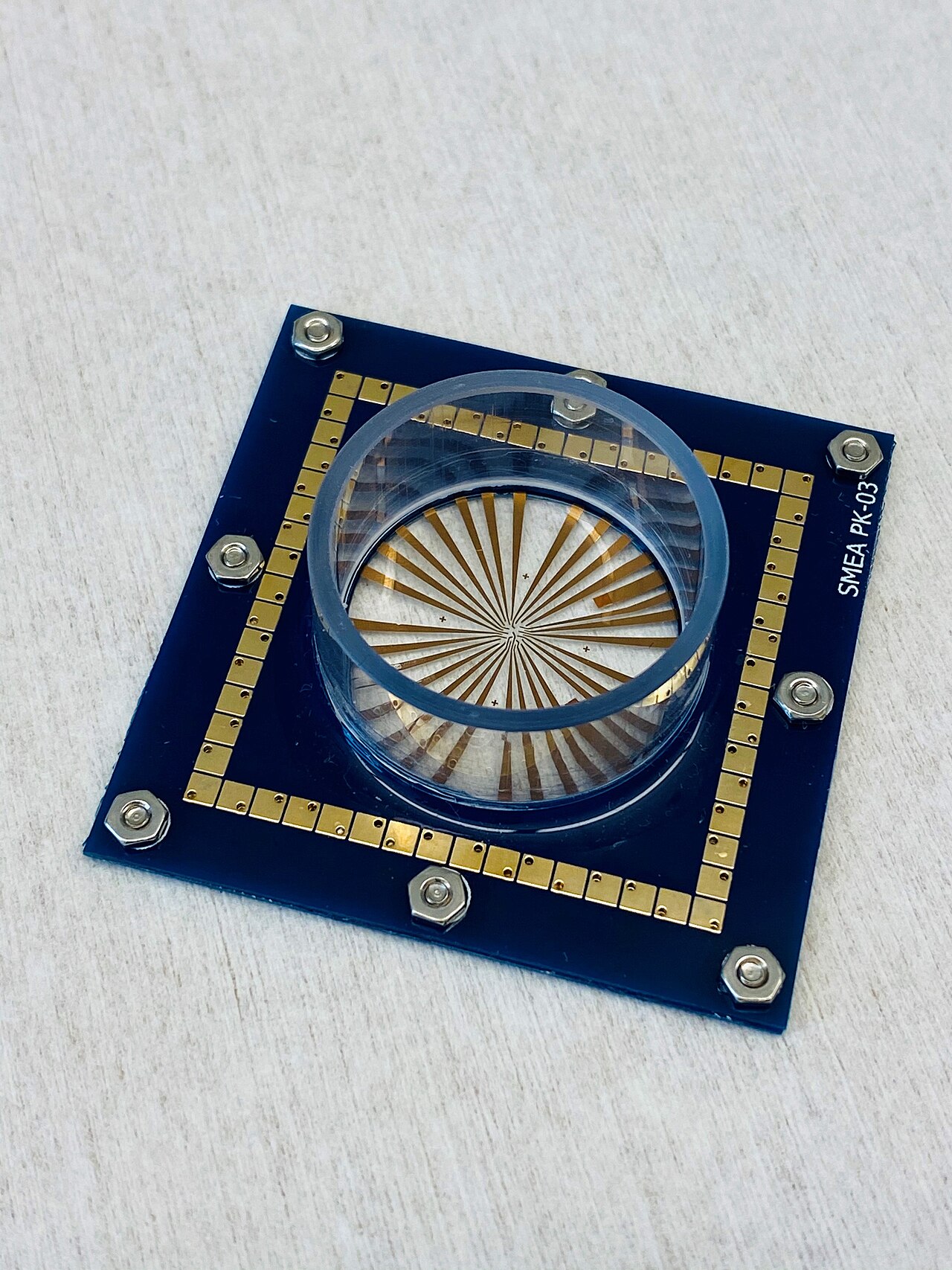
One of the most attention-grabbing results in this whole field involved a dish of living brain cells learning to play the classic video game Pong. A team grew neurons on top of an array of electrodes, fed them electrical signals representing the position of the ball, and let them control the paddle. Over time, the neurons adjusted their activity to keep the ball in play, learning the task through feedback (Kagan et al., Neuron, 2022). The researchers nicknamed the system DishBrain.
What made the result striking was not that the cells played well, because they played fairly crudely, but that a sheet of cultured neurons could learn a goal-directed task at all when embodied in a simulated world. The team framed their findings using the idea that the neurons were minimizing the unpredictability of their inputs, a principle drawn from theories of how brains seek to reduce surprise. Whatever the right interpretation, the experiment showed living neural tissue and a computer working as a single learning loop, blurring the boundary between biological and artificial computation in the most literal way imaginable.
Organoid Intelligence: Computing With Brain Tissue
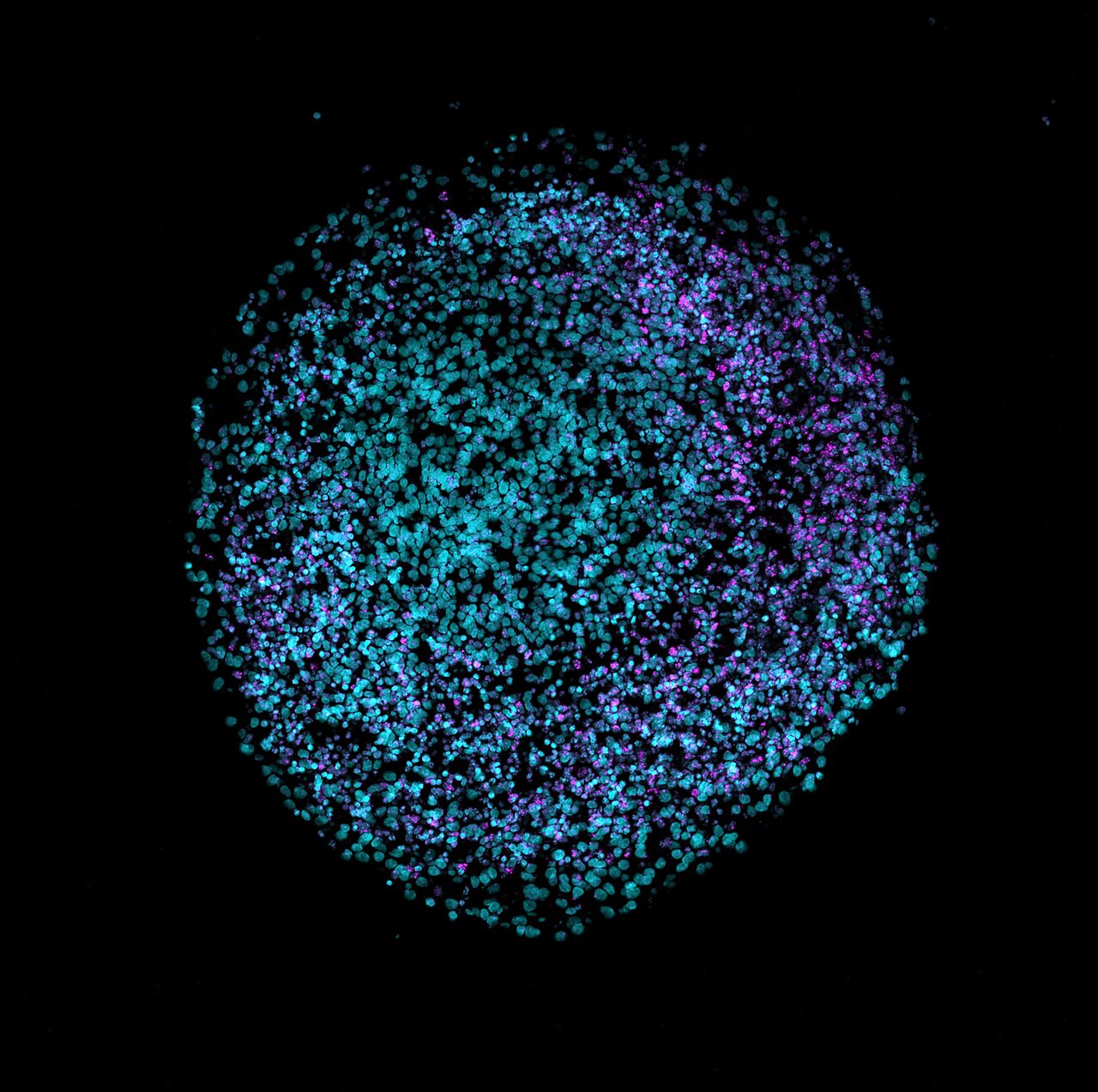
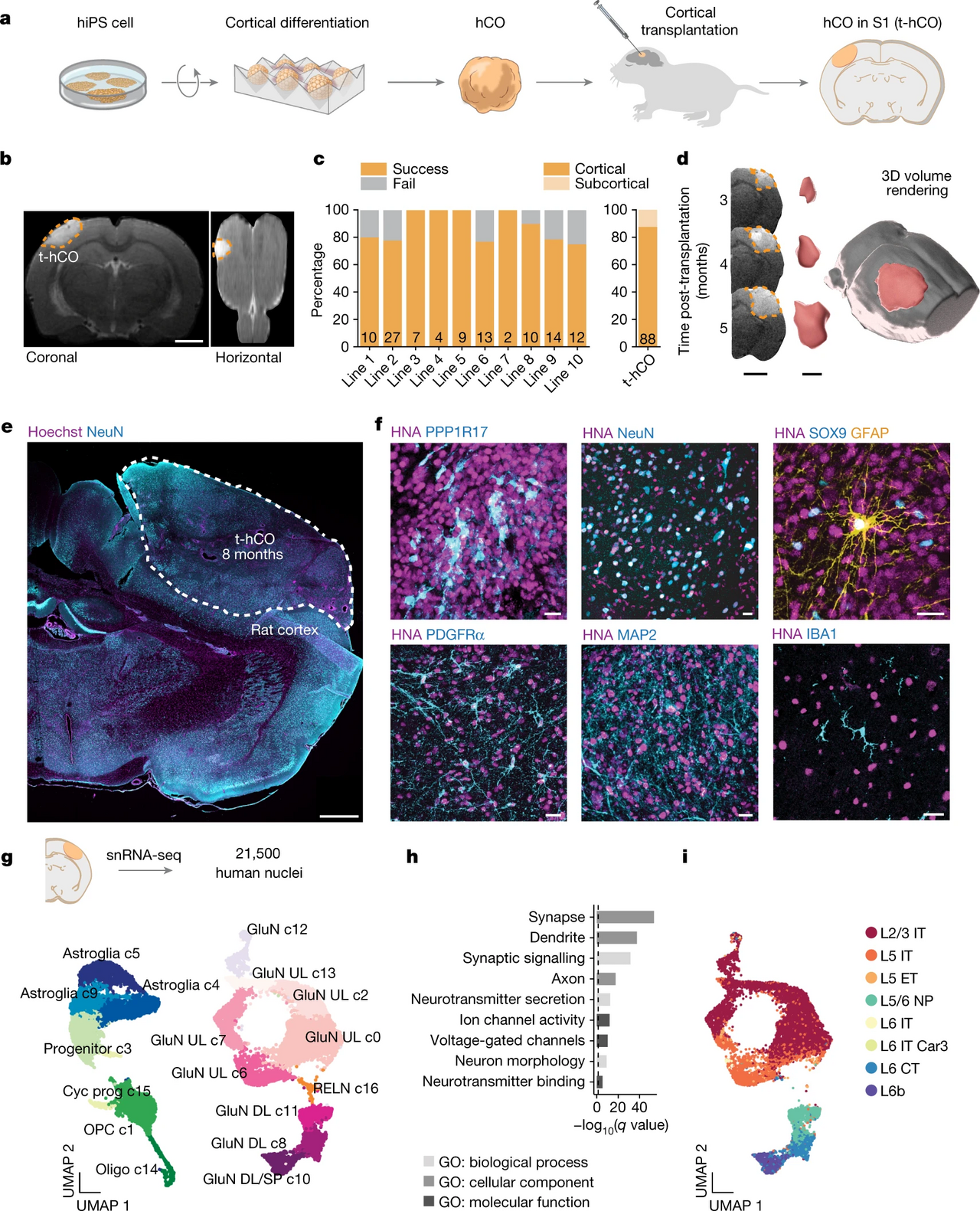
The DishBrain experiment sits at the edge of a much larger and more ambitious idea that has gained a name in the last couple of years: organoid intelligence. Brain organoids are tiny, three-dimensional clumps of neural tissue grown from stem cells, sometimes called mini-brains, though they are nothing like a functioning human brain. The proposal is to harness the natural computational power and astonishing energy efficiency of living neural tissue for information processing, a field its advocates have begun to call biocomputing (Smirnova & Hartung, Nature Reviews Bioengineering, 2024).
The motivation is partly about efficiency. Biological brains perform feats of learning on a power budget that makes even the best AI hardware look wasteful, and tapping into real neural tissue could, in principle, sidestep some of that gap. Reviews of the field have laid out both the tantalizing possibilities and the very real technical hurdles, from keeping organoids alive and nourished to building reliable ways to read information in and out of them (Morales Pantoja et al., Brain Organoid and Systems Neuroscience Journal, 2025). It is early, speculative work, and nobody is replacing a laptop with a dish of neurons anytime soon. But it represents perhaps the most radical interpretation of the brain-machine relationship: not imitating neural networks in silicon, but computing with the wetware directly.
Does the Brain Do Backpropagation?
If you want to start an argument among computational neuroscientists, ask whether the brain uses backpropagation. Backpropagation is the workhorse algorithm that trains essentially every modern artificial network, adjusting connection strengths by passing error signals backward through the layers. For a long time, most neuroscientists assumed the brain could not possibly do this, because the biological machinery did not seem to support sending precise error signals backward across synapses.
That consensus has softened. An influential review argued that, while the brain almost certainly does not implement backpropagation in the exact way computers do, it may well use algorithms that approximate the same thing, achieving similar results through biologically plausible means (Lillicrap et al., Nature Reviews Neuroscience, 2020). The idea is that the brain might compute useful error signals locally and feed them back through its own circuitry, landing in roughly the same place that backpropagation reaches. This reframing matters enormously, because backpropagation has been so successful in AI that finding even a rough biological analogue would suggest the brain and our best machines are solving the learning problem in fundamentally related ways. It remains an open and actively debated question, which is exactly what makes it so interesting.
The Brain as a Reinforcement Learner
Reinforcement learning, the framework in which an agent learns from rewards, has been one of the richest meeting points between AI and the brain, and recent work has pushed the connection into new territory. One striking proposal recast the prefrontal cortex, the brain region tied to planning and flexible behavior, as a kind of meta-reinforcement learning system. In this view, a slower learning process tunes the network so that the network itself can then learn new tasks rapidly, a layered arrangement inspired directly by how advanced AI agents are built (Wang et al., Nature Neuroscience, 2018).
The appeal of this idea is that it explains something brains do effortlessly and machines find hard: learning to learn. A person can pick up a new card game in minutes by drawing on general strategies, rather than starting from zero every time. Framing the prefrontal cortex as a meta-learner offers a computational story for that flexibility, and it does so using concepts that came straight out of AI research. It is a clean example of ideas developed for machines being turned around to illuminate the brain. We trace these themes in our computational neuroscience section, and they build on the dopamine and reward-learning story we covered earlier.
Networks as Microscopes for the Brain
Beyond any single experiment, a broader shift has taken hold: artificial neural networks are increasingly used as scientific models of biological ones. The argument for this was laid out forcefully in a piece making the case for a deep-learning framework for neuroscience, which proposed that thinking in terms of objectives, architectures, and learning rules, the three ingredients of any artificial network, gives neuroscientists a powerful way to understand real brains (Richards et al., Nature Neuroscience, 2019).
The logic is that instead of cataloguing brain regions one cell at a time, researchers can ask what problem a circuit is trying to solve, what structure it has, and what rule it uses to improve, and then build an artificial network with those same ingredients to see if it behaves like the real thing. When it does, the model becomes a testbed for hypotheses that would be impossible to run on living tissue. This approach has already borne fruit in vision and navigation, where artificial networks trained on natural tasks spontaneously developed internal representations resembling those in the brain. The network, in effect, becomes a microscope for ideas, letting scientists peer into computations that biology hides.
New Tools for Reading Neural Activity
A quieter but hugely consequential development is the use of AI to make sense of the torrents of data that modern neuroscience produces. Recording technologies can now capture the activity of thousands of neurons at once, far more than any human could interpret by hand, and machine learning has become essential for finding structure in that flood. A recent method demonstrated how to learn meaningful low-dimensional representations that jointly capture neural activity and behavior, helping researchers connect what the brain is doing to what the animal is doing (Schneider et al., Nature, 2023).
Tools like this matter because the bottleneck in neuroscience has shifted. Collecting neural data is no longer the hard part; understanding it is. By compressing massive recordings into interpretable patterns, AI lets scientists ask sharper questions about how populations of neurons encode decisions, movements, and perceptions. In a neat twist, artificial networks are being used not to imitate the brain here, but to decode it, serving as analytical instruments rather than models. It is yet another facet of a relationship that keeps finding new forms.
Why Both Keep Finding the Same Answers
A theme runs through all of this work that is worth pausing on. Again and again, when artificial networks are trained on the kinds of problems brains evolved to solve, they tend to arrive at brain-like solutions on their own. Networks trained to see develop representations like the visual cortex. Agents trained to navigate develop grid-like codes. Systems built to learn flexibly start to resemble the prefrontal cortex. Nobody hand-builds these resemblances; they emerge.
This pattern hints at something deep, though it should be stated carefully. It may be that certain computational problems have a limited number of good solutions, and that both biological evolution and machine learning, searching for efficiency, keep stumbling onto the same ones. If that is true, then the resemblance between artificial and biological networks is not a coincidence or a borrowed metaphor but a sign of shared underlying principles. That would make the dialogue between the two fields not just productive but fundamental, two different paths converging on the same logic of intelligence. We follow these ideas across our artificial intelligence coverage.
The Cautions and the Ethics
It would be irresponsible to present all this excitement without the counterweight. The resemblances between artificial and biological networks, however striking, are still partial. When a model matches brain activity, it captures one slice of what the brain does and misses enormous amounts of biological detail. Treating these resemblances as proof that machines work like brains, or that brains are just computers, goes well beyond what the evidence supports. The honest position is that the two systems are related in instructive ways and different in equally instructive ways.
The work with living tissue raises sharper concerns still. Experiments that grow neural tissue and teach it tasks, or that aim to compute with brain organoids, force genuinely hard questions about where to draw ethical lines. Could such systems ever have experiences that matter morally? Almost certainly today’s simple cultures and organoids do not, but the field’s own advocates have called for ethical frameworks to be developed alongside the science rather than after it. Responsible progress here means treating these questions as central, not as an afterthought, especially as the tissue involved grows more complex.
Where This Is Heading
The near future of this relationship looks less like a single breakthrough and more like a tightening loop. Recording tools will capture ever more neurons, AI will get better at decoding them, and richer models will feed sharper hypotheses back to the lab. Each turn of that loop should make both our artificial systems and our understanding of biological ones a little better. The most immediate payoffs are likely to come in neuroscience itself and in medicine, where better models and better decoding could improve everything from brain-computer interfaces to treatments for neurological disease.
The more speculative frontiers, computing with living tissue and pinning down whether the brain truly approximates backpropagation, will take longer and may deliver surprises in either direction. Some bold claims will not survive contact with further evidence, as has happened before in this field. But the overall trajectory is clear: the wall between artificial and biological neural networks, once treated as a firm boundary, is becoming a busy two-way crossing. The traffic of ideas, tools, and even living cells moving across it is what makes this one of the most exciting corners of science right now. Explore more in our neuroscience and biocomputing coverage.
Closing Thoughts
Not long ago, the link between artificial and biological neural networks could be summed up in a single sentence about inspiration. Today it takes a whole roundup to cover, and even that leaves things out. Living neurons learn to play games in a dish; organoids are floated as a new computing substrate; the brain’s learning rule is being matched against the algorithms that power AI; and trained networks double as both models and microscopes for the cortex. What ties it all together is a growing suspicion that intelligence, whether it grows in a skull or is trained on a server, may obey a shared set of rules we are only beginning to read. The two kinds of neural network started as a metaphor for each other. They are turning out to be something closer to relatives. For more, browse our coverage of neural networks, computational neuroscience, and organoid intelligence.