Sometime around the middle of the second millennium BC, on a prosperous island in the southern Aegean, a town died in fire and ash. Its people had already fled, warned by the earthquakes that shook their homes, and they carried their most precious things with them, leaving behind the walls, the furniture, the storage jars, and the painted rooms of a thriving Bronze Age port. Then the volcano at the heart of their island erupted with a violence that reshaped the map of the Aegean, and the town vanished beneath metres of pumice and ash. It lay hidden for three and a half thousand years, and when it finally emerged it proved to be one of the most astonishingly preserved settlements of the ancient world, a Bronze Age town frozen at the moment of its abandonment.
This is Akrotiri, on the island now called Santorini and known in antiquity as Thera. Often described as a Bronze Age Pompeii, Akrotiri is in truth even more remarkable than that comparison suggests, for it belongs to a far more distant age, and its preservation is so complete that houses survive to their upper storeys, staircases still climb, and walls still blaze with some of the finest paintings to come down to us from the prehistoric Mediterranean. The eruption that destroyed it was one of the largest in human history, an event whose ash fell across the eastern Mediterranean and whose memory may echo in later legends. Akrotiri is where that catastrophe and the vivid, sophisticated culture it buried can both be seen at once.
Contents
- The Island Before the Blast
- A Town Ahead of Its Time
- Walls That Still Blaze With Color
- Daily Life in a Bronze Age Port
- A Cousin of Minoan Crete
- The Earthquakes and the Escape
- The Eruption That Shook the Aegean
- Atlantis, the Exodus, and Other Echoes
- The Rediscovery of a Lost Town
- Digging and Protecting a Fragile Treasure
- Visiting Akrotiri Today
- Nearby Places
- Final Word
The Island Before the Blast
Before the eruption, Thera was a very different place from the crescent-shaped island we see today. The great flooded caldera that now makes Santorini so spectacular did not yet exist in its current form; instead the island was larger and more rounded, with a volcano rising near its center. It was fertile enough to support farming and vineyards, well positioned on the sea routes that linked Crete to the other Cycladic islands and the Greek mainland, and blessed with harbors that made it a natural stopping point for the traders who crisscrossed the Aegean. On this thriving island, at the site of Akrotiri on its southern shore, a substantial town grew up.
Akrotiri was not a village but a genuine urban settlement, one of the most important in the Aegean of its day. Its prosperity came from its position: ships plying between the great palace civilization of Minoan Crete to the south and the islands and mainland to the north passed this way, and Akrotiri profited from the trade. Imported goods found in the town, pottery, raw materials, and objects from Crete, the mainland, and further afield, show it plugged into a wide network of exchange. This was a cosmopolitan port, wealthy, connected, and culturally sophisticated, at the height of the Aegean Bronze Age.
The people of Akrotiri were part of the brilliant world of the second-millennium Aegean, contemporaries of the Minoans on Crete and forerunners of the Mycenaeans on the mainland. Their material culture was rich and refined, their houses well built and comfortable, their art among the most accomplished of its era. Everything about the town suggests a confident, flourishing community that had every reason to expect its prosperity to continue, right up to the moment the ground beneath it began to shake.
A Town Ahead of Its Time
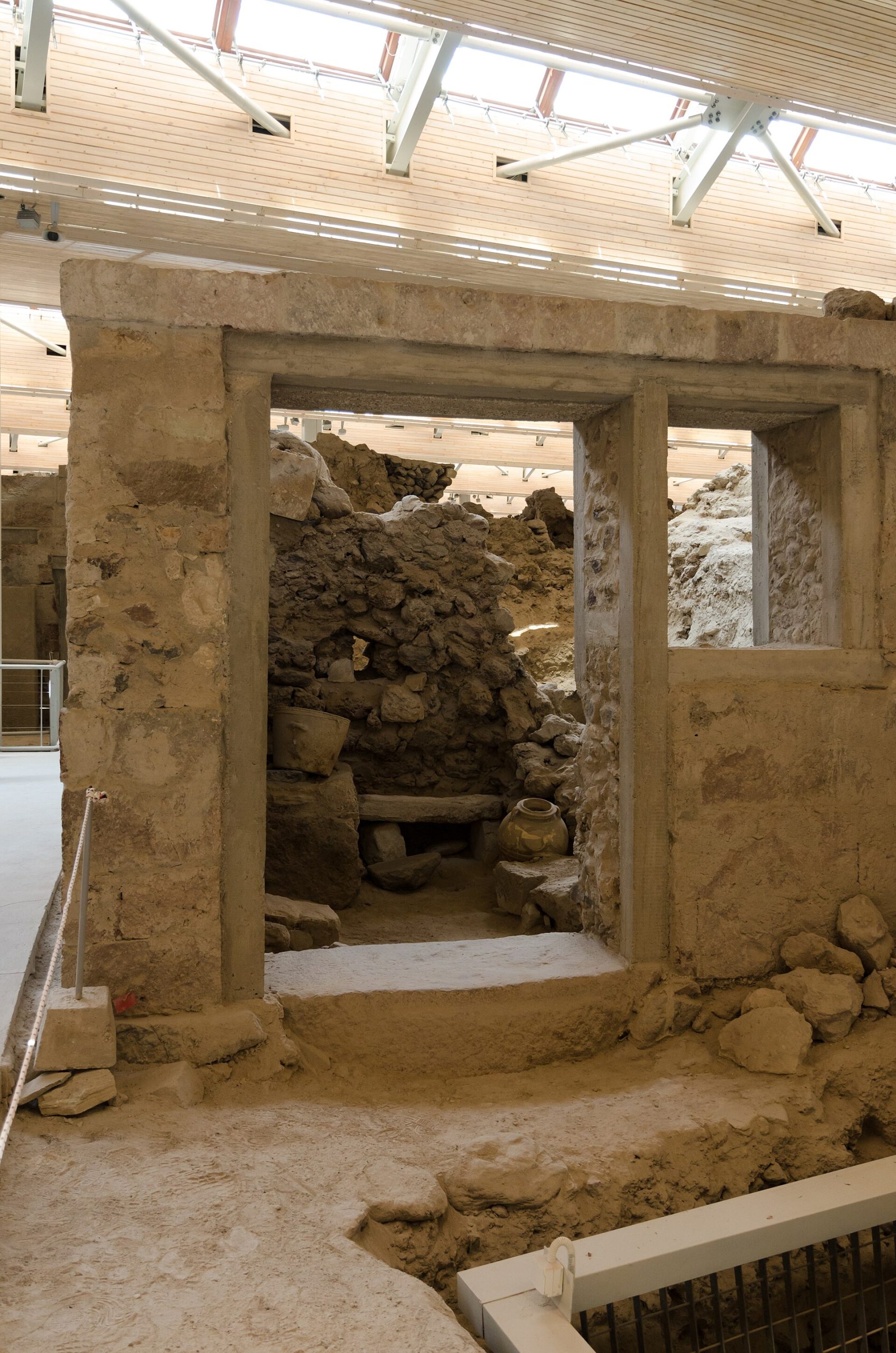
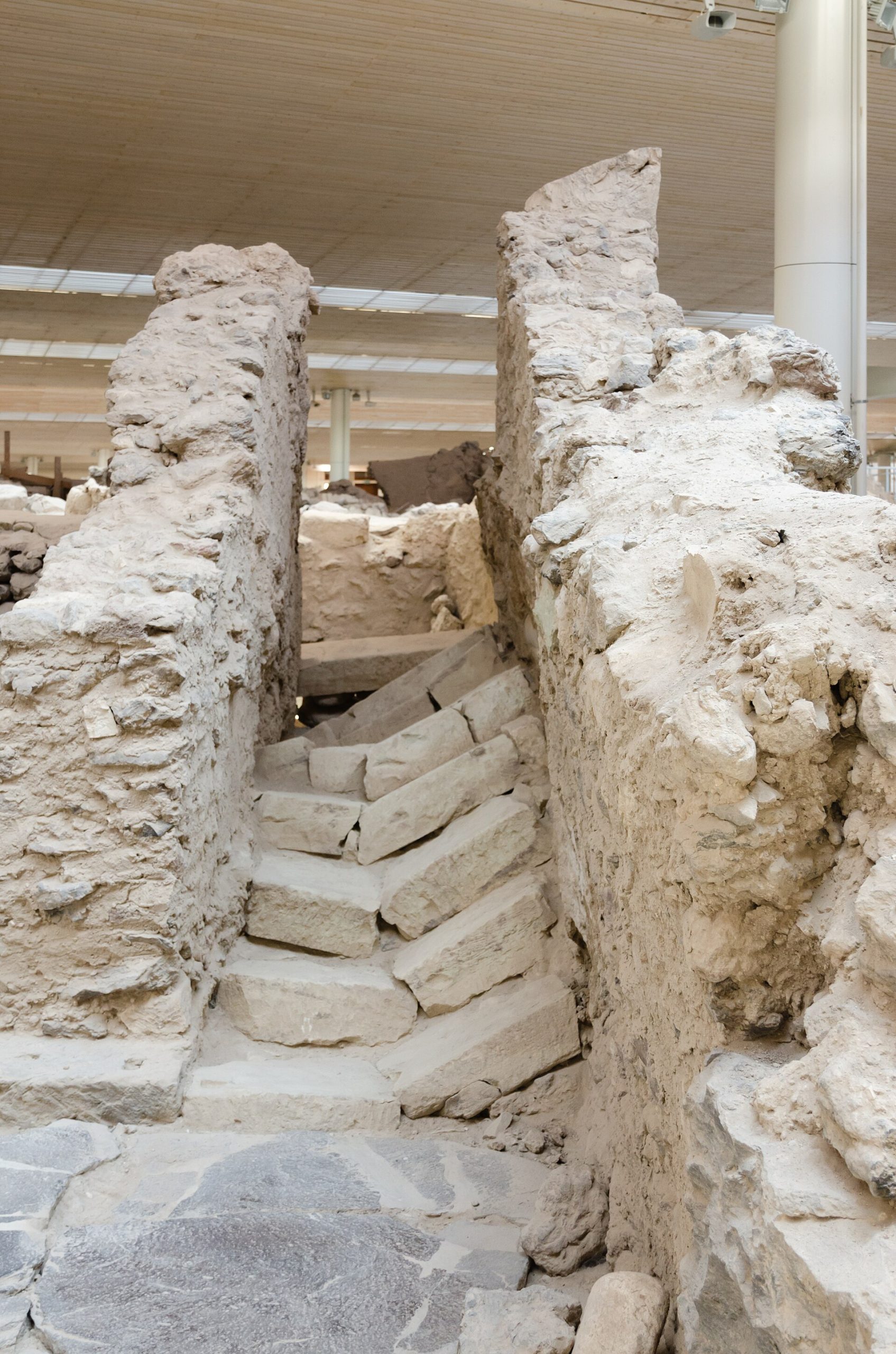
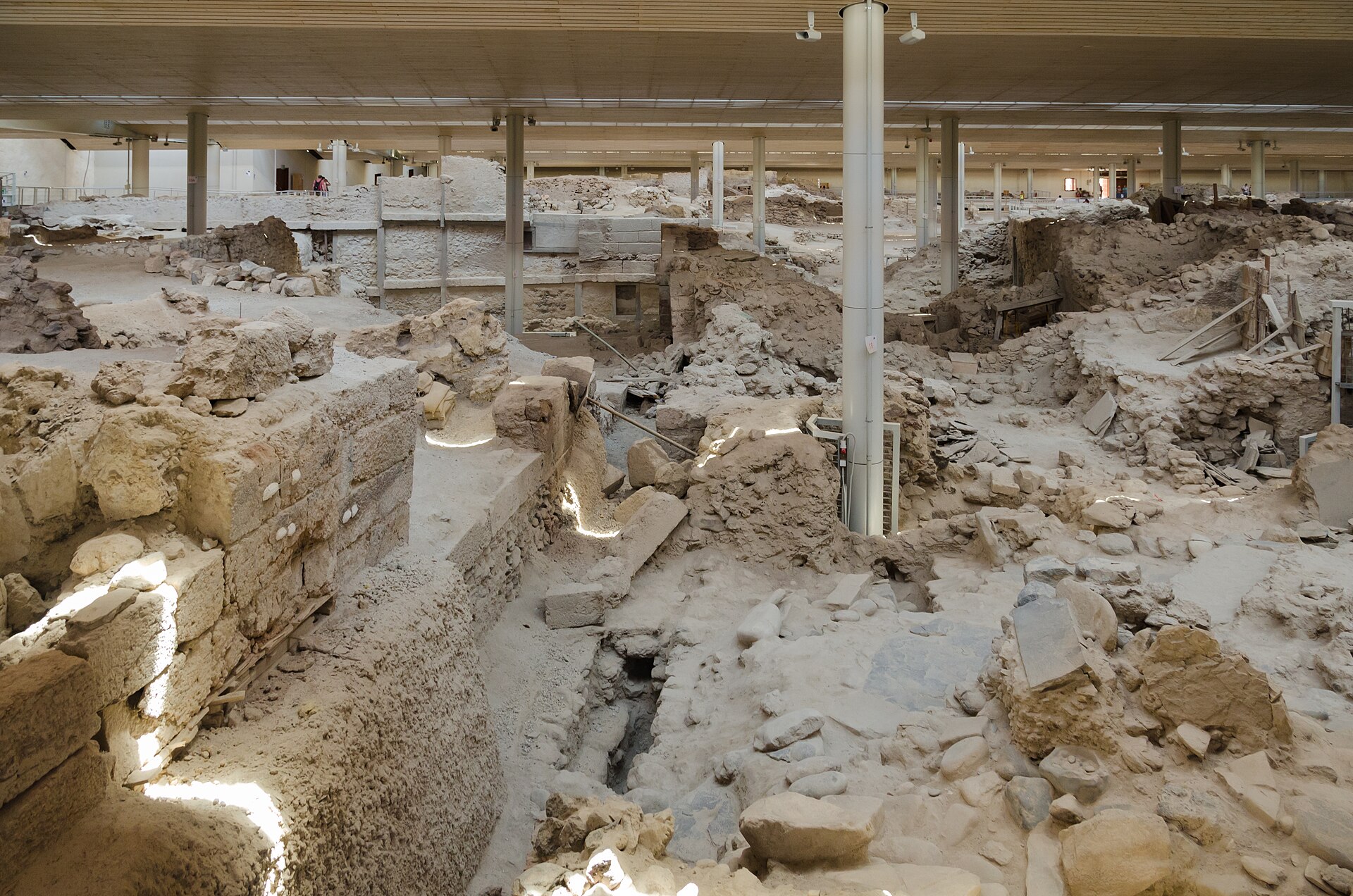
What excavation has revealed at Akrotiri is a town of surprising sophistication. Its houses were substantial, often several storeys high, built of stone and timber-laced walls designed, it seems, with earthquakes in mind, for this was a land that shook often. The buildings were closely packed along narrow, winding, paved streets, and many were fine structures with numerous rooms, some clearly the homes of prosperous families. The preservation is such that in places staircases still rise from floor to floor and window and door openings survive intact, allowing archaeologists to reconstruct the vertical structure of Bronze Age houses as almost nowhere else.
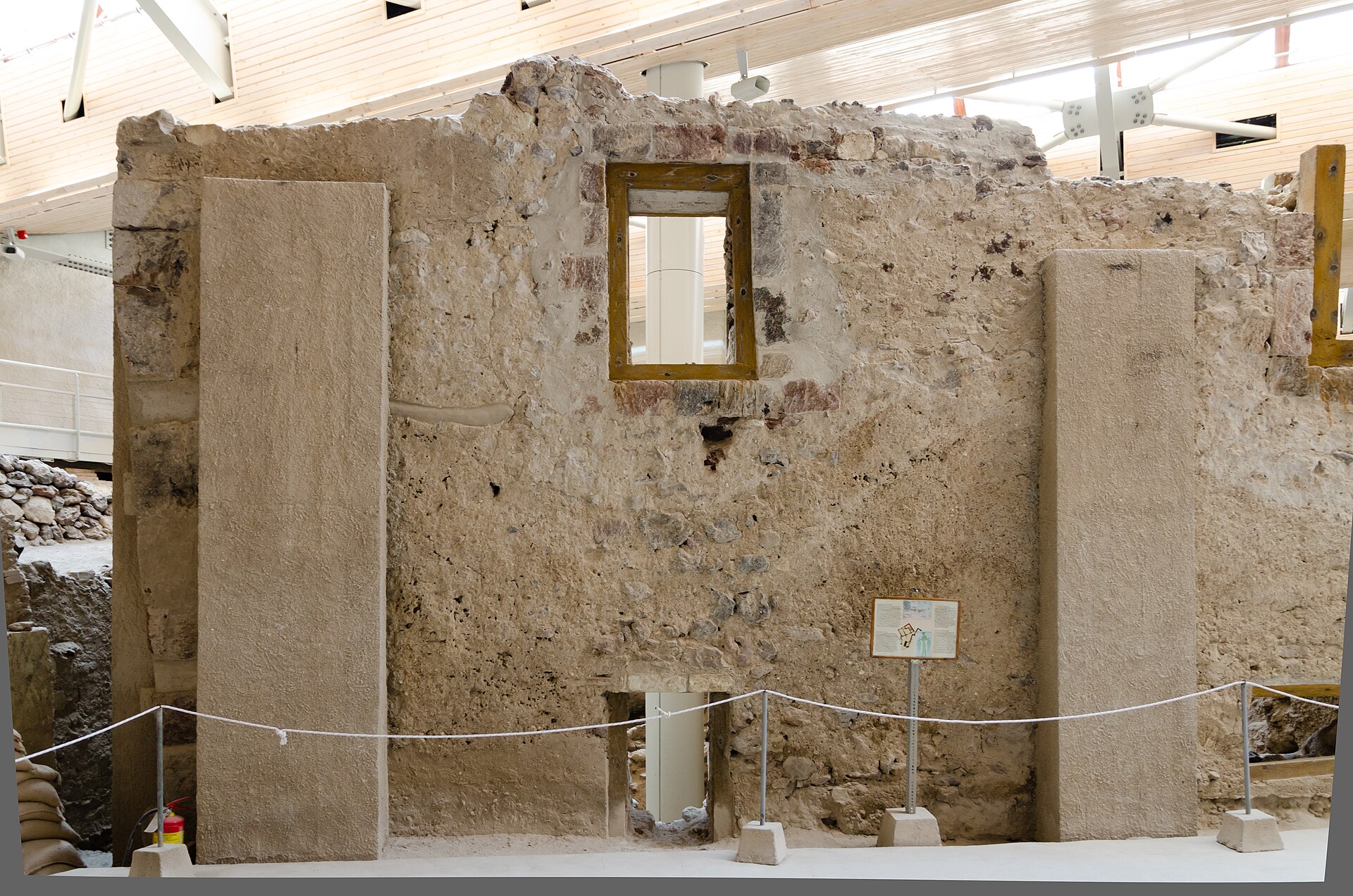
Most striking of all is the evidence for advanced urban infrastructure. Akrotiri had a drainage and sewage system built into the fabric of the town, with clay pipes running beneath the streets to carry away waste and rainwater, an amenity that would not be common again in Europe for many centuries. The presence of such a system, together with the quality of the housing and the abundance of stored goods, tells us this was a well-organized community with the collective resources and knowledge to build and maintain public works, not merely a cluster of dwellings but a planned and managed town.
Inside the houses, excavators found the ordinary furnishings of Bronze Age life preserved by the ash: great storage jars, or pithoi, still holding traces of their contents; pottery of local and imported manufacture; grinding stones, loom weights, tools, and cooking equipment; even, in some cases, the impressions of wooden furniture that had rotted away, from which plaster casts could be made, exactly the technique that famously revealed the victims of Pompeii. Room by room, the daily material world of a town that lived and died in the seventeenth century BC has been recovered, an almost unparalleled window into prehistoric urban life.
Walls That Still Blaze With Color
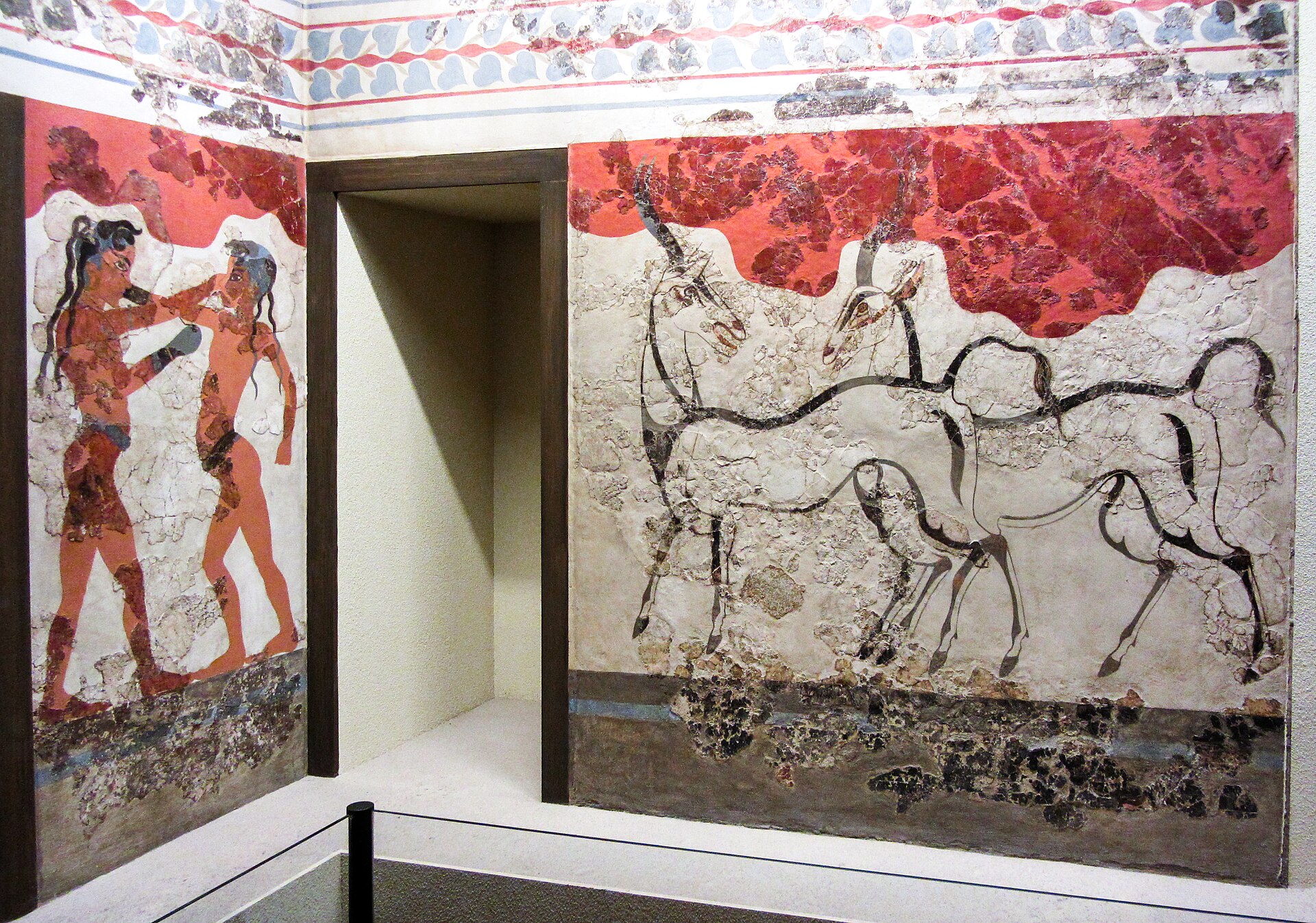
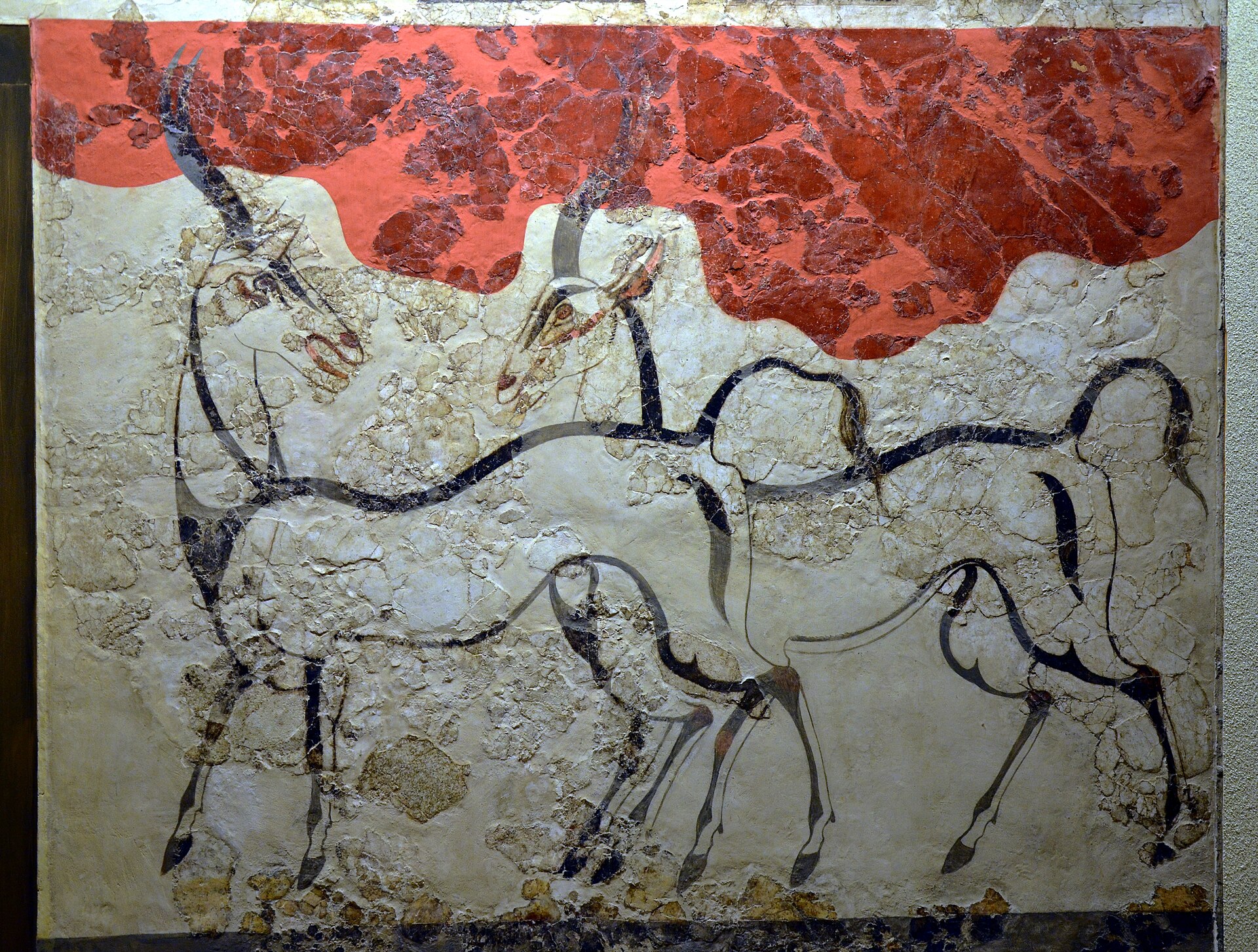
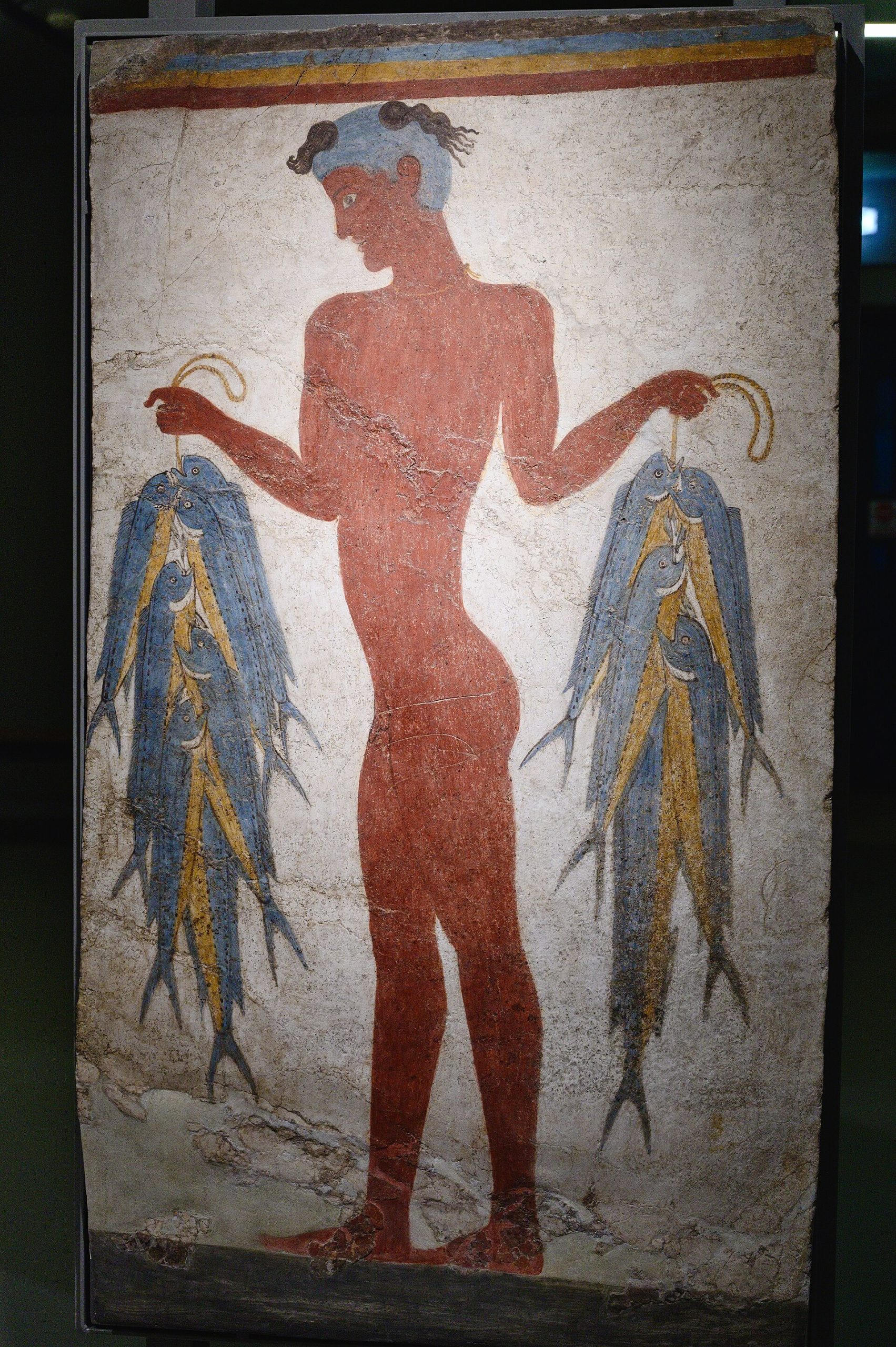
The glory of Akrotiri is its wall paintings. Preserved by the very ash that destroyed the town, the frescoes of Akrotiri are among the finest and most complete to survive from the entire Bronze Age Aegean, and they transform our understanding of prehistoric art. Painted directly onto the plastered walls of houses in brilliant mineral pigments, they depict a world of astonishing vividness and grace: young men and women, animals, plants, ships, and landscapes rendered with a freedom and naturalism that is startling in art more than three and a half thousand years old.
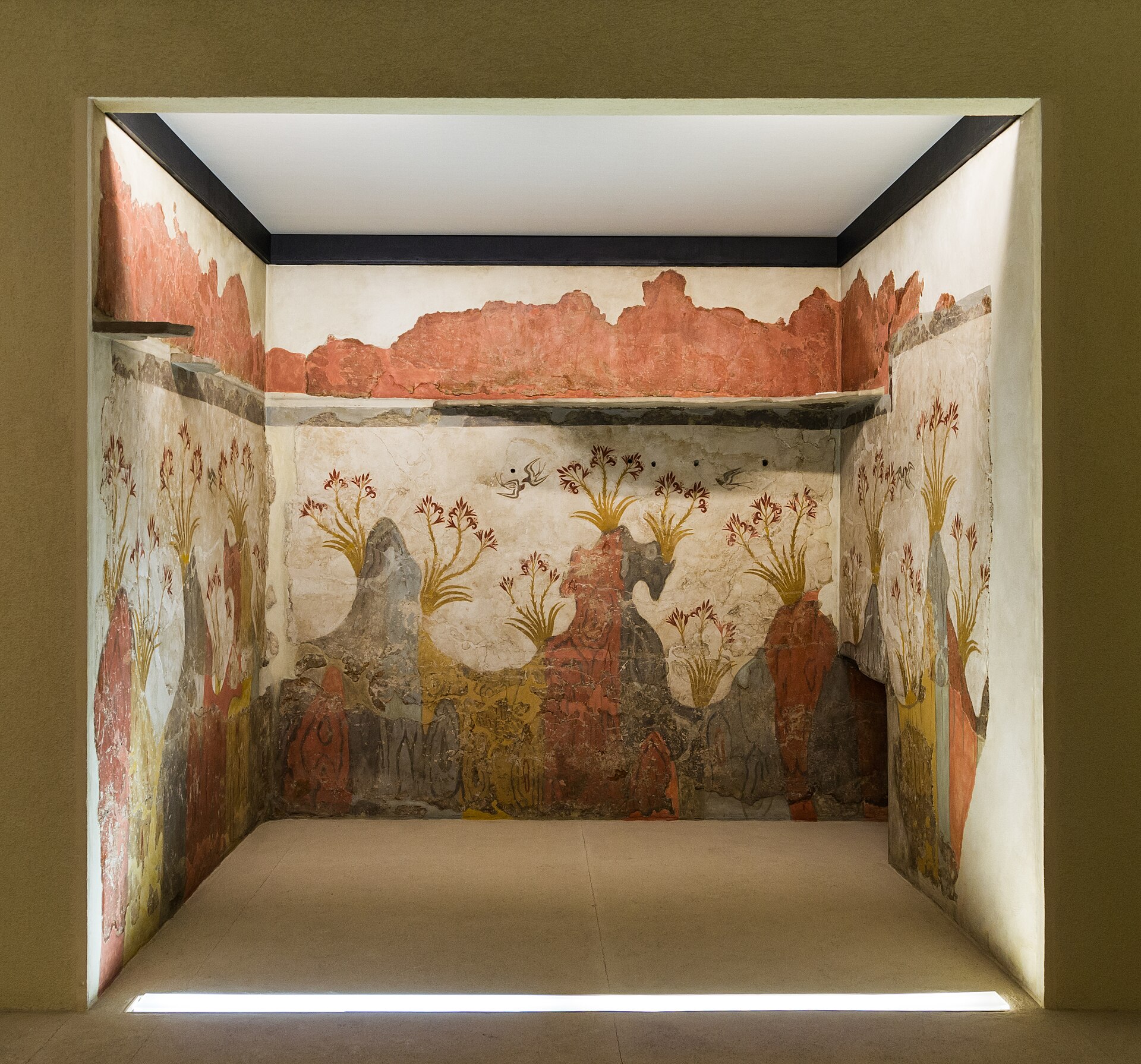
The subjects are wonderfully varied. The Spring Fresco covers the walls of a single room with a rocky volcanic landscape from which red lilies spring, while pairs of swallows dart and court in the air above, one of the earliest pure landscape paintings known anywhere. The famous scene of two boxing boys, their fists bound in gloves, captures childhood and sport with delicate observation. A young fisherman holds up strings of his gleaming catch. Graceful antelopes are drawn with a few sure, sweeping lines that any modern artist would admire. Elsewhere elegant women in elaborate dress take part in what seem to be religious rituals, gathering flowers or making offerings.
Most ambitious of all is the great miniature frieze from the building known as the West House, which shows a flotilla of ships sailing between two towns, with people, animals, and buildings depicted in extraordinary detail. This ship procession is a documentary treasure, offering an unmatched picture of Bronze Age vessels, coastal towns, and maritime life. Together the Akrotiri frescoes reveal a culture that delighted in the natural world, in the sea, in ritual and celebration, and that possessed artists of the highest skill. They are the reason the town is not just an archaeological curiosity but one of the great art discoveries of the twentieth century.
Daily Life in a Bronze Age Port
The finds from Akrotiri allow us to reconstruct the daily life of its inhabitants in unusual detail. This was a community that lived by the sea and by trade. The frescoes of ships and fishermen, the imported goods in the houses, and the town’s harborside position all point to a maritime economy in which fishing, seafaring, and commerce were central. On land the Therans farmed, growing grain and, as the abundant evidence for viticulture suggests, cultivating vines; Santorini’s volcanic soil produces distinctive wines to this day, continuing a tradition that reaches back to the Bronze Age.
The interiors of the houses reveal a comfortable and ordered domestic life. Rooms were set aside for storage, for food preparation, for work such as weaving, indicated by the many loom weights found, and for living, some of them richly decorated with the frescoes for which the town is famous. Beautiful painted pottery, both locally made and imported from Crete and elsewhere, graced Theran tables and shelves. The overall impression is of a prosperous, settled society with the leisure and wealth to invest in fine houses, imported luxuries, and art on their walls.
One of the great puzzles of Akrotiri is what it does not contain. Unlike Pompeii, the town has yielded no human remains and very little in the way of gold, jewelry, or other portable valuables. The clear implication is that the inhabitants had time to escape, and that they took their most precious possessions and, apparently, themselves with them. Where these Bronze Age refugees went, and whether they survived the wider catastrophe, we do not know; no cemetery of the fleeing Therans has been found, and their fate remains one of the haunting open questions of the site.
A Cousin of Minoan Crete
Akrotiri did not exist in isolation. Its art, architecture, and material culture show close and constant connections with the Minoan civilization of Crete, the dominant power of the Aegean in this period, and scholars often describe Theran culture as belonging to the wider Minoan cultural sphere. The frescoes are painted in techniques and styles closely related to those of the Cretan palaces; the pottery, the religious symbols, and even a system of writing found on the island all echo Minoan models. Theran society clearly looked to Crete, sixty or so miles to the south, as a cultural and perhaps political center.
Yet Akrotiri was not simply a Minoan colony. It had its own character, its own local pottery styles, and its own artistic emphases, and the relationship between Thera and Crete was probably one of a prosperous island community within, but not wholly subordinate to, the Minoan world. Whether the Cretan palaces exercised any direct control over Thera, or whether Akrotiri was an independent town that shared in a common Aegean culture, is debated. What is clear is that the two were bound together by trade, religion, and art, part of a single brilliant civilization that flourished across the southern Aegean in the earlier second millennium BC.
This connection makes the destruction of Akrotiri historically significant far beyond the island itself. The eruption that buried the town struck at the heart of the Minoan world at, or near, its zenith, and the question of how far it contributed to the eventual decline of Minoan Crete has been one of the great debates of Aegean archaeology. Whatever the answer, Akrotiri offers an unrivalled snapshot of Minoan-influenced culture at its height, better preserved on Thera than anywhere on Crete itself, because here the ash sealed everything in place.
The Earthquakes and the Escape
The people of Akrotiri did not die suddenly and unaware. The archaeological evidence tells a clear story of warning and flight. Before the great eruption, the volcano announced itself with severe earthquakes, and the signs of these tremors are visible throughout the town: collapsed walls, damaged buildings, and, tellingly, evidence that the inhabitants had begun to clear rubble and make repairs. In some places heaps of debris from the quakes were found piled up, as if the townspeople were in the middle of cleaning up when they finally decided the situation was hopeless and left.
That the inhabitants escaped is the great mercy of Akrotiri’s story, and the reason it differs so profoundly from Pompeii. No bodies have been found in the excavated areas, and the removal of valuables shows a deliberate, unhurried evacuation rather than a panicked flight before a sudden disaster. It seems the earthquakes gave the Therans enough warning to abandon their town in good order, taking what they could carry and leaving behind only what was too heavy or too fixed to move: the storage jars, the furniture, the walls, and the paintings that make the site so extraordinary.
There was, it appears, a pause between the earthquakes and the eruption itself, perhaps weeks or months, during which the town stood empty and partly repaired, waiting. When the eruption finally came, it fell upon a deserted place. This sequence explains the peculiar character of the site: a fully furnished town, rich with the objects of daily life and glowing with painted walls, but empty of its people, a home from which the family had gone, preserved forever at the moment just after they walked out the door.
The Eruption That Shook the Aegean
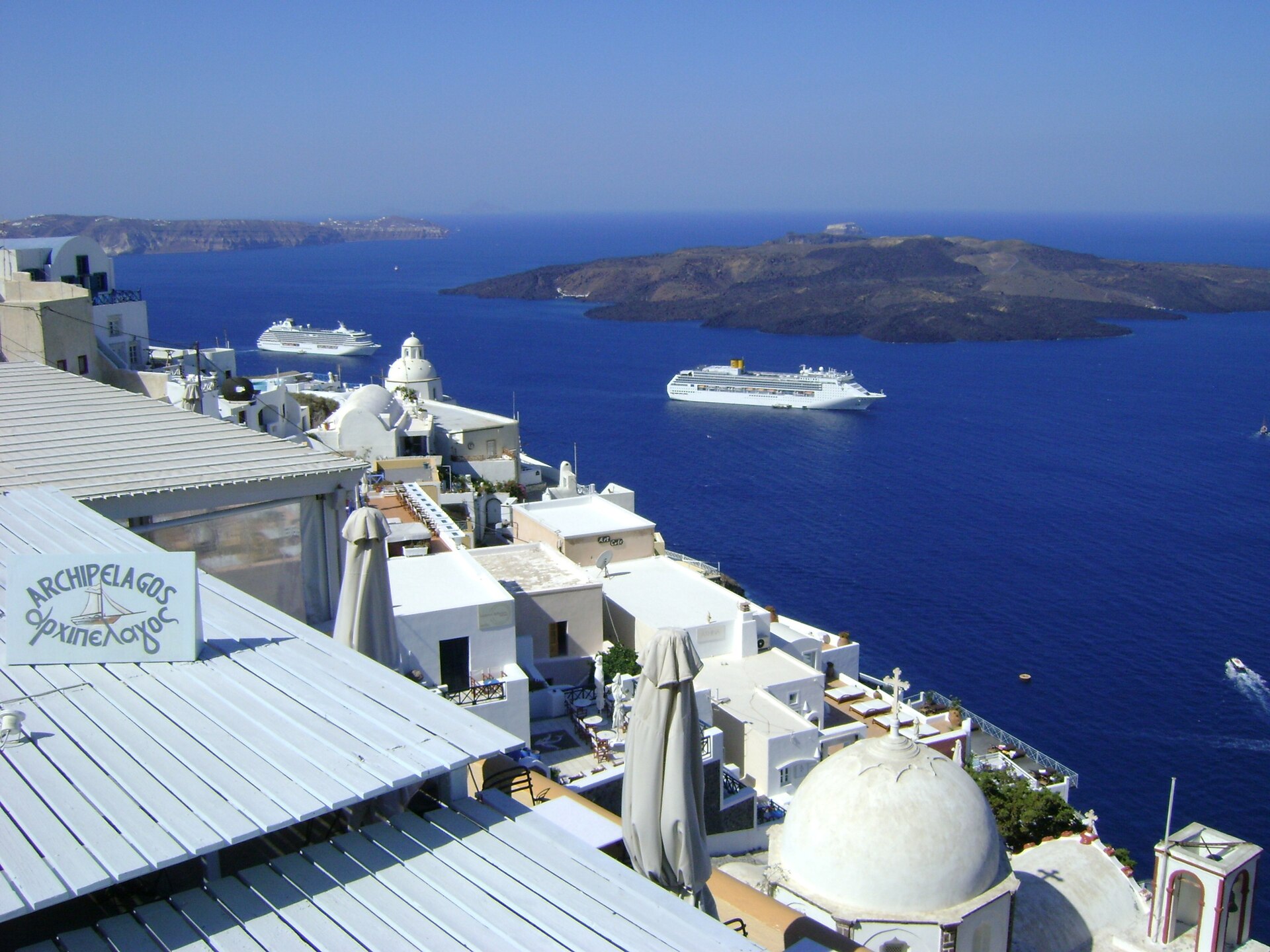
The eruption of Thera was one of the largest volcanic events in human history. When the volcano finally exploded, in the second half of the second millennium BC, it ejected an immense volume of rock and ash, emptying its magma chamber so completely that the center of the island collapsed into the sea, creating the vast flooded caldera that gives Santorini its dramatic modern shape. The layers of pumice and ash that fell on Akrotiri, burying it to a great depth, are only the local record of a blast whose debris was carried across the eastern Mediterranean, with ash layers from the eruption identified in sediments and ice cores far from the island.
The consequences reached far beyond Thera. An eruption of this magnitude would have generated tsunamis that swept across the Aegean, and many scholars believe these waves struck the northern coast of Crete, damaging Minoan harbors and settlements. The ash fall would have affected agriculture over a wide area, and the sheer scale of the event must have sent shockwaves, literal and figurative, through the whole Aegean world. Precisely how much the eruption contributed to the later decline of Minoan civilization remains debated, but it is hard to imagine so vast a catastrophe at the heart of the Aegean leaving that world unshaken.
The exact date of the eruption is itself one of the most contested questions in Aegean archaeology and beyond. Traditional dating based on Egyptian and archaeological cross-connections points to the later part of the sixteenth century BC, while scientific methods such as radiocarbon dating and the study of tree rings and ice cores tend to suggest a date a century or so earlier. The discrepancy of roughly a hundred years has enormous implications for the chronology of the entire Bronze Age Mediterranean, and the debate between the archaeological and scientific dates has been long and vigorous, with no fully agreed resolution yet in sight.
Atlantis, the Exodus, and Other Echoes
So great a catastrophe, striking so brilliant a civilization, has inevitably attracted speculation that it left its mark on later legend. The most famous suggestion connects Thera with the myth of Atlantis. Plato, writing in the fourth century BC, described a great and sophisticated island civilization that was destroyed in a single terrible day and night and swallowed by the sea. Some scholars and many enthusiasts have proposed that a distant memory of the destruction of Thera and the collapse of Minoan power, passed down and transformed over the centuries, lies behind Plato’s tale. The parallels, a wealthy maritime culture overwhelmed by natural disaster, are suggestive, though the connection remains speculative and is far from universally accepted.
Others have wondered whether the eruption might lie behind elements of the biblical account of the plagues of Egypt and the Exodus, since a volcanic event of this size could in principle produce darkened skies, strange weather, and other phenomena over a wide region. Such connections are highly conjectural, and the chronological and geographical difficulties are considerable. But the very fact that scholars reach for these great legends of destruction shows the scale of the Thera eruption: it was the kind of event that could plausibly have echoed down the centuries in the collective memory of the Mediterranean peoples.
What we can say with confidence is that the eruption was a defining event of its age, and that Akrotiri gives us the human face of it: not a myth, but a real town, with real streets and houses and paintings, destroyed by a real volcano. Whether or not any legend preserves its memory, the town itself is the true and tangible record of the catastrophe, more eloquent than any myth precisely because it is not a story but a place, buried and preserved, that we can walk through today.
The Rediscovery of a Lost Town
The existence of ancient remains under the volcanic deposits of Santorini had been suspected since the nineteenth century, when quarrying of the island’s pumice for use in building the Suez Canal turned up traces of buried structures and objects. Early investigators recognized that something ancient lay beneath the ash, but the systematic excavation of Akrotiri did not begin until 1967, when the Greek archaeologist Spyridon Marinatos began digging at the southern end of the island. Marinatos had long theorized that the Thera eruption might explain the decline of Minoan Crete, and he came to Santorini looking for evidence to test his idea.
What he found exceeded all expectations. Beneath the deep blanket of pumice and ash lay not a few scattered ruins but a whole town, its buildings standing to remarkable heights, its rooms full of objects, its walls covered in paintings. The discovery was a sensation, one of the great archaeological finds of the twentieth century, and it made Akrotiri famous overnight. Marinatos devoted the rest of his career to the site, and in a fittingly dramatic turn he died there in 1974, killed by a fall at the excavation, and was buried, by his own wish, at the town he had brought back into the light.
Excavation has continued in the decades since, though only a portion of the ancient town has yet been uncovered; much of Akrotiri still lies buried under the volcanic deposits, awaiting future investigation. Each season’s work adds to the picture, and the site remains an active field of research. The care and slowness of the digging reflect both the fragility of what is being uncovered and the awareness that Akrotiri is a finite and irreplaceable treasure, to be revealed gradually and protected as it goes.
Digging and Protecting a Fragile Treasure
Preserving Akrotiri has been a challenge equal to excavating it. The buildings and frescoes that survived so miraculously under the ash are extremely fragile once exposed, vulnerable to weather, humidity, and the sheer weight of the volcanic deposits that both preserved and threatened them. From the beginning the site was covered with a protective roof to shelter it, but this raised its own difficulties. In 2005 the original shelter collapsed, tragically killing a visitor and forcing the site to close while a new, larger, and safer structure was designed and built. It reopened years later beneath a modern bioclimatic roof that protects the ruins while allowing visitors to move above and among them on raised walkways.
The frescoes have required their own painstaking conservation. Found in fragments, fallen from the walls and buried in the ash, they had to be recovered piece by piece and reassembled like immense and delicate jigsaw puzzles, a process demanding great skill and patience. The restored paintings are among the most precious objects in Greek archaeology, and many are displayed in museums, some on Santorini itself and others in the National Archaeological Museum in Athens, where the finest examples can be seen. Whether the frescoes should remain on the island or be shown in Athens has itself been a matter of some feeling among Santorinians.
The whole enterprise of Akrotiri, excavation, conservation, protection, and display, illustrates the responsibilities that come with such an extraordinary inheritance. The town survived three and a half thousand years under the ash; the task now is to ensure that its emergence into the modern world does not destroy what the volcano preserved. The new shelter, the careful conservation, and the controlled access all reflect a determination to keep Akrotiri safe for the future, so that generations to come can walk through a Bronze Age town as we now can.
Visiting Akrotiri Today
Modern Santorini is one of the most visited islands in the world, famous for its whitewashed villages perched on the rim of the caldera, its sunsets, and its dramatic volcanic scenery, all of it the direct legacy of the eruption that destroyed Akrotiri. Amid the crowds drawn by the views, the archaeological site at the island’s southern end offers something deeper: a chance to step out of the holiday island and into the Bronze Age town that lies at the root of Santorini’s whole story. Sheltered beneath its great modern roof, the excavated part of Akrotiri can be explored on elevated walkways that lead visitors over and through the ancient streets and buildings.
From these walkways one looks down into the rooms of houses that stand, in places, two and three storeys high, sees the storage jars still in position, and traces the narrow paved lanes of a town abandoned three and a half thousand years ago. The scale and preservation are genuinely astonishing, and the experience is quite different from that of most ancient sites, where only foundations remain; here whole buildings survive. To complete the picture, the museums of Santorini and Athens display the frescoes, pottery, and other finds, so that the empty painted rooms of the site can be mentally refilled with the brilliant images that once covered their walls.
For all the fame of Santorini’s sunsets, it is Akrotiri that gives the island its profoundest interest. To stand above the buried town, with the caldera formed by the eruption visible not far away, is to hold both halves of the story at once: the vivid, sophisticated Bronze Age community that lived here, and the volcanic catastrophe that ended it and shaped the island we see today. Few places connect human history and natural power so directly, or preserve so completely a single moment of the deep past.
Nearby Places
- Knossos: The Palace Behind the Myth of the Minotaur
- Delos: The Sacred Island of Apollo
- Mycenae: The Golden Citadel of Agamemnon
Final Word
Akrotiri is the town the volcano saved by destroying. When the great eruption of Thera buried it beneath metres of ash, it sealed a Bronze Age port at the very moment of its abandonment, preserving houses to their upper storeys, streets and drains, storage jars and furniture, and above all the luminous frescoes that rank among the greatest art of the ancient world. Its people, warned by earthquakes, had already fled, leaving behind a home frozen in time for three and a half thousand years. Rediscovered in the twentieth century and still only partly uncovered, Akrotiri lets us walk through a real prehistoric town and glimpse the brilliant Aegean civilization that flourished, and vanished, in the shadow of a volcano. It remains one of the most extraordinary windows into the deep human past anywhere on earth.