In a broad coastal plain south of the Bay of Naples stand three of the best-preserved Greek temples anywhere in the world, and they are not in Greece at all. They rise from the fields of southern Italy, honey-colored in the sun, their massive Doric columns almost complete, so intact that they seem less like ruins than like buildings the ancient Greeks abandoned only yesterday. This is Paestum, a Greek city founded on Italian soil more than two and a half thousand years ago, and its temples are among the finest surviving monuments of Greek architecture, better preserved, in some respects, than almost anything left standing in Greece itself.
Paestum is a reminder of a fact easily forgotten: that the Greek world was far larger than the Greek homeland. For centuries the Greeks planted colonies across the Mediterranean, and southern Italy and Sicily became so thickly settled with Greek cities, so rich and so cultured, that the Romans called the region Magna Graecia, Great Greece. Paestum, known to the Greeks as Poseidonia, the city of Poseidon, was one of these colonies, and its story carries us from Greek foundation through conquest by an Italic people to absorption into Rome, and finally to abandonment and rediscovery. Through it all, the great temples endured, and today they make Paestum one of the most beautiful and evocative ancient sites in Europe.
Contents
- The Greek World Beyond Greece
- Poseidonia, the City of Poseidon
- Three Temples That Refused to Fall
- The So-Called Temple of Neptune
- The Temple of Hera and the Puzzle of Names
- The Temple of Athena
- The Tomb of the Diver
- From Greek City to Lucanian Town
- Paestum Becomes Roman
- Marsh, Malaria, and Oblivion
- Rediscovery and the Grand Tour
- Nearby Places
- Final Word
The Greek World Beyond Greece
To understand Paestum, one must first understand the great age of Greek colonization. From roughly the eighth century BC, the cities of the Greek homeland, driven by population pressure, land hunger, trade, and political conflict, sent out streams of colonists to found new cities across the Mediterranean and the Black Sea. These colonies were not mere trading posts but full Greek cities, independent poleis that carried the language, religion, art, and institutions of their mother cities to distant shores. Some of the most successful of all were planted in southern Italy and Sicily, where fertile land and good harbors allowed Greek settlement to flourish spectacularly.
So numerous and so prosperous did these western Greek cities become that the region earned the name Magna Graecia, Greater Greece. Cities such as Syracuse, Tarentum, Sybaris, and Croton grew rich and powerful, and Magna Graecia became a major center of Greek civilization in its own right, home to famous philosophers, mathematicians, athletes, and artists. Pythagoras taught in southern Italy; the region produced renowned temples, coinage, and works of art; and its cities rivaled and sometimes surpassed those of the homeland in wealth and cultural achievement. The Greek presence in Italy was not marginal but central to the story of the ancient Mediterranean.
Paestum, or Poseidonia, was one city in this brilliant western Greek world. It was founded by colonists from Sybaris, itself a Greek colony famous, indeed proverbial, for its wealth and luxury, and it prospered in the fertile coastal plain where it was planted. Its great temples are the most visible legacy of this Greek Italy, monuments to a civilization that flourished far from Athens and Sparta yet was fully and unmistakably Greek. To stand among them is to be reminded that the achievements we call Greek belonged to a world that stretched from the Black Sea to the coasts of Spain, and that some of its finest surviving works stand on Italian ground.
Poseidonia, the City of Poseidon
The city was founded around the end of the seventh or beginning of the sixth century BC by Greek settlers from Sybaris, and they named it Poseidonia in honor of Poseidon, the god of the sea, an appropriate patron for a coastal colony. The site they chose lay in a fertile plain near the coast, watered by rivers and well suited to agriculture, and the new city prospered from farming, trade, and its position on the routes of the western Mediterranean. Within a few generations it had grown wealthy enough to undertake the building of the monumental temples that still stand today, a clear sign of a thriving and confident community.
Poseidonia was laid out as a proper Greek city, with a defined sacred area for its temples, a public gathering space, residential districts, and a surrounding wall. The great temples were raised in its two main sanctuaries during the sixth and fifth centuries BC, at the height of the city’s prosperity, and their scale and quality show that this was no minor settlement but a rich and important polis, able to command the resources and craftsmanship needed to build on such a scale. The city’s coins, art, and remains all attest to its flourishing during these centuries as one of the notable cities of Magna Graecia.
The very name of the city tells us something about the world it belonged to. In naming their new home for Poseidon, the settlers proclaimed both their piety and their maritime identity, staking a Greek religious claim on Italian soil. The gods of Greece, Poseidon, Hera, Athena, and the rest, crossed the sea with the colonists and were worshipped in Italy exactly as in the homeland, in temples built in the same styles and to the same forms. Poseidonia was, in every sense that mattered, a Greek city, simply one that happened to stand in Italy, and for a time it flourished as such.
Three Temples That Refused to Fall
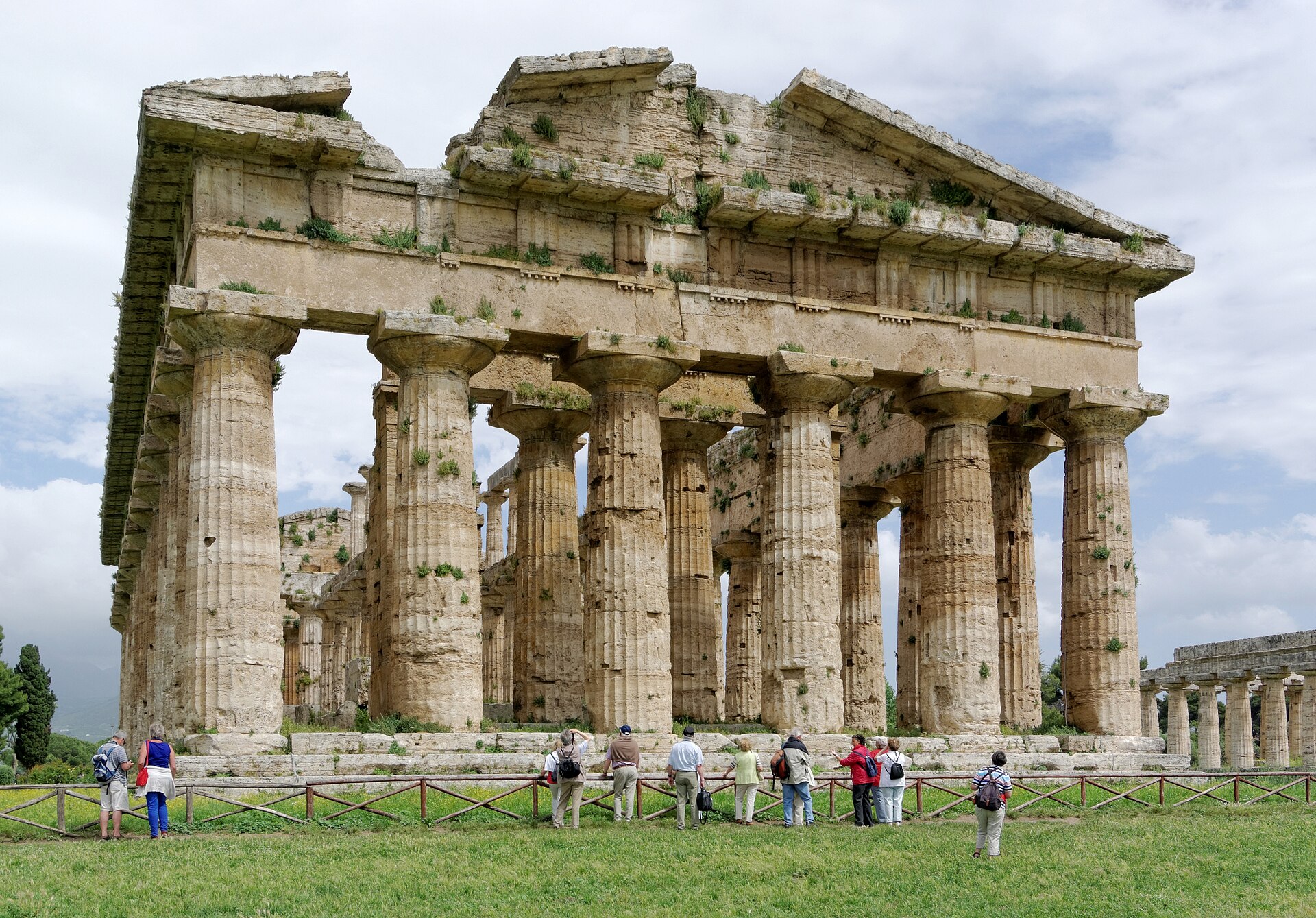
What makes Paestum world-famous is the survival, in astonishing completeness, of three great Doric temples built in the sixth and fifth centuries BC. Elsewhere in the Greek world, most temples were long ago reduced to scattered foundations, robbed of their stone, toppled by earthquakes, or dismantled to build other things. At Paestum, by a combination of good fortune and the durability of the local limestone, three temples stand nearly whole, their columns, entablatures, and pediment frames largely intact, offering a picture of Greek sacred architecture more complete than almost anywhere else, including Greece.
All three are built in the Doric order, the oldest, simplest, and most powerful of the Greek architectural orders, characterized by sturdy fluted columns without bases, plain cushion-like capitals, and an air of massive, dignified strength. They span roughly a century of development, and set side by side they allow visitors to trace the evolution of Doric architecture across generations: from the heavier, more closely spaced columns and swelling profiles of the earliest to the more refined proportions of the latest. For students of classical architecture, this progression, laid out in three standing buildings, is an extraordinary resource, a textbook rendered in stone.
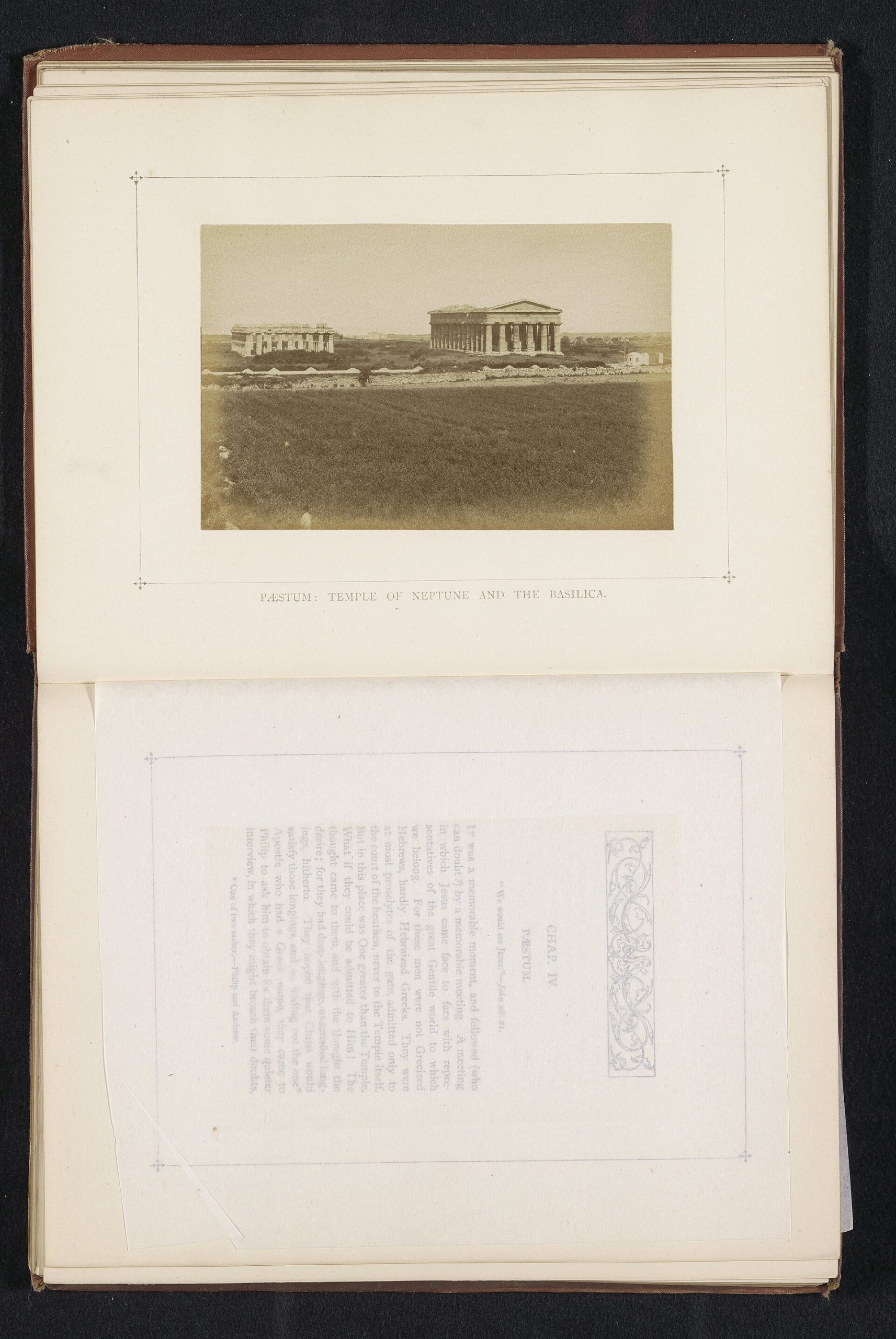
For centuries, however, the temples were known by the wrong names. Early scholars and travellers, guessing at which deities they honored, assigned them identities, one to Neptune, one to Ceres, one called the Basilica, that later research showed to be largely mistaken. Modern study, drawing on the votive offerings and other evidence found in and around them, has established a clearer picture of which gods were actually worshipped where, though the traditional names remain in common use and cause endless confusion. The result is that the temples are often referred to by two sets of names at once, the picturesque old ones and the more accurate modern ones.
The So-Called Temple of Neptune
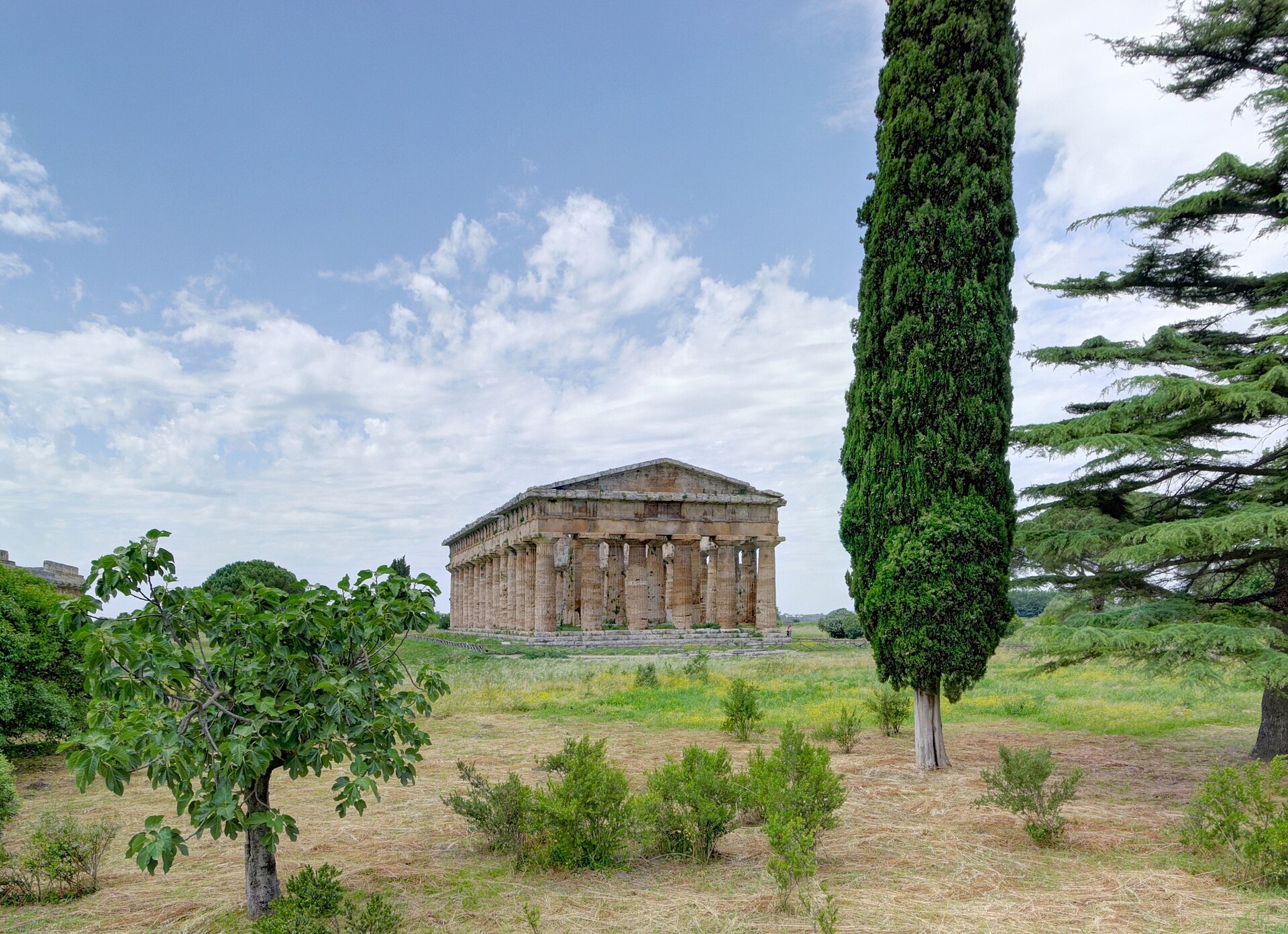
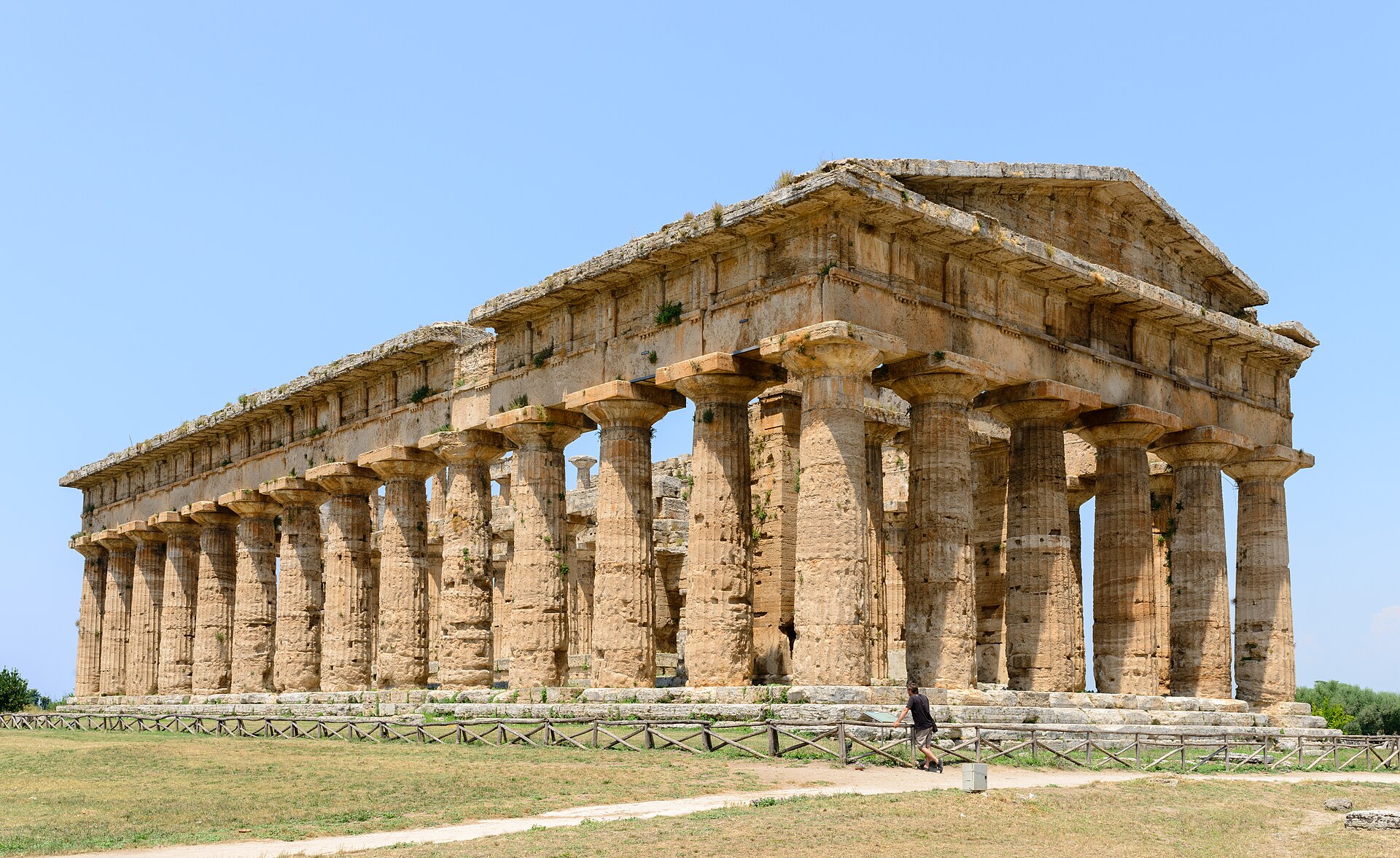
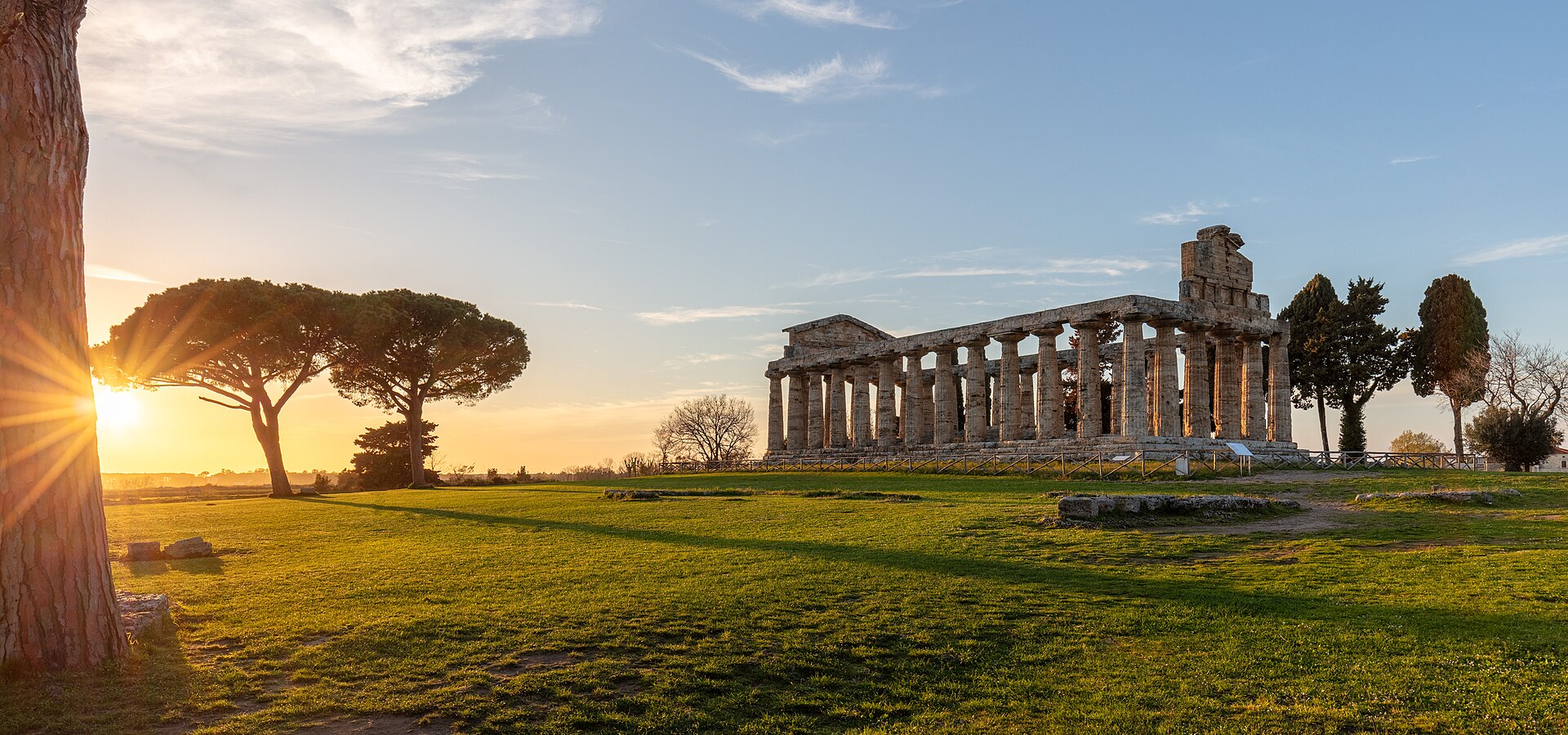
The grandest and best-preserved of the three is the temple traditionally called the Temple of Neptune, or Poseidon, built around the middle of the fifth century BC. It is a magnificent structure, one of the most complete Doric temples in existence, retaining not only its columns all the way around but also much of its entablature and both pediment frames, so that its full architectural form can be read almost intact. Standing before it, one sees a Greek temple essentially as it was designed to be seen, its powerful columns marching in stately rows, its proportions balanced with the confident harmony of the mature classical style.
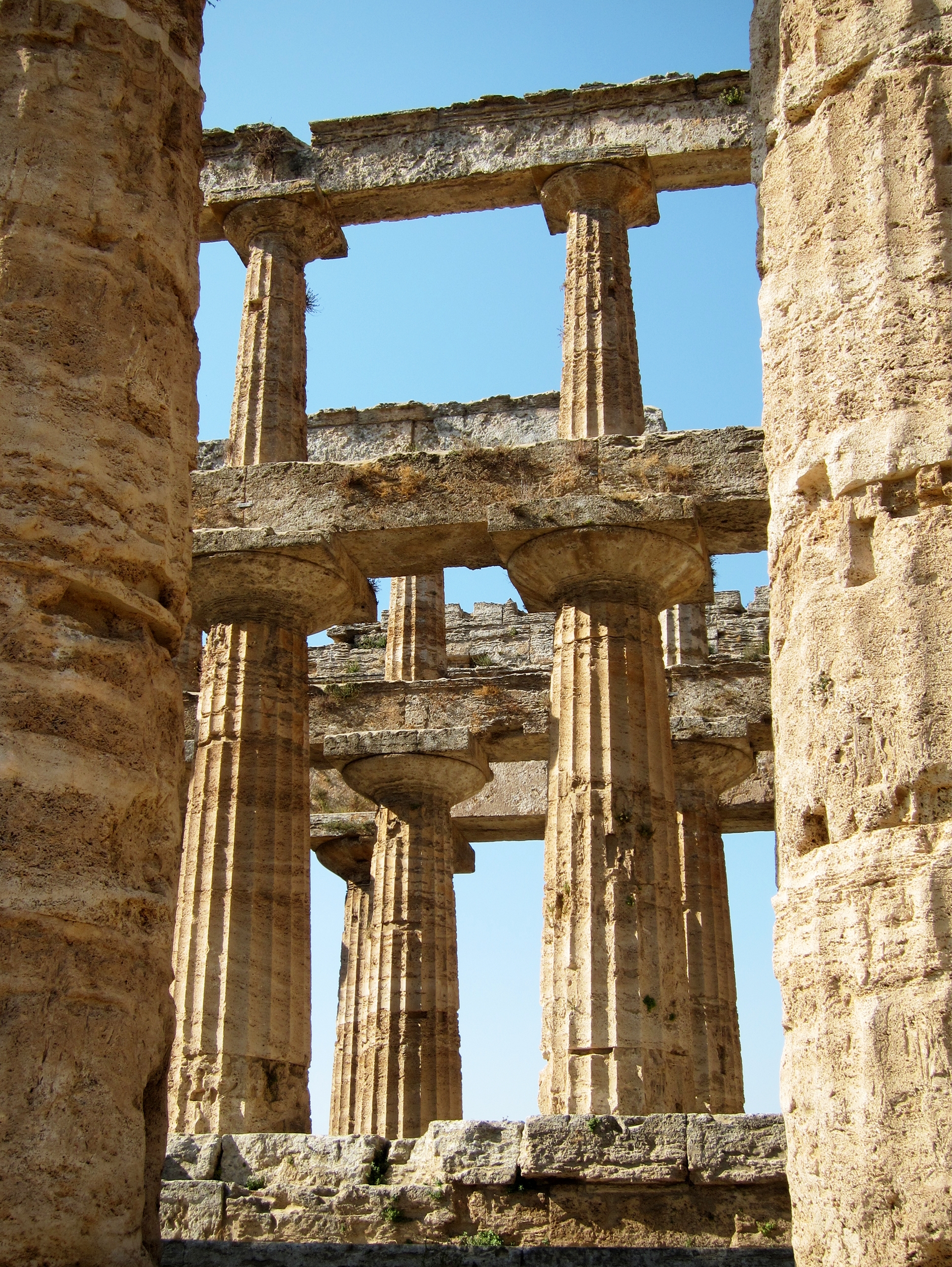
Despite its traditional name, this temple was most likely not dedicated to Neptune at all. The evidence now suggests it was probably sacred to Hera, the queen of the gods, or possibly to Apollo, and the label Temple of Neptune, assigned by early observers who assumed the city of Poseidon must have honored its patron with its greatest shrine, has simply stuck out of long habit. The confusion is a good illustration of how much of what we think we know about ancient sites was shaped by the guesses of early scholars, later corrected by more careful investigation, and of how tenacious those early names can be even after they are known to be wrong.
Whatever god it honored, the temple is a masterpiece. Built at the height of Poseidonia’s prosperity and in the great age of Greek temple building, the same era that produced the Parthenon in Athens, it embodies the classical Doric ideal of strength married to proportion. Its excellent preservation makes it not just beautiful but invaluable, allowing architects and historians to study the details of Greek temple design, from the subtle curvature and tapering of the columns to the arrangement of the interior, in a building that has come down to us almost whole. It is, quite simply, one of the finest Greek temples anywhere on earth.
The Temple of Hera and the Puzzle of Names
Standing close beside the Temple of Neptune is the oldest of the three, a temple built around the middle of the sixth century BC and long known as the Basilica, a name given by early antiquarians who mistook it for a Roman civic building rather than a Greek temple. In fact it is a temple, and the evidence indicates that it was dedicated to Hera, the great goddess who was among the most important deities of the western Greeks. The two temples standing side by side, both apparently sacred to Hera and built roughly a century apart, formed the main sanctuary of the goddess at Poseidonia.
The earlier temple is fascinating precisely because it is early. Its architecture shows the features of the archaic Doric style before it reached the refined proportions of the classical age: its columns are noticeably closer together and have a pronounced swelling profile, and its capitals spread wide in a form that later builders would make more restrained. An unusual feature is that it has an odd number of columns across its front and a central row of columns running down the interior, an arrangement that fell out of favor in later temple design. For the architectural historian, it is a precious document of Doric architecture in its formative phase.
The cult of Hera was central to Poseidonia and to the western Greeks generally, and a famous sanctuary of the goddess also stood a little distance from the city, near the mouth of a nearby river. The prominence of Hera worship here reflects patterns of religion in Magna Graecia, where certain deities were especially honored. The two great temples of Hera at Paestum, together with the abundant votive offerings found in and around them, make the site one of the most important places for understanding the religion of the western Greek world, and a powerful illustration of how the cults of the Greek homeland were transplanted and flourished overseas.
The Temple of Athena
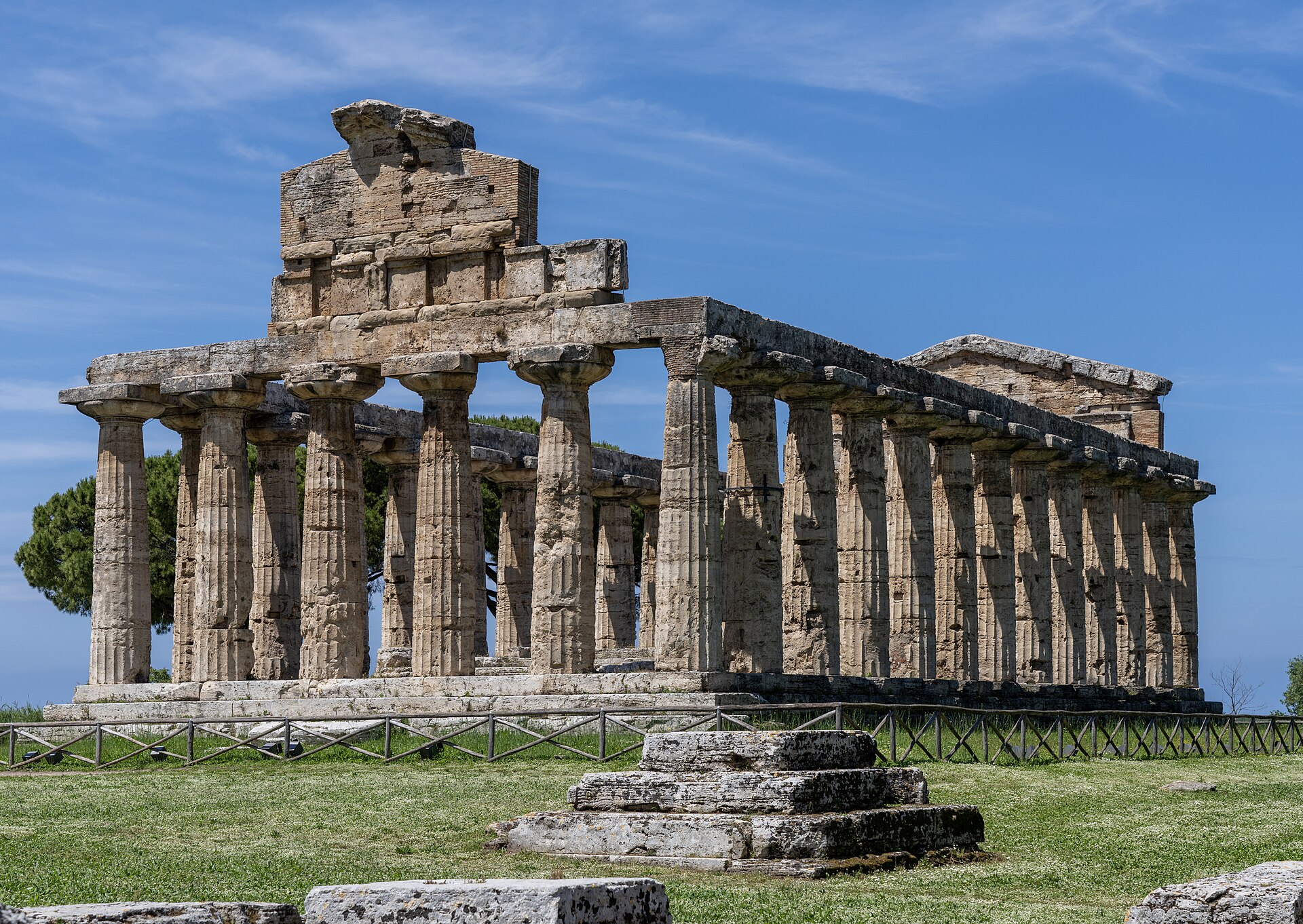
The third of the great temples stands a little apart from the other two, in its own sanctuary at the northern part of the ancient city. Built around the end of the sixth century BC, it was long called the Temple of Ceres, the Roman goddess of grain, but modern research has shown that it was in fact dedicated to Athena, and its sanctuary has yielded many votive offerings appropriate to that goddess. It is smaller than the Temple of Neptune but architecturally interesting, notable for combining features of different styles, with Doric columns on the exterior but elements of the more slender Ionic order used in its porch, a mixture that marks a transitional moment in Greek architecture.
The Temple of Athena had a long and varied afterlife. In the early medieval period, when the surrounding area was still inhabited, the temple was converted into a Christian church, a common fate for well-built ancient temples, which offered ready-made and durable structures for the new religion. Christian graves were dug in and around it, and its use as a church helped ensure its survival through the centuries when much else at Paestum was falling into ruin. The traces of this later Christian phase, layered onto the Greek temple, add another chapter to the building’s history and to the story of the site as a whole.
Together the three temples give Paestum an architectural richness matched by few other sites. They span roughly a century of Doric development, they illustrate the transition toward the mixing of orders, and they include one of the most perfectly preserved Greek temples in the world. Set in their green plain, often with wildflowers around their bases and few crowds to disturb the atmosphere, they present the visitor with the rare experience of Greek sacred architecture encountered almost whole, standing where it was built, under an open Italian sky.
The Tomb of the Diver
Beyond its temples, Paestum is famous for one of the most extraordinary paintings to survive from the ancient Greek world: the Tomb of the Diver. Discovered in 1968 in a cemetery a short distance from the city, it is a modest tomb built of stone slabs, but the inner faces of those slabs are painted with frescoes, and they are almost unique. Very little Greek painting on this scale has survived from the classical period, since the murals that once adorned Greek buildings have almost entirely perished, and the Tomb of the Diver is one of the only examples of Greek figurative wall painting of its era to come down to us intact.
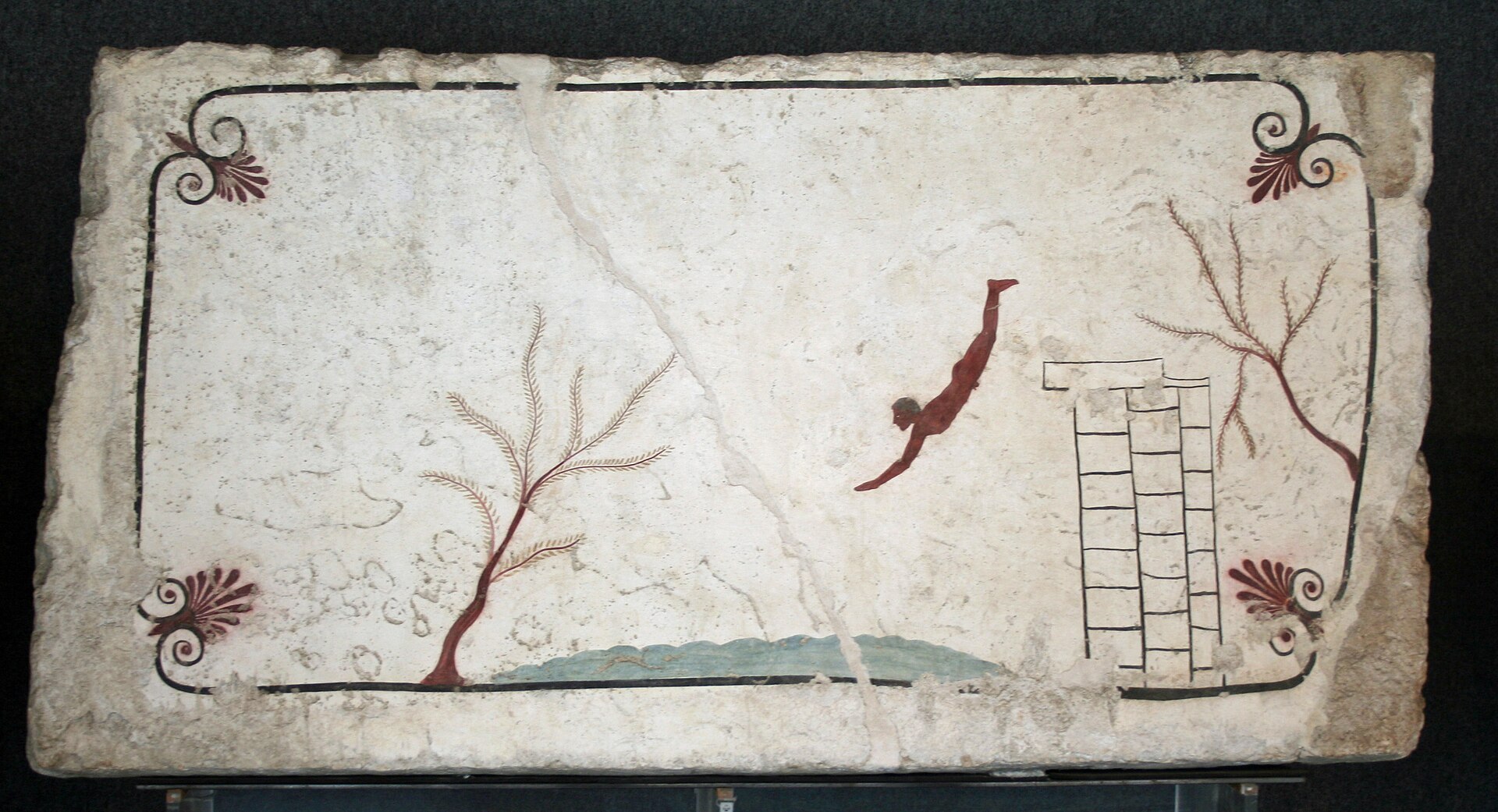
The tomb takes its name from the scene on its lid, which shows a solitary young man captured in mid-air as he dives gracefully from a high platform into a pool of water below. It is an image of great beauty and simplicity, and its meaning has been much debated. Most scholars interpret the dive as a symbol of the passage from life into death, the plunge into the unknown, a poetic and hopeful image of the soul’s transition. The four walls of the tomb, meanwhile, are painted with a scene of a symposium, an aristocratic drinking party, with reclining banqueters, musicians, and attendants, celebrating the pleasures of life.
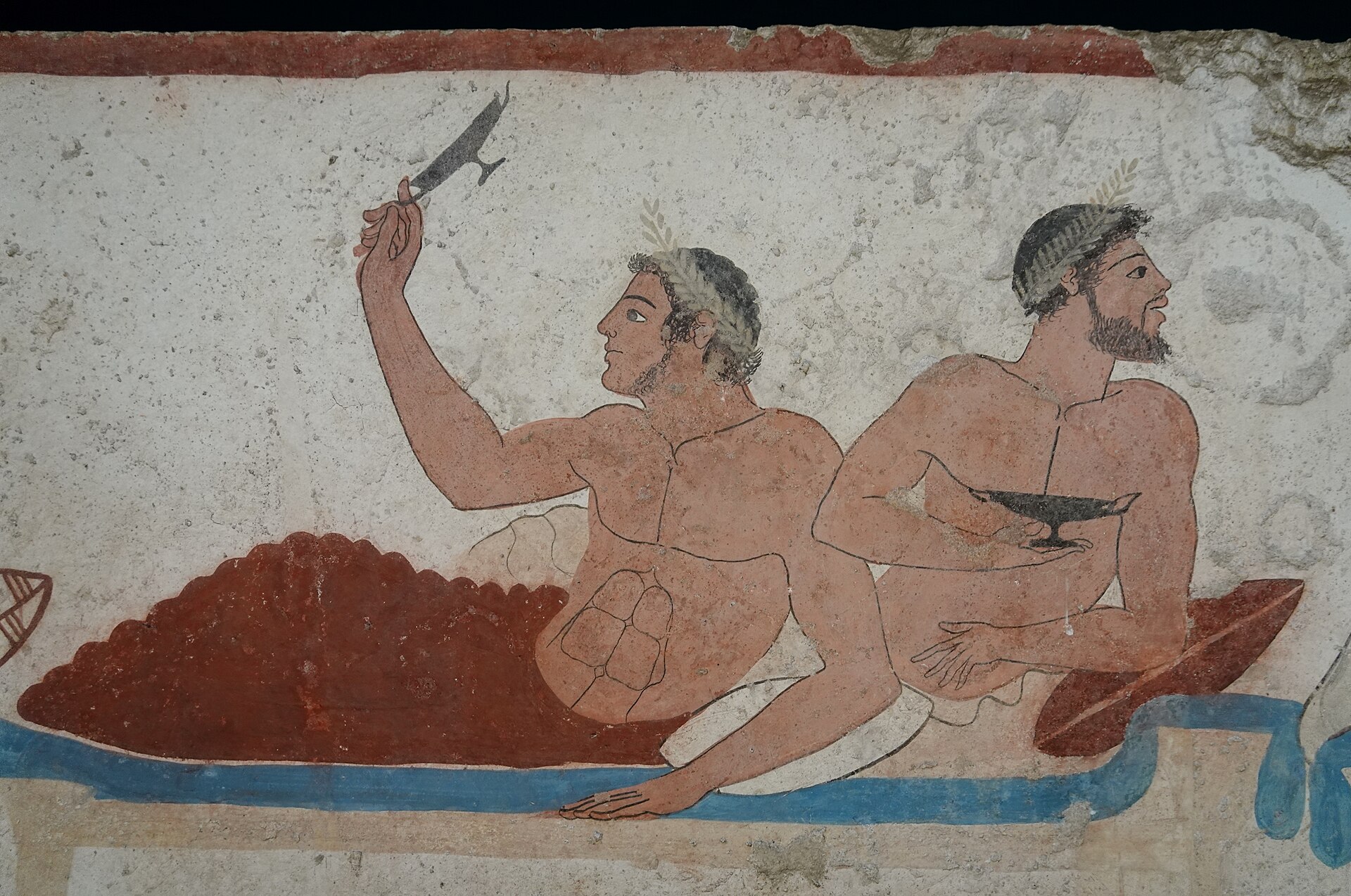
The contrast between the walls and the lid, the earthly banquet and the transcendent dive, gives the tomb a haunting resonance. It seems to set the joys of mortal life against the mystery of what lies beyond, and to offer, in the image of the diver, a serene vision of death as a graceful passage rather than an ending. Painted around 470 BC, the frescoes are also simply precious as art, a rare surviving glimpse of the skill of Greek painters, whose work was as admired in antiquity as their sculpture but has almost entirely vanished. The Tomb of the Diver is displayed in the museum at Paestum, and it is, for many visitors, as unforgettable as the temples themselves.
From Greek City to Lucanian Town
Poseidonia did not remain Greek forever. Around the end of the fifth century BC, the city was taken over by the Lucanians, an Italic people from the surrounding region who, like other native peoples of southern Italy, had grown in strength and pressed upon the Greek coastal cities. The Lucanians absorbed Poseidonia, and for a time it became a Lucanian town, though it retained much of its Greek character, for the Lucanians who took it had themselves been deeply influenced by Greek culture, and the transition was more a change of rulers than a wholesale replacement of civilization.
This Lucanian phase is vividly documented by the painted tombs of the period, which are among the treasures of the site’s museum. Unlike the earlier Greek Tomb of the Diver, these Lucanian tombs are decorated with scenes that reflect the values and interests of the new ruling people: returning warriors on horseback, duels and combats, funeral games, chariot races, and scenes of the afterlife. Painted in a lively, colorful style, they give a detailed picture of Lucanian society, its warrior ethos, its funerary customs, and its blending of native Italic and Greek elements, and they make Paestum a key site for understanding the peoples of ancient southern Italy beyond the Greeks alone.
The Lucanian period shows that Paestum’s story is not simply one of Greeks in Italy but of the meeting and mingling of peoples. The Greek colony, the Italic Lucanians, and later the Romans all left their mark on the city, and its remains preserve the interaction of these cultures in a single place. The great Greek temples continued to stand and to be used through all these changes, a fixed point of continuity as the city passed from one people to another, and the tombs of successive eras record how the inhabitants of Paestum, whatever their origin, lived, fought, worshipped, and buried their dead.
Paestum Becomes Roman
In 273 BC, as Rome extended its power over southern Italy, the city came under Roman control and was refounded as a Latin colony, and it was at this point that it acquired the name by which we know it: Paestum, a Latinized form of the older Poseidonia. Under Rome the city was remodeled in the Roman manner, gaining a forum, an amphitheatre, temples, baths, and the other apparatus of a Roman town, much of which can still be seen among the ruins alongside the far older Greek temples. Paestum became a loyal and prosperous Roman town, famous, among other things, for its roses, which the Roman poets praised, and which were said to bloom twice a year.
The Roman city was laid out around the older Greek core, and the visitor to Paestum today walks through a townscape that layers Roman on Greek: the great Doric temples of the colony’s Greek foundation, and around and between them the forum, amphitheatre, and streets of the Roman town. This layering is part of what makes the site so rich, for it preserves not a single moment but the long life of a city across the Greek, Lucanian, and Roman periods, each leaving its buildings and its dead, its art and its inscriptions, in the same fertile plain.
For several centuries Paestum flourished as a Roman town, sharing in the general prosperity of imperial Italy. But its long-term fate was bound up with the environment of its coastal plain, and as the wider Roman world declined and local conditions worsened, the city that had endured through so many changes of ruler entered its final decline. The forces that would ultimately empty and bury Paestum were not conquest or catastrophe but the slow, grinding pressures of a deteriorating landscape and a collapsing wider order, which together turned one of the great cities of Magna Graecia into a deserted ruin.
Marsh, Malaria, and Oblivion
The decline of Paestum in the later Roman and early medieval periods was driven above all by the changing environment of its coastal plain. Over the centuries the rivers that watered the fertile land silted and shifted, the drainage of the plain deteriorated, and the area around the city turned increasingly to marsh. With the marshes came malaria, the scourge of low-lying Mediterranean coastlands, which made the once-prosperous plain unhealthy and drove people away. As the population dwindled and the wider order of the ancient world dissolved, Paestum shrank, and eventually its site was largely abandoned.
The surviving inhabitants moved to higher, healthier ground in the nearby hills, and the old city was left to the marsh and the malarial air. Its buildings decayed, vegetation crept over the streets, and the site became a lonely, fever-ridden place that few had reason to visit. The great temples, too solid to be easily destroyed, remained standing amid the desolation, but the living city around them died, and Paestum passed out of the mainstream of history, remembered, if at all, only dimly. For much of the medieval and early modern period it lay half-forgotten, its temples hidden in an unhealthy wilderness few dared to enter.
This abandonment, grim as it was, helped preserve the site. Because Paestum was not overbuilt by a later town, and because its temples were too massive to be readily quarried away, they survived where the monuments of continuously inhabited cities were destroyed. The marsh that killed the city also protected its ruins, keeping them isolated and largely undisturbed until the modern age. When Paestum was finally rediscovered, it emerged not as a fragment beneath a living city but as a whole ancient landscape, its temples still standing where the Greeks had raised them more than two thousand years before.
Rediscovery and the Grand Tour
Paestum came dramatically back into view in the eighteenth century, and its rediscovery had a profound impact on European art and taste. As the temples became known to travellers and scholars, they caused a sensation, for here were Greek Doric temples of the archaic and classical periods standing almost complete, offering a direct encounter with the earliest and most austere form of Greek architecture that could not be had even in Greece, which was then difficult for western Europeans to visit. Paestum became a celebrated stop on the Grand Tour, the great educational journey through Italy undertaken by the cultivated classes of northern Europe.
Artists, architects, and writers flocked to draw, paint, and describe the temples, and their images spread across Europe. The great German poet Goethe visited and wrote memorably of his initially startled reaction to the heavy, powerful archaic Doric forms, so different from the lighter classical taste he had expected, and of how the temples grew on him. Architects studied the buildings closely, and the encounter with Paestum’s severe, muscular Doric contributed to the wider Neoclassical movement and to a new appreciation of the primitive strength of early Greek architecture. The temples became icons, reproduced in prints, paintings, and architectural studies throughout the age.
Modern archaeology has since studied Paestum thoroughly, excavating the Greek, Lucanian, and Roman city, uncovering its tombs with their precious paintings, and correcting many of the old misidentifications. The site today is a UNESCO World Heritage listing, recognized together with the nearby ancient sites and landscape as an outstanding testimony to the civilizations that flourished in this part of the Mediterranean. From malarial wilderness to Grand Tour marvel to protected heritage site, Paestum has completed a remarkable journey, and its temples, having outlasted the Greeks, the Lucanians, the Romans, and the marsh, stand today as serene as ever.
Nearby Places
- Ostia: The Port City That Fed a Million Romans
- Pompeii: The Roman City That Vesuvius Buried
- The Pyramid of Cestius: An Egyptian Pyramid in Rome
Final Word
Paestum is Greece in Italy, a colony of the great western Greek world whose temples have outlasted almost everything of their kind in the Greek homeland itself. Founded as Poseidonia by settlers from Sybaris, it raised three magnificent Doric temples at the height of its prosperity, passed from Greek to Lucanian to Roman hands, and gave us, in the Tomb of the Diver, one of the only surviving Greek wall paintings of its age. Abandoned to marsh and malaria and then rediscovered to the wonder of Grand Tour Europe, it stands today as one of the most beautiful and complete ancient sites anywhere, its honey-colored columns rising from the Campanian plain as they have for two and a half thousand years, a serene monument to the vast reach of the Greek world and the endurance of what it built.
You May Like
Norse Explorers Reached Canada 500 Years Before Columbus