Tula rises on a defensible ridge above the Tula River in the modern Mexican state of Hidalgo, roughly 65 kilometers north of Mexico City, at a location its Toltec builders settled sometime after 900 CE, in the political vacuum left by the collapse of the great metropolis of Teotihuacan centuries earlier.
For roughly two and a half centuries, Tula stood as one of the dominant powers of central Mexico, and by the time the Aztecs rose to prominence generations later, its name had become almost synonymous with civilization itself, a legendary golden age that Aztec rulers claimed direct descent from.
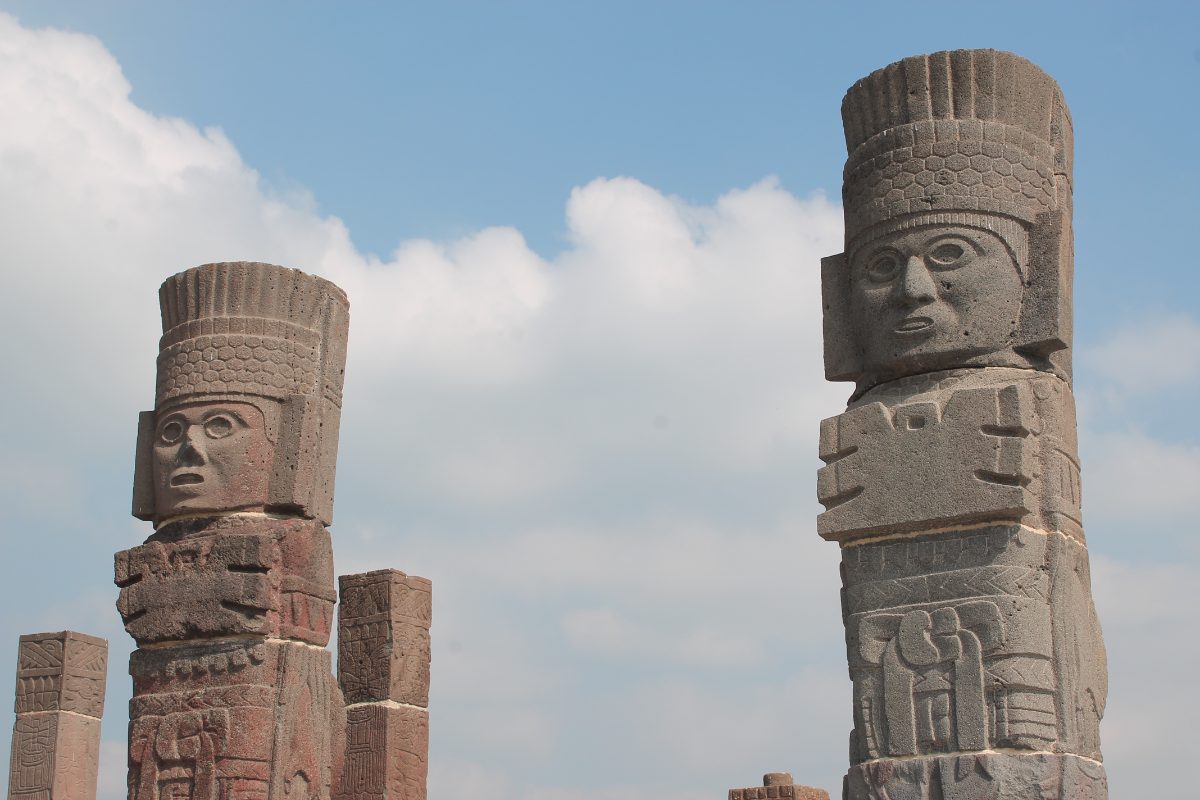
Table of Contents
- Tula and the Twilight Between Two Empires
- Tollan-Xicocotitlan: Locating the Toltec Capital
- The Atlantes of Pyramid B
- The Serpent Wall and the Skull Platform
- Chac Mool and the Puzzle of Tula’s Ties to Chichen Itza
- Ballcourts and the Rituals of Tula
- What Language Did the Toltecs Speak?
- Toltecayotl: How the Aztecs Remembered Tula
- Quetzalcoatl, Warfare, and Toltec Religion
- Collapse and the Long Shadow of a Legendary City
- Nearby Places to Explore
Tula and the Twilight Between Two Empires
Teotihuacan’s collapse around 550 CE left an enormous power vacuum across central Mexico that took several centuries to resolve. Tula emerged as one of several regional centers competing to fill that gap, eventually consolidating enough regional control to be remembered by later Mesoamerican peoples as the preeminent capital of its era.
Archaeologists place Tula’s period of greatest political and military influence between roughly 900 and 1150 CE, positioning it squarely in the Early Postclassic period, the centuries separating Teotihuacan’s fall from the rise of the Aztec Triple Alliance that would eventually dominate the same central Mexican highlands.
Population estimates for Tula at its height range as high as 60,000 residents, making it one of the largest urban centers in Mesoamerica during its own time, controlling agricultural land, trade routes, and tribute-paying communities across a substantial portion of central Mexico.
The ridge Tula’s builders chose offered natural defensive advantages along with reliable access to the Tula River, a resource that supported the irrigated agriculture needed to feed a population that would eventually grow to tens of thousands of residents in a semi-arid region of central Mexico.
Migrant groups from the north, sometimes described in later accounts as Chichimeca, appear to have contributed to Tula’s founding population alongside people descended from Teotihuacan’s earlier collapse, suggesting the city emerged from a merging of distinct cultural traditions rather than a single unified founding population.
Tula’s rulers extended political and economic influence over a substantial swath of central Mexico, controlling access to valuable resources including obsidian deposits and agricultural land, while smaller regional centers throughout the area adopted Toltec-style architecture and pottery as a mark of association with the dominant power.
Trade goods recovered from Tula include turquoise likely sourced from as far away as the present-day American Southwest, alongside Pacific coast shell and Gulf Coast ceramics, indicating the city sat within an extensive Mesoamerican and even broader North American exchange network stretching well beyond its immediate central Mexican territory.
Tollan-Xicocotitlan: Locating the Toltec Capital
Aztec historical accounts describe a legendary city called Tollan, ruled by the priest-king Quetzalcoatl, as the source of all civilized arts, from writing and calendar-keeping to fine craftsmanship. For much of the twentieth century, scholars debated whether this legendary Tollan corresponded to the physical ruins at modern Tula, or whether it referred instead to Teotihuacan or was simply a mythologized composite with no single real-world location.
Archaeological excavation since the mid-twentieth century has confirmed that the site now called Tula was indeed known to its own inhabitants as Tollan, or more fully Tollan-Xicocotitlan, and that its material remains, monumental pyramids, palaces, and extensive residential zones, correspond closely enough to later Aztec descriptions to identify it as the historical core around which the more elaborate legendary Tollan narrative eventually grew.
This does not mean every detail in Aztec accounts of Tollan reflects literal history. Much of what the Aztecs believed about Tula was already several centuries removed from the city’s actual occupation by the time it was recorded in colonial-era texts, blending genuine historical memory with mythologized elaboration in ways that modern historians must carefully untangle.
Confirming Tula’s identity as historical Tollan required decades of careful cross-referencing between excavated architectural remains and details recorded in colonial-era Nahuatl sources, a process complicated by the fact that Aztec chroniclers themselves were working from oral tradition and pictorial manuscripts rather than any contemporary written record from Tula’s own active period.
French archaeologist Desire Charnay conducted some of the earliest systematic excavations at Tula in the 1880s, and his identification of the site with the legendary Tollan, though refined considerably by later twentieth-century research, helped establish the archaeological framework that subsequent generations of scholars would continue to build upon.
Later fieldwork, particularly excavations led by Mexican archaeologists in the mid-twentieth century, expanded significantly on Charnay’s initial work, mapping the full extent of Tula’s ceremonial core and residential zones and refining the chronology separating different construction phases across the site’s active centuries.
Modern visitors sometimes expect Tula to rival the scale of Teotihuacan or Chichen Itza, and while its ceremonial core is considerably more modest in size, this relative compactness has allowed archaeologists to excavate and study a larger proportion of the site’s total footprint than has been possible at some of Mesoamerica’s much larger ancient cities.
The Atlantes of Pyramid B
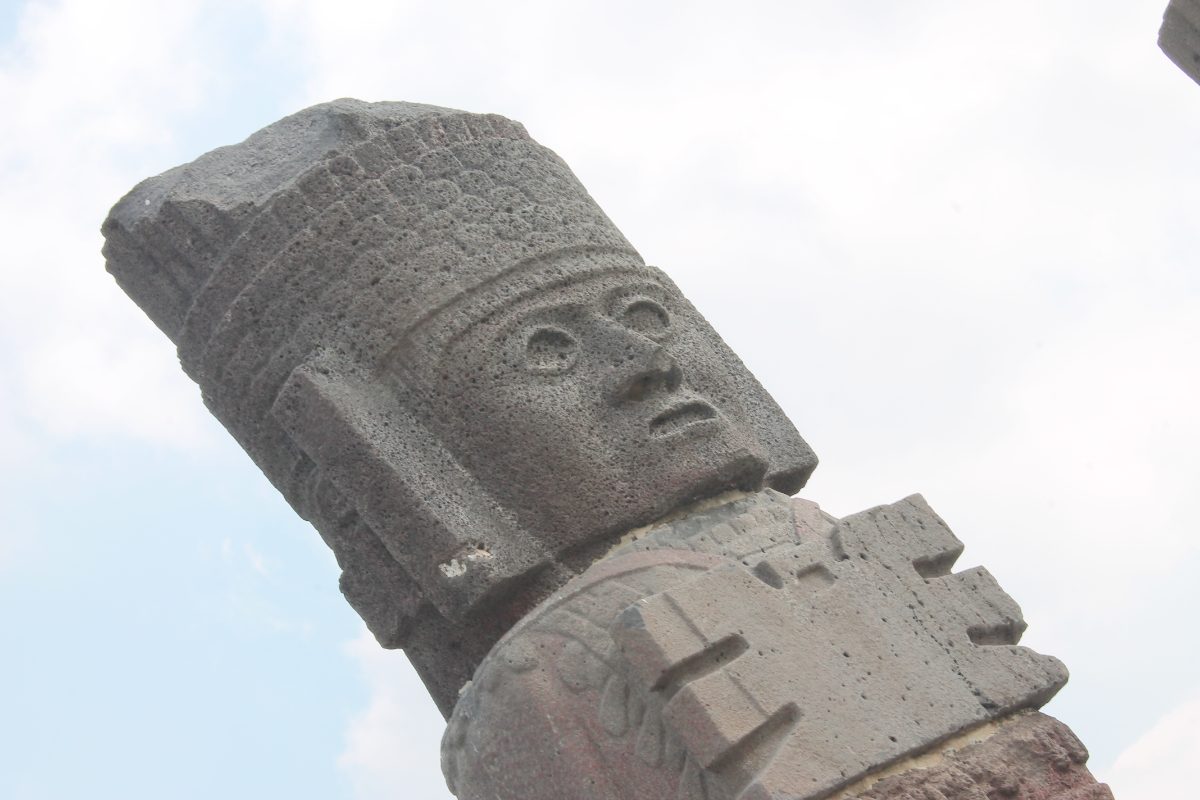
Tula’s most recognizable monument, four colossal basalt warrior columns known as the Atlantes, stand atop Pyramid B, also called the Temple of the Morning Star, each figure carved in sections and stacked roughly 4.6 meters high, originally supporting the roof beams of a temple structure that has since disappeared.
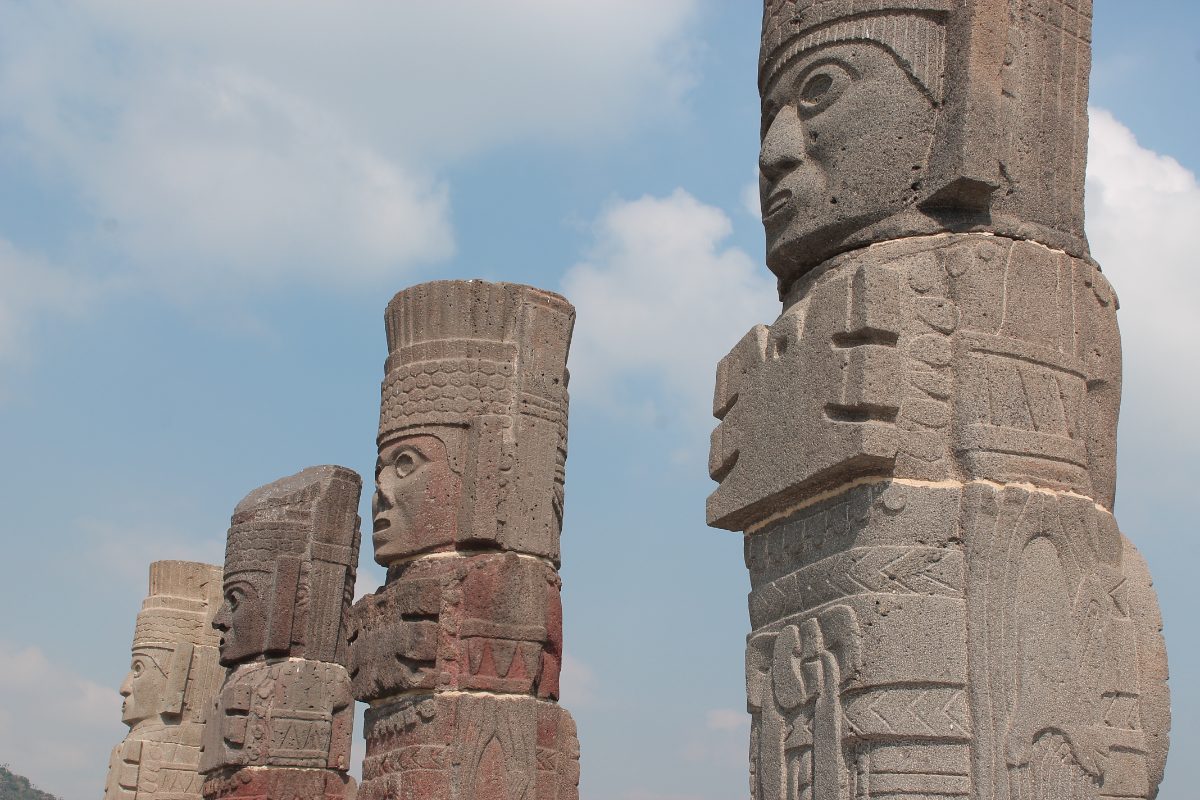
Each Atlante depicts a Toltec warrior equipped with an atlatl spear-thrower, a curved knife, a butterfly-shaped chest ornament associated with warrior status, and an elaborate feathered headdress, together forming one of the most detailed surviving representations of Postclassic Toltec military dress and equipment.
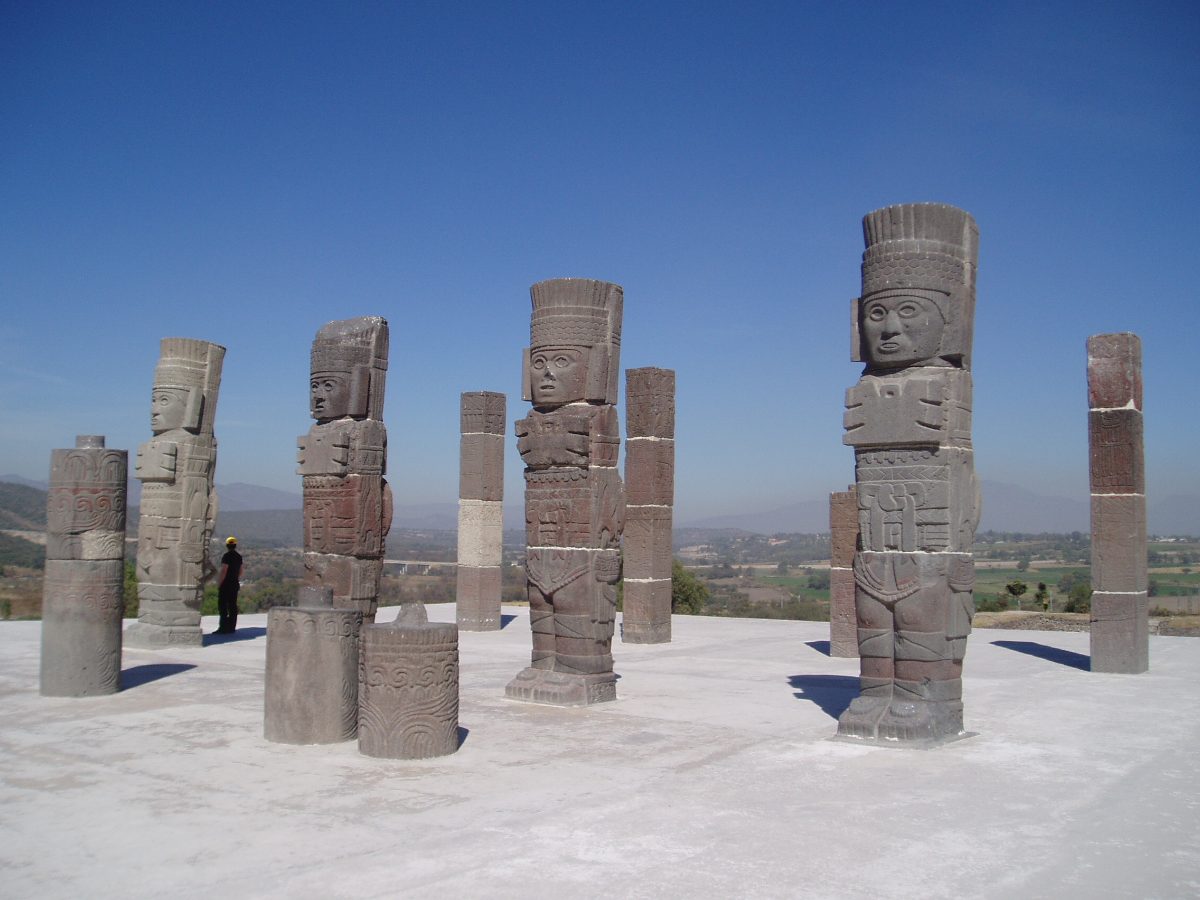
Smaller pillars nearby, carved with additional warrior figures in low relief, once supported the temple’s front colonnade, reinforcing the martial character of Pyramid B’s decoration and suggesting that warrior identity and religious authority were closely intertwined in Toltec political ideology.
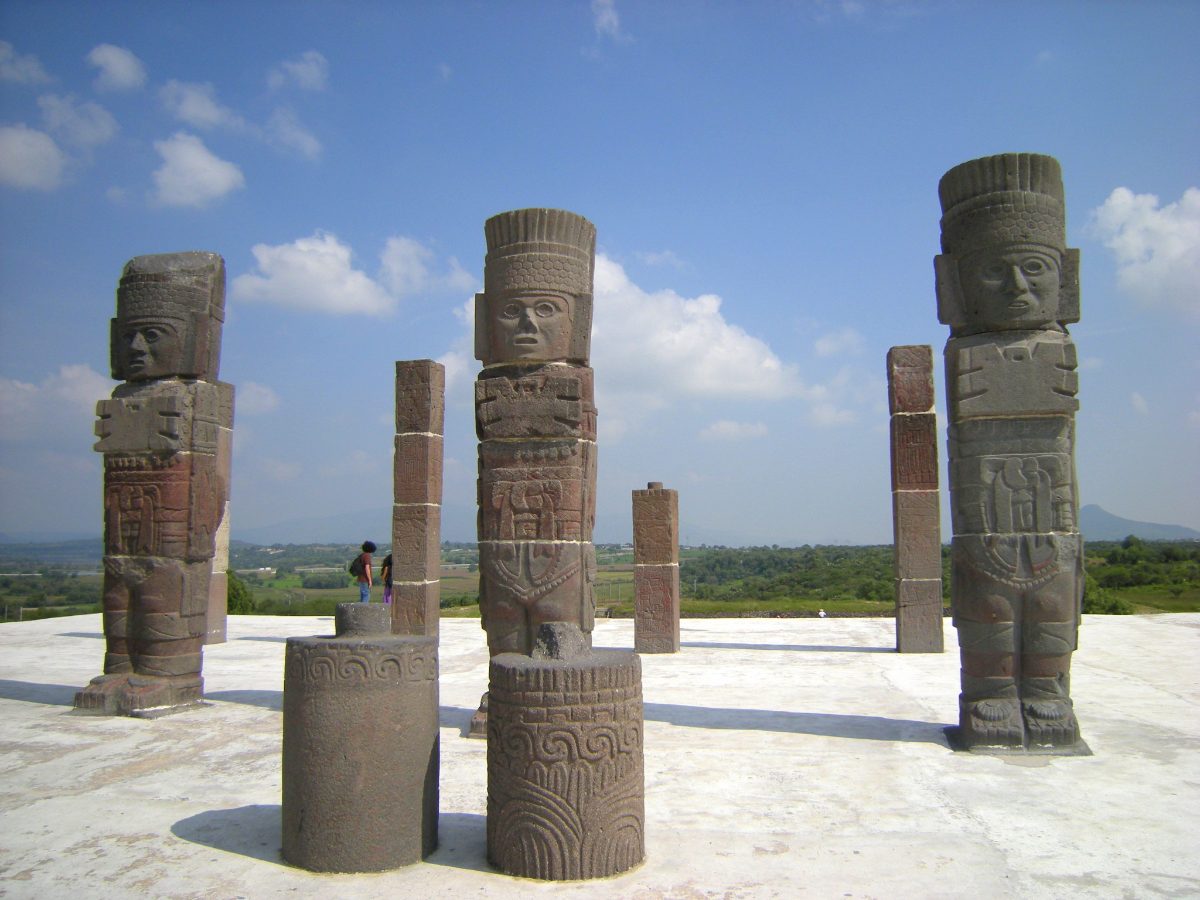
Each Atlante was carved in four separate stacked sections rather than a single monolithic block, a construction method that allowed for easier transport and assembly of such enormous figures using the technology available to Toltec builders, though it also made the columns more vulnerable to later damage and toppling.
Beyond their military symbolism, the Atlantes likely also carried religious meaning as ancestor or deity representations, with some researchers suggesting the figures may specifically commemorate deified Toltec rulers rather than simply generic warrior types, blending political and religious commemoration into a single monumental form.
The Serpent Wall and the Skull Platform
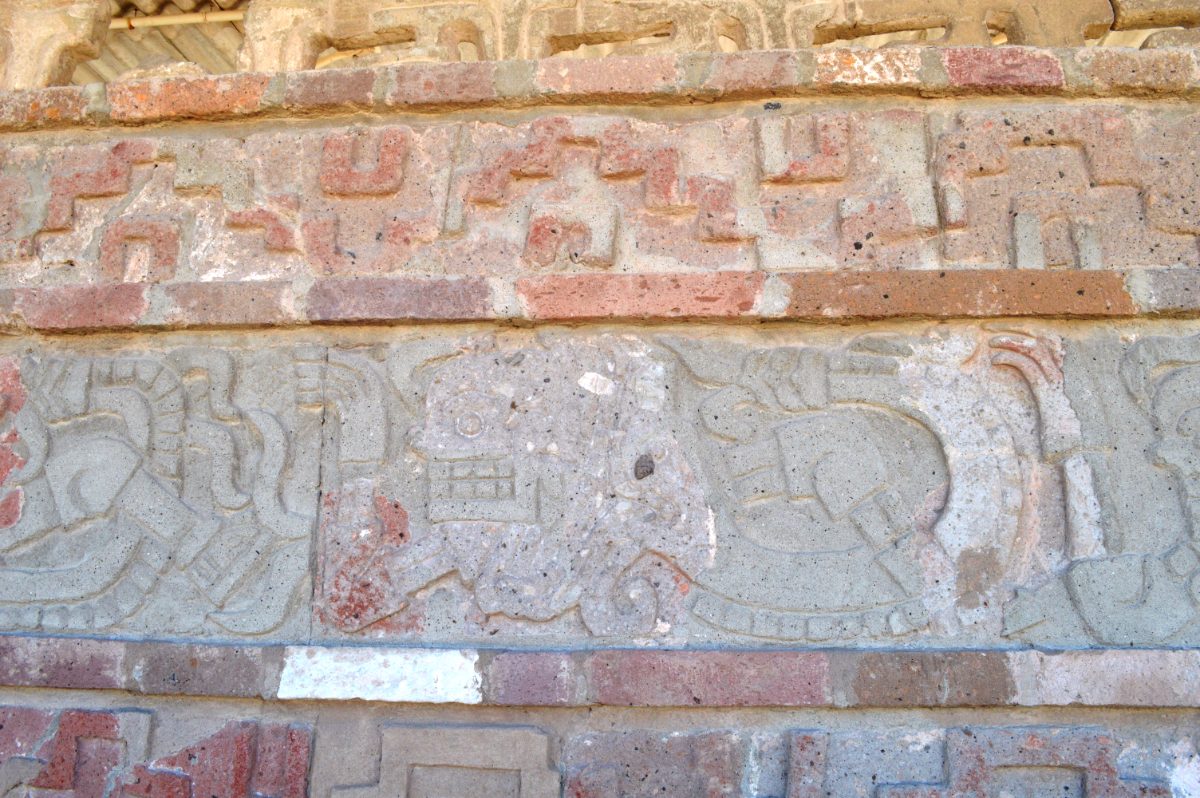
The Coatepantli, or Serpent Wall, runs along the northern edge of Pyramid B’s platform, carved with a running frieze of serpents devouring skeletal human figures, a grim decorative motif that appears again, in modified form, on later Aztec architecture at Tenochtitlan, suggesting a direct line of religious and artistic influence passing from Toltec to Aztec builders.
Nearby, archaeologists have identified the remains of a tzompantli, a skull rack platform once displaying rows of human skulls impaled on wooden poles, almost certainly connected to ritual sacrifice performed at the site, another architectural feature later adopted on a much larger scale at the Aztec capital.
Together, the Serpent Wall and skull platform present an unusually stark, martial religious vocabulary, one that later Aztec rulers appear to have consciously emulated and expanded when constructing their own capital, treating Toltec religious architecture as a template for legitimate, civilized rulership.
Traces of the original red, blue, and yellow paint pigments still cling to sheltered portions of the Coatepantli’s carved reliefs, offering a rare glimpse of how vividly colorful Tula’s monumental architecture would have appeared to observers during the city’s active centuries, in sharp contrast to the bare grey stone visitors see today.
The tzompantli platform’s design, a low rectangular structure meant to display rows of skulls, would later be scaled up dramatically at the Aztec Templo Mayor, where Spanish conquistadors reported seeing tens of thousands of skulls displayed simultaneously, a stark illustration of how Toltec religious architecture could be adopted and vastly expanded by later, more populous empires.
Excavators have recovered actual human skull fragments, some showing drilled holes consistent with mounting on a wooden rack, near the tzompantli platform, providing direct physical confirmation that the structure served its grim ceremonial function rather than functioning purely as symbolic architecture.
Chac Mool and the Puzzle of Tula’s Ties to Chichen Itza
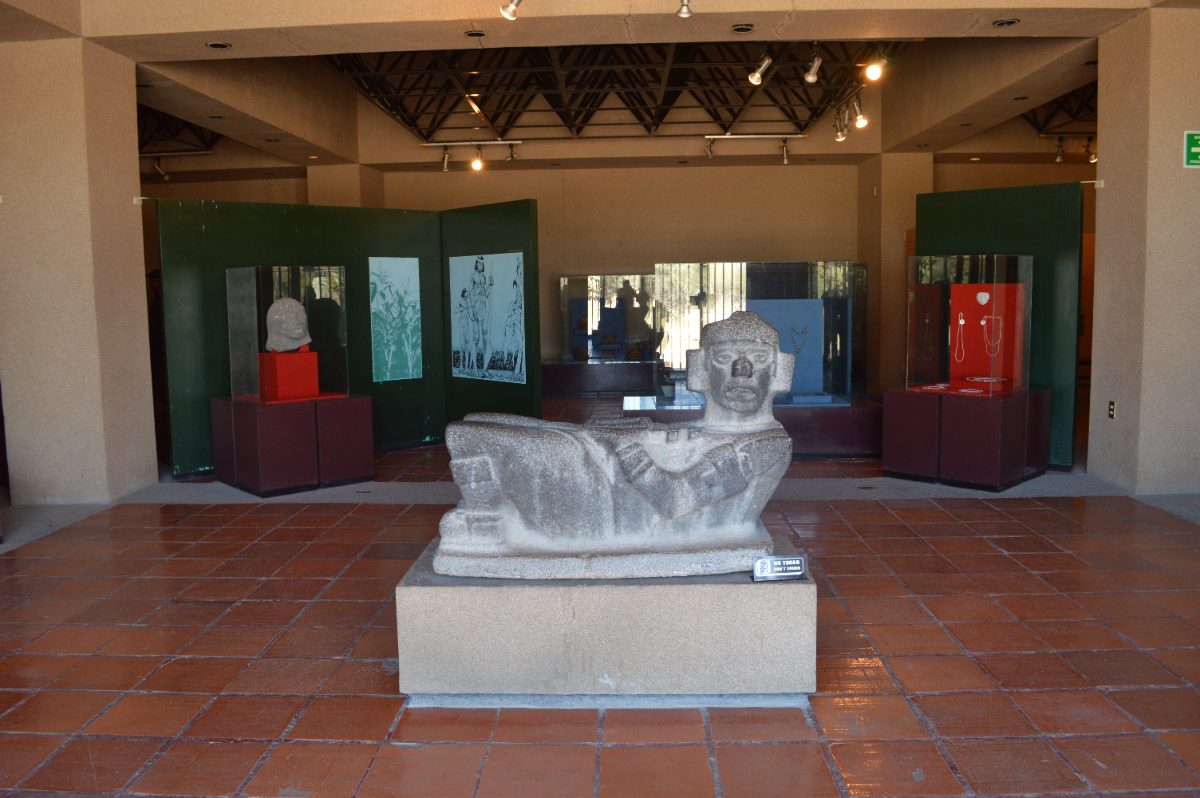
Reclining Chac Mool sculptures, stone figures shown lying on their backs with knees drawn up and a shallow bowl balanced on the abdomen, likely used to receive offerings during ritual ceremonies, appear at Tula in a style strikingly similar to Chac Mool figures found hundreds of kilometers away at Chichen Itza in the Yucatan.
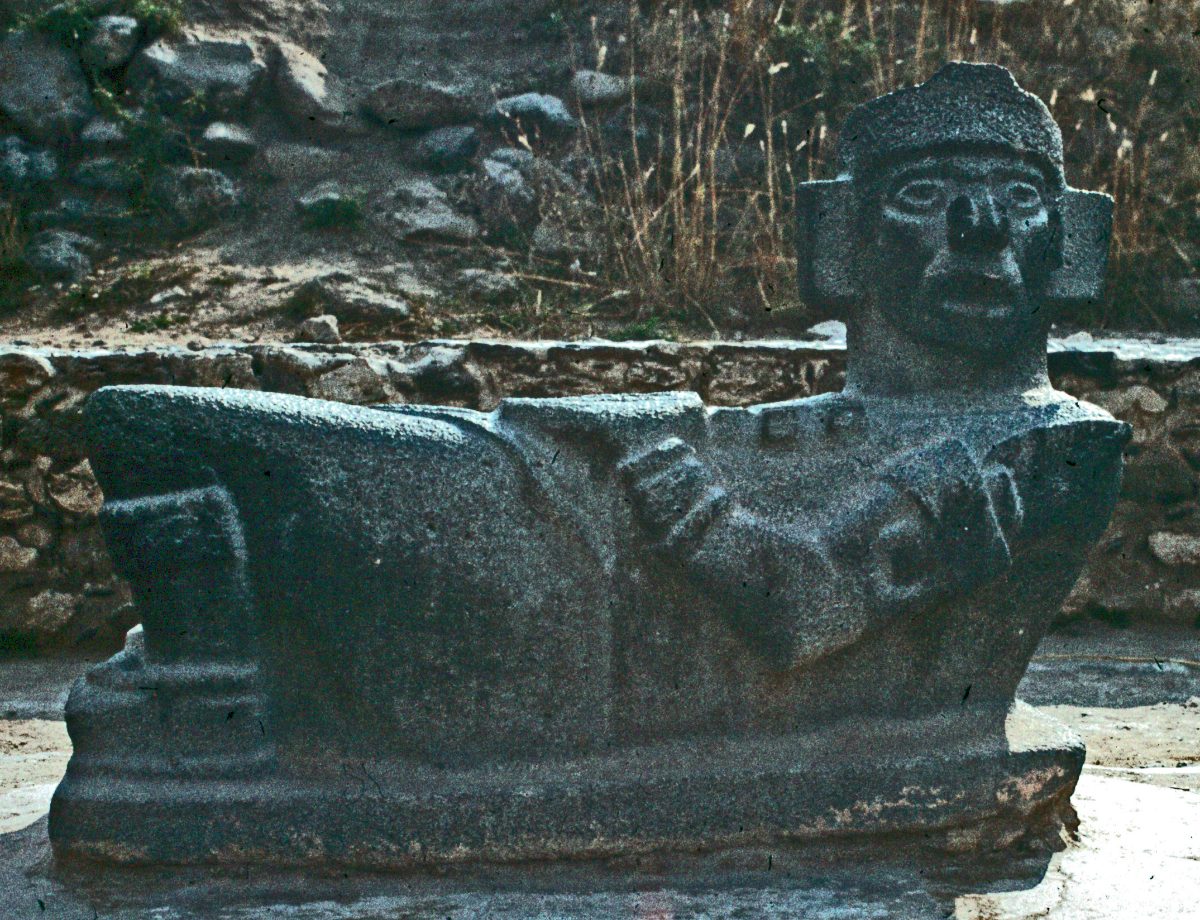
This resemblance, along with shared architectural features including nearly identical colonnaded halls, feathered-serpent columns, and warrior imagery, has fueled decades of scholarly debate over the exact relationship between Tula and Chichen Itza. Aztec legend held that the exiled Toltec ruler Topiltzin Quetzalcoatl fled to the Yucatan and either founded or profoundly reshaped Chichen Itza after his departure from Tula.
Modern archaeologists remain divided on how literally to take this migration narrative. Some argue for genuine Toltec conquest or colonization of Chichen Itza, others for a shared broader Postclassic artistic and religious style adopted independently by both cities through trade contact, and still others suggest influence may have flowed in the opposite direction, from the Maya region toward central Mexico, rather than the reverse. No consensus has fully resolved the question.
Radiocarbon and stylistic dating at both sites has, if anything, complicated rather than resolved the debate, since some Toltec-style features at Chichen Itza appear to predate comparable construction at Tula itself, raising the possibility that the relationship between the two cities was considerably more complex than a simple one-directional migration story would suggest.
Whatever the precise historical relationship, the artistic and architectural parallels between Tula and Chichen Itza remain among the most striking examples of long-distance cultural connection documented anywhere in ancient Mesoamerica, linking a highland central Mexican capital to a Maya lowland city hundreds of kilometers away.
Regardless of which direction cultural influence actually flowed, the shared Chac Mool and colonnade style demonstrates that Postclassic Mesoamerica remained tightly interconnected across considerable distances, with ideas, artistic conventions, and possibly people themselves moving between central Mexico and the Yucatan peninsula long before any single empire unified the two regions politically.
Ballcourts and the Rituals of Tula
Tula’s builders constructed at least two ballcourts within the site’s ceremonial core, rectangular sunken structures used for the ritual ballgame played across Mesoamerica for millennia, its outcome frequently tied to religious and even political significance, including, at some sites, the ritual sacrifice of players from the losing team.
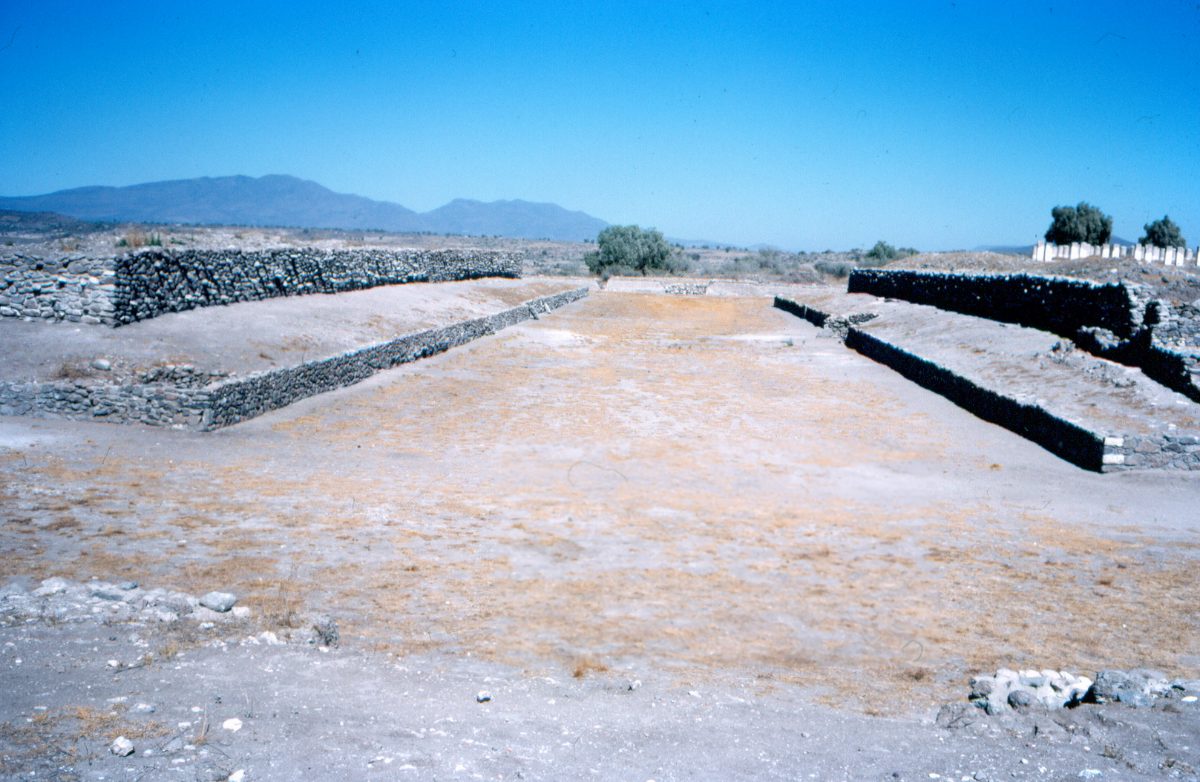
One of Tula’s ballcourts sits adjacent to Pyramid B, placing the game’s ritual arena directly beside the site’s most heavily militarized religious architecture, reinforcing the close relationship between warfare, sport, and sacred ceremony that characterized much of Toltec public life.
Excavated ceramic and stone offerings found near the ballcourts include miniature versions of ballgame equipment alongside more conventional ritual items, suggesting the games themselves were treated as offerings to the gods in their own right, not merely public entertainment for the city’s population.
The larger of Tula’s two known ballcourts remains only partially excavated, and researchers suspect additional ceremonial features connected to the ballgame may still lie buried beneath unexcavated portions of the site awaiting future archaeological investigation.
Rubber, essential for manufacturing the solid balls used in the Mesoamerican ballgame, had to be imported to Tula from tropical lowland regions, another example of the long-distance trade networks that connected this highland capital to ecologically distant parts of Mesoamerica.
Iconography carved into the ballcourt walls and nearby structures depicts figures in ballgame attire alongside warrior imagery, reinforcing the interpretation that the game carried genuine martial and cosmological significance rather than functioning purely as recreational sport for Tula’s residents.
What Language Did the Toltecs Speak?
Most scholars identify the Toltecs as speakers of an early form of Nahuatl, the language family that would later become the dominant tongue of the Aztec empire and remains spoken by more than a million people across Mexico today, making Tula one of the clearer cases in this series of a documented linguistic descendant surviving into the modern era.
Some researchers caution that Tula’s population was likely more linguistically mixed than a single-language narrative suggests, potentially including Otomi speakers alongside Nahuatl speakers, given the region’s long history as a contact zone between different central Mexican language communities both before and after the Toltec period.
Because so much of what is known about Toltec history and culture comes from Aztec-era accounts recorded in Nahuatl centuries after Tula’s decline, some caution is warranted: later Nahuatl-speaking chroniclers may have simply assumed linguistic continuity with a city they revered as their own cultural ancestor, rather than preserving direct, unbroken historical knowledge of Tula’s actual spoken language during its own active centuries.
Nahuatl’s remarkable persistence into the present day, still spoken across substantial parts of central Mexico, means that unlike many of the ancient languages discussed elsewhere in this series, Toltec speech patterns can at least be approximately reconstructed by working backward from well-documented later Nahuatl sources.
Place names throughout the Tula region and much of central Mexico retain Nahuatl roots to this day, a linguistic layer visible on modern maps that offers indirect but suggestive evidence for the deep historical presence of Nahuatl or a closely related language in the area well before the Aztec empire’s later expansion.
Attempts to read any surviving Toltec-era inscriptions have been hampered by the relative scarcity of extensive hieroglyphic texts at Tula compared to contemporary Maya cities, meaning most linguistic conclusions rely more heavily on later documentary sources than on direct decipherment of texts written during the city’s own active period.
Toltecayotl: How the Aztecs Remembered Tula
By the time the Aztecs rose to power in the fourteenth and fifteenth centuries, Tula had become far more than a ruined city; it had become a foundational myth. Aztec nobles used the term Toltecayotl, roughly translating to Toltec-ness or refined civilization, to describe fine craftsmanship, artistic skill, and cultured behavior generally.
Aztec rulers went to considerable lengths to claim direct genealogical descent from Toltec royalty, using this claimed lineage to legitimize their own political authority, a strategy suggesting that actual blood descent mattered less than the symbolic prestige of association with Tula’s remembered golden age.
Aztec pilgrims and rulers reportedly visited Tula’s ruins directly, in some cases removing sculptures and architectural fragments to install in their own capital at Tenochtitlan, a form of deliberate archaeological appropriation meant to physically transfer some of Tula’s prestige and legitimacy into the new Aztec imperial project.
Some Aztec-era sculptures and architectural fragments removed from Tula and reinstalled at Tenochtitlan have since been recovered by archaeologists excavating the Aztec capital, providing direct physical confirmation of the deliberate architectural appropriation described in colonial-era historical accounts.
Aztec poetry and oratory frequently invoked Toltec craftsmen as the ultimate standard of artistic achievement, praising skilled goldsmiths, feather workers, and stone carvers as possessing genuine Toltecayotl, a compliment placing contemporary Aztec artisans in a lineage of craftsmanship reaching back to Tula’s remembered golden age.
This reverence for Toltec heritage persisted right up to the Spanish conquest, with the last independent Aztec emperor, Moctezuma II, reportedly maintaining a personal interest in Tula’s ruins and the historical traditions associated with them, even as his empire’s political and military power had long since eclipsed anything the historical Toltecs themselves ever achieved.
Quetzalcoatl, Warfare, and Toltec Religion
Quetzalcoatl, the feathered serpent deity closely associated with both Tula and later Aztec religion, appears throughout Toltec art in serpent-column form, framing doorways and supporting roof beams in a style that would be closely imitated at Chichen Itza and, later still, at Tenochtitlan itself.
Toltec religious and political leadership appear to have been closely fused, with rulers likely serving simultaneously as military commanders and high priests, a combination reflected in the warrior imagery dominating Pyramid B’s Atlantes and supporting columns rather than any separate, purely civilian palace architecture standing apart from the militarized temple core.
Human sacrifice, evidenced by the Coatepantli’s skeletal imagery and the tzompantli skull platform, appears to have played a significant role in Toltec state religion, continuing and likely intensifying practices already present in earlier Mesoamerican tradition, and passed forward in expanded form to the Aztec empire that followed.
Feathered serpent imagery at Tula shares clear stylistic continuity with earlier representations at Teotihuacan and Xochicalco, suggesting the Quetzalcoatl cult had deep roots in central Mexican religious tradition well before the Toltec period rather than originating as a purely Toltec religious innovation.
Some scholars propose that Quetzalcoatl functioned less as a single deity in the modern sense and more as a title or office, potentially held by a succession of Toltec priest-rulers over time, which would help explain apparent inconsistencies in Aztec legendary accounts describing Quetzalcoatl’s life and eventual departure from Tula.
Ceremonial deposits found buried beneath several of Tula’s structures include greenstone figurines, shell ornaments, and other valuable offerings, a dedication practice consistent with similar foundation rituals documented at other major Mesoamerican ceremonial centers before and after the Toltec period.
Collapse and the Long Shadow of a Legendary City
Tula’s political dominance collapsed around 1150 CE, and Aztec legendary accounts attribute the city’s fall to a combination of internal strife, drought, and the god Tezcatlipoca’s rivalry with Quetzalcoatl, a mythologized narrative that likely encodes real historical instability even if its supernatural framing cannot be taken literally.
Archaeological evidence points to deliberate destruction at parts of the site, including burned structures and toppled monuments, alongside signs of internal conflict, suggesting Tula’s end involved genuine violence and political fragmentation rather than a purely peaceful or gradual decline.
Even after its political collapse, Tula’s ruins remained a place of pilgrimage and symbolic importance for centuries, visited by Aztec rulers seeking to associate themselves with its remembered legacy, a testament to just how thoroughly this relatively short-lived regional power came to define later Mesoamerican ideas about civilization itself.
Modern conservation work at Tula must contend with the same seismic and erosional pressures affecting other Mesoamerican archaeological sites, requiring ongoing structural reinforcement of the Atlantes and surrounding pyramid platforms to prevent further deterioration of monuments already partially damaged during the city’s own violent decline.
Some former Toltec elite families or their descendants appear to have relocated to other regional centers following Tula’s collapse, carrying elements of Toltec religious and artistic tradition with them and potentially contributing to the spread of Toltec-associated architectural styles seen at various sites across central Mexico in the centuries following the capital’s fall.
Nearby Places to Explore
Tula’s story connects directly to other central Mexican and Maya sites already covered on InKend.
- Templo Mayor: The Aztec Great Pyramid at the Center of the World
- Maya Pyramids: The Secrets of El Castillo at Chichen Itza
- Monte Alban: The Zapotec Capital Carved Into a Mountain
closing
Tula ruled its own corner of central Mexico for barely two and a half centuries, yet the Aztecs who came after it treated the city’s memory as the very definition of civilized life, sending rulers and pilgrims to walk among its ruins long after the Atlantes had already stood silent watch for generations.
Standing before those four basalt warriors atop Pyramid B today offers a direct look at the very monuments that once convinced an entire later empire it was looking at the birthplace of its own culture.
You May Like
Mafra, the Palace a King Built From a Vow


3 thoughts on “Why the Aztecs Called Tula Their Ancestral Home”