Off the eastern tip of New Guinea, scattered across the warm waters of the Solomon Sea, lies a group of low coral islands whose people have become famous far beyond their shores. These are the Trobriand Islands, part of the Milne Bay region of Papua New Guinea, and their inhabitants are among the most studied and celebrated island peoples in the world. Living on flat islands ringed by reef and lagoon, they built a rich society founded on yam gardens, an elaborate ceremonial exchange that spans the sea, and a distinctive way of understanding kinship, magic, and life.
The Trobriand Islanders became known worldwide through the work of early anthropologists who lived among them and described their customs in remarkable detail, from the great inter-island voyages of the exchange network to the mounding of yam gardens and the ceremonies that mark the seasons. Yet the Trobrianders are not a people frozen in the pages of old books; they are a living community who continue to garden, to voyage, and to celebrate. This article traces the Trobriand Islanders from their origins and language through their island homeland, their traditional life, their society and beliefs, their crafts and food, their festivals, and the changes that the wider world has brought.
Contents
- Origins in the Island World
- The Name and the Islands
- Language of the Trobriands
- The Coral Island Homeland
- The Traditional Way of Life
- Society, Kinship, and Rank
- Religion, Magic, and Belief
- The Kula and Ceremonial Exchange
- Crafts and the Work of the Hands
- Food, Yams, and the Gardens
- Festivals and the Season of Dance
- History and Contact with the Outside
- The Trobriand Islanders Today
Origins in the Island World
The Trobriand Islanders are an Austronesian-speaking people, part of the great expansion of seafaring communities that settled the islands of the Pacific over thousands of years. Their ancestors reached the coral islands off eastern New Guinea and made them home, adapting to a world of reef, lagoon, and low fertile land where the sea was as much a highway as a barrier. Out of this setting they built a society finely tuned to island life.
Unlike the highland peoples of the New Guinea interior, the Trobrianders are a maritime people, bound to the sea and to the network of islands around them. Their deep history is a story of voyaging, gardening, and the weaving of relationships across the water, and their culture bears the marks of both the wider Austronesian world and the particular conditions of their coral home.
Trobriand understanding of their own beginnings is carried in myth and oral tradition rather than written record. Stories tell of the emergence of the founding ancestors of kin groups from particular places in the land, establishing the ties between people, clan, and territory that remain central to island life. These myths root the Trobrianders firmly in their islands and in the ancestral order that shapes their society.
That a people should master both the demanding art of the yam garden and the equally demanding art of the seagoing voyage speaks to the versatility of a maritime culture in which land and water were never opposed but woven into a single way of living.

The Name and the Islands
The Trobriand Islands take their common name from an eighteenth-century European visitor, but the islanders themselves have their own names for their home and identify above all with their particular island, village, and kin group. The main island is the largest and most populous, and around it lie smaller islands, all sharing in the broad culture that makes the Trobrianders recognizable as a single people.
Within this island world there are differences of custom, rank, and local tradition, and villages have their own identities and rivalries even while sharing a common language and way of life. The sense of belonging is rooted first in the village and the kin group, and only more broadly in the identity of the islands as a whole, which outsiders and administration have helped to define.
For the wider world, the name Trobriand has come to stand for a people whose customs, described in detail by early anthropologists, became famous in the study of human society. Yet behind that fame lies a living community for whom the islands are not a museum but a home, worked and celebrated in the present as they have been for countless generations.
The fame that early scholarship brought to the islands can obscure a simple truth: for the people who live there, the Trobriands are not a famous case study but an ordinary and beloved home, worked, argued over, and celebrated in the here and now.

Language of the Trobriands
The Trobriand Islanders speak an Austronesian language, part of the family that spread across the islands of the Pacific and Southeast Asia, quite distinct from the Papuan languages of the New Guinea highlands. The language is spoken across the islands and binds the community together, carrying the knowledge, custom, and tradition that island life requires.
Within the language lies a rich vocabulary for the sea and the reef, for the many stages and kinds of yam cultivation, for the valuables and voyages of ceremonial exchange, and for the intricate ties of kinship that structure island society. It also holds the spells, myths, and formal speech through which magic, ritual, and tradition are conducted, for words themselves are believed to carry power.
As elsewhere in Papua New Guinea, the national language and English have spread through schools, churches, and administration, bringing bilingualism to many islanders, especially the young. This connects the Trobrianders to the wider nation and world, while the vitality of their own language depends on its continued use in the villages and gardens where it has always been spoken.
The belief that words themselves carry power gave Trobriand speech a weight beyond ordinary conversation, for the spells recited over a garden or a canoe were understood to shape the very outcome of the labour, making eloquence and correct utterance matters of real consequence.
Passed on chiefly through daily use rather than formal schooling, the island language carries within it the whole inherited knowledge of gardening, voyaging, and exchange, so that to lose it would be to lose a way of naming and understanding the island world itself.
The Coral Island Homeland
The Trobriand homeland is a group of low coral islands lying in the Solomon Sea off the eastern end of New Guinea. Flat and fringed by reef and lagoon, the main island offers fertile ground well suited to the cultivation of yams and other crops, while the surrounding waters teem with fish and provide the routes for the voyages that link the islands to one another and to distant communities.
Life on the islands is shaped by the sea in every respect. The reef and lagoon supply food and materials, the open water carries the canoes of traders and travellers, and the rhythm of the seasons governs both the gardens and the great cycles of exchange. It is a world in which land and sea are woven together, and mastery of both gardening and voyaging is essential to island life.
The land itself is deeply humanized, laid out in gardens and villages and rich in the meanings attached to particular places by myth and kinship. Every stretch of ground carries the history of the people who cleared and gardened it and the ancestral ties that bind them to it. For the Trobrianders the islands are not merely a setting but the very foundation of their society and identity.
The low-lying coral character of the islands, so generous in reef and lagoon, also ties the fortunes of the Trobrianders closely to the sea that surrounds them, a relationship that is both the source of their livelihood and, in a changing climate, a source of concern.
Fish, shellfish, and the other creatures of the reef and lagoon supplied a steady bounty from the sea, complementing the produce of the gardens and giving the island diet a richness drawn equally from cultivated land and open water.
The Traditional Way of Life
Traditional Trobriand life centred on the village, a cluster of houses arranged around an open space, with yam storehouses displayed prominently as symbols of wealth and standing. Gardening was the central activity, above all the cultivation of yams, whose growth was surrounded by skill, ceremony, and magic. The sea provided fish and the means of travel, and the canoe was essential to island life.
Work followed the rhythm of the gardens and the seasons, with the yam harvest a moment of great importance and display. Men and women had their distinct roles in gardening, fishing, and the affairs of the community, and the accumulation and exchange of yams and valuables were central to social and political life. The islands supported a dense population through this careful and productive way of living.
Above all, traditional life was bound up with kinship, exchange, and the ceremonies that ordered the year. The great inter-island exchange, the yam harvest, and the observances surrounding birth, marriage, and death gave island life a rich texture in which practical work and profound social and spiritual concern were interwoven at every turn.
The prominent display of yams in decorated storehouses turned the produce of the gardens into a public statement of wealth and standing, so that the harvest was not merely stored away but shown to the whole community as a measure of a household’s success.

Society, Kinship, and Rank
Trobriand society is organized around kin groups traced through the mother’s line, a matrilineal system in which descent, land rights, and belonging pass through women. This shapes the whole structure of society, from the ownership of gardens to the obligations between kin, and it gives the relationship between a man and his sister’s children a particular importance in island life.
The islands also have a system of rank, with certain kin groups and individuals holding hereditary standing and chiefs exercising influence and authority, expressed in privileges, ornament, and the display of wealth. Yet the power of leaders rested heavily on the fulfilment of obligations, on generosity, and on success in the exchanges and gardening that were the substance of island prestige.
Reciprocity and exchange ran through the whole social order. The giving of yams, the presentation of valuables, and the mutual obligations of kin created bonds that had constantly to be honoured. To live well was to meet these obligations skilfully, and much of island life turned on the careful management of the relationships and exchanges that held the community together.
The matrilineal reckoning of descent gave women a central place in the transmission of land and belonging, and it made the bond between a man and his sister’s children, rather than simply that between father and son, one of the defining relationships of island life.
A chief’s authority, real as it was, depended less on command than on his ability to give generously, to accumulate and distribute yams and valuables, and to honour the obligations that his rank placed upon him in the eyes of the community.
Religion, Magic, and Belief
Traditional Trobriand belief was rich in magic, understood as a real and essential power woven into the fabric of life. Spells and rites accompanied the growing of yams, the building and sailing of canoes, the voyages of exchange, the pursuit of love, and protection from harm. Magic was not marginal but central, a body of knowledge and words believed to shape the outcomes of human effort.
Beliefs about the spirits of the dead, about the ancestral world, and about the forces at work in gardens, sea, and society gave island life a profound spiritual dimension. Understandings of conception, of the return of spirits, and of the unseen powers surrounding daily activity reflected a distinctive and much-discussed island view of how life and the world worked.
With the arrival of Christian missions, many Trobrianders became Christian, and the religious landscape of the islands changed. Yet the deep tradition of magic and the inherited sense of an animate, spirit-filled world did not simply vanish. For many islanders older beliefs and the new faith coexist, continuing to inform how gardening, voyaging, and the events of life are understood.
Much-discussed island understandings of conception and of the return of ancestral spirits reflected a view of the world in which the boundary between the living and the dead, and between the seen and the unseen, was thinner and more permeable than in many other societies.

The Kula and Ceremonial Exchange
The Trobriand Islanders are famous above all for the kula, a vast ceremonial exchange network that links them with communities across a ring of islands. In the kula, valued shell ornaments circulate from island to island, necklaces travelling in one direction and armshells in the other, carried on great voyages by seafarers who build lasting partnerships with their counterparts on distant shores.
The kula is not ordinary trade, for the valuables themselves are not consumed or kept but passed onward, gaining fame and history as they travel. To take part is to enter a web of relationships, obligation, and prestige that spans the sea, and success in the kula brings a man renown far beyond his own island. The voyages demanded fine canoes, skilled navigation, and powerful magic.
This great exchange, described in detail by early anthropologists, became one of the most famous examples of ceremonial exchange in the study of human society. For the Trobrianders it remains a living institution, a source of pride, relationship, and standing that ties their islands into a wider world of partners and gives voyaging and valuables a meaning far beyond the material.
As the shell valuables of the kula passed from hand to hand and island to island, they accumulated names, histories, and fame, so that to hold a famous armshell or necklace, even briefly, was to share in a renown that had been built up over many years of voyaging.
The building of the partnerships that made the kula possible was itself a lifelong undertaking, for a man inherited and cultivated relationships with counterparts on distant islands, and these bonds of exchange could pass down through generations.

Crafts and the Work of the Hands
Trobriand craft is rooted in the materials of island and sea and in the demands of gardening, voyaging, and ceremony. The building of canoes, above all the seagoing craft used for the kula voyages, was a highly developed art surrounded by skill, ritual, and magic, and a fine canoe was both a practical vessel and an object of prestige and beauty, often carved and decorated.
The islands are also known for woodcarving and for the making of the valuables and ornaments that play so central a role in exchange. Shell ornaments, carved objects, and other goods were fashioned with care and carried meanings of wealth, status, and relationship. Everyday items for gardening, fishing, and the household were likewise made from the materials the islands provided.
Skills passed from one generation to the next through observation and practice, woven into the fabric of island life. The ability to build a canoe, to carve, or to prepare the goods of exchange was valued and admired, and craft in this sense expressed not only usefulness but identity, standing, and the deep connections between the islands and their people.
The great seagoing canoes, carved and decorated with care and launched amid ritual and magic, were among the supreme achievements of island craft, embodying in a single vessel the knowledge, artistry, and spiritual concern that a kula voyage demanded.

Food, Yams, and the Gardens
The yam is the foundation of Trobriand life and the great symbol of island wealth and prestige. Grown with immense skill and surrounded by magic and ceremony, yams are far more than food; the size and abundance of a harvest reflect the standing of a gardener, and yams are accumulated, displayed, and given away in the exchanges that structure island society.
Alongside yams the islanders grow taro, bananas, and other crops, and they draw abundantly on the sea, for fish and other creatures of the reef and lagoon are central to the island diet. The combination of productive gardens and rich waters allowed the islands to support a dense population and gave island life its characteristic balance of land and sea.
Food and its giving were central to social and ceremonial life. The yam harvest was a time of display and celebration, and the presentation of yams to particular kin was a fundamental obligation that expressed the ties of island society. In the abundance of a harvest and the generosity of its giving, the Trobrianders expressed the strength and vitality of their community.
So central was the yam to prestige that a gardener’s reputation could rest on the abundance and quality of his harvest, and the obligation to present yams to particular kin turned the produce of the gardens into one of the great currencies of island social life.

Festivals and the Season of Dance
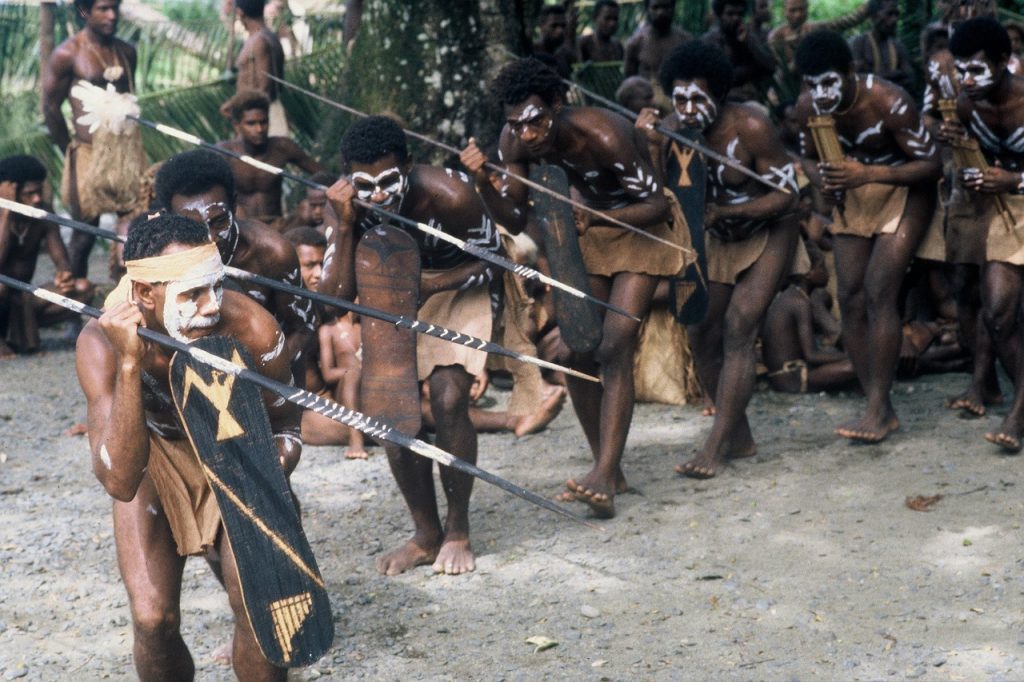
Trobriand ceremonial life was rich in festival and celebration, tied to the cycle of the gardens and the seasons. The period following the yam harvest was, in particular, a time of dancing, feasting, and celebration, when the labour of the gardens gave way to a season of pleasure, courtship, and display that was famous throughout the islands.
These gatherings were marked by dance, song, ornament, and the joy of a community celebrating its abundance. Adorned in their finery, the islanders came together in performances that expressed the vitality of their society and the pleasures of island life, reaffirming the ties among the living in an atmosphere of festivity and delight.
The great voyages of ceremonial exchange were themselves occasions of ceremony and display, as fleets of decorated canoes set out and were received on distant shores. Between the harvest festivals and the arrival of exchange partners, the Trobriand year was punctuated by occasions of gathering and celebration that bound the islands together and gave island life its rhythm and colour.
The season of dance and courtship that followed the harvest was famous throughout the region, a time when the discipline of garden labour gave way to pleasure, display, and the pursuit of romance under the island sky.

History and Contact with the Outside
For much of their history the Trobriand Islanders lived within their own island world, connected by voyaging to neighbouring communities but far from the centres of distant states. Sustained contact with Europeans came in the colonial era, bringing traders, missionaries, and administrators, and the islands were drawn gradually into a wider colonial and then national order.
The islands became especially famous through the work of early anthropologists who lived among the Trobrianders and described their customs in detail, making the islands a landmark in the study of human society. This scholarly fame brought the Trobrianders a particular kind of renown, even as mission, administration, and trade reshaped aspects of island life.
Incorporation into the wider world brought Christianity, schools, new goods, and the structures of a modern state, along with the pressures common to island communities. Yet the Trobrianders retained much of their distinctive culture, including the kula and the centrality of yams, and they navigated the changes of the modern era while holding fast to the institutions that defined their society.
The detailed accounts written by those early observers turned a remote group of coral islands into one of the most cited examples in the whole study of human society, a distinction that few communities of comparable size have ever held.

The Trobriand Islanders Today
Today the Trobriand Islanders remain on their coral islands, still gardening yams, still voyaging, and still taking part in the kula exchange for which they are renowned. Christianity is widespread, schools and the national economy are part of island life, and travel and communication link the islands to the wider nation, yet much of the older way of life persists alongside the new.
Younger islanders move between worlds, attending school and travelling for work and education, while remaining tied to their kin groups, their gardens, and the customs of their islands. This double life brings opportunity and strain alike, as families balance the pull of the wider world against the desire to sustain the language, skills, and obligations that make someone fully of the islands.
The challenges ahead are real, from the pressures facing low-lying island communities to the uncertainties of economic and environmental change. Yet the Trobrianders carry into the future a powerful inheritance: a deep knowledge of garden and sea, a famous tradition of exchange, and a rich ceremonial life. In their yams, their canoes, and their voyages, the Trobriand Islanders continue to sustain a world that is unmistakably their own.
The sight of a decorated canoe setting out across the lagoon, bound for a distant island and a waiting exchange partner, remains one of the enduring images of Trobriand life, a living link between the celebrated past and the island present.
For all the pressures of the modern age, the yam garden and the seagoing canoe remain the enduring emblems of a people whose sense of themselves is bound tightly to the fertile land of their islands and the wide sea that carries their voyages.

Related Peoples of the Region
- Noongar People of the Southwest and Their Country of Six Seasons
- Tiwi People of the Northern Islands and Their World Apart
- Palawa People of lutruwita and Their Remarkable Cultural Return
- Dani People of the Baliem Valley and Their Highland World of Pigs and Gardens
- Asmat People of the Papua Swamps and Their Sacred Art of Woodcarving
- Huli Wigmen of the Papua New Guinea Highlands and Their World of Gardens and Ceremony