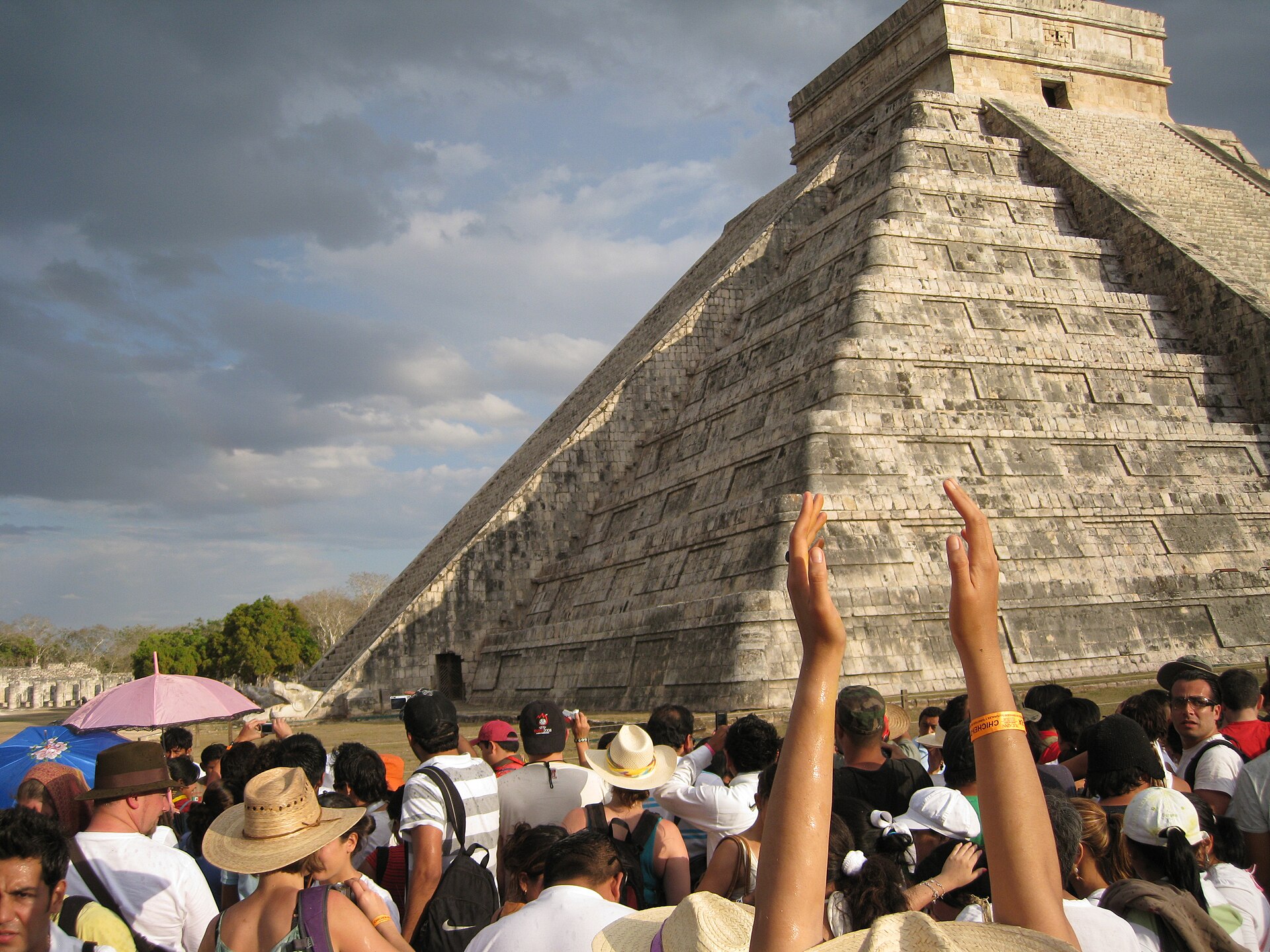
On the flat limestone plain of Mexico’s Yucatán Peninsula rises the most famous of all Maya cities. At its centre stands a single perfect pyramid, El Castillo, a mountain of stone stairs crowned by a temple, so precisely built that twice a year, at the equinoxes, the setting sun casts a serpent of light and shadow slithering down its northern balustrade. Around it spread ball courts, colonnades, an observatory, and a sacred well, the remains of a metropolis that dominated the northern Maya world.
Chichén Itzá flourished as the older Maya cities of the south were falling into decline, rising to power in the centuries around the end of the first millennium. It blended classic Maya traditions with influences from central Mexico, producing an architecture and iconography of feathered serpents, warriors, and sacrifice. Today it is one of the most visited archaeological sites in the world and one of the modern seven wonders, a place where Maya genius meets the drama of ritual and myth.

Table of Contents
- The Last Great Maya City
- El Castillo and the Serpent of Light
- The Temple of the Warriors
- The Chac Mool
- The Great Ball Court
- The Wall of Skulls
- The Observatory
- The Sacred Cenote
- Decline and Rediscovery
- Getting There
- Nearby Places
- Closing Thoughts
The Last Great Maya City
Chichén Itzá rose to prominence from around the ninth century, at a time when the great Classic Maya cities of the southern lowlands, places like Tikal and Palenque, were collapsing. Drawing on this shifting world, it became the dominant power of the northern Yucatán, controlling trade and holding sway over a wide region.
Its name means, roughly, at the mouth of the well of the Itzá, referring both to the people associated with it and to the natural wells that made settlement possible in this dry, riverless landscape. For several centuries it was the beating heart of northern Maya civilization.
El Castillo and the Serpent of Light
The pyramid known as El Castillo, or the Temple of Kukulcan, is a marvel of Maya astronomy in stone. Its four staircases and terraces encode the calendar: the steps together with the top platform total three hundred and sixty-five, the days of the solar year, and its geometry aligns with the movements of the sun.
Most famously, at the spring and autumn equinoxes, the afternoon sun throws a series of triangular shadows along the edge of the northern staircase, creating the illusion of a great serpent descending the pyramid to join the carved serpent heads at its base. It is one of the most celebrated architectural effects of the ancient world.
The Temple of the Warriors
Beside the great pyramid stands the Temple of the Warriors, a stepped platform fronted and flanked by hundreds of carved columns depicting warriors. At its summit sit sculpted figures, and the whole complex recalls the architecture of Tula in central Mexico, evidence of the cultural currents that shaped Chichén Itzá.
The temple embodies the militarized ideology that pervades the city’s art, in which armed men, eagles, jaguars, and images of sacrifice recur. It speaks of an era in which warfare and ritual violence were central to Maya statecraft.

The Chac Mool
Among the most distinctive sculptures at Chichén Itzá is the Chac Mool, a reclining stone figure holding a bowl or disc on its belly, positioned to receive offerings. These enigmatic images stand at the thresholds of temples, guardians of the sacred exchange between people and gods.
The offerings placed upon them may have included food, incense, or the hearts of sacrificial victims. The Chac Mool has become an iconic image of Mesoamerican art, at once serene and unsettling.

The Great Ball Court
Chichén Itzá contains the largest ball court in ancient Mesoamerica, a vast walled playing field where a version of the rubber-ball game sacred across the region was staged. Stone rings set high in the walls and carved panels depicting players make clear that this was no mere sport.
The ball game carried deep religious meaning, tied to cosmic struggle and, at Chichén Itzá, apparently to sacrifice: carvings show a decapitated player, blood streaming as serpents. Here athletic contest, myth, and death were bound together.

The Wall of Skulls
Near the ball court stands the Tzompantli, a low platform whose sides are carved with rank upon rank of human skulls. Such structures, known from across Mesoamerica, were used to display the severed heads of sacrificial victims and enemies, impaled on wooden racks.
Grim as it is, the skull platform reflects a worldview in which sacrifice was essential to maintaining cosmic order and the favour of the gods. It is a stark reminder of the ritual violence woven into the city’s grandeur.

The Observatory
Set apart from the martial monuments is El Caracol, a round tower named for the spiral staircase within. Its windows and alignments are oriented to the movements of Venus, a planet of great importance in Maya astronomy and religion, allowing priests to track its cycles.
The building testifies to the extraordinary astronomical knowledge of the Maya, who could predict celestial events with remarkable accuracy. Science and religion were inseparable here, the heavens read as a guide to ritual and time.

The Sacred Cenote
North of the main pyramid, a causeway leads to the Sacred Cenote, a great natural sinkhole in the limestone filled with water. This well was a focus of pilgrimage and offering, and into it were cast precious objects of gold, jade, and copal, as well as human sacrifices.
Dredging of the cenote has recovered thousands of these offerings, illuminating both the religious practices of Chichén Itzá and its wide-reaching contacts, since some objects came from far-off regions. The well gave the city its name and much of its sacred power.

Decline and Rediscovery
Chichén Itzá’s dominance faded after the twelfth or thirteenth century, as power shifted to other centres such as Mayapán. Though never wholly forgotten, and still visited by the Maya, it declined as a political capital, and much of it fell into ruin and forest.
Rediscovered and explored by travellers and archaeologists from the nineteenth century onward, it has since been extensively studied and restored. Today it draws millions of visitors and stands as a global symbol of Maya civilization.

Getting There
Chichén Itzá lies in the state of Yucatán in southeastern Mexico, roughly midway between the cities of Mérida and Valladolid and within reach of the Caribbean resorts of the Riviera Maya. It is easily visited by car or organized tour, and arriving early rewards visitors with cooler air and thinner crowds.
The site stands at approximately 20.6829, -88.5686. You can open the exact location on Google Maps for directions to the ruins of Chichén Itzá.
Nearby Places
Closing Thoughts
Chichén Itzá gathers into one place the full range of Maya achievement and belief: astronomy in the alignment of its pyramid, mathematics in its calendar, engineering in its monuments, and a religion of startling intensity in its ball court, cenote, and skull platform.
That the sun still draws its serpent of shadow down El Castillo each equinox, before crowds of watching visitors, is a fitting emblem of the city. Chichén Itzá remains a living wonder, a Maya masterpiece that continues to keep time with the heavens.
You May Like


One thought on “Chichén Itzá: The Serpent of Shadow and the Last Great Maya City”