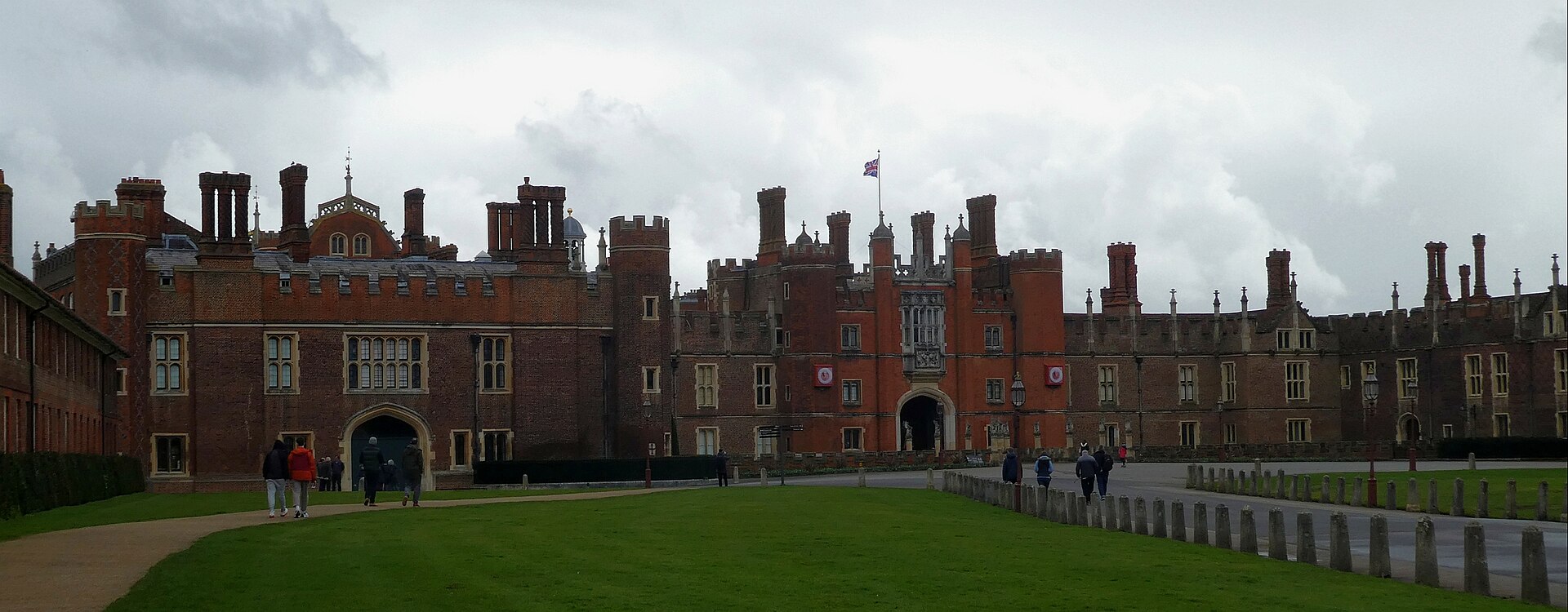
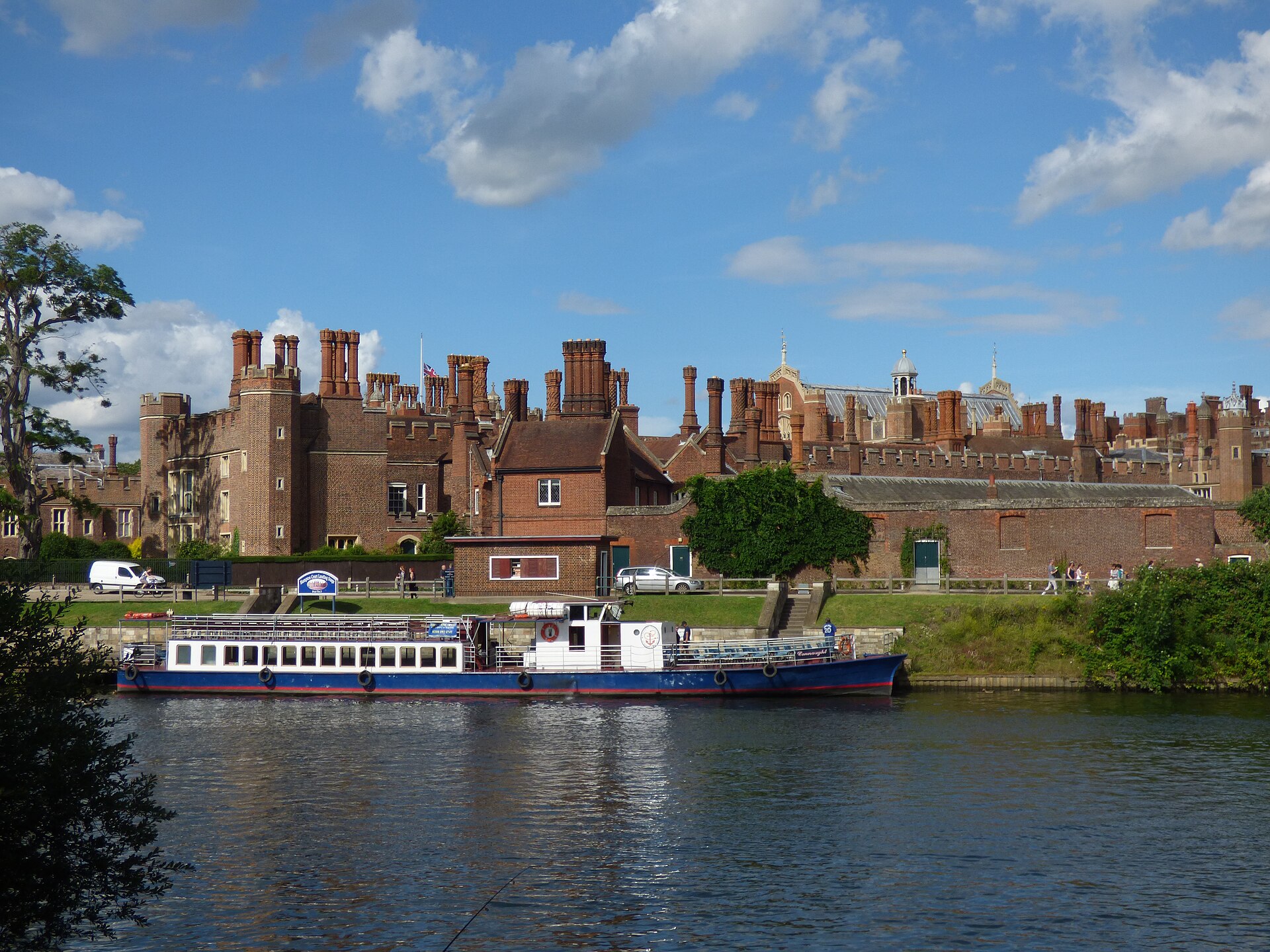
On the banks of the Thames upstream from London stands a palace that is really two palaces in one, joined at the seam and telling two different stories of English kingship. Approach Hampton Court from the west and you meet a vast red-brick Tudor palace of turrets, battlements, and twisting chimneys, the world of Henry VIII and his six wives. Walk through to the far side and you emerge into a serene Baroque palace of golden stone and classical symmetry, the world of William and Mary a century and a half later. Nowhere else are two such different ages of monarchy so dramatically fused in a single great building.
Hampton Court is among the most famous and most atmospheric of all English royal palaces, a place where the drama of the Tudor court and the elegance of the later Stuart age meet beneath one roof. Its Great Hall still echoes with the memory of Henry’s feasts, its Chapel Royal has heard five centuries of worship, its cavernous Tudor kitchens once fed a court of a thousand, and its state apartments preserve the splendour of England’s Baroque monarchy. Few buildings hold so much English history in one place.
The palace is also a place of legend and ghost story, bound up with the loves and tragedies of Henry VIII, whose wives lived, gave birth, and in one case are said still to haunt its galleries. And it is a place of gardens, from the famous hedge maze that has bewildered visitors for three centuries to the ancient vine that is among the oldest in the world. Around the palace spread grounds as rich in history as the building itself.
To visit Hampton Court is to walk through five hundred years of English royal life, from the ambition of a cardinal who built it to the king who seized it, through the golden and terrible days of the Tudors, to the confident grandeur of the age that followed. This is the story of the palace on the Thames, of the two very different monarchies that shaped it, and of how it became one of the greatest treasure houses of English history.
In This Article
- A Palace of Two Faces
- The Cardinal Who Built a Palace
- Henry VIII and the Tudor Palace
- The Great Hall
- The Chapel Royal
- The Great Tudor Kitchens
- The Astronomical Clock and Anne Boleyn’s Gateway
- Six Wives, Tragedy, and Ghosts
- William, Mary, and the Baroque Palace
- The King’s Staircase and the Baroque Apartments
- The Gardens, the Maze, and the Great Vine
- From Royal Residence to National Treasure
- Hampton Court Today
A Palace of Two Faces
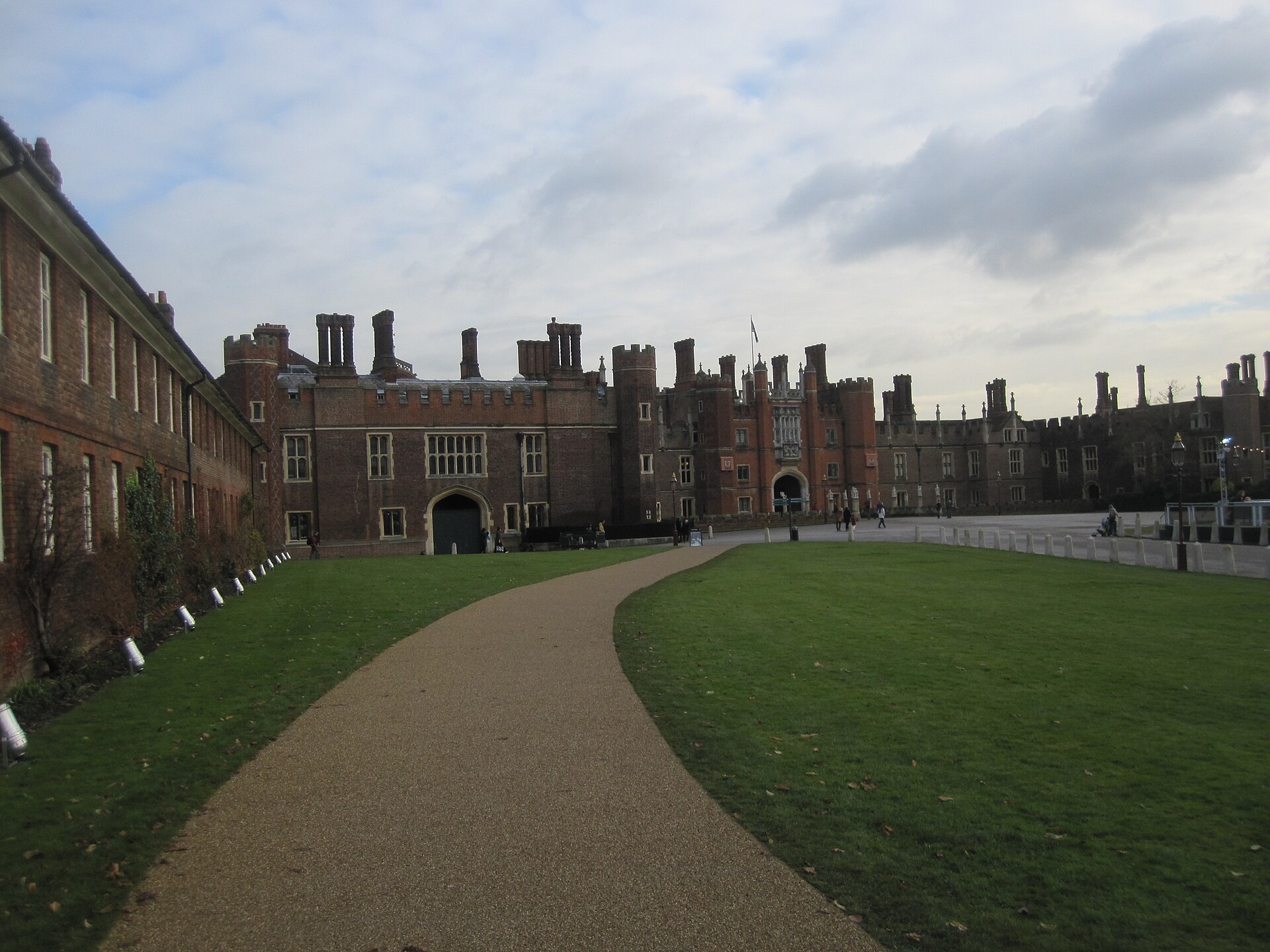
Hampton Court is unique among the great palaces of Europe in being, quite visibly, two palaces welded together. One half is a sprawling Tudor palace of the early sixteenth century, built of warm red brick and bristling with towers, gatehouses, battlements, and the ornate twisted chimneys that are a hallmark of the age. The other half is a stately Baroque palace of the late seventeenth century, built of pale stone in a restrained classical style of symmetry and calm. The two meet within the same great complex.
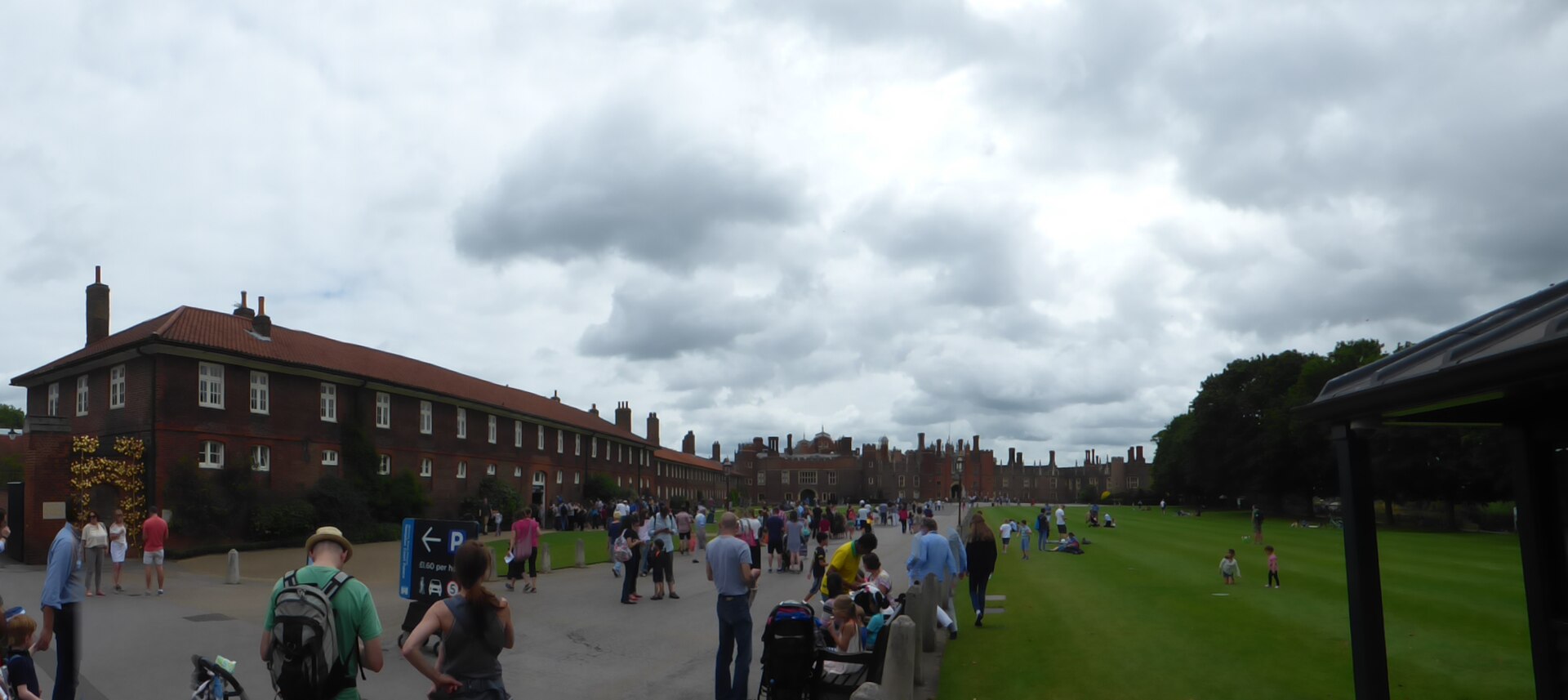
This double character is the result of history, for the palace was created in two great campaigns of building separated by nearly two centuries. The Tudor palace was raised in the age of Henry VIII, while the Baroque palace was added by William and Mary at the end of the seventeenth century, when half the old building was pulled down to make way for the new. A plan to replace the whole Tudor palace was never completed, and so the two ages survive side by side.
The contrast between the two halves could hardly be greater, and it embodies the contrast between the two ages of monarchy that created them. The Tudor palace speaks of a court of pageantry, feasting, and danger, of a mighty and mercurial king; the Baroque palace speaks of a more ordered, classical age, of a monarchy influenced by the ideals of continental Europe. To move from one to the other is to travel between two worlds.
For the visitor, this fusion is one of the palace’s chief fascinations. Few places allow one to experience so directly the changing face of monarchy across the centuries, and the very fabric of Hampton Court tells the story of England’s evolution from the medieval world of the Tudors to the modern age that followed. It is a building in which history is written in brick and stone, and in which two great eras stand forever side by side.
This layering of periods also makes Hampton Court an extraordinary document of the history of English architecture, taste, and monarchy. In no other single building can one trace so directly the journey from the late medieval world, with its emphasis on defence, hierarchy, and display through sheer abundance, to the classical age, with its ideals of proportion, symmetry, and restraint. The palace is, in effect, a textbook of English royal history written in brick and stone, and it repays the visitor who reads it closely with an understanding of how profoundly the nation changed across two centuries.
The Cardinal Who Built a Palace
Hampton Court began not as a royal palace but as the creation of a subject, the most powerful man in England after the king himself. Cardinal Thomas Wolsey, Archbishop of York and Lord Chancellor, was the son of a butcher who rose through the Church and the royal service to become the chief minister of Henry VIII, wielding almost regal power. From around 1515 he set about building himself a residence of unmatched magnificence at Hampton Court.
Wolsey spared no expense. He raised a vast palace of red brick, with grand gatehouses, spacious courtyards, and hundreds of richly appointed rooms, fitted out with tapestries, fine furnishings, and every luxury the age could provide. The result was one of the most splendid houses in England, grander in many ways than the king’s own residences, a fitting reflection of the cardinal’s enormous wealth and ambition.
The magnificence of Wolsey’s palace was, in the end, part of his undoing. His power and his pride made him enemies, and his failure to secure the annulment of the king’s first marriage sealed his fall from favour. As his position crumbled, Wolsey sought to appease the king, and around 1529 he gave Hampton Court to Henry VIII, a gift that could not save him. He died soon after, disgraced, on his way to face charges of treason.
So the palace that a cardinal had built for himself passed into the hands of the king, and the story of royal Hampton Court began. Wolsey’s fall is one of the great dramas of the Tudor age, a warning of the dangers of rising too high, and his palace became the stage on which the even greater dramas of Henry’s reign would unfold. The butcher’s son had built a house fit for a king, and a king duly took it.
Henry VIII and the Tudor Palace
Once Hampton Court was his, Henry VIII set about making it grander still, transforming Wolsey’s already magnificent house into one of the foremost royal palaces in the land. Over the following years the king added and rebuilt on a lavish scale, creating new lodgings, a great hall, a chapel, tennis courts, tiltyards for jousting, and vast kitchens, until the palace could accommodate the enormous royal court and all its activities.
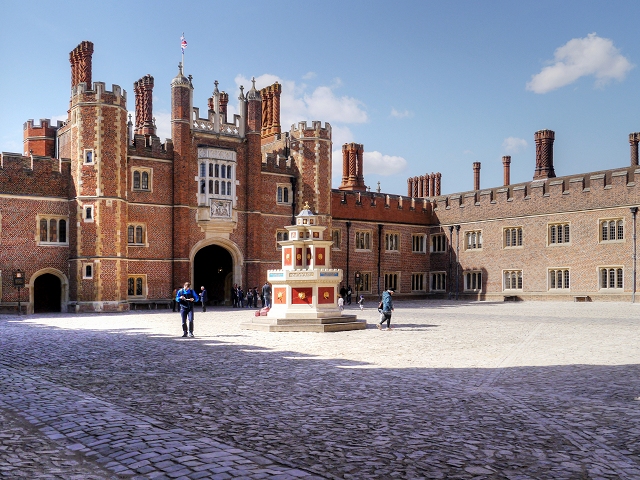
Hampton Court became one of Henry’s favourite residences, a place of feasting, hunting, music, and display, and the setting for much of the drama of his tumultuous reign. Here the king pursued his pleasures and conducted his affairs of state, surrounded by the pomp and danger of the Tudor court. The palace was designed to project the magnificence and power of the monarchy, and under Henry it did so on a spectacular scale.
The Tudor palace that survives today, though only part of what Henry knew, gives a vivid impression of that world. Its red-brick ranges, its gatehouses and courtyards, its great hall and chapel and kitchens, all speak of the scale and splendour of the sixteenth-century court. To walk through them is to enter the world of Henry VIII, a world of enormous appetite, of pageantry and peril, of a king who bestrode his age like a colossus.
Hampton Court is, above all, the palace most closely associated with Henry VIII, the place where his memory clings most strongly. It was here that much of the drama of his reign, and of his marriages, was played out, and the palace remains saturated with his presence. For all its later additions, it is still, in the popular imagination, Henry’s palace, the great stage of the most famous of all English kings.
It was also at Hampton Court that Henry’s long-desired succession was secured, for his only legitimate son, the future Edward VI, was born within its walls. The palace thus stood at the very centre of the dynastic drama that consumed the king’s reign, the endless quest for a male heir that drove his succession of marriages and reshaped the religious life of the entire nation. In this sense Hampton Court was not merely a pleasure palace but a stage on which the future of the Tudor dynasty, and of England itself, was decided.
The Great Hall
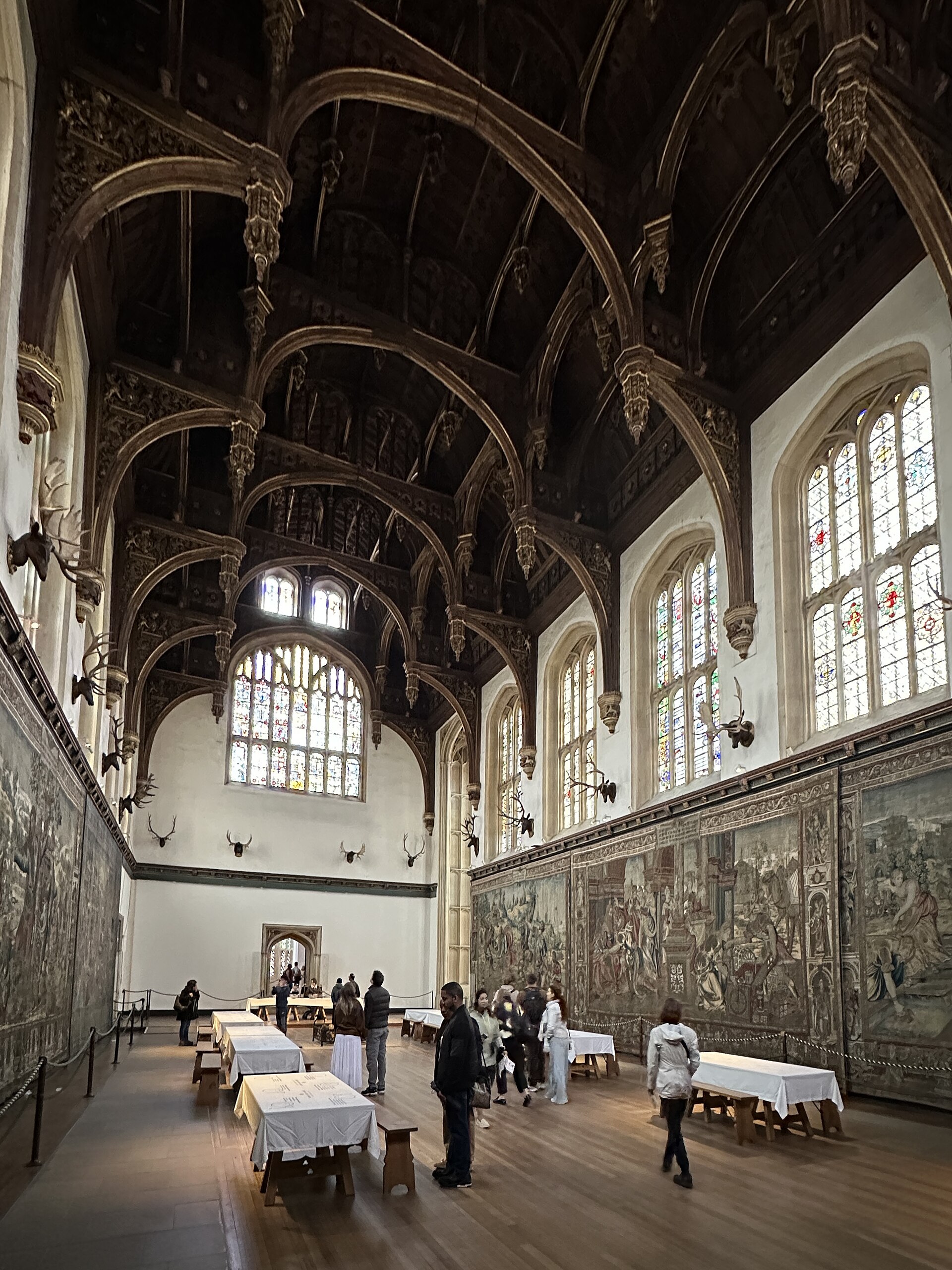
The finest surviving room of Henry VIII’s palace is the Great Hall, the grandest room he built at Hampton Court and one of the last and greatest medieval-style halls constructed in England. Built in the 1530s, it was the ceremonial heart of the Tudor palace, the place where the court gathered to dine in state and where great feasts and entertainments were held amid appropriate splendour.
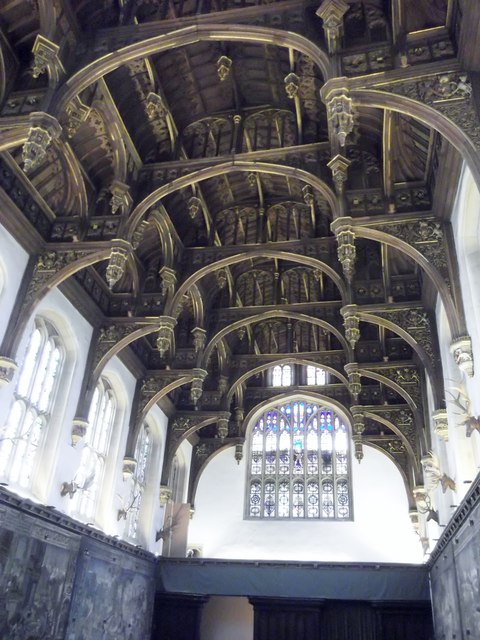
The glory of the hall is its magnificent hammerbeam roof, a masterpiece of the carpenter’s art, its great timbers soaring overhead in an intricate structure richly carved and decorated. This spectacular roof, adorned with pendants and carved detail, is one of the finest of its kind in the country, and it lends the hall an atmosphere of soaring grandeur. Beneath it the walls were hung with priceless tapestries, some of which survive.
The Great Hall was more than a dining room; it was a statement of royal magnificence, designed to impress all who entered with the wealth and power of the king. Here the lower ranks of the court dined daily, while great occasions saw the hall filled with the pageantry of the Tudor monarchy. In later centuries it even served as a theatre, where plays were performed before the court, including works by Shakespeare’s company.
To stand in the Great Hall today, beneath its towering roof and among its tapestries, is to feel the presence of Henry’s court more strongly than anywhere else in the palace. It is a room that has witnessed five centuries of history, and it remains the magnificent centrepiece of the Tudor palace, a fitting monument to the king who built it and to the vanished world of feasting and pageantry over which he presided.
The Chapel Royal
Among the treasures of the Tudor palace is the Chapel Royal, a place of worship that has been in continuous use for some five hundred years and remains a working chapel today. Built in Wolsey’s time and enriched by Henry VIII, it served the religious life of the court, and it has witnessed the devotions of generations of monarchs from the Tudors onward, a living link to the palace’s earliest days.
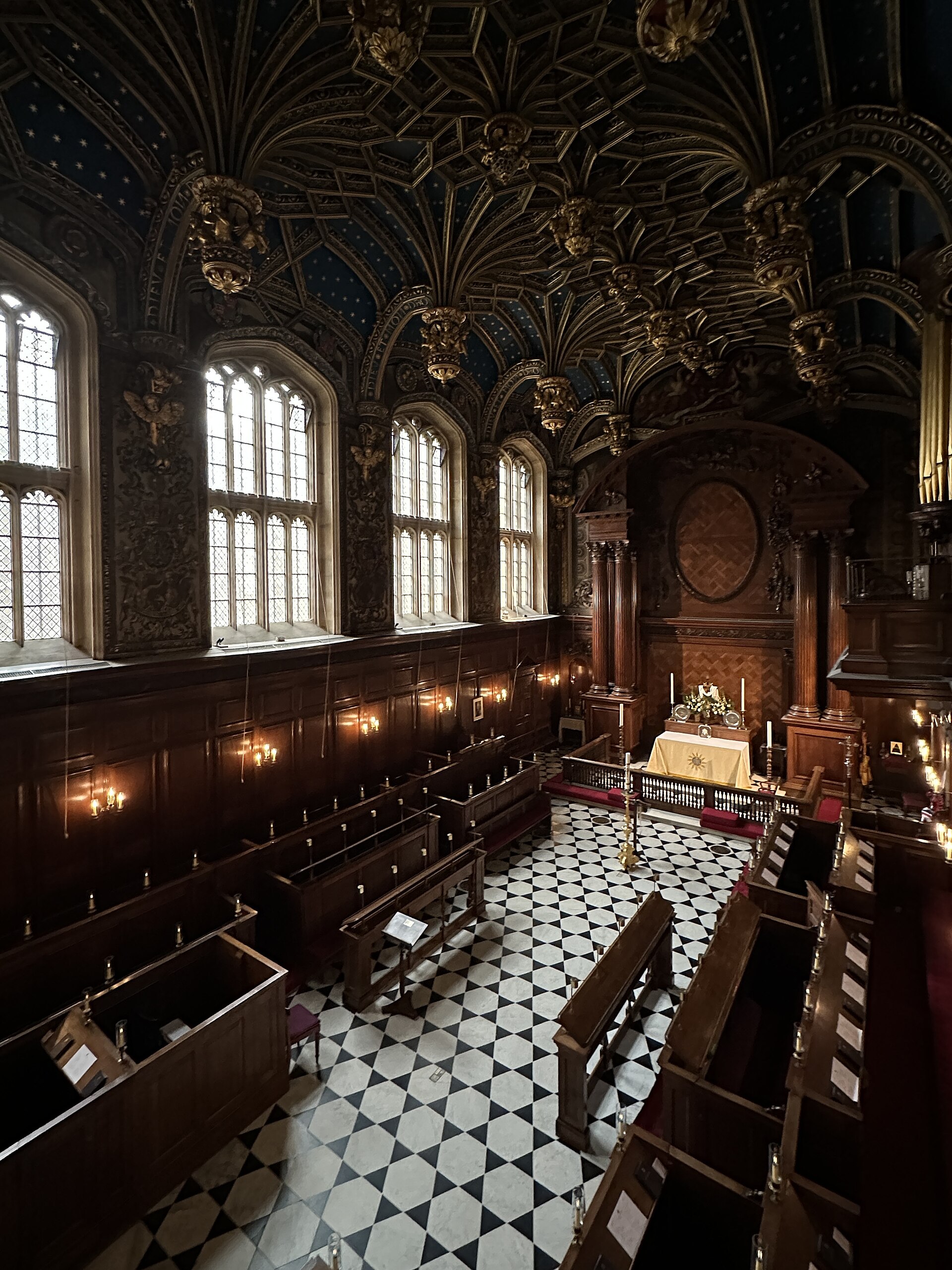
The chapel’s greatest glory is its spectacular vaulted ceiling, a wonder of blue and gold, studded with gilded pendants and richly decorated. Installed in Henry’s reign, this magnificent ceiling transforms the chapel into a jewel of Tudor craftsmanship, its deep blue sky scattered with golden stars and ornament creating an atmosphere of heavenly splendour above the worshippers below.
The chapel has been the setting for momentous events in the palace’s history. It was here that news of the misconduct of one of Henry’s queens was said to have reached him during a service, and it has seen royal christenings, marriages, and worship across the centuries. Its continuous use through all the changes of religion and dynasty makes it one of the most historically resonant spaces in the whole palace.
For the visitor, the Chapel Royal offers a rare experience of a Tudor interior still fulfilling its original purpose. Its glowing ceiling, its atmosphere of devotion, and its long history combine to make it one of the most moving spaces at Hampton Court. It is a reminder that the palace was not only a place of feasting and politics but also of faith, and that religion lay at the very heart of the life of the court.
The Great Tudor Kitchens
To feed the vast court that gathered at Hampton Court required kitchens on an almost industrial scale, and the great Tudor kitchens of the palace are among the most remarkable survivals of their kind anywhere. Built to cater for a court that could number well over a thousand people, they form a sprawling complex of rooms with huge fireplaces, in which enormous quantities of food were prepared day after day.
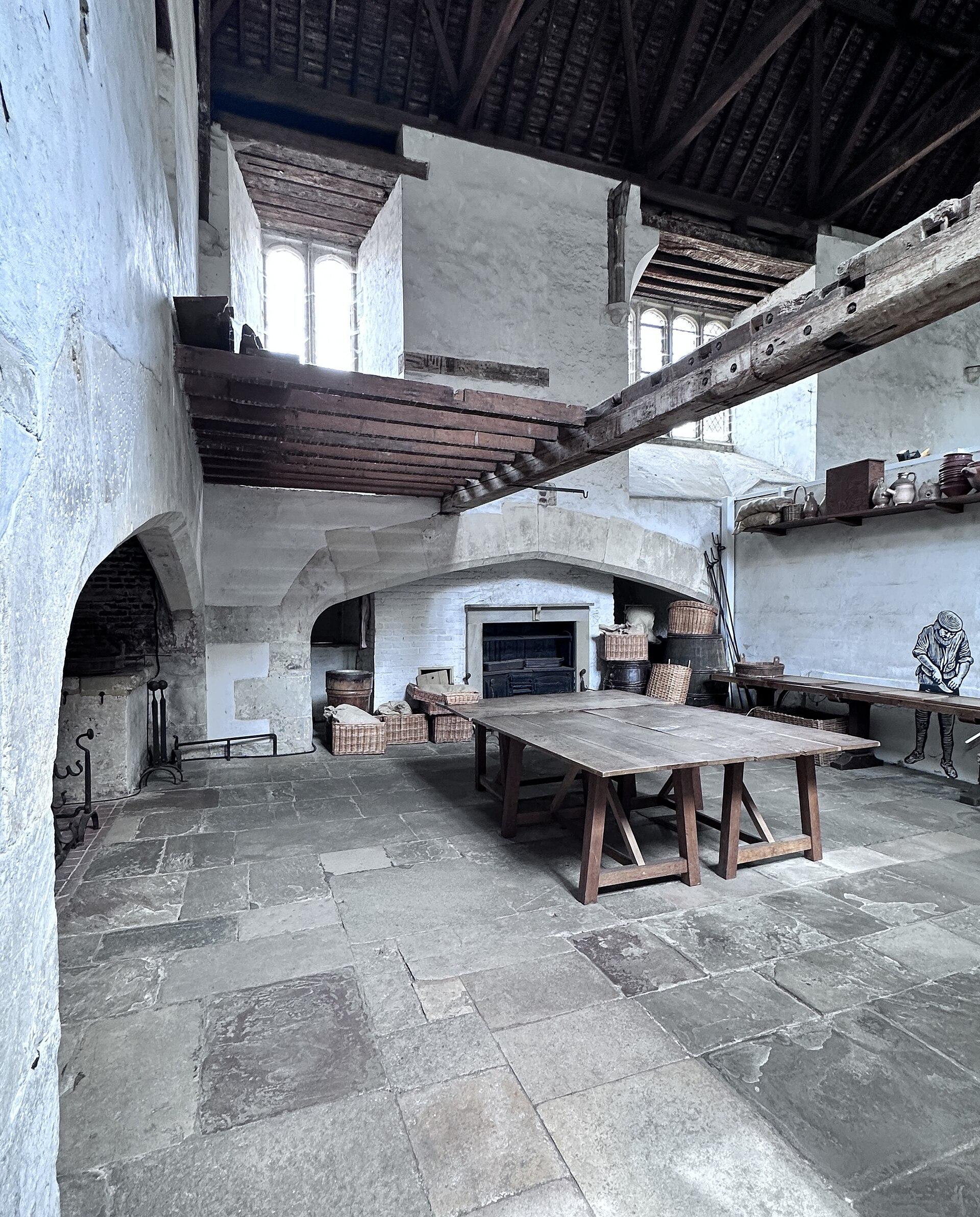
The scale of the operation is astonishing. The kitchens produced thousands of meals, and the court consumed prodigious quantities of meat, bread, ale, and wine. Great fires roasted whole animals on spits, while a small army of cooks, servants, and suppliers laboured to feed the household. The surviving kitchens, with their vast hearths and their array of rooms for different tasks, convey vividly the enormous effort required.
The kitchens were a world of their own, governed by strict organisation and hierarchy, and they reveal a side of palace life very different from the splendour of the state rooms. Here was the engine that sustained the court, a place of heat, noise, and ceaseless activity, essential to the functioning of the whole vast establishment. It is a rare thing for such working spaces to survive so completely.
Today the Tudor kitchens are among the most popular parts of the palace, brought to life to show how the Tudor court was fed. They offer a fascinating glimpse into the practical realities behind the pageantry, into the labour that underpinned the magnificence of the monarchy. To walk through them is to understand that a great palace was not only a place of display but also a huge household that had, above all, to be fed.
The Astronomical Clock and Anne Boleyn’s Gateway
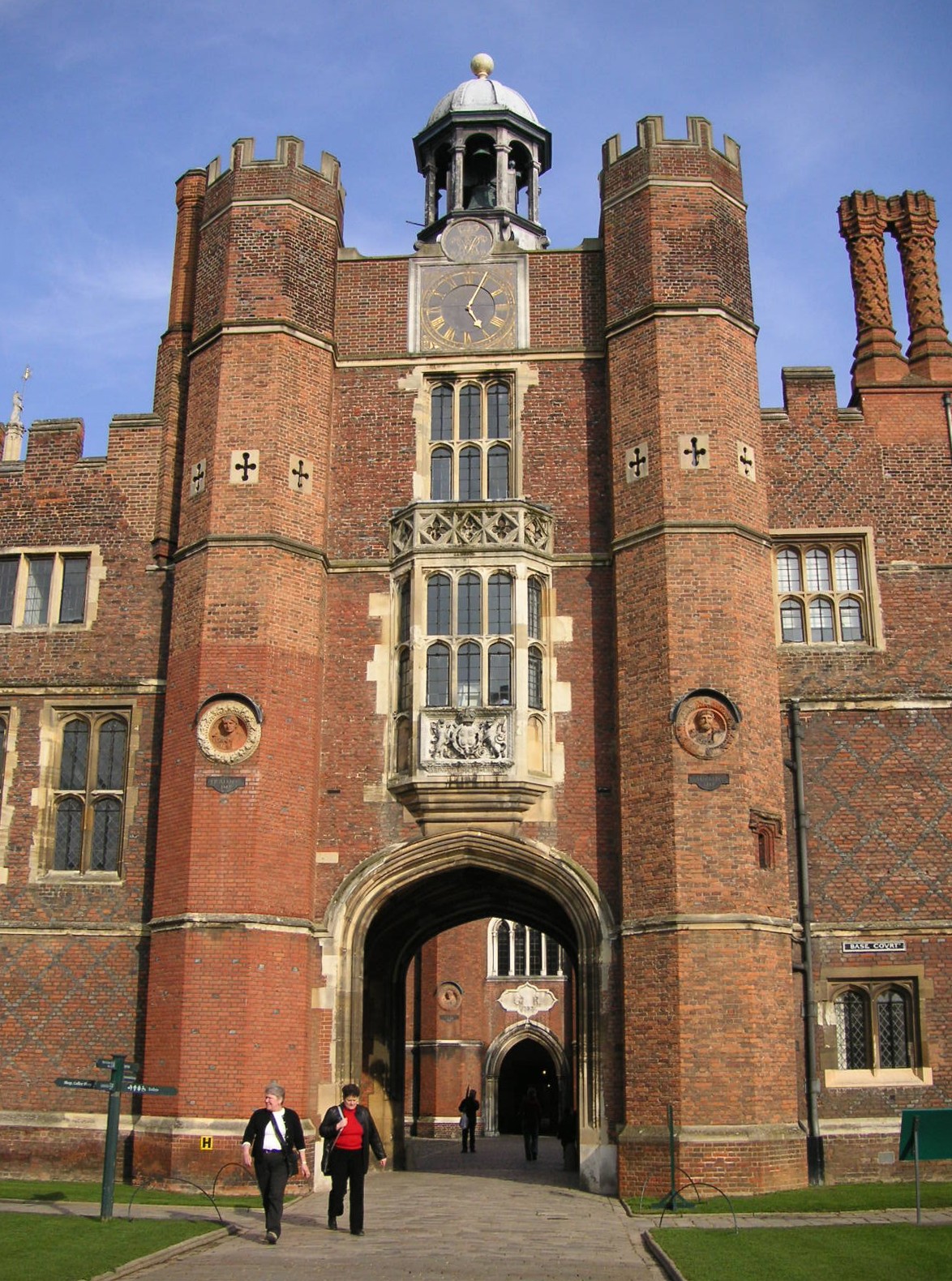
One of the most celebrated features of the Tudor palace is the great astronomical clock, set high on the gateway that leads into one of the inner courtyards. Made in the reign of Henry VIII, this remarkable clock is a masterpiece of Tudor craftsmanship and ingenuity, and it has kept its own peculiar time above the palace for nearly five centuries, a wonder of the age in which it was made.
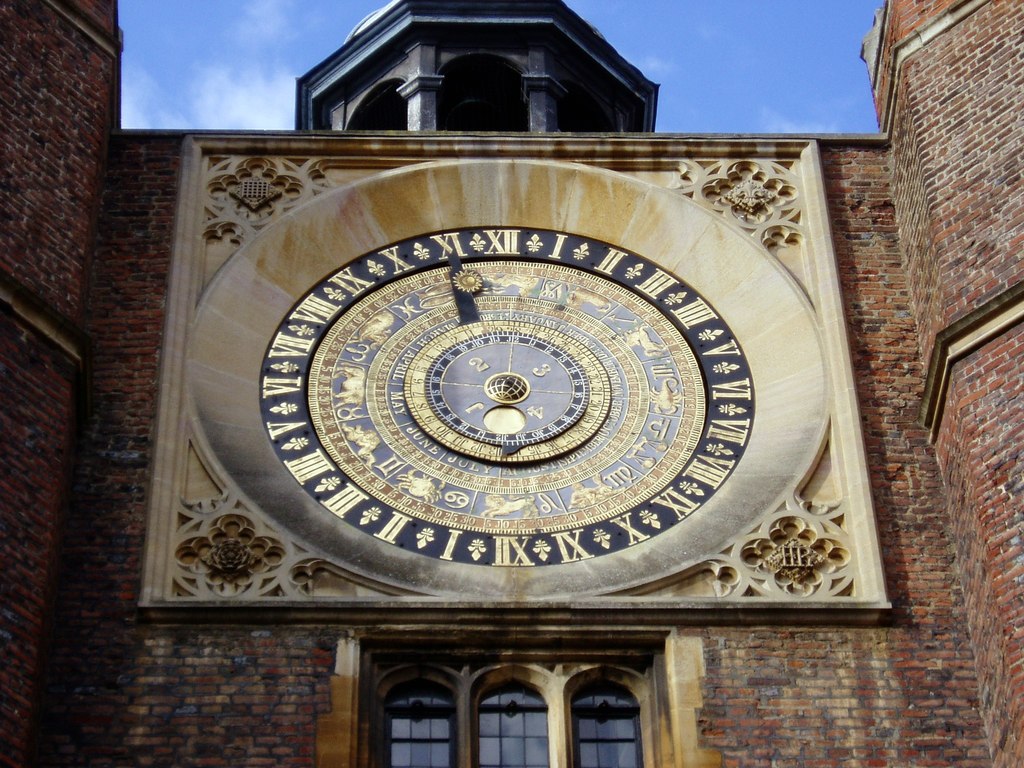
The clock does far more than tell the hour. Its elaborate dials show the month, the day, the phases of the moon, the position of the sun in the zodiac, and even, remarkably, the time of high water at London Bridge, a matter of great practical importance in an age when the court often travelled to and from the palace by barge along the Thames. It reflects the fascination of the age with astronomy and the measurement of time.
The gateway on which the clock is set is known as Anne Boleyn’s Gateway, named for Henry’s ill-fated second queen, whose emblems once adorned it. The association links the clock and its gateway to one of the most famous and tragic of the king’s marriages, and it is a reminder of how the fabric of the palace is woven through with the personal dramas of the Tudor monarchy.
The astronomical clock remains one of the emblems of Hampton Court, a symbol of the sophistication and ambition of the Tudor court. Its intricate dials, still turning above the courtyard, connect the modern visitor directly to the world of Henry VIII, to an age that was beginning to measure and understand the heavens with new precision, and that expressed its confidence in works of art and science such as this.
Six Wives, Tragedy, and Ghosts
No palace is more bound up with the story of Henry VIII’s six wives than Hampton Court, which witnessed key episodes in the drama of the king’s marriages. Several of his queens lived here, and the palace saw moments of joy and of terrible tragedy in their stories. It was here that Jane Seymour, the king’s third wife, gave birth to his longed-for son and heir, only to die days later, plunging the king into grief.
The palace is haunted, too, by the memory of Catherine Howard, Henry’s fifth wife, whose brief reign ended in accusations of infidelity and her execution. According to legend, when she learned of her impending arrest at the palace, she broke free and ran through a gallery to plead with the king, only to be dragged back. That gallery is now known as the Haunted Gallery, where her ghost is said still to run, and her cries to be heard.
These stories give Hampton Court a powerful atmosphere of romance and tragedy, and they have made it one of the most famous supposedly haunted buildings in England. The palace’s association with the loves and deaths of the Tudor queens lends it a human drama that few other buildings can match, a sense that behind the pageantry lay real lives marked by ambition, passion, and terror.
Whether or not one believes in ghosts, the stories of the six wives are inseparable from Hampton Court, and they draw many visitors to walk the galleries where these dramas unfolded. The palace preserves the memory of these women, whose fates were bound to that of the most famous of English kings, and it stands as a monument to one of the most extraordinary and tragic chapters in the history of the English monarchy.
William, Mary, and the Baroque Palace
Nearly a century and a half after Henry’s death, Hampton Court entered a new age. When William III and Mary II came to the throne in the late seventeenth century, they found the old Tudor palace unfashionable and set about transforming it into a modern Baroque residence to rival the great palaces of continental Europe. They commissioned the greatest English architect of the age, Sir Christopher Wren, to carry out the work.
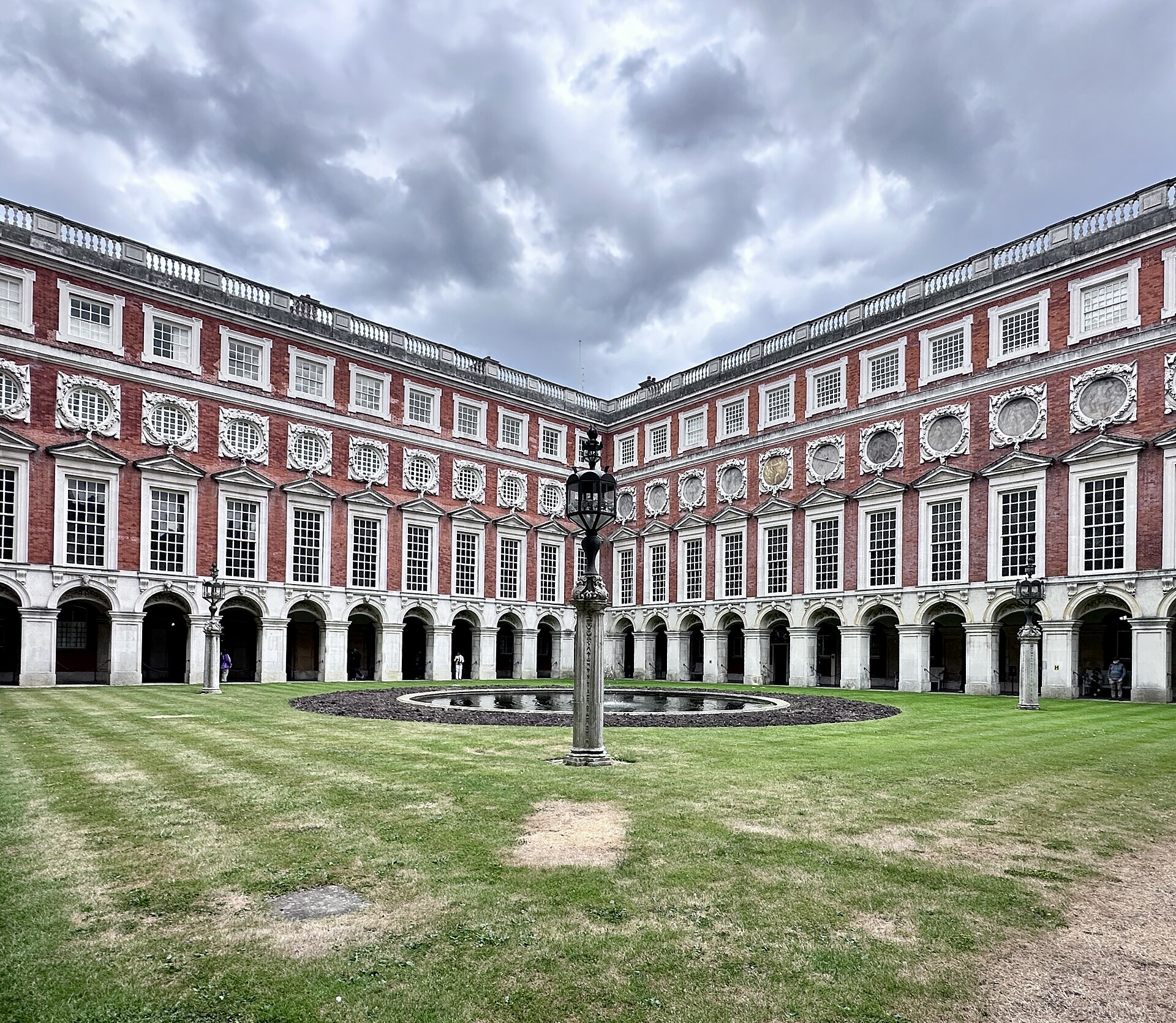
Wren’s original plan was to demolish the entire Tudor palace and replace it with a vast new Baroque building, but in the end only about half the old palace was pulled down. In its place rose Wren’s elegant new ranges of pale stone, built around a graceful courtyard and containing splendid new apartments for the king and queen. Fortunately, the Great Hall and much of the Tudor palace were spared, leaving the two ages to survive together.
Wren’s Baroque palace is a masterpiece of restrained classical design, its symmetrical facades and calm proportions a world away from the exuberant brickwork of the Tudor palace. Built in the fashionable style of the age, influenced by the architecture of France and the Netherlands, it gave Hampton Court a new grandeur suited to the ambitions of the monarchy of William and Mary, joint sovereigns of a newly confident kingdom.
The result of this campaign is the extraordinary double palace we know today, half Tudor and half Baroque. Had Wren’s full plan been carried out, the Tudor palace would have vanished entirely; that it survives is one of the happy accidents of history. Instead, Hampton Court preserves both the world of Henry VIII and the world of William and Mary, a unique monument to two very different ages of the English crown.
The decision to preserve the Tudor Great Hall rather than sweep it away, whether by design or by the simple exhaustion of funds, proved one of the most fortunate in the history of English architecture. Had William and Mary’s grander ambitions been fully realised, one of the greatest of all Tudor buildings would have been lost, and Hampton Court would have become simply another Baroque palace among many. Instead, the incompleteness of the project gave us the unique double palace, and preserved a priceless survival of the age of Henry VIII for future generations.
The King’s Staircase and the Baroque Apartments
The splendour of Wren’s Baroque palace is displayed above all in the state apartments created for the king and queen, reached by grand staircases and decorated by the finest artists of the age. The most magnificent of these approaches is the King’s Staircase, a soaring space whose walls and ceiling are covered with elaborate painted decoration, designed to impress visitors as they ascended toward the royal apartments.
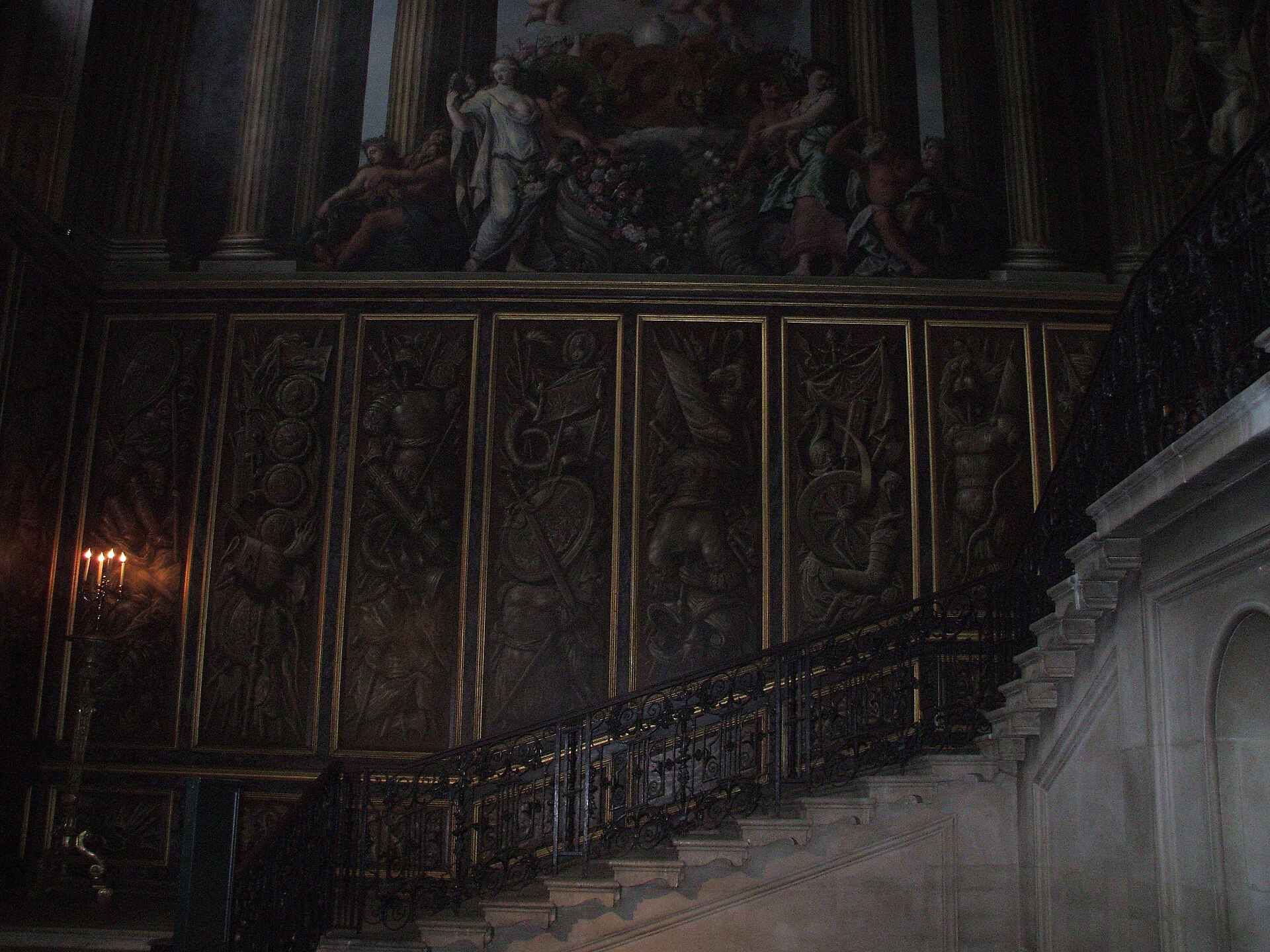
The paintings of the King’s Staircase were the work of the Italian artist Antonio Verrio, who covered the walls with a vast allegorical scheme celebrating the monarchy in the grand Baroque manner. Crowded with gods, emperors, and allegorical figures, the painted decoration transforms the staircase into a theatrical prelude to the state rooms beyond, a dazzling display of the taste and ambition of the age of William and Mary.
Beyond the staircase lie the state apartments themselves, a sequence of grand rooms richly decorated and furnished, hung with fine paintings and tapestries, and designed for the elaborate ceremony of the Baroque court. These rooms, with their painted ceilings, carved ornament, and sumptuous furnishings, embody the confident classicism of the late seventeenth century and provide a striking contrast to the Tudor rooms elsewhere in the palace.
At the heart of Wren’s palace lies the elegant Fountain Court, the graceful courtyard around which the new apartments were arranged, its symmetrical arcaded facades the very image of Baroque calm and order. Together the staircase, the apartments, and the courtyard form one of the finest Baroque interiors in England, a worthy complement to the Tudor palace and a monument to the golden age of English classical architecture.
The Gardens, the Maze, and the Great Vine
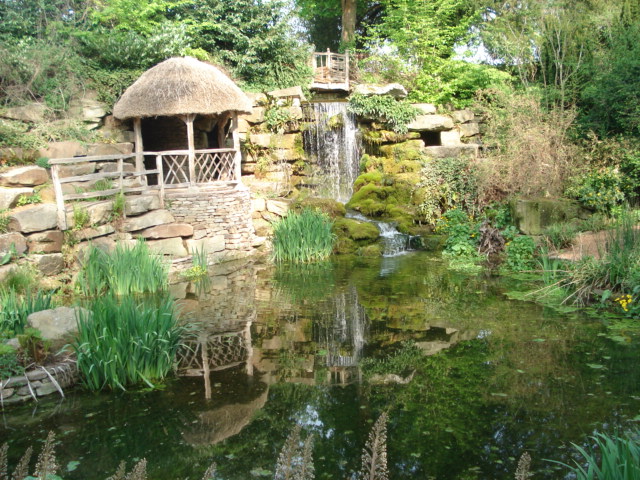
The gardens of Hampton Court are as celebrated as the palace itself, spreading around the building in a rich variety of styles and containing some of the most famous garden features in the world. Laid out and developed over centuries, they range from formal Baroque designs with avenues and fountains to intimate enclosed gardens, and they provide a magnificent setting for the great palace on the Thames.
The most famous feature of the gardens is undoubtedly the Maze, a hedge maze planted in the late seventeenth century and reckoned among the oldest surviving in the world. For more than three centuries it has delighted and bewildered visitors, who lose themselves among its winding paths in search of the centre, and it has become one of the best-loved attractions of the palace, a byword for the pleasures and frustrations of the labyrinth.
Another wonder of the gardens is the Great Vine, planted in the eighteenth century and now among the oldest and largest grapevines in the world. This extraordinary plant, still producing grapes after more than two centuries, is a living link to the palace’s past and a marvel in its own right, its ancient stem and vast spread of branches a testament to centuries of careful cultivation.
Beyond the maze and the vine, the gardens offer formal parterres, long avenues, the tranquil Privy Garden restored to its Baroque glory, and the broad expanse of the park stretching toward the river. Together they form one of the finest garden ensembles in England, a landscape as rich in history as the palace itself, and an essential part of the experience of Hampton Court for the many who come to enjoy them.
The gardens were also, in their day, a serious expression of royal magnificence and of the scientific and horticultural interests of the age. Under William and Mary in particular, great sums were spent laying out formal gardens in the Dutch and French styles then in fashion, with elaborate patterns, exotic plants, and impressive waterworks. The gardens were meant to be seen as an extension of the palace’s grandeur, and their design reflected the same ambitions that shaped the Baroque building itself.
From Royal Residence to National Treasure
Hampton Court remained an important royal residence through the seventeenth and into the eighteenth century, but its days as a home of reigning monarchs eventually came to an end. King George II was the last sovereign to live in the palace, and after his reign the court ceased to reside there, leaving the great building without its original royal purpose and facing an uncertain future.
Rather than fall into ruin, the palace found a new use. Its many apartments were granted by the crown as residences to favoured individuals, often widows or servants of the royal household, in what were known as grace and favour apartments. For generations these lodgings housed a varied community within the old palace, keeping it inhabited and cared for even as its royal role faded into memory.
In the nineteenth century a momentous decision was taken to open the palace to the public, and Hampton Court became one of the first royal palaces to be shown to ordinary visitors. Crowds flocked to see the historic rooms, the great hall, the gardens, and the maze, and the palace began its new life as a place of public resort and a monument to the nation’s history, a role it has held ever since.
This transformation from royal residence to national treasure preserved Hampton Court for posterity. No longer a home of kings, it became a place where the whole nation could encounter its history, and its careful conservation ensured the survival of both the Tudor and the Baroque palace. The end of its royal occupation was thus not a decline but a new beginning, opening the doors of the palace to all.
Hampton Court Today
Today Hampton Court is cared for by the independent charity that looks after several of the great historic royal palaces, and it stands as one of the most visited and best-loved historic sites in Britain. The Tudor palace, with its Great Hall, Chapel Royal, and kitchens, and the Baroque palace, with its state apartments and gardens, are all open to the public, offering an unrivalled journey through five centuries of royal history.
View the exact location on Google Maps
The palace is presented with great imagination, bringing its history vividly to life for visitors of all kinds. Costumed interpreters, exhibitions, and carefully restored rooms help to recreate the worlds of Henry VIII and of William and Mary, while the gardens, the maze, and the famous vine draw crowds throughout the year. Few historic buildings so successfully combine scholarship with the pleasures of a great day out.
Set on the Thames a short journey from central London, Hampton Court is easily reached and endlessly rewarding. Its combination of two great palaces in one, its wealth of history and legend, its magnificent hall and chapel and kitchens, and its glorious gardens make it one of the essential sights of England, a place where the whole sweep of royal history can be experienced in a single visit.
Five centuries after a cardinal first raised his magnificent house on the banks of the Thames, Hampton Court endures as one of the greatest treasure houses of English history. Home to the drama of the Tudors and the grandeur of the Baroque age, haunted by the memory of Henry’s queens, and surrounded by its famous gardens, it remains a palace like no other, where two ages of monarchy stand forever side by side.
The palace has also become a centre for the celebration of history and horticulture, hosting one of the most famous flower shows in the world within its grounds each year, along with concerts, festivals, and events that draw visitors from across the globe. In this way Hampton Court continues to live and to serve the public, not as a static monument but as a vibrant place of enjoyment and learning, carrying its long history forward into the present day.
Palaces Nearby
Along the same stretch of the Thames west of London stands the oldest and largest inhabited castle in the world:
You May Like

The Palaces of Orchha: A Bundela Capital on the Betwa


One thought on “Hampton Court Palace: The Two Palaces of Henry VIII and the Baroque Age”