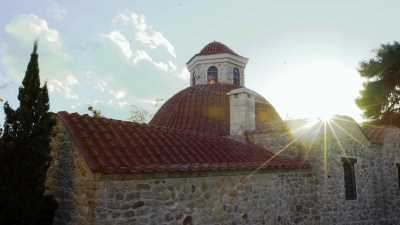
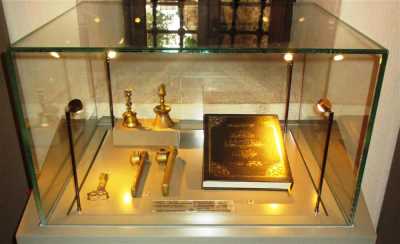
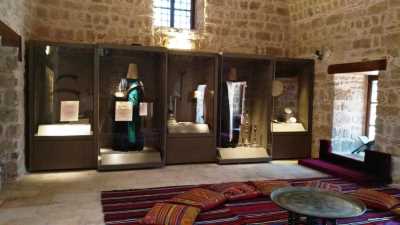
Mevlevihane Museum; It is a building complex consisting of the Mevlevi Lodge, Turkish Bath, Zincikıran Mehmet Bey Tomb and Nigâr Hatun Tomb located within the Yivli Minaret Complex. In these buildings, which are used as museums, information panels about Mevlevi order, animations, clothes and items belonging to Mevlevi order are exhibited. At the same time, activities such as Islamic philosophy and thought courses, Mesnevi and Divan readings, seminars, Sufi music recitals, and sema ceremonies are also held. The museum is in Antalya Kaleiçi.
General Directorate of Promotion Archive
The Mevlevihane building is located on a high terrace within the group of buildings where the Yivli Minaret is located. It is a two-storey masonry building with a rectangular form. To the east of the main space, which is entered through an arched door on the south façade, there is an iwan covered with a pointed vault; There is one room covered with barrel vaults in the northeast, two in the north and three in the west. It is thought that these rooms were used by the dervishes staying in the Mevlevi Lodge. Although it is said that the building was built as a Mevlevihane or sect building during the Seljuk period, a source from the 19th century refers to Prince Korkut as the founder and foundation of the Mevlevihane by saying “sahibu-l hayrat vel-hasenat”. Based on this, it is understood that the building in question functioned as a Mevlevi lodge during the Ottoman period, starting from the early 16th century. As a matter of fact, in the 17th century, Evliya Çelebi also mentions that the building was used as a Mevlevi lodge.
The bath structure within the social complex is known by names such as Mevlevihane Bath, Yivli Minaret Bath or Yivli Minaret Complex Bath. It is not known exactly when it was built. It has a rectangular plan. of the bath; With its plan, dimensions and location, it is thought that it was designed for private use rather than serving crowded groups. Although there are opinions that it was built as a “palace bath” in the first quarter of the 13th century, it is known that it functioned as the bath of the Mevlevi Lodge from the beginning of the 16th century.
Nigâr Hatun lived between 1450-1503, II. They are the mothers of Bayezid’s son, Prince Korkut, and his daughter, Fatma Sultan. It is known that when Prince Korkut was appointed from Manisa to Antalya Sanjak Principality, he came with his son, died in the same year and was buried in Antalya. Nigâr Hatun Tomb was built using smooth cut and rubble stones and bricks, including spoliated marble pieces here and there. It is understood that the building, which resembles Seljuk tombs in style, could have been built in the 15th century Ottoman period at the earliest, although it cannot be determined with certainty.
Zincirkıran Mehmet Bey Tomb is a structure with an octagonal body and a pyramidal cone, built of smooth-faced stone and rising on a square base. There are three sarcophagi inside, which are said to have been previously covered with tiles. On the two-line marble inscription filled with thuluth stacks on the door, it is written that it was built in 1377 by Muhammed, son of Mahmut, son of Yunus Bey, for his late son Ali.
Source: Antalya Provincial Directorate of Culture and Tourism.
Places to Visit in Antalya
Source: Antalya Provincial Culture and Tourism Directorate


One thought on “Mevlevihane Muzesi – Travel Guide – Antalya”