The Great Mosque of Kairouan is admired not only for its age but for the profound influence it had on Islamic architecture across the western Muslim world. Its design brought together earlier traditions into a form that would be echoed in mosques from North Africa to Spain, making it one of the most important architectural achievements of early Islam.
A Fortress of Faith
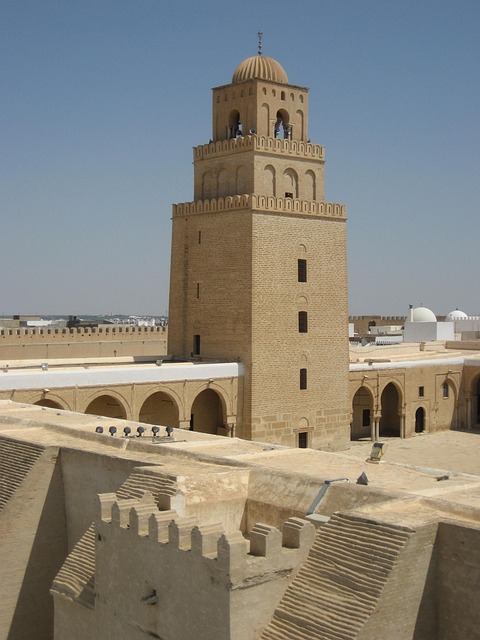
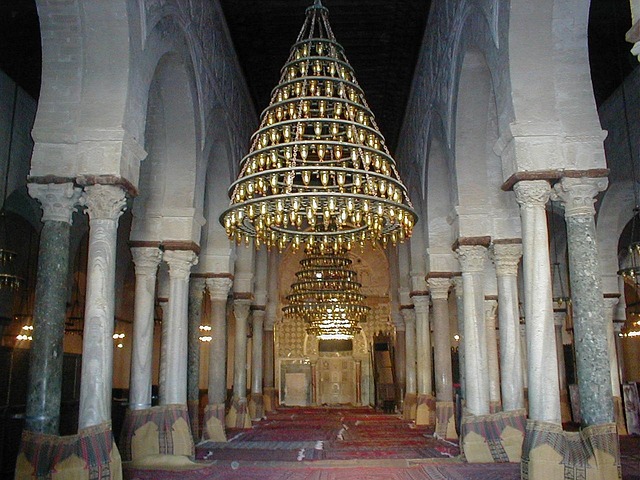
From the outside, the mosque has the appearance of a fortress, with high, plain walls and sturdy buttresses suited to a frontier city. Inside, this severity gives way to a vast and ordered space. The great courtyard, paved and open to the sky, leads to a deep prayer hall supported by rows of columns, many of them reused from older Roman and Byzantine buildings. This blending of materials from earlier eras is part of what gives the mosque its distinctive character.
The Ancient Minaret
Rising above the courtyard is the mosque’s massive square minaret, built in tiers and widely regarded as one of the oldest minarets still standing. Its solid, stepped form became a template for towers across the Maghreb and Andalusia, where the square minaret remained the dominant style for centuries. The minaret’s commanding presence underscores the mosque’s role as the spiritual and visual centre of the city.
A Model for the West
The plan of the Great Mosque, with its broad courtyard and columned prayer hall oriented toward Mecca, was studied and imitated by builders far beyond Tunisia. Its influence can be traced in the great mosques of the western Islamic world, and it helped establish architectural conventions that endured for generations. In this sense, Kairouan was not only a religious centre but a wellspring of artistic and architectural ideas.
More Kairouan Guides
- The Great Mosque of Kairouan
- The Holy City of Kairouan and Its Medina
- Visiting Kairouan: A Complete Guide


