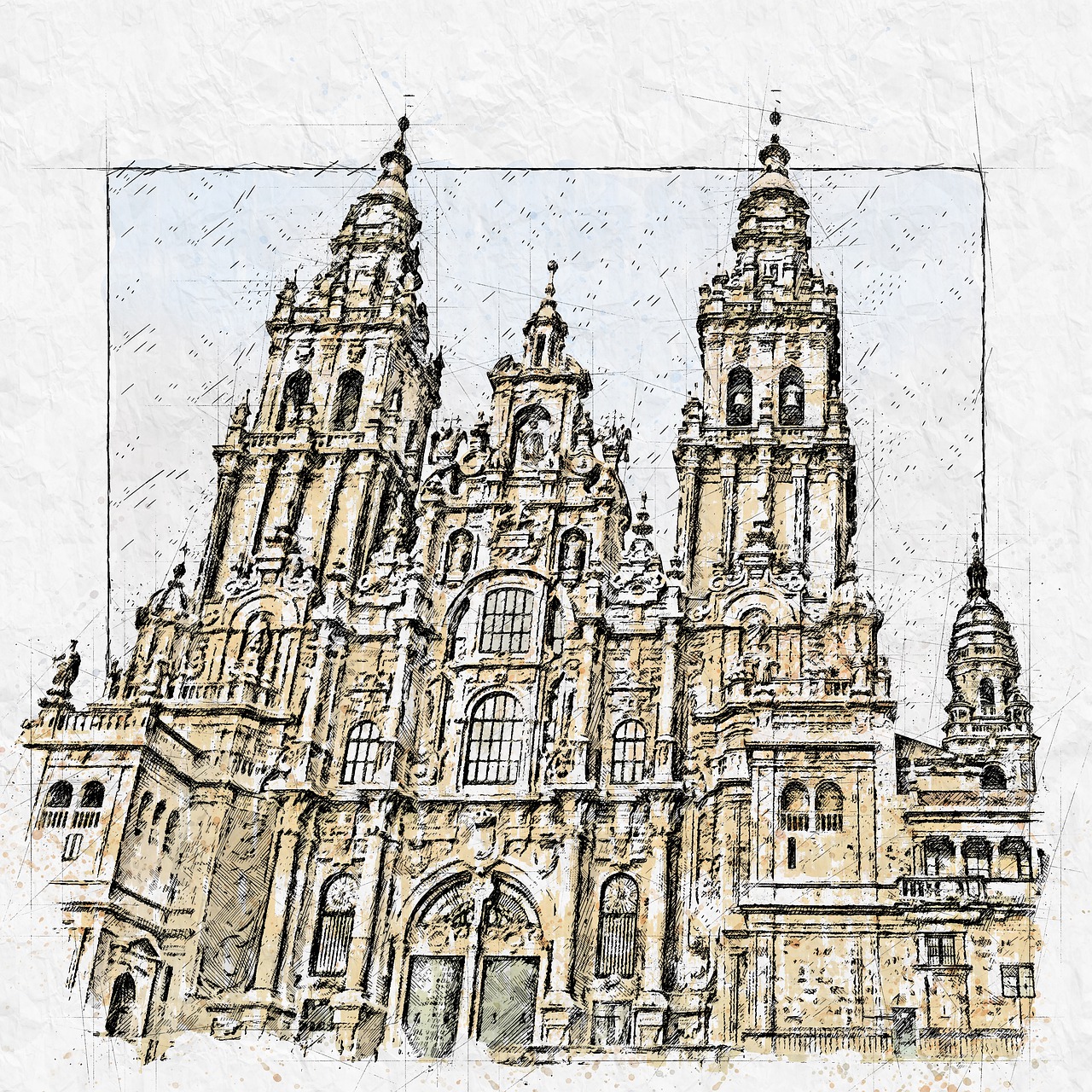
In the green, rainy northwest corner of Spain, the city of Santiago de Compostela has drawn pilgrims for more than a thousand years. At its heart stands one of the great cathedrals of Europe, built over the tomb believed to hold the remains of the apostle Saint James the Greater – in Spanish, Santiago. For medieval Christians it was one of the three supreme pilgrimage destinations, alongside Jerusalem and Rome, and it remains a living goal for hundreds of thousands of walkers every year.
The Tomb of Saint James
Tradition holds that the body of Saint James, one of the closest companions of Jesus, was brought to Galicia after his death and that his tomb was rediscovered here in the 9th century. A church was raised over the site, and the place took the name Compostela. The grand Romanesque cathedral that followed, begun in the 11th century, became the focus of a vast network of pilgrim roads stretching across Europe. Beneath the high altar, pilgrims still descend to a silver casket revered as the apostle’s resting place.
A Masterpiece of Stone
The cathedral is a layered masterpiece. Its towering western front, the Obradoiro facade, is a soaring work of Spanish Baroque that rises above the city’s grand main square. Inside, behind it, survives the Pórtico da Gloria, a Romanesque sculpted doorway regarded as one of the supreme achievements of medieval art. The richly decorated interior, the ornate high altar and the crypt together tell the story of centuries of devotion and royal patronage.
The Botafumeiro
The cathedral’s most famous spectacle is the Botafumeiro, an enormous silver incense burner suspended from the roof of the transept. On special occasions a team of red-robed attendants swings it in great arcs across the church, trailing clouds of incense high into the vaults. Originally it is said to have helped purify the air after crowds of travel-worn pilgrims, and today it remains an unforgettable sight for those lucky enough to witness it.
Visiting the Cathedral
Entry to the cathedral is free, though there are separate tickets for the museum, the rooftops and other special areas, and queues can be long in summer and Holy Years. The Pilgrim’s Mass, held daily, is the spiritual high point for those who have walked the Camino. Modest dress is expected, and arriving early helps you avoid the largest crowds.


One thought on “The Cathedral of Santiago de Compostela”