In the heart of Bergen, at the edge of a harbour that has bustled with ships for a thousand years, stands one of the oldest and best-preserved fortresses in all of Norway. Bergenhus is a place where the golden age of the medieval Norwegian kingdom is written in stone, a walled stronghold that holds the great ceremonial hall of a thirteenth-century king and a towering Renaissance keep, side by side. For much of the Middle Ages, Bergen was the capital of Norway, and Bergenhus was the royal heart of it all.
To visit the fortress is to walk straight into the age when Norwegian power was at its height, when kings held court in a hall built to awe ambassadors and rival monarchs, and when this harbour was one of the great ports of the north. Across the centuries the fortress has been a royal seat, a governor’s stronghold, a military bastion, and, after a devastating wartime disaster, a triumph of restoration. In this article you will follow the whole of that remarkable story. Come and explore Bergenhus, the old heart of a medieval capital.
What makes Bergenhus so rewarding is the way it lets you touch several ages of Norwegian history in a single afternoon. In the space of a short walk you can pass from the great hall of a thirteenth-century king to the Renaissance tower of a sixteenth-century governor, and on through the additions of later military centuries, all without leaving the fortress walls. It is a place where the whole long story of a nation is gathered into one commanding site above the sea, waiting to be explored.
In This Article
- The Old Heart of a Medieval Capital
- Haakon’s Hall, a King’s Great Room
- Building for a Kingdom at Its Height
- The Rosenkrantz Tower
- Inside the Tower of Erik Rosenkrantz
- A Fortress Within Walls
- From Royal Seat to Frontier of Power
- The Hall Through the Centuries
- Disaster in the Harbour
- Rebuilding a National Treasure
- The Fortress in the Life of Bergen
- Exploring Bergenhus Today
- Finding Bergenhus Fortress
- Castles Nearby
The Old Heart of a Medieval Capital
On the northern edge of Bergen’s beautiful harbour, where the city meets the fjord, stands one of the oldest and best-preserved fortifications in all of Norway. Bergenhus Fortress is a place where the deep history of the country is written in stone, a walled compound that has guarded this harbour for the better part of eight centuries. Within its ramparts stand two of the most remarkable medieval buildings in the whole of Scandinavia, and to walk among them is to step directly into the age when Bergen was the beating heart of the Norwegian kingdom.
That is the key to understanding Bergenhus. In the Middle Ages, Bergen was not just an important town but the capital of Norway, the seat of kings and the busiest port in the land, a great hub of trade linked to the merchants of the Hanseatic League. A capital of such importance needed a royal stronghold worthy of it, and that is exactly what grew up on this headland. The fortress you can visit today holds the ceremonial hall of a medieval king and a towering Renaissance keep, side by side, and together they tell the story of Norway’s rise as a kingdom. This is the tale of Bergenhus, the old heart of a medieval capital.
There is something deeply satisfying about a fortress that has stayed so completely at the centre of its city’s life. Where many old strongholds have been left stranded on the outskirts of the towns they once guarded, Bergenhus remains right where the action is, at the edge of a harbour still crowded with boats and framed by the mountains that ring the city. That closeness makes the history feel immediate rather than remote, and it lets you sense how the fortress and the city have grown up together, bound to one another across eight centuries of shared fortune.
Haakon’s Hall, a King’s Great Room
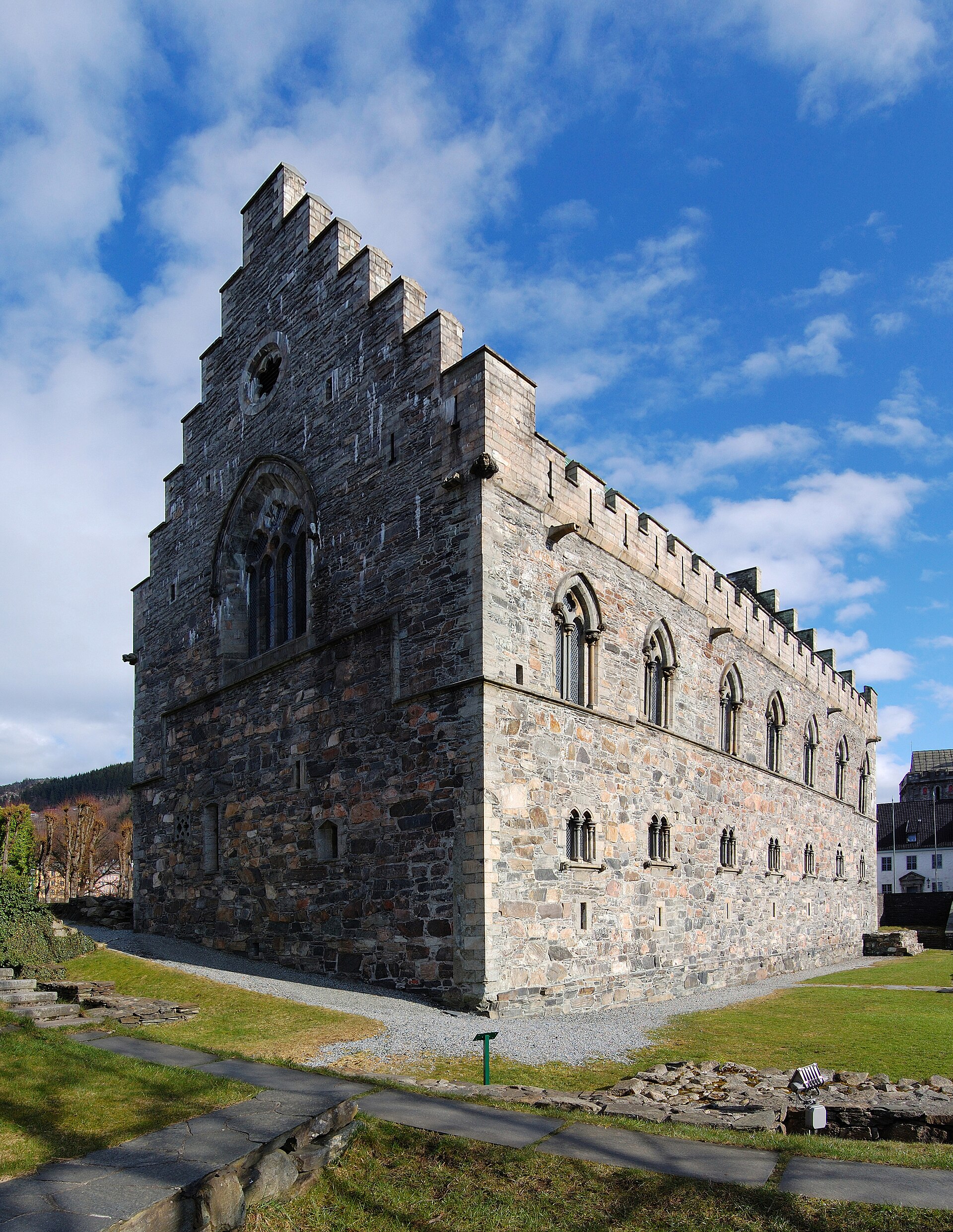
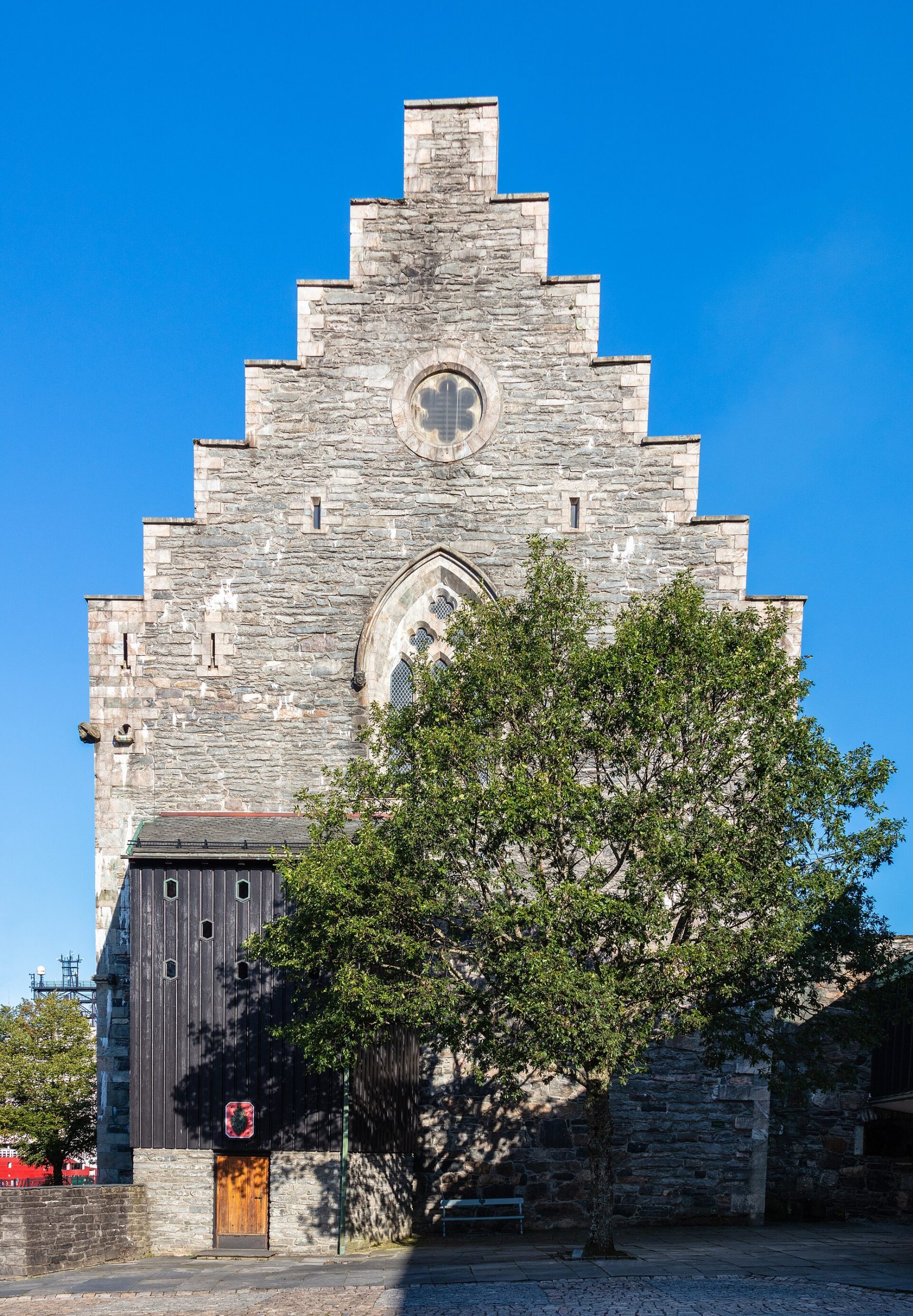
The grandest of the medieval buildings at Bergenhus is Håkonshallen, or Haakon’s Hall, a magnificent stone ceremonial hall raised in the middle of the thirteenth century by one of Norway’s greatest kings, Håkon Håkonsson. This was the golden age of the medieval Norwegian monarchy, a time when the kingdom reached the height of its power and reach, and Håkon wanted a royal hall that would reflect that greatness. The result was one of the largest and most impressive secular buildings of medieval Norway, a vast stone room fit for a king.
The hall was completed around the year 1261, and it was built for a very specific and splendid occasion, the wedding of the king’s son together with the celebrations that surrounded it. Picture the scene as it must have been then, the great hall filled with light and noise, the tables laden, the nobility of the kingdom gathered to feast beneath the high stone walls while the king presided over it all. This was the setting where the business of the realm was conducted with full ceremony, where guests were received and alliances sealed. Even now, standing empty, the hall carries an unmistakable air of royal grandeur, a direct link to the court life of medieval Norway.
It is worth remembering how rare a survival a building like this really is. Timber halls of the medieval north have almost all vanished, lost to fire and decay, and even great stone buildings from the thirteenth century are precious and few. That Haakon’s Hall still stands, and can still be entered and admired, is a remarkable gift from the past. Few places anywhere let you walk into an actual royal ceremonial hall from the golden age of a medieval kingdom, and fewer still where that hall has been so carefully restored to its original grandeur.
The hall’s association with a royal wedding gives it a particularly human warmth amid all its grandeur. This was not only a place of solemn state business but a setting for celebration and joy, for feasting and music and the coming together of a kingdom’s leading families. Something of that festive spirit seems to linger in the great room even now, and it is easy, standing beneath the high walls, to imagine the light of countless candles and the sound of medieval revelry filling the space on that long-ago day of celebration.
Building for a Kingdom at Its Height
To appreciate Håkonshallen fully, you have to understand the confidence of the age that built it. In the thirteenth century Norway was a major northern power, its authority stretching across the seas to Iceland, Greenland, and the isles of Scotland, and its kings dealt as equals with the great rulers of Europe. Håkon Håkonsson himself was a monarch of real stature, and the hall he raised in his capital was a statement of that standing, meant to impress ambassadors, nobles, and rival kings alike.
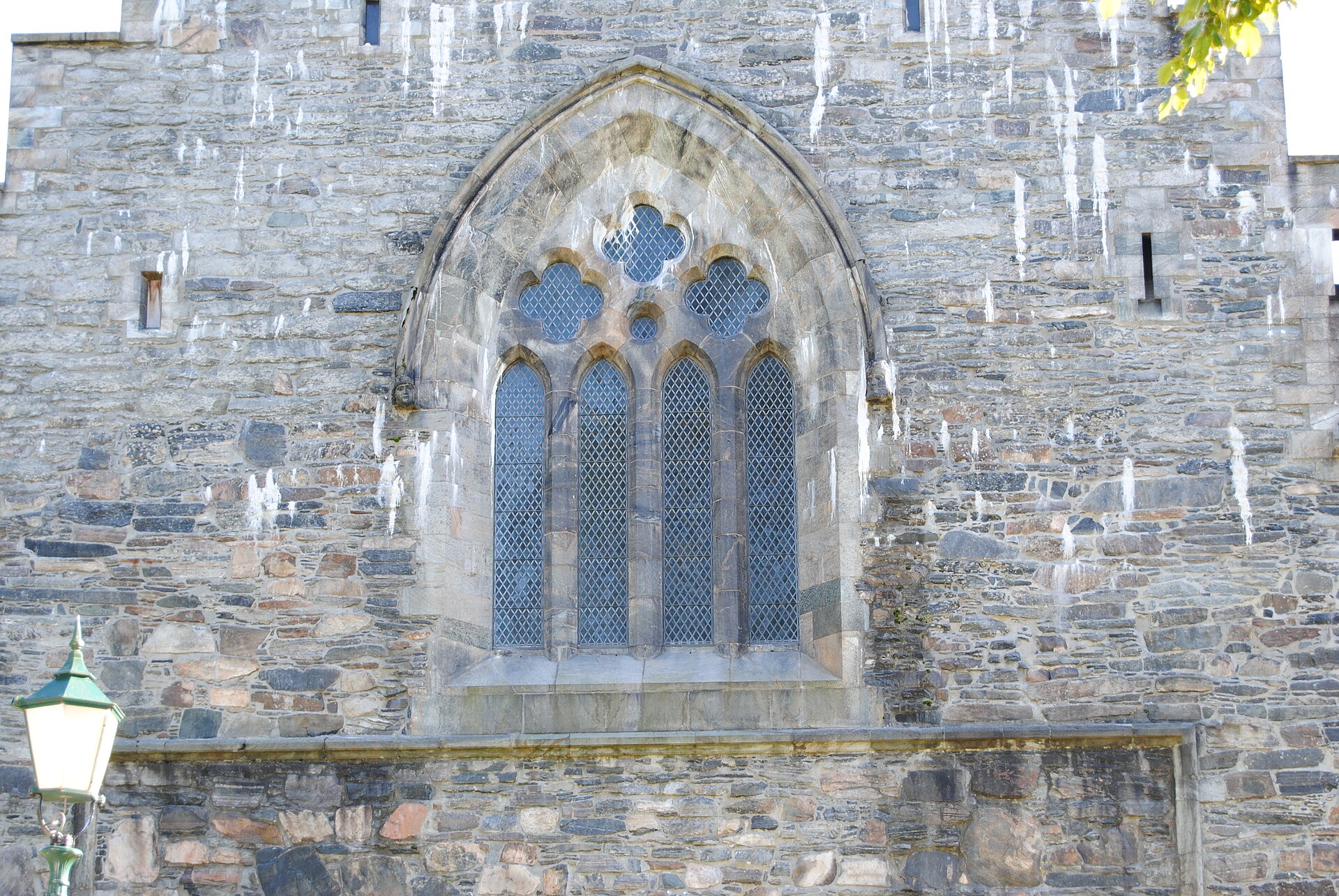
The building’s sheer scale speaks of this ambition. Constructed in stone at a time when many great halls were still built of timber, it was designed to endure and to awe, its long, high interior creating a sense of space and majesty that few buildings in the north could match. The craftsmanship that went into it, the quality of the stonework and the grandeur of the proportions, marked it out as the work of a wealthy and powerful crown. When you stand before its northern facade today, you are looking at one of the finest surviving expressions of medieval Norwegian royal power, a hall built by a kingdom that knew its own strength.
The choice to build in stone rather than timber was itself a statement, for stone was costly and demanding to work, especially on this scale. It spoke of permanence and of a crown that intended its power to last. Standing before the hall today, you can still read that intention in the massive walls and the confident proportions, a message sent down the centuries by a king who wanted the world to know that Norway was a kingdom to be reckoned with. In an age of shifting fortunes, Håkon built something meant to outlast him, and in that at least he succeeded magnificently.
The Rosenkrantz Tower
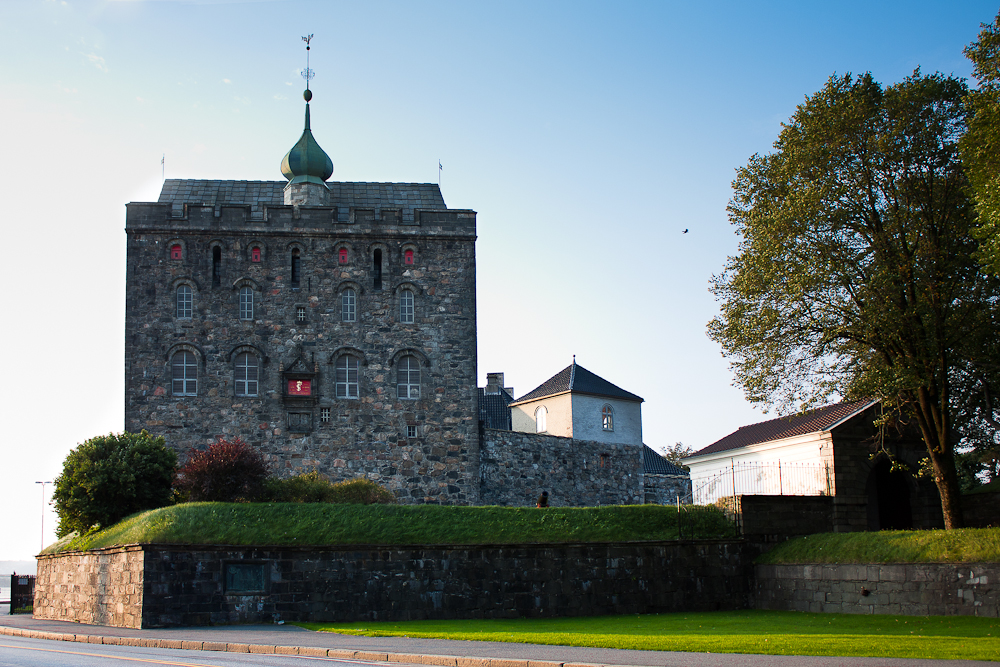
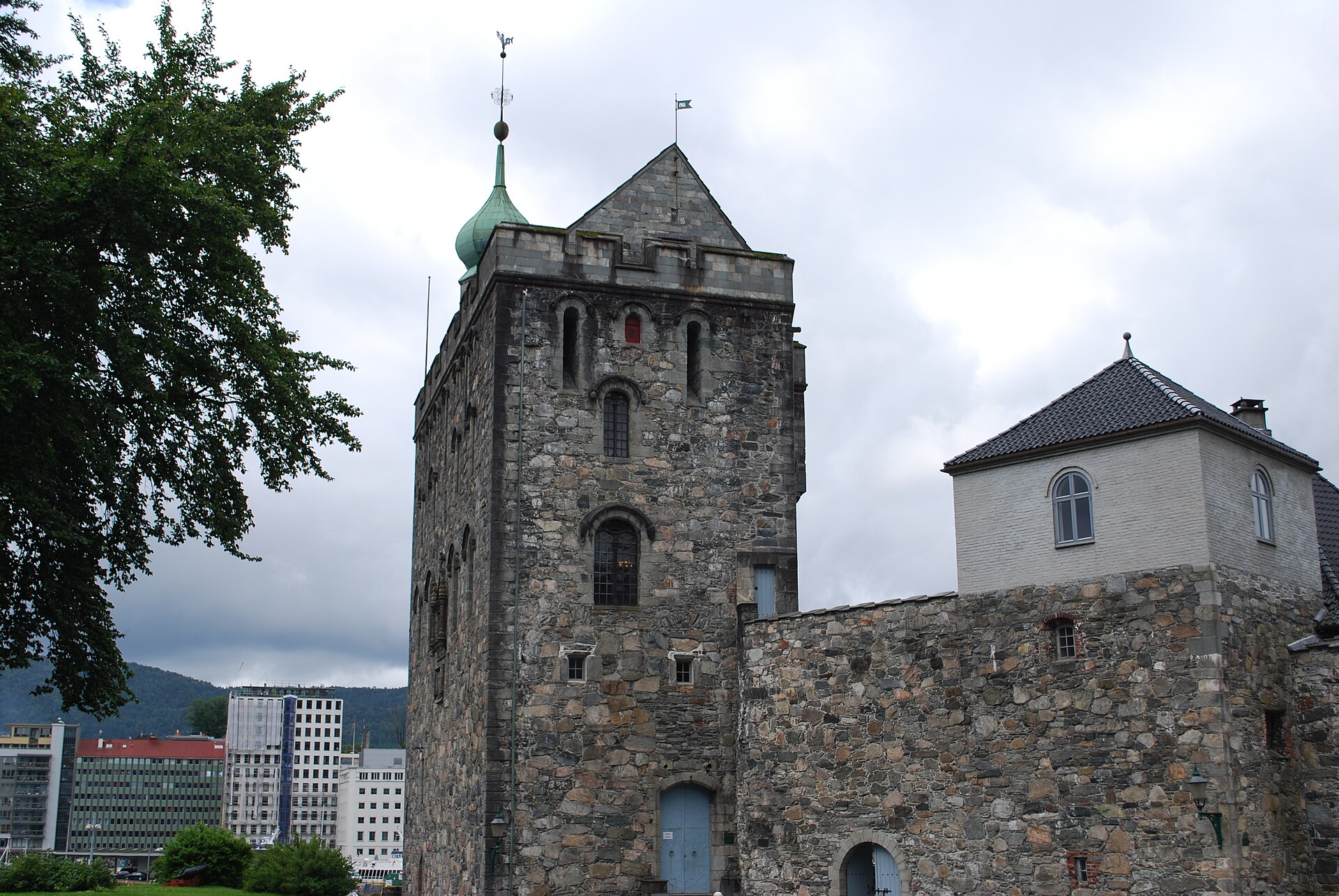
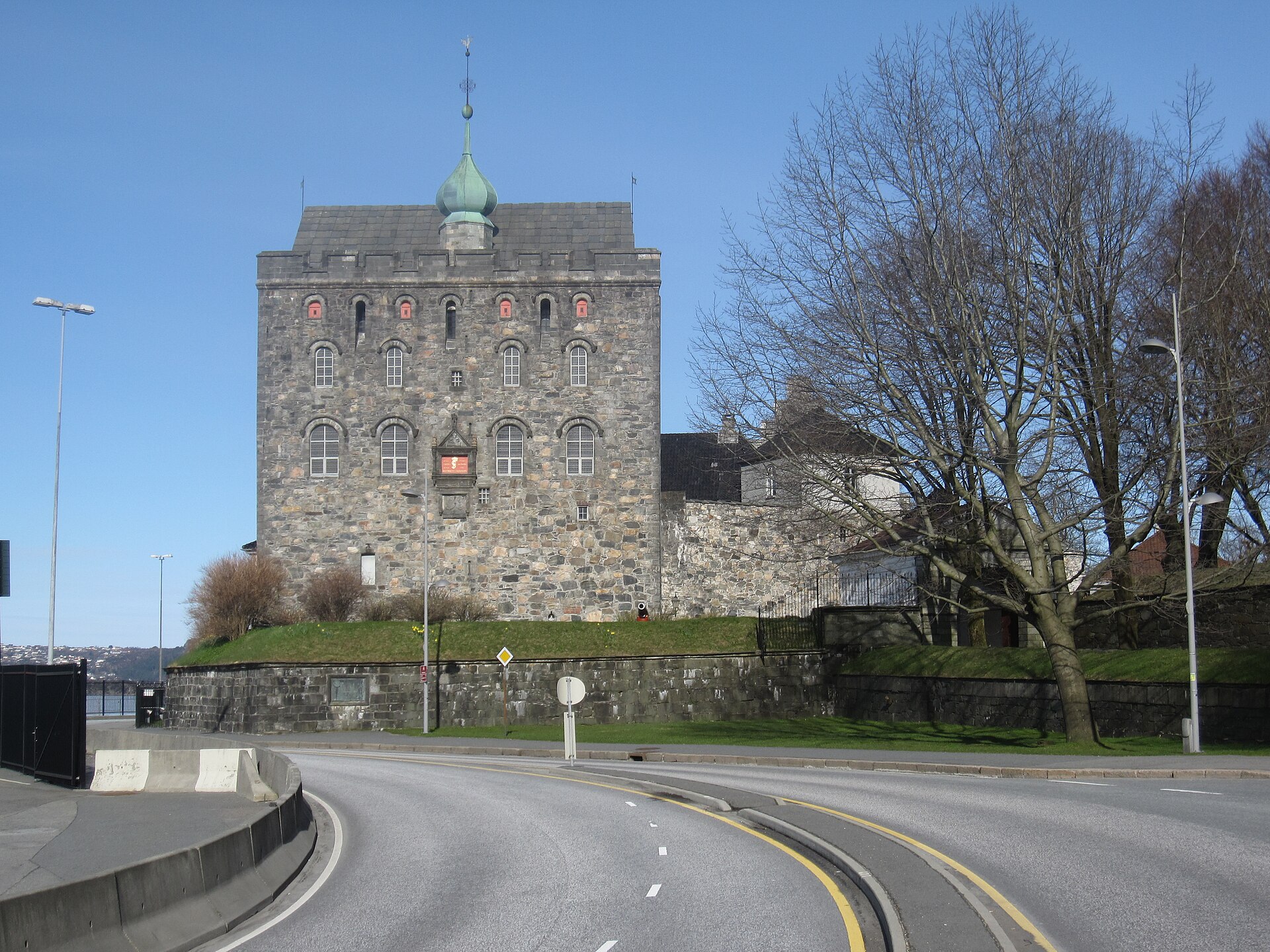
Standing close beside Haakon’s Hall is the fortress’s other great treasure, the Rosenkrantz Tower, a massive stone tower that is one of the most important Renaissance monuments in Norway. Though it has the solid, defensive look of a medieval keep, the tower as we see it took its present form in the sixteenth century, when it was built up and remodelled by a powerful royal governor of Bergen whose name it still bears. The result is a building that fuses the old and the new, a Renaissance stronghold wrapped around a much older core.
For hidden within the Rosenkrantz Tower is far older stonework, including remains that go back to the thirteenth century and the reign of the medieval kings, when an earlier tower and royal residence stood on this spot. The sixteenth-century governor took these older structures and transformed them into a grand and formidable tower that served as both a fortress and a residence, combining serious defensive strength with the comforts and style of a Renaissance lord. Climbing through its many levels today, you pass through several ages of Norwegian history at once, from medieval foundations to Renaissance chambers, all contained within one towering mass of stone.
The blending of medieval and Renaissance work in the Rosenkrantz Tower is exactly what gives it such fascination for anyone interested in the past. Rather than sweeping away the older structures, the sixteenth-century builders absorbed them into their new design, so that the tower became a kind of living record of its own evolution. This layering is typical of how great buildings actually grow, not in a single act of creation but through centuries of adaptation, each generation adding to and reshaping what it inherited, until the whole becomes a chronicle in stone of the ages that made it.

Inside the Tower of Erik Rosenkrantz
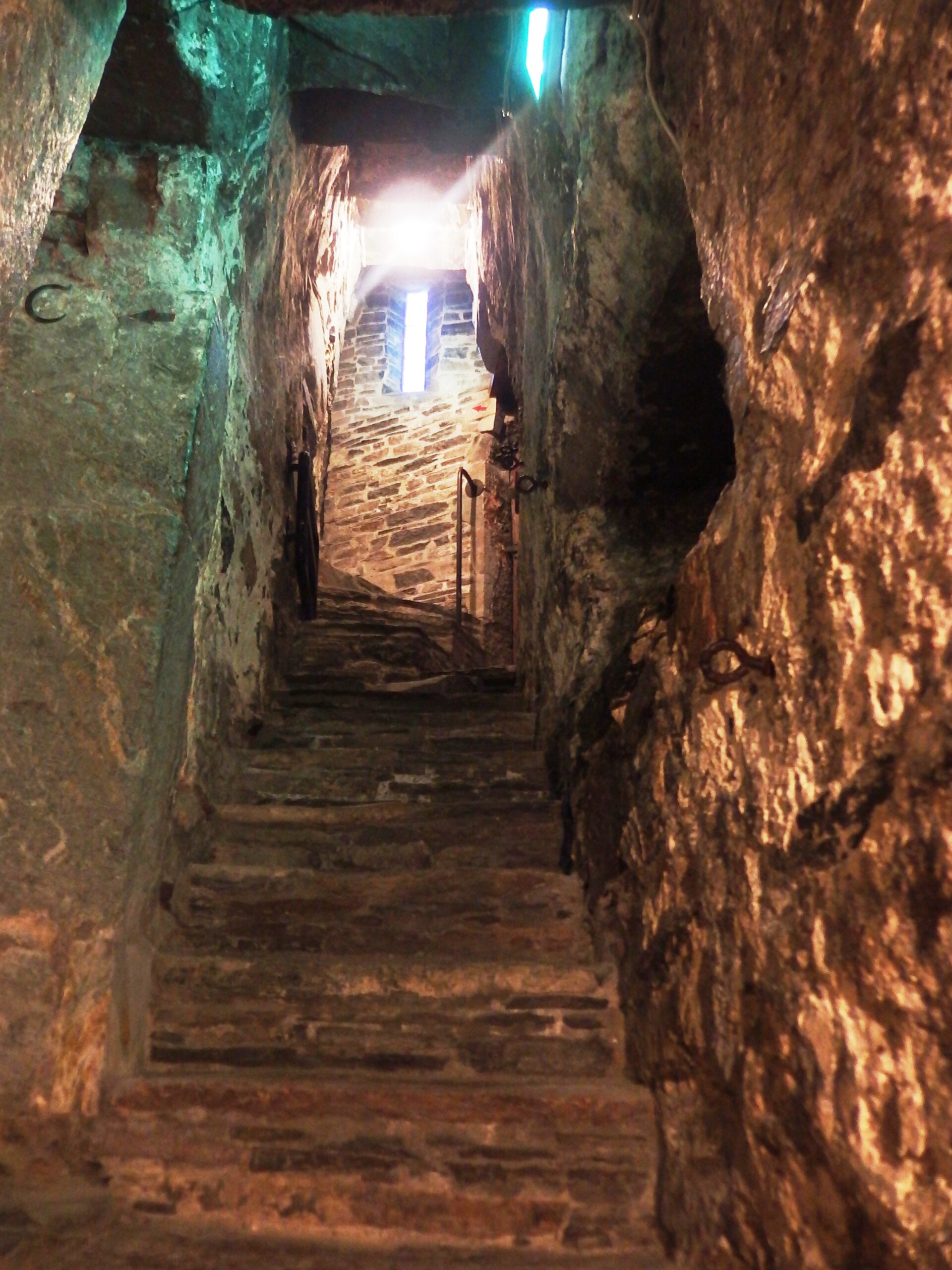
Stepping inside the Rosenkrantz Tower is one of the highlights of any visit to Bergenhus, for the interior is a fascinating warren of stone rooms, spiral stairs, and thick-walled chambers that reward slow and curious exploration. As you climb, you move through the layered history of the building, from the deep medieval foundations up through the residential and defensive rooms added in the Renaissance, each level telling part of the story of how the tower grew over the centuries.
The tower was the work of Erik Rosenkrantz, the sixteenth-century governor who gave it his name, and it reflected both his power and his need for security in a sometimes turbulent age. The rooms served as living quarters, as strongpoints, and as spaces for the business of governing western Norway, and today they house exhibitions that help visitors understand the tower’s long and complex development. Reaching the top, you are rewarded with wonderful views out over the fortress, the harbour, and the city of Bergen spread out below, a fitting reward for the climb through so many layers of the past.
Erik Rosenkrantz himself was a formidable figure, a nobleman and royal official who wielded great power over western Norway in his day, and the tower reflects both his ambitions and the realities of his age. To govern effectively and safely, he needed a base that was at once a comfortable residence and a genuine stronghold, and the tower answered both needs. Exploring its rooms, you can still sense the mixture of authority and caution that shaped it, the desire for the trappings of a Renaissance lord combined with the hard practical need for walls thick enough to withstand trouble.
A Fortress Within Walls
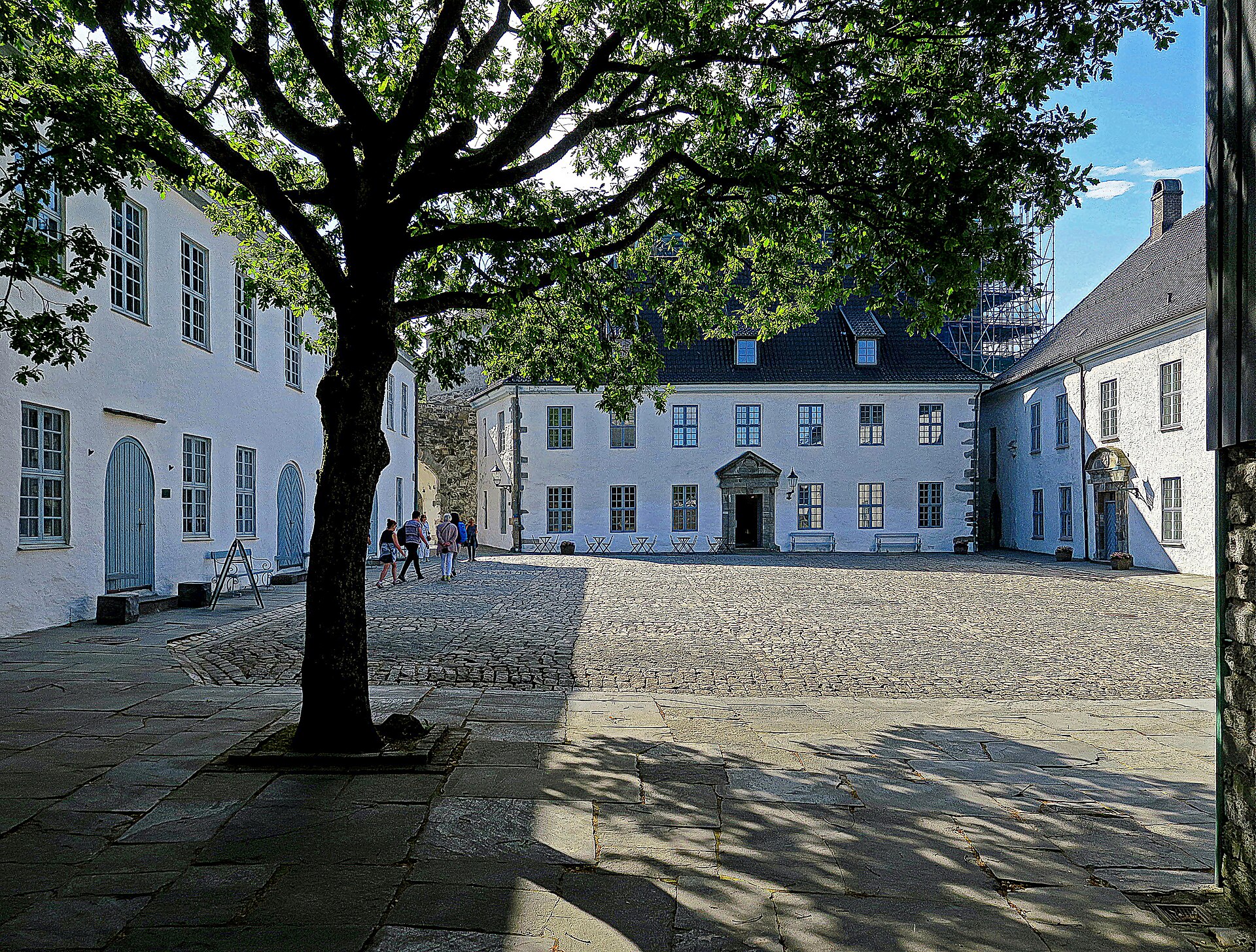
The great medieval buildings of Bergenhus do not stand alone but are bound together within a larger fortified compound, a walled stronghold that grew and changed over the centuries. Ramparts, gates, and courtyards enclose the hall and the tower, along with a range of later buildings added as the fortress continued to serve the crown and the military through the early modern period and beyond. The whole forms a coherent stronghold, layered with the work of many different ages.
Walking through the gates and across the courtyards, you get a strong sense of the fortress as a living, working place rather than a mere collection of monuments. The medieval core is surrounded by the additions of later centuries, when Bergenhus was maintained as a military installation guarding the important port of Bergen. This mixture of medieval grandeur and later practicality gives the fortress a rich and varied character, and it means that a visit takes you through not one period of history but many, all contained within the same set of walls above the harbour.
Each of the buildings clustered within the walls has its own tale to tell, from the medieval masterpieces at the heart of the compound to the barracks, residences, and service buildings of later centuries. Together they turn Bergenhus into a kind of open-air museum of Norwegian architecture and military life, where the styles and needs of many different eras sit side by side. Wandering among them, you begin to appreciate the fortress not as a single monument but as a whole community of buildings that has evolved continuously to meet the changing demands placed upon it.
From Royal Seat to Frontier of Power
For as long as Bergen remained the capital of Norway, Bergenhus was at the very centre of the kingdom’s life, the royal seat from which the country was governed. But the medieval centuries brought great changes to Norway, and in time the focus of power shifted away from Bergen. The kingdom entered into union with its neighbours, and the centre of government moved elsewhere, so that Bergen gradually lost its status as the sole capital even as it remained a vital port and city.
Through all these changes, the fortress kept its importance as a stronghold guarding western Norway and its crucial harbour. It remained a seat of royal and governmental authority in the region, the base from which powerful governors like Erik Rosenkrantz ruled, and a military installation of real significance. The transition from royal capital to regional bastion was a long and gradual one, and Bergenhus adapted to each new role in turn. Its ability to remain useful across so many centuries, from the age of medieval kings to the modern era, is a large part of why so much of it survives for us to enjoy today.
The gradual shift of Bergenhus from royal capital to regional stronghold mirrors the wider story of Norway itself during these centuries, as the country moved through union with its neighbours and saw its centre of power change. Yet through all of it, the strategic value of Bergen and its harbour never disappeared, and so the fortress was never abandoned. That continuity of purpose, adapting from one role to the next without ever falling out of use, is precisely what allowed so much of the medieval fabric to survive, cared for and maintained across the generations rather than left to crumble.
It is striking, too, how the fortunes of Bergen and Bergenhus rose and fell together, the fortress always reflecting the standing of the city it protected. When Bergen flourished as the great port of the north, the fortress flourished with it, and when the city’s political importance waned, the fortress adapted to a quieter but still vital role. This intimate link between stronghold and city runs through the whole history of the place, and it is part of what makes Bergenhus feel so deeply rooted in the life of Bergen rather than imposed upon it from outside.
The Hall Through the Centuries
Håkonshallen has not always looked as splendid as it does today, and its long history has included stretches of hard use and neglect. As the centuries passed and the great age of the medieval monarchy receded into memory, the hall was put to humbler purposes, serving at various times as a storehouse and losing much of its original grandeur. For long periods its true significance was half-forgotten, and the magnificent royal hall of King Håkon stood as a shadow of its former self.
It was only in more recent centuries that the hall’s importance was properly recognised and efforts were made to restore it to something like its medieval glory. Careful restoration work brought back the grandeur of the great room, allowing visitors once more to experience the scale and majesty that King Håkon had intended. That restored splendour is what you see today, and it makes Håkonshallen one of the finest medieval interiors to be found anywhere in Norway, a room that once again does justice to the king who built it and the golden age it represents.
The story of the hall’s decline and recovery is in many ways the story of how attitudes to the past have changed. For centuries a medieval building was simply a useful structure to be adapted to whatever purpose was at hand, its historical value barely considered. Only in more recent times did people come to see such buildings as treasures worth preserving for their own sake, and it was that changing outlook that saved Håkonshallen. Its restoration stands as a monument not only to King Håkon but to the growing sense that a nation’s heritage is something precious and worth protecting.
Disaster in the Harbour
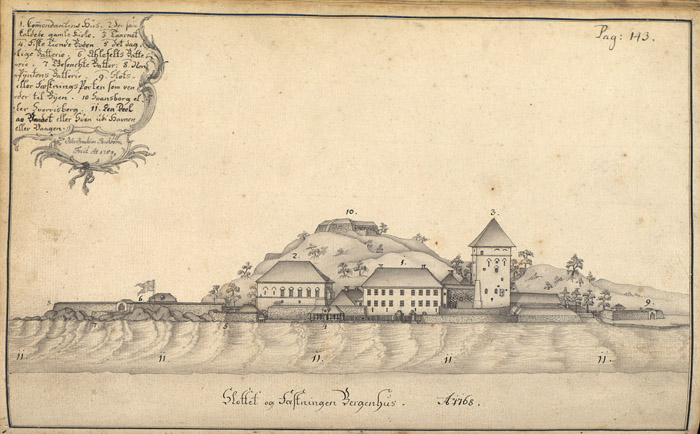
The most dramatic and destructive episode in the modern history of Bergenhus came during the Second World War, and it struck without warning. In 1944, while Norway was under German occupation, a ship laden with explosives blew up in the harbour close to the fortress, a catastrophe that sent a huge blast tearing through the surrounding buildings. The medieval treasures of Bergenhus, which had survived so many centuries, were suddenly and severely damaged in a single terrible moment.
Both Haakon’s Hall and the Rosenkrantz Tower suffered badly in the explosion, their roofs and interiors devastated by the force of the blast. It was a heavy blow to Norway’s heritage, and for a time the future of these irreplaceable buildings hung in the balance. Yet the disaster also became the spur for a great effort of recovery. In the years after the war, the damaged buildings were painstakingly restored, and the care taken in that work is a large part of why they stand so proudly today. The scars of 1944 have been healed, but the story of that day remains part of what makes the fortress so poignant.
The 1944 disaster is a sobering reminder of how fragile even the sturdiest inheritance can be, and how the accidents of war can threaten in a moment what has stood for centuries. That the buildings survived at all, battered but not destroyed, was partly a matter of their own solid construction and partly of the determination to save them that followed. The event has become part of the fortress’s identity, a dark chapter that ultimately led to renewal, and it lends the restored buildings an added poignancy, for we know now just how close they came to being lost forever.

Rebuilding a National Treasure
The restoration of Bergenhus after the wartime explosion was one of the great heritage projects of modern Norway. The damage had been severe, but the will to save these irreplaceable buildings was even stronger, and skilled craftsmen and restorers set about the long task of bringing the hall and the tower back to life. Working carefully to respect the original medieval and Renaissance fabric, they repaired the shattered structures and restored them to the splendour they had lost.
The success of that work is plain to see for anyone who visits today. Haakon’s Hall once more presents its great interior in full, and the Rosenkrantz Tower stands complete and open to explore, both of them looking much as they did in their prime. The restoration ensured that these monuments, having survived eight centuries and a wartime catastrophe, would endure for generations still to come. It is a story of loss and recovery that adds another layer of meaning to the fortress, a reminder of how much care a nation is willing to invest in the buildings that hold its history.
Restoration on this scale demands not just money and skill but a deep respect for the original builders, a willingness to study and understand their work before attempting to repair it. The teams who rebuilt Bergenhus took that responsibility seriously, and the result honours the medieval and Renaissance craftsmen whose work they were saving. When you admire the completed hall and tower today, you are seeing the fruit of that patient, respectful labour, a modern act of care that reached back across the centuries to preserve what earlier ages had created.

The Fortress in the Life of Bergen
Today Bergenhus is a cherished part of the life of Bergen, an open and welcoming green space at the edge of the busy city where locals and visitors alike come to walk, relax, and soak up the history. The fortress grounds are freely accessible, and on a fine day they fill with people strolling the ramparts, sitting on the grass, and enjoying the views over the harbour, so that the ancient stronghold has become a living public space rather than a closed-off relic.
This easy integration into the everyday life of the city is one of the fortress’s greatest charms. The medieval buildings and the modern city coexist happily here, and the sight of families picnicking in the shadow of an eight-hundred-year-old royal hall captures something of what makes Bergenhus so special. It is a place where the deep past is not shut away behind barriers but woven into the fabric of the present, cherished and used by the people of Bergen as it has been, in one way or another, for centuries.
The way the people of Bergen have embraced their fortress says a great deal about the place. It is not treated as a distant historical curiosity but as a beloved part of the city, a green retreat and a source of civic pride woven into daily life. Children play where kings once walked, concerts fill spaces that once echoed with the business of the realm, and the whole compound hums with the ordinary pleasures of a public park. That living relationship between the fortress and its city is, in its own quiet way, as remarkable as any of the grand buildings it contains.

Exploring Bergenhus Today
A visit to Bergenhus today is a rich and varied experience, and there is a great deal to see and do within the fortress walls. The two great medieval buildings, Haakon’s Hall and the Rosenkrantz Tower, are open to visitors and can be explored inside, often with the help of exhibitions and guided tours that bring their long histories vividly to life. Moving between the grand royal hall and the many-layered tower, you get a wonderfully complete picture of medieval and Renaissance Norway.
Beyond the two headline buildings, the fortress grounds themselves reward exploration, with their gates, ramparts, courtyards, and later buildings all adding to the story. The site also hosts cultural events and concerts, making use of its atmospheric spaces, so that the old fortress continues to serve as a gathering place just as it did in the days of King Håkon. Whether you come for the deep history, the fine architecture, or simply the pleasure of wandering an ancient stronghold by the sea, Bergenhus offers one of the most rewarding historical experiences in all of Norway.
The combination of world-class medieval architecture and a genuinely welcoming atmosphere is what makes Bergenhus stand out among the great fortresses of Europe. It manages to be both a site of real historical importance and a place where visitors feel entirely at ease, free to explore at their own pace and to linger as long as they like. Few places balance those qualities so well, and it is that balance, as much as the buildings themselves, that leaves so many visitors with such warm memories of their time within these ancient walls.
Give yourself plenty of time if you can, for Bergenhus is a place that rewards a slow and unhurried visit. There is no need to rush from one sight to the next; the pleasure lies as much in simply being here, wandering the courtyards and pausing on the ramparts, as in ticking off the great buildings one by one. Let the atmosphere of the old fortress settle around you, and you will come away with a far deeper feeling for the centuries of history held within these walls above the harbour of Bergen.

Finding Bergenhus Fortress
Bergenhus Fortress is wonderfully easy to reach, standing at the northern end of Bergen’s harbour, just a short and pleasant walk from the city centre and the famous old wharf of Bryggen. Bergen itself sits on the western coast of Norway among the fjords and mountains, and it is well connected by air, rail, and sea, so that reaching this beautiful city and its historic fortress is straightforward from almost anywhere.
The fortress makes a natural centrepiece for exploring Bergen, and it pairs perfectly with the colourful Hanseatic buildings of Bryggen, the bustling fish market, and the many other attractions of this UNESCO-listed city. You can easily spend a rewarding half-day at the fortress and then continue on to discover the rest of Bergen’s charms. Here are the exact coordinates so you can find your way to the old heart of Norway’s medieval capital.
Bergen is often called the gateway to the fjords, and a visit to Bergenhus fits beautifully into any exploration of this stunning corner of Norway. Many travellers use the city as a base for journeys out into the dramatic fjord country, and the fortress makes an ideal starting point, grounding you in the deep history of the region before you set off to see its natural wonders. History and landscape come together here in a way that few other places can match, and the old fortress is the perfect introduction to both.
Castles Nearby
If Bergenhus has drawn you into the world of Norway’s royal fortresses, two more Scandinavian strongholds make a natural next stop.
- Akershus Fortress in Oslo, Norway’s other great medieval stronghold, guards the capital’s harbour.
- Kronborg Castle in Denmark commands another of the great waterways of the north.
The Old Heart of Norway
Few places anywhere hold so much of a nation’s history within a single set of walls as Bergenhus. Here, on a headland above the harbour of what was once the capital of Norway, stand the great hall of a medieval king and the towering keep of a Renaissance governor, survivors of eight centuries of change and even of a wartime catastrophe that nearly destroyed them. To walk among these buildings is to walk through the golden age of the Norwegian kingdom, when Bergen ruled the seas of the north and its royal fortress stood at the centre of the realm.
That is what makes a visit here so moving. You are not just admiring fine old buildings but standing in the very place where the medieval kingdom of Norway reached its height, where a king raised a hall to match his ambitions and later governors ruled the western coast. Look out from the ramparts over the harbour and the city, and you feel the long continuity of the place, its stubborn survival through triumph and disaster alike. Bergenhus is the old heart of Norway, and it beats still, keeping the memory of a great kingdom alive above the waters of Bergen.
If your travels take you to the west coast of Norway, give Bergenhus the time it deserves. Wander the grounds, step inside the great hall and the towering keep, and stand on the ramparts to watch the boats come and go across the harbour just as they have for a thousand years. Entry to the grounds costs nothing, and the sense of history you carry away is beyond price. The old fortress has kept its watch over Bergen through every age, and it is ready to share the story of Norway’s golden centuries with anyone who comes to visit.
You May Like
The Moscow Kremlin: The Great Red Fortress at the Heart of Russia