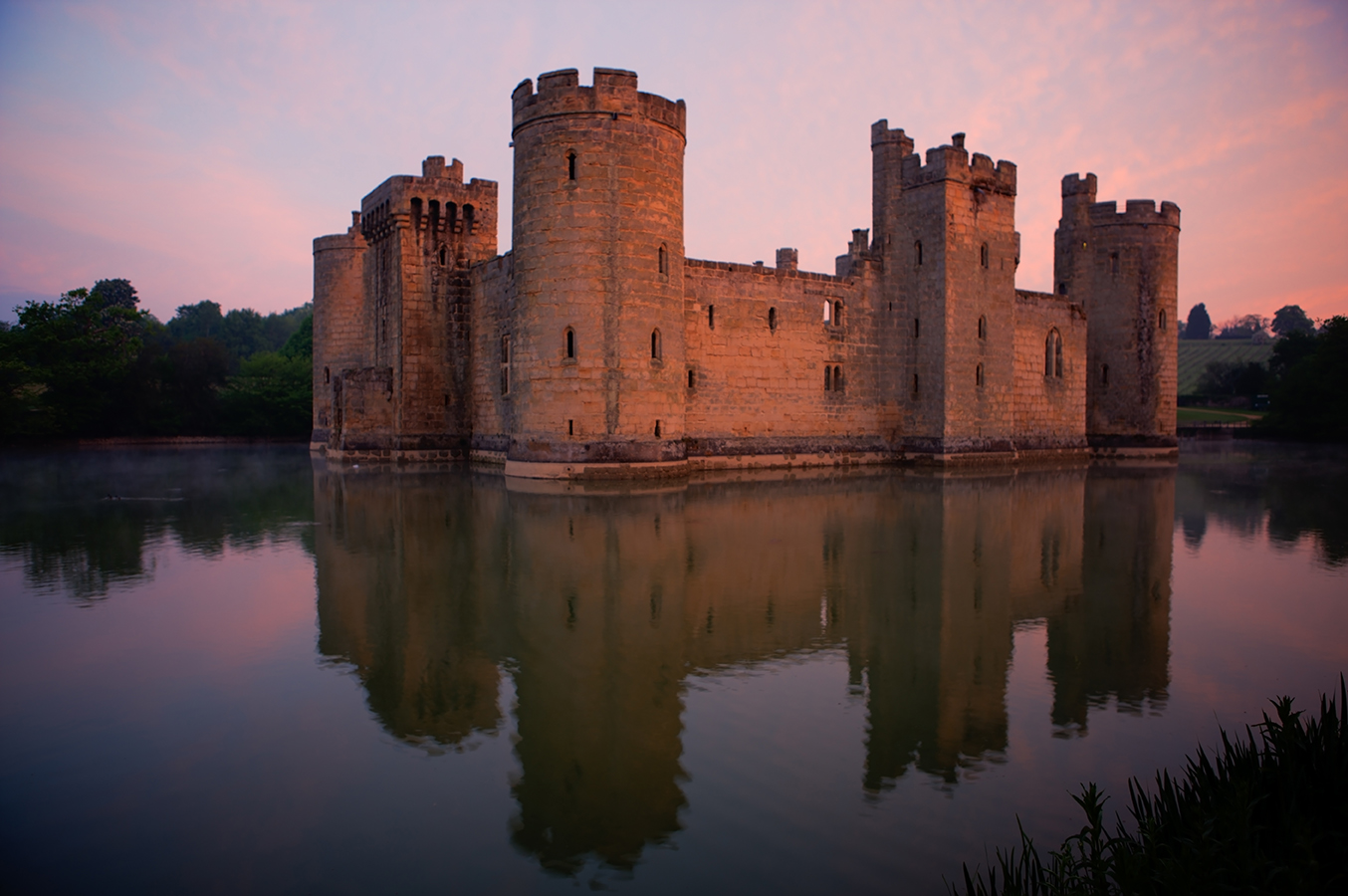
If you asked a child to draw a castle, they would probably draw something very like Bodiam. It has everything: four round corner towers, square towers on the walls between, a mighty gatehouse, battlements all the way round, and a wide, glassy moat with the whole thing reflected in it. It sits low in a quiet Sussex valley, looking for all the world like a castle that has floated up out of a storybook. Photographers and painters adore it, and it is, quite simply, one of the most perfect-looking medieval castles anywhere in Britain.
And yet Bodiam hides a genuine puzzle at its heart, one that historians still argue about. Was it a serious fortress, built in earnest to defend the south coast against French raiders during the Hundred Years’ War? Or was it something subtler and stranger, a beautiful show-castle designed mainly to impress, a knight’s grand statement of wealth and status dressed up in the costume of war? The answer is not as obvious as those thick walls make it look, and the debate is a big part of what makes Bodiam so interesting.
It is also a survivor. Roofless and hollow inside, it came close to vanishing altogether, before it was rescued and restored by one of the most famous statesmen of his age. So let’s cross the moat, walk in under that great gatehouse, and try to work out what Bodiam really was, and why it still enchants everyone who sees it.
We will weigh the evidence as we go, because half the fun of Bodiam is deciding for yourself. Was Sir Edward Dalyngrigge a worried patriot guarding the coast, or a proud new man showing off his fortune, or a bit of both? Keep the question in mind as we move from the gatehouse to the moat to the ruined hall, and see which way the castle tips you by the end.
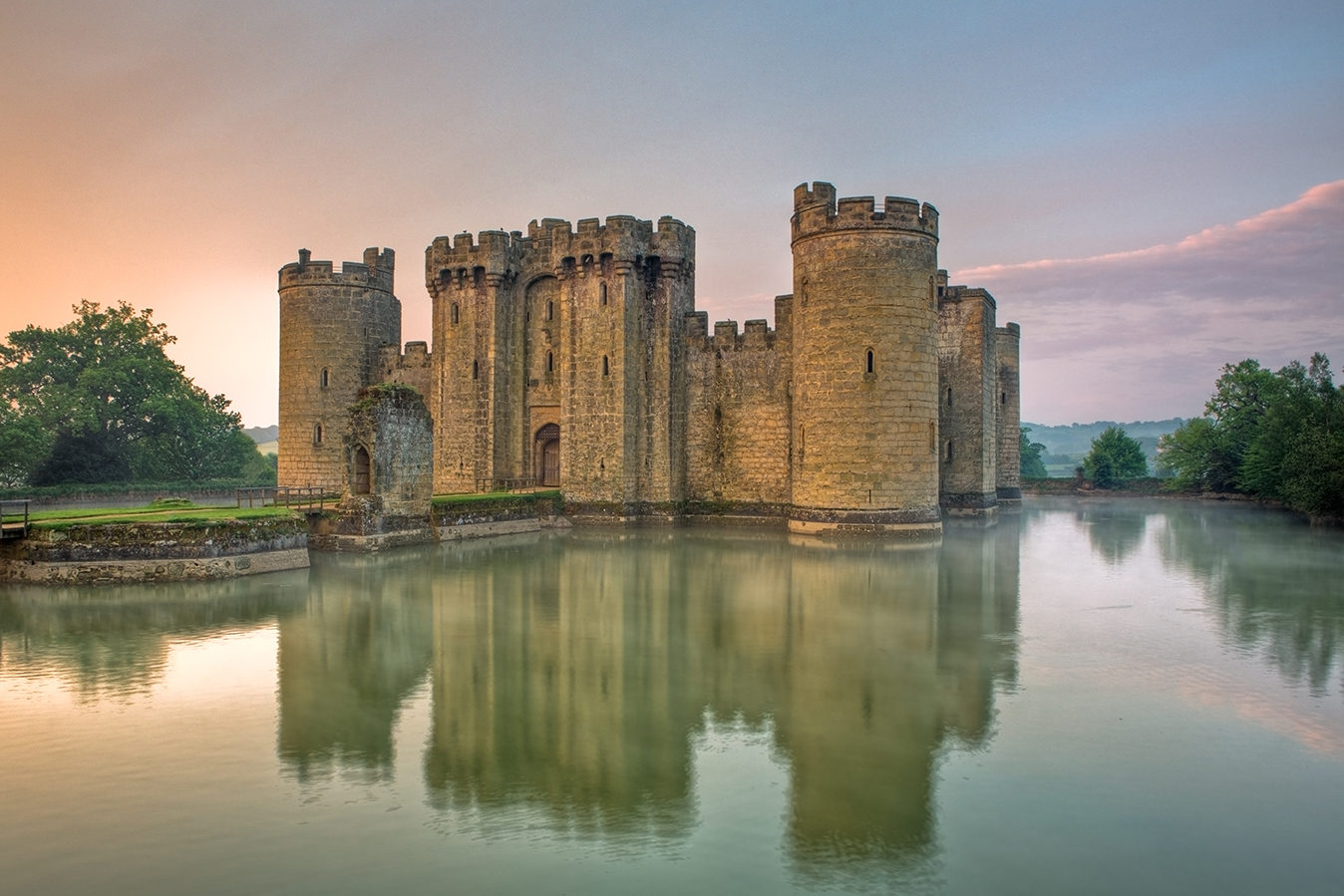
Table of Contents
- A Knight Home from the Wars
- Fortress or Fantasy? The Great Debate
- The Genius of the Moat
- Through the Gatehouse
- A Comfortable Home Behind the Walls
- A Castle That Barely Saw a Fight
- The Siege That Was Called Off
- Rescued by a Viceroy
- The Most Photographed Ruin in England
- A Storybook Castle for Every Age
- How to Visit Bodiam
- Nearby Castles
- Before You Go
A Knight Home from the Wars
Bodiam is unusual among great castles in that we know almost exactly when it was built and by whom. It was raised in 1385 by Sir Edward Dalyngrigge, a knight who had made his name, and a good deal of his fortune, fighting in France during the Hundred Years’ War. Dalyngrigge had served in the companies of English soldiers who campaigned and plundered across the French countryside, and he came home a wealthy and ambitious man, eager to establish himself among the leading families of Sussex.
To build a castle you needed the king’s permission, in the form of a document called a licence to crenellate, and Dalyngrigge got his in 1385. The stated reason was defence: French raiders had been attacking the south coast of England, burning towns and spreading fear, and a castle in this valley could, in theory, help guard the surrounding countryside and the route inland from the sea. On the face of it, Bodiam was a patriotic act of national defence.
Rather than adapt an older building, Dalyngrigge built entirely fresh, on a new site, all in one go, to a single unified design. That is part of what makes Bodiam so satisfying to look at: it is not a jumble of centuries like most castles but a single, coherent vision, raised in a few years by one man with one plan. It is a snapshot of exactly what a wealthy English knight in the 1380s thought a castle should be.
Men like Dalyngrigge were a feature of the age. The long war with France threw up a whole class of English soldiers who grew rich on wages, ransoms, and plunder, then came home hungry for the land, titles, and respectability that would turn new money into old status. Building a castle was the ultimate way to announce that you had arrived, and Bodiam is one of the finest surviving expressions of that ambition set in stone.
Fortress or Fantasy? The Great Debate
Here is where Bodiam gets interesting, because historians have argued for decades about what it really was. At first glance it looks formidable: high walls, round towers, a gatehouse with drawbridges and portcullises, arrow loops, and that broad moat. It has all the trappings of a serious military stronghold, and for a long time that is exactly how it was understood.
But look closer, some historians say, and the defences start to seem strangely half-hearted. The walls are relatively thin, the moat, though wide, is not especially deep, the arrow loops are oddly placed, and the whole thing could arguably be overlooked from nearby high ground. To these scholars, Bodiam looks less like a machine for war and more like a beautiful stage set, a castle designed to look impressive and to advertise its owner’s status and chivalric credentials, rather than to withstand a determined siege.
Others push back, pointing out that Bodiam’s defences would have been perfectly adequate against the kind of threat it actually faced, a fast raid by French marauders rather than a full royal siege. The truth is probably that it was both at once: a genuinely defensible castle and a deliberate work of romance and display, a home that let a self-made knight live like a great lord while looking every inch the warrior he had been. That ambiguity, fortress and fantasy woven together, is Bodiam’s real fascination.
What tips many historians toward the show-castle reading is the way Bodiam is designed to be seen. The careful, theatrical approach across the water, the proud display of heraldry over the gate, the neat symmetry meant to be admired from a distance, all suggest a builder thinking hard about the impression his castle would make. A purely practical fortress would not have bothered so much with the view. Bodiam wanted, above all, to be looked at.
The Genius of the Moat
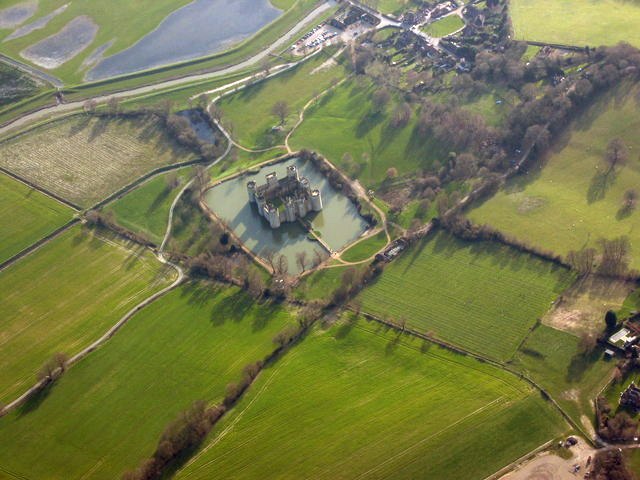
Whatever else it was for, the moat is the making of Bodiam. Broad, still, and rectangular, it wraps the castle completely and provides its most famous quality: that flawless mirror-image of towers and battlements on a calm day. But the moat was not just for show. Water defences forced any attacker to approach across open ground with no cover, made mining under the walls all but impossible, and kept siege engines at a distance.
The approach to the castle was cleverly arranged to make the most of the water. Originally, visitors did not cross straight over on the short bridge you use today. Instead they came by a longer, angled causeway and bridges that zig-zagged across the moat, forcing anyone approaching to expose their flank to the defenders on the walls for as long as possible. It was a piece of controlled theatre as well as defence, drawing the visitor slowly toward that imposing gatehouse.
Today the moat is home to gliding swans and ducks, and its main job is to be beautiful, which it does supremely well. But it is worth remembering, as you admire the reflection, that this lovely sheet of water was also a serious piece of military engineering, doing quietly what thick stone walls did elsewhere.
Recent study of the ground around Bodiam has added a twist to the story. Beyond the moat, archaeologists have traced the remains of ponds, water channels, and earthworks that once formed an elaborate designed landscape around the castle. Far from being an accident, the whole watery setting seems to have been carefully shaped so that a visitor was led on a deliberate, scenic route, catching the castle reflected from the best angles. It is more evidence that Bodiam was built to be admired as much as defended.

Through the Gatehouse
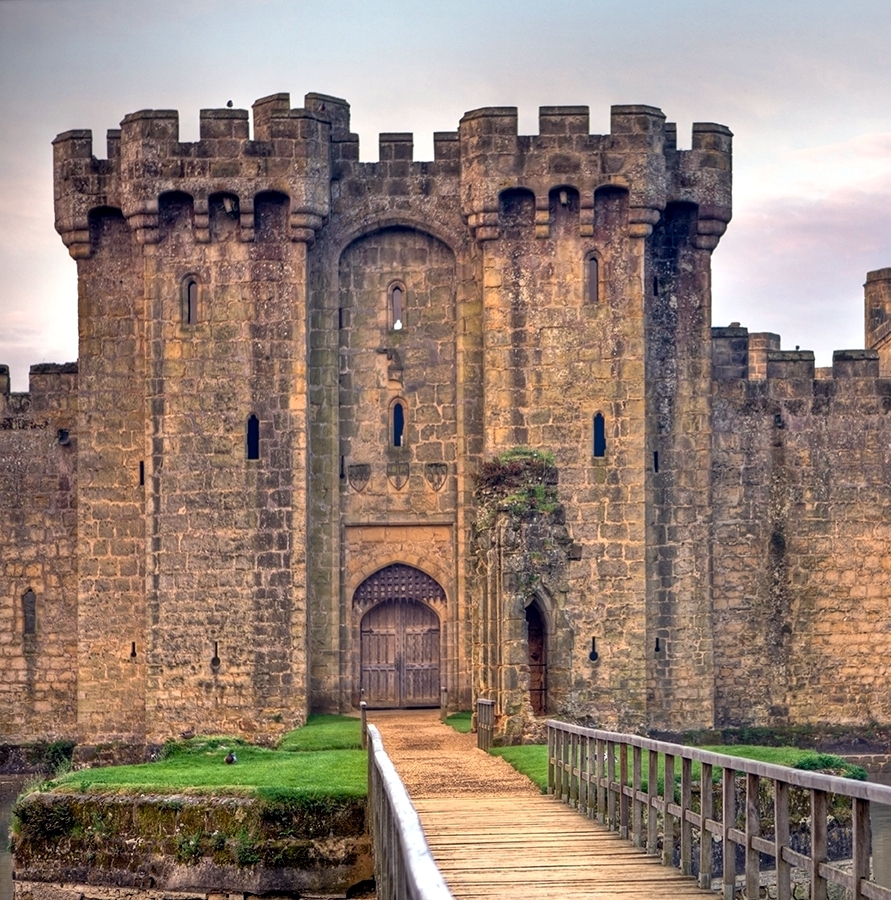
The most heavily defended part of any castle was usually its entrance, and Bodiam’s gatehouse is a fine example of medieval security in depth. Anyone trying to force their way in had to get past a whole sequence of obstacles: a drawbridge that could be raised, more than one portcullis, stout wooden doors, and, above, so-called murder-holes in the ceiling through which the defenders could drop stones or pour unpleasant substances on attackers trapped below.
Above the gate you can still see the original stone coats of arms of Dalyngrigge and his connections, a proud advertisement of the family’s status set right where every visitor would see it. This was the point of the whole exercise, in a sense: to make a grand impression, to announce who lived here and how important he was, at the very moment a guest crossed the threshold.
Passing under the gatehouse today, with the dark stone closing overhead and the marks of the old defences still visible, is one of the most atmospheric moments of a visit. It is easy to feel, just for a second, what it might have been like to approach as a stranger, uncertain of your welcome, with armed men watching from the shadows above.
A Comfortable Home Behind the Walls
Step through into the courtyard and Bodiam changes completely. Where the outside is all military swagger, the inside was designed for comfortable, even gracious, living. Ranged around the central courtyard were all the rooms a well-off medieval household needed: a great hall for dining and ceremony, kitchens, a chapel, private chambers for the lord and his family, and separate quarters for retainers and servants.
The layout was carefully thought out to separate the grand from the everyday and the family from the staff, reflecting the social order of a great household. There were fine lodgings for important guests, a clear hierarchy of spaces, and all the machinery of a self-contained community. Bodiam was not a bare barracks but a genuine home, built for a knight who wanted to live in real comfort and style.
Sadly, the interior ranges are now roofless ruins, so you have to use your imagination to picture the busy, warm, smoky life that once filled them. But the outlines are all there in the standing stonework, and information around the site helps you rebuild the vanished rooms in your mind’s eye, from the high table in the hall to the chapel where the household prayed.
One charming detail survives inside: a well, and the remains of the arrangements that brought water and comfort to the household. Living in a castle sounds romantic, but it depended on a great deal of unglamorous plumbing, storage, and service, and Bodiam was designed with all of that in mind. The people who built it wanted not just to look grand but to live well, with warmth, food, and water laid on as smoothly as the age allowed.

A Castle That Barely Saw a Fight
For all its warlike appearance, Bodiam had a remarkably peaceful career. The great French raid it was supposedly built to repel never came in force to this valley, and for most of the Middle Ages the castle simply served as a grand and comfortable home. The drama its walls seemed to promise largely failed to arrive, which is itself part of the argument that it was always as much about display as defence.
Its one brush with real conflict came much later, during the English Civil War in the seventeenth century. Bodiam was held for the Royalist side, and when Parliament gained the upper hand the castle was surrendered. Like many others, it was then slighted, deliberately damaged so it could never again be defended, and its interior buildings were dismantled and left to decay. That is why the shell survives but the rooms inside do not.
So Bodiam’s ruin is really the result not of a great siege but of a quiet surrender and a bout of demolition, followed by centuries of neglect. For a long time it stood empty and overgrown, a romantic ruin admired by passing artists but slowly crumbling, until, in the nineteenth and twentieth centuries, people began to think it worth saving.
The Siege That Was Called Off
Bodiam did once come close to a real siege, and the story is a good one. In the fifteenth century, during a period of political turbulence, the castle’s owner found himself on the wrong side of a powerful faction, and an armed force was sent to take Bodiam. Cannon were reportedly brought up, and the castle looked set to be attacked in earnest for the first time in its life.
And then, in a very medieval anticlimax, it seems the castle simply surrendered without a serious fight. Faced with overwhelming force, the defenders judged resistance pointless and gave the place up, sparing Bodiam the battering its walls might otherwise have taken. It is one more chapter in the castle’s oddly bloodless career, a fortress forever threatening violence that somehow never quite happened.
This near-miss is often folded into the wider debate about what Bodiam was for. A castle that talks a big military game but repeatedly avoids actual fighting fits neatly with the idea of a place built more to impress and deter than to endure a real pounding. Whether by luck or design, Bodiam kept its good looks intact by never having to test them.
Rescued by a Viceroy
Bodiam’s savior was one of the grandest figures of his age: Lord Curzon, the former Viceroy of India, a statesman with a deep love of historic buildings. Curzon admired the ruined castle so much that he bought it in 1916 and set about carefully repairing and consolidating it, clearing out the moat, stabilising the walls, and researching its history with real scholarly care.
Curzon’s approach was ahead of its time. Rather than rebuilding Bodiam into a fake medieval fantasy, he sought to preserve it honestly as a beautiful ruin, conserving what survived and letting the castle speak for itself. On his death in 1925 he left Bodiam to the National Trust, which has looked after it ever since, ensuring that this most photogenic of castles would be preserved for the public.
It is thanks to Curzon that we can enjoy Bodiam today at all. Without his intervention it might well have slid further into decay and been lost, like so many other medieval castles. Instead it stands complete on the outside, its moat sparkling, one of the most visited and best-loved historic sites in the south of England.
Curzon’s care extended to writing a detailed scholarly book about the castle, unusual for a great aristocrat of his day, and his conservation work set a standard that influenced how ruined buildings were treated afterwards. In an era when many old buildings were being carelessly restored or knocked down, his thoughtful, evidence-based approach helped Bodiam survive as an honest medieval ruin rather than a Victorian fantasy.

The Most Photographed Ruin in England
There is a good case that Bodiam is the most photographed and painted castle ruin in the whole country, and it is easy to see why. Its compact, symmetrical shape, its complete circuit of towers, and above all that mirror-like moat combine to make an almost impossibly perfect picture from almost any angle. In autumn mist, under summer blue, or dusted with winter frost, it is endlessly paintable.
Film-makers have loved it too, using Bodiam as a ready-made medieval backdrop, and it turns up as the very image of a fairy-tale castle in books, adverts, and screens the world over. For many people it is the castle they picture when they imagine the Middle Ages, even if they have never learned its name.
That fame is a modern extension of what Bodiam may always have been about: making a stunning impression. Whether or not it was ever a serious fortress, it has succeeded brilliantly at looking like the perfect castle, and in the age of the camera that has made it more celebrated than fortresses that saw far more history.
Its role as a favourite subject has a nice historical echo. Long before photography, Bodiam was already being sketched and painted by travellers charmed by its romantic decay, and those early images helped build the reputation that eventually saved it. In a sense, Bodiam has been famous for being beautiful for a very long time, and that fame is now part of its story.
A Storybook Castle for Every Age
Few castles have lodged themselves so firmly in the popular imagination as Bodiam. Its perfect, compact form makes it the go-to image whenever anyone needs to conjure the idea of a medieval castle, and it has appeared in countless books, films, and television programmes standing in for the fortresses of legend and history alike. For generations of British schoolchildren, a trip to Bodiam is a first, unforgettable encounter with the Middle Ages.
That appeal is partly about scale. Bodiam is big enough to be genuinely impressive but small and clear enough to take in at a glance and understand, unlike sprawling fortresses that can bewilder a first-time visitor. You can grasp the whole plan from the far side of the moat, walk right around it in a few minutes, and instantly see how a castle was meant to work.
In that sense Bodiam is the perfect teaching castle, and the perfect romantic one. It gives you the idea of a castle in its clearest, most beautiful form, which is why it has become, for so many people, the castle against which all others are measured. It may or may not have been a great fortress, but it is beyond doubt a great symbol.
How to Visit Bodiam
Bodiam sits in a quiet corner of East Sussex, in the valley of the River Rother, in the far south-east of England. It is a comfortable drive from the coast and from towns like Hastings and Tunbridge Wells, and in the warmer months it can even be reached by a heritage steam railway that runs up the valley, which makes for a wonderfully atmospheric arrival. It pairs well with a wider tour of the castles and countryside of Kent and Sussex.
Because the interior is a ruin, a visit is fairly quick compared with a fully furnished castle, but it is hugely rewarding. Walk right around the moat to see the castle from every side, climb the towers where you can for views over the valley, and take time simply to enjoy the reflections. Bring a camera, choose a still day if you can for the best mirror effect, and let yourself be charmed by what is, fortress or fantasy, one of the most beautiful castles in England.
The castle sits at roughly 51.0028, 0.5435. Punch that into Google Maps and it will take you straight to Bodiam Castle in East Sussex.
Nearby Castles
The Castle That Looks Too Good to Be True
Bodiam is the castle that makes you think. It looks, at first, like the most straightforward fortress imaginable, a child’s-drawing castle come to life, and yet the closer you study it the more slippery it becomes. Fortress or status symbol, machine of war or work of romance, it refuses to settle into a single answer, and that is exactly what keeps historians and visitors coming back to puzzle over it.
In the end, perhaps the point is that it never had to choose. A returning soldier with a new fortune built himself a home that was strong enough to be taken seriously and beautiful enough to take the breath away, and six centuries later it is still doing both. Stand at the edge of the moat on a still morning, watch the towers hang motionless in the water, and you will forgive Bodiam for being, above all, gloriously good to look at.
You May Like

Mafra, the Palace a King Built From a Vow


One thought on “Bodiam Castle: Perfect Fortress or Medieval Show-Piece?”