High on the slopes of Mount Parnassus in central Greece, overlooking a valley of olive groves, lie the ruins of Delphi, the most sacred site of the ancient Greek world. Here, for over a thousand years, the famous oracle of Apollo delivered prophecies that kings, cities and ordinary people crossed the ancient world to hear.
The Greeks believed Delphi was the very centre of the world, and its sanctuary was filled with temples, treasuries and statues offered in thanks to the god. Set in a landscape of breathtaking beauty, Delphi remains one of the most evocative of all ancient sites.

Table of Contents
- The Navel of the Ancient World
- The Oracle of Apollo
- The Pythia and Her Prophecies
- The Sacred Way and the Treasuries
- The Sphinx of Naxos and Votive Monuments
- The Theatre
- The Stadium and the Pythian Games
- The Charioteer and Delphic Art
- The Tholos of Athena Pronaia
- Decline, Rediscovery, and UNESCO
- Getting There
- Nearby Places
- Closing Thoughts
The Navel of the Ancient World
The Greeks called Delphi the navel of the world, and a sacred stone, the omphalos, marked the spot. According to myth, Zeus released two eagles from opposite ends of the earth, and they met here, fixing Delphi as its centre.
Set dramatically on the mountainside, with cliffs above and a deep valley below, the sanctuary had an atmosphere of natural grandeur that reinforced its sacred status. Its setting is as unforgettable as its history.

The Oracle of Apollo
Delphi was above all the home of the oracle of Apollo, the god of prophecy, music and light. People came from all over the Greek world and beyond to consult the god about war, colonisation, marriage and countless other matters.
The oracle’s influence was immense. Its pronouncements could sway the decisions of cities and kings, and no major undertaking was lightly begun without seeking the god’s advice at Delphi.

The Pythia and Her Prophecies
The prophecies were delivered by a priestess known as the Pythia, who sat within the Temple of Apollo and spoke on the god’s behalf. Her utterances, often obscure or ambiguous, were interpreted by the priests.
Ancient sources describe her falling into a trance, perhaps induced by vapours rising from the ground. Her famously riddling answers gave rise to many legends of prophecies fulfilled in unexpected ways.
The Sacred Way and the Treasuries
A winding path, the Sacred Way, led up through the sanctuary to the Temple of Apollo. Along it stood dozens of treasuries, small temple-like buildings in which the Greek cities stored precious offerings to the god.
The best preserved is the Treasury of the Athenians, rebuilt from its original blocks. These buildings, and the statues that once crowded the route, made the Sacred Way a dazzling display of the wealth and rivalry of the Greek states.


The Sphinx of Naxos and Votive Monuments
Among the many offerings at Delphi were spectacular monuments set up by cities and rulers to display their power and piety. One famous example is the Sphinx of Naxos, a great winged sphinx that once perched atop a tall column.
Such votive statues and columns filled the sanctuary, turning it into an open-air museum of Greek art and a record of the ambitions of those who dedicated them.

The Theatre
Above the Temple of Apollo stands the theatre of Delphi, its stone seats climbing the hillside and commanding a magnificent view over the sanctuary and the valley beyond. It hosted plays and musical contests.
Music and poetry were sacred to Apollo, and performances here were part of the religious life of the site. Few theatres anywhere enjoy so spectacular a setting.

The Stadium and the Pythian Games
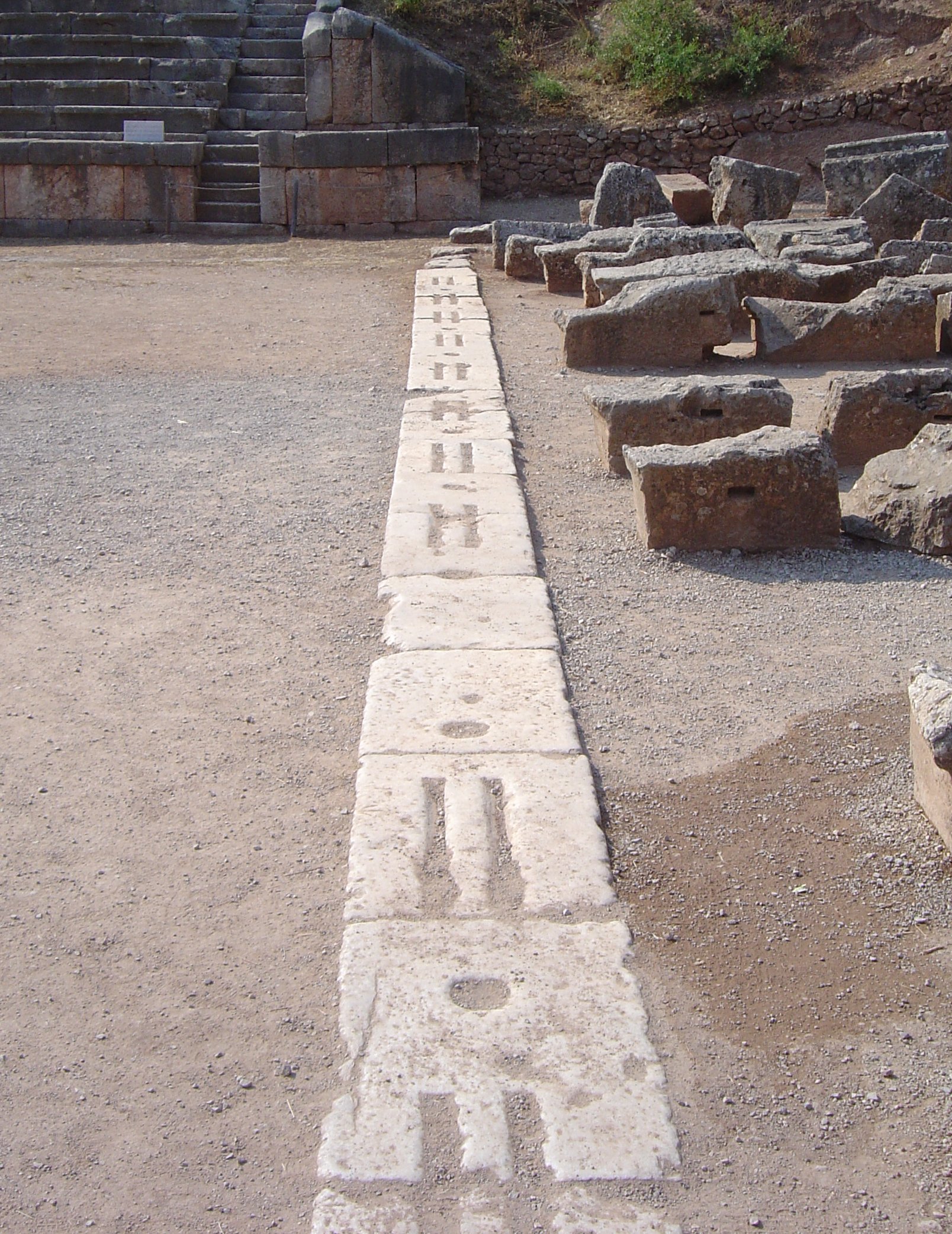
Higher still lies the stadium, where the Pythian Games were held every four years in honour of Apollo. Second only to the Olympic Games, they drew athletes and spectators from across the Greek world.
The games combined athletic and musical competitions, reflecting Apollo’s dual role as god of both sport and the arts. The well-preserved stadium still has its stone starting line and rows of seats.
The Charioteer and Delphic Art
Delphi’s museum holds one of the greatest surviving bronze statues of the ancient world, the Charioteer of Delphi. Cast in the fifth century BC, it depicts the victorious driver of a chariot race with astonishing calm and dignity.
This masterpiece, with its inlaid eyes and finely rendered drapery, is a supreme example of early classical Greek sculpture. It survived because it was buried and forgotten, escaping the melting down that claimed so many ancient bronzes.

The Tholos of Athena Pronaia
A little apart from the main sanctuary stands the Tholos, a graceful circular building of white marble surrounded by columns, part of the precinct of Athena Pronaia. Though its purpose is uncertain, its beauty is not.
With three of its columns re-erected against the backdrop of the valley, the Tholos has become the single most iconic image of Delphi, a symbol of the elegance of Greek architecture.
Decline, Rediscovery, and UNESCO
With the rise of Christianity and the banning of the old religion, the oracle fell silent, and Delphi was abandoned. In time a village grew over the ruins, hiding the ancient sanctuary.
In the nineteenth century the village was moved and the site excavated, revealing Delphi in all its glory. It was inscribed on the UNESCO World Heritage List in 1987 and is now one of the most visited sites in Greece.
Getting There
Delphi lies in central Greece, on the slopes of Mount Parnassus in the region of Phocis, about two and a half hours by road northwest of Athens. The modern village of Delphi is right beside the ruins.
Most visitors come by car or organised tour from Athens, often as a day trip, though the beauty of the setting rewards an overnight stay. The excellent site museum, home of the Charioteer, is an essential part of any visit.
Coordinates: 38.4824, 22.5010 — open Delphi in Google Maps.
Nearby Places
- The Acropolis of Athens — the sacred heart of the city whose treasury stands on the Sacred Way at Delphi.
- Ephesus — home of another great sanctuary of a Greek deity, the wondrous Temple of Artemis.
- Pompeii — a Roman town whose people, like the Greeks at Delphi, sought signs and favour from their gods.
Closing Thoughts
Delphi was the spiritual centre of the Greek world, where a god was believed to speak and where cities displayed their glory in marble and bronze on the slopes of a sacred mountain.
Its oracle shaped the course of Greek history, and its ruins, set amid some of the most beautiful scenery in Greece, still cast a powerful spell. To stand before the Tholos or climb the Sacred Way is to feel why the ancients called this place the centre of the earth.
You May Like
Mafra, the Palace a King Built From a Vow


One thought on “Delphi: The Oracle of Apollo and the Sacred Navel of the Ancient World”