In the year 79 AD, the Roman town of Pompeii vanished in a single day, buried under metres of ash and pumice when the volcano Mount Vesuvius erupted. That catastrophe, which killed thousands, also preserved the city almost perfectly, freezing an entire Roman town at the moment of its death.
Rediscovered and excavated over the past few centuries, Pompeii is the most complete picture we have of daily life in the Roman world: its streets and shops, its houses and gardens, its temples, baths and brothels, and even the shapes of its dying inhabitants, all held in the ash for nearly two thousand years.

Table of Contents
- The City Frozen in Time
- Life in a Roman Town
- The Eruption of Vesuvius
- The Plaster Casts of the Victims
- Houses, Shops, and the Thermopolia
- Frescoes and Mosaics
- Gardens and Villas
- The Forum and Public Life
- The Amphitheatre and Entertainment
- Rediscovery and Excavation
- Getting There
- Nearby Places
- Closing Thoughts
The City Frozen in Time
Pompeii lay near the Bay of Naples, in the shadow of Mount Vesuvius, which the townspeople did not even realise was a volcano. It was a busy, prosperous provincial town of perhaps ten to twenty thousand people.
When Vesuvius erupted, the town was buried so quickly and so deeply that it was sealed away almost intact. This is why Pompeii, uniquely among ancient cities, preserves not just grand monuments but the ordinary fabric of everyday life.
Life in a Roman Town
Walking through Pompeii today is like stepping into a living Roman town. Its streets are lined with shops, bars, bakeries and houses, and the ruts of cart wheels are still worn into the paving stones.
Raised stepping stones let pedestrians cross the streets without stepping in the mud and water below. Everywhere there are the small details of daily life, from painted shop signs to graffiti scratched on the walls.

The Eruption of Vesuvius
On an autumn day in 79 AD, Vesuvius erupted with tremendous force, sending a towering column of ash and rock high into the sky. For hours, pumice and ash rained down on Pompeii, collapsing roofs and filling the streets.
Then came deadly surges of hot gas and debris that swept over the town, killing anyone who remained. An eyewitness account by the writer Pliny the Younger, who watched from across the bay, describes the terror of that day.
The Plaster Casts of the Victims
Among the most haunting sights at Pompeii are the plaster casts of the victims. As the bodies buried in the ash decayed, they left hollow spaces, which archaeologists filled with plaster to recreate the exact shapes of the dying.
These casts show people in their last moments, some huddled together, some shielding their faces. They give Pompeii its extraordinary emotional power, turning an archaeological site into a direct encounter with human tragedy.

Houses, Shops, and the Thermopolia
Pompeii preserves shops and businesses of every kind. Especially common are the thermopolia, ancient fast-food counters with large jars set into stone benches, where hot food and drink were sold to passers-by.
These and the many bakeries, workshops and taverns reveal a bustling commercial life. Recent excavations have even found the preserved remains of meals, giving a vivid picture of what ordinary Romans ate.

Frescoes and Mosaics
The houses of Pompeii are famous for their wall paintings and floor mosaics, preserved by the ash in remarkable freshness. Frescoes of gods, myths, landscapes and daily life cover the walls of even quite modest homes.
The grandest houses, such as the House of the Faun, held spectacular mosaics, including a great depiction of Alexander the Great in battle. These works are among the finest surviving examples of Roman art.


Gardens and Villas
Many Pompeian houses were built around open courtyards and gardens, surrounded by columns and decorated with fountains, statues and painted walls. These peaceful green spaces were at the heart of Roman domestic life.
By studying the root cavities and seeds preserved in the ash, archaeologists have even been able to replant some gardens as they once were, recreating the plants the Romans grew.

The Forum and Public Life
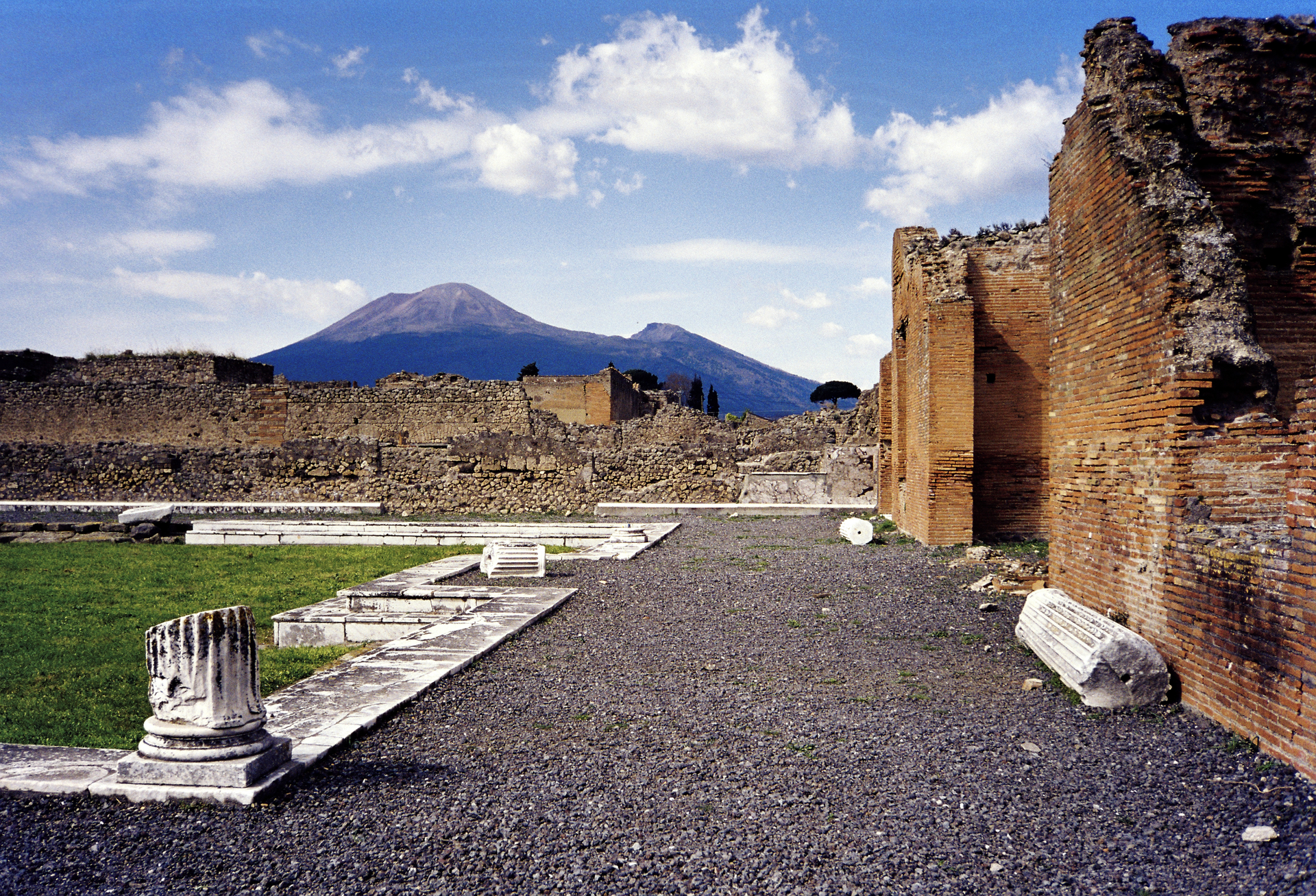
At the centre of Pompeii lay the forum, the main public square, surrounded by temples, markets and government buildings, with Vesuvius rising beyond. Here the citizens gathered for business, politics and religion.
Around the town stood bath complexes, theatres and temples to various gods. Together they show a community enjoying the full range of Roman civic and social life right up to the moment of its destruction.
The Amphitheatre and Entertainment
Pompeii possessed one of the oldest surviving stone amphitheatres in the Roman world, where gladiatorial games and other spectacles were held before large crowds. A famous riot between rival fans once broke out here.
Together with its theatres, the amphitheatre reveals the importance of public entertainment in Roman life. These venues, like so much of Pompeii, survive in remarkable completeness.

Rediscovery and Excavation
Pompeii lay forgotten for centuries until it was rediscovered and excavation began in the eighteenth century. The finds astonished Europe and helped spark a lasting fascination with the classical world.
Excavation continues to this day, and new discoveries are still being made, from untouched houses to fresh frescoes and even more victims. Pompeii, together with nearby Herculaneum, was inscribed on the UNESCO World Heritage List in 1997.
Getting There
Pompeii lies near the Bay of Naples in the Campania region of southern Italy, close to the modern town of the same name. It is easily reached from Naples or Sorrento by the local Circumvesuviana railway, which has a stop right by the site.
The ruins are extensive, so a visit takes several hours or more. Many travellers combine Pompeii with nearby Herculaneum and a trip up Mount Vesuvius itself.
Coordinates: 40.7497, 14.4869 — open Pompeii in Google Maps.
Nearby Places
- The Roman Forum and the Colosseum — the monumental heart of the empire whose everyday life Pompeii so vividly preserves.
- The Acropolis of Athens — the Greek world whose art and myth decorate the painted walls of Pompeii.
- Leptis Magna — another Roman city preserved by burial, this time beneath the desert sand rather than volcanic ash.
Closing Thoughts
Pompeii is the ancient world caught in the act of living: a whole Roman town, with its shops, homes, art and people, sealed by disaster and returned to us across two thousand years.
Nowhere else can we walk so directly into the daily life of the Romans, or feel so keenly the human cost of a natural catastrophe. Beneath the silent cone of Vesuvius, Pompeii remains one of the most moving and revealing places on earth.
You May Like
Mafra, the Palace a King Built From a Vow


2 thoughts on “Pompeii: The Roman Town That a Volcano Buried and Preserved for 2,000 Years”