On the island of Crete stand the ruins of Knossos, the great palace of the Minoans and the centre of the first advanced civilisation of Europe. More than three and a half thousand years old, it is a maze of halls, staircases and storerooms, decorated with some of the most beautiful and lively art of the ancient world.
Knossos is bound up with one of the most famous of all Greek myths, the story of the Minotaur and the labyrinth. Behind the legend lies a real and brilliant Bronze Age culture, rediscovered only a little over a century ago, whose palace still amazes visitors today.
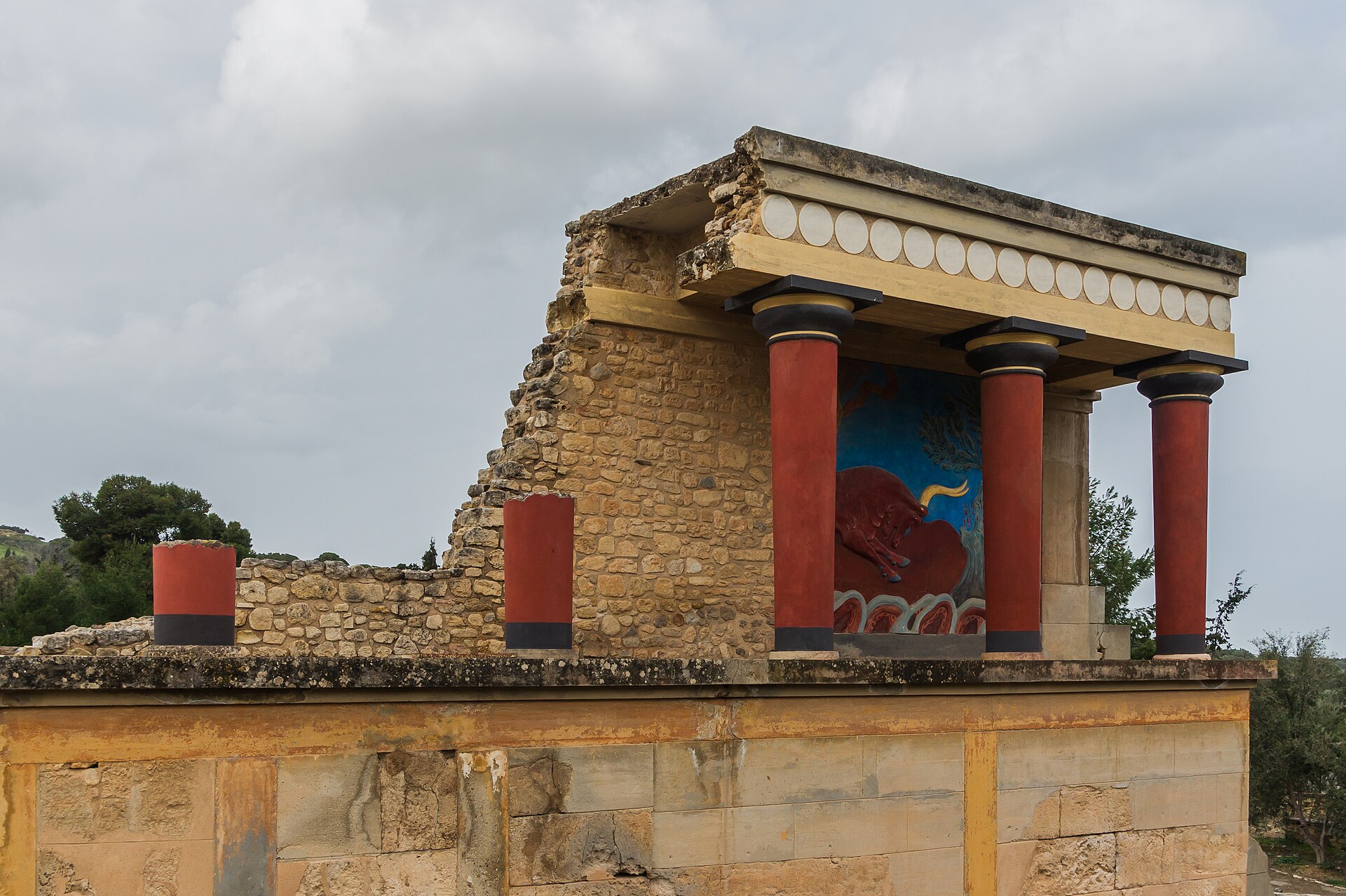
Table of Contents
- The Palace of the Minoans
- Europe’s First Great Civilisation
- The Legend of the Minotaur and the Labyrinth
- The Great Palace Complex
- The Throne Room
- Frescoes of a Vivid World
- Bull-Leaping and Minoan Religion
- Storerooms and the Minoan Economy
- Sir Arthur Evans and the Controversial Restoration
- The Fall of the Minoans and Rediscovery
- Getting There
- Nearby Places
- Closing Thoughts
The Palace of the Minoans
Knossos was the largest and most important of the palaces of the Minoan civilisation, which flourished on Crete in the Bronze Age. It was not a single building but a vast complex of hundreds of rooms arranged around a central court.
At its height it was the heart of a wealthy and sophisticated society that dominated the Aegean through trade and seafaring. The palace served as a royal residence, religious centre, workshop and storehouse all at once.

Europe’s First Great Civilisation
The Minoans, named after the legendary King Minos, created what is often regarded as Europe’s first advanced civilisation. They built fine palaces, developed writing, and produced exquisite art, pottery and metalwork.
Their culture spread its influence across the Aegean, and their ships carried Cretan goods far and wide. Knossos was the greatest centre of this remarkable and mysterious civilisation.
The Legend of the Minotaur and the Labyrinth
According to Greek myth, King Minos kept a fearsome monster, the Minotaur, half man and half bull, in a great labyrinth beneath his palace, where young Athenians were sent to be devoured. The hero Theseus finally killed the beast.
The sprawling, maze-like plan of the real palace, together with the importance of the bull in Minoan art and religion, may well have inspired this enduring legend of the labyrinth.

The Great Palace Complex
The palace of Knossos was a marvel of Bronze Age architecture, with multiple storeys, grand staircases, light wells, and an advanced system of drains and water pipes. Its complexity would have astonished visitors from simpler societies.
A magnificent grand staircase led between the levels of the residential quarters, lit by open shafts that brought light and air deep into the building. Such engineering was far ahead of its time.

The Throne Room
One of the most famous rooms at Knossos is the throne room, where a carved stone seat, sometimes called the throne of Minos, stands against the wall, flanked by painted griffins. It may have been used by a priest-king or priestess.
This atmospheric chamber, with its benches and its restored frescoes, gives a powerful sense of the ceremonial and religious life of the palace.

Frescoes of a Vivid World
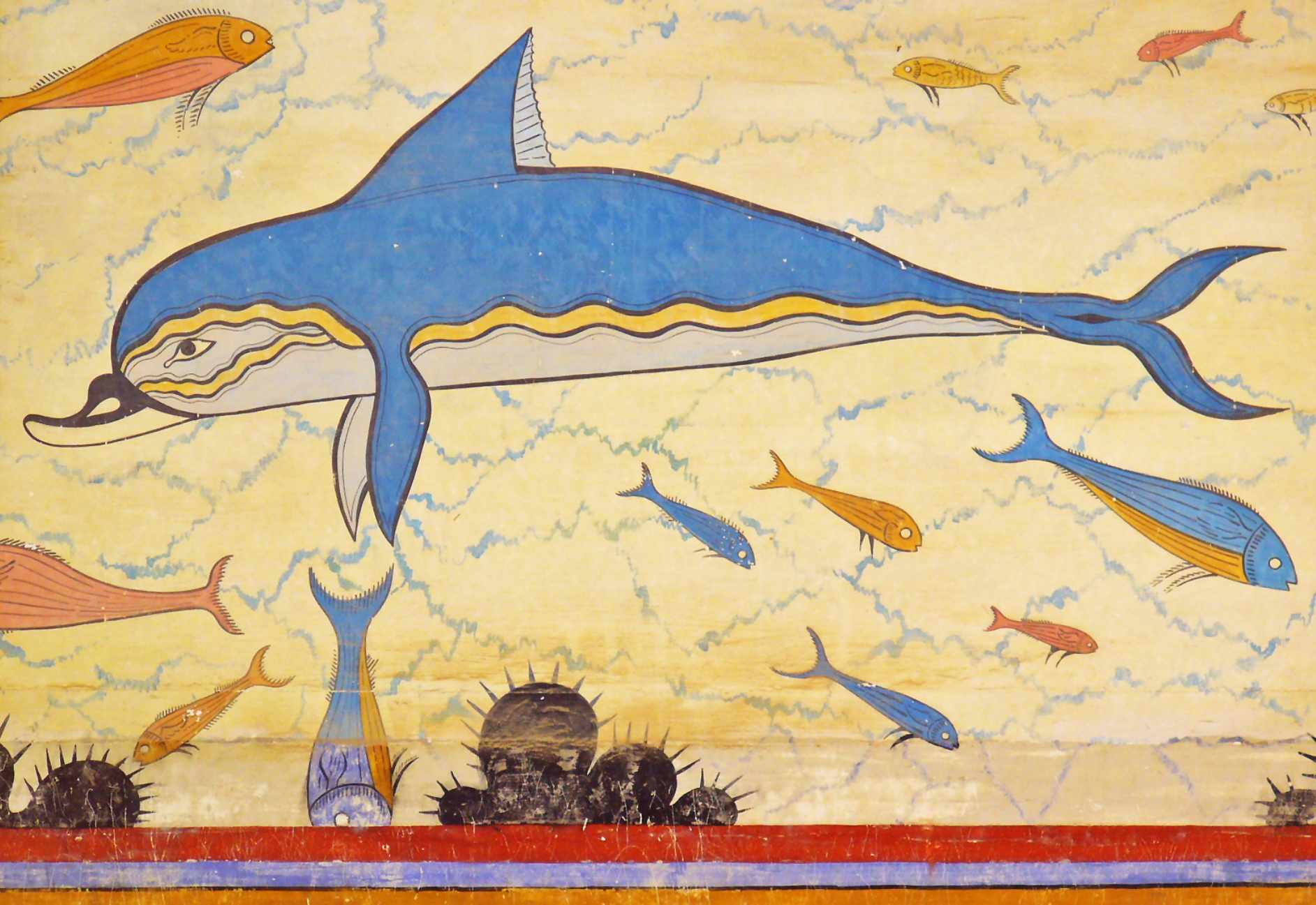
Knossos is famous for its wall paintings, which depict a bright and joyful world of nature and ceremony. Dolphins swim across the walls, elegant figures process in fine clothes, and gardens and animals appear in vivid colour.
These frescoes, though much restored, reveal a society that delighted in beauty, movement and the natural world. They are utterly unlike the stiff formality of much other ancient art.

Bull-Leaping and Minoan Religion
The bull was central to Minoan religion and imagery, and the most famous fresco of all shows young athletes vaulting over the back of a charging bull. This dangerous ritual of bull-leaping may have had deep religious meaning.
Sacred symbols such as the horns of consecration and the double axe appear throughout the palace. Minoan religion seems to have centred on goddesses and on rituals linking humans, animals and the divine.

Storerooms and the Minoan Economy
Much of the palace was given over to storage. Long corridors are lined with magazines holding rows of huge storage jars, the pithoi, which once held olive oil, wine and grain gathered from the surrounding land.
This concentration of goods shows that the palace was an economic hub, collecting and redistributing the produce of the region. Clay tablets found here, written in early scripts, record these stores and transactions.

Sir Arthur Evans and the Controversial Restoration
Knossos was excavated at the start of the twentieth century by the British archaeologist Sir Arthur Evans, who named the Minoan civilisation. He went further than most, rebuilding parts of the palace in concrete and repainting frescoes.
His reconstructions make Knossos vivid and easy to imagine, but they are also controversial, as they reflect his own interpretations. Visitors today see a palace that is part ancient ruin and part modern re-creation.
The Fall of the Minoans and Rediscovery
The Minoan civilisation declined in the Bronze Age, weakened by natural disasters, possibly including a great volcanic eruption on the nearby island of Thera, and eventually came under the control of the mainland Mycenaeans.
Knossos was abandoned and forgotten until its rediscovery brought the Minoans back to light. Today the palace is one of the most visited archaeological sites in Greece and a symbol of the deep roots of European civilisation.
Getting There
Knossos lies just a few kilometres south of Heraklion, the largest city on the Greek island of Crete. Heraklion has an international airport and ferry connections to mainland Greece.
From Heraklion the site is easily reached by local bus, taxi or car. A visit is best combined with the Heraklion Archaeological Museum, which houses the original frescoes and finds from the palace.
Coordinates: 35.2979, 25.1633 — open Knossos in Google Maps.
Nearby Places
- The Acropolis of Athens — the later flowering of Greek civilisation whose deep roots lie in Minoan Crete.
- Delphi — the sacred heart of the later Greek world that inherited so much from the Minoans and Mycenaeans.
- Thebes — the Egyptian city with which the seafaring Minoans traded across the Bronze Age Mediterranean.
Closing Thoughts
Knossos is where the story of European civilisation begins: a vast Bronze Age palace of staircases and storerooms, alive with frescoes of dolphins, gardens and leaping bulls.
Home, in legend, to the Minotaur and the labyrinth, and, in reality, to the brilliant Minoans, it unites myth and archaeology as few places can. Rebuilt in part but rooted in the deep past, Knossos remains one of the most fascinating ruins in the world.
You May Like
Mafra, the Palace a King Built From a Vow


One thought on “Knossos: The Minoan Palace of Crete and the Real Labyrinth of the Minotaur”