Mesa Verde in southwestern Colorado holds some of the best-preserved cliff dwellings in North America, multi-story stone villages tucked into sandstone alcoves where Ancestral Puebloan families lived, farmed, and raised children for roughly two centuries before moving on.
Built mostly between 1190 and 1280 CE, sites like Cliff Palace, Balcony House, and Spruce Tree House represent the final, most architecturally sophisticated phase of nearly 700 years of continuous settlement on the mesa above, a shift from open mesa-top farming villages into some of the most dramatic residential architecture anywhere in the ancient Americas.
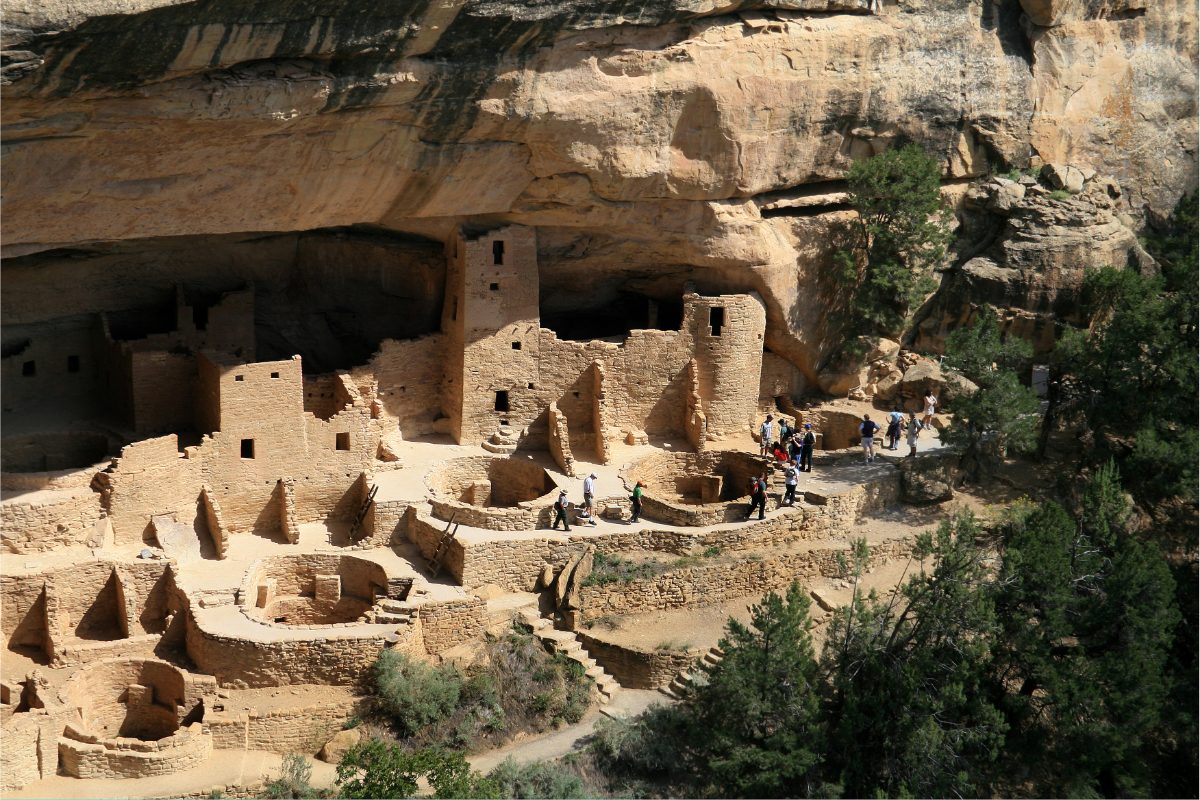
Table of Contents
- Cliff Dwellings Above the Canyon
- From Mesa Top to Cliff Alcove
- Cliff Palace: The Largest Dwelling
- Balcony House and the Art of Living on a Ledge
- Spruce Tree House and Daily Life
- Square Tower House and the Mesa Skyline
- Sun Temple and the Sacred Landscape
- What Language Did the Cliff Dwellers Speak?
- Religion, Farming, and Society at Mesa Verde
- Why They Left the Cliffs
- Nearby Places to Explore
Cliff Dwellings Above the Canyon
Mesa Verde, Spanish for ‘green table,’ rises to over 8,500 feet in elevation, its flat-topped mesas cut by deep canyons where seasonal seeps and springs provided a more reliable water source than the open plains below. Pinon and juniper woodlands covered the mesa top, supplying fuel and building material to the communities who farmed its surface for centuries.
The cliff dwellings themselves occupy natural sandstone alcoves carved by erosion over millions of years, recesses that offered shelter from snow and rain, natural insulation against temperature swings, and a defensible position above the canyon floor, all without requiring any roofing material for the deepest interior rooms.
The alcoves themselves formed over millions of years as groundwater seeping through porous Cliff House sandstone dissolved softer layers beneath a harder cap rock, eventually undercutting the cliff face until sections collapsed, leaving behind the deep, curved recesses that Ancestral Puebloan builders later adapted into ready-made shelters requiring far less structural work than building entirely exposed pueblos on the open mesa top.
Seep springs at the back of many alcoves, where water percolating through the rock finally reached the surface, provided a dependable water source even during dry stretches, and several cliff dwellings were positioned specifically to take advantage of these natural seeps rather than relying solely on rainfall collection or travel to the canyon floor below.
Snow accumulation on the mesa top during winter months also played an underappreciated role in the region’s water supply, since slow spring snowmelt recharged the seep springs and shallow aquifers that fed both farmland irrigation and the alcove springs relied upon by cliff dwelling residents, making winter snowfall arguably as important to the community’s survival as summer rainfall.
From Mesa Top to Cliff Alcove
People farmed the Mesa Verde region as early as 550 CE, living first in shallow pit houses dug into the mesa top and gradually shifting toward above-ground masonry pueblos by the 800s and 900s, a architectural progression mirrored across much of the wider Ancestral Puebloan world, including at Chaco Canyon roughly 90 miles to the south.
The dramatic move into cliff alcoves came relatively late, concentrated mostly in the final decades of the thirteenth century, and archaeologists still debate why: proposed explanations include defense against raiding or internal conflict, protection from increasingly unpredictable weather, or simply a cultural or religious preference for the alcoves that emerged toward the end of the mesa’s occupation.
Tree-ring dating shows most cliff dwelling construction was compressed into a remarkably short window, often just a few decades, suggesting a rapid, possibly urgent reorganization of the population rather than a slow architectural evolution, a detail that lends weight to theories involving stress, conflict, or environmental pressure rather than purely gradual cultural change.
During the ninth and tenth centuries, Mesa Verde’s mesa-top population lived in increasingly substantial pueblos built around central plazas, some incorporating great kivas comparable in concept, though smaller in scale, to those found at Chaco Canyon, suggesting the two regions shared closely related religious and architectural traditions even as each developed its own distinct expression of them.
Far View House and the surrounding mesa-top community, now preserved within the park’s Far View Sites complex, illustrate this earlier phase well, with multiple room blocks, kivas, and a reservoir suggesting a coordinated, sizeable community living in the open well over a century before the dramatic shift into the cliff alcoves nearby.
Population estimates for the wider Mesa Verde region at its peak, combining mesa-top villages and cliff dwellings together, range from roughly 5,000 to as many as 7,500 people spread across the plateau, figures reconstructed from systematic archaeological surveys mapping known room blocks, kivas, and associated farming terraces across the park and surrounding lands.
Dendrochronological samples taken from roof beams throughout the park have allowed researchers to build one of the most precise construction timelines available for any ancient North American site, often dating individual rooms to within a single year, a level of chronological detail that lets archaeologists trace the pace and sequence of the mesa’s final cliff-dwelling building boom almost season by season.
Cliff Palace: The Largest Dwelling
Cliff Palace is the largest cliff dwelling in North America, containing an estimated 150 rooms and 23 kivas built into a single sandstone alcove roughly 90 feet deep. Its resident population is estimated at around 100 people, organized into multiple household clusters sharing the alcove’s protected space.
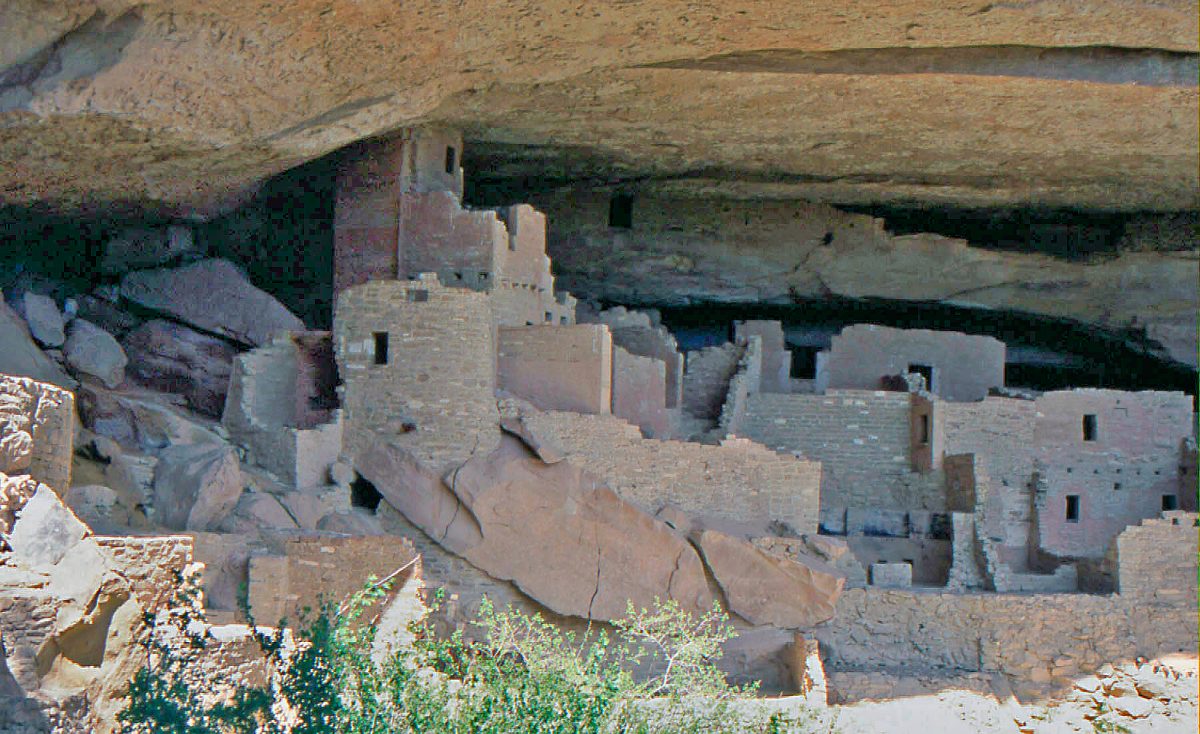
Construction at Cliff Palace used shaped sandstone blocks set in mortar, with rooms stacked up to four stories in places and connected by an intricate network of doorways, hand-and-toeholds carved directly into the rock, and wooden ladders, requiring residents to navigate a genuinely three-dimensional living space quite unlike the flatter pueblos built on open ground elsewhere in the region.
Excavations at Cliff Palace, carried out first by ranching brothers Richard and Alfred Wetherill in 1888 and later by professional archaeologists, recovered pottery, textiles, tools, and turkey pens, evidence of a fully functioning residential community rather than a purely ceremonial or defensive outpost.
Cliff Palace’s layout suggests it may have functioned partly as a gathering place for smaller surrounding communities rather than purely as a residence for its own inhabitants, given its unusually high ratio of kivas to residential rooms compared with most other Mesa Verde dwellings, a pattern that hints at a semi-public or ceremonial role beyond ordinary domestic life.
Modern conservation work at Cliff Palace continues to stabilize masonry walls weakened by a century of freeze-thaw cycles and, in earlier decades, well-intentioned but sometimes damaging restoration attempts, and the National Park Service now limits visitor access to guided tours to reduce further wear on the fragile eight-hundred-year-old structure.
Richard Wetherill, credited with the site’s rediscovery by non-Indigenous explorers in December 1888 while searching for stray cattle, named Cliff Palace on the spot, struck by the scale of the ruins visible across the canyon, and his family’s subsequent excavations, though far less rigorous than modern archaeological standards, produced some of the earliest detailed documentation of Mesa Verde’s cliff dwellings.
The alignment of certain rooms and towers at Cliff Palace with solar events at the equinox and solstice has led some researchers to propose an additional astronomical function layered atop its residential and ceremonial roles, though such alignments remain harder to confirm definitively than the more explicit solar markers documented at Chaco Canyon’s Fajada Butte.
Balcony House and the Art of Living on a Ledge
Balcony House, tucked into a smaller, higher alcove, required residents to climb a 32-foot wooden ladder simply to reach the entrance, and a narrow tunnel just 18 inches wide to access part of the interior, an arrangement that has led some researchers to suggest defense was a significant concern for at least some cliff-dwelling communities.
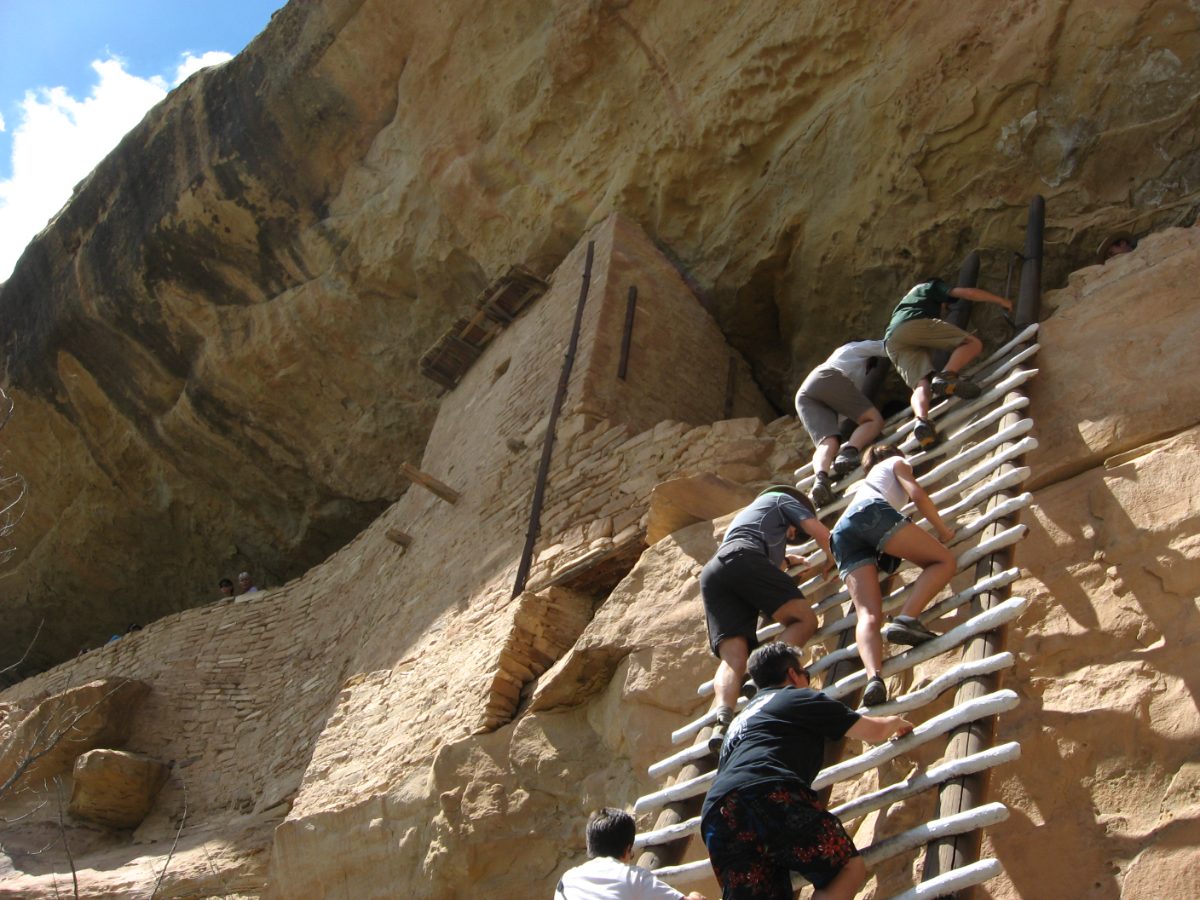
Its name comes from a wooden balcony that once extended along an upper room, a feature reconstructed by early twentieth-century excavators based on surviving support beams, offering a glimpse of how cliff dwelling residents made creative use of every available surface within their confined alcove space.
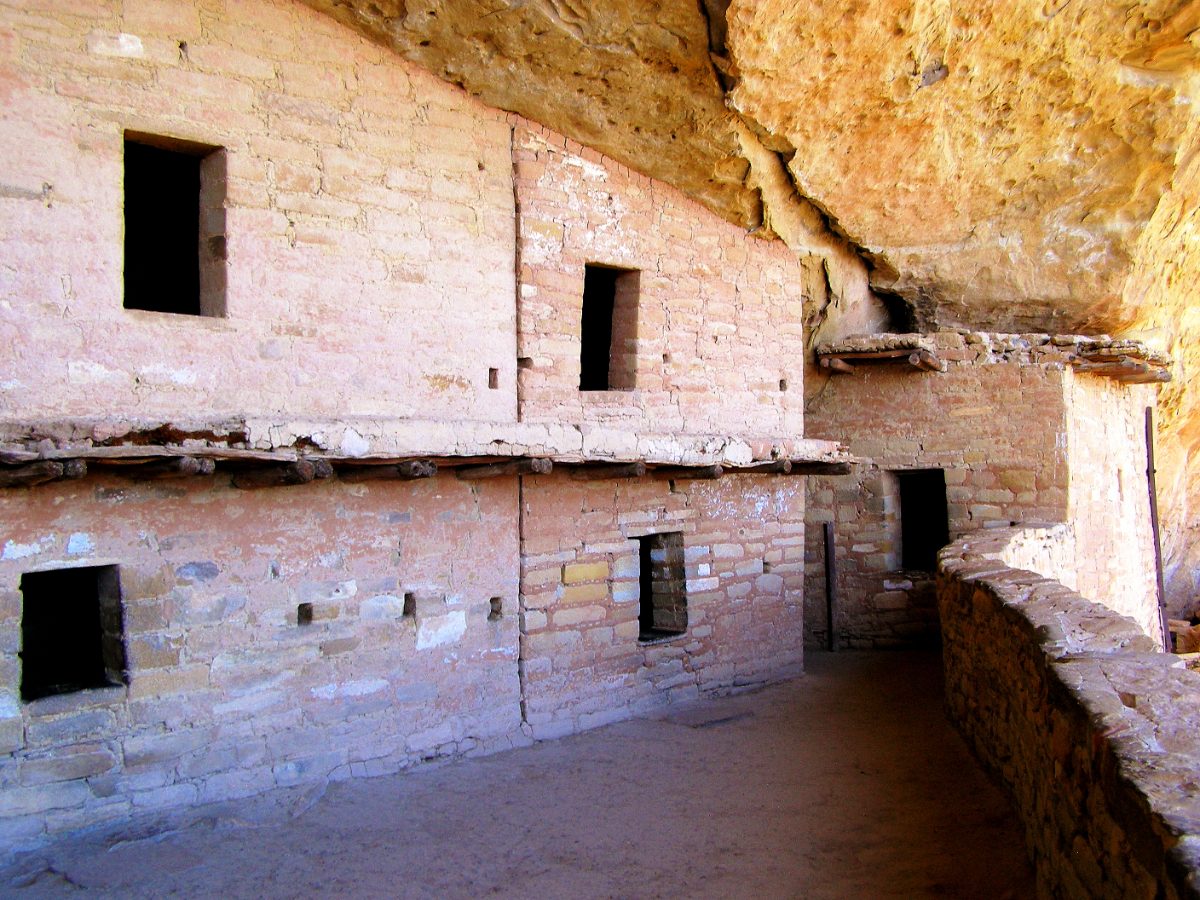
Beyond its dramatic entrance, Balcony House also contains a small enclosed courtyard and several kivas whose plastered walls still bear faint traces of painted decoration, evidence that even in this comparatively small and defensively positioned dwelling, residents invested effort in the same kind of ceremonial and decorative traditions seen at Mesa Verde’s larger sites.
Access restrictions at Balcony House today mirror, in a practical sense, the site’s original design: visitors must still climb a wooden ladder and pass through the narrow tunnel to reach the dwelling, giving modern tourists an unusually direct physical sense of the effort thirteenth-century residents accepted daily simply to reach their homes.
Structural engineers who examined Balcony House in the twentieth century noted that its builders reinforced sections of the alcove’s rear wall with masonry retaining structures, additional evidence that Ancestral Puebloan builders possessed a working understanding of load distribution and rock stability well suited to the demanding, irregular alcove environments they chose to build within.
Spruce Tree House and Daily Life
Spruce Tree House, the third-largest dwelling at Mesa Verde with about 130 rooms and 8 kivas, is also among the best-preserved, thanks in part to its relatively sheltered alcove position, and offers some of the clearest surviving evidence of ordinary domestic life among the cliff-dwelling community.
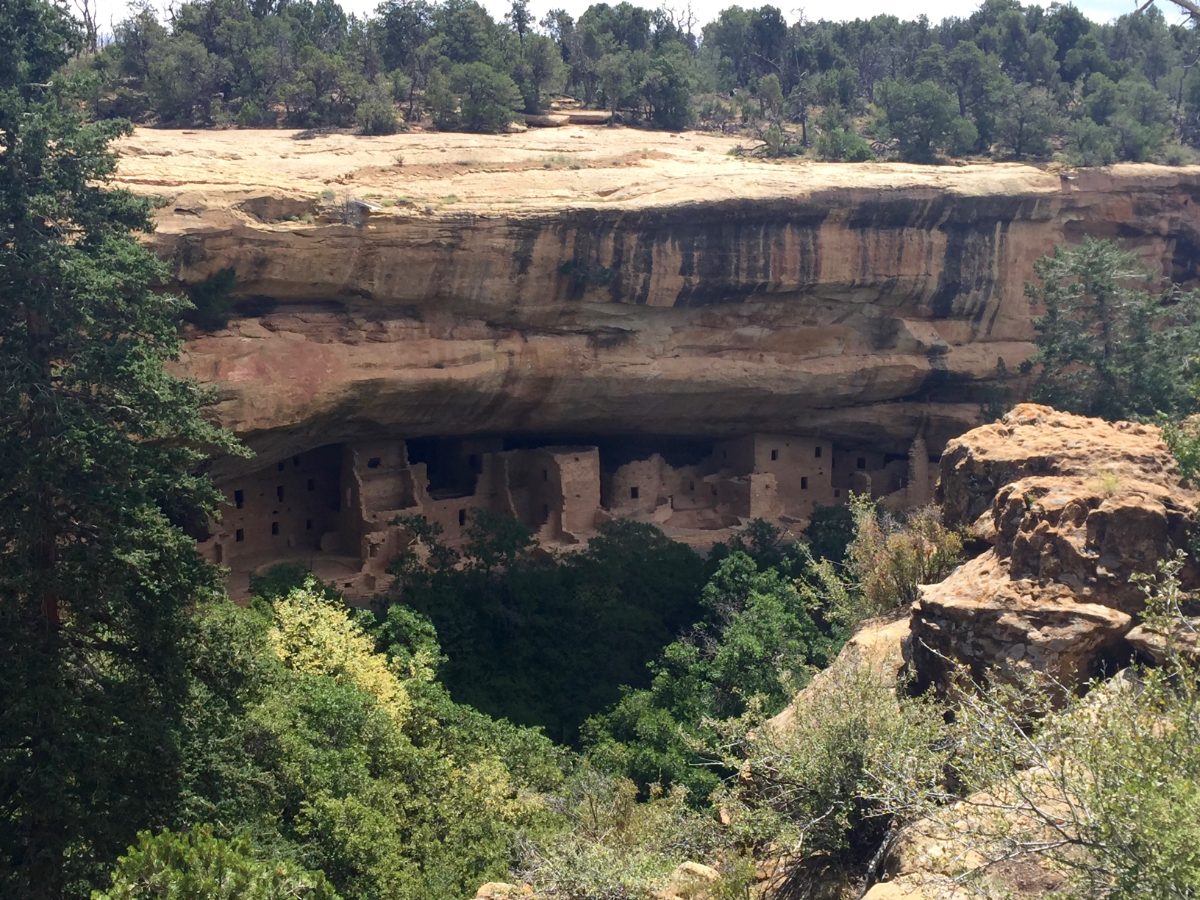
Excavators recovered milling stones for grinding maize, storage rooms for beans and squash, and evidence of turkey pens, since turkeys were raised both for feathers, used in blankets and ceremonial garments, and occasionally for meat, though maize remained the overwhelming dietary staple across the entire Mesa Verde region.
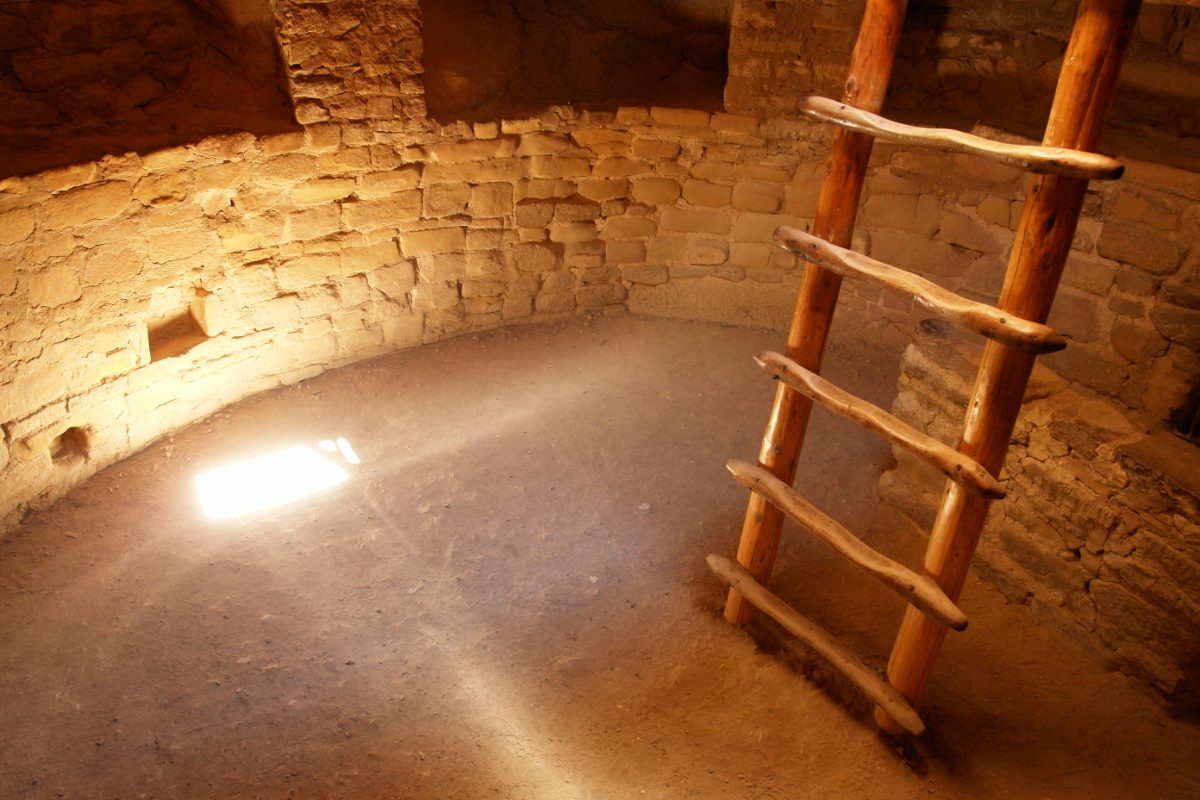
Several kivas at Spruce Tree House retain traces of their original roofing structure, a cribbed log construction covered with mud plaster and typically set slightly below the surrounding room block floor level, physically and symbolically situating these ceremonial spaces closer to the earth than the surrounding domestic rooms.
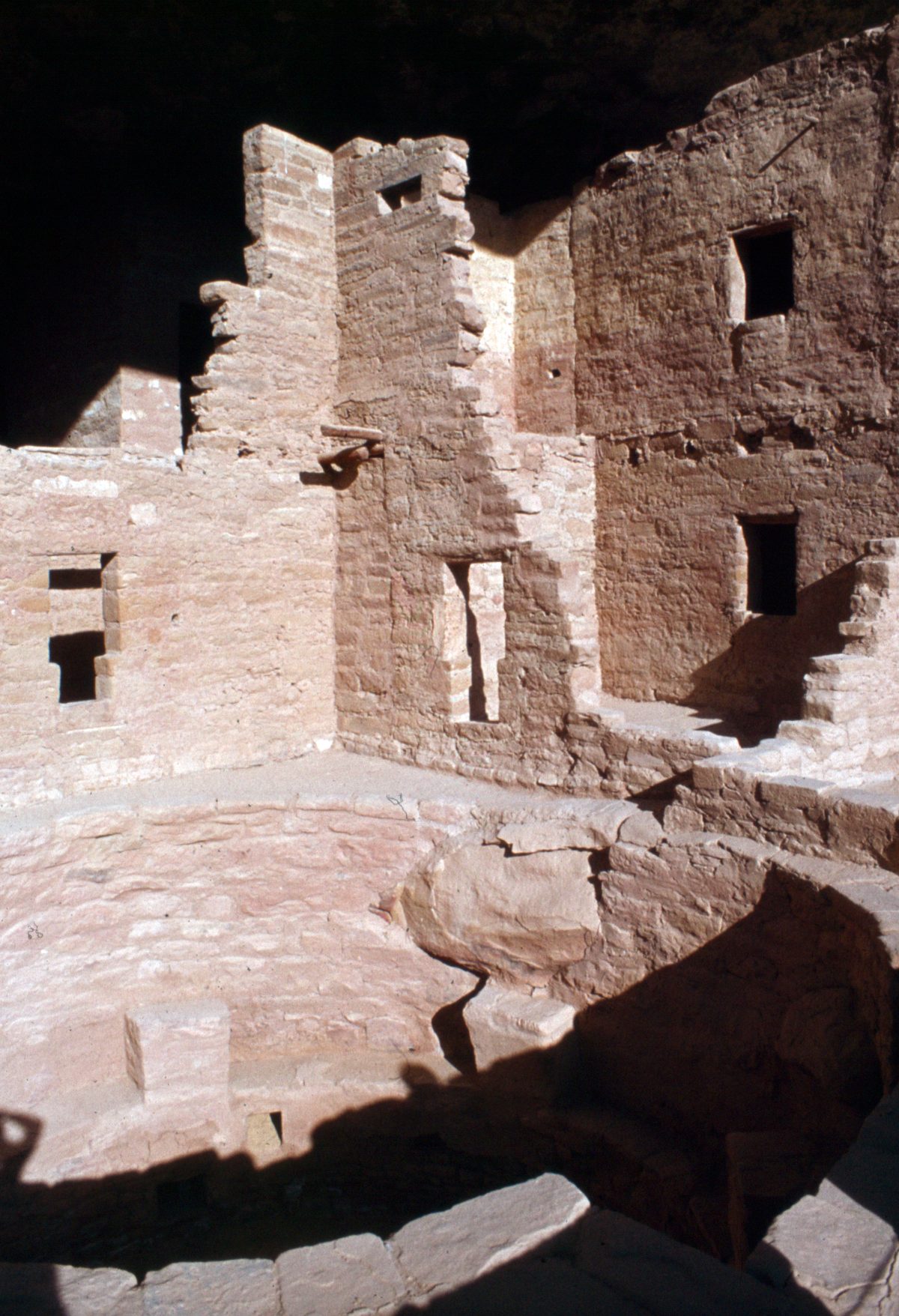
A well-preserved kiva at Spruce Tree House has been fully restored with its cribbed log roof rebuilt, allowing visitors and researchers alike to descend into a space closely approximating its original appearance, complete with a central hearth, ventilation shaft, and deflector stone designed to direct fresh air across the fire without extinguishing it.
Pottery recovered from Spruce Tree House includes both utilitarian corrugated cooking vessels and finely painted black-on-white serving ware, the latter often reserved for special occasions or ceremonial use, giving archaeologists insight into a household economy that distinguished clearly between everyday and more socially significant material culture.
A large, permanent seep spring at the rear of the Spruce Tree House alcove continues to produce water even today, and its reliability likely explains why this location was continuously occupied for a longer stretch than many other cliff dwellings, some of which appear to have been built and abandoned within a single generation.
Because Spruce Tree House sits in one of the most sheltered and accessible alcoves in the park, it has also served since the early twentieth century as one of the primary sites where park rangers introduce visitors to Ancestral Puebloan architecture and daily life, making it, alongside its archaeological importance, a central part of how the wider public first encounters Mesa Verde’s history.
Square Tower House and the Mesa Skyline
Square Tower House takes its name from a four-story tower rising from the alcove floor, one of the tallest surviving structures at Mesa Verde and a striking example of how cliff dwelling architecture could rival, in vertical ambition if not footprint, the larger pueblos built on open ground elsewhere in the Southwest.
Towers like this one appear at several Mesa Verde sites and across the wider Ancestral Puebloan world, and their function remains debated: proposed uses include astronomical observation, signaling between settlements, storage, or defensive lookout, and it is plausible different towers served different combinations of these purposes depending on their specific location and community.
Excavation and stabilization work at Square Tower House has been more limited than at the park’s most-visited dwellings, leaving much of the site in a condition closer to its original, unrestored state, which researchers value for the additional information it may still hold about construction techniques not yet altered by twentieth-century conservation efforts.
Comparable towers at other Ancestral Puebloan sites, including several associated with Chaco-era communities and later Rio Grande pueblos, suggest tower-building was a broadly shared architectural tradition across much of the northern Southwest, adapted locally to each community’s available materials, terrain, and specific ceremonial or defensive needs.
Sun Temple and the Sacred Landscape
Sun Temple, built on the mesa top directly across the canyon from Cliff Palace, is unusual among Mesa Verde’s major structures for having no residential rooms at all, D-shaped in plan and containing several kivas but apparently left unfinished, its walls never fully roofed before construction ceased.
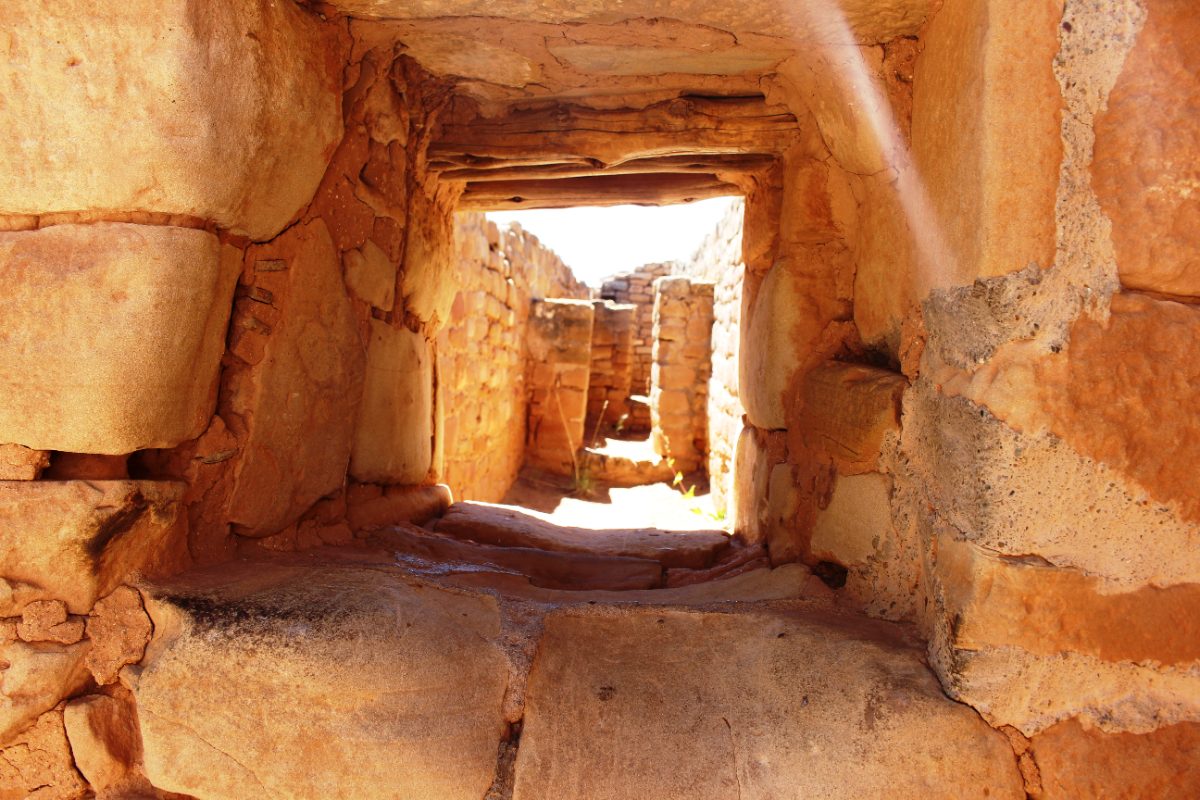
Its name and D-shaped layout, strikingly similar to Pueblo Bonito’s footprint at Chaco Canyon, have led researchers to interpret it as a purely ceremonial or astronomical structure, possibly used to track solstices and other significant solar events for the benefit of the wider farming community living in the canyon below and on the surrounding mesa top.
Excavators found almost none of the everyday domestic debris, broken pottery, hearths, or worn grinding stones, typically associated with residential use, reinforcing the interpretation that Sun Temple served a specialized ceremonial function even though its construction was apparently interrupted before completion, possibly by the very population pressures that would soon lead to the wider abandonment of the mesa.
What Language Did the Cliff Dwellers Speak?
Like Chaco Canyon, Mesa Verde’s Ancestral Puebloan residents left no written texts, so their spoken language must be inferred from the languages of their most likely descendants rather than read directly from an inscription. Archaeological continuity in architecture, pottery style, and settlement pattern strongly links Mesa Verde’s population to the Pueblo peoples of the northern Rio Grande valley in modern New Mexico.
Oral traditions from Hopi, Zuni, and the Rio Grande Pueblo communities, particularly Tewa-speaking pueblos such as San Ildefonso and Santa Clara, describe migrations from the Mesa Verde region following the thirteenth-century abandonment, and many contemporary Tewa and Tiwa speakers, whose languages belong to the Kiowa-Tanoan family, regard Mesa Verde as an ancestral homeland central to their own clan histories.
No single confirmed language can be assigned to Mesa Verde’s population with certainty, since the region may well have hosted speakers of multiple related and unrelated languages, much as Chaco Canyon likely did further south. What is well documented is the strong cultural and architectural continuity connecting Mesa Verde directly to specific living Pueblo communities today, a link far more direct and geographically traceable than for many other ancient sites in the Americas.
Linguists studying the wider Kiowa-Tanoan family, which includes Tewa, Tiwa, Towa, and the more distantly related Kiowa language spoken today on the southern Plains, continue to debate exactly how and when these languages diverged, but the geographic and archaeological evidence broadly supports a homeland somewhere in the Four Corners region encompassing Mesa Verde before later movement toward the Rio Grande valley and, for Kiowa speakers, onto the Plains.
Religion, Farming, and Society at Mesa Verde
Farming sustained nearly every aspect of Mesa Verde life. Maize, beans, and squash grown on the mesa top provided the caloric foundation for the population, supplemented by wild plants, rabbits, deer, and domesticated turkeys, while check dams and small reservoirs helped capture the mesa’s limited and unpredictable rainfall for both drinking water and irrigation.
Kivas functioned as the center of religious and social life, used for ceremonies tied to the agricultural calendar, clan gatherings, and initiation rites, a tradition of underground or partly subterranean ceremonial rooms that continues, in modified form, among Pueblo communities practicing kiva-based religion today.
Skeletal analysis of Mesa Verde burials shows evidence of arthritis, dental wear from stone-ground maize, and periodic nutritional stress, alongside signs of occasional violence in the final decades of occupation, a combination that paints a picture of a hardworking farming society under increasing pressure as the thirteenth century progressed.
Turkey pens found at several Mesa Verde cliff dwellings, along with turkey bone and eggshell fragments, indicate sustained domestication rather than occasional hunting, and turkey feathers were commonly woven into warm blankets, a practical adaptation to Mesa Verde’s cold, high-elevation winters that also carried ceremonial significance in later Pueblo tradition.
Rock art panels found throughout the wider Mesa Verde region, including handprints, spirals, and figures interpreted as representing katsina-like spirit beings, suggest a rich symbolic and religious life extending well beyond the structures themselves, expressed on canyon walls and boulders rather than solely within the built environment of the pueblos and cliff dwellings.
Textile fragments recovered from dry, protected alcove deposits include cotton, likely traded or grown in warmer lowland areas beyond the mesa itself, alongside locally available yucca fiber sandals and woven bags, indicating Mesa Verde’s residents participated in exchange networks reaching well beyond their immediate high-elevation farming communities.
Social organization at Mesa Verde, inferred from room block clustering and burial patterns, appears to have centered on extended family or clan groups occupying connected suites of rooms, with larger dwellings like Cliff Palace likely housing multiple such family groups who shared common kivas and courtyard spaces while maintaining distinct household identities within the larger community.
Why They Left the Cliffs
By 1280, Mesa Verde’s cliff dwellings and mesa-top villages were largely empty. Tree-ring records document a severe, sustained drought across the Colorado Plateau beginning around 1276 and lasting roughly a quarter century, a climatic crisis severe enough to undermine the maize farming that had sustained the region’s population for generations.
Drought alone likely combined with soil depletion after centuries of continuous farming, dwindling firewood supplies after generations of deforestation on the mesa top, and possibly increasing social tension or conflict, evidenced by defensive features at sites like Balcony House and the more remote, harder-to-access placement of many cliff dwellings built in the final building phase.
The migration south was not a disappearance. Descendant Pueblo communities in the Rio Grande valley and at Hopi and Zuni maintain oral histories describing their ancestors’ journey from Mesa Verde, and many contemporary Pueblo people continue to regard the cliff dwellings not as a lost civilization but as one chapter in a continuous history connecting directly to their communities today.
Modern climate reconstruction using tree-ring chronologies from the Mesa Verde region shows this drought as part of a broader pattern affecting much of the Colorado Plateau in the late thirteenth century, coinciding closely with the abandonment not only of Mesa Verde but of many other Ancestral Puebloan communities across the wider Four Corners area during roughly the same decades.
Mesa Verde National Park, established in 1906 as the first U.S. national park created specifically to preserve archaeological rather than natural resources, today works closely with the 24 tribes who trace ancestral connections to the site, incorporating their knowledge and perspectives directly into ongoing research, interpretation, and conservation efforts at the park.
Archaeological surveys of the areas immediately south of Mesa Verde, including sites in the Rio Grande valley that show sudden population growth in the late thirteenth and early fourteenth centuries, provide independent supporting evidence for the migration story preserved in Pueblo oral tradition, showing a genuine demographic shift rather than simply a cultural memory detached from the archaeological record.
Visitors today reach Cliff Palace, Balcony House, and Spruce Tree House only through ranger-guided tours, a management approach adopted specifically to balance public access against the long-term preservation of structures that, despite eight centuries of exposure, remain remarkably intact thanks largely to the dry climate and protective overhang of the alcoves themselves.
Nearby Places to Explore
Mesa Verde belongs to the same Ancestral Puebloan world as several other major sites across the American Southwest, and comparing them helps place its cliff dwellings within a broader regional story.
- Chaco Canyon: The Ancient Center of the Southwest
- Cahokia: The Largest Ancient City North of Mexico
- Two Thousand Years Before Its Famous Neighbor, Hunter-Gatherers Built This: The Story of Watson Brake
A Village Written Into the Rock
Mesa Verde’s cliff dwellings remain one of the most visually arresting achievements of the ancient Americas, entire villages fitted so precisely into the contours of natural sandstone alcoves that they seem to grow directly out of the cliff face itself.
Their builders left behind no written record, yet the architecture, pottery, and enduring oral traditions of their Pueblo descendants together preserve a remarkably clear picture of a farming society that adapted with striking ingenuity to one of the more demanding landscapes in North America, before moving on to build new lives further south.
Mesa Verde was designated a UNESCO World Heritage Site in 1978, recognized for both the exceptional preservation of its cliff dwellings and their importance in documenting the broader story of Ancestral Puebloan architectural innovation across the American Southwest.
You May Like
Mafra, the Palace a King Built From a Vow


One thought on “Mesa Verde: The Ancestral Puebloan Cliff City”