In the western highlands of El Salvador, in a valley called Chalchuapa, sits a pyramid whose smooth concrete surface looks almost nothing like the crumbling stone temples most people picture when they hear the word ‘Maya ruin.’ That unusual appearance is itself a piece of Tazumal’s history, the product of a twentieth-century restoration as controversial as the ancient city it was meant to protect.
Tazumal was never a footnote site. For over a thousand years it stood at a genuine cultural crossroads, absorbing influence from Teotihuacan in the distant Valley of Mexico, surviving one of the largest volcanic eruptions in Central American history, and eventually watching Nahua-speaking migrants from the north settle among its Maya-descended population.
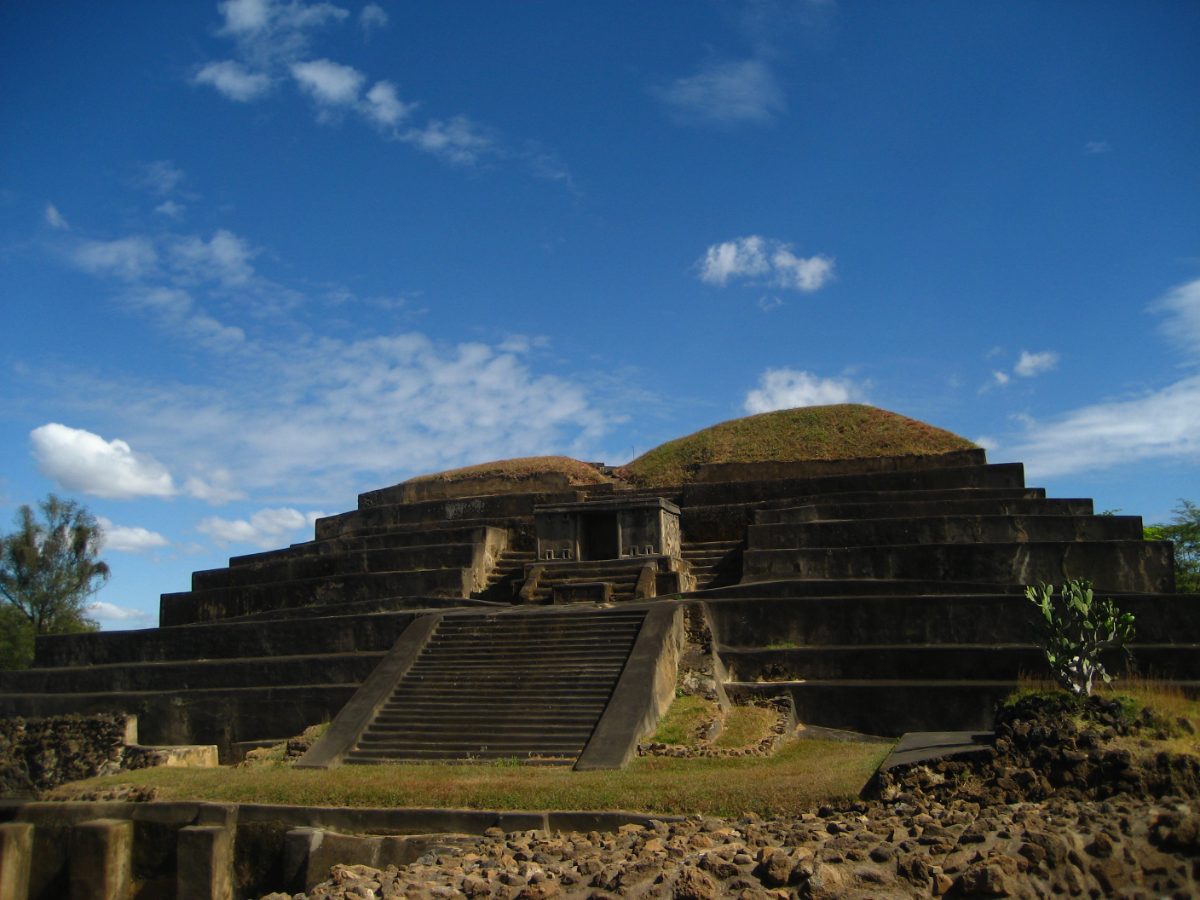
Table of Contents
- Arriving in the Chalchuapa Valley
- A City Rebuilt After Disaster
- The Great Pyramid of Structure B1-1
- A Controversial Restoration
- What Language Was Spoken at Tazumal?
- The Statue of Xipe Totec
- Trade, Obsidian, and Ties to Central Mexico
- Ballcourt and Ritual Life
- Decline and the Pipil Migration
- Excavation and Visiting Tazumal Today
- Nearby Places to Explore
Arriving in the Chalchuapa Valley
Tazumal sits within the modern town of Chalchuapa, part of a larger archaeological zone that also includes the nearby mounds of El Trapiche and Casa Blanca. The valley’s volcanic soil, replenished repeatedly by eruptions from nearby peaks, made it exceptionally fertile ground for agriculture, drawing settled communities here as early as 1200 BCE, among the earliest dates for permanent village life anywhere in El Salvador.
The name Tazumal itself is not Spanish and not Classic Maya either. It comes from Nahuat, the Pipil language spoken by later inhabitants of the region, and is generally translated as something close to ‘the place where the victims were burned,’ a grim but evocative label attached long after the city’s original Maya founders had given way to newer arrivals.
The broader Chalchuapa archaeological zone is unusually dense for a region often overlooked in surveys of Mesoamerican civilization, with El Trapiche’s monumental earthen mounds dating back even earlier than Tazumal’s main constructions, suggesting the valley supported organized, hierarchical communities for well over two thousand years before Spanish contact.
Radiocarbon dates and stratigraphic sequences recovered across the valley show settlement continuity stretching from these earliest Preclassic villages straight through the Classic period city that visitors encounter at Tazumal today, making Chalchuapa one of the longest continuously studied habitation sequences documented anywhere in the Maya cultural sphere’s southeastern periphery.
Chalchuapa’s name, unlike Tazumal’s, has Nahuat roots as well, generally interpreted as referring to abundant water or precious jade, a fitting description for a valley whose fertile volcanic soil and reliable water sources sustained continuous human settlement across multiple distinct cultural periods and language communities over thousands of years.
A City Rebuilt After Disaster
Around 431 CE, the nearby Ilopango volcano produced one of the most powerful eruptions in Central America’s ancient history, burying huge stretches of central and western El Salvador under thick layers of ash and forcing mass abandonment across the region for a generation or more. Tazumal sat close enough to feel the effects directly.
What makes Tazumal notable is that it did not stay abandoned. Excavated construction layers show renewed building activity after the eruption, evidence of a community, whether the original inhabitants returning or newcomers resettling fertile but scarred land, willing to rebuild directly on top of a landscape reshaped by disaster.
Volcanic ash from the Ilopango eruption has been identified in soil layers as far away as Mexico and Colombia, giving archaeologists a precise chronological marker, and the fact that Tazumal shows clear rebuilding directly atop or alongside that ash layer makes it one of the more concrete examples anywhere in the Americas of a Mesoamerican community recovering from a documented natural catastrophe.
Some researchers have proposed that the Ilopango eruption may have triggered wider population movements across the region, potentially even contributing to migrations that reshaped settlement patterns as far away as the Maya lowlands of Guatemala and Belize, though establishing direct causal links across such a wide area remains an active and debated area of research.
Geological surveys of the Ilopango caldera, now a large lake southeast of San Salvador, have helped archaeologists refine the eruption’s date and estimated scale, placing it among the largest volcanic events anywhere on Earth during the first millennium CE, an eruption whose atmospheric effects some researchers have even linked to unusual climate anomalies recorded in written sources from distant Europe and Asia around the same period.
For a time after the eruption, sunlight-blocking ash clouds and stripped soils would have made farming nearly impossible across huge portions of the region, meaning any community choosing to resettle and rebuild at Tazumal had to first solve basic problems of food security before monumental construction could resume, a slower and less dramatic story than sudden collapse but arguably a more impressive testament to resilience.
The Great Pyramid of Structure B1-1
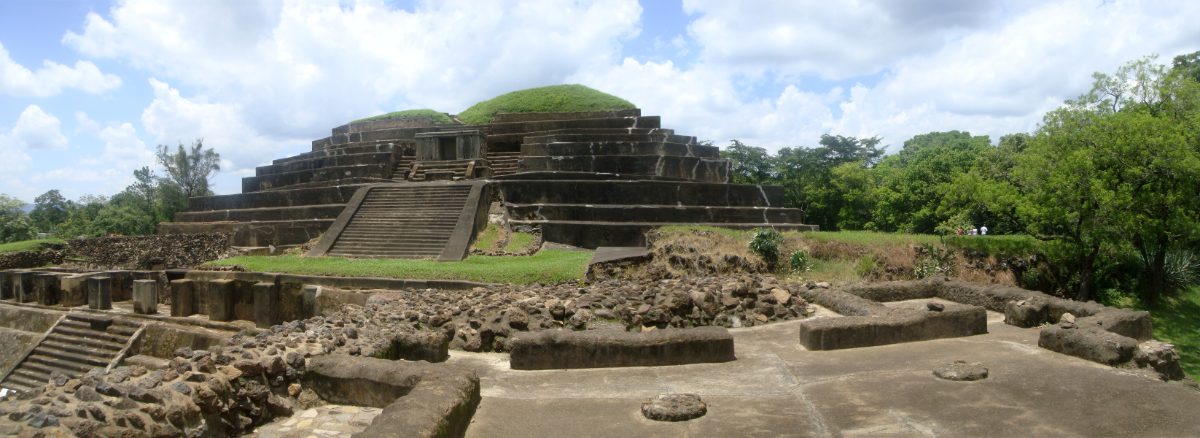
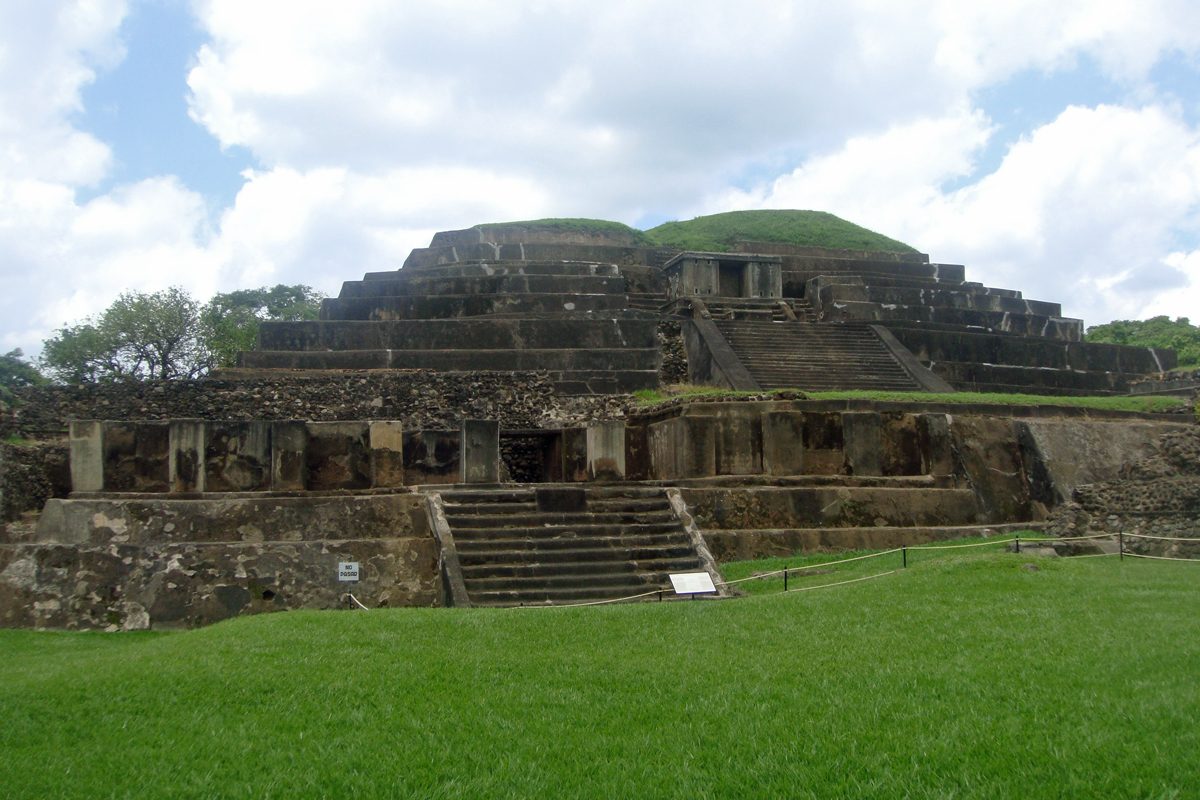
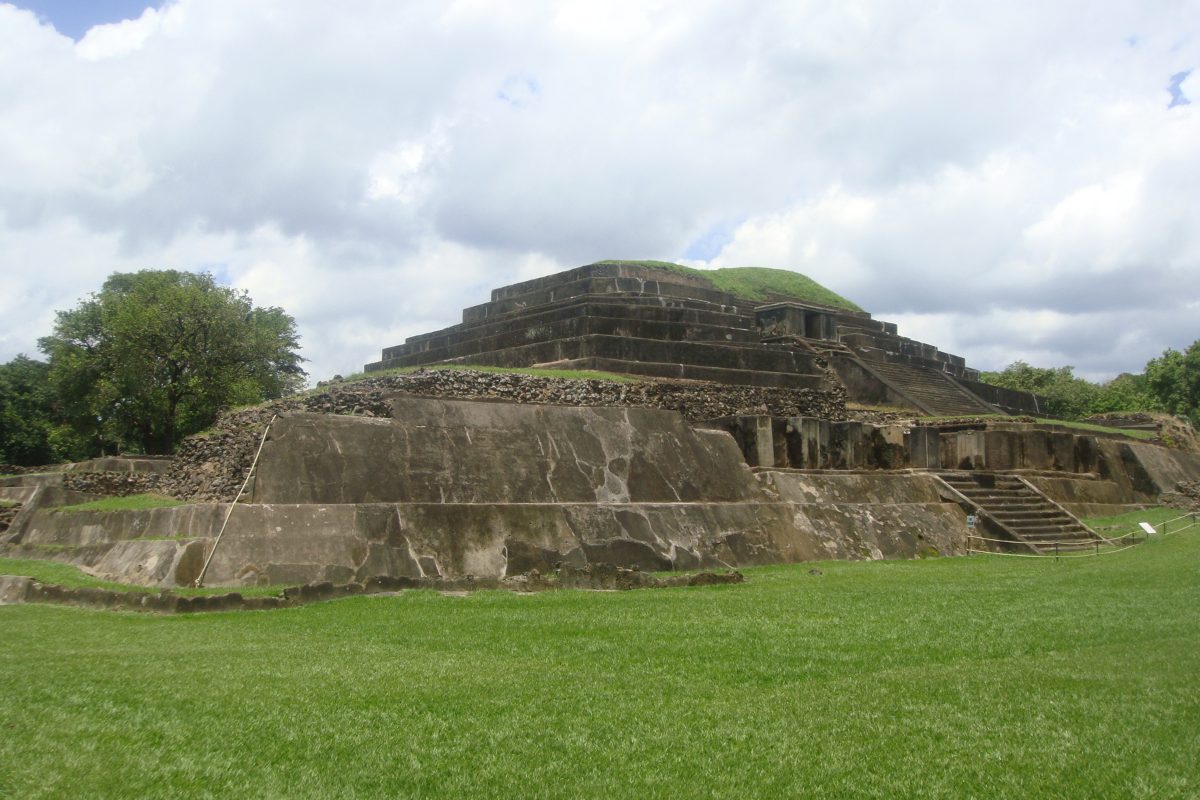
The site’s dominant structure, known to archaeologists as B1-1, rises in stepped tiers reaching roughly 24 meters, making it one of the largest pre-Columbian structures in El Salvador. Multiple construction phases are layered within it, spanning centuries of use and renovation by successive generations of builders.
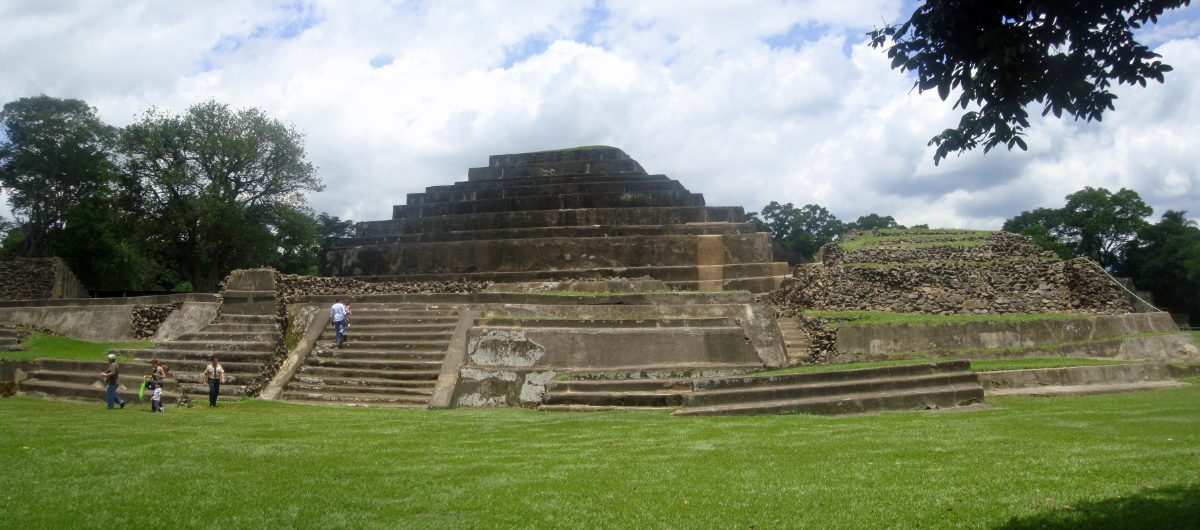
Excavation revealed that different building phases show distinct architectural influences, including talud-tablero style elements associated with Teotihuacan in central Mexico, a construction technique using alternating sloped and vertical panels that appears at Maya sites with strong ties to that distant highland Mexican metropolis.
Later building phases atop B1-1 show a shift away from the earlier Teotihuacan-influenced style toward more locally distinct architectural choices, a pattern some archaeologists interpret as evidence of Tazumal asserting a more independent regional identity once direct ties to the distant Mexican highland power weakened over succeeding centuries.
Comparable talud-tablero architecture appears at sites across Mesoamerica with documented or suspected Teotihuacan contact, including parts of the Maya lowlands, making Tazumal one data point within a much larger pattern of a single central Mexican city’s architectural style spreading across an enormous cultural and geographic distance during the Classic period.
Excavators working within B1-1 identified distinct construction episodes separated by deliberate infilling, a technique in which builders packed rubble and soil into earlier structures before raising new platforms directly on top, gradually increasing the pyramid’s overall height and footprint across successive generations of use.
Artifacts recovered from these successive fill layers, ranging from broken ceramic vessels to obsidian debris, give archaeologists a kind of layered time capsule, allowing them to date each construction phase relative to the others even in the absence of the inscribed monuments that provide more precise chronologies at larger Classic Maya capitals.
A Controversial Restoration
When archaeologist Stanley Boggs led major excavations at Tazumal in the 1940s and 1950s, restoration techniques for Mesoamerican monuments were far less standardized than they are today. Boggs’s team resurfaced much of Structure B1-1 in modern concrete, intended to stabilize and protect the ancient core beneath.
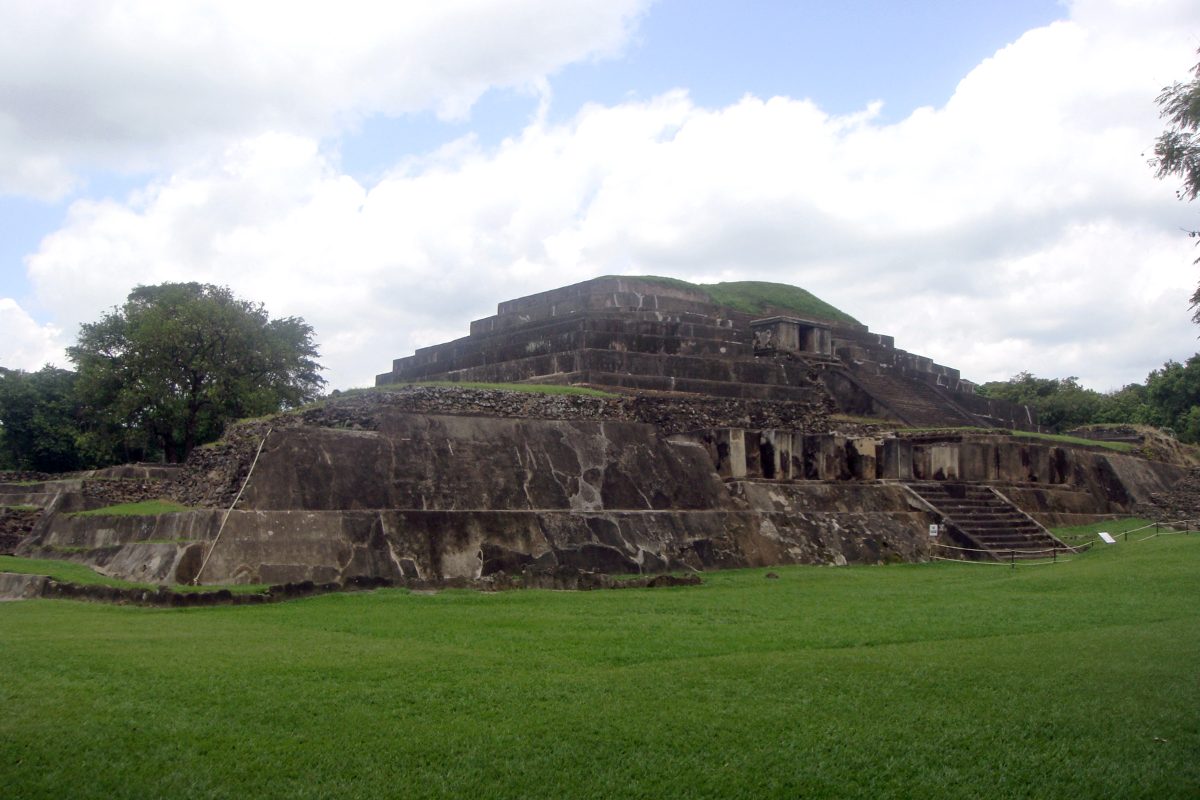
The result is a pyramid that, to modern eyes accustomed to the weathered stone of Tikal or Copan, can look almost artificial, a smooth gray mass rather than a textured ancient ruin. Later generations of archaeologists have criticized the approach for prioritizing structural preservation over authentic appearance, though the concrete has undeniably kept the core from further collapse.
Modern conservation philosophy generally favors minimal intervention and reversible techniques precisely because of cautionary examples like Tazumal, where an earlier generation’s well-intentioned concrete work cannot easily be undone without risking damage to whatever original stone and plaster survives beneath it.
Despite the aesthetic criticism, Boggs’s underlying archaeological documentation, detailed records of stratigraphy, artifact context, and construction sequences, remains foundational to everything scholars now understand about Tazumal, a reminder that a project’s excavation records can retain lasting scientific value even when its physical restoration choices age poorly by later standards.
Visitors comparing photographs from before and after the 1940s restoration can see the transformation clearly, a rubble-strewn mound gradually reshaped into the crisp stepped profile now familiar from postcards and tourism brochures, a visual clarity that has undeniably helped Tazumal become one of El Salvador’s more recognizable archaeological landmarks despite the debate among specialists.
What Language Was Spoken at Tazumal?
During its Classic period height, the population around Tazumal most likely spoke a Maya language related to Poqomam or Ch’orti, part of the same broader Maya linguistic world that extended through Guatemala and Honduras. Hieroglyphic texts are scarce at the site compared to major Classic Maya capitals, so this remains an inference drawn from regional linguistic geography rather than local written evidence.
By the Postclassic period, that picture had changed. Nahuat-speaking Pipil migrants, whose language descended from the same broad family as Nahuatl spoken far to the north in central Mexico, moved into the Chalchuapa area and much of western El Salvador, eventually giving the region, and this very site, the Nahuat name it carries today.
This linguistic layering, Maya giving way gradually to Nahuat rather than being violently displaced overnight, mirrors patterns documented elsewhere in the region during the Postclassic period, when migration and cultural blending, rather than sudden conquest, more often explain how dominant languages shifted across parts of southern Mesoamerica.
Because so few inscribed monuments survive at Tazumal compared to major Classic Maya capitals further north, much of what is inferred about its Preclassic and Classic period language relies on regional comparison with better documented neighboring areas, including sites in the Guatemalan highlands and the Copan Valley, rather than direct textual evidence recovered at Tazumal itself.
The Statue of Xipe Totec
Among Tazumal’s most striking finds is a stone statue depicting Xipe Totec, ‘Our Lord the Flayed One,’ a deity closely associated with central Mexican religious traditions tied to agricultural renewal, springtime, and ritual human sacrifice involving flayed skin worn as a symbolic costume representing new growth emerging from the old.
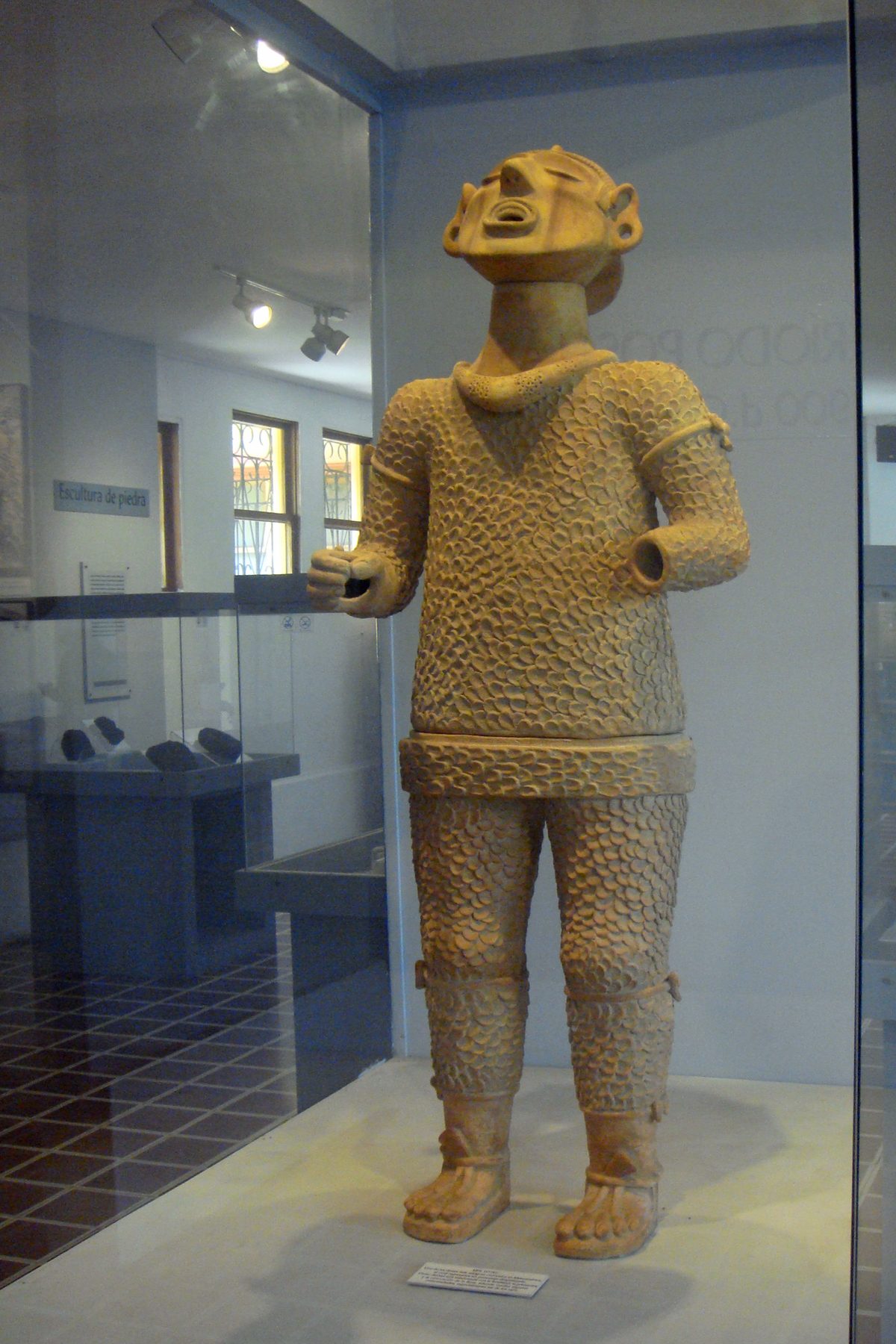
Finding a Xipe Totec statue this far south, well outside the deity’s central Mexican heartland, is strong physical evidence of the cultural exchange, migration, or trade contact linking Tazumal to distant Teotihuacan and later Nahua-speaking cultures, reinforcing the site’s role as a genuine crossroads rather than an isolated regional center.
Xipe Totec worship is closely tied in central Mexican sources to springtime agricultural renewal ceremonies, and its presence at Tazumal has led some scholars to propose that agricultural fertility rites tied to this deity may have been adopted, whether through direct migration or cultural borrowing, into local ritual practice well before large-scale Pipil settlement transformed the valley’s population more broadly.
Flaying imagery associated with Xipe Totec, however unsettling to modern viewers, carried a specific symbolic logic in Mesoamerican religious thought, representing the shedding of an old exterior to reveal new life beneath, a metaphor drawn directly from agricultural cycles of planting, growth, and harvest that would have resonated strongly with any farming community, Maya or Pipil alike.
Art historians studying the Tazumal statue note stylistic similarities to Xipe Totec representations from the Gulf Coast and central Mexican traditions, further supporting the idea of direct contact or migration rather than an isolated local reinvention of similar religious imagery arrived at independently.
Trade, Obsidian, and Ties to Central Mexico
Chalchuapa sits near significant obsidian sources, and Tazumal’s inhabitants both mined and traded this volcanic glass widely, producing blades and tools valued across a trade network stretching well beyond El Salvador’s modern borders. Obsidian sourcing studies have traced material found at distant sites back to workshops in this very valley.
That trade network likely explains much of the outside influence visible in Tazumal’s architecture and artifacts, since long-distance exchange routes carried not just raw materials and finished goods but also religious ideas, artistic styles, and construction techniques between distant Mesoamerican regions.
Chemical sourcing techniques, comparing trace element signatures in obsidian artifacts to known volcanic sources, have allowed archaeologists to trace pieces recovered from sites hundreds of kilometers away directly back to specific quarries near Chalchuapa, offering unusually precise physical proof of the reach of this valley’s ancient trade connections.
Beyond obsidian, the valley’s residents also had access to jade sources and cacao-growing regions further east, positioning Chalchuapa within a dense web of exchange routes that moved both raw materials and finished luxury goods across what modern borders now divide into El Salvador, Guatemala, and Honduras.
Workshops identified near Tazumal show evidence of specialized obsidian blade production on a scale suggesting output well beyond local household needs, supporting the idea that craft specialists here supplied a market extending across a substantial portion of the southeastern Mesoamerican trade sphere.
Ballcourt and Ritual Life
Like most major Mesoamerican centers, Tazumal included a ballcourt used for the ritual ballgame played across the region for centuries, a contest that carried religious and cosmological significance well beyond simple athletic competition. Excavated offerings and burials found near the site’s ceremonial structures point to a religious life blending Maya tradition with the newer influences arriving from the north.
Burial goods recovered near Tazumal’s ceremonial core include both locally produced polychrome ceramics and imported pieces, further evidence that the site’s residents maintained active exchange relationships with distant communities even as local artistic traditions continued to develop along their own distinct lines.
While Tazumal’s ballcourt is smaller than the massive examples found at Chichen Itza or Copan, its presence confirms that the ritual ballgame’s practice extended well into this southeastern corner of Mesoamerica, linking Chalchuapa’s religious life to a broader shared tradition stretching across an enormous swath of the ancient Americas.
Excavated offering caches near the ballcourt included both ceramic vessels and worked stone objects, deposited in patterns that suggest deliberate ritual placement rather than casual discard, consistent with practices documented at ballcourts across the wider Mesoamerican world where the game’s outcome was frequently understood in cosmological rather than purely competitive terms.
Decline and the Pipil Migration
Tazumal’s major monumental construction slowed by the Postclassic period, part of a broader regional pattern affecting many Maya centers, though the Chalchuapa valley itself never emptied out entirely. Instead, the population gradually shifted in character, as Nahuat-speaking Pipil groups migrating from central Mexico settled among, and eventually numerically dominated, the descendants of the valley’s original Maya inhabitants.
This slow demographic and linguistic transition, rather than a single dramatic collapse, is part of what makes Tazumal historically distinct from the abandoned Classic Maya capitals further north and east, since the valley remained continuously inhabited even as the dominant language and some cultural practices shifted over the following centuries.
By the time Spanish colonizers arrived in the sixteenth century, Nahuat had become the dominant language of much of western El Salvador, a linguistic landscape that persisted long enough that Nahuat, locally called Pipil, remained a living spoken language in parts of the country into the twentieth century, even as it became critically endangered in more recent decades.
Efforts to document and revitalize Nahuat in modern El Salvador have gained renewed attention in recent decades, with community language programs drawing a direct, if often overlooked, historical line back to the very migrations that reshaped Tazumal and the wider Chalchuapa valley more than a thousand years ago.
Colonial-era Spanish administrative records referred to the broader region using Nahuat-derived place names almost exclusively by the time of conquest, indirect confirmation of just how thoroughly the linguistic landscape had shifted in the centuries following the initial Pipil migrations into the Chalchuapa valley and neighboring parts of western El Salvador.
This pattern, an underlying Maya foundation gradually overlaid by Nahua-Pipil culture and language, is echoed at several other sites across western El Salvador and parts of neighboring Guatemala, making Tazumal a particularly well-studied example of a broader Postclassic transformation that reshaped ethnic and linguistic identity across a significant stretch of southeastern Mesoamerica.
Excavation and Visiting Tazumal Today
Following Stanley Boggs’s mid-century excavations, Tazumal became one of El Salvador’s most visited archaeological sites, with an on-site museum displaying ceramics, obsidian tools, and other artifacts recovered from the valley’s long occupation, including additional pieces from the neighboring mounds at Casa Blanca and El Trapiche.
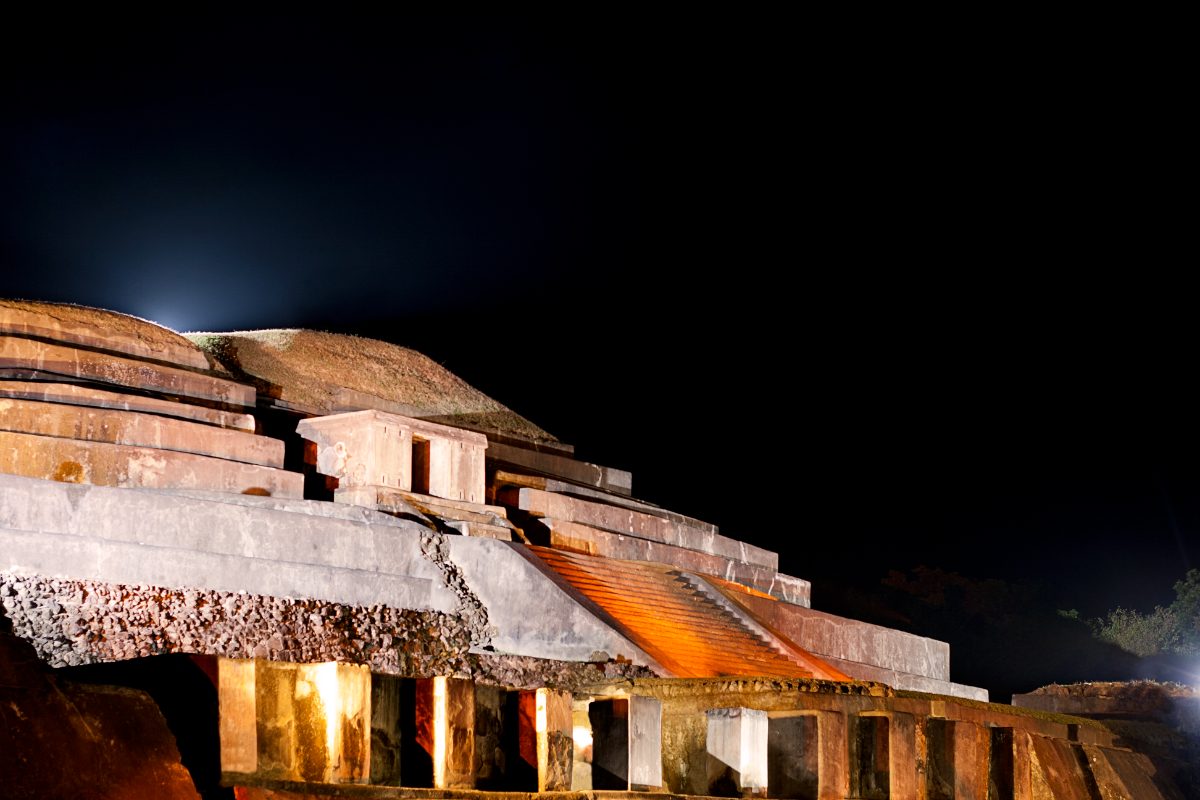
Located within easy reach of Santa Ana, one of El Salvador’s larger cities, Tazumal remains an accessible day trip for visitors interested in a side of Mesoamerican history often overshadowed by the more famous ruins of Guatemala, Honduras, and Mexico further north.
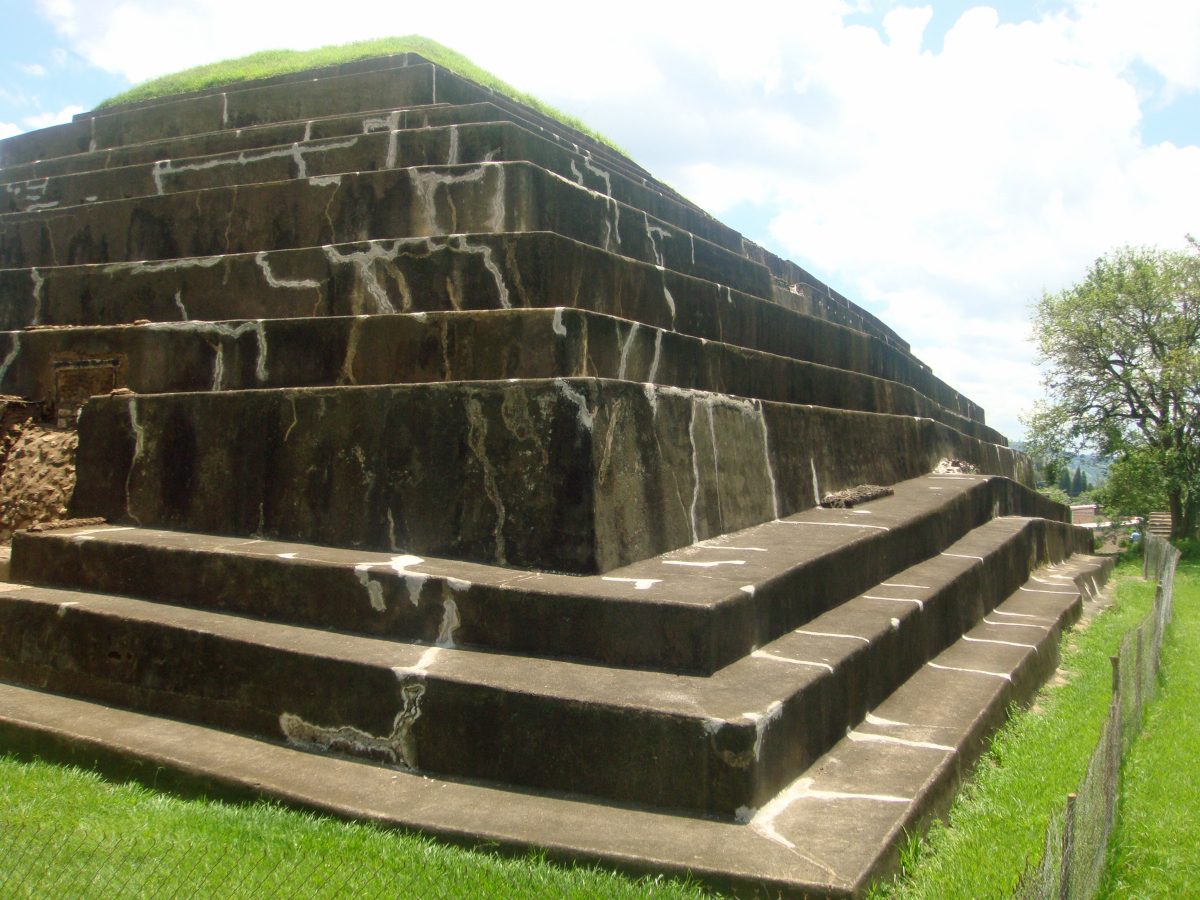
The on-site Museo Tazumal, though modest compared to the national museums of neighboring Guatemala and Mexico, houses a collection that includes some of El Salvador’s most significant archaeological finds, giving visitors direct access to artifacts spanning the full arc of the valley’s occupation rather than requiring a separate trip to the capital.
Ongoing conservation work at the site continues to grapple with the same core tension that shaped Boggs’s original restoration decades ago, balancing the practical need to protect fragile ancient masonry from tropical rainfall and vegetation against a growing preference among archaeologists for restoration methods that preserve, rather than replace, original material wherever possible.
Nearby Places to Explore
Tazumal’s history connects it to other Central American sites covered elsewhere in this series.
- Copan: The Maya City of Kings and Scribes
- Quirigua: The Vassal City That Beheaded Its Overlord’s King
- Joya de Ceren: The Maya Village Buried Alive in Ash
Closing Thoughts
Tazumal’s story does not fit neatly into the narrative of Classic Maya rise and collapse told at sites like Tikal or Copan. It is instead a story of continuity through disaster, cultural blending across a long-distance trade network reaching all the way to Teotihuacan, and a gradual linguistic transformation as Nahua-speaking migrants reshaped the valley’s identity over centuries.
That concrete-clad pyramid, however debated among archaeologists, still stands today as a physical record of every phase of that history, from its Preclassic Maya foundations through its Postclassic Pipil chapter to its twentieth-century rediscovery and restoration.
You May Like
Mafra, the Palace a King Built From a Vow