High in the northwest of the Indian subcontinent, cradled among the towering ranges of the western Himalayas, lies a valley so beautiful that emperors compared it to paradise on earth. This is the Vale of Kashmir, and its people, the Kashmiris, have lived for millennia in one of the loveliest and most contested landscapes in the world. Around them rise snow-capped peaks; below stretch lakes dotted with houseboats and floating gardens, orchards heavy with apple and cherry, fields of rice, and meadows of wildflowers. Yet this earthly paradise has also been, for decades, one of the most militarised and sorrowful places on the planet, its name known around the world less for its beauty than for the long and bitter conflict fought over it.
The Kashmiris number perhaps seven or eight million in the valley itself, with many more scattered across the wider region and in a diaspora reaching to every continent. They are a people of refined culture and ancient learning, heirs to a Sanskrit and Persian intellectual tradition, masters of exquisite crafts, and bearers of a distinctive blend of Hindu, Buddhist, and Islamic heritage that produced one of South Asia’s most syncretic spiritual cultures. To tell their story honestly is to hold two truths at once: the splendour of their land and civilisation, and the deep and unresolved tragedy of their recent history. This is an account of who the Kashmiris are, where their language comes from, and how a people came to live in a paradise that became a prison.
In This Article
- The valley and the mountains that made it
- A language apart and where it comes from
- The land of sages, from Sanskrit learning to Buddhist councils
- The coming of Islam and the spirit of Kashmiriyat
- Centuries of foreign rulers
- 1947 and the wound that would not heal
- The years of fire
- A changed status
- The most exquisite crafts in India
- The feast of thirty-six dishes
- Life on the water
- A paradise still waiting

The valley and the mountains that made it
Geography is destiny in Kashmir more than almost anywhere else. The heart of the Kashmiri homeland is the Vale of Kashmir, a broad, fertile oval of lowland lying at around sixteen hundred metres above sea level, ringed completely by mountains: the Pir Panjal range to the southwest and the great Himalayas to the northeast. The Jhelum river winds through the valley, feeding the famous lakes of Dal and Wular and the wetlands that have shaped Kashmiri life for centuries. Sheltered by its mountain walls, the valley enjoys a temperate climate utterly unlike the heat of the Indian plains, with cold, snowy winters and mild, blossoming springs, the seasons that gave Kashmir its orchards, its saffron, and its reputation as a place of unearthly beauty.
That same ring of mountains, which long protected Kashmir and gave it a self-contained world of its own, also made it a coveted prize, a cool refuge that rulers of the hot plains longed to possess. The wider region known today as Kashmir extends far beyond the valley to include the high desert of Ladakh with its Tibetan Buddhist culture, the Hindu-majority lowlands of Jammu, and, across the heavily guarded ceasefire line, the territories administered by Pakistan. But the Kashmiris proper, the speakers of the Kashmiri language and bearers of its distinctive culture, are above all the people of the valley, and it is their story that lies at the centre of the Kashmir question.

A language apart and where it comes from
The Kashmiri language, which its speakers call Koshur, is one of the most distinctive tongues of the subcontinent. It belongs to the Indo-Aryan branch of the great Indo-European family, but within it Kashmiri is usually classed in the Dardic group, a cluster of languages spoken in the mountainous regions of the far north that are among the most archaic and unusual of the Indo-Aryan tongues. The Dardic languages preserve features lost elsewhere and have developed in long isolation in their high valleys, and Kashmiri is by far the largest and most important of them. This places Kashmiri ultimately in the same broad family as Hindi, Punjabi, and the other languages of the plains, all descended from ancient forms of Sanskrit and Prakrit like those of the northern plains, yet on a branch all its own.
What makes Kashmiri especially remarkable is its grammar, which has a word-order feature unusual in the region, and the deep layers of vocabulary it has absorbed over the centuries, first a profound Sanskrit inheritance from its Hindu and Buddhist past, then a heavy overlay of Persian and Arabic words that arrived with Islam and the long centuries of Persianate court culture. Kashmiri has been written in several scripts over its history, and today it is most commonly written in a modified Perso-Arabic script, with the Sharada script of its Hindu past now largely confined to ritual and scholarship. The language carries a magnificent literary tradition, above all in poetry, from the medieval mystic verses of the woman saint Lal Ded, whose sayings are treasured by Kashmiris of every faith, to a rich tradition of Sufi and romantic poetry.
The land of sages, from Sanskrit learning to Buddhist councils
Long before it became a symbol of conflict, Kashmir was one of the great centres of learning in the ancient world. For many centuries it was a renowned seat of Sanskrit scholarship, a place where philosophy, poetry, grammar, and the sciences flourished under a series of Hindu dynasties. Kashmiri scholars produced foundational works in aesthetics and literary theory, and the valley gave birth to a profound school of philosophy known as Kashmir Shaivism, a sophisticated mystical and metaphysical tradition centred on the worship of Shiva that remains influential in Indian thought to this day.
Kashmir was also a crucial cradle of Buddhism. Tradition holds that one of the great Buddhist councils was convened in Kashmir under the emperor Kanishka, and from the valley Buddhist monks and missionaries carried their teachings north across the mountains into Central Asia and on toward China and Tibet, making Kashmir a vital relay station on the spread of the faith across Asia. The valley also produced one of the masterpieces of world historical writing, the Rajatarangini, a twelfth-century chronicle of the kings of Kashmir composed in Sanskrit verse, often regarded as one of the earliest genuine works of history written in India. This deep heritage of Hindu and Buddhist learning is the foundation on which all later Kashmiri culture was built.

The coming of Islam and the spirit of Kashmiriyat
From around the fourteenth century, Islam spread through the valley, brought largely by Sufi mystics and wandering preachers rather than by conquering armies, and over time the great majority of Kashmiris embraced the new faith. What emerged, however, was something distinctive: a Kashmiri Islam deeply colored by the valley’s older mystical traditions, expressed above all in the Rishi movement founded by the revered saint Nund Rishi, also known as Sheikh Noor-ud-din. The Kashmiri Rishis blended Sufi devotion with the ascetic and vegetarian ideals of the valley’s Hindu and Buddhist past, venerating saints honored by Muslims and Hindus alike.
This produced the famous ideal of Kashmiriyat, a shared Kashmiri identity and a tradition of religious tolerance and coexistence between the Muslim majority and the Hindu minority, the Kashmiri Pandits, who were the valley’s ancient Brahmin community and the keepers of its Sanskrit learning. For centuries Kashmiri Muslims and Pandits lived intertwined lives, sharing shrines, festivals, language, and culture. Kashmiriyat became a cherished idea of what made Kashmir special, a syncretic, gentle, learned culture distinct from the harder religious identities of the plains. The tragedy of modern Kashmir is in large part the story of how that shared world was torn apart.

Centuries of foreign rulers
For much of the past five hundred years, the Kashmiris were ruled by outsiders, a long experience of subjection that shaped their sense of themselves. In the sixteenth century the Mughal emperor Akbar annexed the valley, and the Mughals fell in love with it, building the famous terraced pleasure gardens beside the lakes, with their fountains and chinar trees, and treating Kashmir as their summer paradise. It was a Mughal emperor who is said to have applied to the valley the famous Persian verse declaring that if there is a paradise on earth, it is here. After the Mughals came the harsh rule of Afghan governors, remembered as a period of cruelty and oppression, and then, in the early nineteenth century, conquest by the Sikh empire of the Punjab.
The decisive turn came in 1846, when, after defeating the Sikhs, the British sold the valley and its people, through the notorious Treaty of Amritsar, to a Dogra ruler from Jammu in exchange for a sum of money. Thus the Kashmiris, an overwhelmingly Muslim population, came under the rule of a Hindu Dogra dynasty that governed the princely state of Jammu and Kashmir under overall British paramountcy. Dogra rule was widely experienced by the Muslim majority as exploitative and discriminatory, marked by heavy taxation, forced labour, and exclusion from power, and it bred deep resentment that erupted into political agitation in the twentieth century. This long history of being ruled and even sold by others is essential to understanding the Kashmiri demand to determine their own fate.
1947 and the wound that would not heal
When British India was partitioned in 1947 into India and Pakistan, the princely states had to choose which country to join. Jammu and Kashmir, with its Muslim majority but its Hindu ruler, faced an agonising choice, and the maharaja hesitated. The crisis broke when armed tribesmen from Pakistan invaded the state; the maharaja, seeking military help, signed an instrument of accession to India, and Indian troops were flown in. The result was the first war between India and Pakistan, which ended in 1948 with the territory divided along a ceasefire line, later called the Line of Control, that still splits the region today, with India administering the valley, Jammu, and Ladakh, and Pakistan holding the territories to the west and north.
The dispute has never been resolved. India regards the accession as legal and final and considers the whole region an integral part of the country; Pakistan disputes this and claims the Muslim-majority territory; and many Kashmiris themselves have long demanded the right, once promised in United Nations resolutions, to a plebiscite to decide their own future, an aspiration that has never been fulfilled. The two countries have fought further wars over Kashmir and have come repeatedly to the brink, and the valley sits at the heart of one of the most dangerous unresolved conflicts in the world, made graver still because both nations now possess nuclear weapons. Behind the geopolitics, it is the ordinary Kashmiris who have paid the price.

The years of fire
From the late 1980s the long simmering grievances of the valley exploded into a full insurgency. Anger over rigged elections, the denial of self-determination, and decades of frustrated political aspiration boiled over, and an armed uprising against Indian rule began, supported across the border. What followed were the darkest decades in modern Kashmiri history. The valley was flooded with troops, becoming one of the most heavily militarised regions on earth, and tens of thousands of people, by most estimates, were killed over the years of conflict. Both the militants and the security forces stand accused of grave abuses, and ordinary Kashmiris were caught between them, enduring crackdowns, curfews, disappearances, and a pervasive atmosphere of fear and grief that shaped an entire generation.
One of the deepest tragedies of this period was the shattering of the old ideal of Kashmiriyat. In the early 1990s, amid threats and targeted killings, the great majority of the Kashmiri Pandits, the valley’s ancient Hindu community, fled their homeland in fear, becoming refugees in their own country and ending centuries of shared life with their Muslim neighbours. Their exodus is a profound wound, mourned by Pandits as an uprooting from an ancestral home and lamented by many Kashmiri Muslims as the loss of a part of themselves. The breaking apart of the valley’s intertwined communities is among the saddest chapters in the whole story, and the question of the Pandits’ return remains painful and unresolved.
A changed status
For decades, the state of Jammu and Kashmir held a special constitutional status within India, guaranteed under what was known as Article 370, which granted it a degree of autonomy and its own constitution, along with provisions reserving land and certain rights to its permanent residents. This special status was, for many Kashmiris, a symbol of the unique terms on which their territory had joined India. In 2019 the Indian government abruptly revoked this special status, downgraded the state into directly governed union territories, and imposed an extended security clampdown and communications blackout across the valley.
The move was celebrated by its supporters as the full integration of Kashmir into India and a path to development and an end to separatism, and condemned by its critics, including most Kashmiris and international human rights observers, as a unilateral imposition that stripped the people of their voice and deepened their alienation. Whatever one’s view, the change marked a new and uncertain chapter for the Kashmiris, and the underlying questions of their political future, their rights, and their long desire to be heard remain as open and as fraught as ever. An honest account cannot pretend these wounds are healed; they are not.

The most exquisite crafts in India
For all the sorrow of its recent history, Kashmir remains a place of astonishing creativity, and the Kashmiris are among the finest craftsmen in the world. The valley is most famous for its woollen shawls, above all the legendary pashmina, woven from the fine underfleece of high-altitude goats, and the almost mythically delicate shahtoosh, so fine a shawl can be drawn through a ring. Kashmiri embroidery, the intricate sozni needlework and the bold kani weaving, transforms these shawls into objects coveted for centuries by emperors and aristocrats from Delhi to Paris, where the very word cashmere entered the language as a byword for luxury.
Kashmir is equally renowned for its hand-knotted silk and wool carpets, their patterns descended from Persian designs brought by the Sufi masters, as well as for delicate papier-mache painted in floral motifs, intricately carved walnut wood, and crewel embroidery. The valley’s agriculture is famous too: its orchards supply much of India’s apples, cherries, and walnuts, and the fields around Pampore produce Kashmiri saffron, among the most prized in the world, the crimson threads painstakingly plucked from purple crocus flowers each autumn. These crafts and crops are not only the economic backbone of the valley but the living expression of a refined aesthetic culture thousands of years in the making.
The feast of thirty-six dishes
Kashmiri cuisine reflects the valley’s history as a meeting point of Central Asian, Persian, and Indian influences, and it is unlike any other regional cooking in India. Its crowning glory is the wazwan, a magnificent multi-course banquet of mostly meat dishes, traditionally numbering many courses and prepared by master chefs called wazas, served at weddings and great occasions and eaten communally from a shared platter. Signature dishes include the pounded meatballs called gushtaba, the slow-cooked rogan josh stained red with Kashmiri chilli, and tabak maaz, and the whole feast is a ceremony of hospitality and honour as much as a meal.
Everyday Kashmiri food revolves around rice, the staple of the valley, accompanied by mutton, lake fish, and the local greens, and flavoured with the dried and powdered spices and the fennel and ginger that mark the cuisine. Tea is central to social life, especially the salty pink noon chai and the fragrant saffron-and-almond kahwa served to guests. To share a Kashmiri meal is to be welcomed into one of the warmest hospitality traditions in South Asia, a generosity that has survived even the hardest of times.
Life on the water
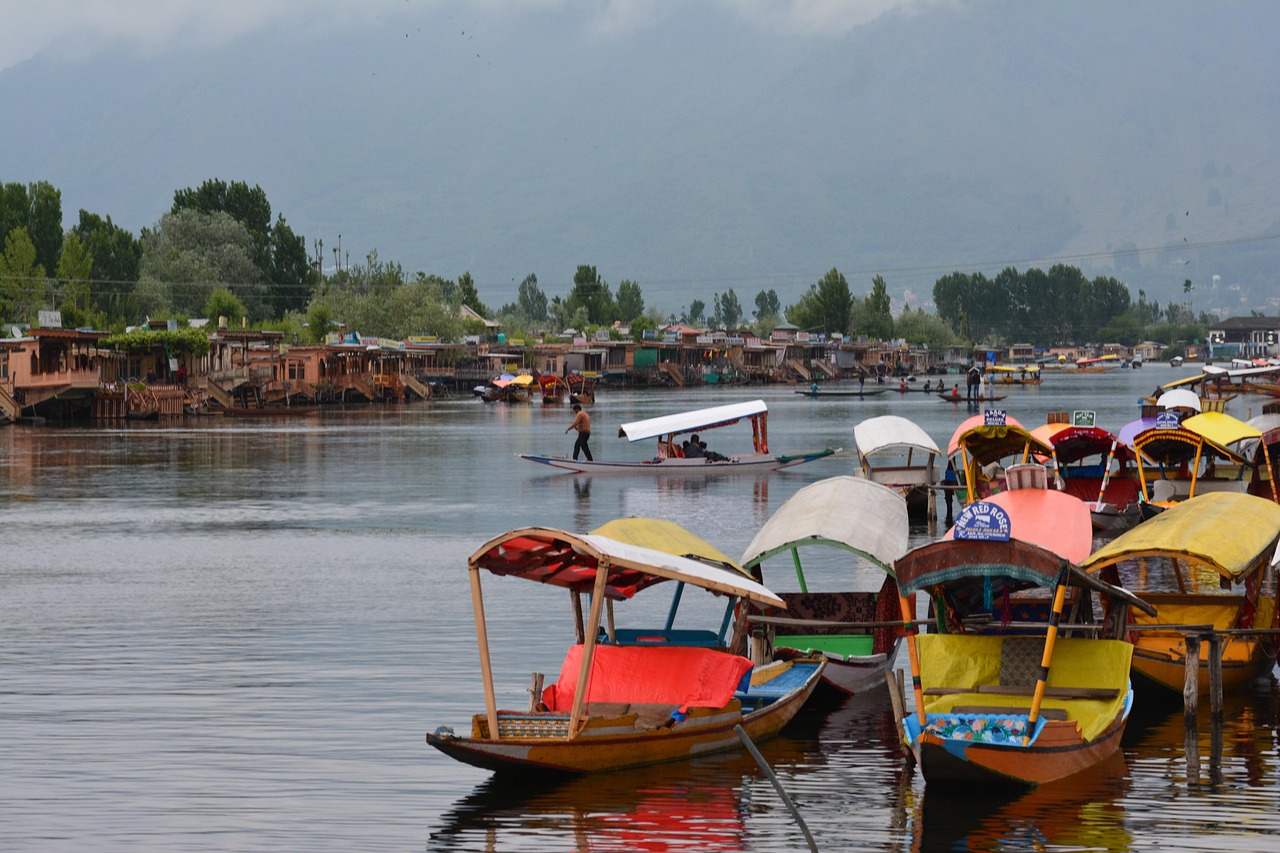
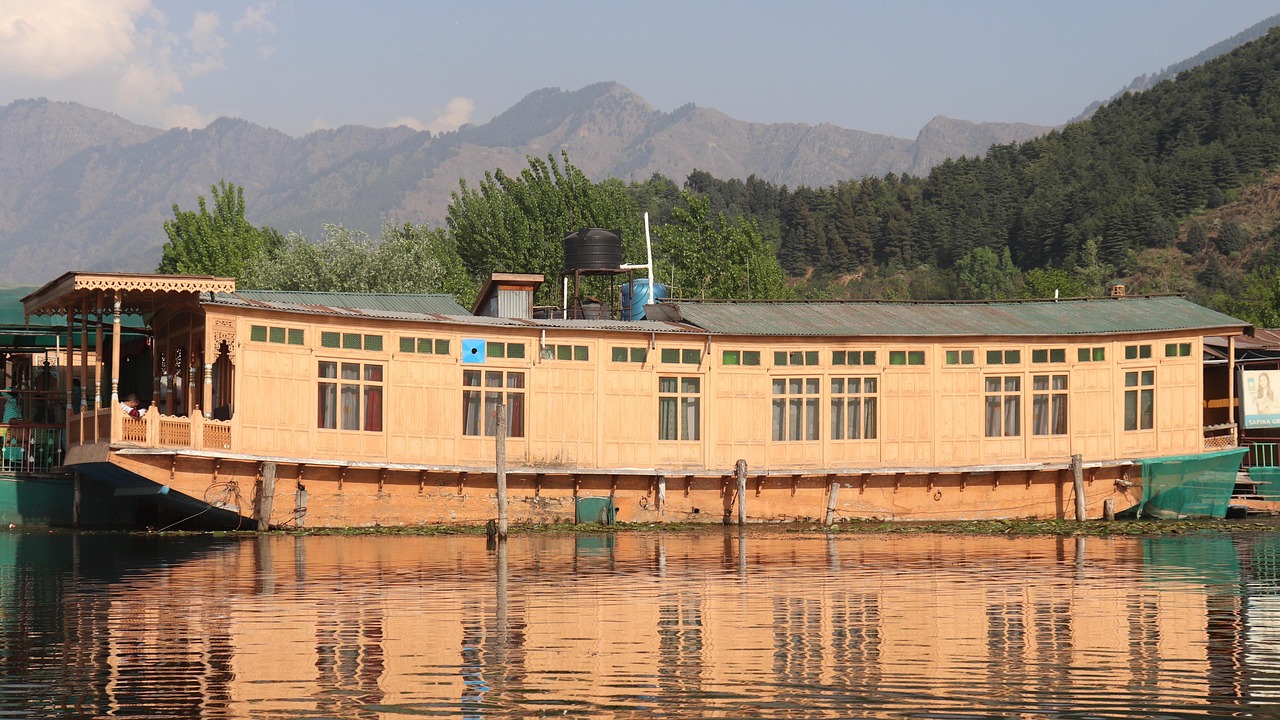
No image is more closely tied to Kashmir than its lakes, and the unique way of life that grew up upon them. On Dal Lake and its neighbours, generations of Kashmiris have lived quite literally on the water, in carved wooden houseboats that originated in the colonial era when the Dogra rulers forbade outsiders from owning land, prompting visiting British and others to build floating homes instead. Today these elaborately panelled houseboats, with their cedar interiors and verandas opening onto the water, are an emblem of the valley. Around them glide the slender shikara boats, paddled gondolas that serve as taxis, floating shops, and flower stalls, carrying everything from vegetables to brides across the still water.
Most remarkable of all are the floating gardens, beds of matted weeds and soil anchored on the lake on which Kashmiri farmers grow vegetables, tending them from boats, a form of agriculture practised here for centuries. Each spring the great Mughal gardens and the famous tulip garden on the slopes above the lake burst into colour, drawing the crowds back to a valley that, whenever peace allows, reclaims its ancient role as a place of beauty and retreat. This intimate, water-borne way of life, balanced between the lake and the mountains, is one of the things that makes Kashmiri culture utterly distinctive among the peoples of India.
A paradise still waiting
The Kashmiris carry one of the richest and most refined cultural inheritances in the subcontinent, a Dardic language with a deep literary soul, a heritage of Sanskrit philosophy and Buddhist learning, a syncretic spiritual tradition that once made their valley a model of coexistence, and crafts of unmatched beauty. They also carry one of its heaviest burdens, a homeland fought over by others for centuries, divided by a line drawn through their land, and scarred by decades of violence, loss, and the breaking apart of communities that had lived together for a thousand years.
To understand the Kashmiris is to refuse the easy temptation to see their valley only as a postcard or only as a battlefield. It is both, and it is more: the home of a living people with their own language, faith, memory, and longing, a people who have endured being ruled, sold, fought over, and silenced, and who still hold to the dream of being heard. The beauty of Kashmir is real, and so is its grief. The deepest hope for this paradise on earth is that its people might one day live in it not as subjects of a quarrel between others, but in the dignity and peace that their long and luminous civilisation has always deserved.
You May Like
The Damara, an Ancient People of Namibia


One thought on “A Paradise on Earth and a Wound That Will Not Heal, the Story of the Kashmiri People”