High in the central Caucasus, where snow-capped peaks tower over deep green valleys and swift rivers cut through the rock, lives a people whose roots run back to the ancient horsemen of the steppe. Among stone towers and old villages, in a land divided by the great mountain wall between Europe and Asia, the Ossetians have kept alive a language and a heritage that make them unique in the whole Caucasus.
The Ossetians are an Iranian-speaking people, the last living heirs of the Scythians, Sarmatians, and Alans, the mounted nomads who once ruled the steppes north of the Black and Caspian Seas. While their ancient kinsmen vanished into history or were absorbed by other peoples, the Ossetians, sheltered in their mountain valleys, preserved a tongue and a memory descended directly from that vanished world of the steppe.
This article is part of our Folks series, in which we travel from people to people across the vast spaces of Russia and its neighbours. Here we follow the Ossetians through the whole arc of their story, and to keep the path clear we will move through these stages in turn:
- Origins and the world of the Alans
- The name they carry and what it means
- Their language, the last of the steppe Iranians
- The homeland in the central Caucasus
- The old way of life in the mountains
- Society, clan, and the old order
- Religion, between the cross and the old gods
- The Nart sagas and the world of story
- Crafts and the work of skilled hands
- Food and the table of the mountains
- Festivals and the turning of the year
- History under the Russian state
- The Ossetians today
Origins and the World of the Alans
The story of the Ossetians begins not in the mountains but on the open steppe, among the great Iranian-speaking nomads of antiquity. Their ancestors were the Scythians and Sarmatians, and above all the Alans, mounted warriors and herders who ranged across the vast grasslands north of the Caucasus and the Black Sea in the age of Rome. Fierce cavalry and famed horsemen, the Alans were known and feared far across the ancient world.
For centuries the Alans dominated the northern Caucasus steppe, building a powerful realm and trading and fighting with the great empires around them. They even played a part in the migrations that reshaped Europe, with bands of Alans travelling as far west as Gaul and Spain in the turmoil that followed the fall of Rome. In their homeland they built a medieval Christian kingdom of Alania that flourished for generations.
This world was shattered by the Mongol invasions of the thirteenth century and the campaigns that followed. The Alan realm on the steppe was destroyed, its cities ruined, and its people scattered or slaughtered. The survivors fled south into the high valleys of the central Caucasus, where the mountains offered shelter from the horsemen of the plains and a refuge in which a remnant of the Alan people could endure.
It was in these mountain valleys that the Ossetians took shape as we know them, the descendants of those Alan refugees, keeping alive the Iranian language and much of the culture of their steppe ancestors even as they adapted to a new life among the peaks. They are, in a real sense, the last of the Alans, a living link to the vanished world of the steppe Iranians.
That such a people should survive at all is one of the quiet marvels of history. Empires that seemed far mightier than the Alans have left no living speakers, yet in these narrow valleys a fragment of the ancient steppe world still breathes, farming, feasting, and telling its old stories.
The Name They Carry and What It Means
The people call themselves by names rooted in their own language, and their land they know by their own word for it. The name by which the wider world knows them, Ossetian, comes by a longer road: it derives, through Georgian and Russian, from an older name for the Alans, so that the modern label still carries an echo of that ancient steppe people from whom they descend.
Their homeland is divided into two parts, North Ossetia and South Ossetia, split by the crest of the Caucasus range. North Ossetia lies within the Russian Federation, while South Ossetia lies on the southern slopes, in a region long tied to Georgia and the subject of bitter modern dispute. The single people thus straddles the great mountain divide, one nation across two sides of the range.
Within their own tongue the Ossetians distinguish the main branches of their people, above all the two great dialect groups whose names reflect old divisions of territory and speech. These divisions, like the clans and valleys of the mountains, gave the people their internal variety, even as they shared a single language and a common descent from the Alans.
So the name Ossetian, like so many names, is a label given from outside, carrying within it the memory of the Alans. Behind it stands a people who know themselves by their own words, rooted in their mountains and their language, and conscious of their descent from the great Iranian nomads of the ancient steppe.
Their Language, the Last of the Steppe Iranians
The Ossetian language is the great treasure of the people, for it is the last living descendant of the speech of the Scythians, Sarmatians, and Alans. It belongs to the Iranian branch of the great Indo-European family, making the Ossetians distant linguistic cousins of the Persians, Kurds, and Pashtuns, and the only people in the Caucasus who speak an Iranian tongue as their own.
Isolated in their mountains and surrounded by peoples speaking utterly different languages, the Ossetians preserved their Iranian speech for many centuries, though it absorbed influences from its Caucasian neighbours along the way. The language has two main dialects, and its survival is a remarkable case of an ancient tongue enduring in a mountain refuge long after its steppe relatives had disappeared.
Scholars have found in Ossetian a precious window onto the vanished languages of the ancient steppe, for it carries words and forms descended directly from the speech of the Scythians and Alans. Through it, something of the world of the ancient steppe nomads still lives on the tongues of a mountain people in the Caucasus, a living monument to a lost age.
For this reason Ossetian has drawn the attention of scholars from far beyond the Caucasus, who study it to reconstruct the lost languages of antiquity. What is for the linguist a scientific treasure is, for the Ossetians themselves, simply the everyday speech of home, handed down without a break across the centuries.
In the modern era Ossetian came to be written, chiefly in the Cyrillic alphabet, and it developed a literature of its own, with poets and writers who raised the mountain speech into a literary language. Like many smaller tongues it faces pressure from Russian today, and its preservation, as the last of the steppe Iranian languages, is a matter of pride and concern for the whole people.
The Homeland in the Central Caucasus
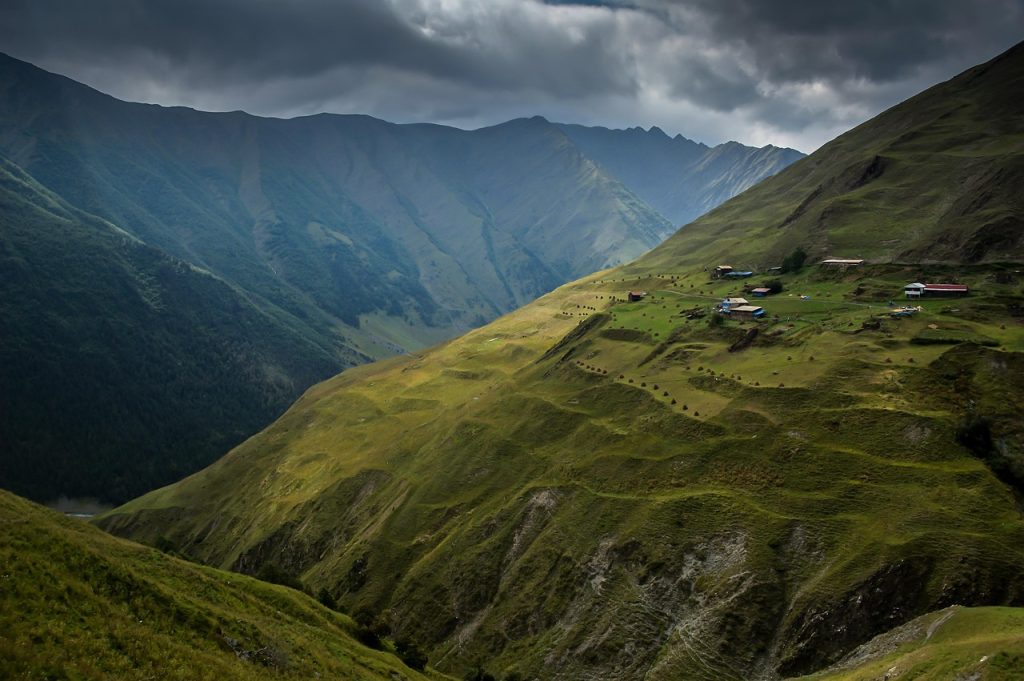
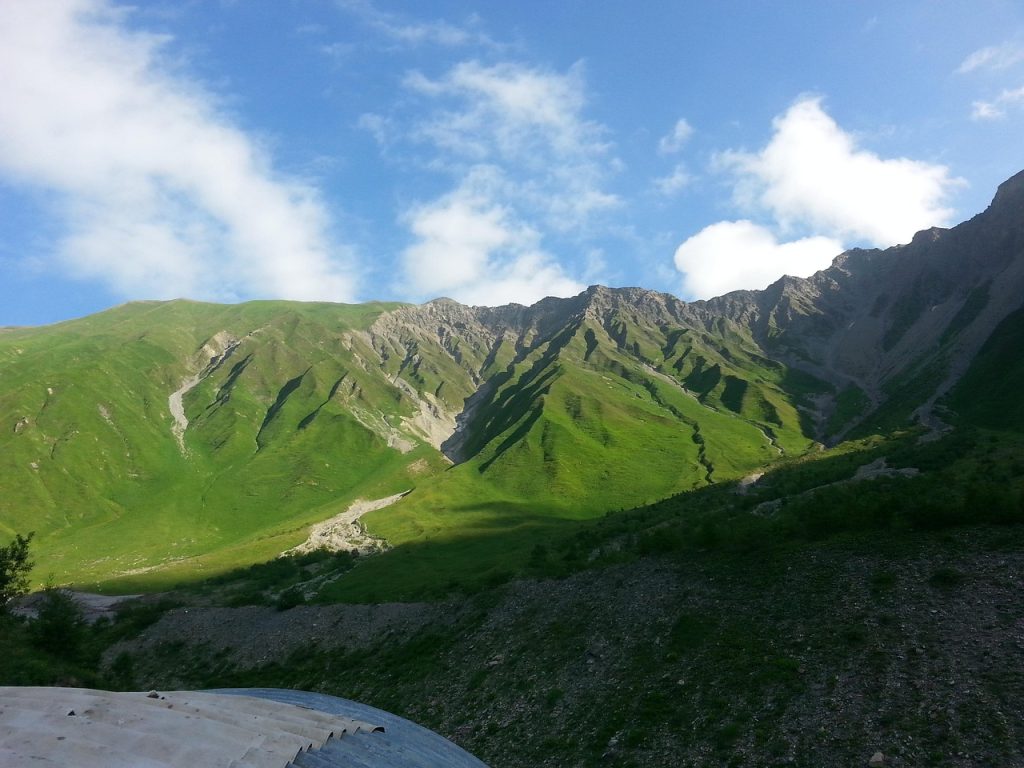
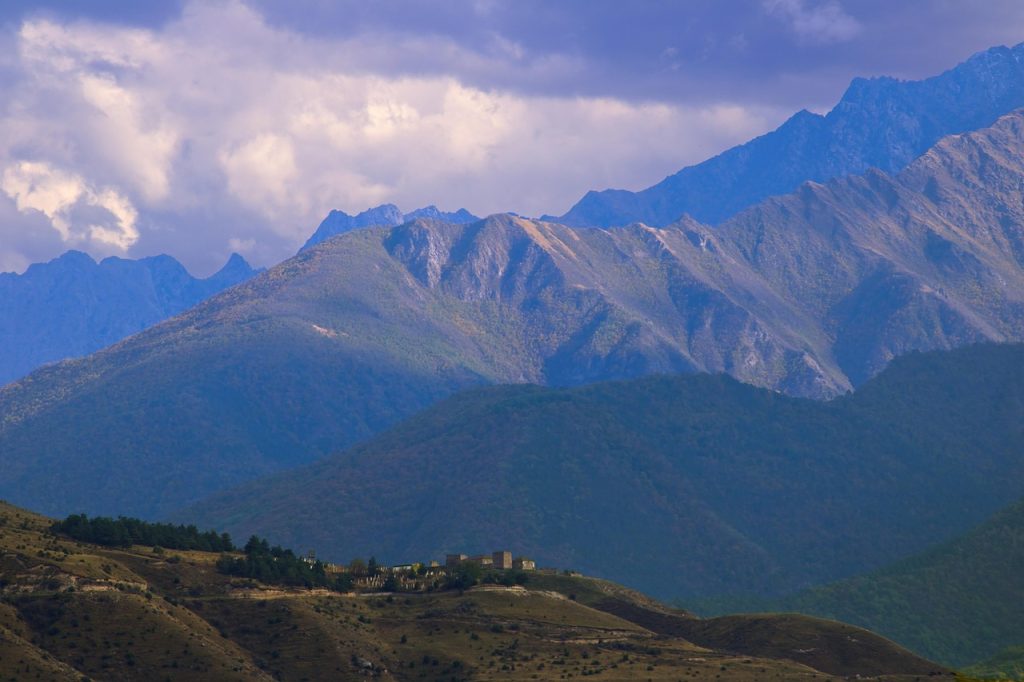
The homeland of the Ossetians lies in the central Caucasus, astride the great range that divides the northern plains from the lands to the south. It is a country of towering peaks, some among the highest in Europe, of deep gorges, swift rivers, and high green pastures, a dramatic landscape of rock and snow and grass where the people built their villages in the sheltered valleys.
North Ossetia occupies the northern slopes and the foothills where they meet the plain, a land of mountain valleys opening onto flatter, more fertile country to the north. South Ossetia lies on the southern side of the range, a region of high valleys and mountains descending toward the lands of Georgia. Between them rise the passes and peaks of the main Caucasus chain, crossed by ancient roads.
These passes have always given the Ossetian land an importance out of proportion to its size, for whoever held them controlled one of the few ways through the great wall of the Caucasus. Much of the people’s history has been shaped by this role as guardians of the mountain gates.
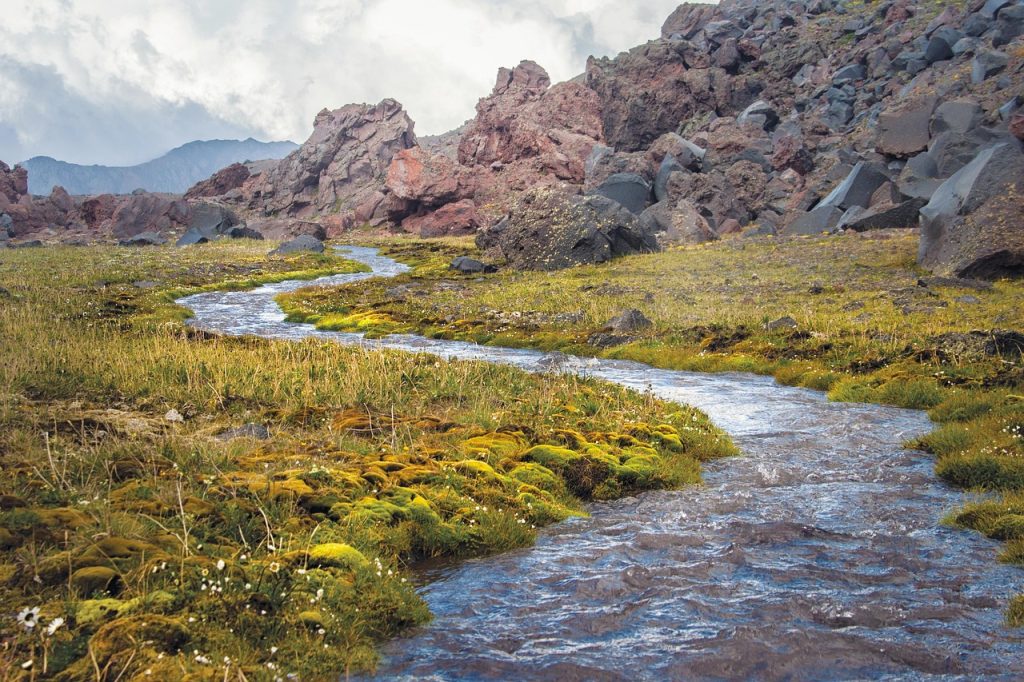
This is a land of great beauty and great harshness. The high valleys are green and rich in summer, filled with wildflowers and grazing herds, but winter brings deep snow, avalanche, and isolation, cutting off villages for months at a time. The rivers, fed by glaciers and snowmelt, rush down through gorges that the people spanned with bridges and guarded with towers.
The capital of North Ossetia is Vladikavkaz, a city at the foot of the mountains whose very name speaks of the meeting of Russia and the Caucasus. From here the Ossetian land climbs into the high valleys where the old villages, the stone towers, and the ancient shrines still stand, a homeland shaped by the mountains that both sheltered and confined the people through the centuries.
The Old Way of Life in the Mountains
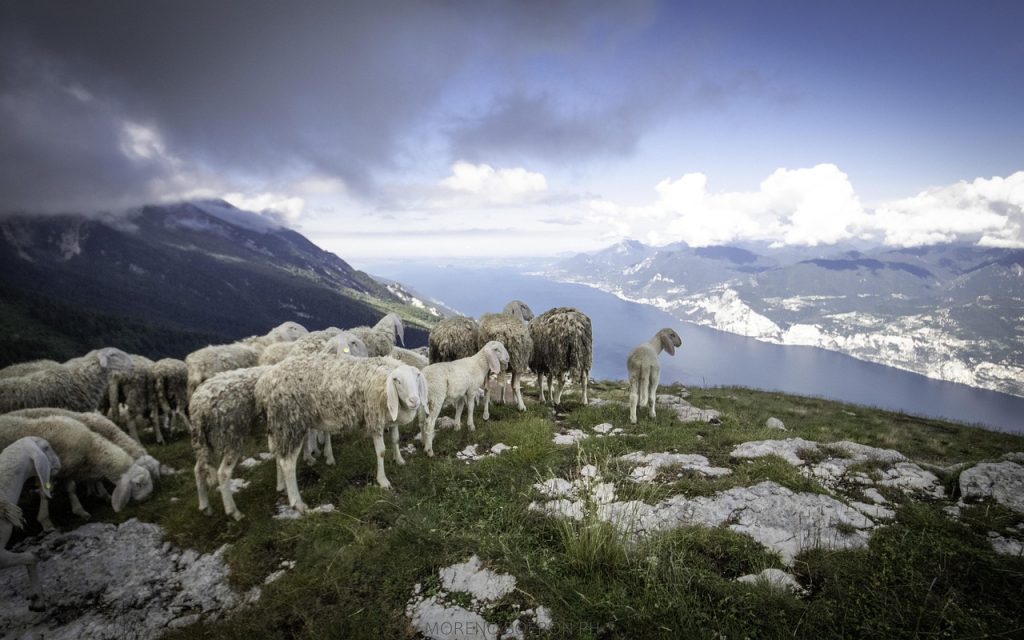
The traditional life of the Ossetians was the life of a mountain people, built around herding, farming, and the defence of the valley. In the high pastures they grazed sheep, cattle, and goats through the summer, moving the flocks up to the alpine meadows and down again with the seasons, while in the valley bottoms they farmed small terraced fields wherever the land allowed.
Farming in the mountains was hard and the arable land scarce, so the people made the most of every patch of soil, growing grain, beans, and other hardy crops on terraces cut into the slopes. The herds were the mainstay, giving meat, milk, wool, and hides, and the movement between winter villages and summer pastures shaped the rhythm of the year in the classic pattern of mountain life.
The most striking feature of the old Ossetian world was the stone tower. Across the valleys, families and clans built tall defensive towers of stone, refuges in times of raid and feud and symbols of the strength and honour of the family. Fortified villages of these towers and stone houses clung to the slopes, testimony to a world in which the blood feud and the raid were constant dangers.
Life in this world demanded toughness, self-reliance, and a strong sense of honour and kinship. The Ossetians were known as brave warriors, and military skill was prized, for the mountains were no safe haven but a land of feuds between clans and raids from without. Yet the same world also bred deep traditions of hospitality, custom, and communal solidarity that bound the people together.
Society, Clan, and the Old Order
Ossetian society was built on kinship and on a strong sense of custom and honour. The people were organized into families, lineages, and clans, and a person’s clan and family defined their place in the world, their allies, and their obligations. These ties governed marriage, the holding of land, and the conduct of the feud, and they bound individuals into a wider web of mutual duty.
The old society had its ranks and distinctions, with noble families and free commoners and, in the past, dependents of lower status. Yet in many of the mountain valleys the spirit was more that of free clansmen than of a rigid feudal order, with the heads of families and the elders guiding the affairs of the community and settling its disputes according to ancient custom.
Custom law, the unwritten code of the people, regulated life in remarkable detail, from hospitality and marriage to the grim rules of the blood feud, in which an injury to one member of a family demanded vengeance or compensation. The council of elders and the weight of public opinion enforced these customs, maintaining order in a world without kings or courts.
Hospitality held a sacred place in this order. A guest, even a stranger or an enemy, was under the protection of the host and was to be honoured and defended, and the rituals of welcome, feasting, and the offering of food and drink were governed by strict and elaborate custom. This deep tradition of hospitality remains one of the most cherished values of the Ossetian people.
To sit at an Ossetian table is to enter a world of careful ceremony, where the order of the toasts, the words of the elder, and the sharing of the pies all follow a pattern hallowed by long use. The guest is not merely fed but honoured, drawn for a time into the life and protection of the household.
Religion, Between the Cross and the Old Gods
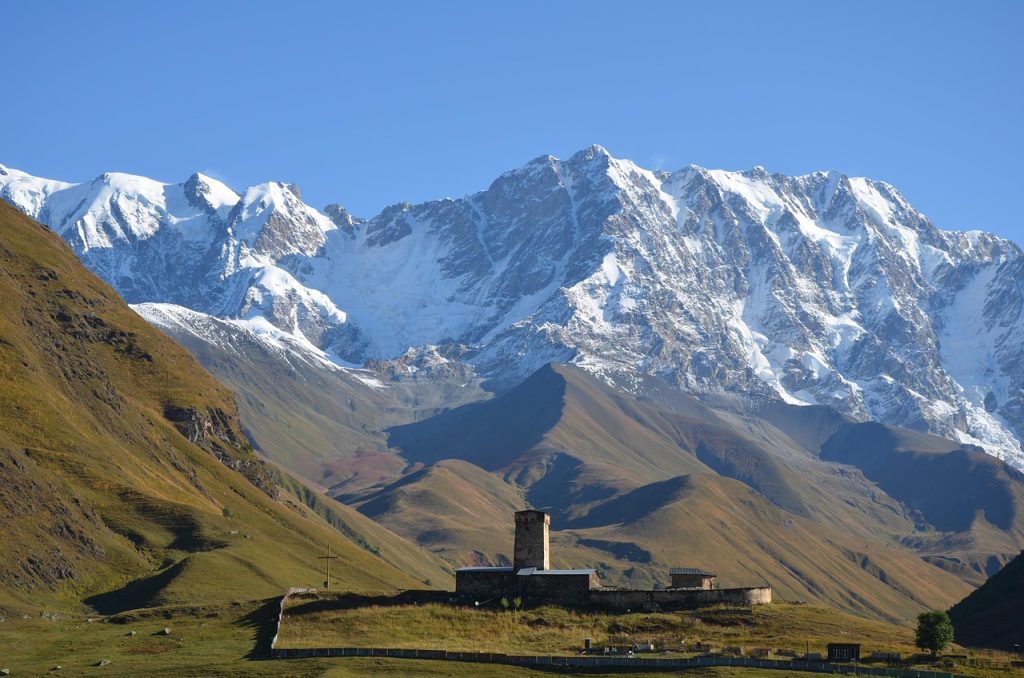
The religious world of the Ossetians is a rich blend of Christianity and a very ancient native tradition descended from their Iranian and steppe past. Christianity reached the Alans in the medieval period, and the Ossetians have long counted themselves a largely Christian people, with Orthodox churches and Christian feasts marking their year, though a minority follow Islam, adopted from Caucasian neighbours.
Beneath and alongside the Christian surface, however, lives a powerful older layer of belief, a native religion with its own supreme god and a host of patron powers who watch over travellers, warriors, harvests, and herds, and who are invoked at the feasts and rituals that punctuate the year, blending seamlessly with the Christian calendar.
Sacred groves, shrines, and holy places dot the mountains, sites where offerings are made and prayers spoken, often at ancient sanctuaries that predate the coming of Christianity. Ritual feasts, with their three sacred pies, their toasts to the deities, and their careful order of prayer and offering, are among the most distinctive expressions of this living tradition, carried on to this day.
Visitors are often surprised to find how naturally the two worlds coexist, so that a family may keep a Christian feast and in the same breath invoke the old patron powers of the mountains. To the Ossetians there is no contradiction, only a single inherited way of honouring the sacred.
This blend of the cross and the old gods gives Ossetian religion a character quite its own, unlike anything else in the region. It preserves, in its patron deities and its rituals, echoes of the ancient Iranian and steppe faith of the Alans, so that the religious life of the people, like their language, is a living link to a world that has otherwise vanished from the earth.
The Nart Sagas and the World of Story
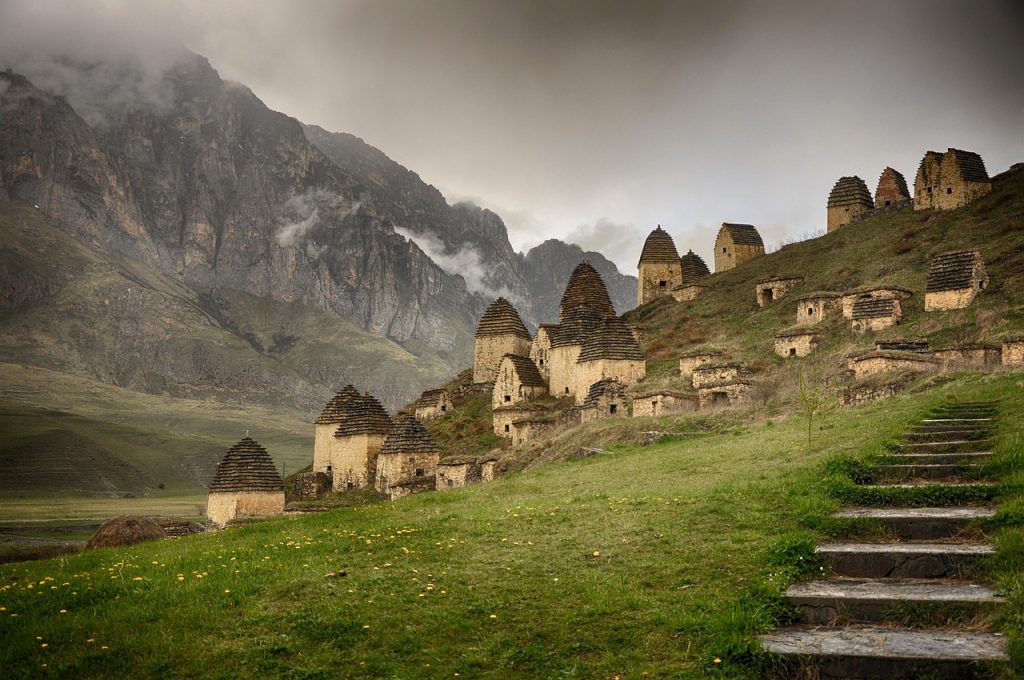
The great treasure of Ossetian oral literature is the cycle of the Nart sagas, a vast body of heroic legend shared in different forms across the Caucasus but preserved with special richness among the Ossetians. These tales tell of the Narts, a race of mighty heroes and heroines, their battles, feasts, loves, and quarrels, and their dealings with gods, giants, and monsters in a world of ancient grandeur.
The Nart sagas are far more than entertainment; they carry the mythology, values, and worldview of the people, descended in part from the beliefs of the ancient Scythians and Alans. Scholars have found in them echoes of Iranian myth and even parallels to the legends of distant peoples, marking the sagas as one of the great mythologies of the world and a precious survival from the steppe past.
Among the Narts move unforgettable figures: the wise and powerful matriarch who guides her people, the cunning trickster hero, the mighty warriors who perform impossible deeds. Through their adventures the sagas explore courage, honour, cunning, and fate, holding up a mirror to the ideals and struggles of the society that told them around the hearth on winter nights.
Alongside the Narts were countless other tales, songs, proverbs, and riddles, and a tradition of feast oratory in which skilled speakers delivered the toasts and prayers that ordered the great gatherings. Music and dance, performed to traditional instruments, accompanied every celebration, with stately and vigorous dances that remain a beloved and vivid expression of Ossetian culture.
Crafts and the Work of Skilled Hands
The crafts of the Ossetians grew from the mountain life and from the materials the land and the herds provided. Working stone was a fundamental skill, for the people built their houses, their fortified towers, and their shrines of stone fitted with great care, a craft of masonry that produced the striking towers and villages that still stand as monuments to their builders.
Metalworking had ancient roots in the Caucasus, a region famed since antiquity for its smiths, and the Ossetians shared in this heritage. They forged and decorated weapons, tools, and the fittings of horse harness, and worked silver into the ornaments, belts, and jewellery that adorned festive costume. The making and adorning of arms was a craft of special honour among a warrior people.
From the herds came wool, worked by the women into felt, cloth, and the warm garments needed in the mountains, including the felt cloaks and caps of the Caucasian highlander. Weaving, sewing, and embroidery were the domain of women, who decorated clothing and household goods with patterns carrying old meanings, and whose skill was a valued part of a family’s standing.
Woodwork, leatherwork, and the making of the tools and vessels of daily life rounded out the crafts of the people. Everything was shaped by the demands of a hard mountain existence, favouring what was strong and useful, yet within these limits the Ossetians brought skill and a love of decoration to their work, turning the materials of the mountains into objects of both use and beauty.
Food and the Table of the Mountains
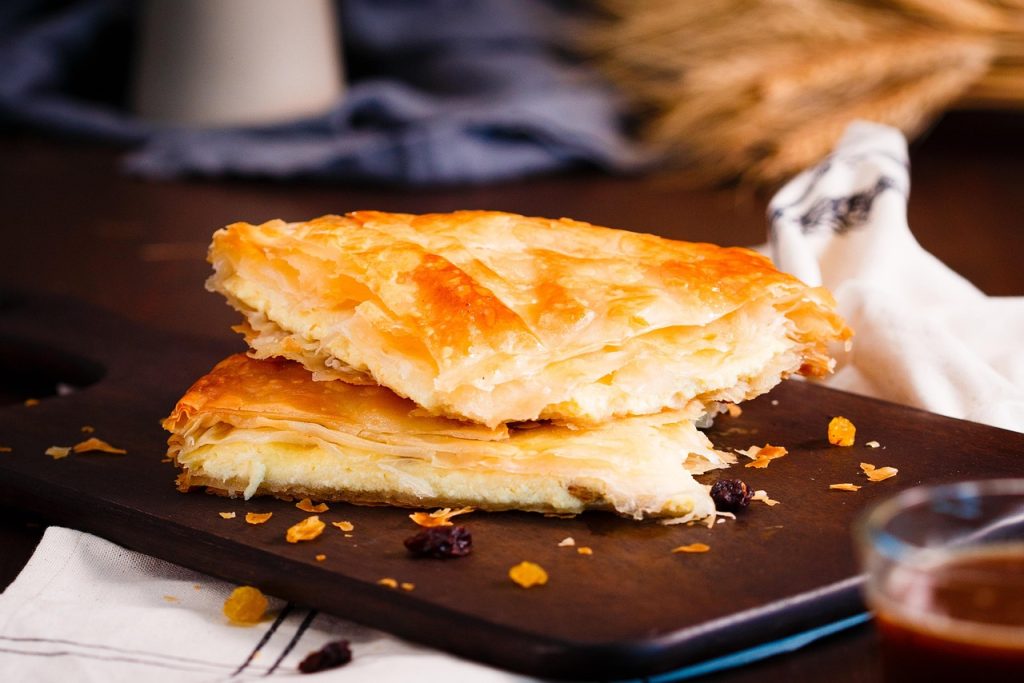
The food of the Ossetians reflects their mountain life of herding and farming, built around meat, dairy, grain, and the produce of the high valleys. Meat, above all from their flocks and herds, was central, boiled or roasted and served at every feast, with a rich meat broth and boiled meat forming a classic dish of celebration and hospitality.
The most famous of all Ossetian foods are the pies, round filled pastries that hold a place of honour at every table and every ritual. Filled with cheese, with meat, with potato, with beetroot leaves, or with other fillings, these pies are baked and served in stacks, and at sacred feasts three of them are offered together in a rite rich with ancient meaning, dedicated to the powers of heaven, sun, and earth.
Cheese and dairy foods, made from the milk of the herds, were staples of the diet, along with grain in the form of bread and porridge and the vegetables and beans grown on the mountain terraces. A distinctive salty cheese, used fresh and in the beloved pies, is one of the signature tastes of the Ossetian kitchen, known well beyond the mountains.
Beer brewed from barley has a special and ancient place among the Ossetians, and traditional Ossetian ale is bound up with ritual and feast, poured in the toasts that order the great gatherings. Simple, hearty, and tied to the seasons and the herds, Ossetian food, and above all the sacred pies and ale, remains at the heart of the people’s ceremonies and their famous hospitality.
Festivals and the Turning of the Year
The festivals of the Ossetians follow a calendar that blends the Christian year with the feasts of their ancient native religion, so that the turning of the seasons is marked by celebrations honouring both the saints and the old patron deities. Through the year, communities gather at their shrines and sacred places for ritual feasts, with prayers, toasts, and the offering of the sacred pies and ale.
The great winter festivities around the new year brought feasting, visiting, and old customs of divination and blessing as the people looked ahead to the coming year. As the seasons turned, other festivals greeted the arrival of spring and the driving of the herds up to the high pastures, and later gave thanks for the harvest and the safe gathering of the year’s bounty before the return of winter.
Many festivals are dedicated to particular patron powers, celebrated at their special shrines, and draw the people of a village or a whole district together in worship and merriment. These gatherings, governed by the strict and elaborate rituals of the feast, with their ordered toasts and prayers led by respected elders, are among the most vivid expressions of Ossetian tradition and identity.
Through all the festivals run the arts and customs the people love: the stately and lively dances, the songs and the recitation of legend, the contests of skill, and above all the sacred rituals of the feast with their pies, their ale, and their toasts. In these gatherings the Ossetians renew their bonds of kinship and community and reaffirm the ancient heritage that sets them apart.
History Under the Russian State
The Ossetians came under Russian influence relatively early among the Caucasian peoples, from the eighteenth century, as the Russian Empire pushed south toward and across the great mountain range. Their largely Christian faith and their strategic position on the routes through the central Caucasus gave them a particular relationship with Russia, and many Ossetians entered Russian service, including in its armies.
The building of the great military road through the mountains, past the site of Vladikavkaz, tied the Ossetian land ever more closely to Russia and made it a key corridor between the empire and its new possessions to the south. Under Russian rule the mountain people were gradually drawn into a wider economy and administration, and in time many moved down from the high valleys toward the plains and the growing towns.
The twentieth century brought the Ossetians autonomy within the Soviet system, but divided into two, with North Ossetia on the northern side of the range and a separate South Ossetian region to the south, tied to Georgia. Education, publishing, and cultural institutions developed in the Ossetian language, even as religion was suppressed and the old ways came under the pressures of a modernizing state.
This division of the people across the mountain range became the source of bitter conflict in modern times, especially as the Soviet Union broke apart and old tensions erupted into war in the Caucasus. The Ossetians, caught up in these struggles, have carried the weight of a history in which their position astride the great divide brought both opportunity and tragedy, shaping the modern life of the nation.
The Ossetians Today
Today the Ossetians live chiefly in North Ossetia within the Russian Federation, with its capital at Vladikavkaz, and in South Ossetia across the range, together with communities elsewhere in Russia and beyond. They number several hundred thousand, a people conscious and proud of their unique heritage as the last of the Alans and the only Iranian-speaking nation of the Caucasus.
The preservation of their ancient language is a central concern, for Ossetian is a living monument to the vanished speech of the steppe Iranians. It is taught in schools and used in literature and media, and its survival, along with the great Nart sagas, is a source of deep pride, even as it faces the familiar pressures that weigh on smaller languages within the modern world.
The old customs remain remarkably strong. The rituals of hospitality, the sacred feasts with their three pies and their ordered toasts, the honouring of the patron deities at their shrines, and the traditions of kinship and honour continue to shape Ossetian life, blending with modern ways in a manner that keeps the ancient heritage alive in the present day.
The story of the Ossetians is that of a people who carried the language and spirit of the ancient steppe into a mountain refuge and there endured, the last living heirs of the Scythians and Alans. From their high valleys of towers, shrines, and sacred pies, our Folks journey travels on toward the next of the many nations who share the vast lands of Russia and the Caucasus.