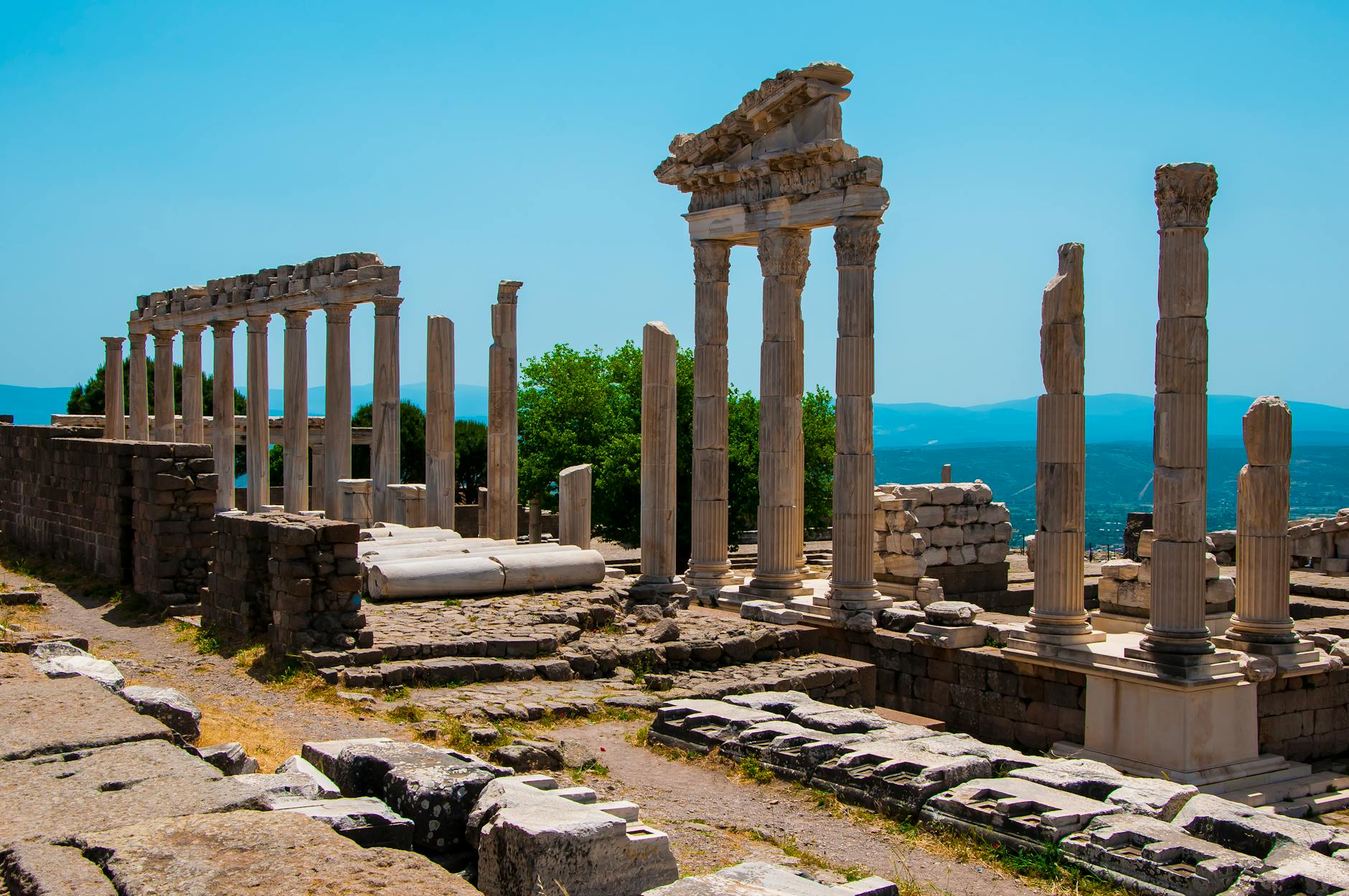


Pergamon pictures
Bergama, a district of Izmir province, is located in the northwest of the Aegean Region. The total surface area of Bergama, which is built on the fertile lands of the Bakırçay Basin, is 1688 square kilometers. The district’s distance to Izmir and the airport is 110 kilometers.
The city is located 8 kilometers from the Izmir-Çanakkale highway. Bergama attracts attention with its coastal towns such as Dikili and Çandarlı, its proximity to a natural miracle such as Kozak Plateau, the city of Izmir and its historical values.
Bergama, which has 114 villages, is one of the districts with the most villages in Turkey and its general population is 120 thousand and its central population is 60 thousand.
Historical Places
Altar of Zeus
King of Pergamum II. The famous Zeus Altar, built by Eumenes as an expression of gratitude to the savior Zeus after winning the war with the Galatians, has unfortunately been located in the Pergamon Museum in Berlin, Germany, for the last 130 years.
Today, only the bases of the magnificent altar, which was taken to Germany in pieces during the excavations that the Germans started in Bergama in 1871, are in Bergama today.
The Zeus Altar, built 2000 years ago in Pergamon and considered one of the most beautiful works of art of the Hellenistic period, has been away from its homeland for 120 years. The masterpiece, 12 meters high and 35 meters long, should return to its true home, from the hall in Berlin to the Pergamon Acropolis, and welcome its visitors there.
Asklepion
B.C. With its history dating back to the 4th century, Asklepieon Health City was built dedicated to Asklepieos, the god of health in mythology, and was built in the 4th century AD. It continued its activity as a famous treatment center until the 5th century.
The entrance gate of Asklepieon, which proves that Pergamon was an important health city in ancient times, still stands today under the name Viran Gate. It is known that on this gate it is written ‘death is forbidden to enter’ and among those examined at the entrance, terminally ill patients whose treatment is impossible are not allowed in.
The patients taken inside would walk along the 650-meter-long sacred path, drink the healing water that can be drunk even today and wash with it, and then the treatment of the disease would begin. In Asklepieon, where it is understood from the findings that surgeries were also performed, treatment was applied with medicine, plants, music, water, mud and sun baths. There is also a snake column, the symbol of medicine, in Asklepion, which is known to have trained famous physicians such as Galen.
There is also a theater with a capacity of 3500 people in Asklepieon, which is still used today.
Allianoi The Ancient City of Allianoi, a large part of which was unearthed with the excavations that started in 1998, proves that Bergama was an important health center in ancient times. B.C. II. From the century A.D. II. Allianoi, which is estimated to have been used until the 11th century, is a health cult dedicated to Asklepieos, the God of Health, just like the Asklepieon of Pergamon.
However, it is supported by important findings that suggestion therapy was applied in Asklepieon and that Allianoi was a hydrotherapy (water treatment) center. The hot water produced here can be used even today. Allianoi, which stands out as the most intact Ilıca structure in Anatolia, is unfortunately in danger of being submerged by the waters of the Yortanlı Dam, which is under construction in the region.
Necessary work must be done to prevent this important cultural heritage of humanity from being destroyed by dam waters.
Basilica, whose name is mentioned in the Bible as one of the first 7 churches of Christianity, was built in A.D. II.
It is also called the Temple of Serapis because it was built in the 16th century by the Roman Emperor Hadrian, dedicating it to the mythological god Serapis. The Basilica, located in the city of Bergama, is popularly known as the Red Courtyard because it was built of red brick. The Selinos Stream flows under the Basilica, whose main building is 60×26 meters and stands out as one of the most magnificent religious buildings in Anatolia.
The area around the Basilica, which attracts the attention of travelers with this feature, is called ‘the neighborhood neither on earth nor in the sky’. A church was also built inside the Basilica during the Byzantine Period. After centuries, the Basilica has been hosting the mass organized by the 1st Patriarch Barthelemeos in May for the last two years.
Taşhan: The inn built in 1432 used abundant amounts of spoliated materials. The upper floors of the building, where ancient stones were used on the facade, had an alternating brick-stone pattern. The building is in ruins.
You May Like
Aspendos Ancient Theater Travel Guide