It is estimated that the history of the ancient city of Kaunos dates back to 3 thousand years before Christ. Kaunos, which was rich enough to have gold coins minted in its name, later came under the rule of the Ionians, the Union of 12 Ports, Alexander the Great, the Persians, the Romans, the Byzantines, the Knights of Rhodes, the Seljuks, the Menteşe Principality and the Ottomans.
The location of Kaunos, mentioned in many written works, was precisely determined by the British Archaeologist Hoskyn in 1842. Hoskyn, who searched for Kaunos in the Lycian and Carian border regions, found a public assembly tablet in the ruins in Dalyan. From this tablet he learned that the place was Kaunos. Thus, Kaunos took its place in world literature.
Another study that drew attention to Kaunos in the world of archeology was the research conducted by Swiss archaeologist Pavo Roos in the late 1950s. Roos prepared the results of his research as a doctoral thesis.
The first historical information about Kaunos can be found in the works of the famous Greek historian Herodotus, the geographer Strabon from Amasya and the Latin poet Ovidus. You can also find information about the artifacts found in Kaunos and the wars fought there in the Kaunos and Byblis articles of various encyclopedias. Excavations that have been carried out in Kaunos since 1966 were stopped at the end of the 2003 summer season.
Now, with the artifacts unearthed, Kaunos will be rebuilt and tried to regain its former appearance. Excavation and restoration work in Kaunos was carried out in 1966 by Prof. It started under the management of Baki Öğün. After Öğün’s retirement, Prof. directed the excavations. Cengiz Işık published a book about Kaunos in 2001. This book is full of archaeological terms that those interested in archeology may like, but which ordinary citizens may not understand.
Prof. stated that it is not possible to completely unearth the thousands of years of history of Kaunos. Işık says, “This place has been robbed throughout history. Moreover, the topographic structure of the slope on which the city was built is not suitable for this.” Indeed, part of the city is under water. Prof. In his statement in 2003, Işık said that they would not carry out excavations from now on. Prof.
Işık stated that they will leave other works waiting to be unearthed to future generations, and that from now on, they will try to restore the unearthed works and provide visitors with the opportunity to visit Kaunos of thousands of years ago.
Prof. According to the information given by Işık, many of the artifacts unearthed here have been distributed to various places. A lion statue is in Köyceğiz Park. The gold finds were sent to the Ankara Museum. Those found in the last 10-15 years were in Fethiye museums, and those found before were in Bodrum museums. Some artifacts are kept in the building known as the archaeologists’ house in Kaunos.
As you can see, when you come to Dalyan, you can visit the Kaunos Ancient Kanti, but you cannot see the valuable artifacts found here. However, Dalyan’s old PTT building appears as a “museum” in official records, but it remains empty.
The famous historian Herodotus writes in his work that although the people of Caunos spoke the same language as the Carians, they came from the island of Crete and maintained their own traditions and customs.
Strabo, a geographer from Amasya who lived during the Roman period, writes in his book that Kaunos was a fertile country, but he did not like its weather because the summer and autumn seasons were too hot. Adhering to the belief of that period, the author shows the abundance of fruits as the reason for the bad climate in this region. According to the same author’s description, the people of Caunos are “sickly, pale-faced and short-lived people like a leaf.”
It is thought that the cause of this is “malaria”.
The fact that Kaunos attracted the attention of famous historians and geographers is shown as evidence that the city was a very important settlement center at that time.
Kaunos has been known for its salt, salted fish and figs since its foundation. The heyday of Kaunos dates back to its founding in B.C. It is thought to date back to the 5th century. Since Kaunos has been the scene of various civilizations throughout history, many different building techniques are seen in the city. It is understood from the city walls that the city was very large compared to the dimensions of that period.
The main structures that can be seen in the ancient city, built on a rugged land, are: Acropolis (castle and walls), city walls, theatre, church, bath, warehouse, fountain, agora, stoa and urban roads, temples and sacred areas, port and cemetery.
In addition, when we consider the structures such as the military port, shipyards, sports center, residences that have not survived to the present day, and the underground works that have not yet been excavated, it becomes clear how large and important a residential area the ancient city was.
It is thought that Kaunos, which minted coins in its own name, was an independent state for a while, and that Pisilis (in Sarıgerme), Sultaniye (by Lake Köyceğiz) and many other small ancient cities in the surrounding area were under its control.
In addition to architectural works, many statues, statue bases, coins, amphorae, pediments (diadems), ornaments, vases, oil lamps, figures, bowls and pottery have been found in the excavations so far.
You can reach Kaunos, located right across from Dalyan, in 3 ways. The easiest way is to cross to the opposite shore by boat, from the level of the king’s tombs. Here, boats owned by ladies from Dalyan are waiting and carrying passengers across the Dalyan Canal. If you choose this path, you can see the royal tombs closely where you cross the street. A 10-minute walk takes you to the upper entrance of Kaunos.
The second way is to go to the archaeologists’ house by boat. From here, you can reach the upper entrance with a 5-minute walk.
The third way is to go by boat to the lower entrance of Kaunos, next to the Dalyan Fisheries Cooperative.
There are boards showing places to visit in Kaunos, a buffet, WC and cafeteria where you can meet your needs. If you get tired of visiting, we recommend you to rest under the shade of the centuries-old olive trees growing between the steps of the ancient theater and breathe in the history.
Acropolis (castle and walls): The castle in Kaunos is on a high hill. From this hill, the entire ancient city, Dalyan, Iztuzu Beach, the entire delta stretching between Dalyan and the Mediterranean, fields, gardens and forests can be seen. The eastern and southern slopes of the castle are cliffs. You can access the castle from the path next to the ancient theatre.
The double rows of walls surrounding the castle date back to B.C. It was built in the 5th century. It is understood from the shape of the doors, loopholes and parapets on the walls that the castle underwent major repairs in the Middle Ages.
Church (Big Church): There is a beautiful church on the right of the road leading to the theater. Researchers suggest that there are two churches in this region. For this reason, the church next to the theater is called the Big Church. The existence of the church in Kaunos shows that this place maintained its importance during the Roman period.
It is thought that the church was built in the 5th century or later. It consists of an entrance and three compartments. The entrance is in the West, the sacred direction is in the East. The graves and old buildings around the church were cleaned and the structure of the church was revealed.
Roman Bath: It is one of the baths in the best condition among the Roman baths in Anatolia. In the bath, sections such as changing area, cold, warm, hot and massage areas, heating system and pool are being repaired. The most beautiful and impressive façade of the bath is the South facade, which has plenty of windows. These windows overlook the city and the harbour.
Palestra (Sports School): In Kaunos, there was a sports school east of the bath extending to the church. It is thought that wrestling was held here and training in other sports was given. Not much has survived from the sports school, which covered a wide area.
Temples and Temenos (Sacred Area): There were polytheistic religions in ancient times. People living in this period believed in goddesses and gods such as Zeus, Aphrodite, Artemis and Apollo. Ancient cities chose protective gods and goddesses for their cities from among these gods. In an inscription found in Kaunos, the names Apollon, Posedion, Artemis and Aphrodite are mentioned.
Herodotus wrote that the people of Caunos worshiped their own gods, not foreign gods.
Archaeologists have found six temples in Kaunos. Four of these temples belong to the Roman period and two belong to the Hellenistic period.
Agora and Stoa (Marketplace and Porticoes): Agora and stoa were found around and at the end of a road running west from the ancient fountain, parallel to the trade port.
There is a sacred temple area on the slope behind the stoa, which belongs to the Hellenistic period. M.O. It belongs to the 2nd century. It is 97 meters long and its floor is paved with stone. Inscriptions were found around it.
Nympheum (Monumental Fountain): There are customs-related records in the inscription of the monumental fountain located to the east of the Stoa, which also mentions the name of the Roman Emperor Vespasian. The inscription is an extremely important written document in terms of containing information about the commercial life of the period.
Warehouse: It is a two-storey building, not too big, on the road leading from the theater to the port in the ancient city. It is thought that there were buildings used as warehouses on the coast of Kaunos, a port city.
Port (Little Port / Sülüklü Lake) and Customs: The port, known today as Sülüklü Lake, played an extremely important role in making Kaunos a commercial city. The port, which merchant ships could easily enter at the time, was sheltered and belonged to the group of closed type ports. Today, it has become filled and turned into a swamp. It is estimated that the mouth of the port was once closed with chains.
It is understood from the inscription on the monumental fountain, which contains some rules and information about customs, that there was also a customs office in the port. Traces of breakwaters were also found in the harbour.
Tholos (Round structure): It is claimed that the structure identified with the name Tholos was built for a hero. It is located south of the port, close to the city walls. It becomes difficult to do research here because it is full of water.
City Waters and Gates: Apart from the walls surrounding the acropolis, the city is also surrounded by walls. The walls continue on the front facing Balıklar Mountain in the North and Northeast, Küçük Kalesi in the South and Southwest, Çömlekçi Hill in the West, and today’s Dalyan Town in the North. Although the construction of the walls dates back to ancient times, they have undergone various repairs later. The height reaches several meters in some places.
Traces of the gates opening into the city walls are also visible in places.
Çömlekçi Hill: It is in the West of the city, opposite the Küçük Castle. It is thought that the part of the trade port between Küçük Kale and Çömlekçi Hill was closed with a chain. There are tombs, walls, the Western Castle and the Western Gate in the surrounding area. It is thought that the castle and walls here date back to the 3rd century.
Small Castle: It is in the southwest of the port. There is a wall connection between it and the acropolis. The gate in the city wall surrounding the south attracts the eye.
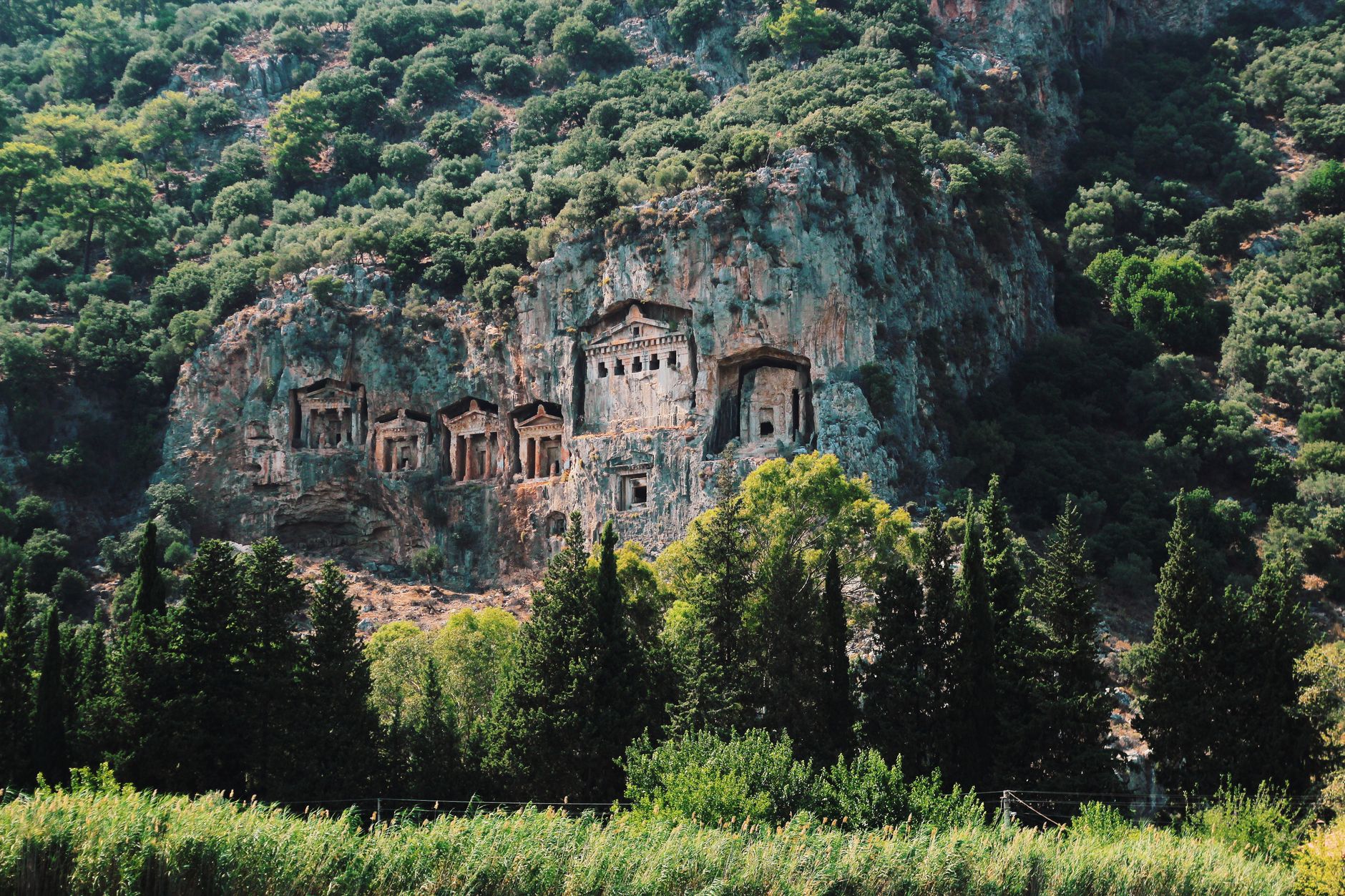
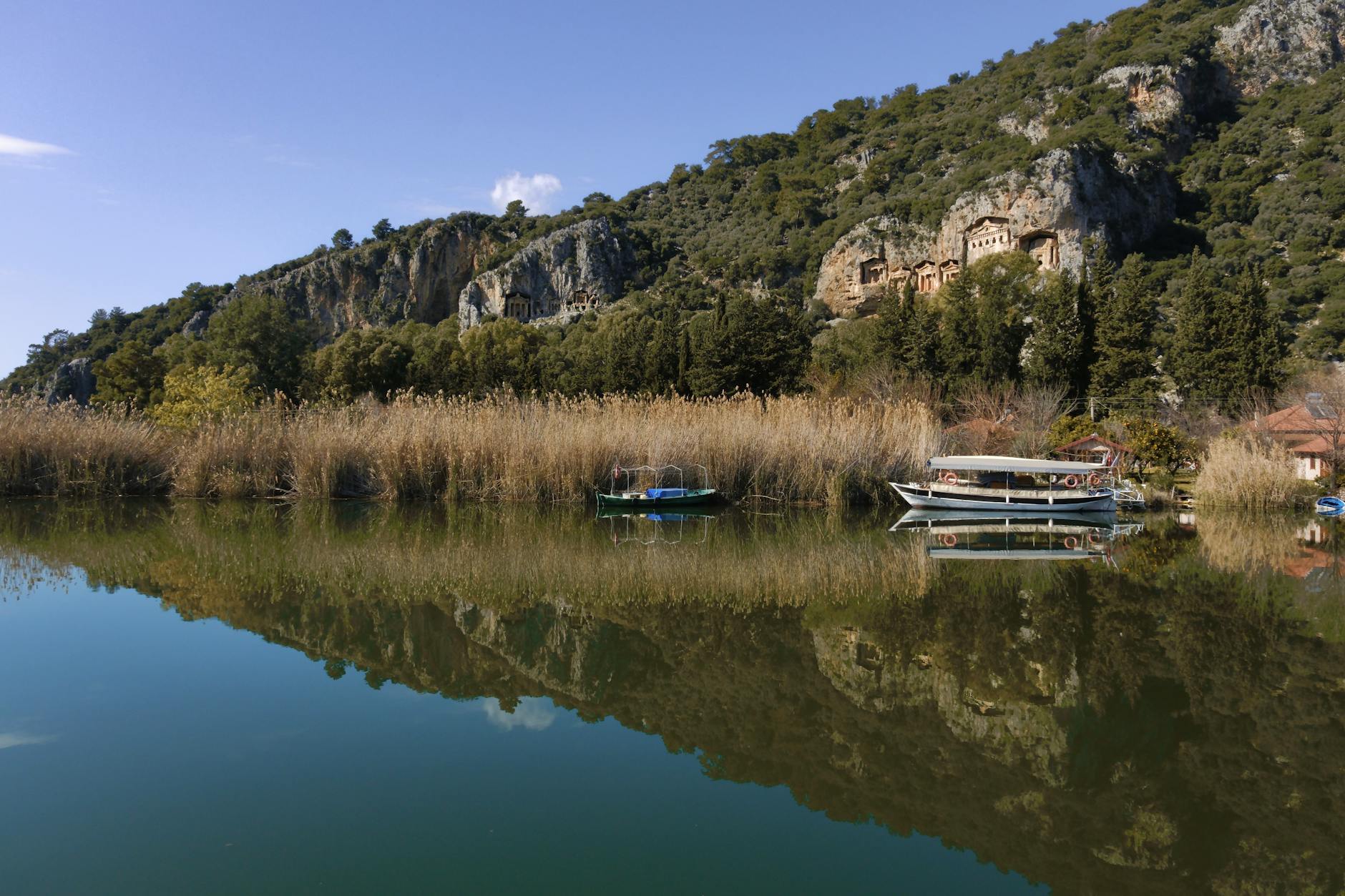
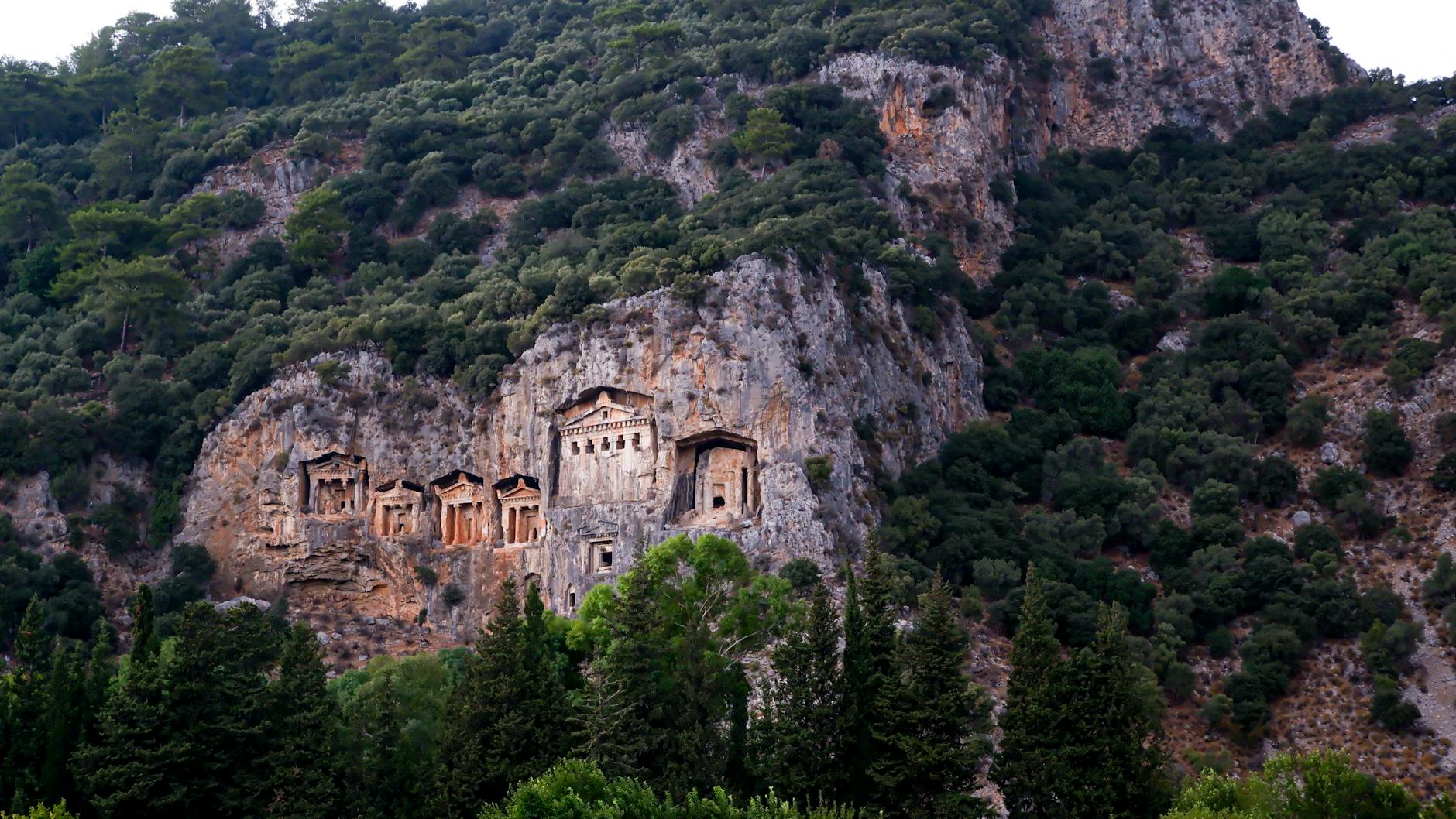
Necropolis (Cemetery) and Rock Tombs: Like other ancient cities, Kaunos has a large cemetery outside the residential area. Different types of graves stand out in the cemetery area with its beautiful view. The most striking of these are the monumental rock tombs of the kings. The rock tombs carved into high rocks are like the symbol of Dalyan today.
Some ceramics, pottery and other findings found in the rock tombs indicate that the tombs date back to B.C. It suggests that it belongs to the 4th century. The tombs look like Lycian type rock tombs. The reason for this is that the region is close to the Caria-Lycia border. Rock tombs of this type have not been found outside Anatolia.
Especially, the most outstanding examples of rock tombs are encountered in the ancient cities within the Lycian Region. Lycian type rock tombs are also found in Kaunos, which is located between Caria and Lycia. It is possible to see the closest similar examples of these graves in Telmessos (Fethiye). For example, it is located on a hillside in Telmessos and dates back to IV.
The rock tomb, thought to belong to King Amnythas in the 6th century BC, and other tombs around it are very similar to the examples in Kaunos.
When choosing the location of the tombs, which were carved to look like a small temple facade, attention was paid to the view and the difficulty of access.
Battle Harbor and Shipyards: Historical sources state that the ancient city had a battle harbor and shipyards on the edge of the Dalyan Canal. The port, located on the northern side of the Acropolis, is completely full today.
Dwellings: During the excavations, some house foundations from the Early Byzantine period were found on the terrace behind the stoa. It is estimated that the main residential area of the ancient city is the area extending from the sacred temple area to the North and West.
BYBLİS’ TEARS
We don’t know if you like legends? If you like it, you will be saddened by what we tell you. The legend that has survived from Herodotus is as follows:
The Carian King Miletos, the son of Apollo, had twins. The boy is called Kaunos and the girl is called Byblis. The twins grow up together and fall in love with each other. This secret love is revealed when their baby is born. The king is very angry and expels his son from his country. He goes with those who love him and establishes the city that bears his name, opposite today’s Dalyan, on the border of Lydia.
What happened to Byblis? That’s where it’s sad. Byblis, who was very upset about the insults she received and being separated from her beloved brother, shed tears until the springs dried up and eventually committed suicide by jumping off a rock. According to legend, the labyrinth-like canals in Dalyan were formed from the tears of Byblis.
Roman Historian and Poet Ovidius narrates this event differently. According to Azra Erhat, who narrated it to us from Ovidus, the legend about the founding of Kaunos is as follows:
Byblis falls in love with Kaunos. Byblis expresses her feelings by writing a letter to Kaunos. Kaunos, on the other hand, responds to Byblis’ feelings with anger and disgust. Kaunos, who does not want to see his twin again, leaves his father’s country with those who love him. He came to Kaunos and founded the city named after him. Byblis, on the other hand, wants to end her life because of her unrequited love and throws herself over a high rock.
But the Nymphs (water nymphs) took pity on Byblis and turned it into a spring. The tears of Byblis become a river and the ages stop.
This is how sad the story of the founding of Kaunos is.
You May Like
Aspendos Ancient Theater Travel Guide