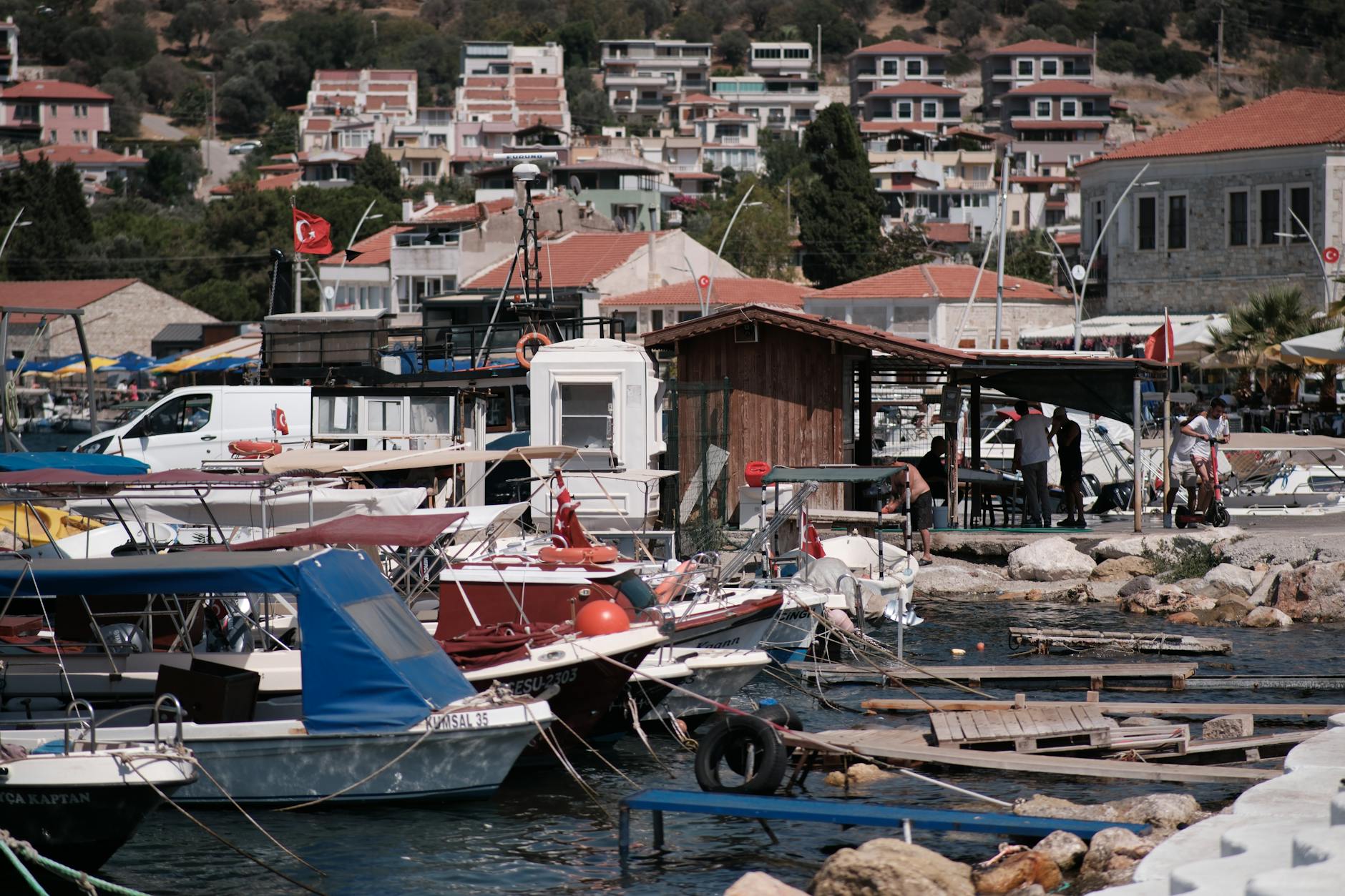
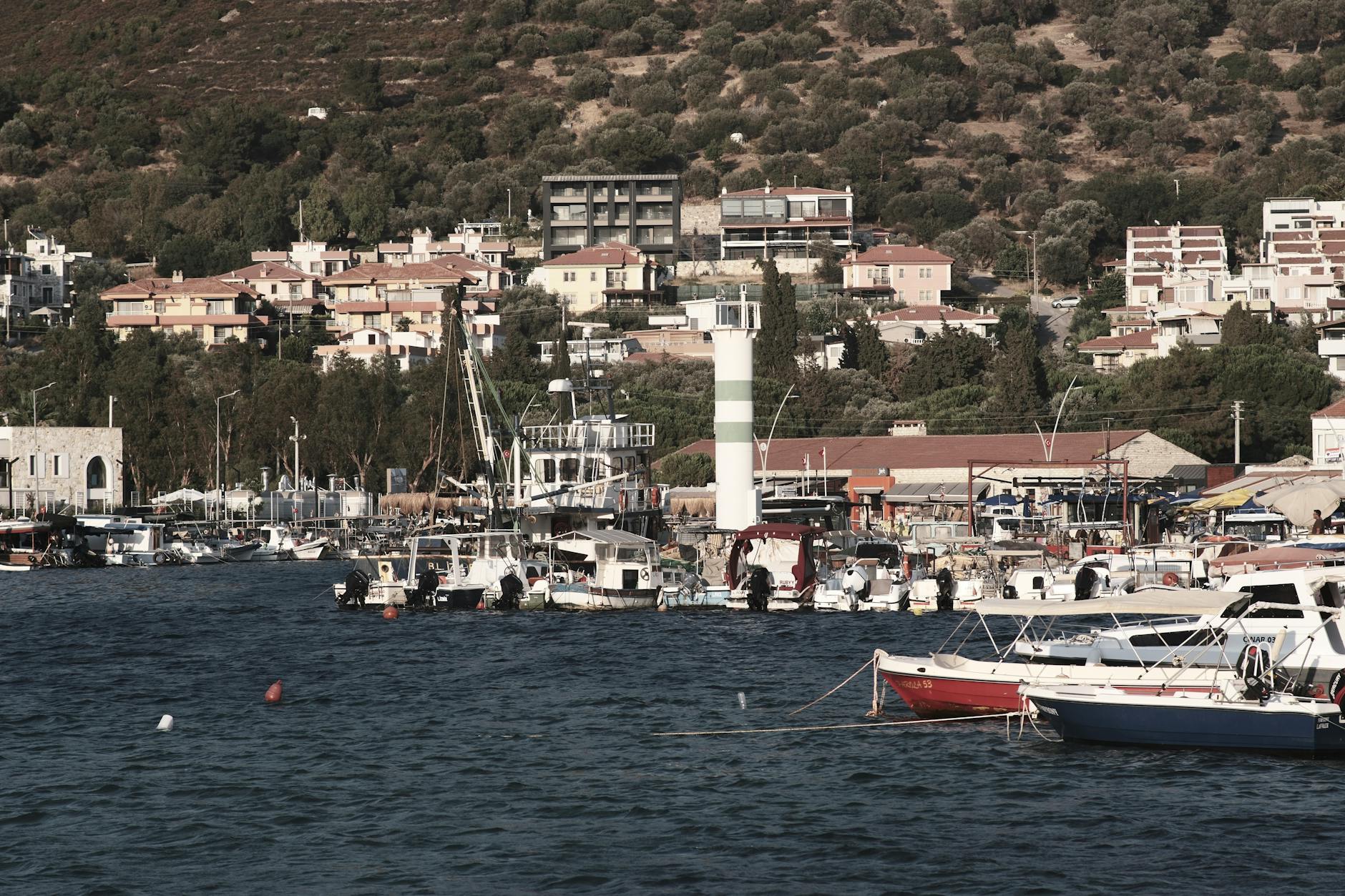
Foça is a coastal town located 70 km northwest of Izmir. When the city emerged as an Ionian settlement in ancient times, it was named Phokaia because of the seals living in the surrounding sea, and the word came to be Foça. In addition to its historical and archaeological importance, Foça is a mythological settlement mentioned in the Homeric epic. In 1867, Foça and its subdistrict Yenifoça were merged and connected to the province of Manisa.
It was under Greek rule from May 15, 1919 to September 11, 1922. During the War of Independence, Atatürk entered Foça on September 11, 1922, and September 11 began to be celebrated as the liberation of Foça.
Foça has two symbols: “Rooster” and “Seal”. Siren Rocks, Devil’s Bath, Stone House (Mausoleum), Five Gates (Genoese) Castle, Outer Castle from the Ottoman period, Fatih Mosque, Kayalar Mosque, Hafız Süleyman Mosque and Ottoman Cemetery, as well as civil architectural structures bearing the characteristics of Aegean architecture, enrich the environmental values of Foça.
History: Foça is one of the important centers founded by the Ionians, who escaped from the Dorian invasion in Greece and went to the Aegean coast and established many settlements there, including Smyrna. The ancient city of Foça is included in the 12 Ionian union and is located in the Aiolis region. Foça, which took its name from the ancient city Phokaia from ‘seals’, had an important port and naval power during its time.
With its naval fleet, Foça established colonies in Alain in Corsica, Velia near Pastum, Marseille and the cities on the east coast of Spain. Foça lived through the Persian, Alexander the Great, Genoese and Ottoman periods.
The city of Phokaia, which entered a period of rapid growth starting from the 7th century BC, showed great development in maritime according to the ‘Father of History’ Herodotus. The Phocaeans, who used fast boats with 50 oars and the capacity to carry 500 passengers, were the first Hellenes to go on long sea voyages. They introduced Adriatic Etruria, Iberia and Tartessos to the Hellenic world.
Climate: The Mediterranean climate prevails in Foça. Winters are rainy and warm, and summers are dry. It receives cool sea air from three sides. The average temperature of the summer months is 26 degrees, and the sea water temperature is 22 degrees. The hottest months of summer are July and August.
Places to Visit in Foça
Siren Rocks: Consisting of islets resembling seals, the largest of these rocks is the Orak Island rocks. They are mentioned in the Homeric epic and are mentioned as the rocks hit by ships that lost their way. The largest of these rocks, which consist of islets resembling seals, is the Orak Island rocks.
Devil’s Bath: The structure, which is located at the foot of Çan Hill and is a rock tomb type, is known as Satan’s Bath. 2 km from the town centre. away.
Stone House: 10 km from Foça. This rock mausoleum, rising on the roadside, is half-carved. The building, which was built under Persian influence, was built in the Lycian-Lydian tradition and dates back to 4 BC. It dates back to the century.
castles
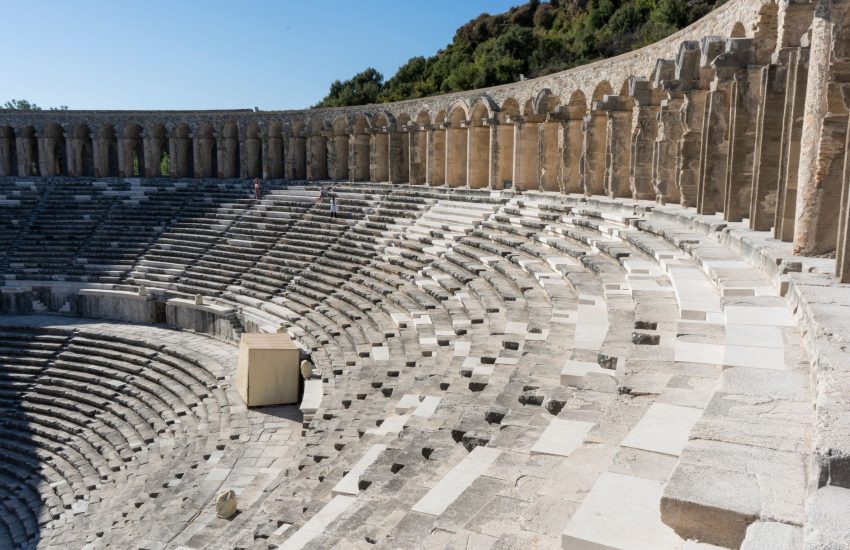
Five Gates Castle: This ancient Castle was given to the Genoese Manuel Zacharna by Michel Paleoloc in 1275, and its walls were repaired by the Genoese over time. After Phokaia joined the Ottoman lands in 1455, the walls were repaired and equipped with towers, nine of which we can distinguish today. The part of Beş Kapılar that is used as the Open Air Theater today was the ‘boathouse’.
According to the inscription on the entrance gate, this repair was made by Silahtar İskender Ağa, the lumberjack of Sultan Mustafa Han, son of Suleiman the Magnificent, who served as Saruhan Sanjak Principality between 1533 and 1541, in 1538-1539.
Outer Castle: According to sources, the castle known as the ‘Outer Castle or Genoese Castle’ in the ‘Kale Burnu’ in the southwest of Foça was built by the Ottomans in 1678, at a strategic point to protect the region, as a throat cutter. Located on a cape, the Castle is separated from the mainland in the east by a large moat for defense purposes. During underwater archaeological research, stone cannonballs were found at the bottom of the sea off the castle.
It is thought that these cannonballs were catapulted from the castle to enemy ships.
mosques
Fatih Mosque: It is on Old Courthouse Street inside the Castle. The mosque is a structure that has survived to the present day without losing its original condition. It was built by Fatih Sultan Mehmet after the conquest of Foça in 1455. In its initial construction, it bore the classical Ottoman architectural style.
Kayalar Mosque: It is inside the castle. The mosque, whose construction date and who built it is unknown, shows all the features of the late Ottoman architectural style. There is a fountain added later to the west of the building.
Hafız Süleyman Ağa Mosque: The building, popularly known as Süleyman Ağa Masjid, was built by Foça Castle Dizdarı Hamzaoğlu Mustafa in 1548. However, it is understood from its current appearance that the building has undergone various repairs in later periods.
baths
Two baths have survived from the Ottoman period to the present day. Both are located in Atatürk District. The bath, located at the corner of the intersection of 115 and 116 streets, is classified as a Turkish bath with a dome in the middle, a transverse heat, and a double private private bath. The changing room has been completely destroyed. 118 no. The other bathhouse located on Lu Street is in a very dilapidated state. It has a different architecture than the known Turkish baths and is thought to have been built later than the other.
Foca Islands
It is an island group consisting of six uninhabited islands located in front of Foça. These are: Orak Island, İncir Island, Kartdere Island, Fener Island, Hayirsız Island and Metalik Island. There is a long bushy beach on the southern coast of Orak Island, and steep cliffs reaching 80 meters high in Orak, Hayirsız and Kartdere. Especially İncir Island is used as a picnic area and beach by tourists and local people.
The islands and surrounding bays host one of the last Mediterranean monk seal colonies in Turkey.
Foca Houses
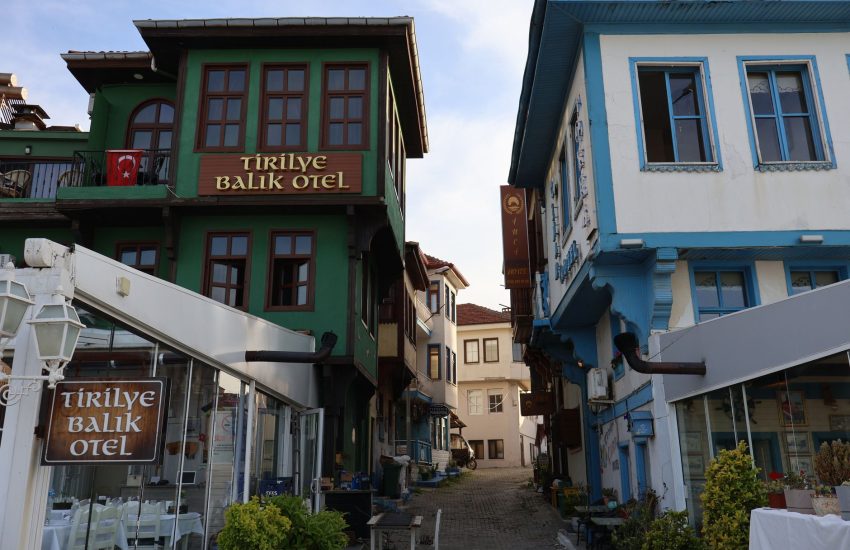
Traditional Foça houses can be examined in three main groups: Tower houses, Adjacent Houses and Single House Type. Tower houses; Outside of Foça, they are found scattered singly or in groups in abandoned or still inhabited villages. They are called ‘tower houses’ because their height is greater than the width of the facade. Adjacent Houses; These houses were built side by side, facing each other and adjacent to each other in a street.
There is no front garden in adjoining houses, the buildings open directly to the street. Single House Type; They are split-order, unplastered masonry stone structures.
Mediterranean Seals
The friends of the sailors of Foça who have not left them alone in their struggle with the sea, which has been going on for centuries, are the cute seals. Mediterranean monk seals, whose total number is around 350-400 in the world, live only in Türkiye, Greece and the coasts of Northwest Africa.
Some of the Mediterranean monk seals have made the islands around Foça their home. Despite the increasing tourism and fishing, they use the caves and shores on these islands for breeding, raising their young, resting and sunbathing. Mediterranean monk seals, whose Latin name is ‘Monachus Monachus’, need to go ashore and human signs in the places they live disturb them.
This species is one of the 12 mammal species in danger of extinction on earth.
In order to protect the Mediterranean monk seals living on the Foça islands, it is prohibited to approach the islands between Aslanburnu and Deveboynu Burnu within a distance of 2 miles, and to approach Siren Rocks and Orak Island, where the seals are seen, more than 100 meters.
Sports Activities
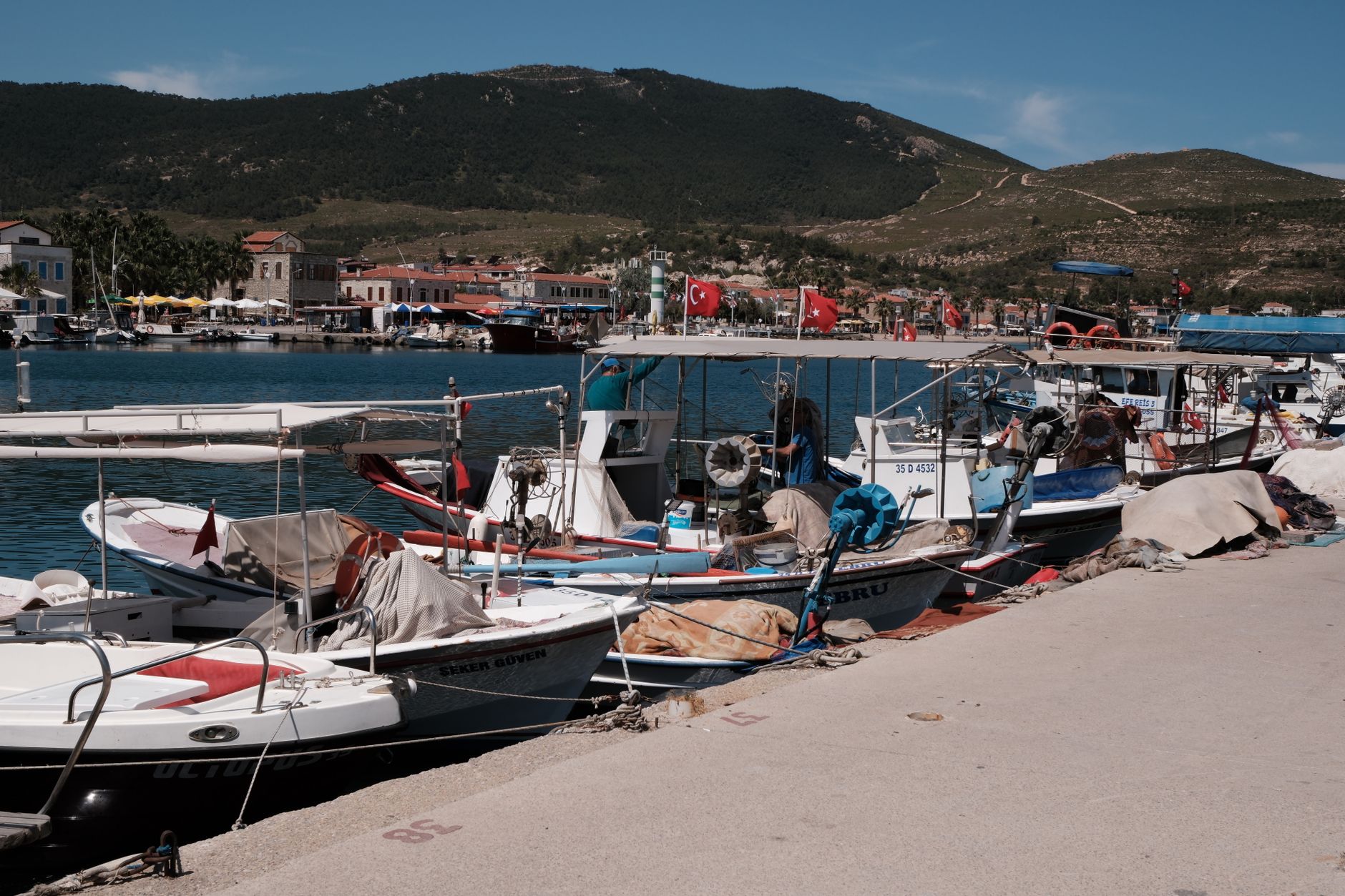
Fishing: The livelihood of the people of Foça is based on fishing as well as tourism. The only unchanging fact of the people of Foça for centuries is that they earn their living from the sea. Being sailors like their ancestors, the people of Foça are faithful and free.
Due to the richness of fish species, the region maintains its importance on the Aegean coast. Thanks to the fishermen of Foça, it is possible to find delicious fish such as red mullet, coral, sea bream, sea bass, mullet and whiting almost every day, fresh and cheap. While the fishermen sip their tea in the red of the sunset, the fish collected in their nets are prepared in restaurants to be served to the guests of Foça.
You May Like
Amasya Hotel Pension Accommodations