Trysa Ancient City is located in the east of the plateau near the village of Davazlar on the Kaş-Kale road. Its name is not found in any of the ancient sources. Trysa appears to be one of the member cities of the Lycian Union, which was formed in the 2nd century BC. The city is known for its coins from the Lycian Union period, with the abbreviation ‘TP’ in which the first two letters are written. Trysa, whose name and especially its heroon have been mentioned in the archaeological literature since the end of the 19th century, also looks like a well-protected castle where a small lord or king resides, like the cities of Phellos, Istlada and Sura.
Antalya Provincial Directorate of Culture and Tourism
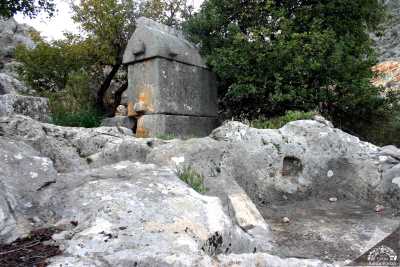
The ruins of the Trysa Ancient City, which looks like a long, narrow acropolis, in the east-west direction, at the top of a very steep cliff in the northeast and south directions, thirty meters above today’s Gölbaşı village, cover an area of five hundred fifty meters long and one hundred fifty meters wide. Some parts of this area are terraced. It is surrounded by a wall built of irregular stones on the north and west sides, dating back to the 5th century BC. Apart from the walls, today in Trysa, there are heroon walls, small ruins of the temple and many sarcophagi as ruins. Most sarcophagi are plain or have tops shaped like busts or animal heads.
Antalya Provincial Directorate of Culture and Tourism

The only structure of the city whose quality can be determined is the severely damaged temple located on the southwestern foot of the acropolis. According to the architectural elements, nothing remains of the two columns between the ante walls on the front façade. Fragments of an inscription honoring a citizen who served Zeus and Helios as a priest were found here. According to the inscription in question, the temple belongs to one or both of these gods.
Antalya Provincial Directorate of Culture and Tourism
Trysa’s largest work is the heroon, located at the northeastern end of the city and standing in a closed area of eighteen square meters, dating back to the second quarter of the 4th century BC. It is surrounded on four sides by a wall built with rectogonal blocks. On the outer face, on the south side, there is a frieze with mythological scenes in two horizontal bands. These scenes include episodes from the Iliad and Odyssey, the exploits of Theseus, parts of the Seven against Thebes, the battles of the Greeks and Amazons, Centaurs and Lapiths, as well as many other unidentified figures. The architrave blocks decorated with double rows of friezes and ornaments on the one meter wide and three meters high walls of this sarcophagus, which was carved from the local rock and prepared for a family, were taken to Vienna, and today, only an Ionic cymation block from this frieze is located near the eastern corner.
In addition, the sarcophagus of Dereimis and Aeschylus, standing in the southeast corner outside the heroon, with a gothic pediment, a quadriga (four-horse chariot) relief on both sides of the lid, and reliefs depicting a funeral feast on both sides of the ribbon-like piece placed on top, was taken to Vienna by the Austrians together with the friezes of the heroon in 1882-1983 and is exhibited in the Kunsthistorisches Museum.

Trysa, which is an important center because some of the monuments in the city are the earliest examples of all of Lycia, is among the “Ancient Cities of the Lycian Civilization” (2009) recommended for the UNESCO World Heritage List.
Source: “Trysa”, Antalya from Past to Today [II. Volume], Antalya Provincial Directorate of Culture and Tourism (2012)
Places to Visit in Antalya
Source: Antalya Provincial Culture and Tourism Directorate