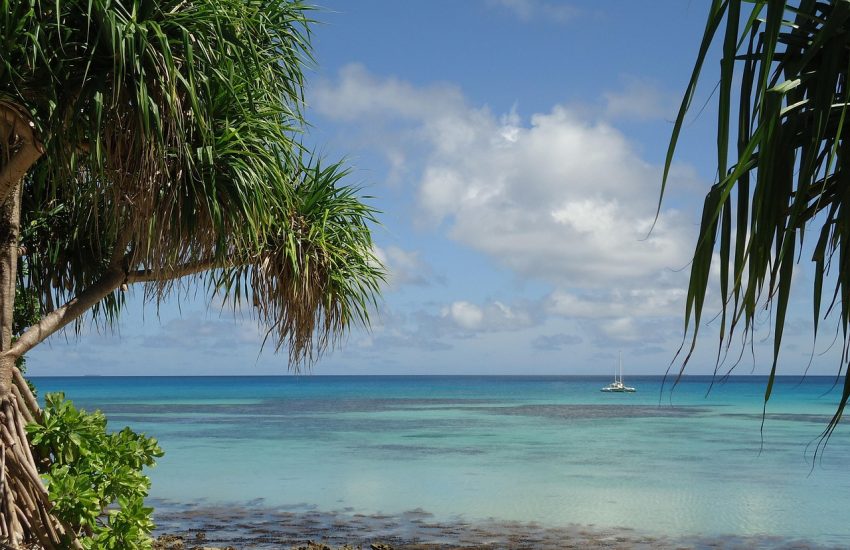
Across two chains of coral atolls whose land averages two meters above the sea live the heirs of the Pacific’s most refined navigators. The Marshallese read ocean swells the way others read maps, built the fastest sailing canoes of the old sea, and organized survival on ribbons of coral through clans that descend, mother to mother, from the founding voyages. In the twentieth century their islands were made the proving ground of the thermonuclear age; in the twenty-first they stand at the waterline of the warming world.
This portrait follows the Ri-Majel of Aelon Kein Ad, these islands of ours: the stick charts and wave pilots, the matrilineal land that no storm could erase, the mission churches and the months-long Christmas, the first-birthday feasts and revived master mats, the sixty-seven blasts whose ledger remains open, and a nation negotiating its own physical survival with the tide.
Contents
- Two Thousand Years on Ribbons of Coral
- Aelon Kein Ad, These Islands of Ours
- Kajin Majel Across Two Chains and a Diaspora
- Twenty-Nine Atolls a Breath Above the Sea
- Stick Charts, Wave Piloting, and the Atoll Economy
- Matrilineal Land and the Rule of the Iroij
- Spirits of the Reef and the Mission Churches
- First Birthdays, Jaki-ed Mats, and the Navigator’s Test
- Weavers of Pandanus and Builders of the Fastest Canoes
- Breadfruit, Pandanus, and the Lagoon’s Catch
- Kurijmoj, the Marshallese Christmas Season
- Sixty-Seven Blasts and the Price of the Cold War
- A Nuclear Nation Facing the Rising Tide
Two Thousand Years on Ribbons of Coral
The Marshallese have lived on their coral ribbons for around two thousand years, descendants of Micronesian voyagers who worked their way east through the Carolines and settled two parallel chains of atolls, the sunrise Ratak and the sunset Ralik. On land that nowhere rises higher than a coconut tree, they built one of the most specialized maritime cultures the species has produced.
An atoll offers almost nothing: no stone but coral, no metal, thin soil salted by spray. The settlers answered with the coconut, the pandanus, the breadfruit, and above all the canoe, and they turned the gaps between islands from barriers into roads, binding each chain with regular voyaging.
Out of that necessity came the Marshallese navigational science: pilots who read the interference patterns of swells bending around atolls the way others read coastlines, trained from childhood by lying blindfolded in canoes to feel the sea’s grammar through the hull.
Their genealogies, chants, and land titles carry the deep history: every Marshallese belongs from birth to a matrilineal clan whose rights in particular strips of atoll land run back, mother to mother, toward the founding canoes.
Archaeology on atolls is a race against the sea, yet excavations on Majuro, Ebon, and Kwajalein have pulled fishhooks, shell adzes, and earth ovens from beneath the coconut groves dated to the first centuries AD, and the pattern they sketch, small founding groups, rapid inter-atoll linkage, matches the genealogies the chiefs still recite at land hearings.
Archaeology on atolls is a race against the sea, yet excavations on Majuro, Ebon, and Kwajalein have pulled fishhooks, shell adzes, and earth ovens from beneath the coconut groves dated to the first centuries AD, and the pattern they sketch, small founding groups, rapid inter-atoll linkage, matches the genealogies the chiefs still recite at land hearings.

Aelon Kein Ad, These Islands of Ours
The islands wear an English captain’s surname: John Marshall sailed through in 1788 and the chart-makers attached his name to islands he barely paused at. The Marshallese phrase for their own country is Aelon Kein Ad, these islands of ours, and it is the name the independence generation put on its constitution’s preamble.
The people call themselves Ri-Majel, the people of the Marshalls, and their language Kajin Majel; the outside name and the inside name live together, as they do across the colonized Pacific.
Two atoll names became world words without their people’s consent: Bikini, taken for a swimsuit within days of the 1946 tests while its owners sat in exile, and Enewetak, a byword of the thermonuclear age. Marshallese speakers note, with restraint, what it means to have your homeland known chiefly as a synonym for destruction.
The country’s motto answers all of it: Jepilpilin ke ejukaan, accomplishment through joint effort, the atoll’s oldest rule stated as national policy.
Kajin Majel Across Two Chains and a Diaspora
Kajin Majel is a Micronesian language of the Oceanic family, split into the Ratak and Ralik dialects that mirror the two atoll chains, mutually intelligible and mutually teased. Its sound system, with rounded and unrounded consonant pairs, is one of the more intricate in the Pacific, and its orthography was long argued between mission spelling and linguistic reform.
It remains robust at home, the daily language of government, radio, and the church, spoken by effectively all of the islands’ residents; the pressure point is the diaspora, where children in Arkansas and Hawai’i grow up in English and summer visits home.
The language’s registers of respect mirror the society: distinct vocabulary softens speech toward iroij chiefs and elders, and oratory at land meetings and funerals is a ranked skill, with proverbs of canoe and current carrying the argument.
Mission literacy came early and deep, the Marshallese Bible has been read for a century and a half, and the modern corpus, dictionaries, school curricula, and a lively Marshallese-language social media, keeps Kajin Majel writing its own record.
Marshallese names carry the system in miniature: land parcels, winds, and sea passages all bear names that encode ownership and story, and learning them is learning the law; an elder walking a child down an islet path, naming as they go, is the archive transmitting itself.
Marshallese names carry the system in miniature: land parcels, winds, and sea passages all bear names that encode ownership and story, and learning them is learning the law; an elder walking a child down an islet path, naming as they go, is the archive transmitting itself.

Twenty-Nine Atolls a Breath Above the Sea
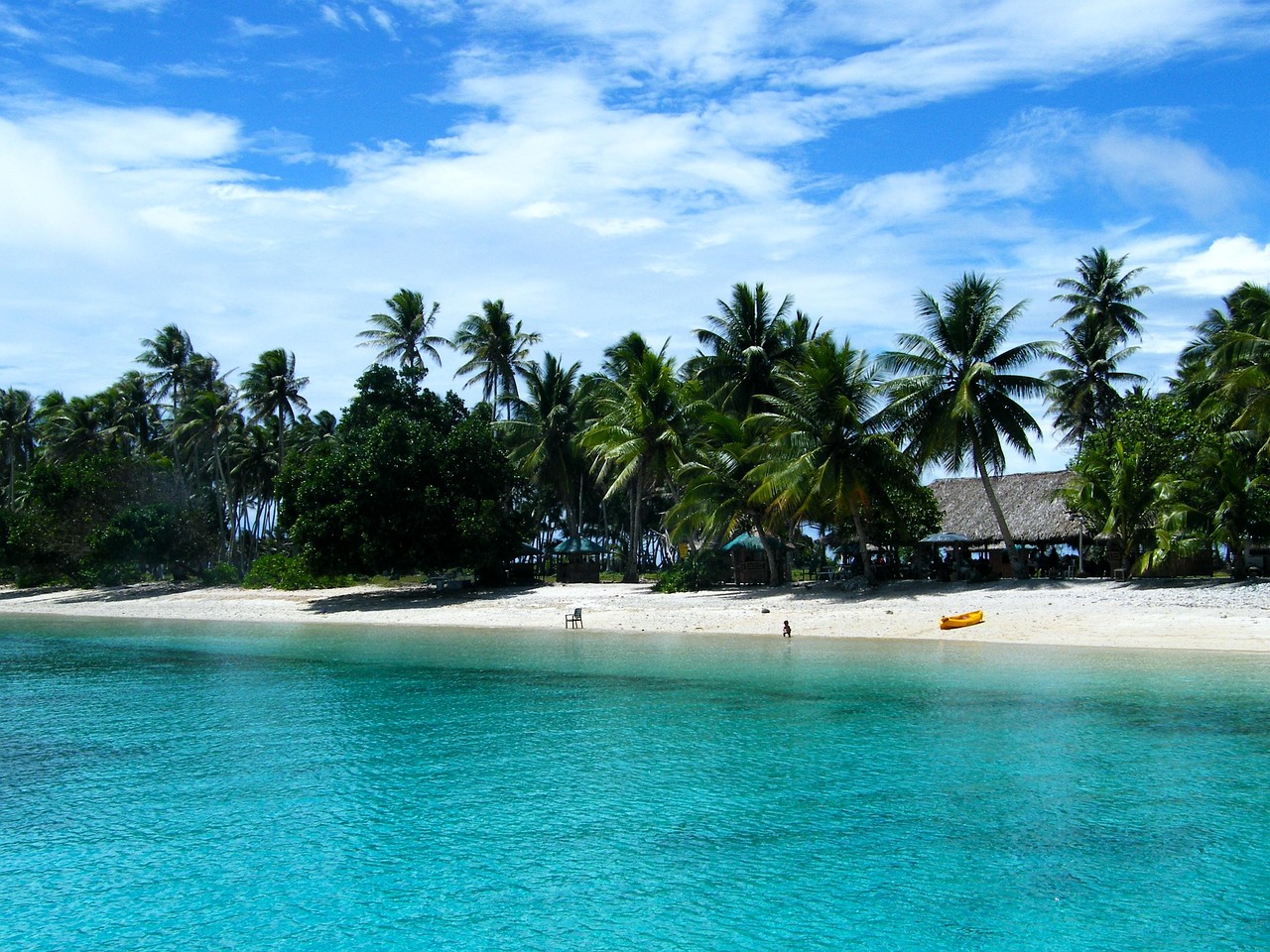
The Republic of the Marshall Islands consists of twenty-nine atolls and five solitary islands, over a thousand islets in all, scattered across nearly two million square kilometers of ocean, with a total land area smaller than Washington, D.C. The average height of that land is about two meters.
Kwajalein is the world’s largest atoll by lagoon, a hundred-kilometer ring of reef whose waters the United States leases as a missile test range; Majuro, the capital atoll, houses half the nation’s people on a ribbon so narrow that its main road is never out of the sea’s hearing.
The atolls’ true geography is vertical: a living reef holding a fossil reef, a freshwater lens floating in the coral beneath each islet, rain-fed and fragile, and the lagoon, calm side and larder, against the ocean side’s surf.
That geometry is now the nation’s exposure: king tides wash through Majuro’s causeways, saltwater creeps into the lenses and the taro pits, and a people whose land has always been a breath above the sea measure the century in centimeters.
Distance still disciplines everything: the outer atolls see a supply ship monthly at best, solar panels and rain tanks have replaced none of the old self-reliance, and a Majuro family’s weekend voyage to its home islet is planned like the small expedition it remains.
Distance still disciplines everything: the outer atolls see a supply ship monthly at best, solar panels and rain tanks have replaced none of the old self-reliance, and a Majuro family’s weekend voyage to its home islet is planned like the small expedition it remains.

Stick Charts, Wave Piloting, and the Atoll Economy
The Marshallese canoe was the finest sailing machine of the old Pacific: the walap voyaging canoes and the smaller tipnol rode an asymmetric hull with the outrigger always to windward, shunting end for end instead of tacking, and visiting Europeans clocked them at speeds their own ships could not touch.
The navigators’ school was the stick chart: frames of lashed palm ribs and cowrie shells mapping not islands but swells, how the ocean’s patterns bend, cross, and knot around the atolls. The charts were teaching diagrams, memorized and left ashore; the pilot’s instrument at sea was his own body against the hull.
Atoll subsistence ran on a divided estate: breadfruit and pandanus groves and taro pits on the islets, the lagoon’s fish corralled with weirs and nets, the ocean side’s tuna and flying fish taken by canoe, and the coconut serving as food, drink, oil, rope, and timber.
Land moved through women, chiefs took tribute in first fruits and mats, and inter-atoll voyages carried tribute, brides, and war; the system’s whole logic was insurance, kin and obligations spread across many low islands so that no single storm could starve a lineage.
The tribute voyages were also intelligence networks: a chief’s fleet returning from the northern atolls carried news of breadfruit yields, marriages, and quarrels along with mats and preserved pandanus, and a good navigator was prized as much for what he knew as for how straight he sailed.
The tribute voyages were also intelligence networks: a chief’s fleet returning from the northern atolls carried news of breadfruit yields, marriages, and quarrels along with mats and preserved pandanus, and a good navigator was prized as much for what he knew as for how straight he sailed.

Matrilineal Land and the Rule of the Iroij
Marshallese society is matrilineal to its bones: every person belongs to the mother’s jowi, the clan, and rights to land, the scarcest thing in an atoll world, descend through women. A Marshallese asked where they are from answers with the land parcels of their mother’s line.
Authority is a three-cornered contract: the iroij, the chiefs, hold paramount rights, the alap heads of lineages manage the land, and the ri-jerbal, the workers, live from and keep it productive. Each owes the others, and the copra check and the lease payment are still divided among all three.
The iroij remain constitutional facts: a Council of Iroij advises the republic’s parliament, the Nitijela, on custom and land, and the great chiefly lines of Ralik and Ratak have supplied presidents and senators to the modern state.
Daily life runs on the bwij, the extended family, on adoption that circulates children among kin, and on the ethic of joint effort the motto names; the atoll’s oldest lesson is that no one survives alone on two meters of coral.
The bwij’s reach is transoceanic now: a lineage meeting about a Majuro land lease may videoconference Arkansas and Honolulu, the alap presiding over speakerphone, and remittances flow along exactly the channels tribute once did, the atoll’s insurance logic scaled to a hemisphere.
The bwij’s reach is transoceanic now: a lineage meeting about a Majuro land lease may videoconference Arkansas and Honolulu, the alap presiding over speakerphone, and remittances flow along exactly the channels tribute once did, the atoll’s insurance logic scaled to a hemisphere.

Spirits of the Reef and the Mission Churches
The old Marshallese cosmos was populated by ekjab, spirits resident in reefs, trees, and particular islets, by ancestor ghosts who traveled between atolls, and by the great figures of chant, Letao the trickster chief among them, whose mischief explains much of how the world went crooked. Navigation, tattooing, and medicine each had their attendant spirits and their tapu.
Congregationalist missionaries from Boston and Hawai’i landed at Ebon in 1857, and the conversion that followed was thorough: within two generations the islands were church-going, hymn-singing, and Sabbath-keeping, and the mission’s Marshallese teachers carried the faith atoll to atoll in their own canoes.
The church became the atoll’s second lagoon, the place everything gathers: services in Kajin Majel anchor the week, deacons and women’s groups run much of village life, and the great church conferences bring whole atolls together under thatch and tin.
The old knowledge did not vanish so much as specialize: families still hold medicine, navigation, and weather lore as inherited property, ekjab are spoken of at the edges of the reef at night, and the missionaries’ hymnody itself has become tradition, sung in harmonies now counted as Marshallese as the canoe.
Church music is the community’s deepest art form today: a cappella harmonies in Kajin Majel, hymnbooks worn soft, and the jepta season’s compositions add new verses every year to a repertoire that functions as the nation’s collective diary.
Church music is the community’s deepest art form today: a cappella harmonies in Kajin Majel, hymnbooks worn soft, and the jepta season’s compositions add new verses every year to a repertoire that functions as the nation’s collective diary.

First Birthdays, Jaki-ed Mats, and the Navigator’s Test
The great Marshallese celebration is the kemem, the first-birthday feast: an infant’s survival of the dangerous first year is answered with a gathering of hundreds, pigs and breadfruit heaped, songs composed, and the child passed hand to hand through its whole bwij, a census of belonging disguised as a party.
Woven wealth is women’s wealth: the jaki-ed, the fine clothing mats of dyed pandanus whose geometric borders identified clan and rank, lapsed in the twentieth century and have been deliberately revived, with master weavers training cohorts and the best new mats entering museums and state gifts.
Tattooing once wrote rank across bodies, chiefly faces included, in patterns named for the sea’s forms; suppressed by the mission century, it is returning on younger skin from the diaspora inward.
And the navigation itself is tradition made curriculum again: Waan Aelon in Majel, the canoe house in Majuro, teaches hull-building and wave piloting to new generations, and a Marshallese pilot’s blind reading of the swells has been verified by GPS-tracked crossings that landed within sight of the target atoll.
The kemem’s economics are the old redistribution intact: families save for a year, kin contribute by assignment, and the feast’s surplus travels home with the guests; anthropologists call it wealth leveling, the Marshallese call it a birthday.
The kemem’s economics are the old redistribution intact: families save for a year, kin contribute by assignment, and the feast’s surplus travels home with the guests; anthropologists call it wealth leveling, the Marshallese call it a birthday.

Weavers of Pandanus and Builders of the Fastest Canoes
Marshallese craft begins with pandanus and coconut fiber: sails, sleeping mats, baskets, fans, and the jaki-ed at the art’s summit, all plaited from leaves cured, split, and softened by hand. The handicraft cooperatives of Majuro ship woven ornaments worldwide, one of the few exports an atoll can grow.
The canoe is the master craft: hulls of breadfruit wood sewn and lashed with sennit, outriggers balanced to the centimeter, every joint serviceable by its crew at sea. Canoe races open national holidays, and the annual Cup regattas keep builders competitive.
Shell and coral supplied the old toolkit, adzes, fishhooks, jewelry, and shell-work leis and headbands remain the ornament of every celebration, pressed on departing guests in numbers that fill suitcases.
The stick charts, no longer needed at sea, have become the nation’s visual signature, reproduced in the parliament’s architecture and the national museum’s logo, a mapping tradition unlike any other on earth doing new work as identity.
Weaving remains a daily language between women, patterns exchanged, judged, and inherited, and the cooperative’s export tags now carry the weaver’s name and atoll, provenance the market finally learned to pay for.
Weaving remains a daily language between women, patterns exchanged, judged, and inherited, and the cooperative’s export tags now carry the weaver’s name and atoll, provenance the market finally learned to pay for.

Breadfruit, Pandanus, and the Lagoon’s Catch
The atoll pantry is short and ingenious: breadfruit eaten roasted, pounded, or fermented in pits against the lean season; pandanus fruit chewed fresh or boiled to the sweet conserve called mokwan; taro coaxed from dug and composted pits; and the coconut at every stage, drinking nut, cream, copra, and the sweet toddy tapped from the flower spathe.
The lagoon and reef fill the protein column, reef fish grilled over husk fires, flying fish chased by torchlight, tuna and mahimahi from the ocean side, octopus and clams from the flats, dressed with lime and coconut.
Feast cooking centers on the earth oven and the underground breadfruit ferment, and a kemem or church conference is measured in breadfruit by the hundred and pigs by the row.
Import dependence is the modern shadow: rice, flour, and tinned meat dominate town diets, with the health costs the region shares, and food-security programs now replant breadfruit varieties and taro pits, the old atoll insurance rewritten as policy.
Fishing keeps its etiquette: the first catch of a boy’s line goes to his grandmother, reef closures are still called by lineage right in places, and a good toddy-cutter’s morning climb supplies the neighborhood’s sweetness before the store opens.
Fishing keeps its etiquette: the first catch of a boy’s line goes to his grandmother, reef closures are still called by lineage right in places, and a good toddy-cutter’s morning climb supplies the neighborhood’s sweetness before the store opens.
Kurijmoj, the Marshallese Christmas Season
The Marshallese year crescendos into Kurijmoj, the Christmas season that is less a day than a quarter: from October, village and church groups called jepta rehearse songs, dances, and skits in secret, then tour and compete through December in performances that run for hours, exchanging gifts and mock raids between groups.
The season’s climax folds worship and carnival together on Christmas Day, congregations performing in turn, women’s lines in matching dresses, comic interludes, and the beet, the marching-dance step, filling churches from Majuro to Springdale, Arkansas.
National holidays orbit the sea: Manit Day, custom day, brings weaving, canoe, and fishing contests each fall; the outrigger regattas crown the calendar; and Nuclear Victims Remembrance Day, March 1, the Bravo anniversary, is the gravest date, marked with testimony and wreaths at sea.
Every kemem, wedding, and church conference adds its own feast, and the jepta system means most Marshallese spend part of every year in rehearsal, the community perpetually preparing to sing to itself.
Even the gravest date has its Marshallese form: March 1 testimony is followed by shared food and song, grief handled as everything is handled on an atoll, together and aloud.
Even the gravest date has its Marshallese form: March 1 testimony is followed by shared food and song, grief handled as everything is handled on an atoll, together and aloud.
Sixty-Seven Blasts and the Price of the Cold War
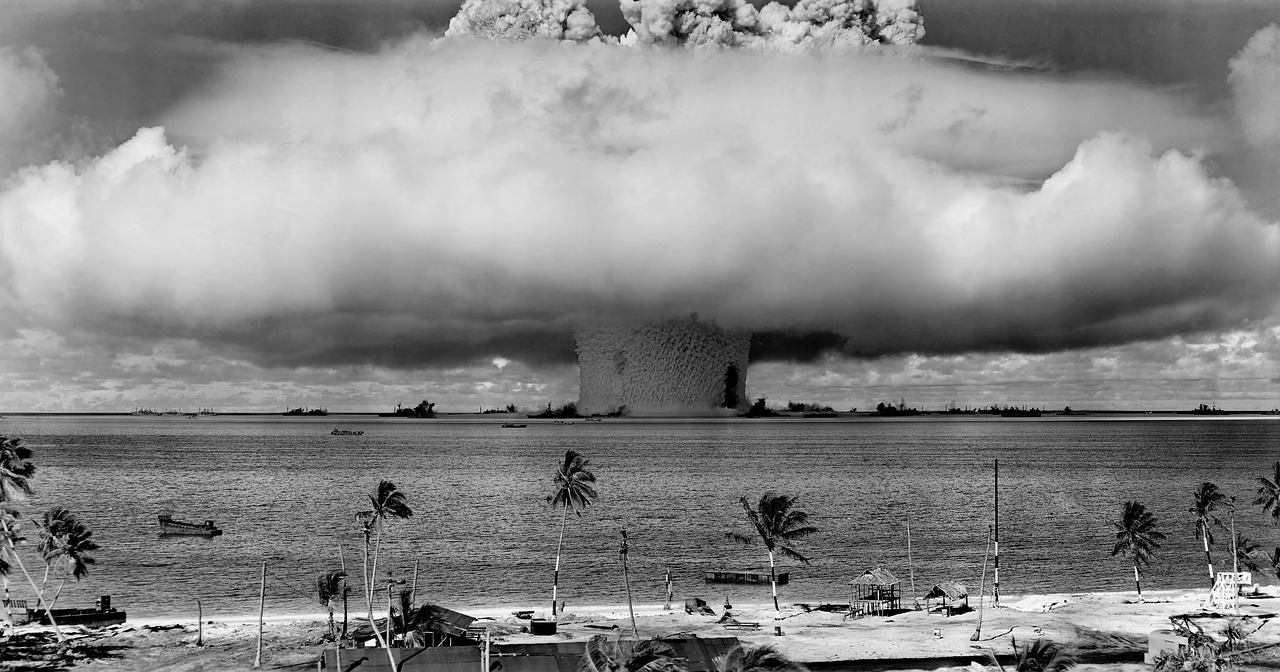
Spain claimed, Germany bought, and Japan fortified the Marshalls in turn, and the Second World War arrived as amphibious catastrophe at Kwajalein and Enewetak. What followed cut deeper: chosen as America’s Pacific proving ground, the islands absorbed sixty-seven nuclear tests between 1946 and 1958.
Bikini’s people, asked to move for the good of mankind, began an exile that has never ended; Enewetak’s were displaced for decades. On March 1, 1954, the Castle Bravo shot, a thousand Hiroshimas, showered Rongelap and Utrik with fallout ash children played in as snow; the burns, thyroid disease, and evacuations that followed made the Marshallese the atomic age’s most studied and least consulted subjects.
The republic negotiated free association with the United States, independent since 1986, with defense and Kwajalein’s missile range leased against American funding and the right of Marshallese to live and work in the U.S.; a Nuclear Claims Tribunal awarded damages in the billions that have never been fully funded.
Rongelap’s people, told their atoll was safe, evacuated themselves aboard the Rainbow Warrior in 1985 when the readings said otherwise; the ledger of the testing era, in land, bodies, and trust, remains open in Washington’s books and Majuro’s speeches alike.
The testimony of Marshallese witnesses, mothers describing births no language had words for, elders mapping lost islets from memory, entered the world’s disarmament record and changed it; the 2017 nuclear ban treaty’s preamble carries the Marshalls’ fingerprints, a small nation’s grief made international law’s conscience.
The testimony of Marshallese witnesses, mothers describing births no language had words for, elders mapping lost islets from memory, entered the world’s disarmament record and changed it; the 2017 nuclear ban treaty’s preamble carries the Marshalls’ fingerprints, a small nation’s grief made international law’s conscience.
A Nuclear Nation Facing the Rising Tide
About 42,000 people live in the republic, and at least as many Marshallese live in the United States under the compact’s open door, with Springdale, Arkansas, improbably hosting the largest community anywhere; poultry-plant wages remit home, and the kemem and Kurijmoj travel with the passports.
The home economy rests on the compact’s funds, Kwajalein’s lease, fishing licenses sold across a tuna-rich exclusive economic zone, and copra; the republic’s ship registry, flagging much of the world’s tonnage, gives the low atolls an outsized presence on the ocean’s paperwork.
Climate is the existential file: the government’s adaptation plans study elevation, land raising, and the legal survival of a state whose territory the sea may overrun, and Marshallese diplomats, heirs of the nuclear testimony tradition, are among the bluntest voices in climate negotiations, asking the world not to do to them twice what it did once.
Through it all the culture keeps its wake: canoes launch from Majuro’s shore, jaki-ed come off the looms, the jepta rehearse from October, and the nation’s poets, Kathy Jetnil-Kijiner’s UN reading first among them, have made the atoll’s two meters of coral a moral standpoint the whole world can locate.
The republic has also become a legal innovator of necessity, arguing that statehood and maritime boundaries fixed by treaty survive physical submergence, a doctrine now gaining ground in international law; the Marshalls may end up defending every low-lying nation’s future in the abstract language of boundaries and baselines.
The republic has also become a legal innovator of necessity, arguing that statehood and maritime boundaries fixed by treaty survive physical submergence, a doctrine now gaining ground in international law; the Marshalls may end up defending every low-lying nation’s future in the abstract language of boundaries and baselines.

Related Peoples of the Region
- Tongan People of the Friendly Islands and Their Kingdom That Was Never Conquered
- Tongan People of the Friendly Islands and Their Kingdom That Was Never Conquered
- Native Hawaiians of the Polynesian Triangle’s Northern Star and Their Great Recovery
- Native Hawaiians of the Polynesian Triangle’s Northern Star and Their Great Recovery
- Tahitians of Ma’ohi Nui and Their Islands at the Center of the Eastern Sea
- Tahitians of Ma’ohi Nui and Their Islands at the Center of the Eastern Sea
- Rapa Nui People of Easter Island and Their Ancestors Carved in Stone
- Rapa Nui People of Easter Island and Their Ancestors Carved in Stone