Many of the castles in this series are fairy tales, romantic fantasies built or rebuilt in the nineteenth century to look the way we imagine castles should look. The Imperial Castle of Nuremberg is something altogether different, and in some ways far more important. This is a genuine medieval fortress, one of the most historically significant castles in all of Germany, a place where the emperors of the Holy Roman Empire held court for five hundred years and where the destiny of a large part of Europe was, at times, decided.
Rising on a great outcrop of sandstone above the red roofs of Nuremberg, the castle is not a single building but a whole complex of towers, halls, chapels, and walls, accumulated over the long centuries when Nuremberg was one of the most important cities of the empire. Every Holy Roman Emperor for half a millennium stayed here, and the castle became a symbol of imperial power itself, bound up with the government of a realm that stretched across the heart of the continent.
To climb to the Kaiserburg, as the Germans call it, is therefore to climb into the very heart of German and European history. This is not a romantic dream but the real thing, a working imperial fortress that shaped the politics of centuries, that survived war and destruction, and that still crowns the old city it once ruled. Come up the sandstone rock with me and we will explore the castle of the emperors, and discover why Nuremberg’s fortress matters more, perhaps, than any fairy tale.

In This Article
- The Crown of a Free City
- Three Castles in One
- Where the Emperors Came
- The Golden Bull and the Diet
- The Emperor’s Double Chapel
- The Round Tower and the Deep Well
- Into the Imperial Courtyard
- The Oldest Stones
- The Imperial Stables and the City’s Might
- A View Over a Renaissance City
- The Castle Garden
- Destruction and Rebirth
- Visiting the Imperial Castle
The Crown of a Free City
To understand the Imperial Castle, you must understand the city it crowns. Nuremberg was, in the Middle Ages and the Renaissance, one of the greatest cities of the Holy Roman Empire, a free imperial city answerable directly to the emperor, immensely wealthy from trade and craft, and a centre of art, learning, and invention. Its merchants traded across Europe, its craftsmen were famous for their skill, and its citizens were fiercely proud of their independence.
The castle on its rock above the city was the physical link between this proud city and the empire to which it belonged. It was not the seat of a local lord ruling over the townspeople, but an imperial fortress, a place where the emperor himself resided when he came to Nuremberg, standing above the city as a symbol of the higher authority that both protected and honoured it. City and castle were partners in the story of the empire.
From almost anywhere in the old town you can look up and see the castle on its height, and the sight sums up the whole relationship. Below spread the roofs, churches, and market squares of one of Europe’s greatest cities; above rose the fortress of the emperors. Nuremberg was a jewel of the empire, and the Imperial Castle was its crown, the two together forming one of the most important centres of power and culture in medieval and Renaissance Europe.
A free imperial city like Nuremberg enjoyed a proud independence, governing its own affairs and answering to no local lord but only to the distant emperor. This unusual status made such cities among the most dynamic places in the empire, and Nuremberg was the greatest of them, a self-governing republic of merchants and craftsmen whose wealth and skill were famous throughout Europe, all beneath the watchful presence of the imperial castle.
Three Castles in One
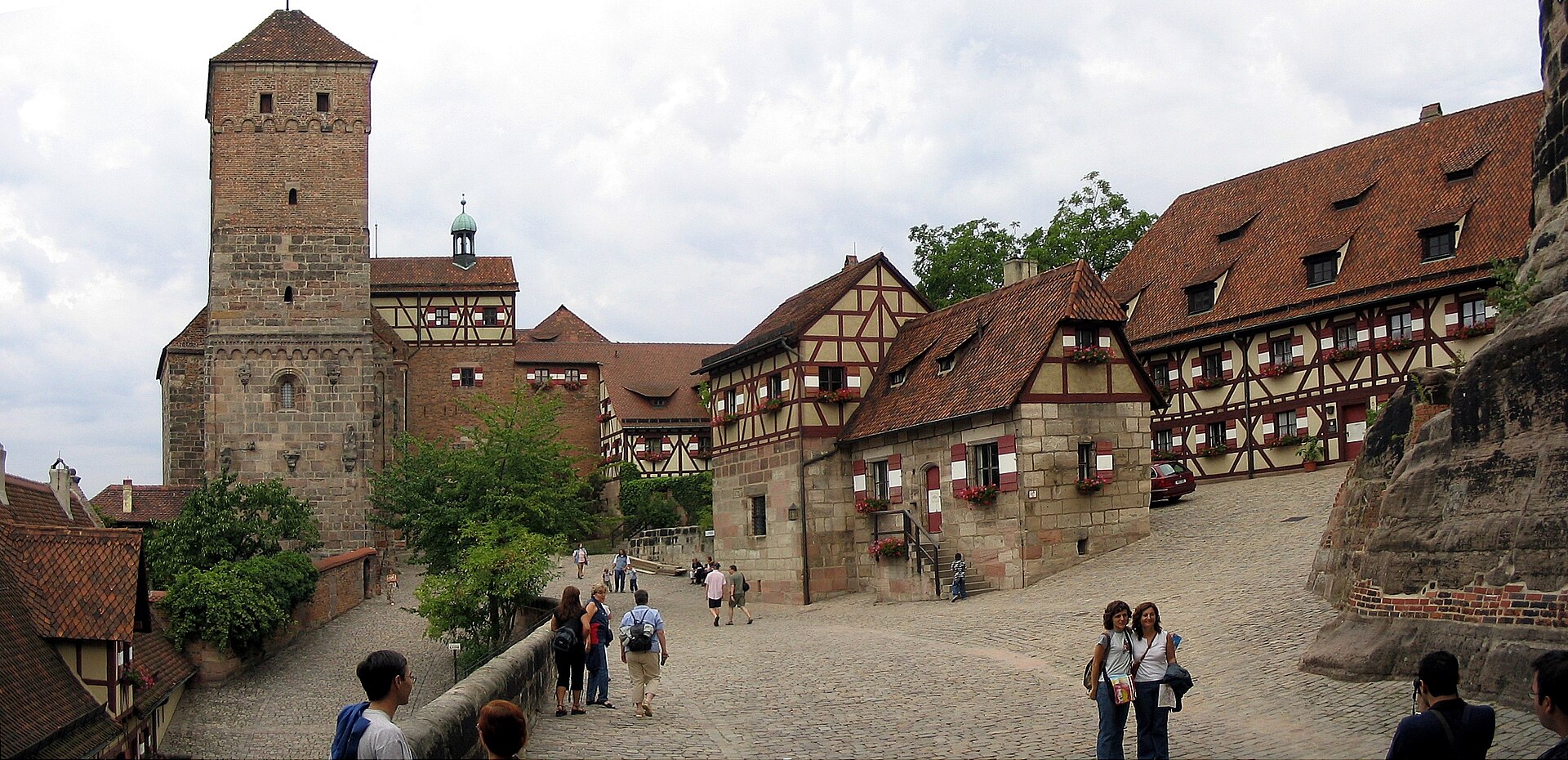
What we call the Imperial Castle is not a single structure but a complex of buildings that grew up together on the sandstone ridge, and it helps to think of it as several castles in one. There is the imperial castle proper, the residence of the emperors, with its halls and chapel; there is the area once held by the burgraves, the hereditary officials who governed the fortress on the emperor’s behalf; and there are the towers and buildings raised by the city of Nuremberg itself.
This layered structure reflects the complicated politics of the medieval empire, in which authority was shared and contested among the emperor, his officials, and the powerful city. Over time the balance shifted, and the city of Nuremberg came to control more and more of the fortress, until eventually it held the whole castle, maintaining it on the emperor’s behalf. The buildings on the rock are a physical record of that long negotiation of power.
Seen from above, the complex reveals its scale and variety, a sprawl of towers, halls, walls, and courtyards climbing the ridge. Each part has its own history and its own character, from the ancient towers of the earliest fortress to the grand imperial apartments to the massive structures raised by the city. Together they make up one of the largest and most impressive castle complexes in Germany, and one of the most historically layered.
The presence of the burgraves, the hereditary officials who once held part of the fortress, points to the layered and often tense distribution of power on the rock. In time the city bought out and absorbed their holdings, an important step in Nuremberg’s steady acquisition of control over the whole castle. The physical divisions of the complex thus preserve, in stone, the political struggles that shaped the fortress over the centuries.
This complexity can make the castle a little bewildering at first, but it is also part of its fascination, for each stage of the climb reveals a different age and a different kind of building. Taking the time to understand how the parts fit together turns a visit into a journey through the whole long history of the fortress, from its earliest towers to its grandest imperial halls.

Where the Emperors Came
The defining fact of the Imperial Castle is its role as a residence of the Holy Roman Emperors. For roughly five centuries, every emperor of the Holy Roman Empire stayed at Nuremberg, making the castle one of the principal seats of imperial power in the whole realm. The empire had no fixed capital, and its rulers moved constantly among their many palaces and cities, but Nuremberg was among the most important stops on that endless royal progress.
This gave the castle an extraordinary political weight. When the emperor was in residence, Nuremberg became, for a time, the centre of the empire, the place where he received ambassadors, dispensed justice, held councils, and conducted the business of governing a realm that sprawled across central Europe. The halls of the castle rang with the affairs of state, and decisions made here rippled out across a vast territory.
For the city, hosting the emperor was both an honour and a source of pride and profit, confirming Nuremberg’s standing as one of the foremost cities of the empire. The long association between the castle and the imperial office made the fortress a symbol of the empire itself, and it is this deep connection to the highest power in the land that sets Nuremberg apart from the romantic castles of later ages. This was where the empire was governed.
The Holy Roman Empire itself was a realm unlike any other, a sprawling and loosely bound collection of hundreds of territories, cities, and lordships spread across the heart of Europe, held together by the person and office of the emperor. In such a realm, with no true capital, the great imperial castles like Nuremberg took on an outsized importance as fixed points of authority in a constantly moving court, anchors of a mobile monarchy.
The constant movement of the imperial court meant that a castle like Nuremberg had to be ready at any time to receive the emperor and his large following, with all the apartments, halls, and services that such a visit required. Maintaining the fortress in a state fit for imperial residence was a serious and continuing responsibility, and it fell increasingly to the city, which took up the task as a matter of both duty and pride.
The Golden Bull and the Diet
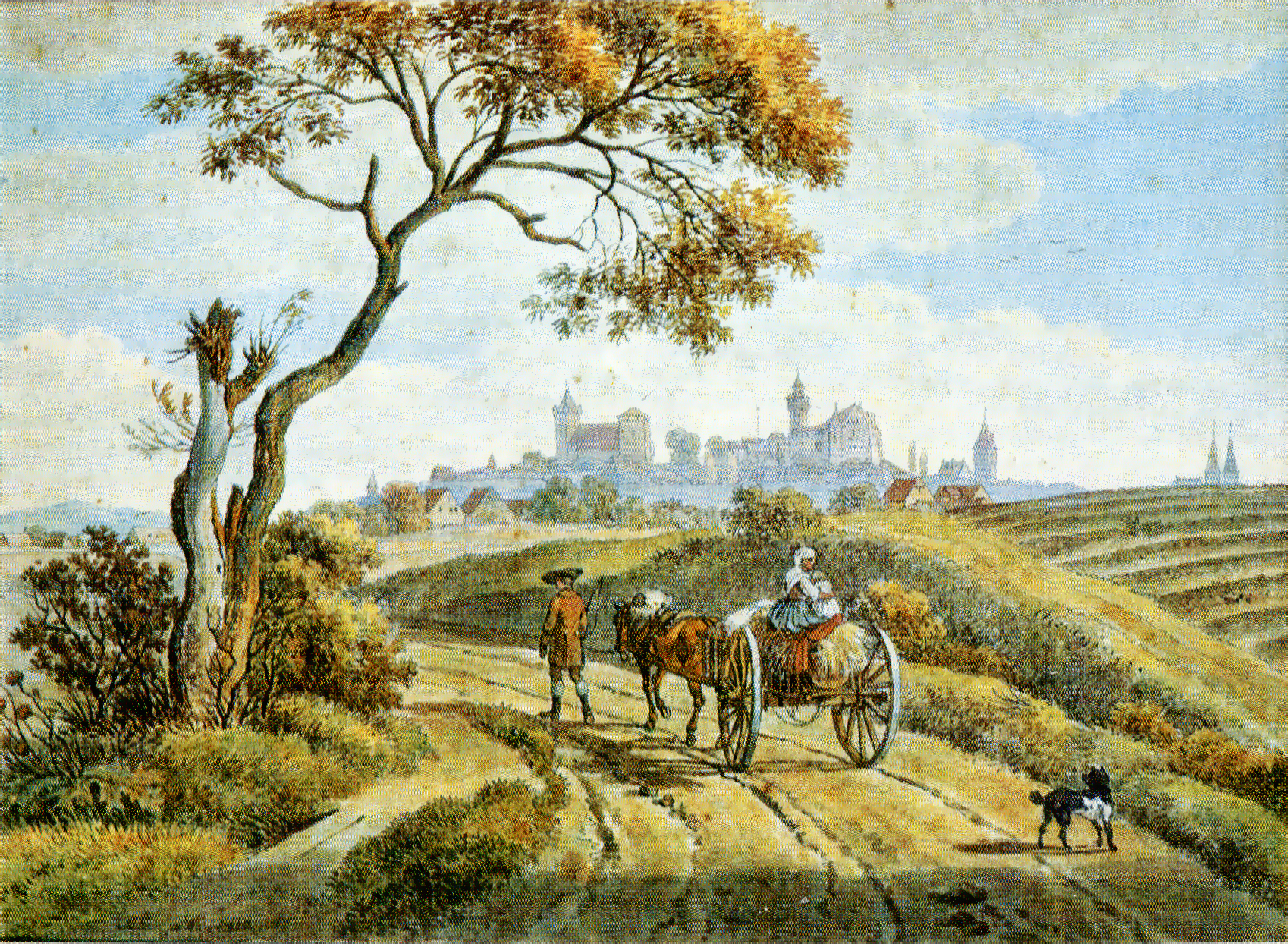
Nuremberg’s importance to the empire was not merely a matter of custom; it was written into the very constitution of the realm. In the fourteenth century, a great imperial law known as the Golden Bull, which set out the rules for electing and crowning the emperor, gave Nuremberg a special role. It decreed that each newly elected king should hold his first imperial assembly, the great council of the empire, in the city of Nuremberg.
This made Nuremberg, in effect, a constitutional heart of the empire, the place where each new reign was formally inaugurated in the presence of the great princes and lords of the realm. The imperial assemblies, or diets, were the closest thing the empire had to a parliament, gatherings where the emperor and the leading powers of the realm debated the great questions of the day, and Nuremberg’s guaranteed role in them cemented its status.
The grand halls of the castle, above all the Imperial Hall, were the setting for such gatherings when the emperor was in residence. Here, beneath painted ceilings and amid the trappings of imperial majesty, the business of the empire was conducted, and the great men of the realm assembled around their ruler. To stand in these rooms is to stand where the government of the Holy Roman Empire, that strange and sprawling realm at the centre of Europe, was carried on for centuries.
The Golden Bull was one of the most important documents in the history of the empire, a fundamental law that governed the election of the emperor for centuries. That it singled out Nuremberg for so central a role is a measure of the city’s standing, and it bound the fate of the city and its castle ever more tightly to the constitutional life of the realm. Few cities were so deeply written into the workings of the empire itself.
The Emperor’s Double Chapel
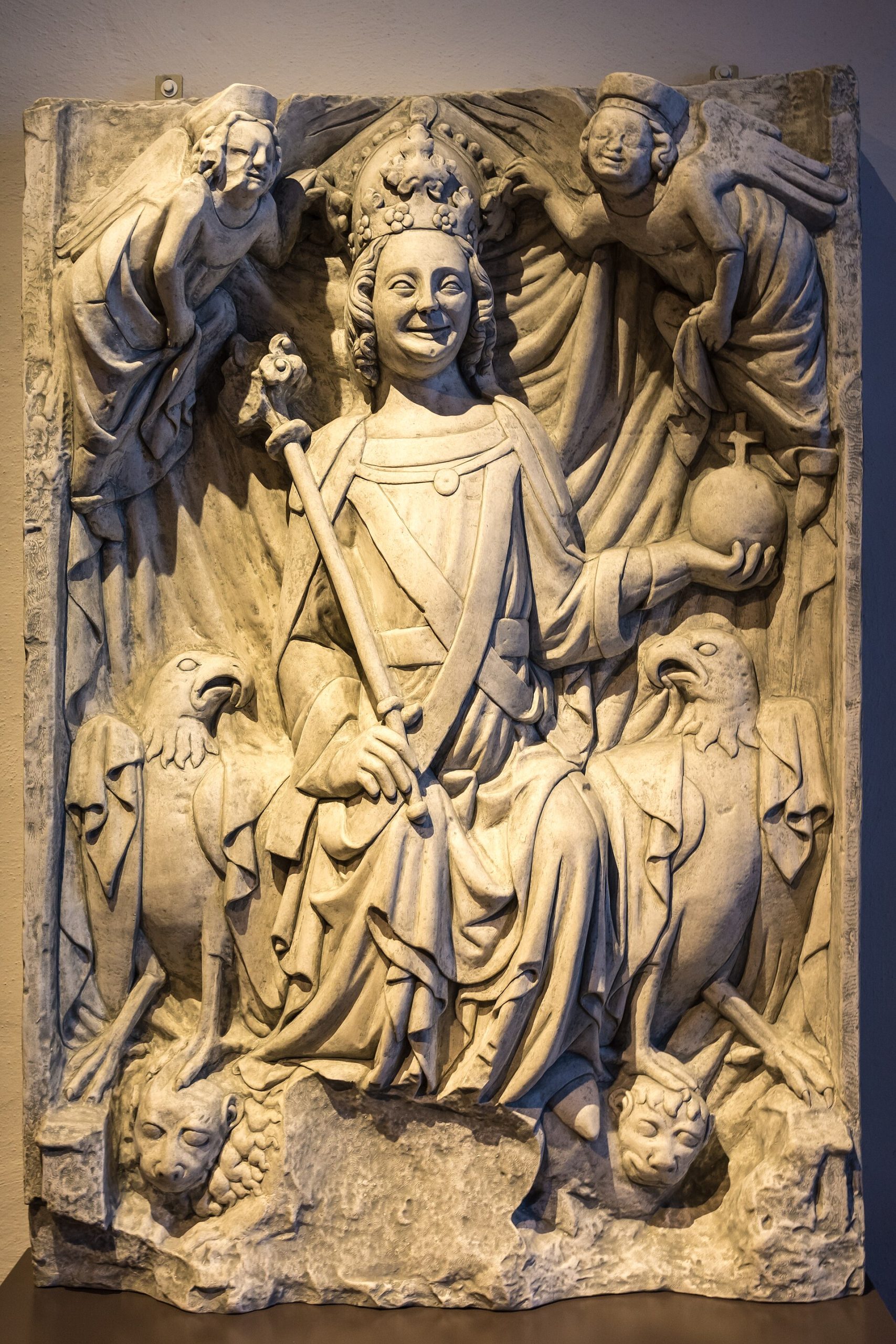
One of the greatest treasures of the castle is its imperial chapel, a rare and beautiful example of a medieval double chapel. This is a chapel built on two levels, one above the other, connected by an opening in the floor, and it is among the finest surviving examples of its kind. Its Romanesque architecture, with rounded arches and sturdy columns, makes it one of the oldest and most atmospheric parts of the whole castle.
The two levels of the chapel reflected the strict hierarchy of medieval society. The lower level was for the servants and lesser members of the household, while the upper level was reserved for the emperor and his court, who could look down through the central opening to the space below. Emperor and servant thus worshipped together yet apart, each in their proper place, the very architecture expressing the ordered ranks of the medieval world.
For the emperor to have his own chapel within the castle was essential, a place to worship, to hear mass, and to mark the sacred occasions that bound together religion and rule in the medieval empire. The double chapel of Nuremberg is a jewel of Romanesque art and a direct link to the world of the medieval emperors, one of the most precious survivals in a castle rich in history. To enter it is to step into the private religious world of the rulers of the empire.
For a long period the sacred symbols of the empire itself, the imperial regalia used in the coronation of emperors, were kept in safety at Nuremberg, adding yet another layer of sacred importance to the city and its castle. To hold the very insignia of imperial rule was a mark of the deepest trust and honour, and it confirmed Nuremberg’s place at the spiritual as well as the political heart of the realm.
The Round Tower and the Deep Well
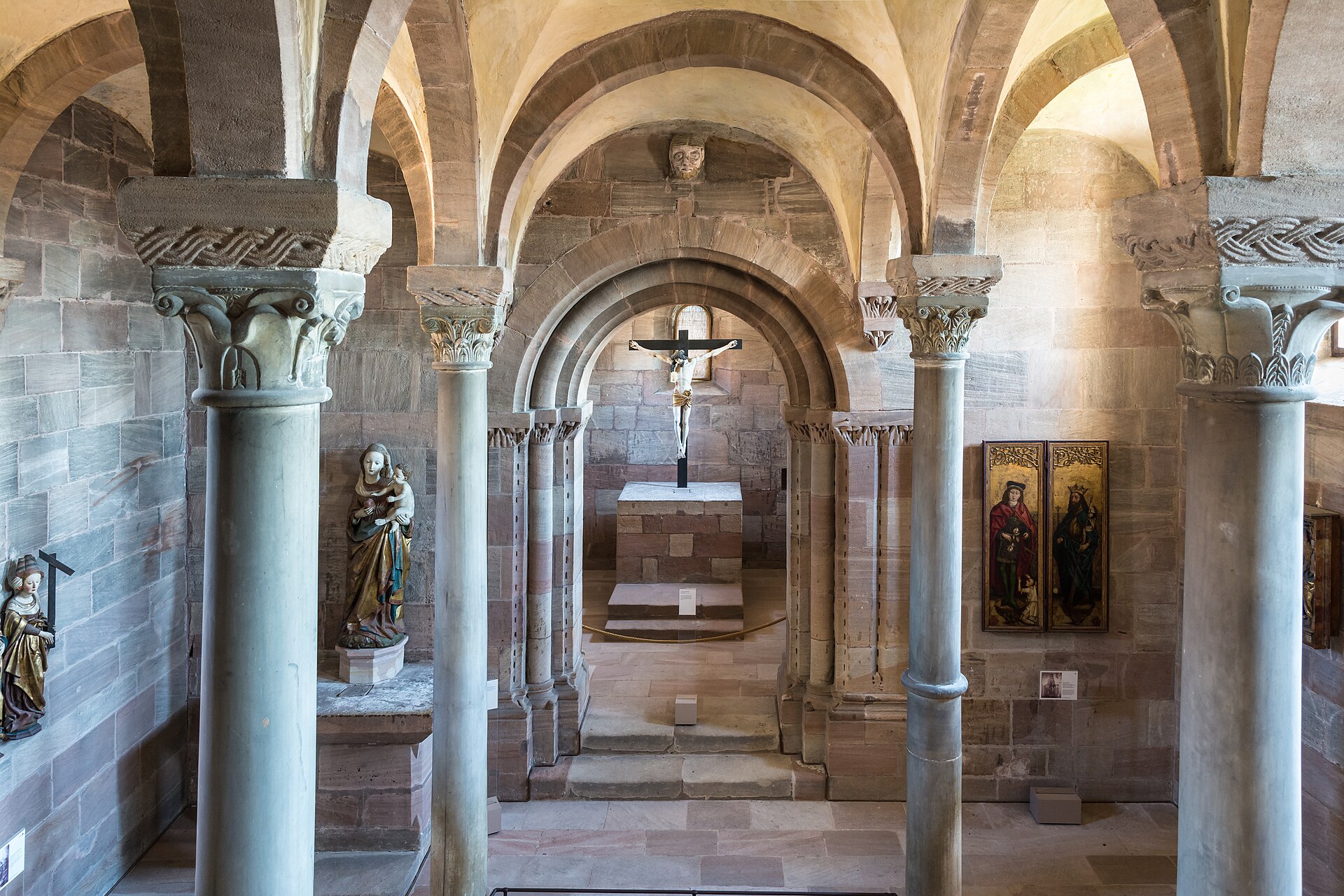
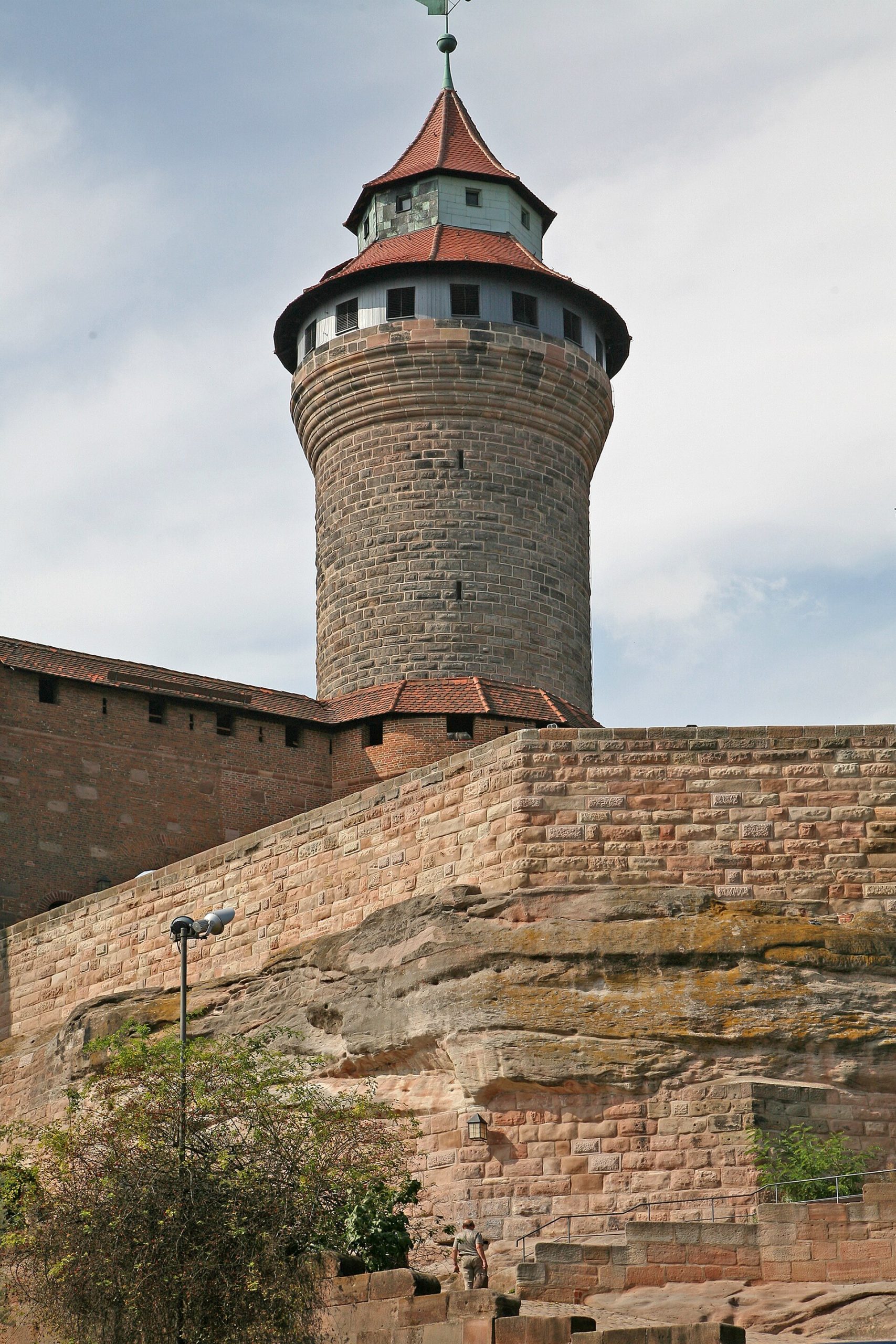
Dominating the skyline of the castle is the Sinwell Tower, a great round keep whose name comes from an old word meaning simply round. Rising high above the rest of the fortress, it served as the ultimate strongpoint and lookout, from which the garrison could watch over the city and the surrounding country and into which the defenders could withdraw as a last resort. Its round form was well suited to resisting attack, deflecting blows and offering no weak corners.
Climbing the tower today rewards the visitor with a magnificent panorama over Nuremberg and the land beyond, the same commanding view that made the site so valuable to its medieval builders. From the top, the red roofs of the old city spread out below, ringed by the remains of the city walls, with the towers and churches of Nuremberg rising among them. It is one of the finest views in the region and a fitting climax to a visit.
Near the tower lies another of the castle’s marvels, its deep well, a shaft sunk far down through the sandstone rock to reach water. A reliable water supply was essential to any fortress that hoped to withstand a siege, and digging a well through solid rock to such a depth was a formidable feat of medieval engineering. Demonstrations still lower light and water far down the shaft to reveal its astonishing depth, a vivid reminder of the practical challenges that lay behind the grandeur of a great castle.
The engineering of the deep well is easy to underestimate until you grasp its scale. To cut a shaft through solid sandstone to reach reliable water, deep beneath the castle, required immense labour and skill, and the result was one of the fortress’s most vital assets. Without water a castle could not survive a siege, and the deep well was, in its unglamorous way, as important to the security of Nuremberg as any wall or tower.
From the summit of the tower the strategic logic of the whole castle becomes plain, for the eye commands the city and the roads and country beyond in every direction. Whoever held this height held the key to Nuremberg, and the tower’s dominance of the skyline was as much a statement of power as a practical lookout, visible for miles as a sign of the authority that resided on the rock.
Into the Imperial Courtyard
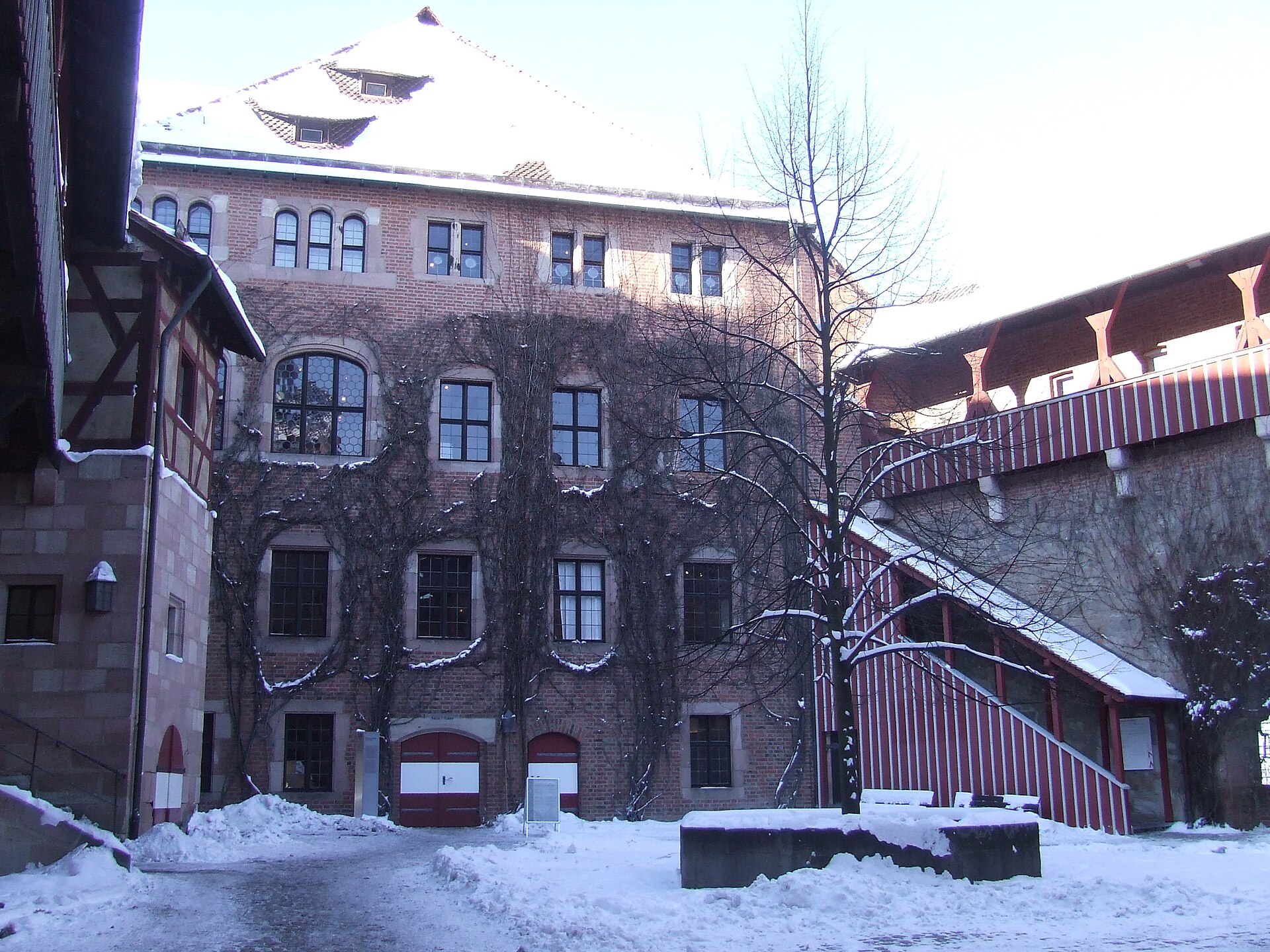
Passing through the gates, you come into the courtyards at the heart of the castle, enclosed by the historic buildings that housed the emperor and his court. Here the various parts of the complex come together, the residential halls, the chapel, the towers, and the working buildings, arranged around the open spaces where the life of the castle was conducted. It is the natural centre of a visit, the point from which the whole fortress can be explored.
The courtyards preserve the atmosphere of a genuine medieval fortress, with their half-timbered upper storeys, their wells, and their sturdy stone walls. Unlike the romantic fantasies of later ages, everything here was shaped by real need and real use, and the courtyard has the plain, functional beauty of a place built to serve the practical business of imperial residence and defence. There is a bracing authenticity to it that the fairy-tale castles lack.
Standing in the courtyard, surrounded by centuries of history, it is easy to imagine the comings and goings of the past, the arrival of the emperor and his retinue, the bustle of servants and officials, the assembling of the great for a council or a feast. This was a working heart of the empire, and the courtyard, quiet now, once saw the constant traffic of imperial government. It is the ideal place to pause and take in the long history of the fortress before exploring its treasures.
The half-timbered buildings that rise around the courtyards give this part of the castle a warmer, more domestic character than its formidable outer defences, a reminder that the fortress was also a home. Emperors and their households actually lived here, and the courtyards were the setting for the daily rhythms of that life as much as for the great occasions of state, a blend of the everyday and the momentous.
The Oldest Stones
Among the many towers and buildings of the castle, some are far older than others, and the oldest of all carry us back to the very beginnings of the fortress. The tower known by an old name suggesting the heathen or pagan past is among the most ancient surviving structures, its rugged stonework a direct link to the earliest phases of the castle, long before the grand halls and the romantic embellishments of later centuries.
These ancient parts remind us that Nuremberg’s castle grew over a very long time, its fabric accumulating layer upon layer across the centuries. What began as a modest early fortress was expanded again and again as the importance of the castle and the city grew, until it became the sprawling complex we see today. The oldest towers are the seeds from which the whole grew, and they anchor the castle firmly in the deep medieval past.
There is a special pleasure in seeking out these oldest stones amid the grandeur of the later castle. Weathered and plain, they speak of the fortress in its infancy, of a time when Nuremberg was only beginning its rise to greatness. To touch them is to touch the beginning of the story, the point from which the castle, the city, and their long imperial history all slowly unfolded across the centuries that followed.
Tracing the different ages of the castle’s stonework is one of the quiet rewards of a careful visit. The eye learns to distinguish the rugged early work from the more refined later building, and to read in the walls the long story of the fortress’s growth. Few castles offer so rich a record of continuous development, from humble beginnings to imperial grandeur, all legible in the fabric for those who look closely.

The Imperial Stables and the City’s Might
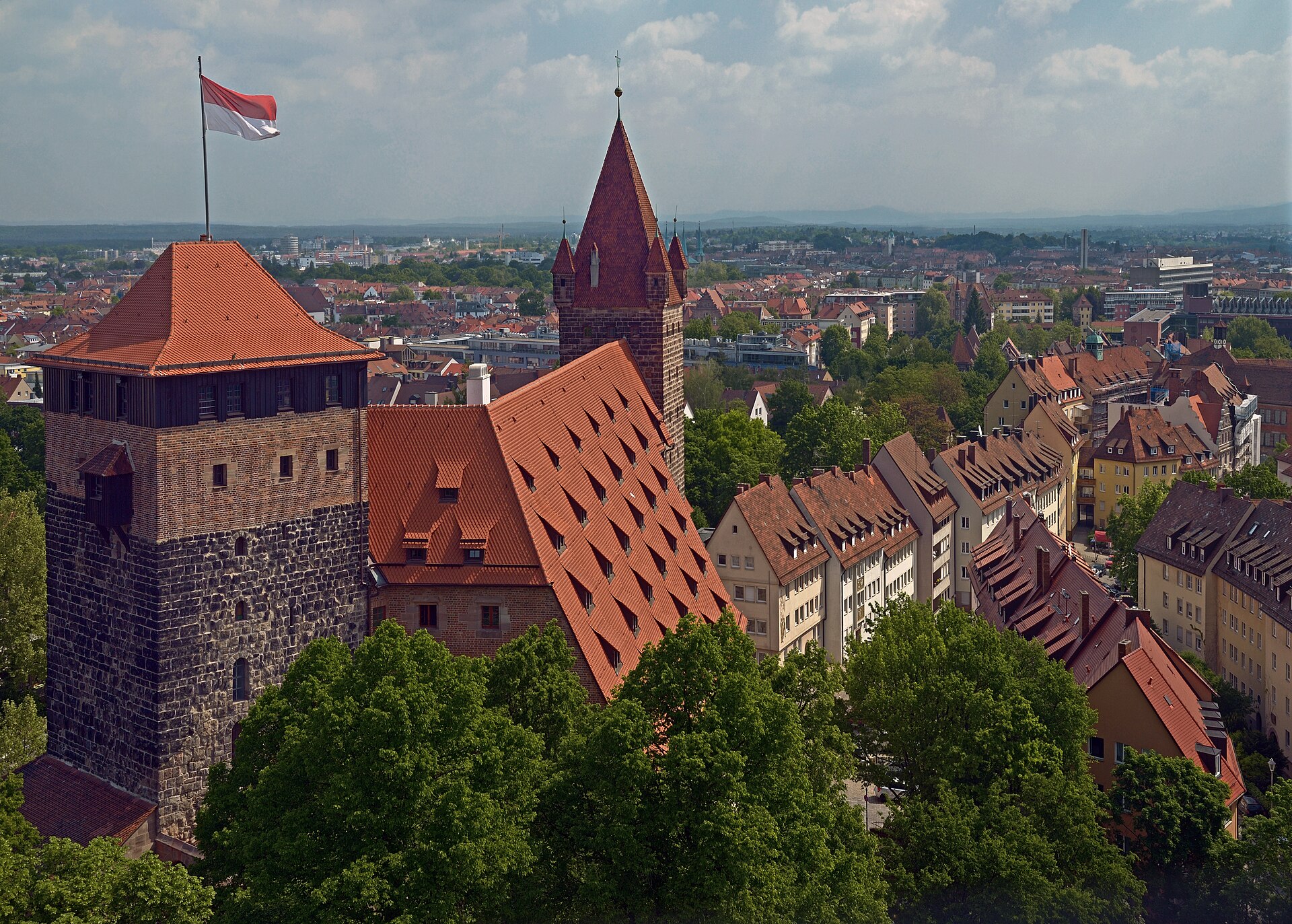
Among the most impressive structures of the castle complex is the great building that served, at different times, as imperial stables and as a granary, a massive edifice raised by the city of Nuremberg near the end of the Middle Ages. Its sheer size speaks of the wealth and ambition of the city, which by then controlled much of the castle and maintained it as a matter of civic pride and imperial duty.
The building reflects Nuremberg’s role not just as the emperor’s host but as one of the great powers of the empire in its own right. A city rich enough to raise such a structure, and to store within it the grain that could feed its people through a siege or a famine, was a formidable force, and the great granary was a statement of that strength. In later centuries the building found new uses, and today part of it serves, remarkably, as a youth hostel.
This blending of imperial and civic power is one of the defining themes of Nuremberg’s castle. The fortress was at once the emperor’s residence and the city’s responsibility, and the great buildings raised by the citizens stand alongside the imperial halls as equal expressions of power. In the stables and granary, as much as in the emperor’s chapel, you can read the story of a mighty city and its long partnership with the empire it served.
The reuse of the great granary as a youth hostel is a charming example of how historic buildings can find new life across the centuries. Where grain was once stored against famine and siege, young travellers now sleep beneath the medieval roof, an unexpected but fitting continuation of the building’s long service to the city. Few can claim to have spent a night within the walls of an imperial fortress, but at Nuremberg it is possible.
A View Over a Renaissance City
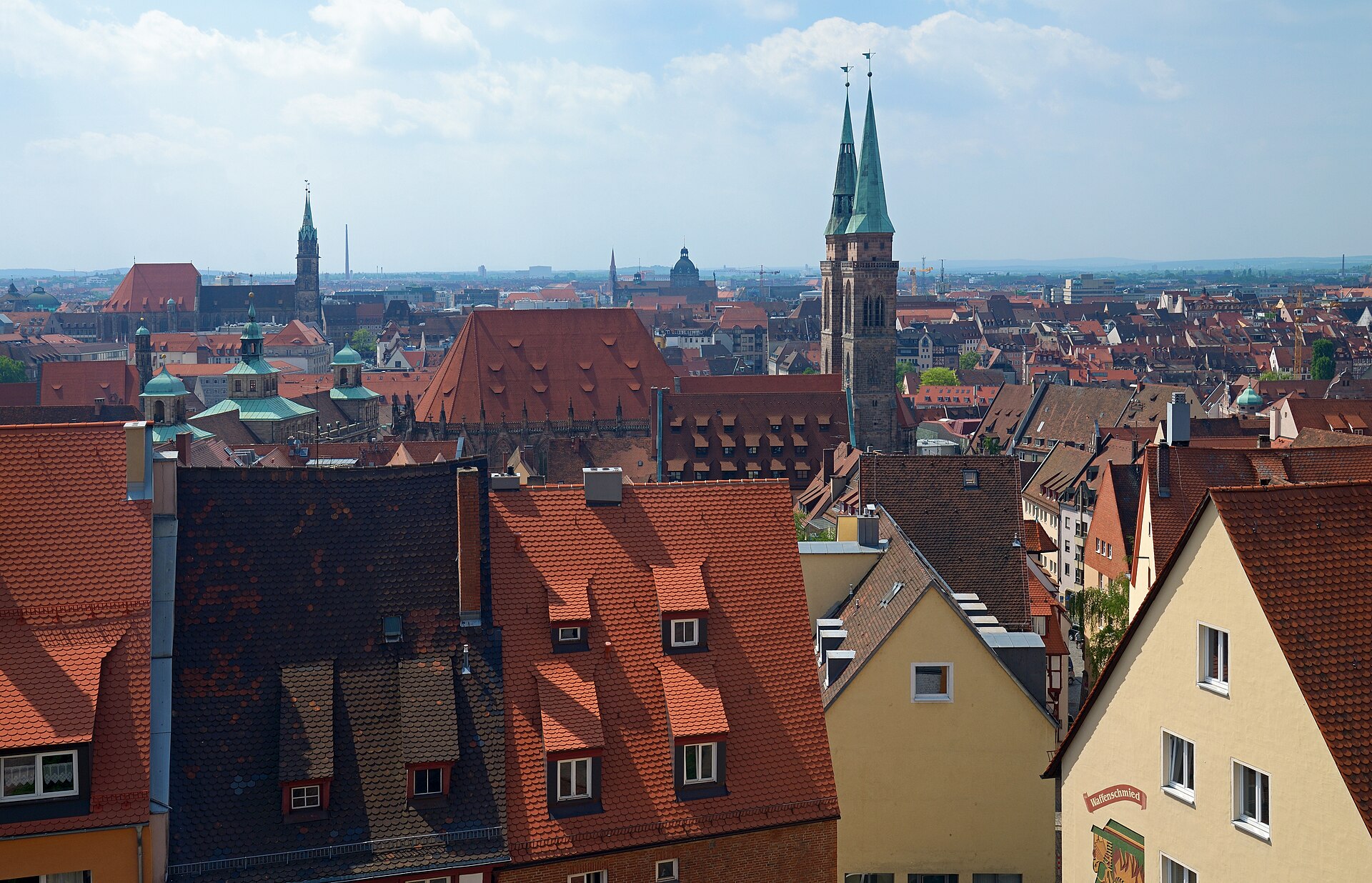
From the castle heights, the view over Nuremberg is a view over one of the great cities of the Renaissance. In its golden age, Nuremberg was not only rich and powerful but a centre of art, science, and craftsmanship, home to some of the most celebrated artists and inventors of the age. The city that spreads below the castle was, in its day, a place of extraordinary creativity, and the castle presided over that flowering.
The greatest of Nuremberg’s artists worked in the streets you can see from the castle, and the city was famous across Europe for its painters, sculptors, printers, and metalworkers, as well as for pioneering craftsmen and scholars. To look down from the castle is to survey the setting of a remarkable cultural achievement, a city that combined commercial might with a brilliance in the arts and sciences that few places of its time could match.
This cultural greatness was bound up with the city’s imperial status and its wealth, and the castle above was part of the same story of power and prestige. The fortress and the city rose together, and the view from the heights ties them together in a single prospect, the imperial castle looking out over the Renaissance metropolis it crowned. Few views in Germany take in so much history and so much achievement at a single glance.
Nuremberg’s golden age produced achievements that shaped European culture far beyond the city’s walls, in printing, in the fine arts, and in the sciences. The city was a crossroads of ideas as well as of trade, where the new learning of the Renaissance met the wealth and skill of a great commercial centre. The castle looked out over a place that was, for a time, one of the true engines of European civilisation.
The Castle Garden
Not all of the castle is towers and halls and defences. Within its walls lies a garden, a peaceful and beautiful corner that offers a gentler counterpoint to the martial grandeur of the fortress. Laid out to make use of the space along the ramparts, the garden provides a place to walk and to rest, with fine views out over the city and the surrounding country from the castle heights.
A garden within a great castle was both a practical amenity and a pleasure, offering the household a place to grow herbs and flowers and to take the air within the safety of the walls. At Nuremberg the garden is a lovely surprise amid the stone, a green and tranquil space where the visitor can pause and enjoy the setting, softening the severity of the fortress with the colours and scents of growing things.
The garden also offers some of the finest views to be had of the castle and the city, framed by greenery and set against the sky. It is a reminder that even a fortress built for war and government made room for beauty and repose, and it is one of the quieter pleasures of a visit, a place to sit for a while and take in the long history and the wide prospect of one of Germany’s most important castles.
Corners like the garden also help the visitor to imagine the fuller life of the castle, which was not only a place of ceremony and defence but a residence where people passed their days across the seasons. A moment spent in the garden, with the city spread below and the towers rising behind, brings home the human scale of the fortress amid its imperial grandeur, and offers a welcome pause in a busy day of sightseeing.

Destruction and Rebirth
The long history of the Imperial Castle very nearly came to an end in the twentieth century. During the Second World War, Nuremberg suffered terrible bombing, and the old city, including the castle, was devastated. Much of the historic fabric that had accumulated over the centuries was destroyed or badly damaged, and the fortress that had hosted emperors for five hundred years lay, like the city below it, largely in ruins.
That the castle stands today, once again crowning its city, is the result of a great and painstaking effort of reconstruction in the decades after the war. Working from records, surviving fragments, and careful study, the restorers rebuilt the castle and the old city, striving to recover what had been lost. It was a labour of years and of deep dedication, an act of faith in the value of the past and in the possibility of recovery.
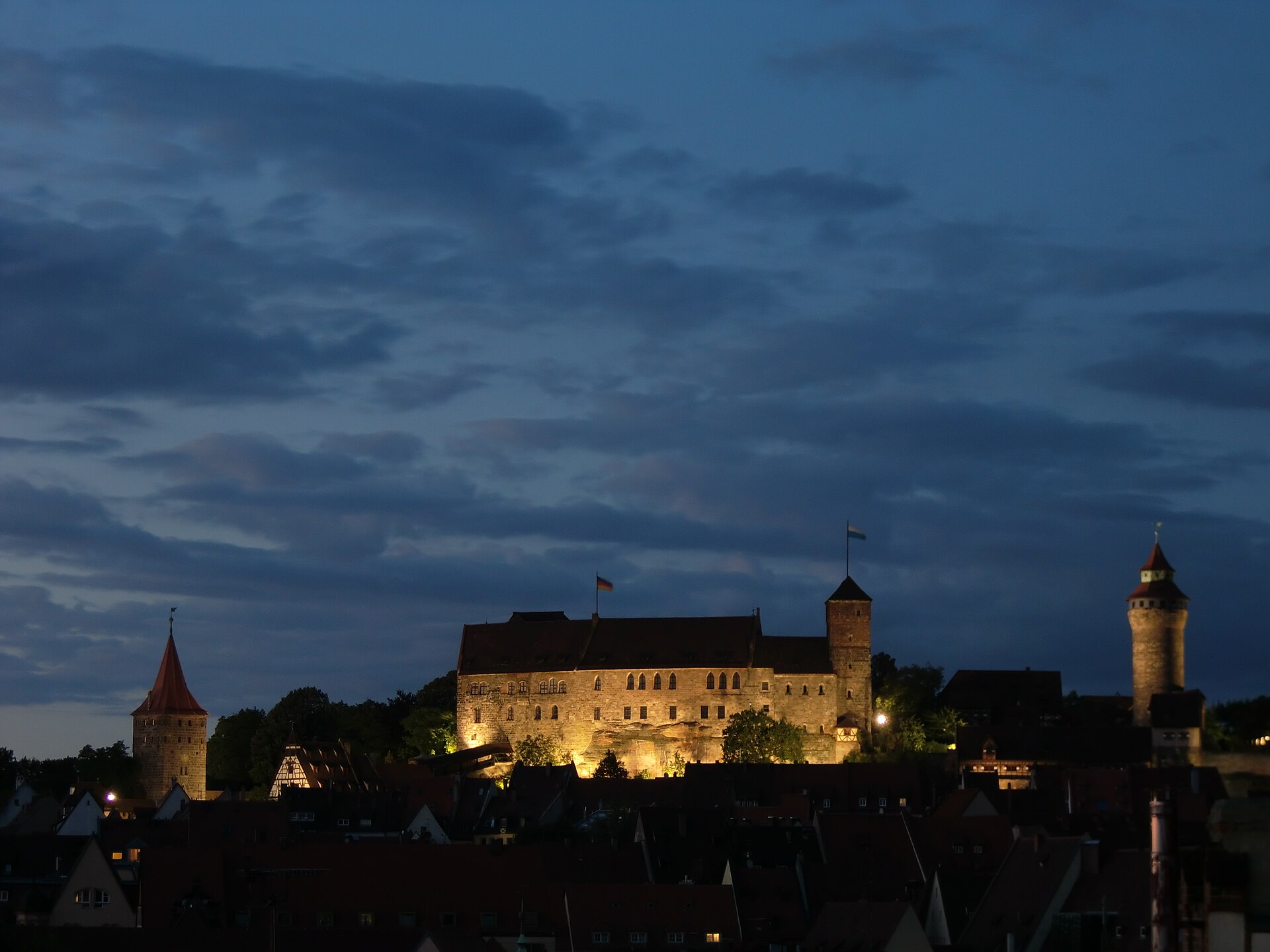
The rebuilding of Nuremberg’s castle is thus part of the larger story of Germany’s recovery from the catastrophe of the war, a determination to preserve and restore the treasures of the past even after terrible destruction. Floodlit above the rebuilt city at night, the castle stands as a symbol not only of the medieval empire but of resilience and renewal, a monument that has survived the worst that history could throw at it and endures still.
The careful rebuilding of the castle raises questions that hang over many restored monuments: how much of what we see is original, and how much is faithful reconstruction. At Nuremberg the answer is a mixture, genuine medieval fabric standing alongside painstaking postwar rebuilding, but the result honours the spirit and the substance of the original, and it allows the long history of the fortress to continue rather than ending in the rubble of the war.
Visiting the Imperial Castle
The Imperial Castle stands at the highest point of the old town of Nuremberg, in the state of Bavaria, and it is easily reached on foot through the historic streets of the city. Nuremberg is a major city, well connected by rail and road, and the castle is its crowning sight, so most visitors combine it with exploring the old town, with its churches, museums, market squares, and the remains of the medieval city walls.
The castle is looked after as a museum, and a visit allows you to explore the imperial apartments, the double chapel, the Sinwell Tower with its panoramic view, the deep well with its demonstrations, and the museum displays that tell the story of the castle and the empire. Around these there are the courtyards and the garden to enjoy, and the views over the city from the ramparts. Allow a good half-day to do the castle and its surroundings justice.
If you would like to find it and plan your visit, here is the castle’s position above the old town: 49.4577, 11.0764. Take time, too, for the city below, one of the most historic in Germany, for castle and city are two halves of a single story. The Imperial Castle of Nuremberg is not a fairy tale but something rarer and deeper, a genuine seat of imperial power that shaped the history of Europe, and it rewards everyone who climbs its sandstone rock with a real encounter with the medieval empire.
The wider old town of Nuremberg is one of the great pleasures of a visit, its rebuilt medieval streets, its churches, its fortifications, and its famous market all repaying exploration. Seen together, the castle and the city form one of the most complete and evocative medieval townscapes in Germany, and a day spent moving between the fortress on the rock and the streets below is a journey deep into the world of the imperial city and the empire it served.
Castles Nearby
- Neuschwanstein, the fairy-tale castle of the Dream King
- Schloss Hohenschwangau, the castle that made a king
- Schloss Lichtenstein, the fairy-tale castle born from a novel
The Castle at the Heart of the Empire
Among all the castles of Germany, the Imperial Castle of Nuremberg holds a place apart. It is not a romantic dream or a fairy tale in stone, but a genuine seat of power, one of the most important imperial residences of the Holy Roman Empire, where emperors held court and councils met and the government of a great realm was carried on for five hundred years. Its importance is not a matter of beauty alone but of history at the deepest level.
To visit it is to touch that history directly. In the double chapel where emperors worshipped, in the halls where the diets of the empire assembled, in the towers and courtyards and the deep well cut through the rock, you meet the medieval empire not as a fantasy but as a reality, hard, complex, and consequential. And in the castle’s destruction and rebuilding you meet, too, the more recent history of a country that nearly lost this treasure and chose to restore it.
So when you come to Nuremberg, climb the sandstone rock to the castle of the emperors and give it the attention it deserves. Look out over the great city it crowned, stand where the empire was governed, and feel the weight of a thousand years of history in its stones. Of all the castles in Germany, this is the one where the real medieval empire comes most vividly and most truly to life, the fortress at the very heart of a vanished realm.
You May Like
Mafra, the Palace a King Built From a Vow


2 thoughts on “Nuremberg Imperial Castle: The Fortress at the Heart of the Empire”