Deep in the forests of northern Cambodia lies the largest religious monument ever built. Angkor Wat is only the most famous of hundreds of temples that once formed the heart of the Khmer Empire, a civilisation that for centuries ruled much of Southeast Asia from a vast city of stone and water.
At its height Angkor was among the greatest cities on earth, home to perhaps a million people, its temple-mountains rising above an immense network of canals and reservoirs. Abandoned and half-swallowed by the jungle, it remains one of the wonders of the world.
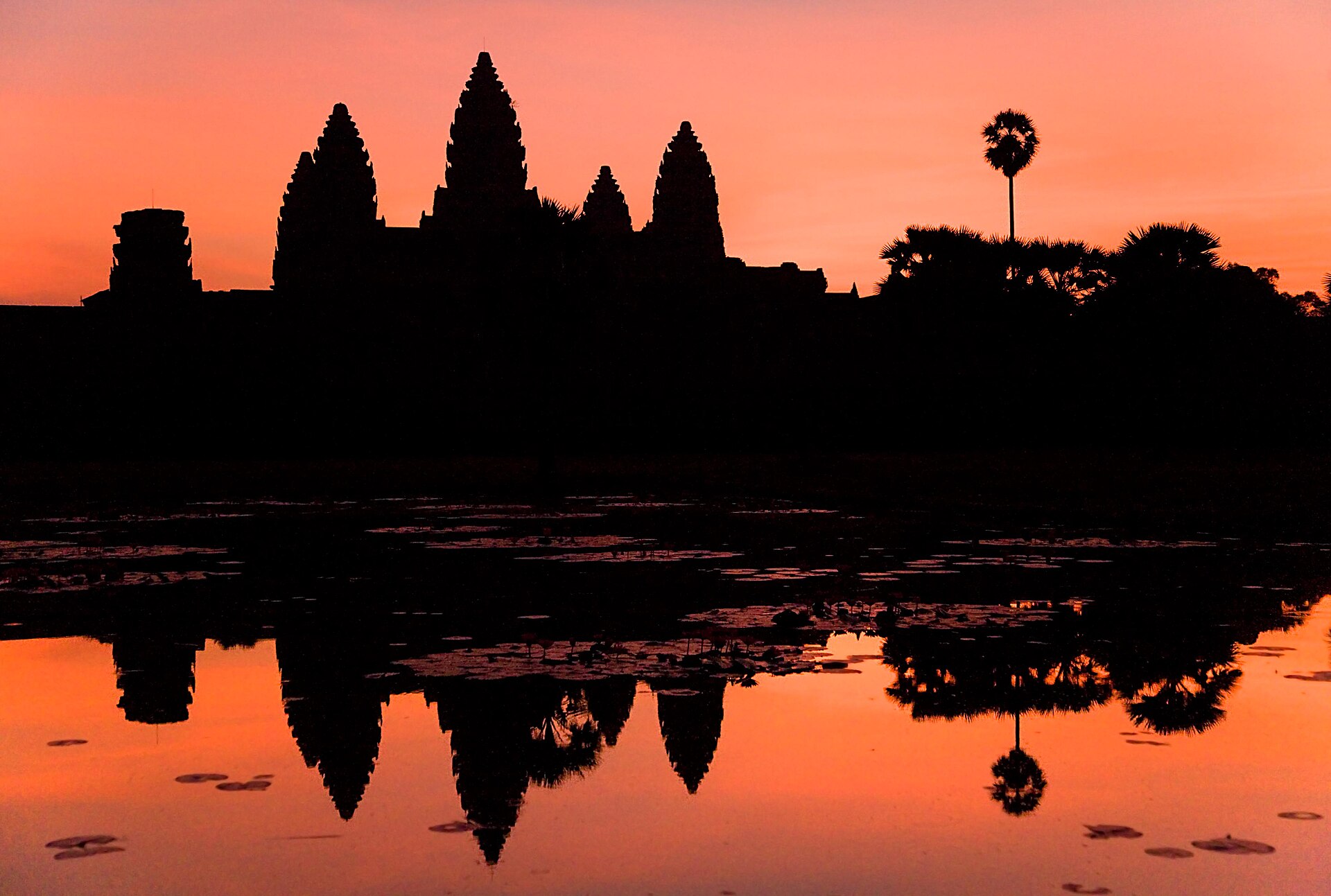
Table of Contents
- The Largest Religious Monument on Earth
- The Khmer Empire and Its God-Kings
- Angkor Wat: Temple-Mountain of Vishnu
- The Causeway, Moat, and Cosmic Design
- The Bas-Reliefs and Celestial Dancers
- Angkor Thom and the Faces of the Bayon
- Ta Prohm: The Temple in the Jungle
- Banteay Srei and Khmer Artistry
- Water, Decline, and Abandonment
- Rediscovery, Conservation, and UNESCO
- Nearby Places
- Closing Thoughts
The Largest Religious Monument on Earth
Angkor Wat covers an area of many hectares, enclosed by a moat so wide it resembles a lake. Built in the early twelfth century, it is the largest religious structure ever raised, and it has never entirely ceased to be a place of worship.
But Angkor Wat is only part of a much larger whole. Around it stretch the remains of Angkor, the sprawling capital of the Khmer Empire, dotted with temples, palaces and the traces of a huge managed landscape.

The Khmer Empire and Its God-Kings
From the ninth to the fifteenth century, the Khmer Empire dominated mainland Southeast Asia. Its rulers styled themselves god-kings, linking their power to Hindu deities and later to the Buddha, and expressed that power through monumental temple building.
Each great king sought to outdo his predecessors, raising new temple-mountains as symbols of the cosmos and of his own divine authority. The result was one of the most extraordinary concentrations of monumental architecture anywhere in the world.
Angkor Wat: Temple-Mountain of Vishnu
Angkor Wat was built by King Suryavarman II as a temple dedicated to the Hindu god Vishnu and, it is thought, as his own funerary monument. Its five towers, shaped like lotus buds, represent the peaks of Mount Meru, the mythical home of the gods.
The whole temple is a model of the Hindu universe in stone, rising in concentric enclosures toward the central sanctuary. Its harmony of proportion and scale makes it a masterpiece of Khmer, and of world, architecture.

The Causeway, Moat, and Cosmic Design
Visitors approach Angkor Wat across a long stone causeway spanning the broad moat, which symbolises the cosmic ocean surrounding the world. Passing through the outer gate, they enter a vast sacred enclosure.
Every element of the design carries meaning, from the orientation of the temple to the layout of its galleries. Uniquely, Angkor Wat faces west, a direction associated with death, supporting the idea that it served as a royal tomb.

The Bas-Reliefs and Celestial Dancers
The galleries of Angkor Wat are lined with some of the finest bas-reliefs in the world, stretching for hundreds of metres. They depict scenes from Hindu epics, great battles, and the famous Churning of the Sea of Milk, a myth of creation.
Everywhere too are carved apsaras, celestial dancers, thousands of them, each subtly different in pose and ornament. These graceful figures bring the vast stone walls to life with movement and beauty.

Angkor Thom and the Faces of the Bayon
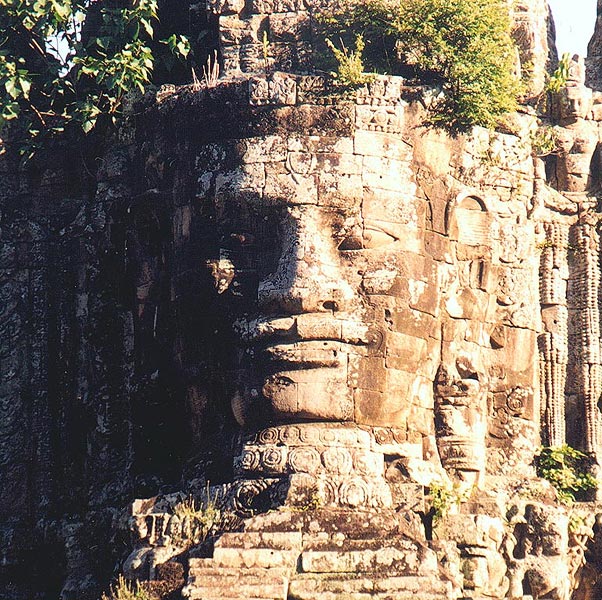
A short distance away lies Angkor Thom, a great walled city built by King Jayavarman VII, entered through monumental gates topped with serene carved faces. At its centre stands the Bayon, one of the most extraordinary temples of Angkor.
The Bayon is famous for its towers, each carved with enormous calm faces gazing out in the four directions. Whether they represent a god, the king, or both, these enigmatic faces are among the most haunting images in all of Asian art.

Ta Prohm: The Temple in the Jungle
Perhaps the most atmospheric of all the temples is Ta Prohm, which has been deliberately left much as explorers found it, entwined with the jungle. Giant tree roots pour over its walls and prise apart its stones.
The sight of ancient masonry gripped by living trees perfectly captures the romance of Angkor’s rediscovery. Ta Prohm shows both the power of nature and the fragile beauty of the ruins it has reclaimed.

Banteay Srei and Khmer Artistry
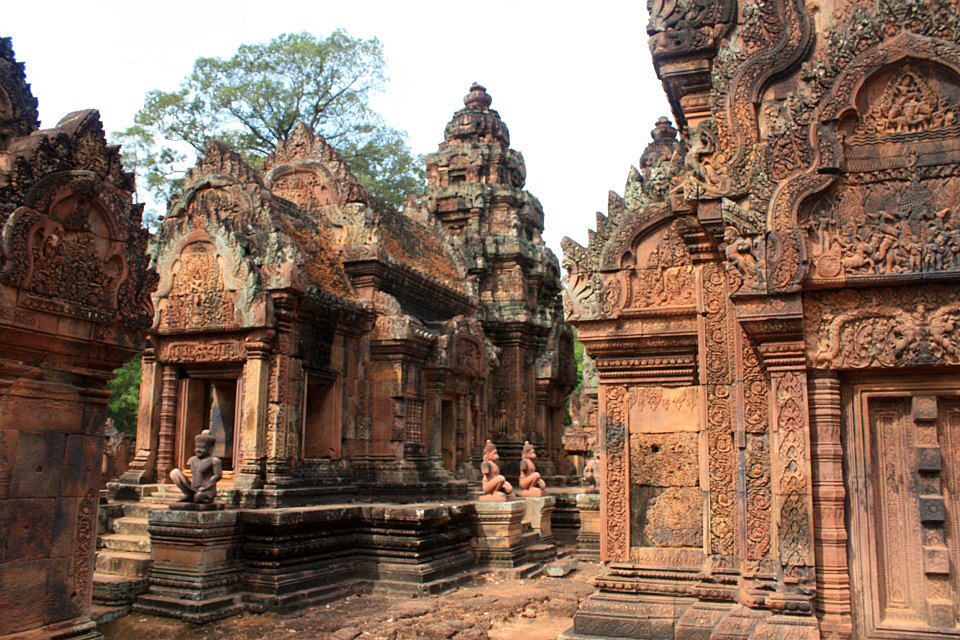
Not all the temples of Angkor are colossal. Banteay Srei, a small temple built of pink sandstone, is celebrated for the astonishing delicacy of its carving, so fine it has been compared to work in wood or ivory.
Its miniature scale and exquisite detail reveal another side of Khmer art, in which refinement mattered as much as size. It remains one of the jewels of the Angkor region.
Water, Decline, and Abandonment
Angkor’s greatness rested on an immense system of reservoirs, called barays, and canals that stored and distributed water for the city and its rice fields. This hydraulic network sustained a huge population.
Over time a combination of environmental strain, shifting trade, war and possibly climate change weakened the empire. The court eventually moved south, and Angkor was gradually abandoned to the encroaching forest.
Rediscovery, Conservation, and UNESCO
Angkor was never entirely forgotten by the Khmer people, but it captured the wider world’s imagination when European explorers described the ruins in the nineteenth century. Since then, generations of scholars have worked to study and restore the temples.
Angkor was inscribed on the UNESCO World Heritage List in 1992. Today it is the pride of Cambodia and one of Asia’s most visited sites, its silhouette so beloved that Angkor Wat appears on the national flag.
Nearby Places
- Sigiriya — another South Asian marvel of royal ambition, water gardens and sacred art reclaimed by the jungle.
- Thebes — the temple-city of Egypt, another vast sacred landscape built by god-kings on a monumental scale.
- Babylon — a great capital, like Angkor, that depended on the careful management of water in a demanding landscape.
Closing Thoughts
Angkor is a whole vanished world in stone: temple-mountains modelling the cosmos, endless galleries of carved myth, and faces smiling out over a city that once rivalled any on earth.
That so much survives, half-embraced by the forest, only deepens its spell. From the dawn silhouette of Angkor Wat to the roots of Ta Prohm, the temples of the Khmer remain among the most magnificent achievements of humankind.
You May Like
Mafra, the Palace a King Built From a Vow


One thought on “Angkor: The City the Jungle Swallowed and the Largest Temple on Earth”