Deep in the Lacandon rainforest of Chiapas, in southern Mexico, a small and otherwise modest Maya city holds one of the greatest artistic treasures of the ancient Americas. Bonampak is famous for a single building, the Temple of the Murals, whose three rooms are covered with the finest and best-preserved wall paintings the Maya ever made.
These vivid murals, more than twelve hundred years old, show battle, ceremony, music and sacrifice in astonishing colour and detail. They transformed our understanding of the Maya, revealing a world of courtly splendour and violence that overturned older ideas of a peaceful, purely astronomical people.

Table of Contents
- The Temple of the Murals
- A Small Maya City in the Lacandon Jungle
- The Three Painted Rooms
- Room One: The Presentation of the Heir
- Room Two: The Battle
- Room Three: Celebration and Sacrifice
- A Window into Maya Court Life
- Shattering the Myth of the Peaceful Maya
- Stelae and the Kings of Bonampak
- Rediscovery and Its Ties to Yaxchilan
- Getting There
- Nearby Places
- Closing Thoughts
The Temple of the Murals
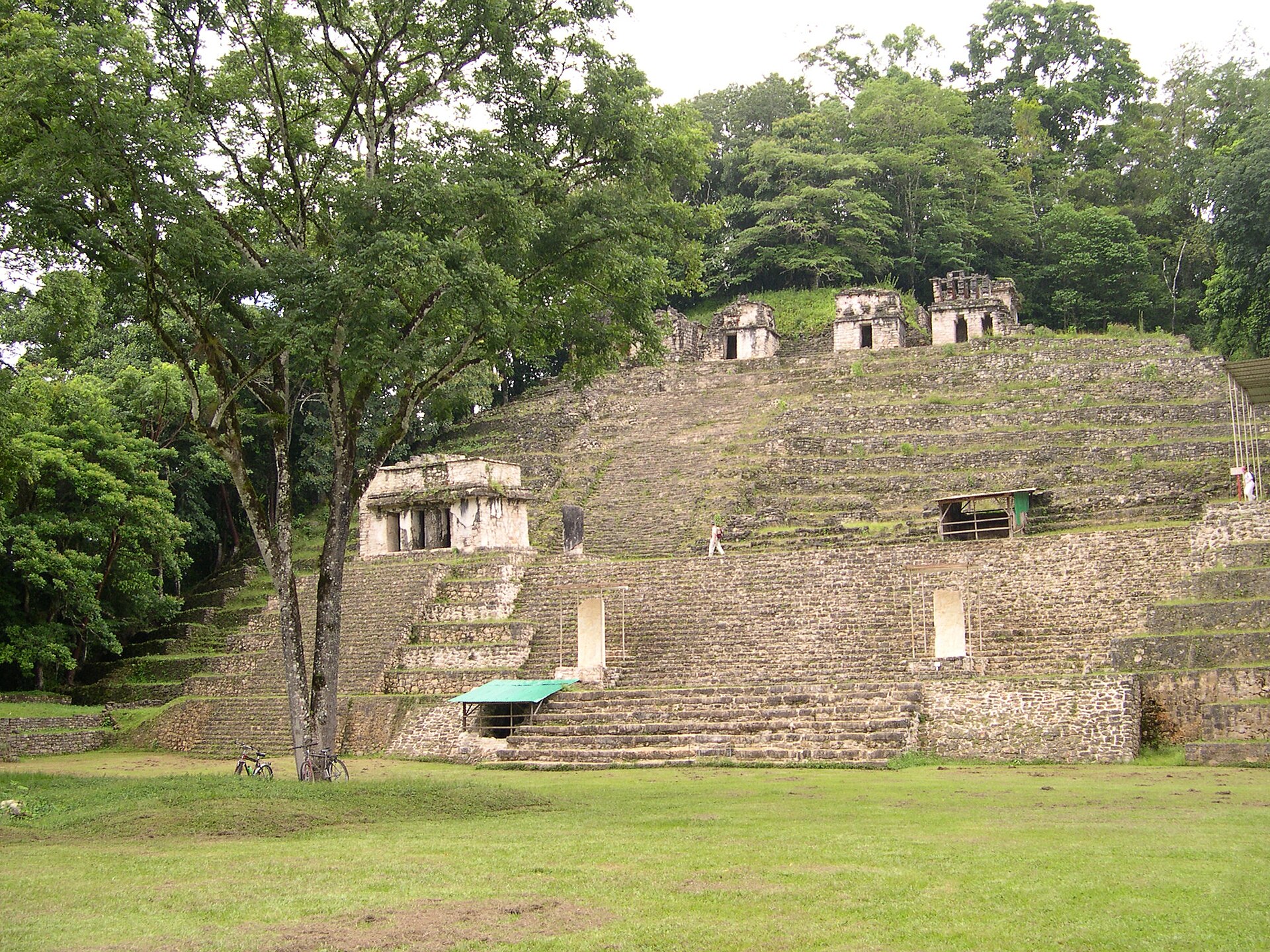
Bonampak’s fame rests almost entirely on one small building perched on its acropolis, known as the Temple of the Murals. From the outside it is unremarkable, but its three interior rooms hold an unbroken cycle of painted scenes.
Painted around 790 AD, the murals cover the walls and vaulted ceilings from floor to top. They are the most complete surviving example of ancient Maya painting, a form of art that has otherwise almost entirely perished.
A Small Maya City in the Lacandon Jungle
Bonampak itself was a minor centre, closely tied to the more powerful nearby city of Yaxchilan, which dominated the region. Its rulers were linked by kinship and politics to their greater neighbour.
Set deep in dense rainforest near a tributary of the Usumacinta River, Bonampak was never a great capital. Yet its modest scale makes the survival of such magnificent paintings all the more remarkable.

The Three Painted Rooms
The Temple of the Murals contains three adjoining rooms, each painted with a connected sequence of scenes that together tell a single story of royal ceremony, war and its aftermath. They are read in order, like chapters.
The paintings are crowded with figures, richly dressed nobles, musicians, warriors, captives and servants, all rendered with individual gestures and expressions. The sense of a living court captured in the moment is extraordinary.

Room One: The Presentation of the Heir
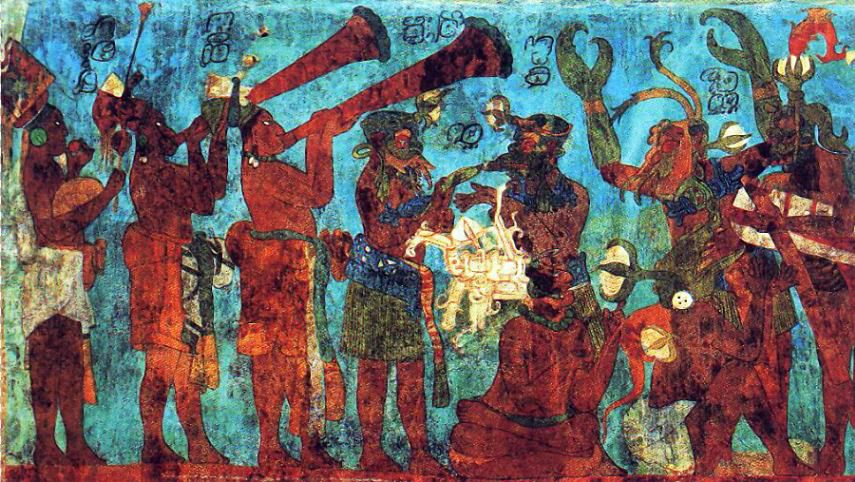
The first room shows a great court ceremony. Nobles in white robes gather, and a young heir to the throne is presented to the assembled elite, an event surrounded by ritual and display.
Vividly painted musicians play trumpets, drums and rattles, and performers in costume take part. The scene bursts with the colour and pageantry of a Maya royal court at the height of its splendour.
Room Two: The Battle
The second room contains the most dramatic scene of all: a fierce battle in the jungle. Warriors clash in a chaotic, swirling melee, seizing enemies by the hair, while the king leads his men to victory.
Above, the aftermath is shown as captives are presented to the ruler on a stepped platform, some bleeding, one already dead. It is a powerful and disturbing image of Maya warfare and the fate of the defeated.
Room Three: Celebration and Sacrifice
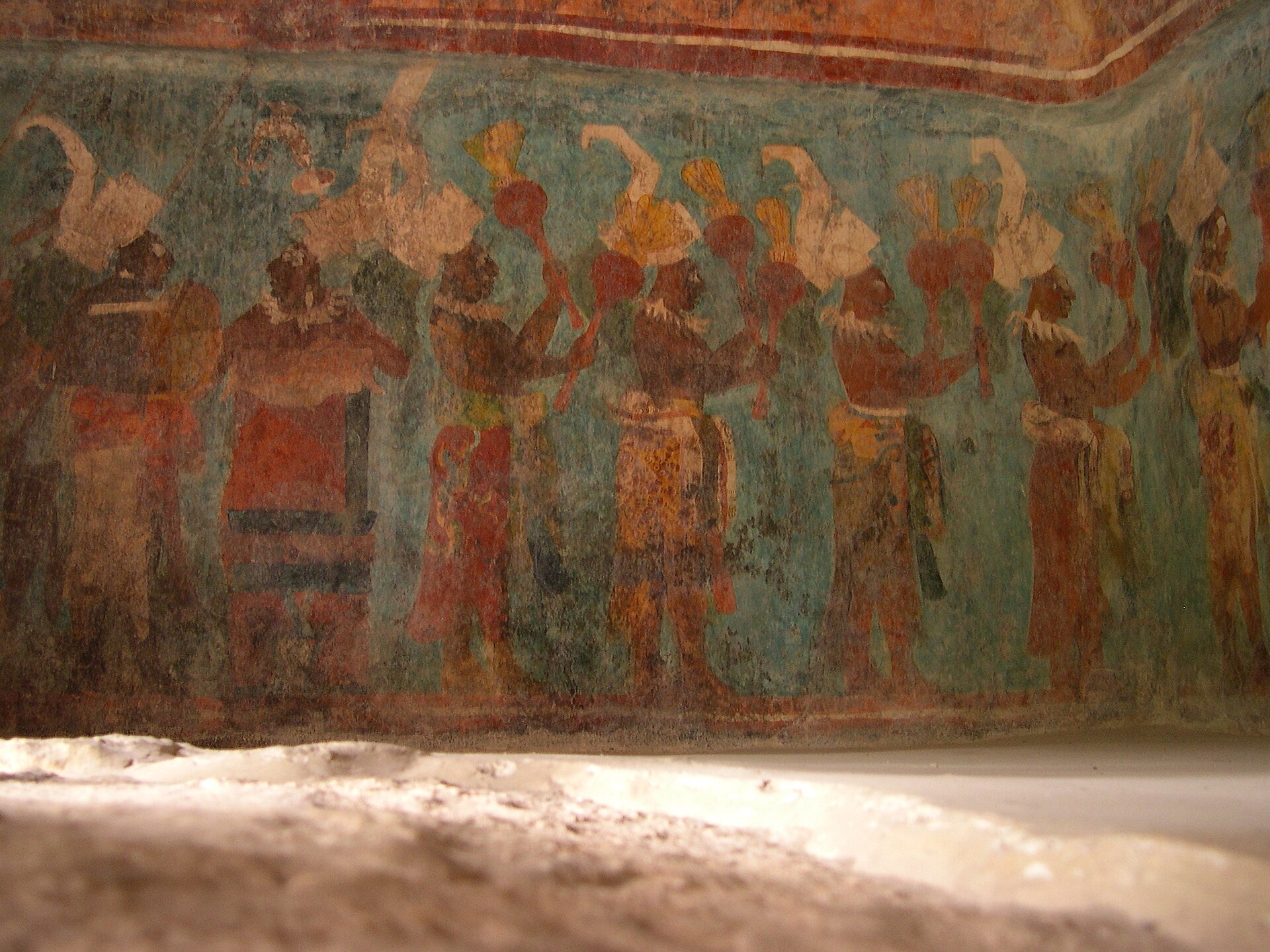
The third room depicts the celebration of victory. Lords in towering feathered headdresses dance on a pyramid, and a ceremony of ritual bloodletting takes place, in which the royal family offers its own blood.
Together the three rooms form a complete narrative, from the presentation of the heir, through war, to the bloody rituals that secured the dynasty’s future. Few works of art anywhere so vividly stage the ideology of an ancient kingdom.

A Window into Maya Court Life
The murals are a priceless record of Maya life. They show the clothing, jewellery, musical instruments, weapons and rituals of the elite in a detail found nowhere else, capturing colours and fabrics that have otherwise vanished.
From the paint on the nobles’ bodies to the instruments in the musicians’ hands, the murals let us see the Maya court almost as a contemporary would have seen it. They are as valuable to historians as they are beautiful.
Shattering the Myth of the Peaceful Maya
When the murals were revealed, they helped overturn a then-popular image of the Maya as a peaceful people of priests and astronomers. The graphic battle and the torture of captives showed a society in which warfare and violent ritual were central.
Together with the decipherment of Maya writing, the Bonampak murals helped reveal the Maya as they really were: a civilisation of competing kingdoms, dynastic ambition and frequent war, as well as art and science.
Stelae and the Kings of Bonampak
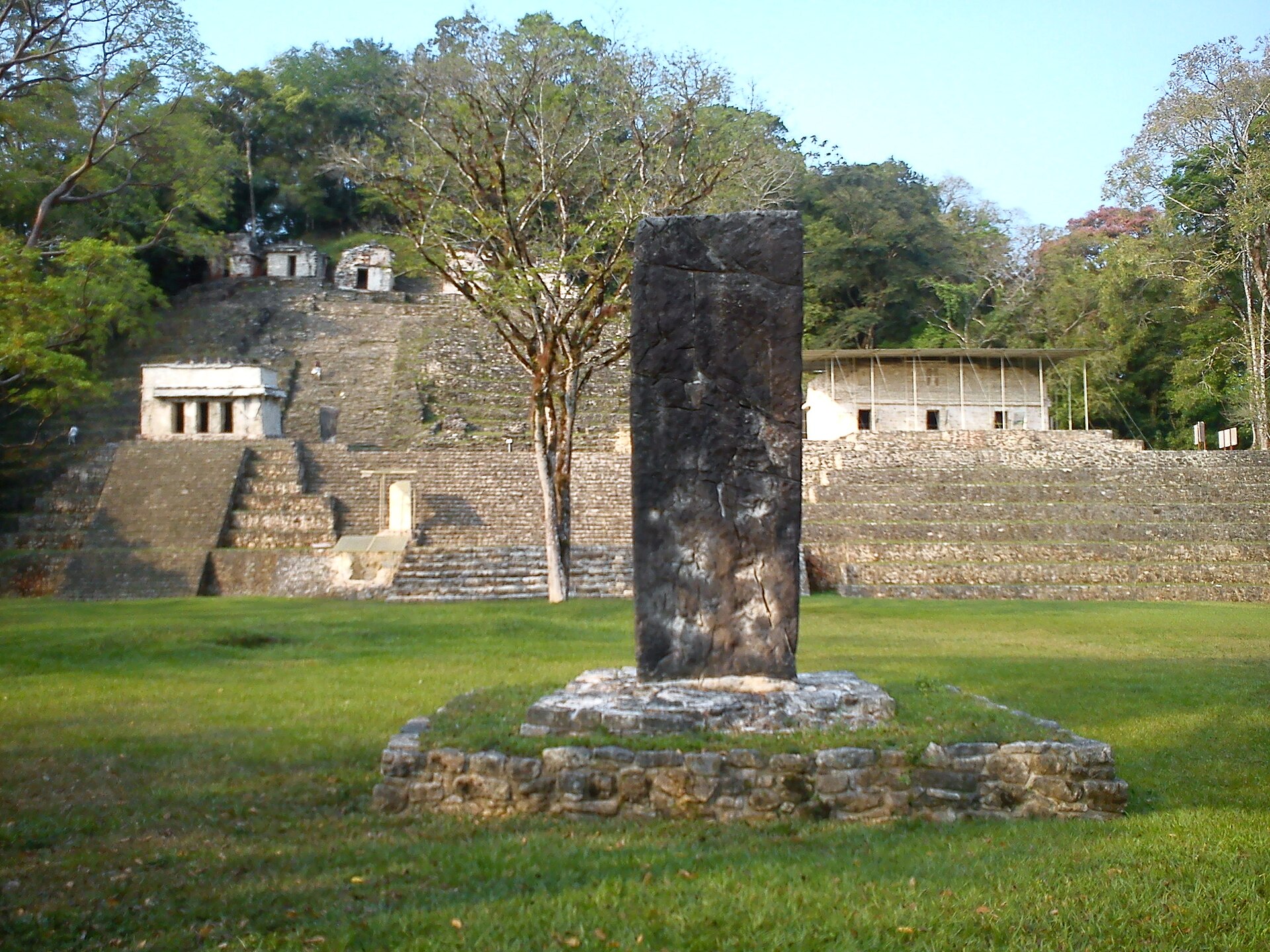
Beyond the murals, Bonampak has carved stelae and lintels depicting its rulers in ceremonial poses, some among the largest Maya stelae known. They name the kings and record their reigns and rituals.
These monuments, together with the paintings, allow scholars to place Bonampak within the wider political web of the Maya lowlands, especially its close relationship with powerful Yaxchilan.

Rediscovery and Its Ties to Yaxchilan
Bonampak was revealed to the outside world in 1946, when it was shown to explorers by the Lacandon Maya who still lived in the surrounding forest. The discovery of the murals caused a sensation.
Since then the site has been carefully studied and its paintings copied and analysed, work that continues to shed light on the Maya court. Bonampak is usually visited together with nearby Yaxchilan, its greater neighbour on the Usumacinta.
Getting There
Bonampak lies in the Lacandon jungle of eastern Chiapas, in southern Mexico, not far from the Guatemalan border. The nearest base is the town of Palenque, several hours away by road.
The final approach passes through Lacandon community land, where visitors typically transfer to local transport for the last stretch to the site. It is often combined with a river trip to nearby Yaxchilan.
Coordinates: 16.7042, -91.0642 — open Bonampak in Google Maps.
Nearby Places
- Yaxchilan — Bonampak’s powerful neighbour and ally, usually visited on the same journey into the Lacandon jungle.
- Calakmul — one of the Maya superpowers whose wars and alliances shaped the world Bonampak’s murals depict.
- Tulum — a later Maya city, a different face of the same civilisation that painted the walls of Bonampak.
Closing Thoughts
Bonampak may be a small city, but its painted rooms are a giant of world art: a complete, living picture of the Maya court in ceremony, in battle and in bloody triumph, preserved in colour for more than a thousand years.
By revealing the Maya as a people of splendour and violence alike, the murals changed history. Deep in the Lacandon forest, this modest temple holds one of the most vivid and valuable windows we have onto any ancient civilisation.
You May Like
Mafra, the Palace a King Built From a Vow