In the heart of Mali, on the flood plains of the Niger River, stands the largest building in the world made entirely of mud. The Great Mosque of Djenne, with its towering earthen walls bristling with wooden beams, is the crowning masterpiece of a distinctive African architecture, and the spiritual heart of an ancient trading town.
Djenne is more than its famous mosque. It is one of the oldest cities in sub-Saharan Africa, a centre of trade and Islamic learning whose entire old town of mud-brick houses has survived as a living monument to a remarkable building tradition.

Table of Contents
- The Great Mud Mosque of Djenne
- A City on the Niger’s Inland Delta
- The Largest Mud-Brick Building in the World
- Sudano-Sahelian Architecture
- The Annual Replastering Festival
- Djenne and the Trans-Saharan Trade
- A Town of Mud-Brick Houses
- Ancient Djenne-Djenno
- A Centre of Islamic Learning
- Preservation and UNESCO
- Getting There
- Nearby Places
- Closing Thoughts
The Great Mud Mosque of Djenne
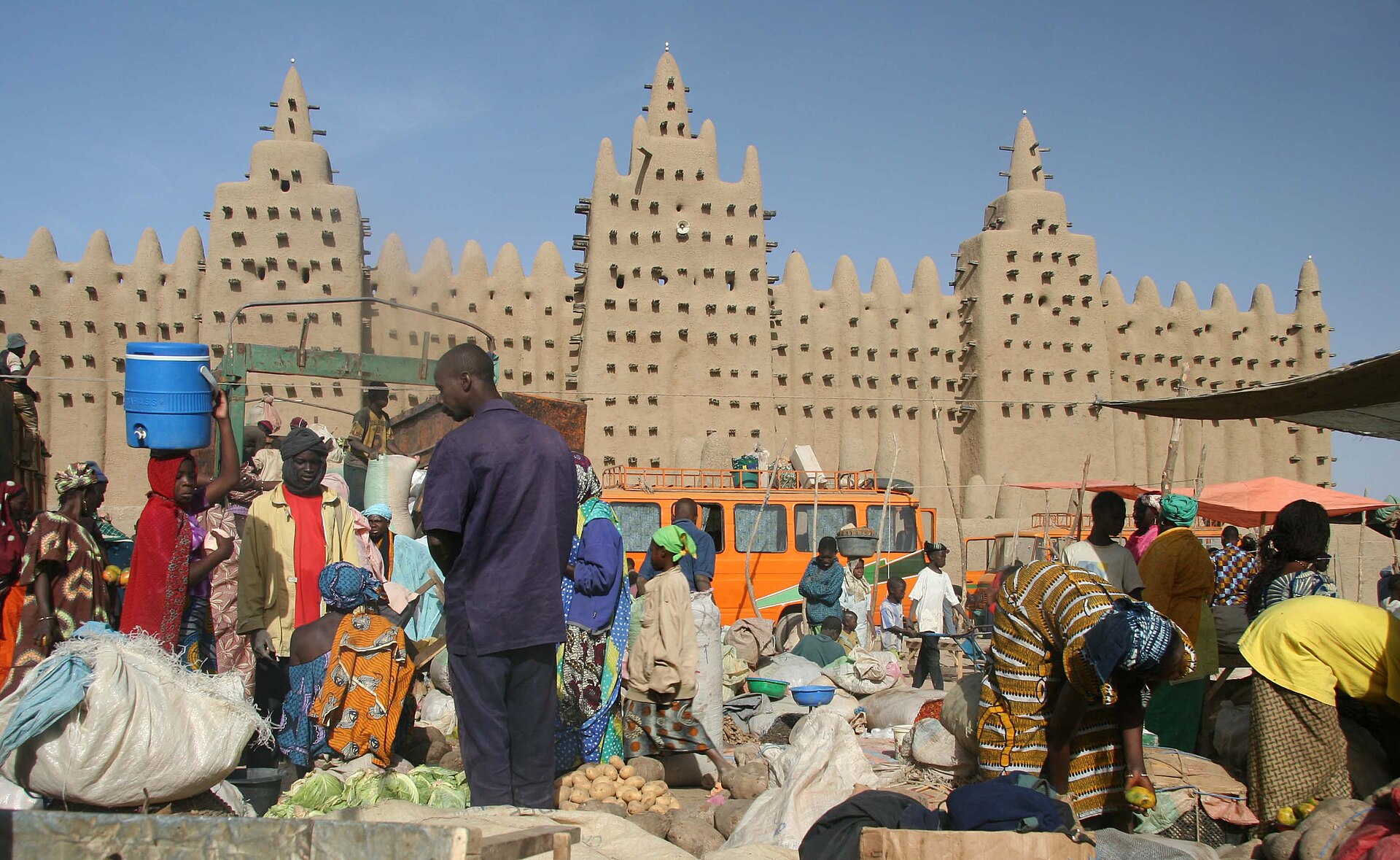
The Great Mosque of Djenne is the most famous building in Mali and one of the great monuments of Africa. Its massive walls, three tall towers and forest of projecting wooden beams create an unmistakable silhouette against the sky.
The present mosque was rebuilt in the early twentieth century on the site of much older mosques, following centuries of tradition. It remains an active place of worship and the pride of the town.

A City on the Niger’s Inland Delta
Djenne sits in the inland delta of the Niger, a vast area of seasonal floods and fertile land in central Mali. Each year the rising waters surround the town, and for a time it becomes almost an island.
This setting made Djenne a natural centre for trade and agriculture, linking the river networks of West Africa to the caravan routes of the Sahara. Its position was the foundation of its long prosperity.

The Largest Mud-Brick Building in the World
The Great Mosque is built entirely of sun-dried mud brick, coated with mud plaster, making it the largest such structure anywhere. Its walls are enormously thick, keeping the interior cool in the fierce heat.
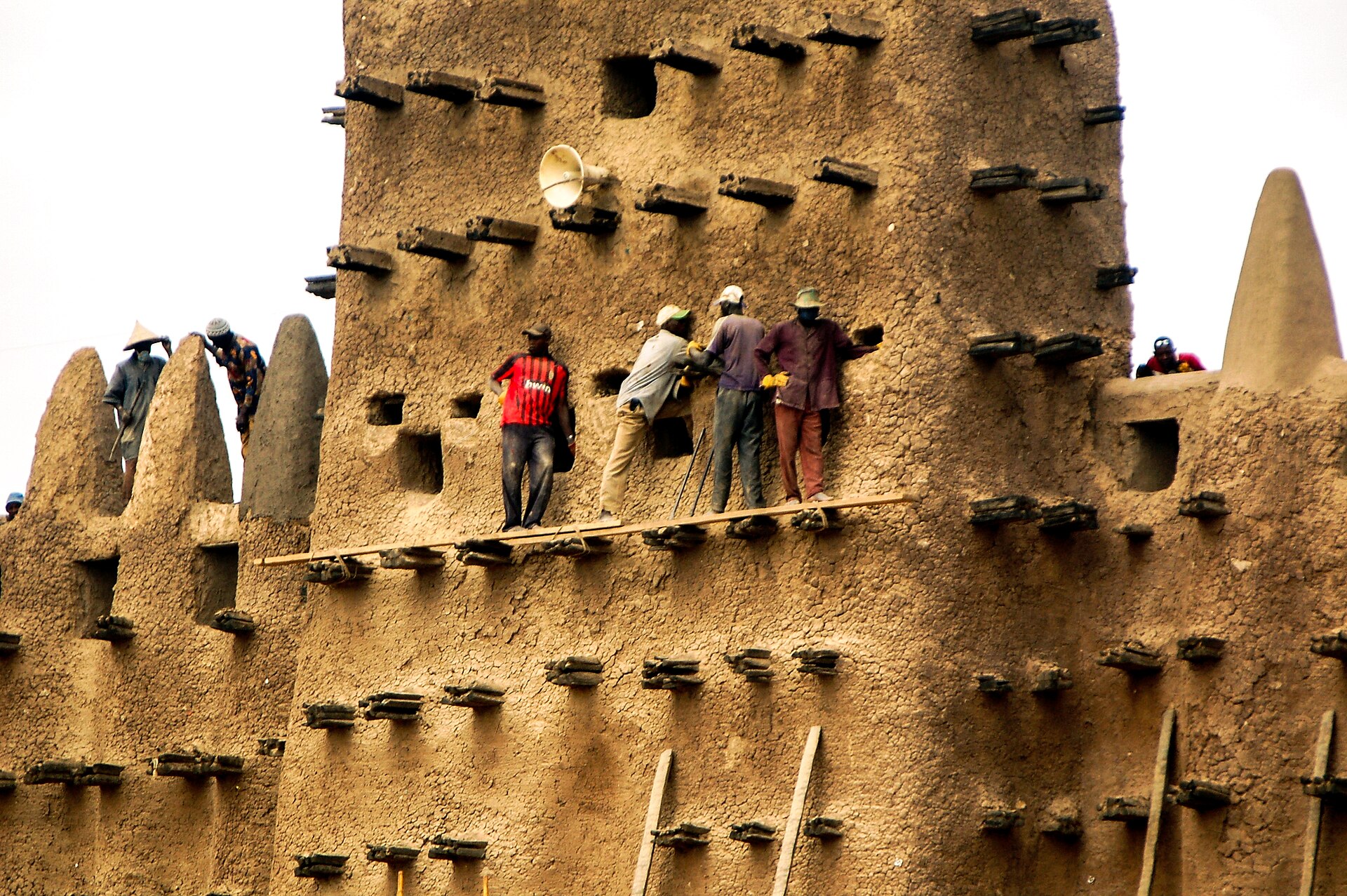
Wooden beams project from the walls, both as decoration and as permanent scaffolding for repairs. The whole building must be maintained constantly, for mud is a living material that the rains would otherwise wash away.

Sudano-Sahelian Architecture
The mosque is the supreme example of Sudano-Sahelian architecture, a style found across the West African Sahel. It is characterised by mud construction, tapering buttresses, and the distinctive spiked beams known as toron.
This architecture is perfectly adapted to its environment, using local earth to create cool, monumental buildings. Djenne’s whole townscape, not just its mosque, is a showcase of this tradition.
The Annual Replastering Festival
Because it is made of mud, the mosque needs regular re-plastering, and this has become one of the great communal events of Djenne. Each year, in a festival atmosphere, much of the town gathers to renew the mosque’s surface.
Men climb the projecting beams to spread fresh mud plaster, while others carry the mud and women bring water, all to music and celebration. This yearly act of collective care both maintains the building and binds the community together.

Djenne and the Trans-Saharan Trade
For centuries Djenne prospered as a key link in the trans-Saharan trade, closely tied to the fabled city of Timbuktu further north. Gold, salt, slaves and other goods passed through its markets.
Djenne’s merchants grew wealthy, and their success funded its mosques and fine houses. The great weekly market, still held before the mosque, continues a commercial tradition many centuries old.
A Town of Mud-Brick Houses
Djenne is not only its mosque. The surrounding old town is a dense maze of two-storey mud-brick houses, many with elaborate facades, narrow lanes and small squares, all built in the same earthen tradition.
This makes Djenne one of the best-preserved historic towns of its kind in Africa. Walking its streets is to move through a living example of a centuries-old urban world built entirely from the earth.


Ancient Djenne-Djenno
A few kilometres from the present town lie the mounds of Djenne-Djenno, an ancient settlement that is one of the oldest known urban sites in sub-Saharan Africa, inhabited from around the third century BC.
Excavations there have revealed a sophisticated early African town that flourished long before the arrival of Islam or European contact. Djenne-Djenno pushed back the known history of urban life in West Africa by many centuries.
A Centre of Islamic Learning
Like Timbuktu, Djenne became an important centre of Islamic scholarship, home to Quranic schools and learned teachers. Students came to study religion, law and other subjects in its madrasas.
This role gave Djenne a spiritual and intellectual importance to match its commercial wealth. Its mosque was the focus of a rich religious and educational life that endured for centuries.
Preservation and UNESCO
The old towns of Djenne, together with the archaeological site of Djenne-Djenno, were inscribed on the UNESCO World Heritage List in 1988. The site is valued both for its living architecture and for its ancient origins.
Preserving a town built of mud is a perpetual challenge, dependent on continued traditional skills and communal effort. Political instability in the region has added to the difficulties, and the site has faced growing threats in recent years.
Getting There
Djenne lies in central Mali, in the Mopti Region, several hundred kilometres northeast of the capital, Bamako. Reaching it involves a long road journey, and during the flood season the final approach crosses the river by a small ferry.
The nearest larger town is Mopti. Travel in this part of Mali has been strongly affected by regional insecurity in recent years, so visitors should carefully check current conditions and advice before planning a trip.
Coordinates: 13.9053, -4.5551 — open Djenne in Google Maps.
Nearby Places
- Timbuktu — Djenne’s famous sister city on the same trade routes, another centre of mud architecture and learning.
- Great Zimbabwe — another great African city, built in stone rather than mud, grown rich on long-distance trade.
- Chan Chan — the largest mud-brick city in the Americas, facing the same challenge of preserving earthen architecture.
Closing Thoughts
The Great Mosque of Djenne is one of the wonders of Africa: a mountain of mud raised by human hands, renewed each year by the whole community that worships within it.
Set in a living town of earthen houses beside an ancient city of the same soil, Djenne shows how a great and lasting architecture can be built from the humblest of materials. It remains a masterpiece of African civilisation and communal devotion.
You May Like
Mafra, the Palace a King Built From a Vow