In the green hills of northern Jordan lies one of the best-preserved provincial Roman cities anywhere in the world. Jerash, the ancient Gerasa, still has its colonnaded streets, temples, theatres and a unique oval plaza, so complete that walking through it feels like stepping into a living Roman town.
Often called the Pompeii of the East, Jerash was not buried by a volcano but slowly abandoned and covered by sand and soil, which protected it for centuries. Today it offers one of the clearest pictures we have of urban life in the Roman Near East.

Table of Contents
- The Pompeii of the East
- Gerasa: A City of the Decapolis
- Hadrian’s Arch and the Grand Entrance
- The Oval Plaza
- The Cardo Maximus, Jerash’s Colonnaded Street
- The Temple of Artemis
- The Theatres and Public Performance
- The Nymphaeum and Street Life
- Earthquake, Decline, and Burial
- Rediscovery, Festival, and Heritage
- Nearby Places
- Closing Thoughts
The Pompeii of the East
Jerash earned its nickname not from sudden disaster but from its remarkable state of preservation. Where many ancient cities survive only as scattered stones, here whole streets, gateways and public buildings still stand, giving a rare sense of the plan and scale of a Roman city.
The ruins spread across a wide site, with the ancient city on one side of a valley and the modern town on the other. This separation helped save the old city from being built over, leaving its monuments free to be excavated and admired.

Gerasa: A City of the Decapolis
In Roman times Gerasa was one of the cities of the Decapolis, a group of prosperous Greek-influenced towns on the empire’s eastern frontier. It grew wealthy from trade and agriculture and adorned itself with the full range of Greco-Roman public architecture.
Its golden age came in the first and second centuries AD, when much of what we see today was built. The city’s prosperity is written in its temples, theatres and the generous scale of its colonnaded streets.
Hadrian’s Arch and the Grand Entrance
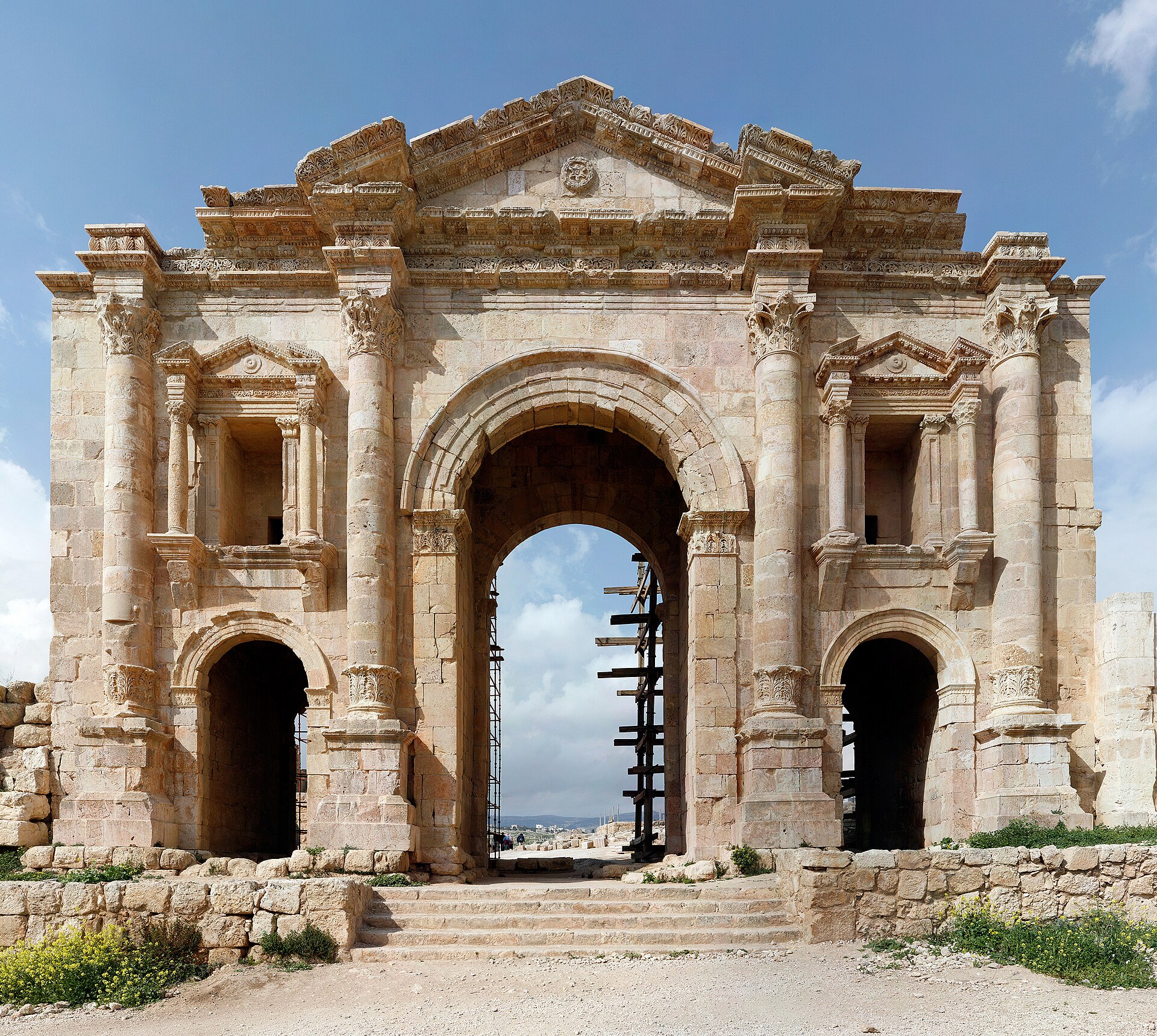
Visitors to Jerash today enter, as ancient travellers did, beneath a great triumphal arch. It was raised to honour a visit by the emperor Hadrian in the early second century, a mark of the city’s pride and its ties to imperial Rome.
Standing somewhat apart from the main walls, the arch was meant to anticipate a planned expansion of the city that was never fully carried out. It remains an impressive and elegant gateway to the ruins.
The Oval Plaza
Beyond the entrance lies Jerash’s most distinctive feature, a great oval plaza ringed by a sweeping colonnade. This unusual open space, broad and gracefully curved, is unlike almost anything else in the Roman world.
It served as the forum of the city, a gathering place linking the main street to the temple above. Overlooking it stood the Temple of Zeus, whose ruins crown the slope beside the plaza.

The Cardo Maximus, Jerash’s Colonnaded Street
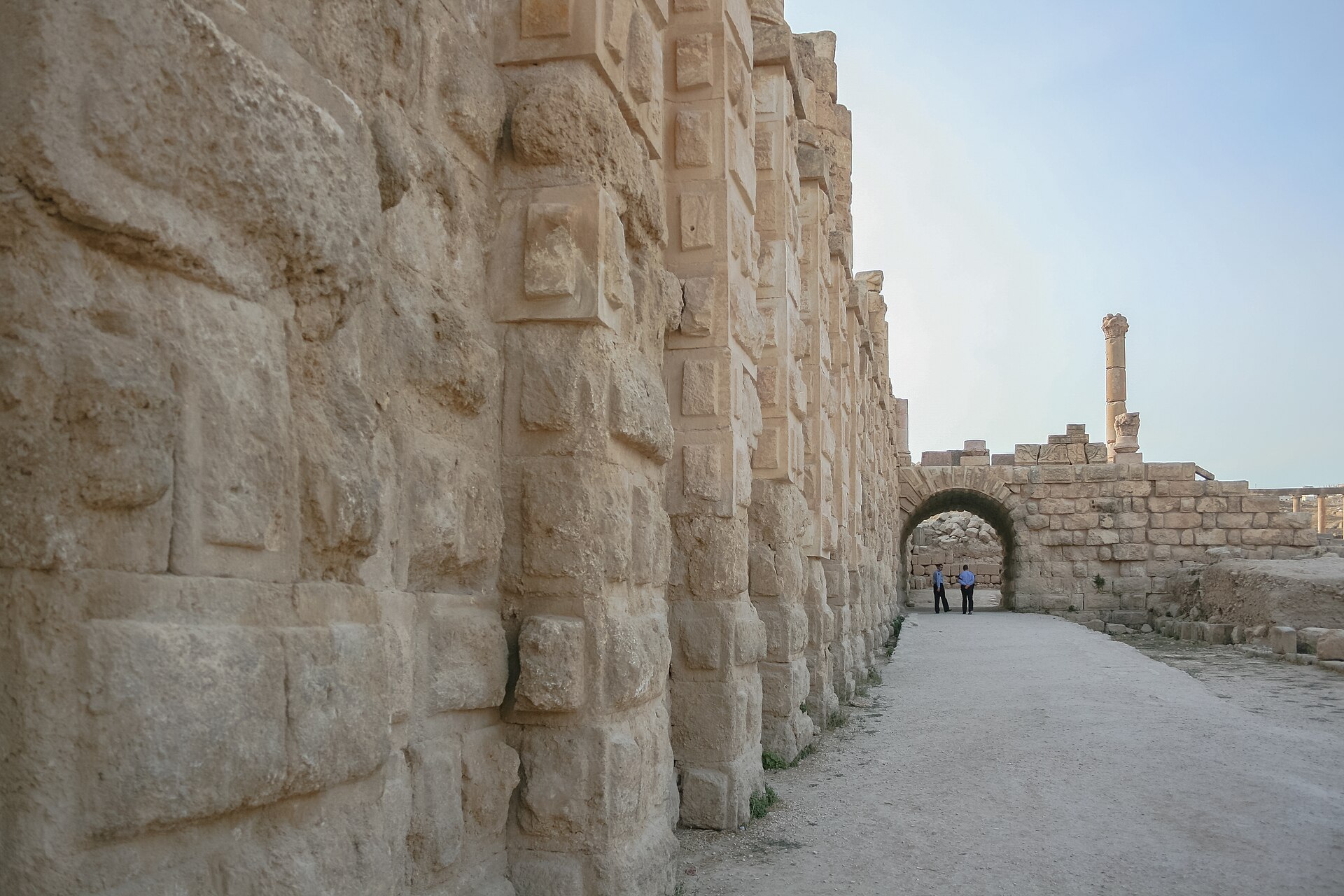
From the plaza the Cardo Maximus, the main north-south street, runs for hundreds of metres through the heart of the city, lined on both sides by columns. The ruts of ancient chariot wheels are still visible in its paving stones.
Along the street stood shops, fountains and the entrances to public buildings, making it the bustling commercial and social spine of Gerasa. Its columns, many still standing, give the ruins their characteristic silhouette.

The Temple of Artemis
The patron deity of Jerash was Artemis, and her temple was the grandest religious building in the city. Approached by a monumental stairway and gateway, it stood on a raised terrace dominating the surrounding streets.
Its tall columns, beautifully proportioned, still rise against the sky. So finely balanced are they that in places a coin or blade slipped into a joint can be seen to move gently as the great drums sway almost imperceptibly in the wind.

The Theatres and Public Performance
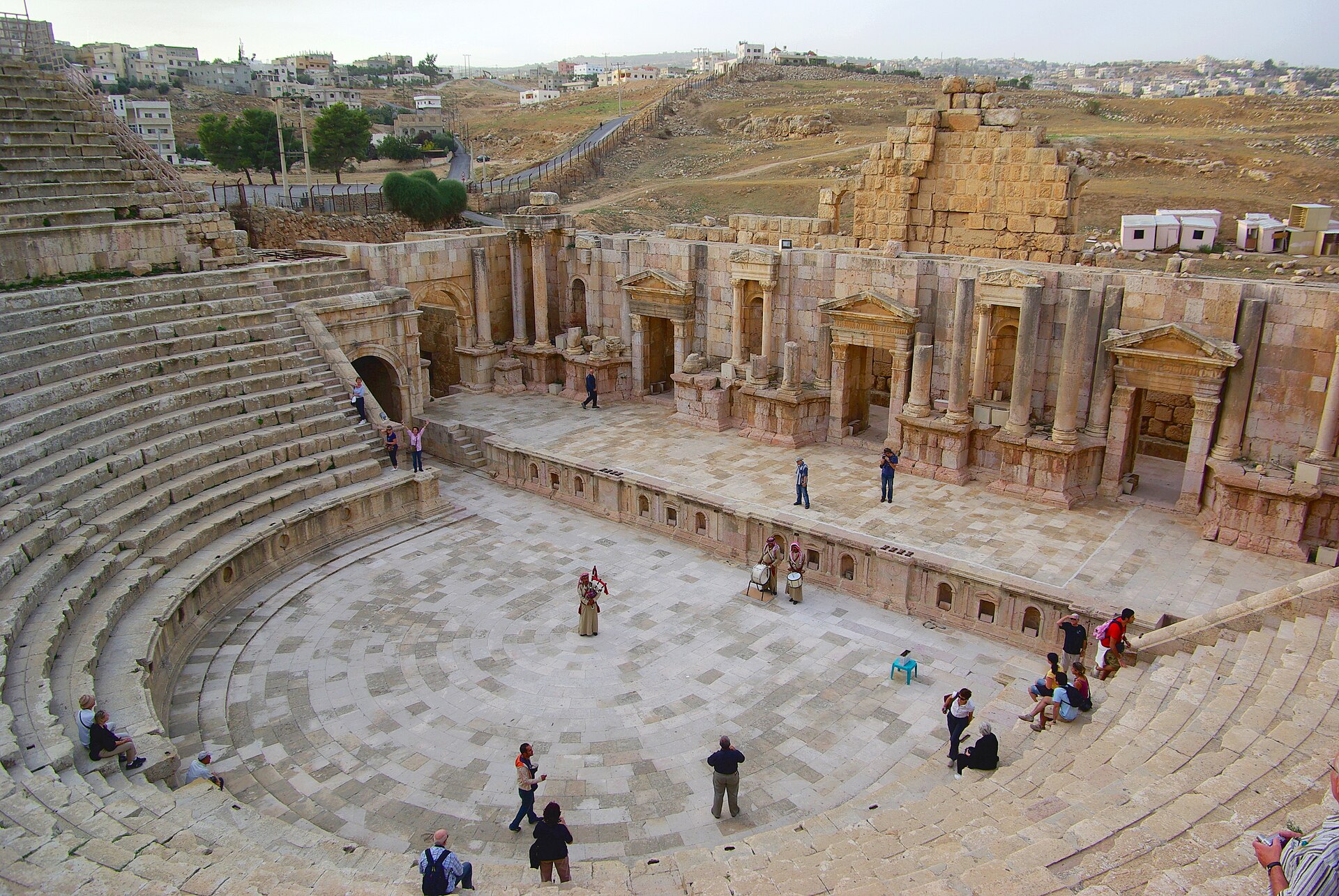
Jerash had more than one theatre, the largest being the South Theatre, able to seat several thousand spectators. Its stone seats and elaborately decorated stage building survive in excellent condition.
The acoustics remain so good that a voice from the centre of the stage carries clearly to the highest rows. These theatres hosted drama, music and civic gatherings, central to the public life of the city.
The Nymphaeum and Street Life
One of the finest monuments along the Cardo is the nymphaeum, an ornate public fountain dedicated to the water nymphs. Once faced with marble and topped with a half-dome, it poured water into basins for the people of the city.
Such fountains were both practical and decorative, marking Jerash as a city that enjoyed the comforts and display of Roman urban life. Around them the daily business of the town unfolded.

Earthquake, Decline, and Burial
Jerash flourished into the Byzantine period, when many churches were built among the older temples. But changing trade routes, plague and above all a devastating earthquake in the eighth century brought decline.
Gradually the population dwindled and the ruined city was left to the elements. Windblown soil and sand slowly buried the fallen buildings, unintentionally preserving them for the archaeologists of a later age.
Rediscovery, Festival, and Heritage
Jerash was brought back to wider attention by European travellers in the nineteenth century, and systematic excavation has since revealed the city we see today, one of the great archaeological parks of the Middle East.
Now the ancient streets host a popular annual arts festival, filling the old theatres and plaza with music and performance once more. Long protected and cherished, Jerash stands among the finest surviving examples of a Roman provincial city.
Nearby Places
- Baalbek — the colossal Roman sanctuary of the same eastern provinces, on an even grander architectural scale.
- Petra — the Nabataean capital in southern Jordan, sharing Jerash’s blend of eastern and classical worlds.
- Palmyra — another richly colonnaded caravan city of the Roman Near East.
Closing Thoughts
Jerash gives us something rare: not a single monument but a whole Roman city we can still walk through, from its triumphal arch and oval plaza to its temples, theatres and colonnaded streets.
To stroll down the Cardo, past the standing columns of Artemis and into the great curved plaza, is to experience the shape and rhythm of ancient urban life more directly than almost anywhere else in the Roman world.
You May Like
Mafra, the Palace a King Built From a Vow


One thought on “Jerash: The Pompeii of the East and Its Extraordinary Oval Plaza”