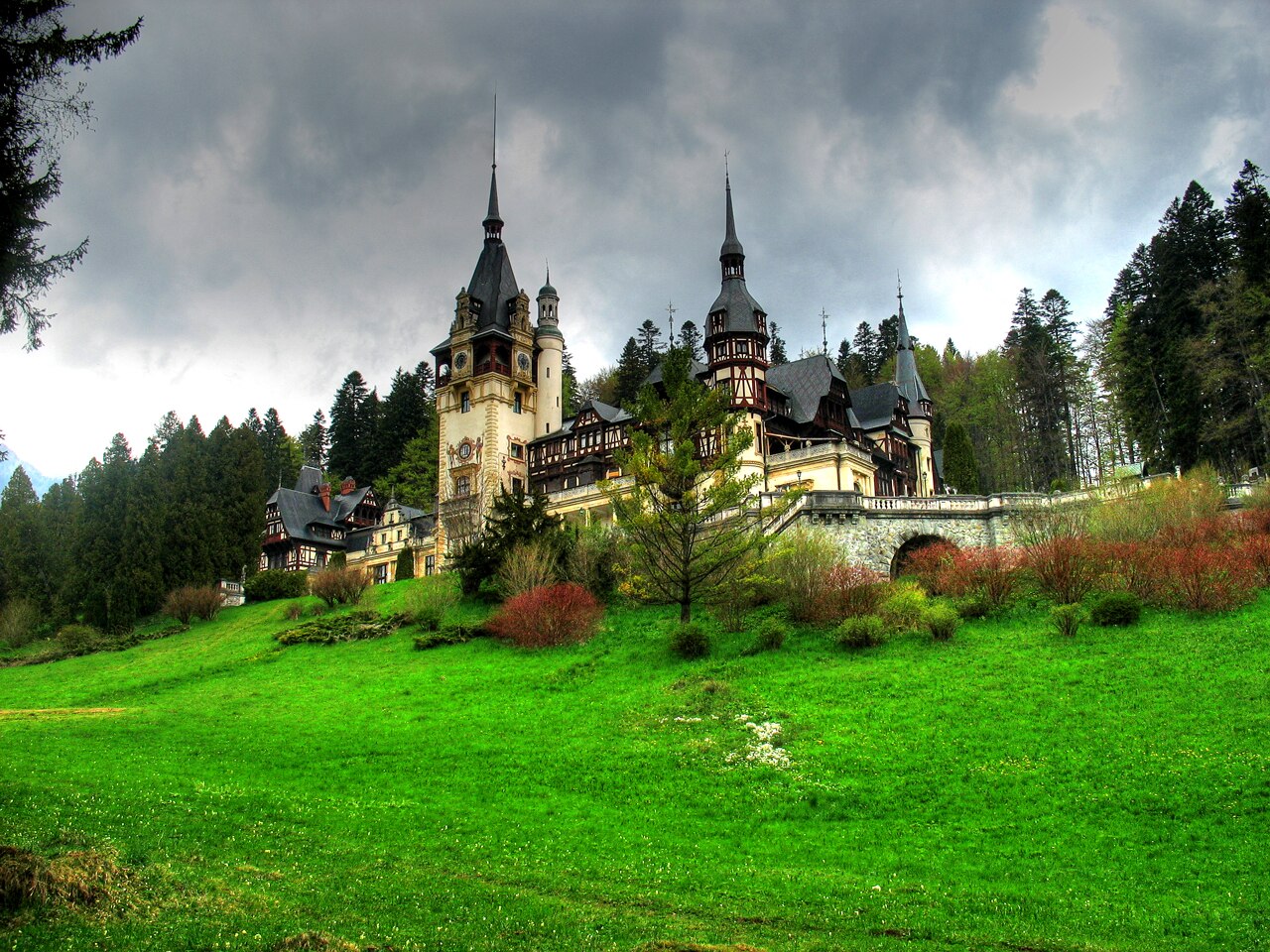
Deep in the wooded Carpathian Mountains of Romania, where pine-covered slopes rise steeply on every side, there appears one of the most romantic buildings in all of Europe. Peles Castle emerges from the forest like something out of a fairy tale, its timbered gables, pointed turrets, and ornate stonework crowding together beneath the mountain sky. It is a vision of storybook splendour set amid dramatic natural beauty, and it takes the breath away.
Yet Peles is far more than a pretty picture. Built in the closing decades of the nineteenth century as the summer residence of Romania’s first king, it is a masterpiece of the Neo-Renaissance style and one of the most technologically advanced buildings of its age. Behind its romantic facade lay marvels of modern engineering, and within its walls waited some of the most sumptuous interiors to be found anywhere in Europe.
The castle is above all the creation of a single visionary king, who poured his ambition, taste, and love of his adopted country into its construction. It was designed to be both a royal home and a statement of the new Romanian monarchy’s arrival among the nations of Europe, and it remains a powerful symbol of that era and of the country’s rich cultural heritage.
In this guide you will explore Peles from its origins under the king who dreamed it, through its remarkable architecture and pioneering technology, its dazzling interiors, from the great Hall of Honour to the armoury and the exotic salons, its surroundings and its life today as a museum. By the end you will understand why this mountain castle is regarded as one of the jewels of Europe.
In This Article
- A King’s Mountain Dream
- Carol I, Romania’s First King
- Building in the Carpathians
- German Neo-Renaissance in the Mountains
- A Castle Ahead of Its Time
- The Hall of Honour
- The Armoury and Its Weapons
- A Journey Through Many Rooms
- The Music Room and the Moorish Salon
- The Little Theatre and Early Cinema
- Pelisor and the Surrounding Gardens
- Planning Your Visit to Peles
- See Peles for Yourself
A King’s Mountain Dream
The story of Peles begins with a king in search of a summer home. Romania in the later nineteenth century was a young state, newly emerged into full independence, and its first monarch wished for a residence away from the heat and formality of the capital, somewhere he could retreat in the summer months amid the beauty of nature. He found what he sought in the mountains near Sinaia.
The setting captivated the king from the first. The valley, ringed by forested peaks and watered by mountain streams, offered a landscape of dramatic beauty that reminded him of the scenery of his homeland far to the west. Here, he decided, he would build a castle, a place that would combine the grandeur of a royal residence with the romance of a mountain retreat.
Acquiring the land and planning the castle became a passion for the king, who involved himself closely in every aspect of the project. This was to be no mere holiday villa but a great royal seat, a summer capital in the mountains where the court could gather and where the monarchy could display its taste and its ambition against a backdrop of natural splendour.
From these beginnings grew one of the most ambitious building projects of the age. What the king envisioned was a castle that would rival the great royal residences of Europe while drawing on the romantic traditions of his native land, a fusion of grandeur and fairy-tale charm set amid the Carpathian forests. Peles would become the embodiment of that dream.
There was a political dimension to the choice of the mountains as well as a personal one. By building his summer residence deep within Romanian territory, in a landscape of great natural beauty, the king rooted the new monarchy firmly in the land itself. Peles was not an imported palace in the capital but a castle grown from the Romanian mountains, and in that sense it helped to bind the foreign-born dynasty to its adopted country.
Carol I, Romania’s First King
The visionary behind Peles was Carol I, the first king of modern Romania. Born a German prince of the house of Hohenzollern-Sigmaringen, he had been invited to rule the Romanian lands and would go on to lead the country to full independence and to establish it as a kingdom, becoming its first monarch. Peles was, in many ways, the personal expression of this remarkable ruler.
Carol brought to his adopted country the tastes and traditions of his German background, and these are written all over Peles. The castle’s Germanic Neo-Renaissance style, its timbered facades, and its romantic character all reflect the world from which the king came, transplanted to the Romanian mountains and blended with his ambitions for his new realm.
A disciplined and dedicated ruler, Carol devoted himself to the development of Romania, and the building of Peles was part of his wider project of establishing the prestige and permanence of the new monarchy. A magnificent royal residence demonstrated that the young kingdom belonged among the established states of Europe, and Peles served this symbolic purpose as much as it served as a home.
The castle remained close to Carol’s heart throughout his reign, a place of retreat and of pride, and it was here that he spent his summers and received important guests. Peles is inseparable from his memory, a monument to the king who founded the Romanian monarchy and who left, in this mountain castle, one of the most enduring legacies of his long and consequential reign.
Carol’s long reign spanned nearly half a century, a period in which Romania transformed itself from a fragile principality into an established European kingdom. Peles rose alongside this transformation, and the castle can be read as a mirror of the reign, growing steadily in grandeur and confidence just as the country did. To visit Peles is, in a sense, to visit the achievement of Carol’s entire reign made visible in stone and timber.
It is a poignant footnote that the castle so closely tied to Carol I would, in the changing fortunes of the following century, pass through periods of state ownership before being returned to its role as a treasured monument and museum. Through all these changes, the association with the founding king has endured, and Peles remains above all his creation, the summer seat of the monarchy he brought into being.
Building in the Carpathians
Constructing a great castle in a remote mountain valley was an enormous undertaking, and the building of Peles stretched over many years and drew on the skills of workers from many lands. The rugged terrain, the harsh mountain weather, and the sheer ambition of the design all posed formidable challenges, and the project became a vast international enterprise.
Craftsmen and labourers from numerous countries worked on the castle, bringing with them a range of skills and traditions that contributed to its rich and eclectic character. Materials were gathered from far and wide, and the finest artisans were employed to create the elaborate carving, stonework, and decoration that make Peles so extraordinary. The work was a meeting of many hands and many cultures.
The construction unfolded in stages over decades, with the castle being expanded and enriched over time as resources allowed and as the king’s ambitions grew. What began as a substantial residence developed into an ever more elaborate complex, its rooms multiplying and its decoration becoming ever more sumptuous as the years passed.
By the time the work was essentially complete, Peles had become one of the most magnificent castles in Europe, a triumph of design, craftsmanship, and determination. The long and demanding construction, carried out in so challenging a setting, stands as a testament to the vision of the king and to the skill of the many who laboured to bring that vision to life among the mountains.
The decades-long construction also meant that Peles absorbed the changing tastes and technologies of a rapidly evolving age. Innovations that appeared during the long building process could be incorporated as the work went on, so the finished castle represents not a single moment but a span of years of artistic and technical development. This gives Peles a depth and richness that a more quickly built residence could never possess.
German Neo-Renaissance in the Mountains
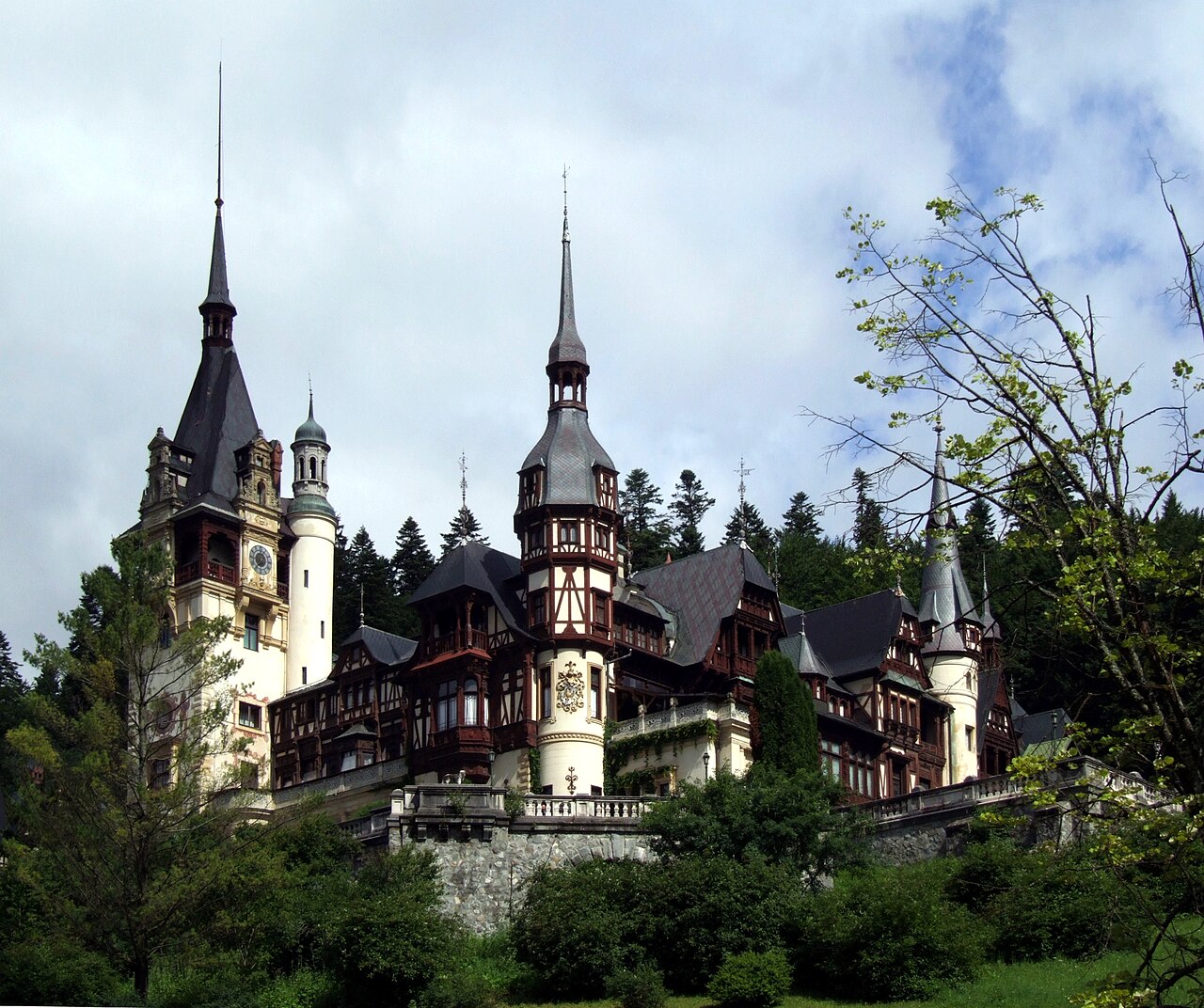
Architecturally, Peles is a masterpiece of the Neo-Renaissance style, drawing above all on the German and central European traditions favoured by its royal builder. Its exterior is a picturesque composition of steep roofs, decorative gables, timbered upper storeys, towers, and turrets, richly ornamented with carving and stonework, creating an effect of romantic complexity and abundance.
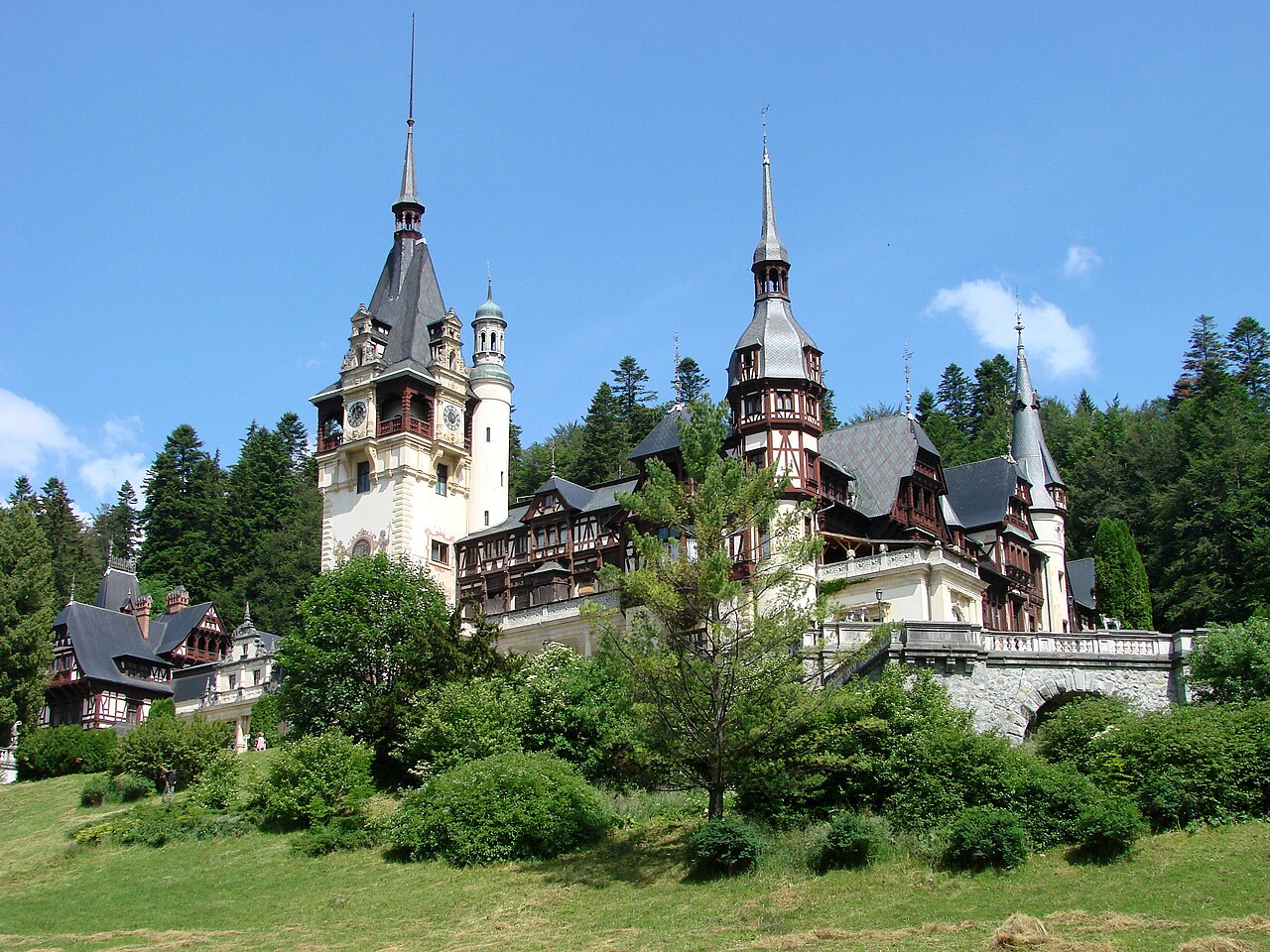
The style deliberately evokes the great houses and castles of the Germanic Renaissance, transplanted to the Romanian mountains and blended with other influences. The result is an eclectic and exuberant design that revels in detail and variety, with each facade and gable offering something new to admire. It is architecture as spectacle, designed to enchant and impress.
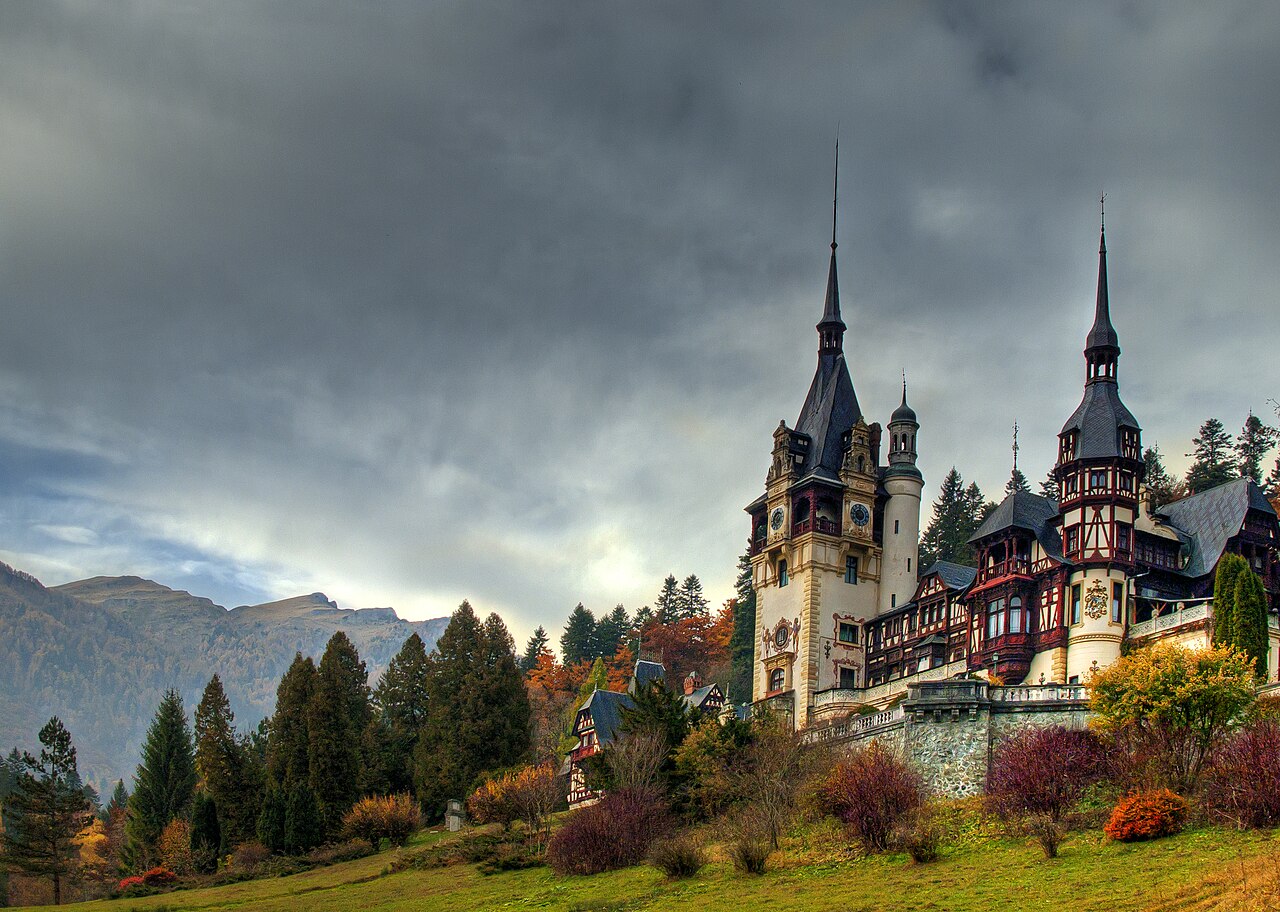
The castle harmonises beautifully with its dramatic setting. Its verticality echoes the surrounding peaks, and its timbered, romantic character seems perfectly suited to the forested mountain landscape. Rather than imposing itself upon nature, Peles appears to grow out of it, a fairy-tale vision that belongs to its mountain valley as if it had always been there.
This marriage of architecture and setting is central to the appeal of Peles. The romantic Neo-Renaissance style, so evocative of legend and history, finds its perfect home amid the Carpathian forests, and the interplay of the ornate castle with the wild natural beauty around it creates one of the most memorable architectural sights in all of Europe.
The eclecticism of the design was very much of its time, when architects and patrons drew freely on the styles of the past to create something new. Peles gathers Renaissance, Gothic, Baroque, and other influences into a single romantic whole, and rather than seeming confused, the mixture reads as abundance. It is a building that wants to contain everything beautiful, and its generosity of ornament is a large part of its charm.
A Castle Ahead of Its Time
For all its romantic, historicist appearance, Peles was one of the most technologically advanced buildings of its era, a marvel of modern engineering hidden behind a fairy-tale facade. While it looked back to the Renaissance in style, it looked firmly forward in its use of the latest innovations, making it a fascinating blend of the romantic and the modern.
The castle was among the first in the region, and indeed in Europe, to enjoy the benefits of modern technology on a comprehensive scale. It was equipped with its own systems for electricity, generated on site, as well as central heating and other conveniences that were remarkable for their time. The comfort and sophistication of the castle far exceeded what most contemporaries could imagine.
Among its most celebrated features were an early central vacuum-cleaning system and a retractable glass ceiling in one of its grand halls, which could be opened to the sky. Such innovations reveal the extent to which the castle embraced the cutting edge of contemporary engineering, combining the pleasures of modern living with the splendour of a royal residence.
This combination of romantic style and modern technology is one of the things that makes Peles so remarkable. It stands at a fascinating moment in history, when the nostalgia of the historicist styles met the confidence of the industrial age, and it embodies both. Behind its dreamlike exterior beat the heart of a thoroughly modern building, a castle truly ahead of its time.
It is worth dwelling on how astonishing these conveniences would have seemed to visitors of the time. In an age when most people still lived without electric light or central heating, to step into a mountain castle blazing with electric lamps, warmed throughout, and fitted with the latest devices must have felt like entering the future. Peles was a showcase not only of royal wealth but of the transformative promise of the modern age.
The Hall of Honour
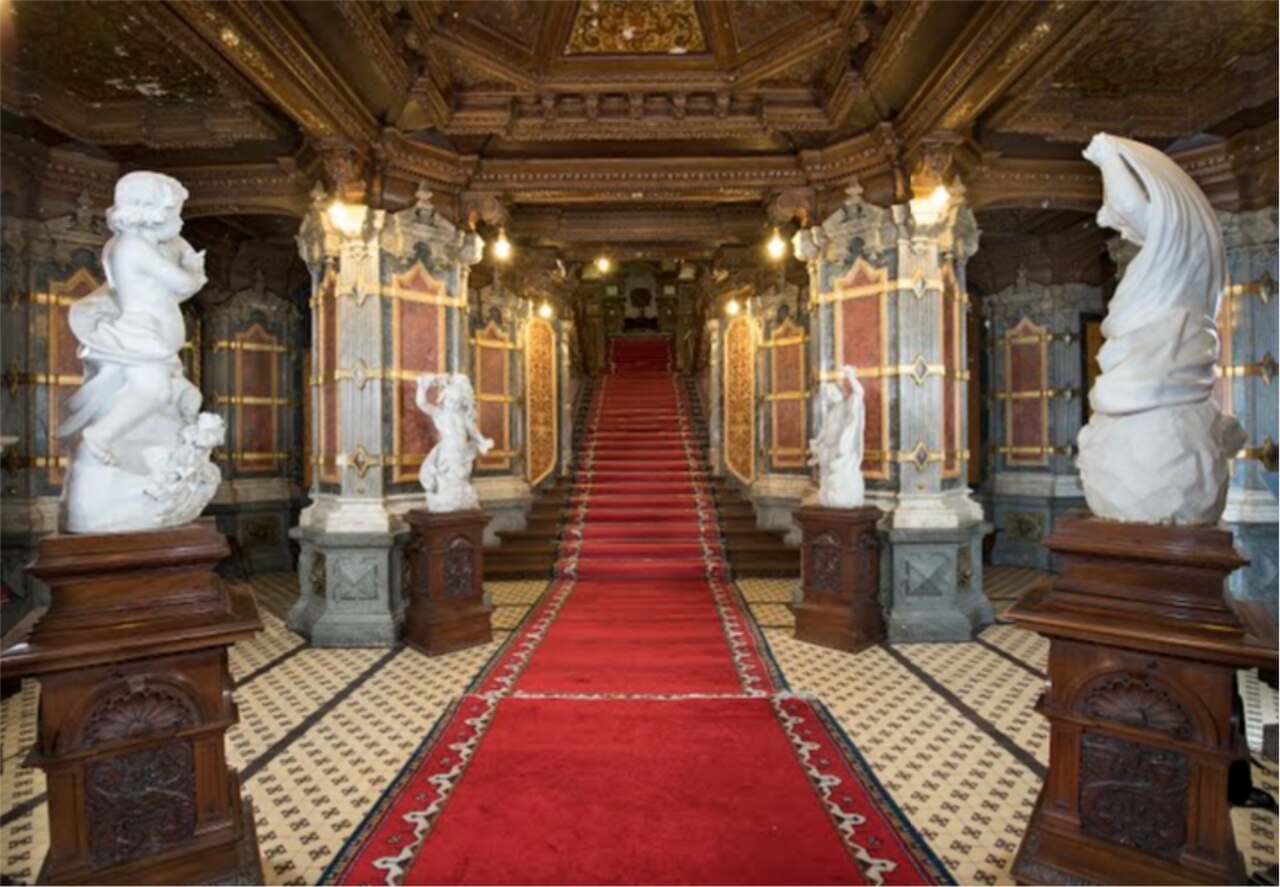
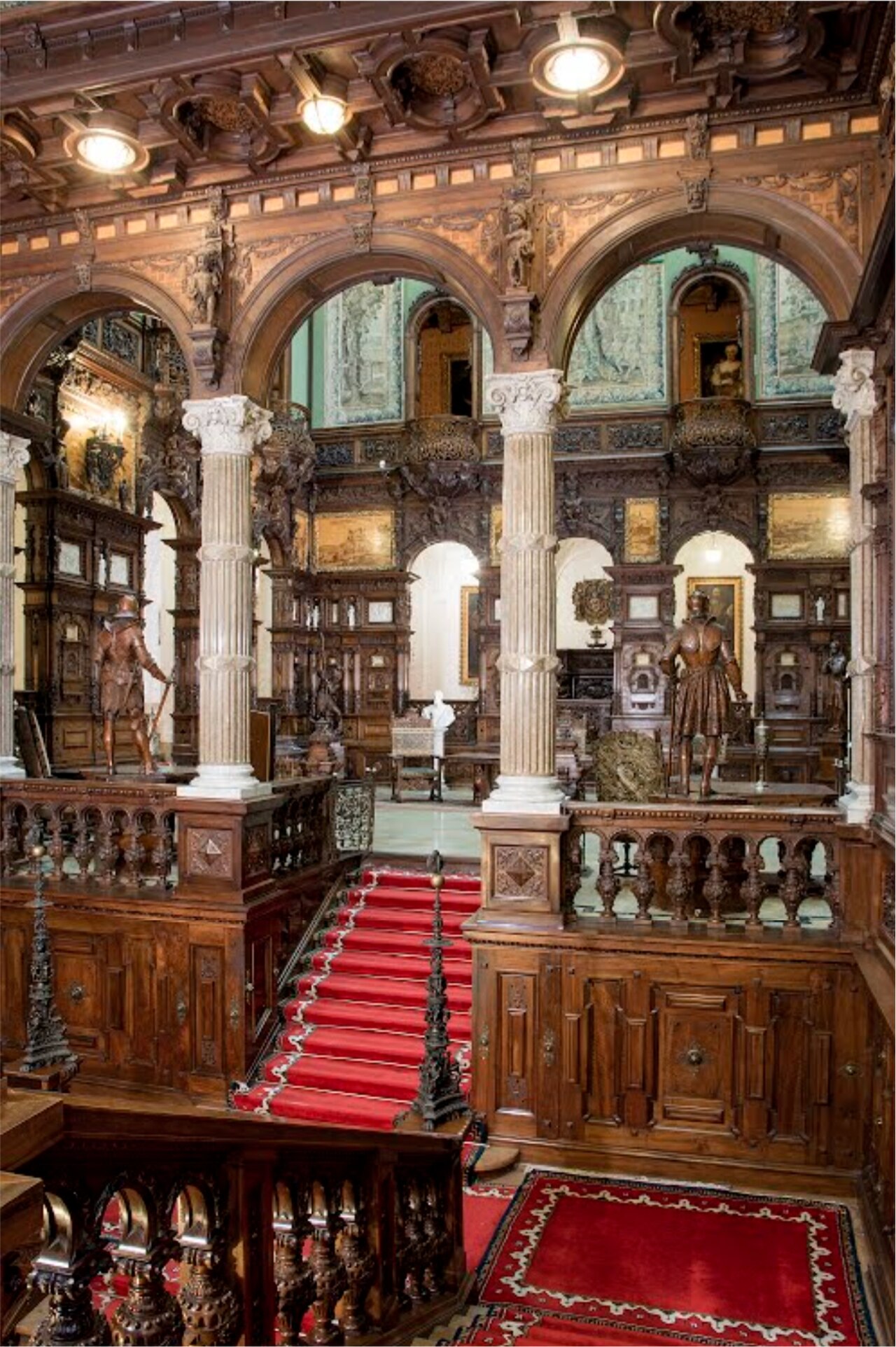
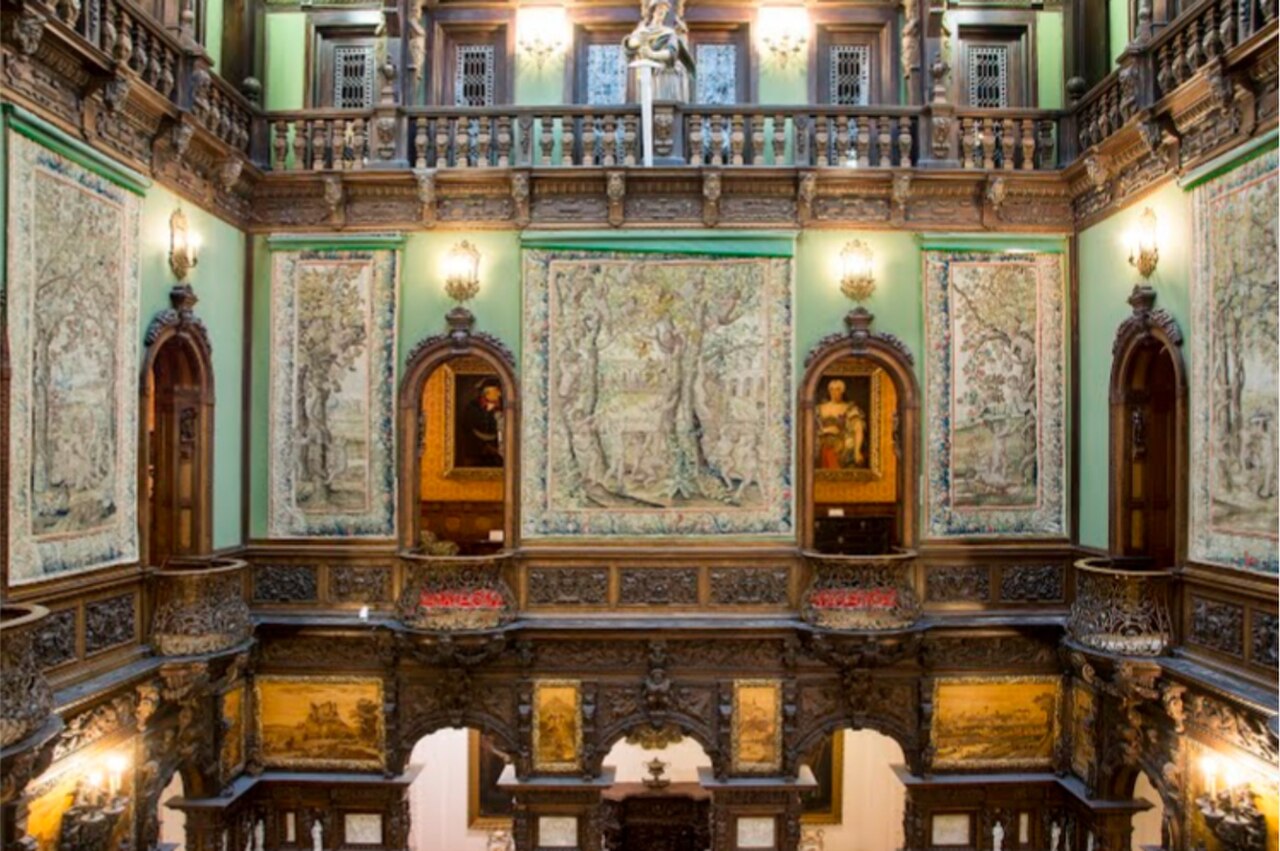
The magnificent heart of Peles is its Hall of Honour, a grand central space that rises through several storeys at the core of the castle. Lined with intricately carved walnut panelling and galleries, and crowned by the famous retractable glass ceiling, this hall is one of the most spectacular interiors in the entire building and a fitting centrepiece for so ambitious a castle.
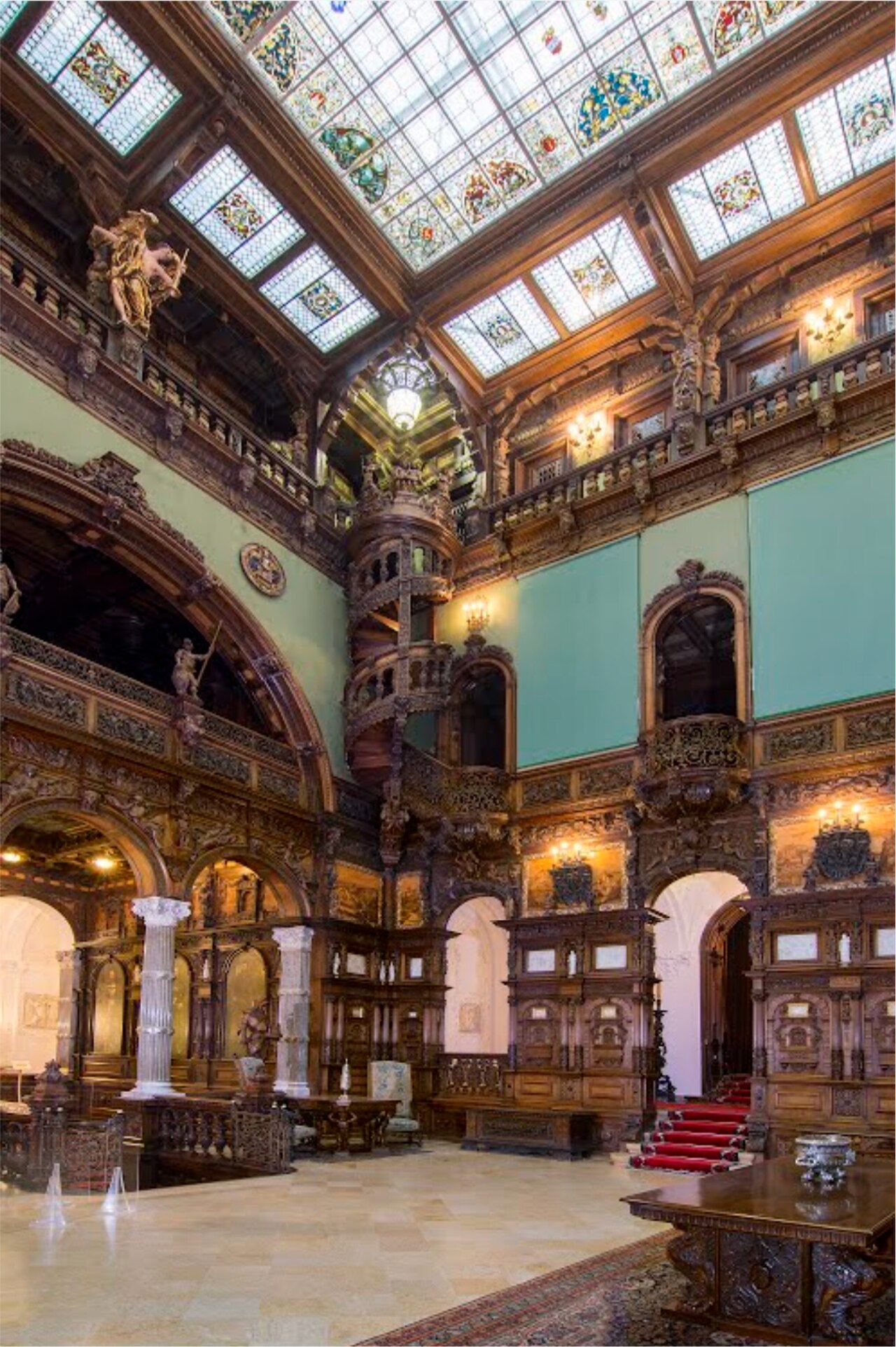
The woodwork of the Hall of Honour is of extraordinary richness, covering the walls and galleries with elaborate carving that displays the skill of the finest craftsmen. Figures, ornament, and decorative panels combine to create an atmosphere of dark, warm splendour, and the hall glows with the beauty of its carved surfaces, a masterpiece of the woodcarver’s art.
The retractable glass ceiling is one of the marvels of the castle. On fine days it could be opened to let in the light and air of the mountains, flooding the hall with sunshine, while in poor weather it kept the space snug and warm. This ingenious feature combined beauty with the castle’s characteristic embrace of modern technology.
For visitors, the Hall of Honour is the unforgettable climax of a tour of Peles. Standing within it, surrounded by the glowing carved wood and looking up toward the glass ceiling, you feel the full ambition and artistry of the castle. It captures in a single space the fusion of romantic splendour and modern ingenuity that defines Peles as a whole.
The carved decoration of the hall repays the closest attention, for hidden within it are countless figures, scenes, and details drawn from history and legend. Craftsmen laboured for years to cover the surfaces with this ornament, and each visit reveals something new. The hall is less a single design than an entire world of carving, a demonstration of what the woodcarver’s art could achieve when given unlimited ambition and resources.
The Armoury and Its Weapons
Among the most impressive spaces in Peles is its armoury, one of the finest collections of arms and armour in the region. Gathered by the royal builder, whose interest in military history and craftsmanship was considerable, the collection fills several halls with weapons and armour spanning many centuries and many lands, a treasure trove for anyone fascinated by the martial arts of the past.
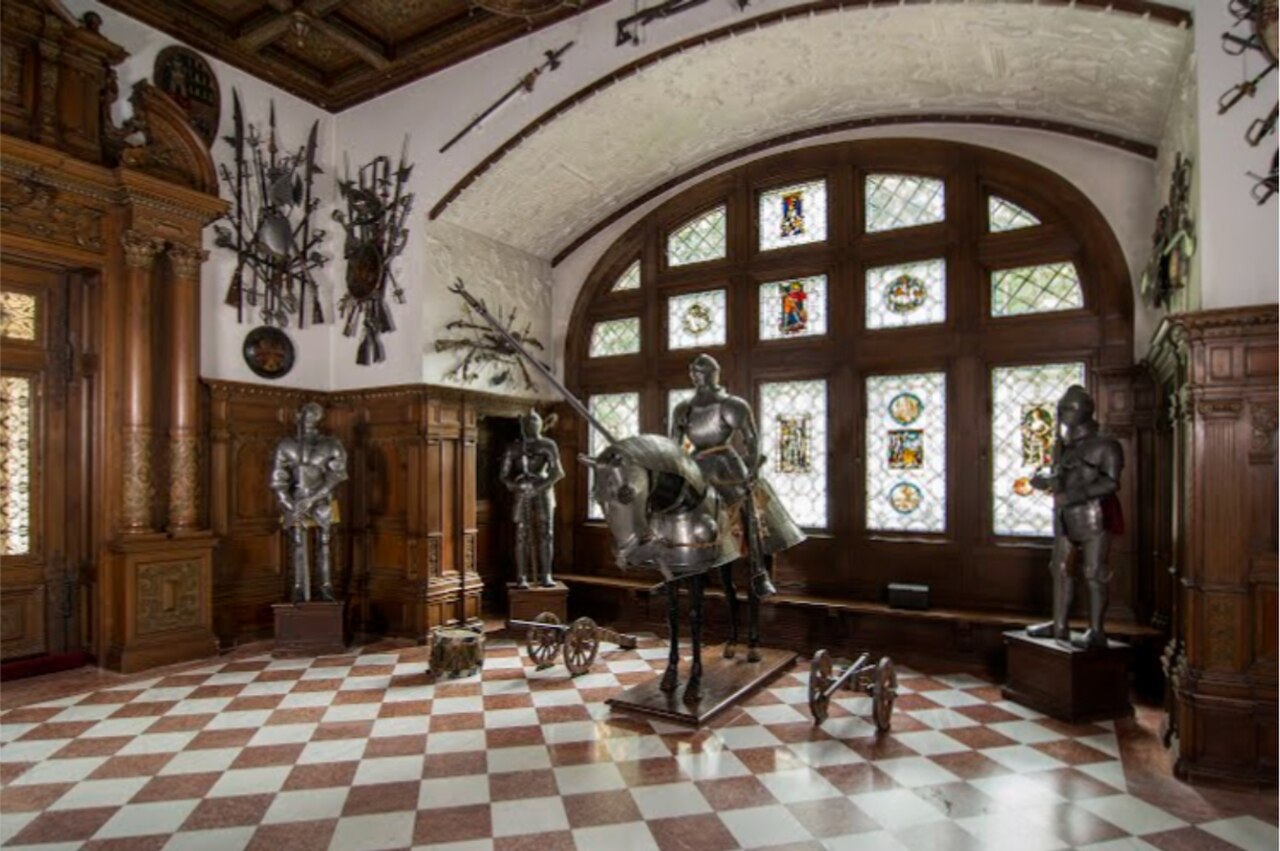
The armoury displays everything from suits of plate armour and edged weapons to firearms and elaborate ceremonial pieces, many of them of great historical and artistic value. Among the treasures are complete suits of armour, including examples designed for both horse and rider, magnificent objects that combine practical purpose with extraordinary craftsmanship.
The collection reflects not only the king’s personal interests but the wider fascination of the age with history and with the romance of the medieval and Renaissance past. Assembling such an armoury was itself a statement of culture and refinement, and its presence at Peles adds another layer to the castle’s rich and varied character.
For visitors, the armoury is one of the highlights of the castle, offering a striking contrast to the domestic splendour of the other rooms. The gleaming weapons and armour, arranged in their historic halls, evoke the world of chivalry and warfare that so captivated the nineteenth-century imagination, and they testify to the breadth of the collections that Peles contains.
The scale of the armoury reflects the seriousness of the king’s interest, for this was no token display but one of the most substantial collections of its kind assembled in the region. To gather so many fine pieces required knowledge, connections, and considerable expense, and the result is a collection that would grace any great museum, preserved here in the romantic setting of the mountain castle for which it was assembled.
A Journey Through Many Rooms
Peles contains a vast number of rooms, more than a hundred and sixty in all, each decorated with care and often according to a particular theme or style. Moving through the castle is like travelling through a series of different worlds, as one richly decorated space gives way to another, each with its own character, colour, and atmosphere.
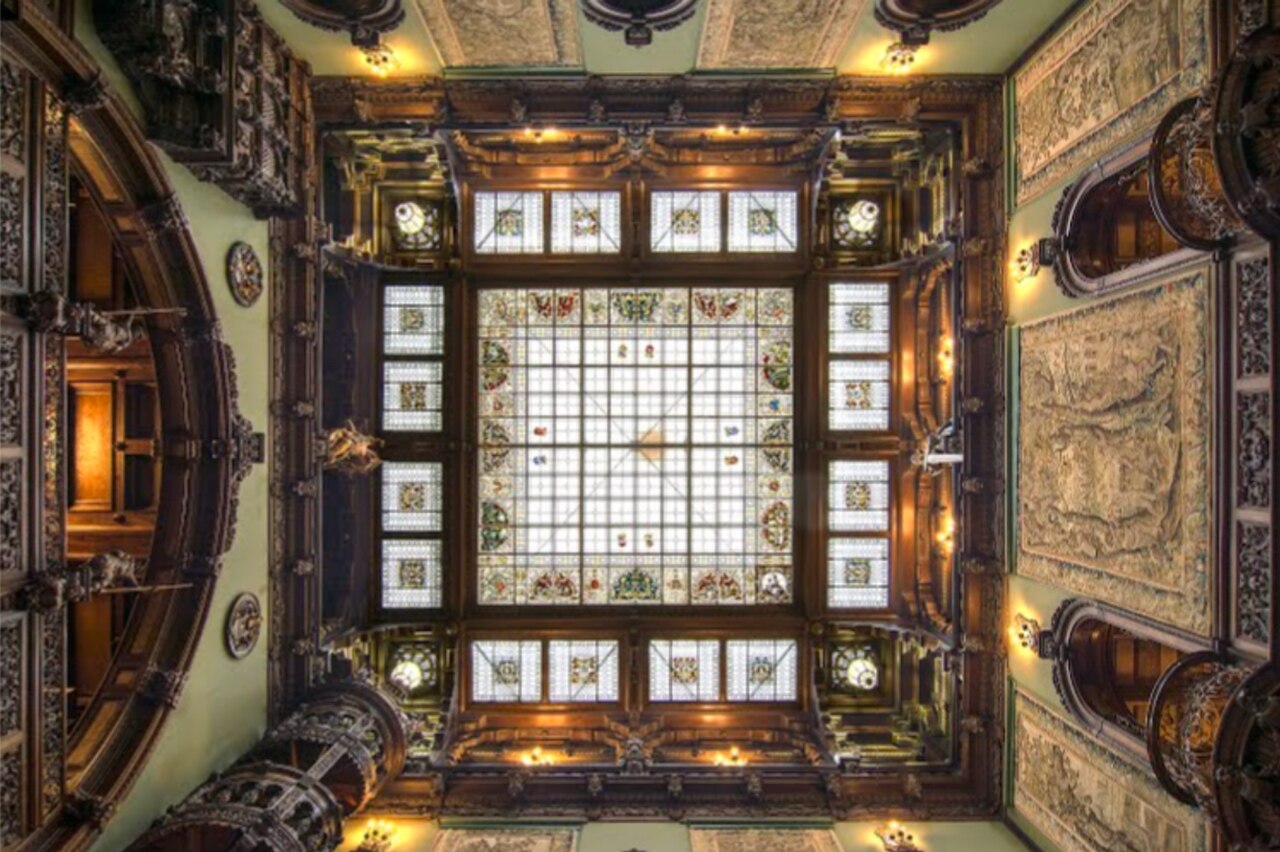
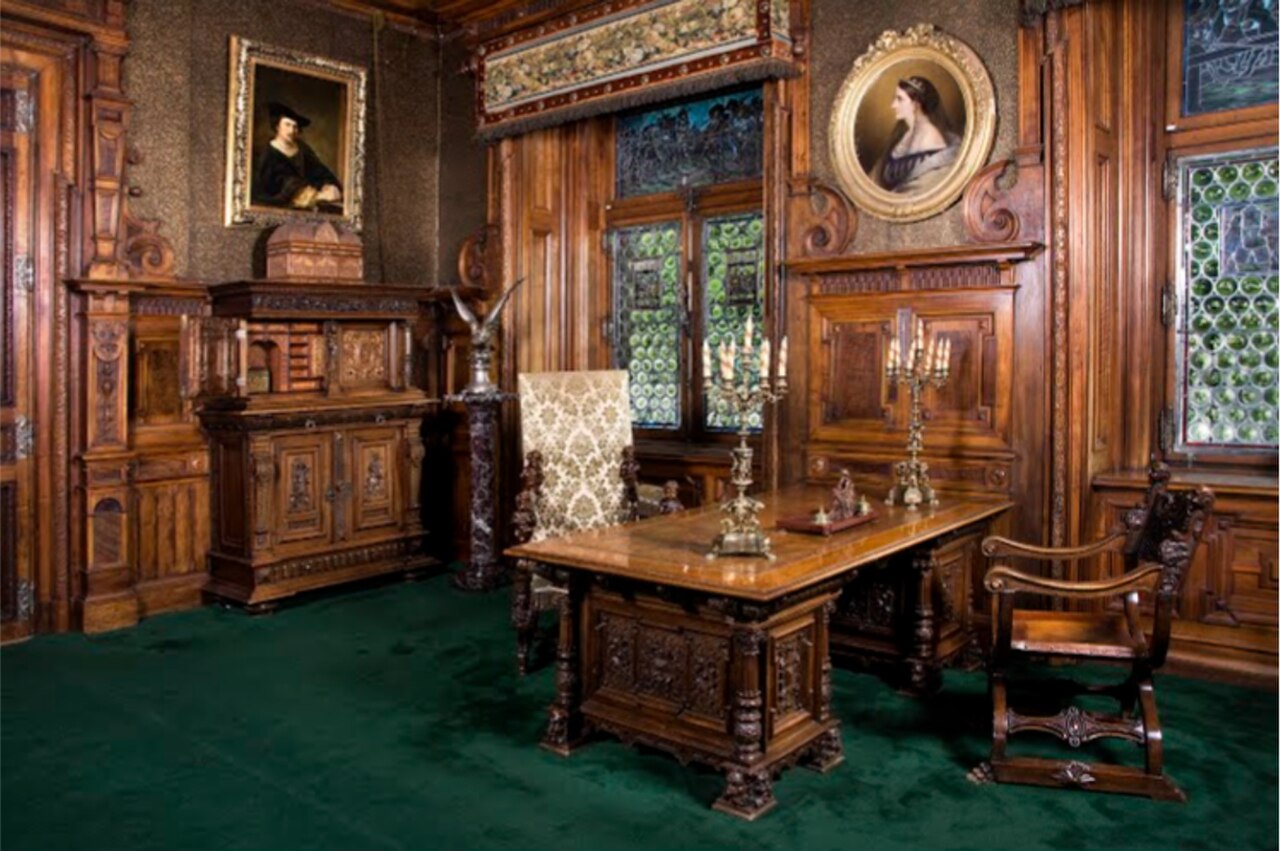
The rooms reflect an astonishing range of styles and influences, from various periods of European history to the arts of distant lands. There are studies and libraries, drawing rooms and bedrooms, halls and salons, each conceived as a complete decorative environment. The variety is dazzling, and it reflects the eclectic tastes of the age and the ambition of the castle’s creators.
Fine materials and craftsmanship are everywhere apparent, from carved wood and moulded plaster to silk hangings, painted decoration, stained glass, and precious objects. No expense was spared in the decoration of the rooms, and the result is an interior of extraordinary richness, a showcase of the decorative arts of the late nineteenth century at their most opulent.
For visitors, the sheer abundance of beautiful rooms can be almost overwhelming, and part of the pleasure of Peles lies in this profusion. Each space offers something new to discover, and together they create an impression of inexhaustible splendour, a castle in which every room is a work of art and every turn reveals another marvel.
The thematic decoration of the rooms also tells a story about the nineteenth century’s relationship with the past. Each historical style was chosen for the associations it carried, evoking a particular mood or era, so that moving through the castle became a kind of imaginative journey through history. The rooms were designed not merely to be beautiful but to transport those who entered them into other times and places.
The Music Room and the Moorish Salon
Among the many splendid rooms of Peles, some stand out for their special character and beauty. The music room, decorated with fine paintings and furnishings, was a place for entertainment and culture, where the court could gather to enjoy performances and the pleasures of art. Its elegant decoration reflects the refined tastes of the royal household.
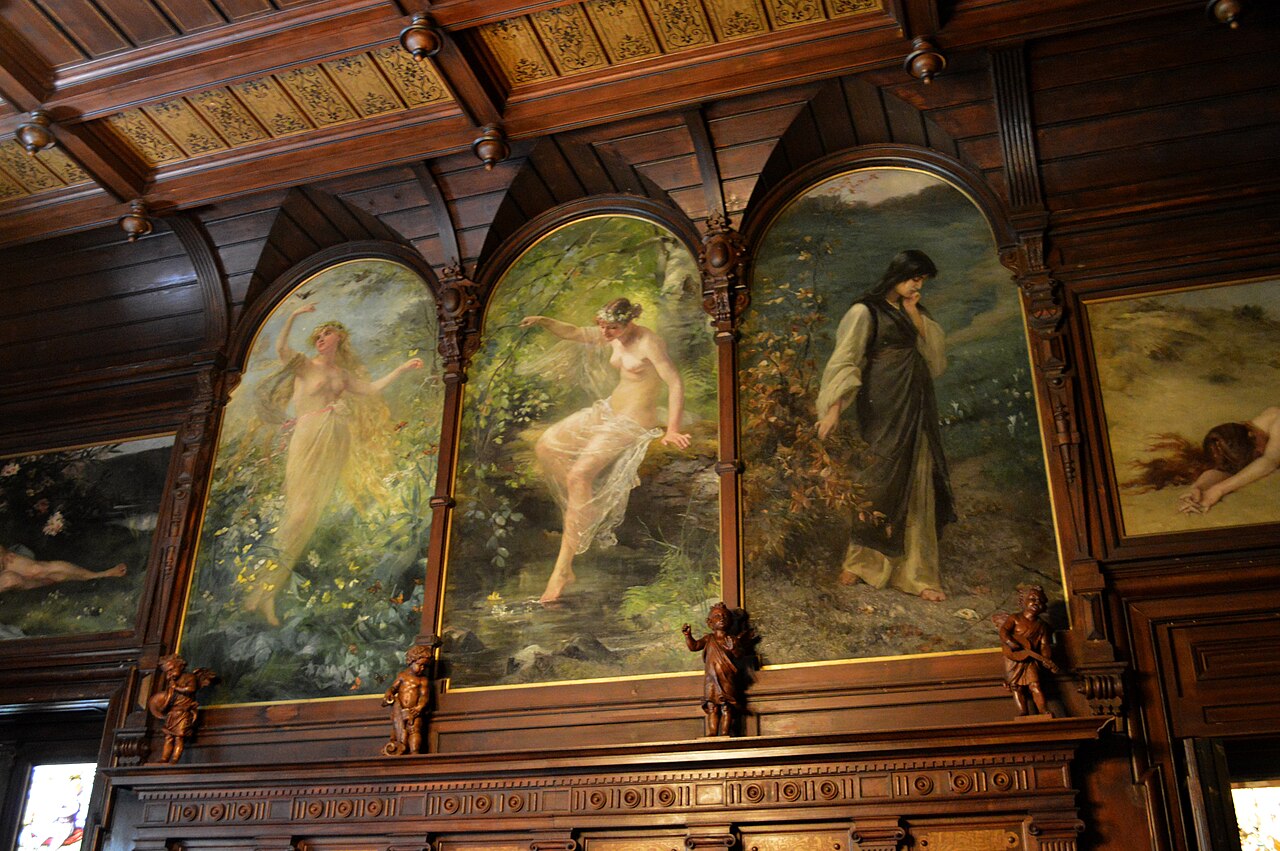
Even more exotic is the Moorish salon, a room decorated in the style of Islamic art and architecture, with intricate ornament, a fountain, and an atmosphere of eastern luxury. Such rooms reflected the nineteenth-century fascination with the art of the Orient, and they provided a touch of the exotic and the fantastic amid the European splendour of the rest of the castle.
These themed rooms reveal the eclectic spirit of the age, which delighted in gathering the styles of many cultures and periods under one roof. At Peles, the visitor can pass from a Germanic hall to an oriental salon in a few steps, experiencing the whole range of the historicist imagination that shaped the decorative arts of the time.
Rooms like these add greatly to the charm and interest of Peles, offering surprises and delights amid the grandeur. They show that the castle was not only a place of solemn splendour but also of pleasure and fantasy, a setting where the royal household could indulge its tastes and its imagination in the creation of beautiful and evocative spaces.
The taste for the exotic that produced the Moorish salon was widespread in nineteenth-century Europe, where rooms in Turkish, Moorish, or oriental styles became fashionable in grand houses. Such spaces offered an escape into an imagined East, a fantasy of luxury and mystery that contrasted with the familiar European styles of the other rooms. At Peles, the salon brings a touch of this dreamlike exoticism into the heart of the Carpathians.
The Little Theatre and Early Cinema
Among the many treasures of Peles is its own small theatre, a beautifully appointed space within the castle where performances could be staged for the royal household and its guests. The presence of a private theatre reflects the cultured life of the court and the importance placed on music, drama, and entertainment in the royal household.
The theatre is notable not only for its elegance but for its place in the history of technology and culture. As one of the earliest spaces of its kind in the region to be equipped with electric lighting, and later associated with the early history of moving pictures in the country, it stands at the meeting point of tradition and innovation that characterises the whole castle.
That a mountain castle should contain such a theatre speaks to the ambition and sophistication of its creators. Entertainment on this scale was a mark of the highest culture, and the theatre allowed the court to enjoy performances in the comfort and privacy of the castle, far from the public stages of the capital.
For visitors today, the little theatre is a charming reminder of the living culture of the castle in its heyday. It evokes the evenings of music and drama that once filled the royal residence, and it adds yet another dimension to the rich and varied experience that Peles offers, a glimpse of the pleasures that animated the court in its mountain retreat.
The link between the castle’s theatre and the earliest days of cinema in the country gives it a special place in cultural history. To think that moving pictures, then a brand-new marvel, should have been shown in this mountain castle underlines once more how Peles stood at the forefront of its age. Tradition and novelty met here as nowhere else, in a private theatre fit for a king yet open to the newest wonders of the modern world.
Pelisor and the Surrounding Gardens
Peles does not stand alone but at the heart of a wider royal domain that includes gardens, grounds, and other buildings. Close by stands a smaller castle, built as a residence for the next generation of the royal family, which complements the great castle and forms part of the same royal ensemble amid the mountain forests.
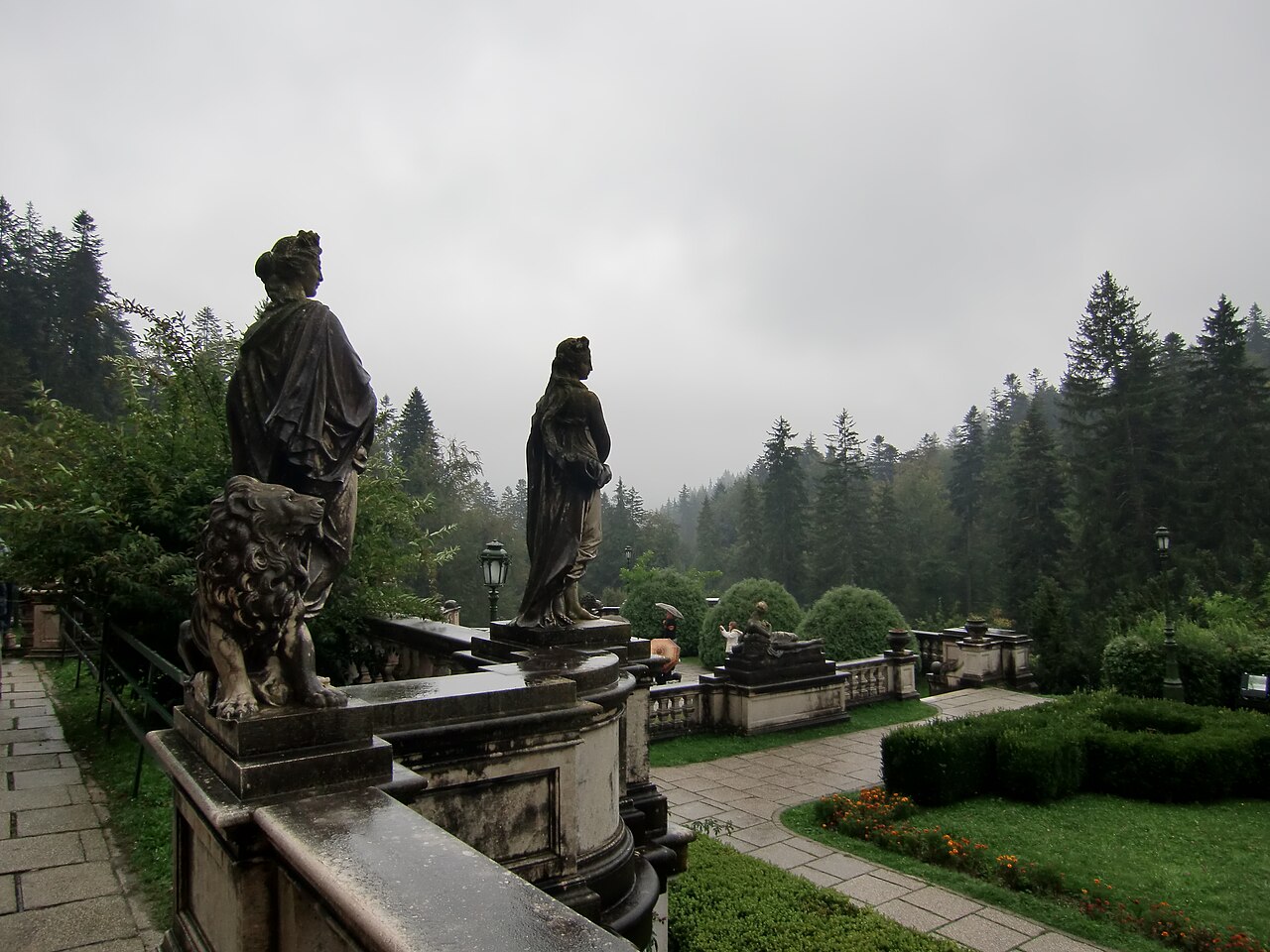
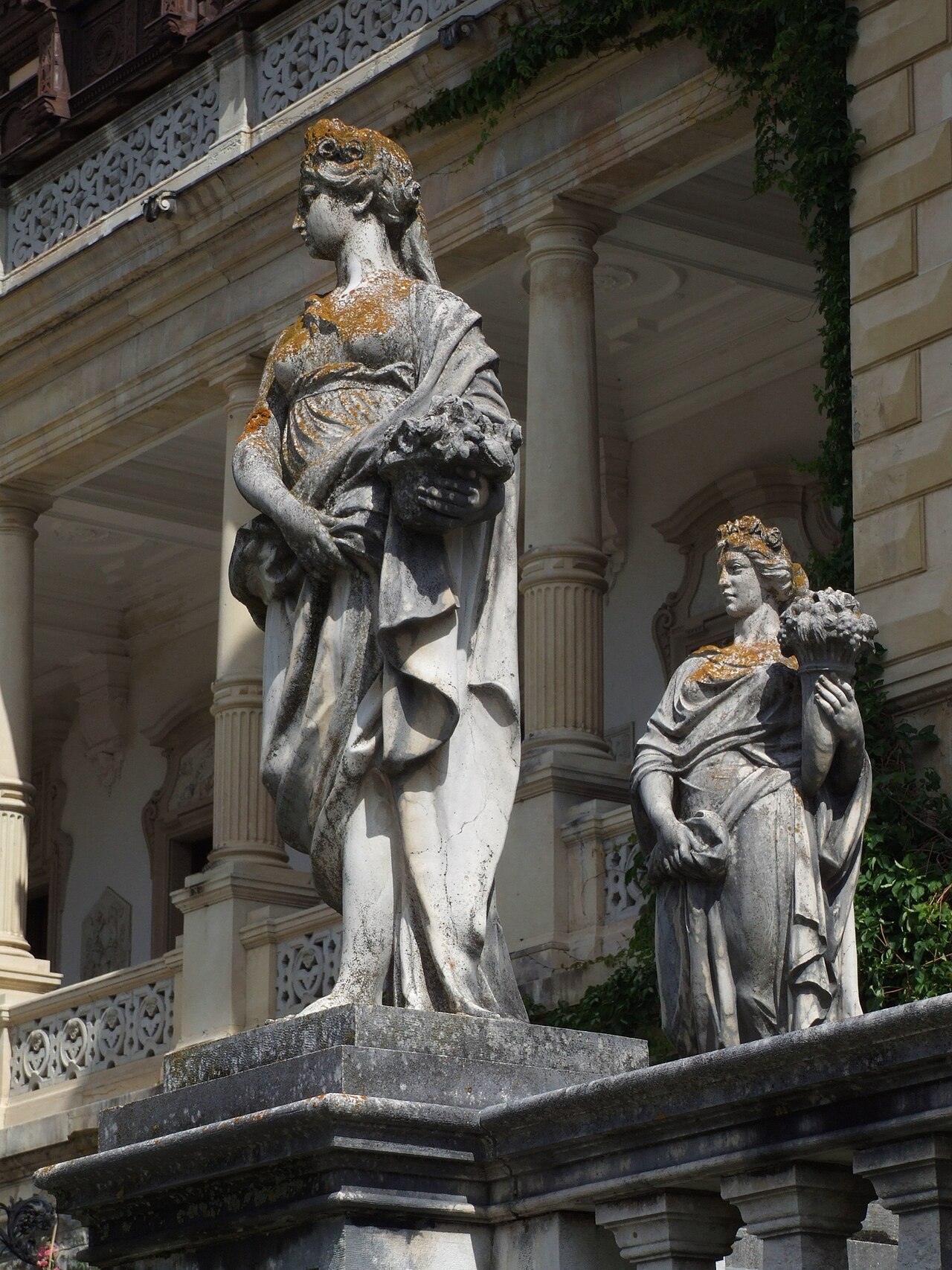
The gardens around Peles are laid out in terraces that descend the mountain slopes, adorned with sculptures, fountains, and ornamental plantings. These formal gardens provide a fitting setting for the castle, softening the transition between the ornate building and the wild forest beyond, and offering beautiful views of the castle and the surrounding peaks.
The sculptures and decorative features of the gardens add to the romantic atmosphere of the whole domain, echoing the artistry of the castle in the open air. Terraces, staircases, and ornamental details create a series of outdoor spaces to explore, each offering new perspectives on the castle and its mountain setting.
Together, the castle, its neighbour, and their gardens form a complete royal landscape, a world unto itself amid the Carpathians. Exploring the grounds is an essential part of any visit, allowing you to appreciate the relationship between the buildings and their setting and to experience the full romance of this mountain retreat created for the kings of Romania.
The neighbouring castle, built in a somewhat lighter and more modern style, offers an interesting contrast to the grandeur of Peles itself and is associated with a later royal generation known for its artistic sensibility. Together the two buildings show how the royal family’s tastes evolved over time, and a visit that takes in both gives a fuller picture of the life and culture of the Romanian monarchy in its mountain retreat.
Planning Your Visit to Peles
Peles lies near the mountain town of Sinaia, a popular resort in the Carpathians that is easily reached from the Romanian capital and other cities. The journey into the mountains is beautiful in itself, and the castle is one of the most visited attractions in the country, drawing travellers from around the world to admire its splendour and its setting.
View Peles Castle on Google Maps
Visitors can tour the interior of the castle, seeing the Hall of Honour, the armoury, and a selection of the magnificent rooms, usually as part of a guided visit. The tours reveal the extraordinary richness of the interiors and the history of the castle and its royal builders, and they are the heart of any visit. The surrounding gardens and grounds can be explored as well.
As with any major attraction, it is wise to check current opening hours and ticket arrangements before you go, since these can vary with the season, and the castle can be busy at peak times. Different tours may cover different parts of the castle, so it is worth planning which areas you most wish to see. The mountain setting means the weather can change quickly.
You can find the castle and plan your route using the map link below. Whether you come for the romantic architecture, the dazzling interiors, the armoury, or the beauty of the mountain setting, Peles offers one of the most memorable experiences in Romania. Give yourself time to enjoy both the splendour within and the gardens and grounds without.
Many visitors find that Peles rewards an unhurried approach, for the density of its decoration and the beauty of its setting deserve to be savoured. Arriving with time to spare allows you to tour the interiors, explore the gardens, and simply stand and take in the sight of the castle against the mountains. It is the kind of place that lingers in the memory, and giving it a full visit ensures you carry away its full magic.
See Peles for Yourself
A castle as spectacular as Peles, set in so dramatic a landscape, is best appreciated in motion, and the short film below offers a closer look at the building, its interiors, and its mountain setting. It conveys the romance of the exterior, the splendour of the Hall of Honour and the other rooms, and the beauty of the surrounding Carpathians.
As you watch, keep in mind the remarkable story behind it: a German prince who became Romania’s first king, a mountain valley that captured his heart, and a castle that fused romantic splendour with pioneering modern technology. Peles is a place where fairy tale and engineering meet, and where the ambition of a king lives on in one of the most beautiful castles in Europe.
Palaces Nearby
If Peles has captured your imagination, two more palaces of the wider region make natural companions, each offering a different vision of royal life.
- Belgrade’s Royal Compound and the Two Palaces of a Dynasty — the Serbian royal family’s hillside estate of two contrasting palaces at Dedinje.
- Euxinograd, Bulgaria’s Hidden Palace by the Black Sea — a French-inspired royal summer palace with a celebrated park near Varna.
You May Like
Inside the Azm Palace, a Hidden Paradise of Old Damascus


One thought on “Peles, the Fairy-Tale Castle of Romania’s First King”