Scratched into a stretch of Peruvian desert roughly 400 kilometers south of Lima are hundreds of lines, geometric shapes, and enormous drawings of animals, some more than 300 meters long. From ground level, most of them are almost impossible to recognize as anything more than shallow trenches in reddish-brown gravel. It was only after airplanes began flying over the region in the 1920s and 1930s that anyone realized these markings formed deliberate, recognizable images, visible in their full form only from high above.
The Nazca Lines have puzzled researchers for a century, not because their existence is mysterious, but because so little direct evidence survives explaining exactly why a desert culture with no aircraft, no hot air balloons confirmed to have been used at the time, and seemingly no way to view their own work from above chose to create art on such an enormous scale.

Table of Contents
- Drawings Only Visible From the Sky
- How Lines Etched in Desert Stone Survived 2,000 Years
- The Animals, Plants, and Shapes of the Nazca Lines
- The Nazca People and Their Lost Language
- Water, Drought, and a Desert Culture’s Gods
- Theories, from Astronomy to Ritual Walking Paths
- Maria Reiche and the Woman Who Devoted Her Life to the Lines
- The Aliens Theory That Refuses to Die
- Threats From Modern Development and Protest
- UNESCO Protection and How to See the Lines Today
- Nearby Places
Drawings Only Visible From the Sky
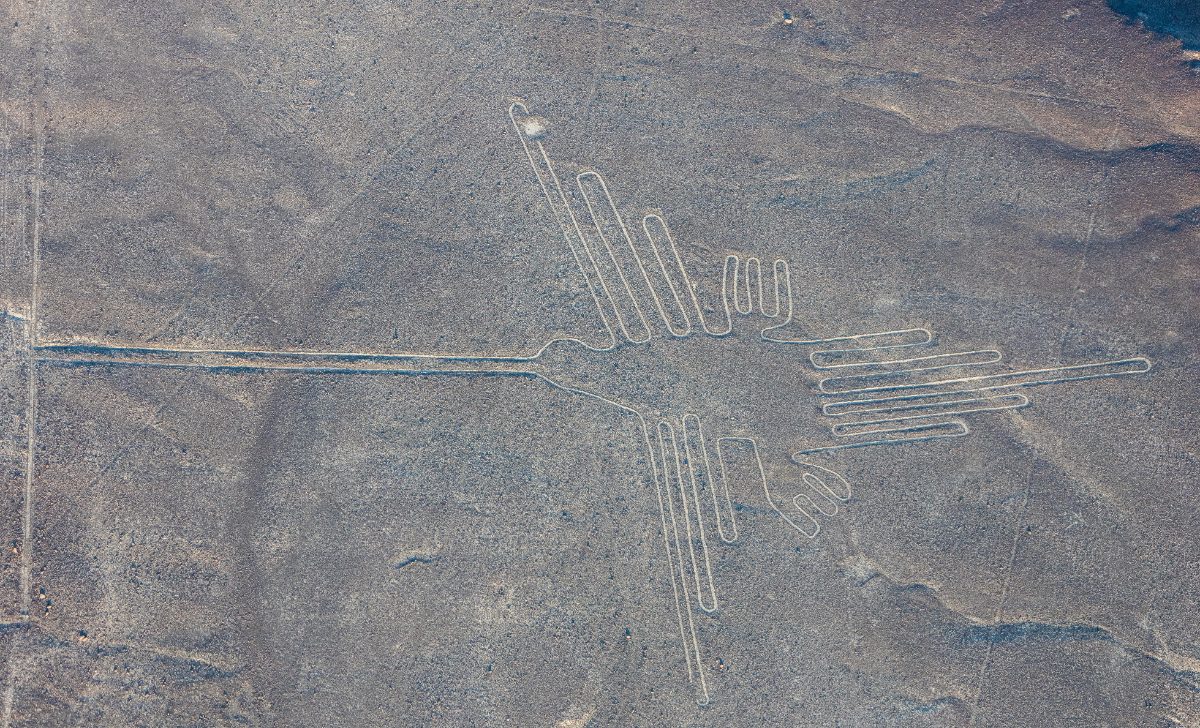
The Nazca Lines consist of more than 800 straight lines, 300 geometric figures, and around 70 recognizable figurative designs, including animals such as a hummingbird, spider, monkey, and condor, spread across roughly 450 square kilometers of the Nazca Desert on Peru’s southern coast.
Most researchers date the majority of the lines to the Nazca culture, which flourished in the region from around 100 BCE to 800 CE, though some of the straight lines and trapezoids may have been created earlier by the preceding Paracas culture, suggesting the practice of desert marking developed and evolved over several centuries rather than beginning and ending with a single generation.
Because the figures are so large, many of them can only be fully appreciated from an aircraft, leading to persistent questions about how, and why, their creators designed images meant to be seen from a vantage point they themselves likely never achieved, at least not through any technology confirmed by the archaeological record.
Pilots and passengers flying commercial routes over southern Peru in the early 20th century are sometimes credited with the first modern sightings of the lines from the air, though local residents had almost certainly known of at least some of the smaller, more visible markings for generations before aviation made their full scale apparent.
Toribio Mejia Xesspe, a Peruvian archaeologist, is generally credited with the first scholarly description of the lines in 1927, having observed some of the markings from nearby hillsides even before regular aerial observation became possible, though it was the growth of commercial and scientific aviation in subsequent decades that truly revealed their full extent.
How Lines Etched in Desert Stone Survived 2,000 Years
The lines were created using a surprisingly simple technique: removing the reddish-brown, iron-oxide-coated pebbles that cover the desert surface to reveal the lighter-colored, yellowish-gray ground underneath. This contrast in color is what makes the lines visible at all, and it has proven remarkably durable thanks to the region’s almost uniquely stable desert conditions.
The Nazca Desert receives extremely little rainfall, has very low wind levels at ground surface, and experiences minimal erosion compared to most other environments on Earth, a combination of factors that allowed lines etched more than 1,500 years ago to remain visible today without any significant restoration or maintenance.
This same stability, ironically, has also made the lines vulnerable to modern threats. Because the surface layer is so thin and so easily disturbed, a single vehicle track or careless footstep can leave a visible mark lasting decades or longer, a fragility that stands in sharp contrast to the durability of stone structures at sites like Chavin de Huantar or Caral.
Researchers have used simple experimental archaeology to test how the lines might have been created, successfully reproducing smaller test geoglyphs using wooden stakes, cords, and basic surveying techniques consistent with tools known to have been available to the Nazca, demonstrating that no advanced technology would have been necessary to achieve the precision seen in the original figures.
The largest and straightest lines, some extending for several kilometers with only minor deviation, suggest a level of surveying skill that likely relied on sighting poles and carefully measured cord lengths, methods that would have allowed workers on the ground to maintain a consistent bearing across long distances without any aerial reference point.
The Animals, Plants, and Shapes of the Nazca Lines

Among the most famous figures are the hummingbird, with its long beak and wings, the spider, drawn with unusual anatomical precision, the monkey, notable for its curled tail, and the condor, one of several bird figures spread across the desert plain. Each figure is composed of a single continuous line, suggesting they may have been created by walking a planned path from start to finish without lifting the tool used to clear the surface stones.

Beyond animal figures, the site includes long dead-straight lines, some extending for kilometers across the landscape with almost no deviation, along with large geometric shapes including trapezoids, triangles, and spirals whose purpose remains even less clear than that of the recognizable animal figures.
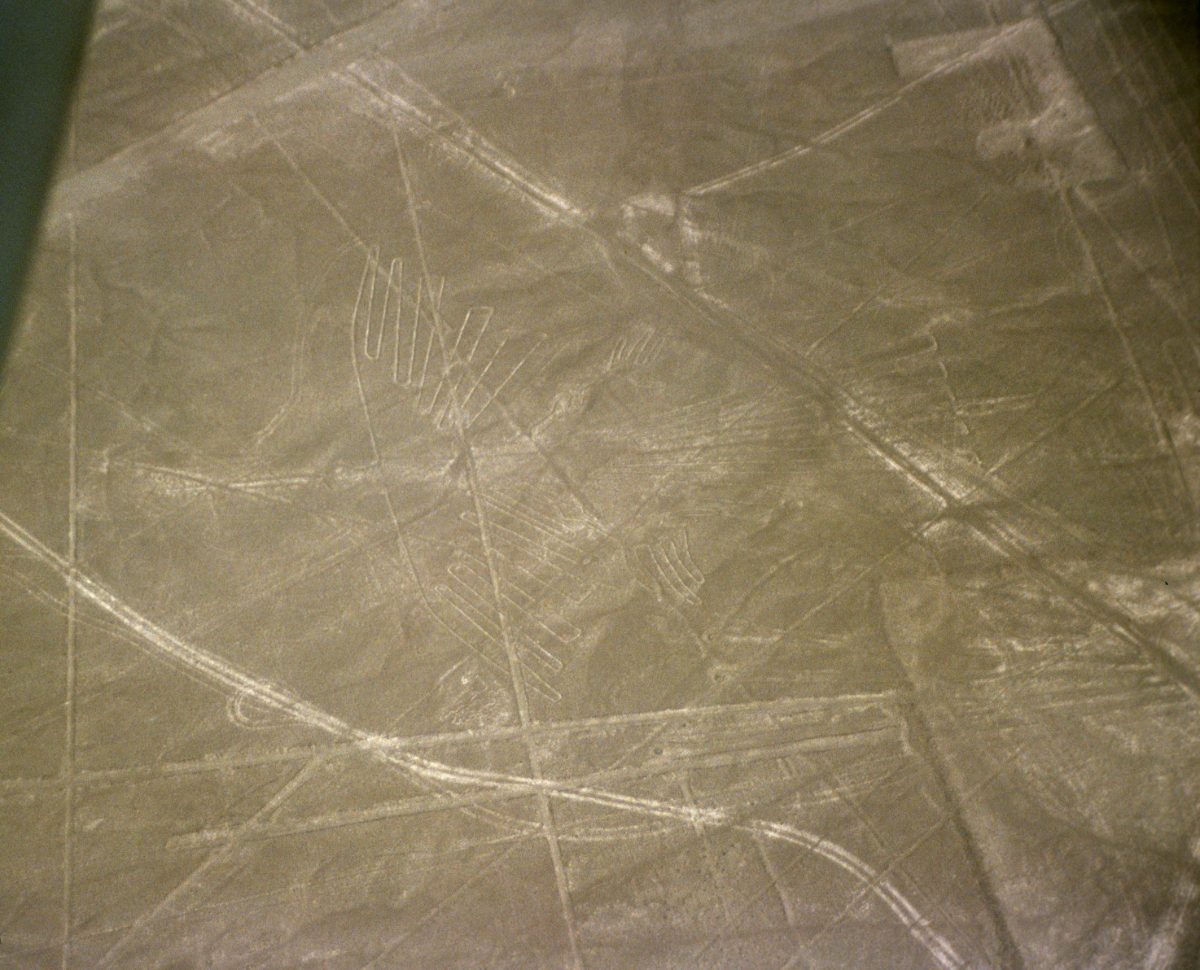
Some lines appear to radiate outward from central points in a star-like pattern, a layout that has fueled theories connecting the lines to astronomical observation, ritual pathways, or possibly a combination of both purposes serving the religious and practical needs of Nazca society.
Some of the less famous geoglyphs depict plant life, including a tree and various flowering forms, alongside abstract shapes that may represent constellations, textile patterns translated into monumental scale, or symbolic designs whose exact meaning has not survived in any written or oral tradition connected to their creators.
The Nazca People and Their Lost Language
Much like the builders of Teotihuacan, the Nazca people left behind no confirmed writing system and no language that survives today in any identifiable form. What is known about them comes almost entirely from archaeological evidence: ceramics, textiles, settlement patterns, and the geoglyphs themselves, rather than from any decipherable written record.
Some researchers have proposed that the Nazca language may have been related to languages spoken by other pre-Inca coastal cultures, but no confirmed linguistic descendant exists today, placing the Nazca alongside Teotihuacan and San Agustin among the ancient American cultures whose original language has been entirely lost to history.
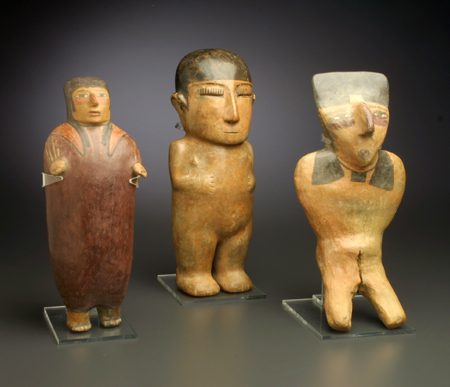
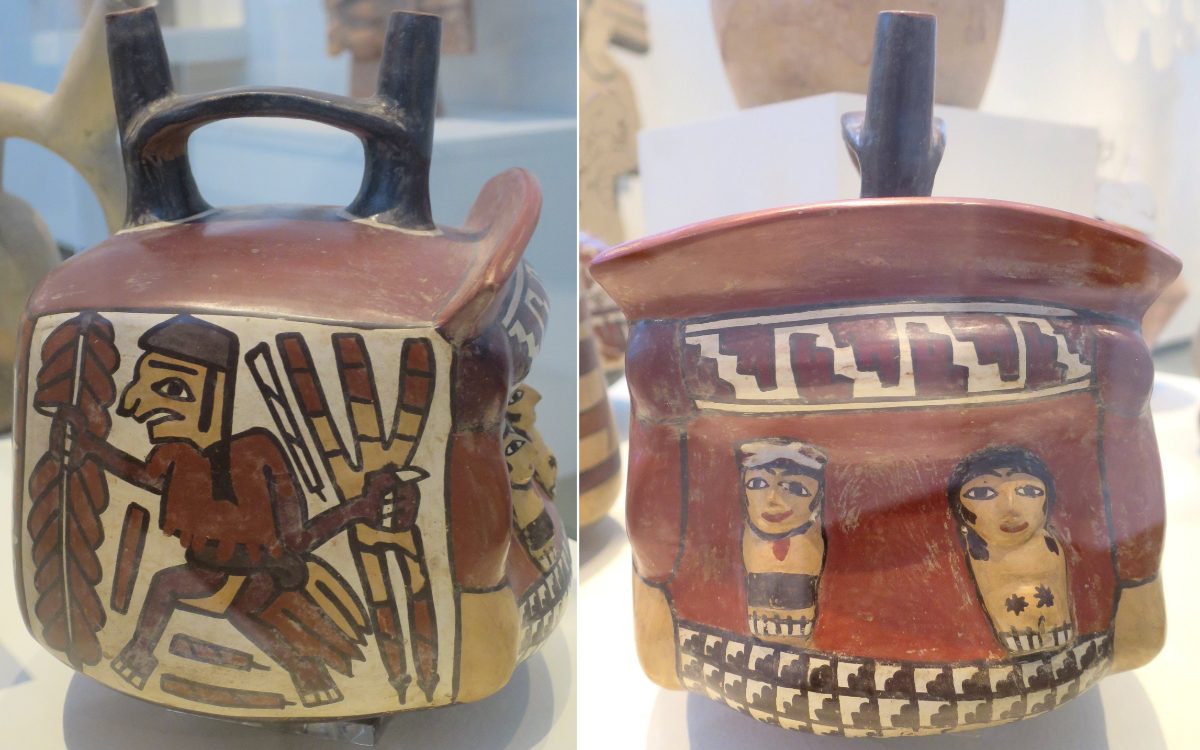
What has survived instead is an extraordinarily rich visual and material culture. Nazca ceramics are widely regarded as among the most technically accomplished and artistically distinctive pottery traditions in the pre-Columbian Americas, decorated with vivid polychrome designs depicting many of the same animal and mythological figures found among the desert geoglyphs themselves.
Nazca textiles, though less famous than their ceramics, also display extraordinary technical skill, using elaborate embroidery techniques and vivid natural dyes to create garments and ceremonial cloth depicting many of the same mythological and animal figures found among the geoglyphs, reinforcing the idea that this imagery held consistent religious meaning across multiple forms of Nazca artistic expression.
Because so much of what is known about Nazca religious life comes from indirect evidence such as ceramics and geoglyphs rather than any surviving oral or written tradition, interpretations of Nazca belief systems remain necessarily provisional, continually revised as new archaeological findings emerge from ongoing excavation across the region.
Water, Drought, and a Desert Culture’s Gods
Water scarcity dominated life for the Nazca people, whose desert homeland receives only minimal rainfall and depends heavily on runoff from Andean rivers that often ran dry for extended periods. In response, Nazca engineers built an extensive system of underground aqueducts called puquios, channeling groundwater to the surface through a network of tunnels, some of which remain functional and in occasional agricultural use even today.
Many of the geoglyphs, particularly the animal figures, are believed to have carried religious significance tied to water and fertility. Spiders and monkeys, for example, are sometimes associated in Andean cosmology with rain-related rituals, suggesting the lines may have functioned partly as offerings or petitions directed at deities believed to control the region’s scarce and unpredictable water supply.
Archaeological evidence of processions and ritual activity at some of the geoglyph sites, including broken ceramics deliberately left along certain lines, supports the idea that the lines were not purely artistic expressions but active components of ongoing religious practice, revisited and used repeatedly across generations rather than created once and left untouched.
Some archaeologists have proposed that the eventual decline of Nazca society, sometime around 750 to 800 CE, may have been linked to prolonged drought conditions that overwhelmed even the sophisticated puquio aqueduct system, a pattern of climate-linked societal stress that echoes the environmental pressures believed to have contributed to Teotihuacan’s decline far to the north.
Theories, from Astronomy to Ritual Walking Paths
Since their broader rediscovery in the early 20th century, the Nazca Lines have attracted a wide range of scientific theories. American historian Paul Kosok, who studied the lines extensively in the 1940s, proposed that some of the straight lines aligned with solstice sunset points, suggesting the Nazca used the desert as a kind of giant astronomical calendar.
Later research has generally found the astronomical alignment theory only partially convincing, since statistical analysis of the sheer number of lines makes some solar or stellar alignment almost inevitable by chance alone. Many contemporary researchers instead favor interpretations centered on ritual walking paths, with the lines functioning as processional routes connected to water worship and communal ceremony rather than as a purpose-built observatory.
Some scholars have also proposed that certain lines may have marked territorial boundaries between different Nazca communities or kin groups, or that they connected specific water sources to ceremonial centers, reflecting the practical realities of desert survival as much as any purely religious or astronomical motivation.
Anthropologist Johan Reinhard, known for his high-altitude archaeological work elsewhere in the Andes, proposed that many of the lines functioned as sacred pathways connecting mountain water sources to valley settlements, framing the geoglyphs as part of a broader Andean tradition of ritual movement through a landscape understood to be alive with spiritual significance.
Maria Reiche and the Woman Who Devoted Her Life to the Lines
No single person did more to bring the Nazca Lines to international attention and to protect them from destruction than Maria Reiche, a German-born mathematician who first visited the site in 1940 and went on to spend more than five decades living near and studying the lines, often at considerable personal expense and with limited institutional support.
Reiche meticulously mapped and measured hundreds of individual lines and figures, developed early theories connecting them to astronomical observation, and became a tireless advocate for their preservation, successfully lobbying Peruvian authorities to restrict vehicle access and agricultural activity across large sections of the desert plain.
Her advocacy played a direct role in the site’s eventual protection and its 1994 designation as a UNESCO World Heritage Site, and she remains closely associated with the Nazca Lines in the public imagination, sometimes referred to as the ‘Lady of the Lines’ in recognition of her decades of dedicated fieldwork.
Reiche’s personal archive of measurements, photographs, and field notes, accumulated over more than 50 years of dedicated study, remains an invaluable resource for archaeologists today, providing a detailed historical record of the site’s condition decades before modern satellite and drone technology became available for large-scale survey work.
The Aliens Theory That Refuses to Die
Despite the lack of any credible archaeological evidence, the Nazca Lines have long been associated in popular culture with claims of ancient extraterrestrial contact, most notably popularized by Swiss author Erich von Daniken’s 1968 book Chariots of the Gods, which speculated that the lines functioned as landing strips or signals for visiting alien spacecraft.
Mainstream archaeologists have thoroughly rejected this theory, pointing to abundant evidence, including tools, ceramics, and settlement remains directly associated with the Nazca culture, confirming the lines were created by human hands using well-understood surface-clearing techniques entirely consistent with the technology and beliefs of the time.
Despite this, the extraterrestrial theory persists in popular media, illustrating a broader and recurring pattern in which ancient achievements by non-European cultures are sometimes met with unwarranted skepticism about their creators’ own capabilities, a pattern that has also surrounded discussions of sites such as Sacsayhuaman and the pyramids of Egypt.
Ironically, the extraterrestrial theory’s popularity has occasionally worked against efforts to protect the site, drawing large numbers of tourists more interested in a sensationalized narrative than in the genuine, well-documented achievements of Nazca engineering and artistry, complicating outreach efforts aimed at building broader public appreciation for the archaeological record.
Threats From Modern Development and Protest
Modern development has posed real, ongoing threats to the Nazca Lines. Unauthorized vehicle traffic, illegal squatter settlements, and sand mining operations have all damaged sections of the fragile desert surface in recent decades, sometimes destroying lines that had survived intact for over a thousand years in a matter of minutes.
In one widely publicized 2014 incident, environmental activists from the group Greenpeace entered a restricted area near the hummingbird geoglyph without authorization to stage a climate change protest, leaving footprints that damaged the fragile surface, an event that drew international criticism and highlighted just how easily the site can be harmed even by visitors with no intention of causing damage.
Peruvian authorities have since increased restrictions on access to the most sensitive areas of the site, though balancing tourism revenue, scientific research, and preservation needs remains an ongoing challenge for a monument that, unlike a stone pyramid, cannot simply be repaired once its surface has been disturbed.
Climate change presents a longer-term concern as well, since any significant shift in the region’s historically stable, low-rainfall desert conditions could accelerate erosion of the fragile surface markings that have survived largely unchanged for well over a thousand years under the area’s unusually dry and calm atmospheric conditions.
UNESCO Protection and How to See the Lines Today

UNESCO designated the Nazca Lines and the surrounding Pampas de Jumana a World Heritage Site in 1994, recognizing both the scale of the geoglyphs and their outstanding value as evidence of pre-Columbian engineering, artistry, and religious practice. This designation has helped secure stronger legal protections and international attention aimed at preserving the site for future study.

Most visitors today view the lines either from a small observation tower built along the Pan-American Highway, offering a limited but accessible view of a handful of figures, or from small aircraft that fly tourists over the full extent of the geoglyphs, the only way to see most of the larger and more famous figures in their complete form.
Ongoing research continues to identify new geoglyphs using satellite imagery, drone photography, and even artificial intelligence-assisted pattern recognition, with researchers announcing the discovery of dozens of previously unknown figures in recent years, suggesting the full scope of Nazca desert art may still be far from completely mapped even after a century of study.
In 2022 and again in subsequent years, researchers using drone and satellite imagery combined with machine learning pattern detection announced the discovery of more than 100 previously unrecorded geoglyphs in the wider Nazca region, a discovery rate that suggests the site’s full inventory of ancient markings is considerably larger than what has been studied and documented over the past century.
Nearby Places
The Nazca Lines sit within a broader network of ancient Peruvian coastal and highland cultures explored elsewhere in this series.
- Caral, the oldest city in the Americas, whose builders predated the Nazca by more than two thousand years
- Pachacamac, the coastal oracle site whose religious influence extended across much of Peru’s desert coast
- Sipan, the Moche royal tomb that revealed the religious world of a culture contemporary with the Nazca
Closing Thoughts
The Nazca Lines remain one of the clearest reminders that ancient peoples were capable of extraordinary large-scale planning and artistic ambition without any of the tools modern observers might assume were necessary. Whether created for gods, for water, or for reasons still not fully understood, the lines have outlasted their creators by well over a thousand years, etched so lightly into the desert that the greatest danger they now face comes not from time, but from careless footsteps.
You May Like

Mafra, the Palace a King Built From a Vow