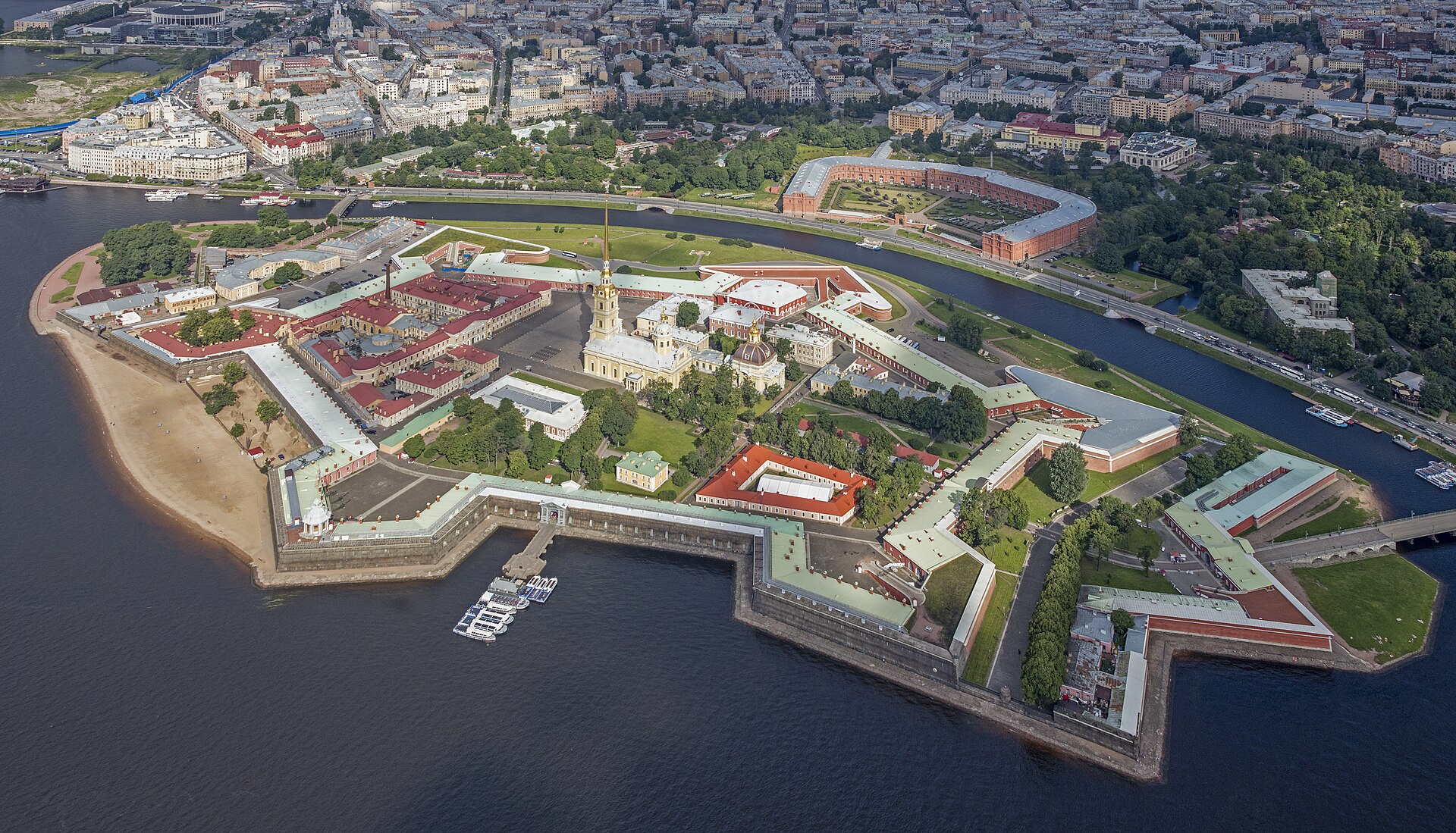
On a small island in the Neva River, at the very heart of one of the most beautiful cities in the world, stands the fortress from which the whole of St. Petersburg grew. The Peter and Paul Fortress was the first structure of the new Russian capital, founded by Tsar Peter the Great in 1703, and its founding is counted as the birth of the city itself. From this star-shaped stronghold, its golden-spired cathedral soaring above the walls, sprang one of the greatest cities in all of Europe.
Yet the fortress is far more than a symbolic beginning. Across three centuries it has been a military stronghold built against the Swedes, the sacred burial place of the Russian emperors, a dreaded political prison that held the enemies of the state, and today a great museum open to all. Within its walls lie the tombs of the tsars beneath the tallest spire in the city, the grim cells that held revolutionaries and princes alike, and the cannon that still booms across the river every noon. In this article you will explore the whole of it. Come and discover the fortress where St. Petersburg began.
What makes the Peter and Paul Fortress so compelling is the way so many different histories are gathered within its single set of walls. It is at once a founding monument, a masterpiece of military engineering, a royal mausoleum, a notorious prison, and a living part of the daily life of a great city. Few places anywhere let you experience so much of a nation’s story in one location, and the sheer density of meaning packed onto this small island in the Neva is what gives the fortress its unmatched power to move and to fascinate.

In This Article
- The Fortress Where St. Petersburg Began
- Peter the Great’s New Capital
- A Star Fortress on the Neva
- Built Against the Swedes
- Walls That Never Saw Battle
- The Cathedral and Its Golden Spire
- The Angel Above the City
- The Necropolis of the Tsars
- Where the Emperors Rest
- A Prison for the Enemies of the State
- The Noon Cannon and the Daily Ritual
- A Museum on Hare Island
- Finding the Peter and Paul Fortress
- Castles Nearby
The Fortress Where St. Petersburg Began
On a small island in the Neva River, at the very heart of one of the most beautiful cities in the world, stands the fortress from which the whole of St. Petersburg grew. The Peter and Paul Fortress was the first structure of the new Russian capital, laid out by the great tsar Peter the Great himself, and its founding is counted as the founding of the city. From this star-shaped stronghold, with its golden-spired cathedral rising above the walls, sprang one of the greatest cities in Europe. To visit the fortress is to stand at the birthplace of St. Petersburg.
Yet the Peter and Paul Fortress is far more than a symbolic starting point. Across three centuries it has been a military stronghold, the burial place of the Russian emperors, a dreaded political prison, and today a great museum, and its history is bound up with the whole dramatic story of imperial Russia. Within its bastioned walls lie the tombs of the tsars, the cell blocks that held the enemies of the state, and the cathedral whose soaring spire has crowned the city skyline for three hundred years. In this article you will explore all of it. This is the story of the fortress where St. Petersburg began.
There is a wonderful symbolism in the way a whole magnificent city grew outward from this single fortified island, like ripples spreading across the Neva. Everything that St. Petersburg would become, its palaces and canals, its bridges and cathedrals, began here on Hare Island with Peter’s fortress. To stand within the walls today, surrounded on all sides by the great city that sprang from this spot, is to feel the presence of that founding moment and to marvel at the extraordinary vision that conjured a European capital out of the northern marshes.
Peter the Great’s New Capital
The Peter and Paul Fortress owes its existence to the boundless ambition of one of the most remarkable rulers in all of history, Tsar Peter the Great, who set out at the beginning of the eighteenth century to transform Russia into a modern European power. As part of that great project, Peter resolved to build an entirely new capital, a window onto Europe on the shores of the Baltic, and in the year 1703 he founded a fortress on an island in the Neva to guard the site of his new city. That act of founding is remembered as the birth of St. Petersburg itself.
Peter’s new capital was to be a bold break with the old Russia of Moscow, a modern, European city built from nothing on the marshy delta of the Neva. The fortress was its seed and its shield, the first stone laid in what would become one of the most magnificent cities on earth. The whole enterprise reflected Peter’s iron will and his determination to drag Russia into a new age, and the fact that a great imperial capital rose from these cold northern marshes is a testament to his extraordinary vision. The Peter and Paul Fortress stands as the enduring monument to that founding moment.
The building of St. Petersburg was one of the boldest acts of city-founding in all of history, an entire capital willed into existence by a single determined ruler on a site of forbidding difficulty. The cost in labour and lives was immense, for the marshy delta had to be tamed before the city could rise, and the achievement stands as a monument to both Peter’s genius and his ruthlessness. The fortress, as the first structure of this new world, embodies that whole heroic and terrible enterprise, and it remains forever linked to the towering figure of the tsar who conceived it.
A Star Fortress on the Neva
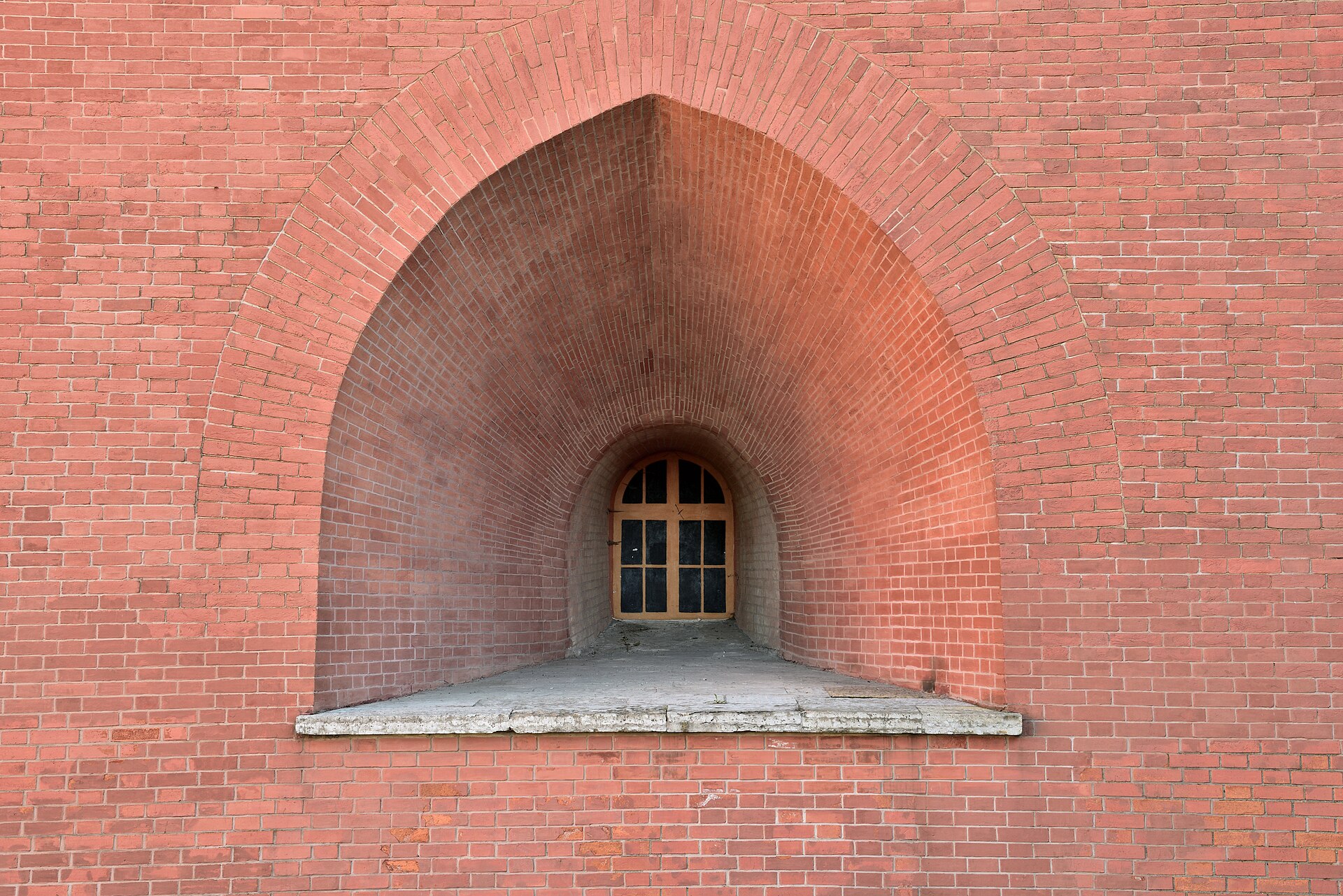
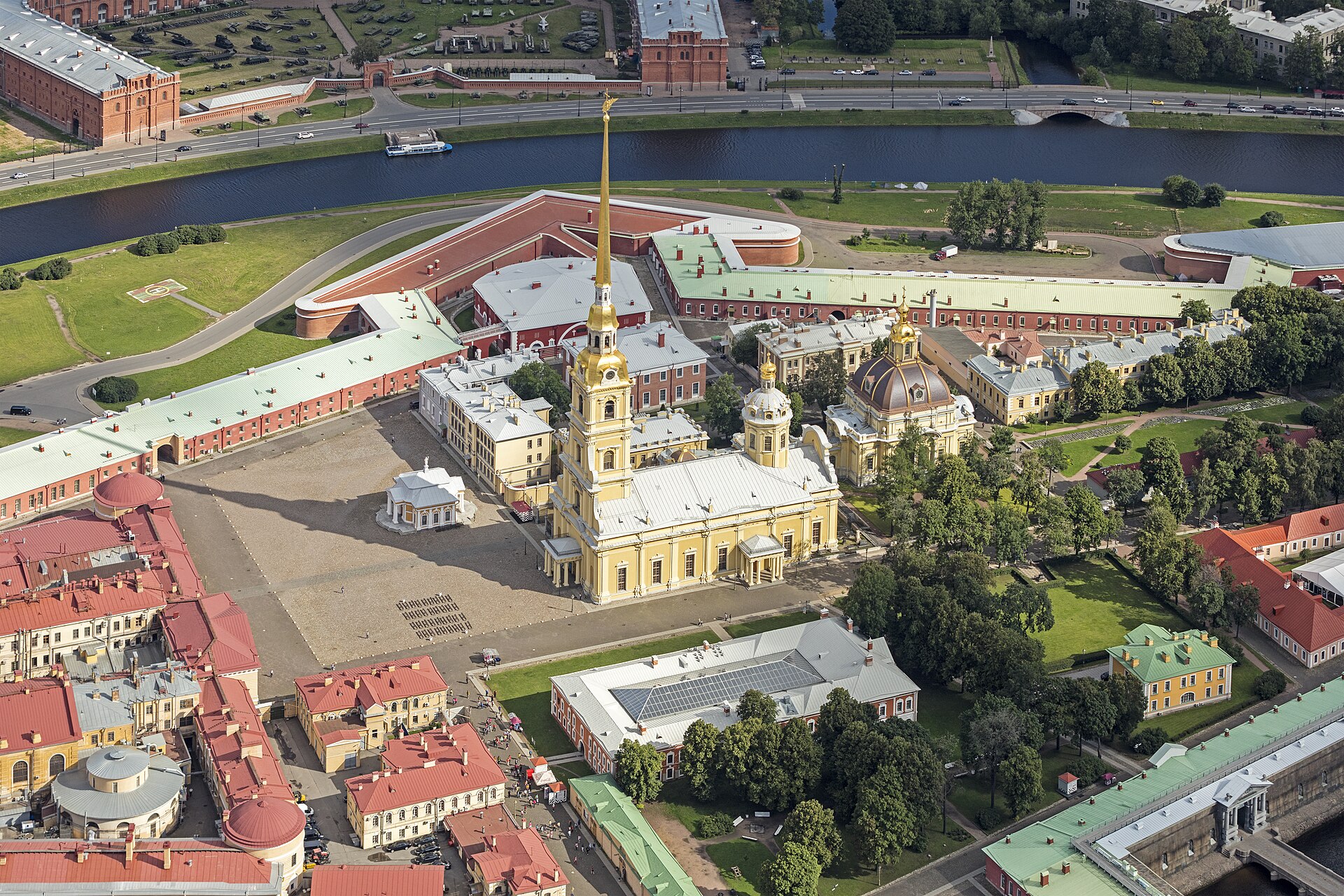
The Peter and Paul Fortress was designed according to the most advanced principles of military engineering of its day, as a bastion fortress, the type of stronghold that had replaced the medieval castle across Europe in the age of gunpowder. Rather than tall walls and round towers, such fortresses relied on low, thick ramparts and projecting angular bastions arranged so that every stretch of wall could be swept by defensive fire, giving the whole a distinctive star-like shape. The fortress on the Neva was a fine example of this modern art of fortification.
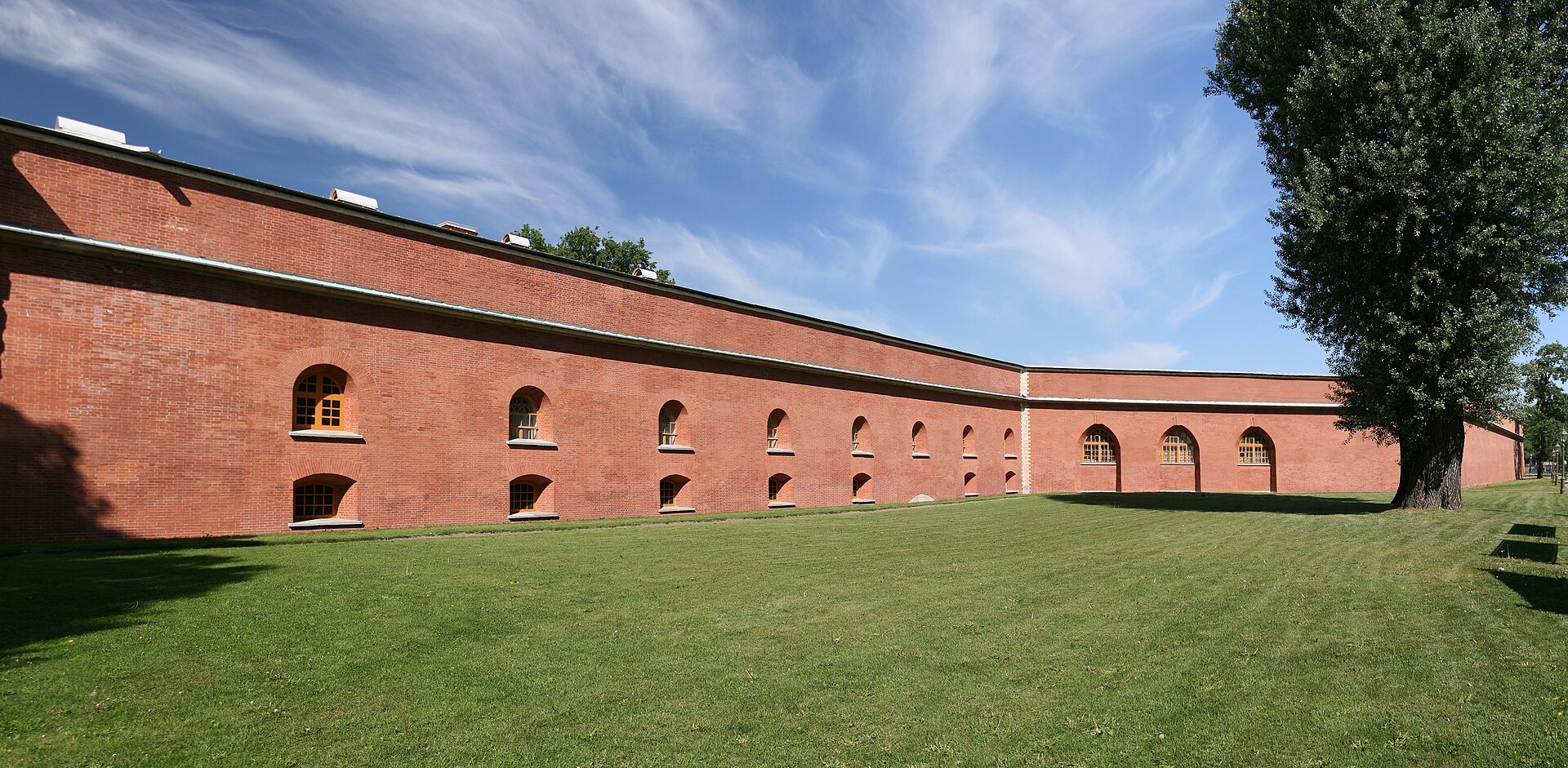
The design and building of the fortress owed much to the Italian-Swiss architect Domenico Trezzini, one of the many foreign masters that Peter the Great drew to his new capital, and who did more than almost anyone to shape the early architecture of St. Petersburg. Under his direction, the original earthen fortifications were rebuilt in stone and brick, creating the strong bastioned walls that survive today. The fortress represents the meeting of Peter’s ambition with the finest European engineering of the age, a thoroughly modern stronghold raised to guard a thoroughly modern city.
The star-shaped bastion fortress was the cutting edge of military science in Peter’s day, a design perfected in the wars of western Europe and now brought to the shores of the Baltic. In choosing this modern form for his new fortress, Peter was once again turning his back on the older traditions of Russia and embracing the latest ideas of the wider world, exactly as he did in so many other areas of his reforming reign. The fortress is thus not only a stronghold but a statement, a declaration in stone of Peter’s determination to make Russia a modern European power.
Built Against the Swedes
The Peter and Paul Fortress was born out of war, for at the time of its founding Russia was locked in the long and bitter struggle against Sweden known as the Great Northern War. Peter the Great had seized the lands at the mouth of the Neva from the Swedes, and he needed to defend his hard-won foothold on the Baltic and the new city he was building there against the possibility of a Swedish counterattack. The fortress was raised precisely to meet this threat, guarding the sea approach to the young capital.
For a time the danger was very real, for Sweden was a formidable military power, and the survival of Peter’s new city was by no means assured in those early years. The fortress stood ready to defend it, its guns commanding the river and the approaches from the sea. In the end, Russia triumphed in the great war, and the threat to St. Petersburg receded, but the fortress remained as the guardian of the city and a permanent reminder of the struggle out of which the capital had been born. It had done its duty simply by standing ready, a shield that deterred the enemy from ever putting it to the test.
The Great Northern War was one of the defining conflicts in the history of northern Europe, a long struggle that ended with Russia supplanting Sweden as the dominant power in the Baltic region. The founding of St. Petersburg and its fortress was itself a bold move in that war, planting a new Russian capital on territory only just wrested from the enemy. That Peter dared to build his great city on such a contested frontier, even as the war still raged, speaks volumes about his confidence and his determination, and the fortress stands as the guardian of that audacious gamble.

Walls That Never Saw Battle
One of the most striking facts about the Peter and Paul Fortress is that, for all its formidable strength, it never actually saw battle. The powerful bastions and thick walls, built with such care to withstand a Swedish assault, were never put to the test by an attacking army. The very existence of so strong a fortress, guarding the approaches to the capital, was enough to deter any enemy from attempting an attack, and so the guns of the fortress never fired a shot in anger against a foe.
This is not unusual among the great fortresses of the age, for the purpose of such a stronghold was as much to deter as to fight, and a fortress that was never attacked had in a sense succeeded perfectly at its task. But it also meant that the Peter and Paul Fortress was free to take on other roles across its long history, and it did so with a vengeance. Freed from its military purpose, it became instead the sacred burial place of the emperors and the grim prison of their enemies, and it is for these roles, rather than for any battle, that the fortress is best remembered today.
There is a certain irony in the fact that a fortress built with such care for war should have found its lasting fame in entirely peaceful roles, as a church, a tomb, and a museum, and in the darker role of a prison. Yet this is often the fate of great fortresses, whose very strength ensures that they are never tested and so survive to serve other purposes down the centuries. The Peter and Paul Fortress, spared the destruction of battle, has come down to us remarkably complete, a perfectly preserved example of the fortification of its age.
The Cathedral and Its Golden Spire
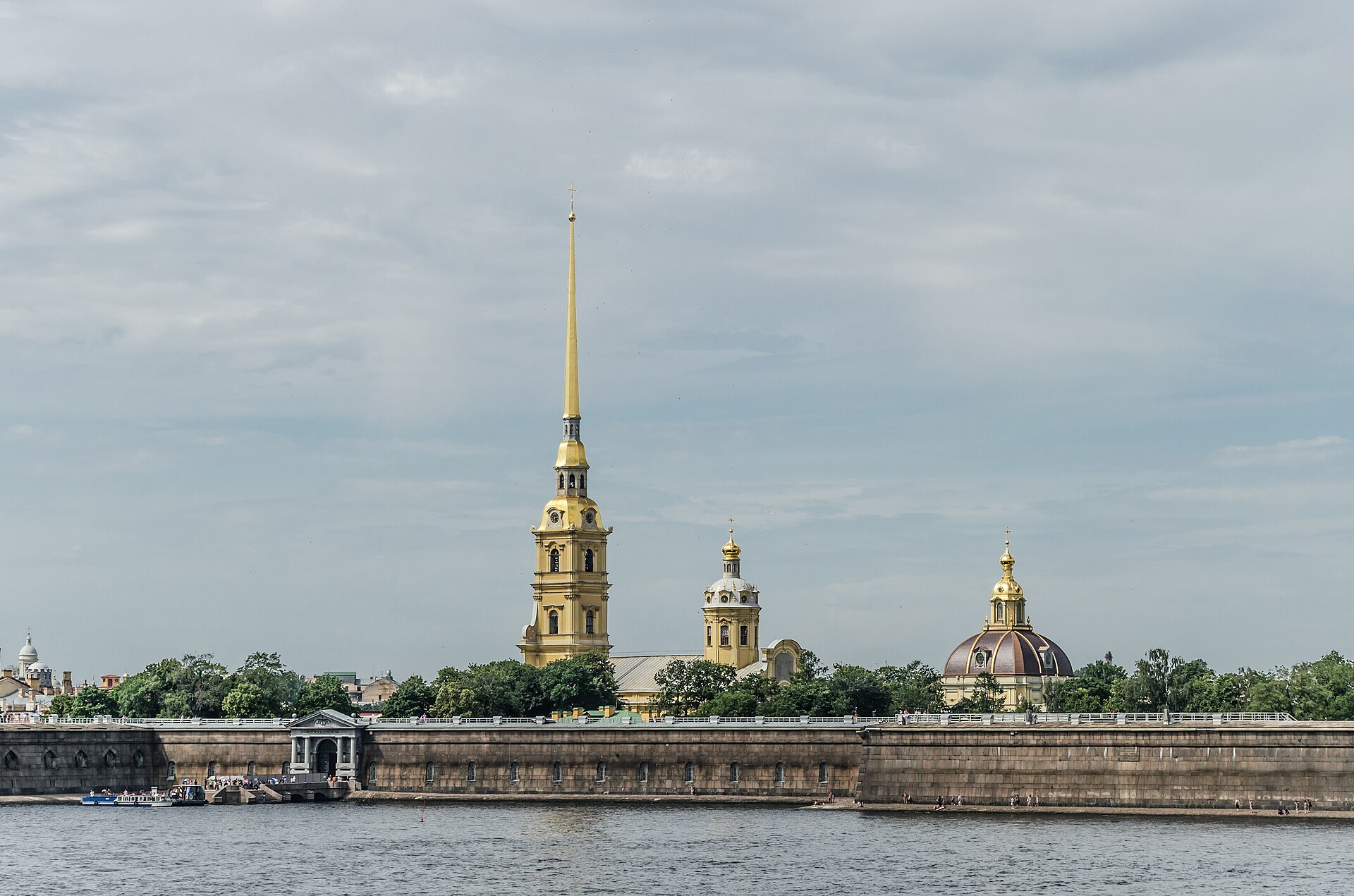
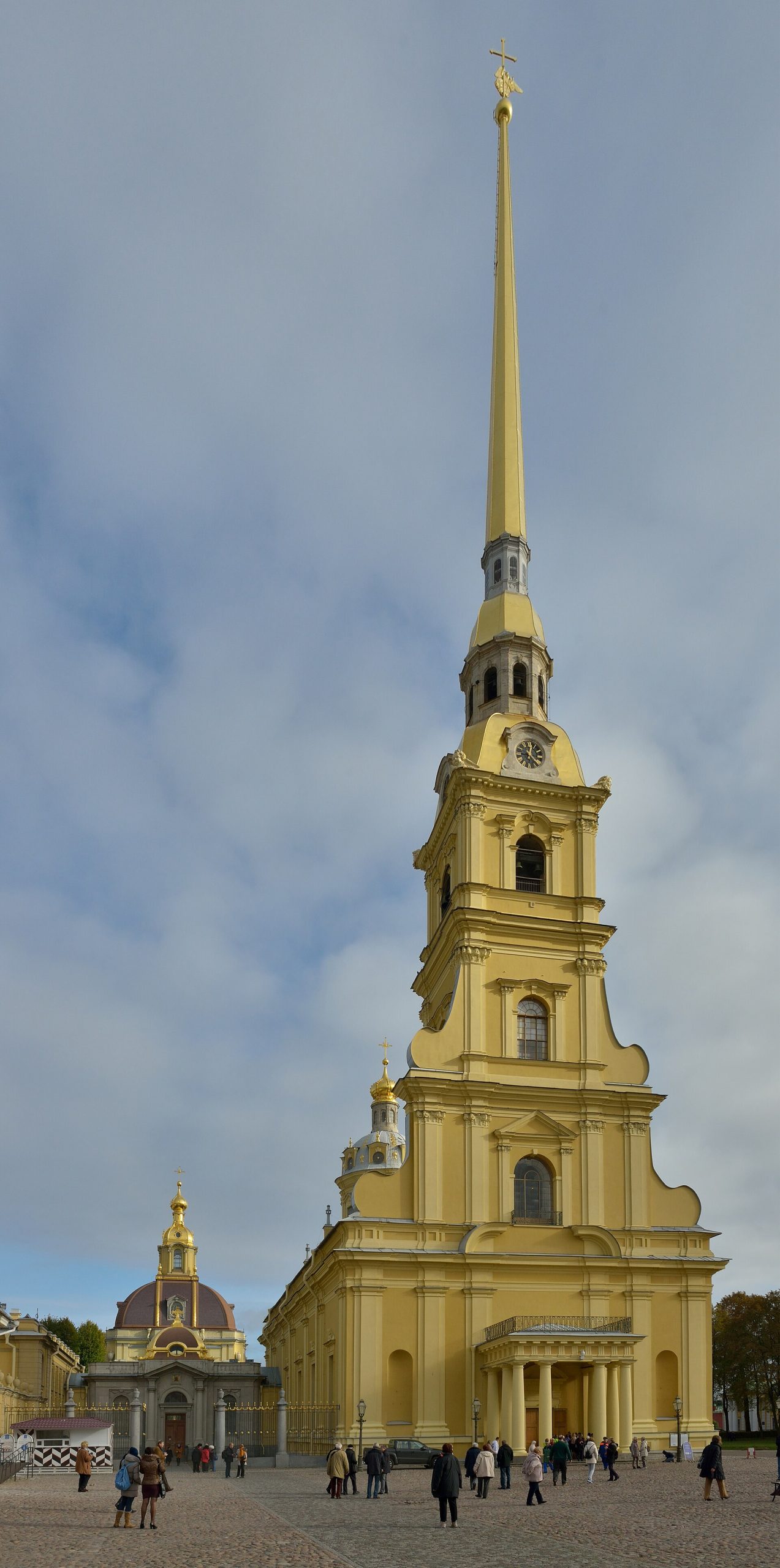
At the very heart of the fortress rises its greatest treasure, the Peter and Paul Cathedral, one of the most important and beautiful churches in all of Russia. Built in the early eighteenth century, again largely under the direction of the architect Domenico Trezzini, the cathedral was a bold departure from the traditional Russian church, designed instead in the European baroque style that Peter the Great favoured for his new and modern capital. Its most famous feature is its extraordinary bell tower, crowned by a soaring golden spire that rises high above the fortress and the city.
The cathedral was intended from the first to be a symbol of the new Russia that Peter was creating, and its European design set it apart from the onion-domed churches of old Moscow. Its slender golden spire, gleaming above the walls of the fortress, became one of the defining images of St. Petersburg, and for a very long time it was the tallest structure in the entire city. The cathedral is thus both a masterpiece of architecture and a powerful statement of Peter’s vision, a church that announced to the world the birth of a new and European Russia on the shores of the Baltic.
The decision to build the cathedral in the European baroque style rather than the traditional Russian manner was a deliberate and significant one, part of Peter’s whole programme of turning Russia toward the West. Where the old churches of Moscow clustered their onion domes low against the sky, the new cathedral soared upward in a single slender spire, a form drawn from the churches of northern Europe. In this the cathedral perfectly expressed the spirit of the new capital, and it set the tone for the European architecture that would come to define the whole magnificent city of St. Petersburg.
The Angel Above the City
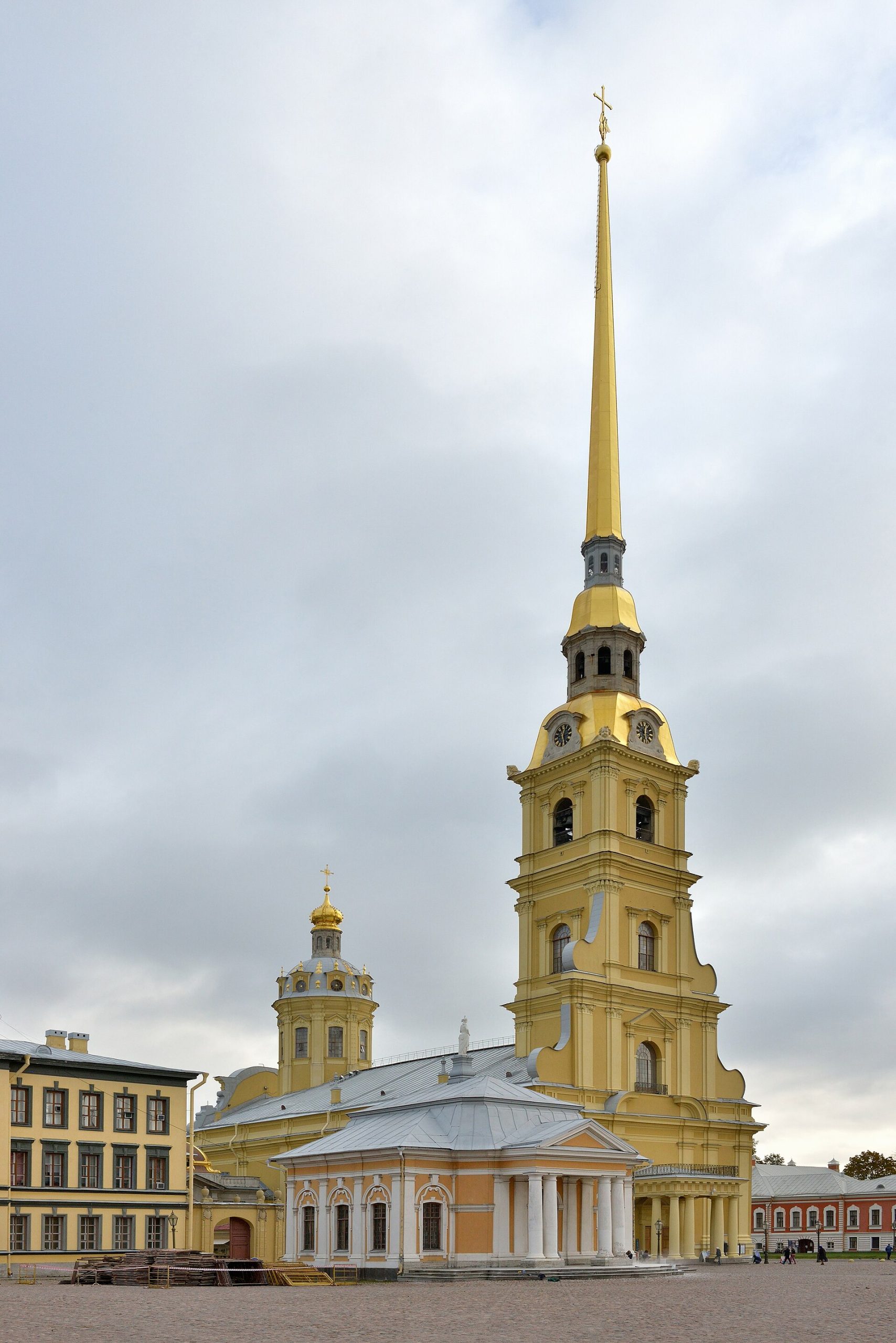
The golden spire of the Peter and Paul Cathedral is one of the great landmarks of St. Petersburg, a slender needle of gold that soars high above the fortress and can be seen from far across the city. At its very summit stands a famous golden angel holding a cross, an emblem that has watched over St. Petersburg for three centuries and has become one of the most beloved symbols of the city. The angel and the spire together crown the cathedral and the fortress, drawing the eye upward and giving the whole ensemble its unmistakable silhouette.
For most of the history of St. Petersburg, the spire of the cathedral was the tallest structure in the entire city, rising above all the palaces and other churches, and by long tradition no building was permitted to exceed its height. This gave the cathedral a commanding presence over the skyline, its golden point catching the light above the Neva. The angel at its summit has become an object of great affection for the people of St. Petersburg, a guardian spirit hovering over the city that Peter the Great built, and it remains one of the most enduring and iconic images of the whole northern capital.
Restoring and maintaining so tall and slender a spire has been a continual challenge across the centuries, and the great golden needle has been repaired and regilded many times to keep it gleaming above the city. The famous angel at its summit has its own stories and legends, including tales of the brave souls who climbed the spire to repair it in ages before modern equipment. Through all of it, the spire and its angel have remained constant, a fixed point in the ever-changing life of St. Petersburg and a symbol of the city’s endurance through three eventful centuries.

The Necropolis of the Tsars
The Peter and Paul Cathedral holds a role of the deepest significance in the history of Russia, for it became the burial place of the emperors, the great necropolis of the Russian imperial family. Beginning with Peter the Great himself, who was laid to rest in the cathedral he had built, nearly all the rulers of Russia across two centuries of empire were buried within its walls. To enter the cathedral is thus to stand among the tombs of the tsars, in the presence of the very rulers who shaped the destiny of Russia and much of Europe.
The tombs of the emperors and empresses fill the cathedral, gathered together in death within the fortress that stood at the birthplace of their capital. Here lie the great figures of Russian imperial history, from Peter the Great who founded the city to Catherine the Great and the emperors who followed, a gathering of rulers unmatched in its historical importance. The cathedral is, in effect, the mausoleum of the Russian empire, and walking among its tombs is a profoundly moving experience, a journey through the whole sweep of imperial Russian history in a single sacred space.
The gathering of nearly all the Russian emperors into a single cathedral gives the building an almost overwhelming historical weight, for here in one space lie the rulers who fought the wars, built the palaces, and shaped the destiny of one of the greatest empires the world has known. From the reforming genius of Peter the Great to the enlightened ambition of Catherine the Great and beyond, the makers of imperial Russia rest together within these walls. Few places anywhere allow so direct an encounter with the whole span of a great dynasty’s history.
It is worth reflecting on the deliberate choice to make this cathedral, rather than any church in old Moscow, the resting place of the emperors, for it tied the imperial dynasty forever to the new city and the new Russia that Peter had created. In choosing to be buried here, Peter and his successors affirmed St. Petersburg as the true heart of their empire, and the cathedral became the sacred anchor of the dynasty in its modern capital. This connection between the rulers and the city they built gives the necropolis a significance beyond even the sum of its illustrious tombs.

Where the Emperors Rest
The interior of the Peter and Paul Cathedral is a place of solemn beauty, its walls and vaults richly decorated in the baroque style and its floor crowded with the tombs of the imperial dead. The tombs themselves are mostly simple in form, plain rectangular monuments of stone, though some of the later ones are made of magnificent semi-precious stone, and each bears the name of the ruler who lies beneath. The overall effect is one of great dignity, a fitting resting place for the sovereigns of a mighty empire.
In the final years of the twentieth century, the cathedral received its most poignant burials, when the remains of the last Russian emperor and his family, who had met a tragic end in the revolution, were at last laid to rest here with due ceremony, decades after their deaths. This deeply moving event brought the story of the Russian monarchy full circle, gathering the last of the emperors into the same sacred space as the first. The cathedral thus holds the whole span of the imperial dynasty, from its founder to its final tragic end, and it stands as one of the most historically significant burial places in the world.
The reinterment of the last imperial family within the cathedral, so many decades after their deaths, was an event of profound emotional significance for Russia, a moment of reckoning with the tragic end of the monarchy and the turbulent century that followed. In laying them to rest among their ancestors, the cathedral closed a circle that had been broken by revolution, and it gave a final resting place to figures whose fate had haunted the nation. The presence of these tombs adds a note of deep poignancy to the cathedral, connecting the glory of the imperial past to its sorrowful end.

A Prison for the Enemies of the State
Alongside its role as a fortress and a royal necropolis, the Peter and Paul Fortress served for two centuries in a far grimmer capacity, as one of the most feared political prisons in all of Russia. Within its walls, particularly in the notorious bastion set aside for the purpose, the enemies of the state were held in harsh confinement, from the earliest days of the empire right through to the revolution. The list of those imprisoned here reads like a roll call of Russian history, and the fortress cast a long shadow of dread across the imperial centuries.
The prisoners held within the fortress included some of the most famous and significant figures in Russian history, among them writers, revolutionaries, and even members of the imperial family who had fallen from favour. Indeed, one of the very first prisoners was Peter the Great’s own son, held here after a bitter conflict with his father. Across the generations, the cells of the fortress held those who challenged the autocratic power of the tsars, and the place became a symbol of the harsh repression of the imperial state. This dark history is an inseparable part of the fortress’s story, and the former prison can be visited today as a sombre memorial.
The dual identity of the fortress, as both the sacred resting place of the emperors and the grim prison of their enemies, captures something essential about the nature of imperial Russia, a state of dazzling splendour and harsh repression existing side by side. Within these same walls lay the tombs of the rulers and the cells of those who opposed them, the two faces of autocratic power gathered on a single island. This stark juxtaposition makes the fortress a place of unusual moral and historical complexity, and it lends a sobering depth to any visit.

The Noon Cannon and the Daily Ritual
Among the most beloved traditions of the Peter and Paul Fortress is the firing of a cannon every day precisely at noon, a ritual that has marked the middle of the day for the people of St. Petersburg for a very long time. The boom of the noon gun echoes across the Neva and the city, a daily signal that residents and visitors alike come to know and love, and the firing of the cannon has become one of the cherished customs of the fortress and the city it guards. It is a living link to the military past of the stronghold.
This daily ritual, along with the flag that flies from the fortress and the other ceremonies that mark its calendar, keeps the Peter and Paul Fortress alive as a working part of the life of St. Petersburg, not merely a monument to be visited but a presence woven into the daily rhythm of the city. The noon cannon in particular has become a much-loved institution, a moment when the whole history of the fortress seems to speak across the water. To be in St. Petersburg at midday and hear the gun of the fortress is to feel the deep continuity between the city’s past and its present.
Traditions like the noon cannon are the threads that bind a great monument to the daily life of the people around it, keeping it alive in the affections of the city rather than allowing it to become a mere relic. Generation after generation of St. Petersburg residents have set their watches, quite literally, by the boom of the fortress gun, and the ritual has become part of the very identity of the city. It is a charming reminder that the fortress is not just a museum of the past but a living presence, still speaking to the city it has guarded for three hundred years.

A Museum on Hare Island
Today the Peter and Paul Fortress is no longer a stronghold or a prison but one of the great museums of St. Petersburg, its walls, cathedral, and prison all open to visitors who come from around the world to explore its remarkable history. As part of the museum of the history of the city, the fortress presents the whole story of St. Petersburg and of imperial Russia through its buildings and its exhibitions, and it has become one of the most popular and rewarding destinations in the entire city.
Within the fortress there is a great deal to see, from the magnificent cathedral with its imperial tombs to the grim cells of the former prison, and from the historic buildings such as the old boathouse to the walls and bastions with their sweeping views over the Neva and the city beyond. A visit can easily fill many hours, taking in the many different facets of this extraordinary place. The transformation of the fortress from a stronghold and prison into a museum open to all is a fitting final chapter in its long history, ensuring that its story is preserved and shared with every generation.
The sweeping views from the walls of the fortress are among the finest in all of St. Petersburg, looking out across the broad Neva to the magnificent facades of the city on the opposite bank. From this vantage point you can see how completely the great city grew up around its founding fortress, and appreciate the beauty of the architectural ensemble that Peter and his successors created. Taking the time to walk the walls and drink in these views is one of the great pleasures of a visit, and it perfectly rounds out the experience of this extraordinary place.
Finding the Peter and Paul Fortress
The Peter and Paul Fortress is wonderfully easy to find, for it sits on its island in the Neva River at the very heart of St. Petersburg, one of the most beautiful and walkable cities in the world. The fortress is connected to the mainland by bridges and is easily reached on foot or by the city’s public transport, and its golden spire, visible from across the river, serves as a natural landmark to guide you toward it. For anyone visiting St. Petersburg, the fortress is an essential stop.
The setting could hardly be more magnificent, for the fortress stands amid the palaces, rivers, and canals of one of the great architectural cities of Europe, and a visit to it can easily be combined with the many other wonders of St. Petersburg that lie close at hand. From its walls you look out across the Neva to the splendid facades of the city that grew from this very spot. Here are the exact coordinates so you can find your way to the fortress where St. Petersburg began.
View on Google Maps: 59.95, 30.3167
Castles Nearby
If the Peter and Paul Fortress has drawn you into Russian history, two more great strongholds of the region make a fine next stop.
- The Moscow Kremlin is the ancient red-walled fortress at the heart of Russia.
- Toompea Castle in Tallinn is another great seat of power on the Baltic.
The Fortress Where a City Was Born
Few fortresses anywhere carry so much history within their walls as the Peter and Paul Fortress. It was the seed from which one of the world’s greatest cities grew, the shield raised against the Swedes in a great war, the golden-spired resting place of the emperors of Russia, and the grim prison of those who dared to challenge them. In its bastions and its cathedral, its tombs and its cells, the whole dramatic story of imperial Russia is gathered together, from the founding vision of Peter the Great to the tragic end of the last of the tsars.
That is what makes a visit to the fortress so moving. You are standing at the very birthplace of St. Petersburg, in the place where a mighty city and a great chapter of Russian history began, and where so much of that history was later played out. To walk among the imperial tombs, to stand in the shadow of the golden spire, and to hear the noon cannon boom across the Neva is to feel the whole depth of the Russian past. The Peter and Paul Fortress is the fortress where a city was born, and it remains one of the most extraordinary places in all of Russia.
If your travels ever take you to St. Petersburg, the Peter and Paul Fortress is the one place above all where the story of the city begins. Cross the bridge to the island, walk the bastioned walls, stand beneath the soaring golden spire, and step into the cathedral to stand among the tombs of the tsars. Listen, if you are there at midday, for the boom of the noon cannon across the Neva. It is an experience of history and beauty unlike any other, and it leaves every visitor with an unforgettable sense of the drama of the Russian past.
You May Like

Fort Cornwallis: The Star Fort Where Penang Began