
In the western and central valleys of Bhutan, in the green folds of the high Himalaya where the great whitewashed fortresses rise above terraced fields, live the Ngalop, the people who more than any other gave the kingdom of Bhutan its language, its faith, and its national character. Though Bhutan is home to several distinct peoples, it is the Ngalop of the west whose culture became the culture of the state, whose tongue became the national language, and whose form of Buddhism became the religion of the realm. To understand them is to understand the public face of the Land of the Thunder Dragon itself.
The Ngalop are descended in large part from Tibetan migrants who crossed the high passes from the north many centuries ago and settled the fertile valleys of western Bhutan, bringing with them the language, religion, and customs of the Tibetan world. Over the centuries they grew into a distinct people, no longer Tibetan but Bhutanese, and they became the dominant community in the country that took shape around them. This post looks at the Ngalop on their own, as one of the peoples that together make up the wider nation of Bhutan.
- The people of the western valleys
- A tongue from the roof of the world
- The Tibetan inheritance
- The Drukpa faith and the founding lama
- How the Ngalop came to rule a kingdom
- The dzong and the monk body
- The gho, the kira, and the national code
- The tsechu and the sacred cham
- Cheese, chilli, and red rice
- Keepers of the national culture
- A people facing the modern world
- At the heart of the Thunder Dragon
The people of the western valleys

The Ngalop homeland is the western and central belt of Bhutan, the region of broad, fertile valleys at moderate altitude where the country’s most important towns and dzongs are found. These valleys, watered by rivers running down from the high snows and warmed by the southern sun, were the best agricultural land in a mostly vertical country, and it was here that a settled, prosperous, rice-growing society could take root and flourish. Geography made this region the natural centre of power, and the people who farmed it the natural leaders of the land.
From these valleys the Ngalop built a way of life centred on the cultivation of rice and other grains on terraced fields, the keeping of cattle, and the round of Buddhist observance that filled the year. The village, the family, and the local monastery formed the framework of existence, and the great dzong of each valley stood as the centre of both administration and faith. It was a settled, hierarchical, deeply religious society, and its prosperity gave it the strength to shape the destiny of the whole country.
The very name Ngalop is often understood to mean something like the earliest risen, a reference to their being among the first to embrace Buddhism in the region. Whether or not the etymology is exact, it captures their self-image as the people who carried the light of the faith into Bhutan and who became, in time, the custodians of the nation’s culture. Their valleys remain the heartland of Bhutanese power, religion, and identity.
A tongue from the roof of the world

The language of the Ngalop is Dzongkha, the tongue of the dzongs, and it is the national language of Bhutan. Dzongkha belongs to the Tibetic branch of the great Tibeto-Burman language family, which means it is a close relative of the language of Tibet and a more distant cousin of the many other Tibeto-Burman tongues spoken across the Himalaya and into the hills of India’s northeast. It is a tonal language, and it is written in a graceful cursive script descended from the same ancient Indian-derived alphabet used for Tibetan.
The name Dzongkha itself, the language of the fortress, points to its origins as the speech of the administrative and religious elite who governed from the dzongs. From this base it spread to become the lingua franca and then the national language of the whole country, taught in schools and used in government across Bhutan, even in regions where other languages are the mother tongue. In this way the language of the Ngalop became the shared tongue of a diverse nation.
The classical written language of religion and scholarship in Bhutan, called Chöke, is essentially classical Tibetan, the language of the Buddhist scriptures, and for centuries it was the medium of all serious writing. Dzongkha, the spoken vernacular of the Ngalop, only gradually developed its own written literature and official status. The relationship between the everyday tongue and the sacred classical language mirrors the deep Tibetan roots of Ngalop culture, rooted in the religious civilization of the high plateau to the north.
The Tibetan inheritance
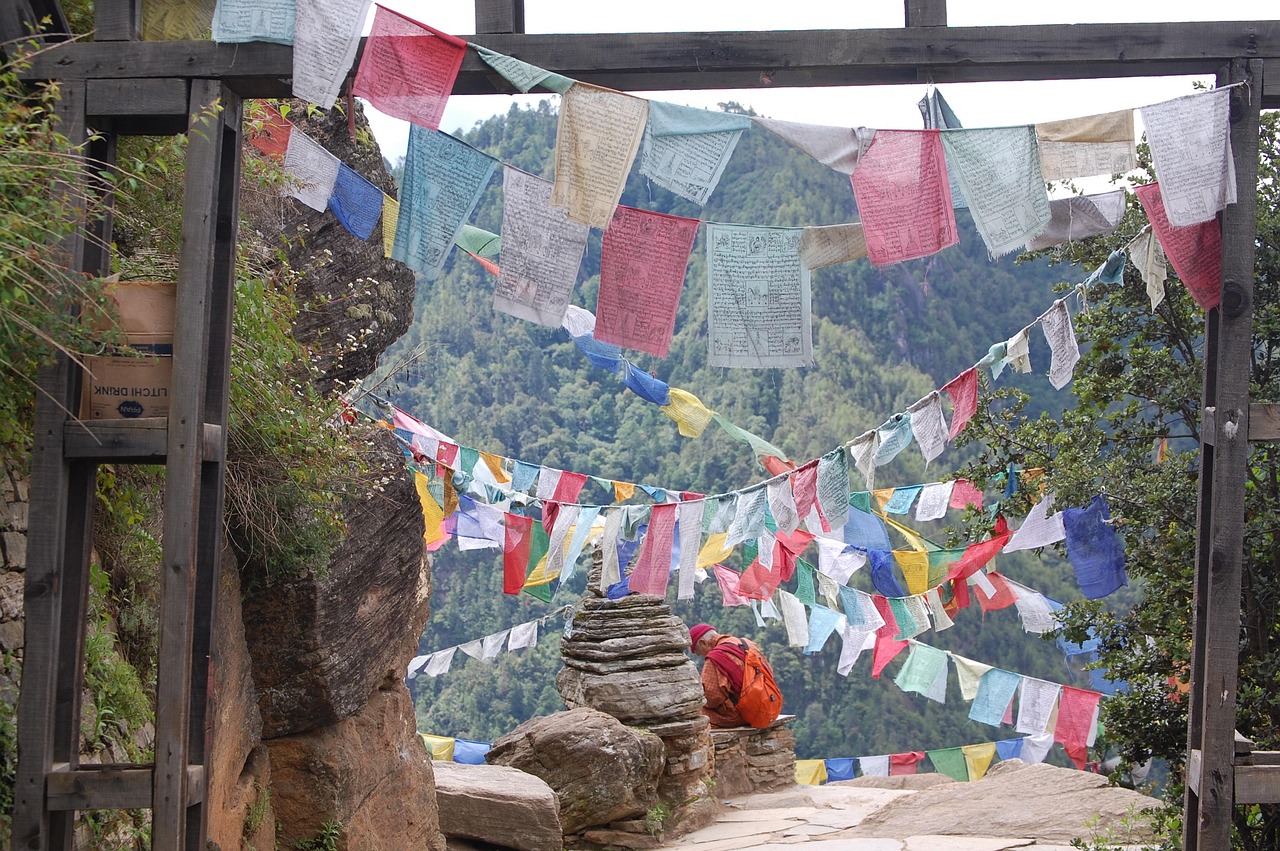
The Ngalop are, in their deepest cultural inheritance, the southern branch of the Tibetan Buddhist world. From Tibet came not only their language but their religion, their script, their art, their architecture, and much of their social order. The migrants who founded Ngalop society carried with them the whole apparatus of a civilization: the monasteries and the monastic discipline, the sacred texts, the painted scrolls and gilded images, the prayer flags and prayer wheels, and the calendar of festivals that still structures the Bhutanese year.
Yet the Ngalop are not Tibetans, and Bhutan is not Tibet. Over the centuries, cut off by the high mountains and shaped by their own history, the Ngalop developed a distinct identity, their own dialects, their own customs, their own school of Buddhism, and their own state. When Tibet itself was convulsed by upheaval in the modern era, Bhutan remained an independent kingdom, and the Ngalop became the keepers of a Tibetan Buddhist civilization that, in its homeland, came under grievous threat. In a real sense Bhutan preserved a world that elsewhere was nearly lost.
This inheritance gives Ngalop culture its profound continuity with the Buddhist past. The landscape itself is read as sacred, dotted with monasteries, chortens, and holy sites, and the rhythms of religious life, the turning of prayer wheels, the fluttering of flags, the recitation of mantras, pervade everyday existence. To be Ngalop is to be heir to one of the great religious civilizations of Asia, kept alive in the valleys of the Thunder Dragon.
The Drukpa faith and the founding lama

The particular form of Buddhism that defines the Ngalop and the Bhutanese state is the Drukpa school, a branch of the Kagyu tradition of Tibetan Vajrayana Buddhism. Indeed the very name of the country, Druk Yul, the Land of the Thunder Dragon, comes from this Drukpa lineage, and the dragon that gives Bhutan its name is the same druk that names the school. The Drukpa faith is not merely the majority religion; it is the official religion of the state and the spiritual foundation of national identity.
The towering figure in Ngalop religious history is the Zhabdrung, the Tibetan lama of the Drukpa school who fled south into Bhutan in the seventeenth century and there united the country, established its laws, and built its great dzongs. He is at once the founder of the Bhutanese state and the consolidator of the Drukpa faith as its spiritual core, and his memory is honoured throughout the land. Under his leadership the religious and the political were fused into a single order that has shaped Bhutan ever since.
The Drukpa tradition gives Ngalop life its monasteries, its monks, its festivals, and its sacred art, and it links the Bhutanese to the wider Vajrayana world while marking them as distinct within it. The reverence for Guru Rinpoche, who is said to have brought Buddhism to the Himalaya and meditated in the cliffside cave that became the Tiger’s Nest, is shared with the broader region, but the Drukpa school gives Ngalop Buddhism its particular character and its intimate bond with the Bhutanese nation.
How the Ngalop came to rule a kingdom

The political dominance of the Ngalop flows directly from their role in founding and governing the Bhutanese state. It was the Drukpa lama from the west who unified the country, and it was the Ngalop valleys that became the seat of power. The system of dual government he created, with a spiritual head and a temporal ruler, was staffed and led overwhelmingly by Ngalop, and the great offices of state, religious and secular alike, were theirs to fill.
When Bhutan moved from the old dual system to a hereditary monarchy at the beginning of the twentieth century, the new royal house emerged from this same world, drawing on the central and eastern regions but ruling a state whose culture was Ngalop in language, religion, and form. The monarchy, the monastic body, the bureaucracy, and the national symbols all reflected Ngalop culture, and so the public identity of Bhutan became, in large measure, the identity of its western people.
This dominance has been a source of both strength and tension. It gave Bhutan a clear and confident national culture, distinct and proudly defended, which helped the small country survive and assert itself in a dangerous neighbourhood. But it also meant that the other peoples of Bhutan, the easterners and the southerners, lived within a national framework shaped by the west, a fact that has at times produced friction in a country striving to be one nation out of many communities.
The dzong and the monk body
The dzong is the supreme expression of Ngalop civilization. These massive fortress-monasteries, with their sloping whitewashed walls, their great central towers, and their golden roofs, rise at the strategic hearts of the western and central valleys, commanding the rivers and routes below. Built without nails or detailed plans, raised by master craftsmen working in an unbroken tradition, they are among the architectural wonders of the Himalaya, and each one serves at once as fortress, monastery, and seat of district government.
Within the dzong lives a community of monks, for the central monk body is one of the great institutions of the Ngalop and Bhutanese world. Boys enter the monasteries young and are trained in the scriptures, the rituals, the sacred arts, and the discipline of the Drukpa order, and from their ranks come the religious leaders of the nation. The monk body, supported by the state, stands alongside the monarchy as one of the twin pillars of Bhutanese society, the spiritual partner to the temporal power.
The dzongs are also the stage for the great religious festivals and the centres of the administrative life of each region, so that in a single building the religious, the political, and the cultural life of the valley comes together. For the Ngalop, the dzong is the very emblem of their civilization, the place where faith and statecraft, art and authority, are gathered under one set of golden roofs.
The gho, the kira, and the national code

The Ngalop are famous, along with their fellow Bhutanese, for the national dress that they wear in daily and official life. Men wear the gho, a heavy knee-length robe gathered at the waist with a belt to form a great pouch at the chest, while women wear the kira, a long, elegant dress of finely woven cloth fastened at the shoulders and waist. The fabrics and patterns vary with region, occasion, and status, and the careful weaving of these textiles is one of the great crafts of Bhutanese women.
This dress is part of a wider code of traditional conduct and etiquette known as driglam namzha, which the Ngalop-shaped state has promoted as a national standard. It governs not only clothing but the proper way to behave in a dzong, the etiquette of respect toward monks and officials, the conduct of ceremonies, and the manners of hospitality. To the Ngalop and the Bhutanese state, this code is the visible armour of a small culture determined to preserve itself against the homogenizing pressures of the modern world.
The insistence on national dress and conduct, rooted in Ngalop tradition, gives Bhutan its strikingly distinctive public face, a country where the everyday street scene looks like nowhere else on earth. For the Ngalop themselves, the gho and the kira are not costumes but the natural clothing of their people, worn with pride as the outward sign of who they are and of the civilization they carry.
The tsechu and the sacred cham

The high points of the Ngalop year are the tsechus, the great religious festivals held in the courtyards of the dzongs to honour Guru Rinpoche and the triumph of the faith. For several days the community gathers in its finest dress to watch the cham, the sacred masked dances performed by monks in elaborate costumes and vivid masks, each dance enacting a religious story, a victory of good over evil, or a teaching about life and death. Simply to witness these dances is held to bring blessing and to purify the soul.
The tsechu is at once the deepest religious occasion and the great social gathering of the year for the Ngalop. Families travel from across the valley, spread out feasts, meet kin, and watch dances performed in nearly unchanged form for centuries. The unfurling of a giant appliqued religious banner at dawn, the antics of the comic atsara figures, and the rhythm of drum and horn make the festival a total experience that binds the community to its faith and to one another.
These festivals are also a powerful assertion of cultural vitality. In an age when global media reaches even remote valleys, the tsechu and the cham keep the religious heart of Ngalop life beating, drawing the young into the tradition and reminding all who attend of the sacred stories that underlie their world. They are the living theatre of the Drukpa faith and the proudest expression of the Ngalop cultural year.
Cheese, chilli, and red rice
Like all Bhutanese, the Ngalop have a cuisine defined by an almost fierce devotion to chillies, treated not as a mere seasoning but as a vegetable in its own right. The national dish, ema datshi, a stew of whole chillies cooked in the local farmhouse cheese, is the very taste of home, startlingly hot to outsiders but beloved by every Ngalop table. Around it the cuisine is built on the staples of the western valleys, above all the nutty red rice grown in the terraced paddies.
The Ngalop kitchen makes much use of dairy, in the form of the cheese and butter that flavour so many dishes and the butter tea that warms the cold mountain mornings. Dried and fresh meats, river fish, buckwheat and other hardy grains in the higher reaches, and a variety of vegetables fill out the table, and festive occasions bring richer dishes and the local grain spirits. It is hearty, warming food, perfectly suited to the cool climate and the hard physical life of a mountain farming people.
As everywhere in the Buddhist Himalaya, food is bound up with religion and hospitality. Offerings are made at the household altar, monks are fed as an act of merit, and the sharing of a meal binds family and community. The Ngalop table, with its fiery cheese stews and red rice, remains remarkably untouched by outside influence, one more sign of a people who have guarded their distinct ways with unusual success.
Keepers of the national culture

More than any other community, the Ngalop are the keepers of Bhutan’s national culture. Their language is the national language, their religion the state religion, their dress the national dress, their architecture the national style, and their festivals the great public ceremonies of the realm. When the world pictures Bhutan, the gilded dzong, the masked dancer, the figure in the gho, the cliffside monastery, it is largely picturing the culture of the Ngalop, raised to the level of a national identity.
This role carries a deep sense of responsibility for the preservation of tradition. The Ngalop-shaped state has made the conscious choice, almost unique in the modern world, to protect its culture deliberately and by policy, from the requirement of national dress to the protection of the monasteries to the careful management of outside influence. For the Ngalop, this is not nostalgia but survival, the determination of a small people to remain themselves in a world that erases distinctiveness.
Theirs is also a living, not a frozen, culture. Young Ngalop carry smartphones, study abroad, and engage with the world, even as they return for the tsechu and wear the gho to school and office. The challenge they face is the same one their state has embraced: how to be fully modern without ceasing to be Ngalop, how to open to the world without dissolving into it, a balancing act they perform with notable success.
A people facing the modern world
The Ngalop today live in a Bhutan transformed. Roads, schools, hospitals, and the internet have reached the western valleys, the absolute monarchy has given way to a constitutional one with an elected parliament, and the young increasingly leave the farms for the towns or for work and study abroad. Yet through all this change the core of Ngalop identity, the language, the faith, the dress, and the festival, has proven remarkably durable, anchored by a state that has made cultural preservation a central national goal.
The dominance of Ngalop culture within Bhutan has not been without its difficulties, particularly in relation to the other peoples of the kingdom, the easterners and the southerners, whose own languages and traditions sit within a national framework shaped by the west. Like other nations built around a dominant culture, including the homelands of the various peoples of Nepal next door, Bhutan has had to navigate the hard questions of unity and diversity, and not every chapter has been easy.
Still, the overall story of the Ngalop in the modern age is one of striking success. They have helped steer their country from medieval kingdom to constitutional democracy, preserved a complete Buddhist civilization that elsewhere came near to extinction, and given a small Himalayan nation a confident, distinctive identity admired around the world. They face the future, as they have faced the past, as the cultural heart of the Thunder Dragon.
At the heart of the Thunder Dragon

The Ngalop are a people who became, in a sense, the face of a nation. Descended from Tibetan migrants who settled the western valleys, they grew into a distinct Bhutanese people, founded and governed the kingdom, and gave it the language, the faith, the dress, and the festivals that the world now recognizes as Bhutanese. Theirs is the culture of the dzong and the cham, the gho and the kira, the red rice and the fiery cheese, the prayer flag on the high pass and the monastery on the cliff.
To tell the story of the Ngalop is to tell the story of how a small Himalayan people preserved one of the great religious civilizations of Asia and built around it an independent, confident nation. They are not the only people of Bhutan, and the fuller picture of the kingdom includes the eastern Sharchop and the southern communities as well. But it is the Ngalop who, more than any other, made Bhutan what it is, and who stand at the very heart of the Land of the Thunder Dragon.
You May Like
The Damara, an Ancient People of Namibia


2 thoughts on “The People of the Western Valleys, the Ngalop and the Soul of Bhutan”
Comments are closed.