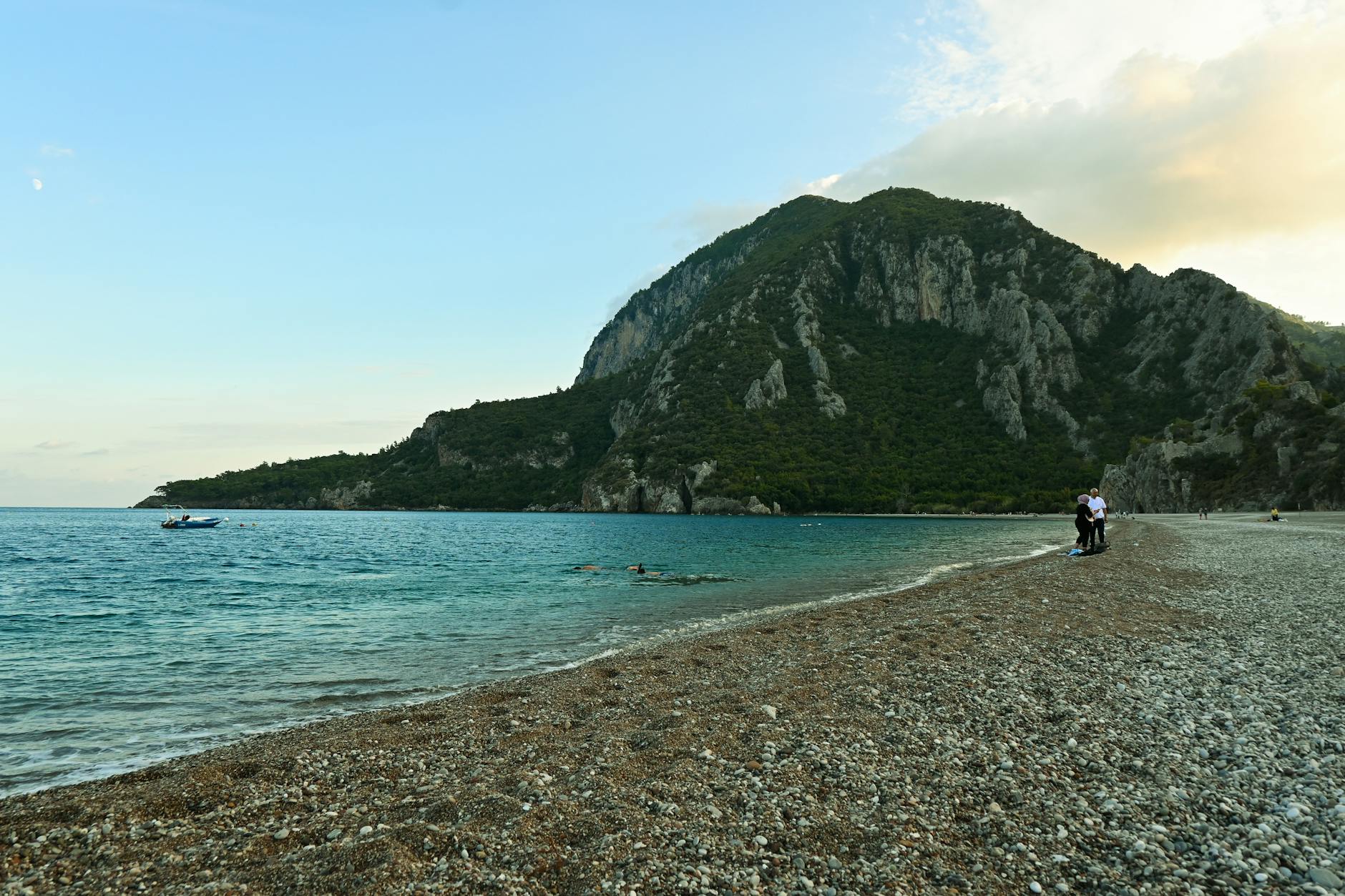
Olympos is located on the south-west coast of the Antalya Gulf, 80 km from the city centre. is in the south. Strabo describes the location of Olympos, which is also known today as Çıralı, Yanartaş and Diliklitaş, as follows:
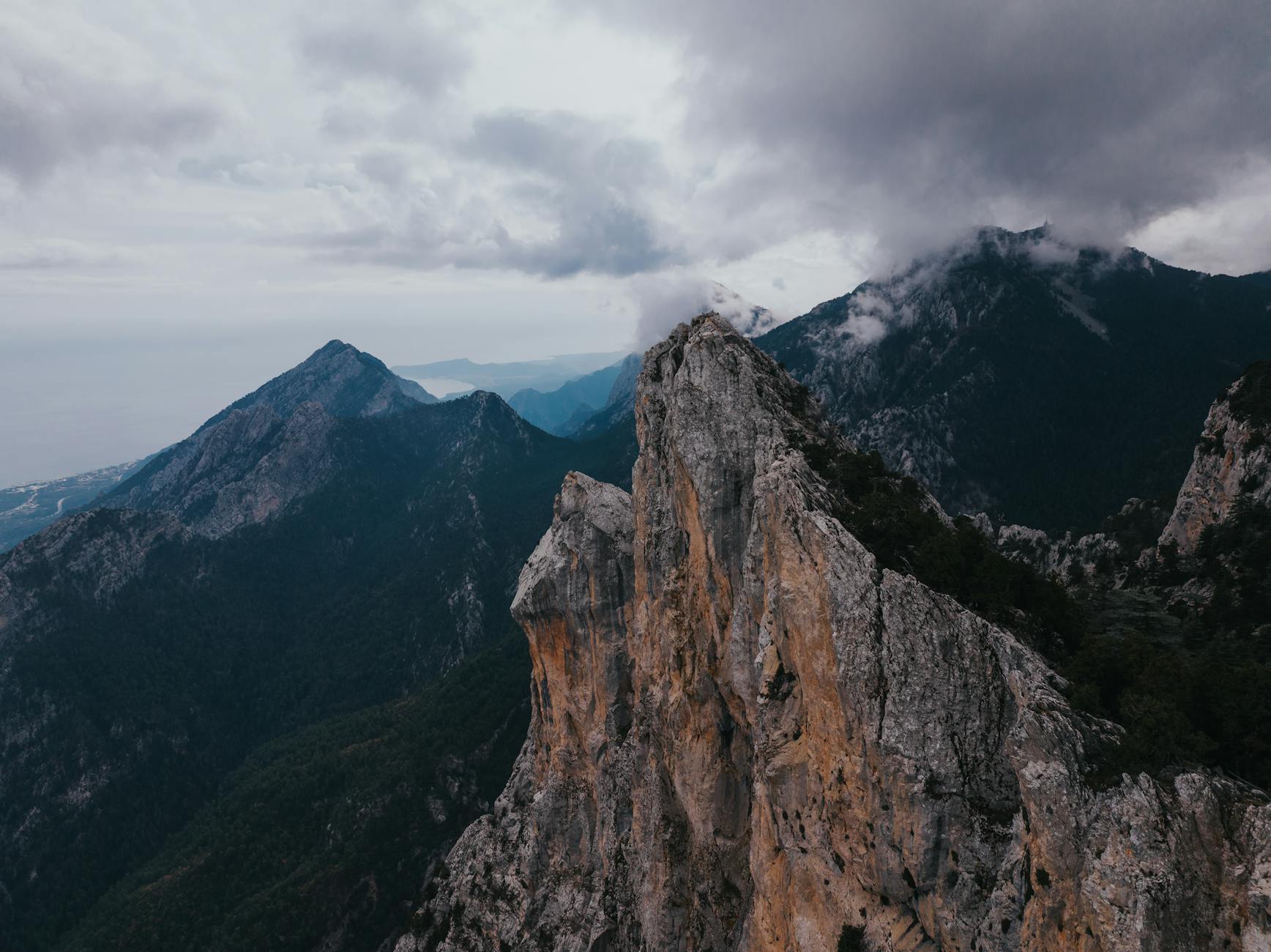
“..From Hiera cape (Kırlangıç cape) to Olbia (near Antalya) is three hundred and sixty-seven stades; and on this extension there is not only Krambusa, but also the City of Olympus, which was later called Phoinikos, and a mountain of the same name.” Starting from the south of the city with Sepet Mountain, the rather steep rise reaches 568 m in Musa Mountain, while the steep slope in the north forms the south of Omurga Mountain, and in the west It is located on Gölbükü hill.
The city was founded on both sides of a river originating from Tahtalı Mountain and flowing towards the sea. In ancient times, the bed of this river was turned into a channel by paving with smooth stones.
Olympos is a word of Luwian origin and was adapted to Hellenic during the Hellenization of Western Anatolia. An exact date cannot be given regarding the founding of Olympos. However, B.C. It is also known that he minted coins within the Lycian League in 168-178. Strabon emphasized that among the 23 cities that make up this union, Olympos, which has three votes in the union, has a special importance.
During the Hellenistic period, the city was the shelter of Mediterranean pirates for a long time. Strabon describes this function as follows: “There is the pirate castle of Zeniketos on the slopes of the Taurus Mountains. I mean Olympos.” The task of clearing the environment, especially Olympos, from pirates was given to the Roman commander Servilius Isauricis.
The Roman commander, who set out from Tarentum in 78 BC, dealt with them for four years and eventually succeeded in defeating Zeniketes, the leader of the pirates, in Olympos. He punished the city for aiding pirates and took the statues there to Rome. M.S. Olympos, which was rebuilt in 200, experienced its brightest period in the following years.
However, in 300 AD, the region suffered a lot of damage from constant pirate attacks and was often plundered. For this reason, it went through difficult times, lost its importance over time and turned into a small, insignificant settlement. The city became famous for the cult of Hephaestus, the god of fire and blacksmiths, due to the natural gas injections in Olympos, which Cicero mentioned as old prosperous cities along with Phaselis.
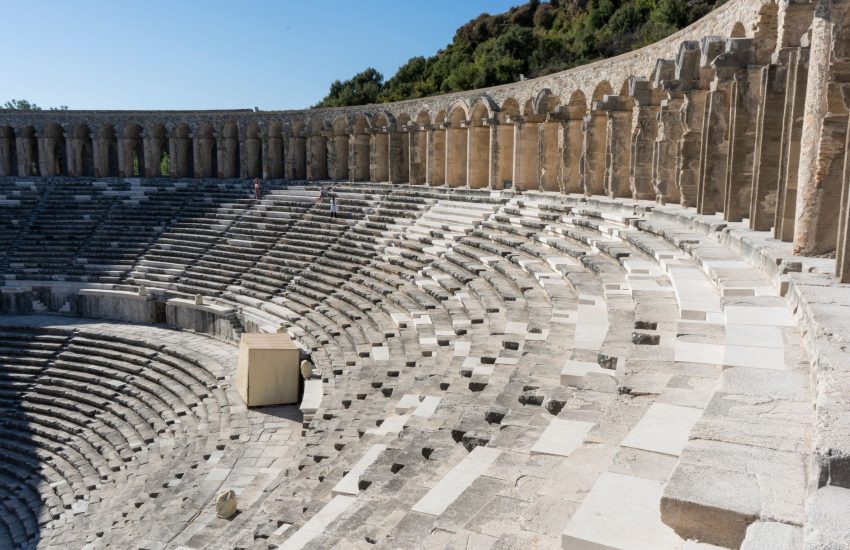
The basilica and bath ruins are the main structures of the city that have survived to the present day. Although one side of the theater is quite well preserved, the seating levels of the Cavea are quite dilapidated. The skene (stage building) of the theatre, supported by arches and vaults, is in a very bad condition.
In the middle of Olympos and 150 m from the river. The temple in the west, 2.90 x 7.85 m. It is a templum in antis (megaron type temple with two small columns in front) in Ionic style. Its stones are scattered around, and only the monumental gate between the cella and pronaos is in good condition.
We read from the inscription on a statue base next to the door of this temple, which is unknown to which god it was assigned, that it has a statue of the Roman Emperor Marcus Aurelius (161-180). This shows that the temple was most likely built during his time. In the south of Olympos, the majority of the tombs are covered with vaults, and the door lintels and inscriptions have survived to the present day, as well as the few sarcophagi tombs that attract attention.
When you enter the city from the seaside, you can see the Acropolis under the A.D. II. century. belongs to and then again M.S. V. century. A burial chamber, which was used for the second time and was unearthed as a result of the excavation carried out by the Antalya Museum in 1992, can be seen. The mosaics with soldier and lion figures on the floor date back to A.D. It belongs to the 5th century. There are two sarcophagi inside the room.
One of them was made for an Olympian named Marcus Aurelius Zosiumas, and the other was made for captain Eudomos. A ship relief is engraved on this sarcophagus, and the name of Captain Eudomos, Zosimas’ uncle, is written in the inscription next to it. The text of the inscription is as follows:
“He entered the last harbor and anchored, never to leave. Because there is no help from the wind or the sunlight anymore. After leaving the light-bearing dawn, Captain Eudomos sank there like the sun, his short-anchored ship, like a broken wave.”
Probably this Zosimas must have been one of the important people of the city. It is debatable whether Eudomos was also a pirate or not. A little above this burial chamber and on the west side, there is a building called “Bishop’s House” in A.D. V .century. There is a building belonging to . This is the 15th century. In the big earthquake in , its base was 1 m. remained under water. It is understood from the ruins that both the floor and the upper floor of this two-storey building were decorated with mosaics.
The main street of Olympos runs parallel to the river. Previously, this river was crossed by a bridge known to have been built in the Roman period. Today, only traces of the bridge’s feet can be seen. It is very likely that the vaulted ruins surrounded by columns next to the Byzantine basilica between the theater and the sea belong to the Agora and Gymnasium.
Unfortunately, most of the vaults, house ruins and graves in the city were destroyed and robbed by treasure hunters.
Places to Visit
Kemer is one of the busiest holiday resorts. Its clean sea, which maintains its charm with its unique Mediterranean blue, is surrounded by lush pine forests and citrus groves of the Taurus Mountains. In Kemer, completely different worlds occur during the day and at night. While the coastal part of the beach becomes invisible with colorful umbrellas and sun loungers, the open sea becomes colorful with people riding Jet-Ski, banana, water ski, parasailing and surf hamburger.
There is also a water paradise in Kemer called Aquaworld, which was put into service in recent years. Especially tourists participate in all kinds of water entertainment and slide down the slides and enjoy the activities until the evening. At night, Mediterranean dishes can be enjoyed until late hours at tables spilling onto the illuminated streets.
Having an adventure on the bumpy, dusty track of Olympos National Park, integrating with nature in the company of open-top 4×4 jeeps, away from asphalt roads and crowds; If you want to rest both your eyes and your soul in the green of the pines, the blue of the sky and the purple of the mountains, come on safari…
The safari is starting!..The agency collects the booked tourists staying around Antalya’s Kemer district and participating in the tour, one by one, from the hotels they stayed in in the morning and brings them to the departure point. Here, jeeps are given to those who have a driver’s license and want to drive the vehicle themselves during the safari, while other passengers are placed in the vehicles depending on the situation.
Before setting off, it is emphasized to the drivers that the safari is not a rally, that the mountain road is empty, away from traffic, without signs and police on duty, and that traffic rules should not be violated. Passengers who are willing to swallow the dust of the safari on a kind of endurance and adventure type trip are asked to drive on the right side of the road, not to overtake each other and not to leave the convoy.
While the convoy, which starts at 10 o’clock, heads towards Olympos National Park, the agency officials insure the tour by faxing the names of the passengers to the insurance company, just in case. The safari passengers, who pass through the Aslanbucak Village of Kemer district and start climbing towards the Bey Mountains, say goodbye to the asphalt road after 3 km and enter the uphill and dirt mountain road of the 108 km track.
In the summer months, among the intense sounds of cicadas and accompanied by the clean and cool mountain air, you first come to Kesmebağ location. In the region covered with pine trees, tourists are occasionally seen riding horses. A little further on, the canyon begins and the road parallel to Kemer stream is taken.
While some of the tourists on the Olympos tour take their breaks at the exit and return to the Olympos Ancient City in order to avoid overlapping in the same place at the same time; Some of them take their last break at Kesme Boğazı location and leave their safari dust by entering the small pond of Kemer stream.
First break… The first break is given in the small settlement where forest workers stay in the winter. After getting off the vehicles at the fountain, having a wander around and cooling off, at 10.30, they visit a village house used for tour passengers in Tek Kanat, a neighborhood of Gedelme Village.
During the tea break with phyllo bread and goat cheese, the lady of the house displays the eye-catching handcrafted textiles to her guests. While tourists, mostly Russian and German, admire these laceworks they encounter on the top of the mountain, they also organize mini tours for the children with the village donkey.
Climbing to an altitude of 1600 m, the group looks at Kemer from the observation hill. During the third break, tour passengers mingle with each other and take souvenir photos. Meanwhile, while the air is 13-14 degrees cooler than Antalya, the sun rising towards noon is showing its effect.
After visiting Mount Olympos, at an altitude of 2366 m, where the gods gather according to Greek mythology, we come to the Yörük cemetery of another village where no burials have been made for 25 years. After another photo break, appetite is whetted with the ice-cold and digestive spring water of Ağalar Village.
The natural rock resembling a “Klu Klux Klan” mask on the roadside of the region, which attracts attention with its land structure and rock shapes, causes tourists to take another break. The group suddenly jumped out of the jeeps and scattered around like flowers, and the guide said, “Come on, get in the car, we’re going!” It recovers and moves as quickly as the Turkish command.
Next is the exciting and highly competitive ‘rope pulling’ competition held on the wooden bridge after Söğüt Cuması village… The losing party from the group is divided into two, falling into the water and getting soaked. At 13.30, they come to the restaurants called Forella and Özer of the live trout production farm in Altınkaya village for lunch.
Tourists get out of the jeeps parked parallel to each other and quickly, visit the fish ponds and sit at the tables of the restaurant, which has prepared in advance for this tour. The meal, consisting of standard fried trout, omelette for those who don’t like it, shepherd’s salad, beer, cola and soft drinks, is eaten with great appetite; Tourists participating in the tour can now communicate with each other in a common language, albeit vaguely. After the meal, we move to the “Rehavet Terraces”.
Here, people rest, sometimes sitting cross-legged, sometimes lying down, while sipping apples, cinnamon and sage. Meanwhile, the guide entertains the tourists with small animations and invites them back to the jeeps. The jokey staff of the restaurant bid farewell to the tour by dousing it with a hose. On the road, village children sell small but delicious green apples.
Meanwhile, if one of the tires of the tour vehicles bursts, the tire of the jeep, which is lifted by the team in one move without a jack, is changed in as little as two seconds.
And the return… In the first stage of the descent, the Saraycık ruins are visited. In the ancient area, wall reliefs and ruins such as the Acropolis are seen, and another stage is followed by a short trekking. Those who get on the jeeps again, sometimes pass through a stream bed like a speedboat through the waters in the interesting terrain, and sometimes pass over 70-degree slopes. At the end of these enjoyable stages of the tour, we come to Kesme Bosphorus.
While photographs are taken on the delicate bridge over the stream, whose legs date back to the Lycian period, and you try to wash off the dust of the safari in the pond, the tour guide distributes the certificates, arranged according to the names, documenting the participants of the safari, one by one. Then, he calls the agency on the radio and announces that they are approaching and the service vehicles are being prepared.
After 5-6 km, around 18.30, the journey, which was never intended to end, ends for the day, and when you come to Kemer, you wake up from a dream.
What is needed? For the tour that continues under the sun all day long, a hat, light shoes with rubber soles that are resistant to wetness, comfortable shorts, a towel, a swimsuit, a pocket knife for peeling fruit and a camera to document what happened are the most necessary needs. Apart from this, for long-haired ladies, a hair clip to collect their hair against dust, a scarf to tie around their necks and protect their mouths from dust from time to time, sunglasses and cream are also among the necessary tools.
Ladies should choose plain clothes that can withstand dirt and dust instead of accessories. Families with children can keep a bottle of ammonia with them in case of a possible bee sting.
You May Like
Aspendos Ancient Theater Travel Guide