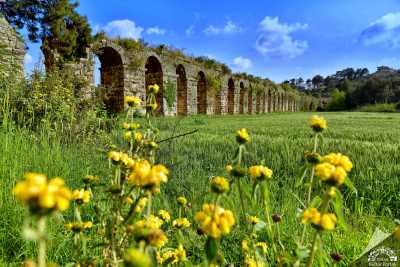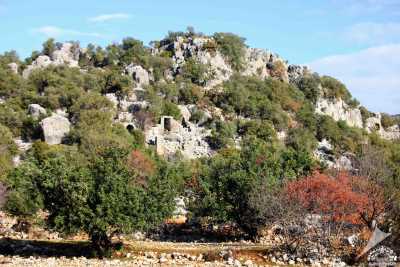
Istlada Ancient City is the most impressive among the small-sized cities of Lycia with its interesting tombs that have survived to the present day. The name of Istlada, located within the Lycian Union, can be read in many inscriptions in the region. Based on these inscriptions, the city has a history dating back to the beginning of the 4th century BC. The ruins of Istlada are today scattered around Kapaklı, Hoyran and Hayıtlı in the Demre district of Antalya.
Antalya Provincial Directorate of Culture and Tourism
It is known that the city was settled in the Hellenistic, Roman and Byzantine periods, respectively, after the Lycian period. Istlada; It looks like a small castle surrounded by walls, like Apollonia, Aperlai, Phellos or Isinda. The walls extending east and west of the acropolis end with a gate near the eastern end, which will allow entrance into the castle. Just to the west of the gate, the ruins of a building built for the purpose of controlling the gate stand out. The cisterns and wells seen here and there, as well as the canals dug into the local rock that allow water to accumulate in them, show that the water need in the city is met by accumulation.
Antalya Provincial Directorate of Culture and Tourism
It has a very special place in the world of archeology with its embossed tomb called Hoyran Monument, located in Istlada Kapaklı village. The monument was built by carving the main rock into a house-type tomb. In the middle of the pediment, the grave owner can be seen with his wife and son. In the frieze under the very low Gothic pediment, the tomb owner reclining on a divan in the middle and his soldiers at his feet; At his bedside, it is seen that a group consisting of his son, daughter, wife and women participated in the ceremony. On the acroteria, one of which is broken, there are sphinx depictions facing outwards. It has been determined that the monument dates back to the 4th century BC, based on the inscription engraved in the Lycian alphabet and the reliefs on it.

Antalya Provincial Directorate of Culture and Tourism
The east and north of the acropolis are full of rock tombs, sarcophagi and single block tombs in the form of stele. The majority of the sarcophagi are in the typical Lycian sarcophagus form, consisting of a base, sarcophagus and lid. There are stelae between the sarcophagi. All of them are made of limestone, which is the natural formation of the region. The rock tombs date back to the Classical Age, and the sarcophagi date back to the Roman period. The rock tomb, known as the rooster and dove tomb due to the bird depictions on it, is one of the oldest examples and dates back to the early 4th century BC. Another interesting sarcophagus example is the stele-style tomb monument consisting of a single block, with a relief of a standing warrior on it, located in front of the typical rock tomb complex.
Antalya Provincial Directorate of Culture and Tourism
Looking south from the summit where the ruins are located, you can see Gökkaya Bay and its surroundings, which is the most striking view of the region and is thought to have been the harbor of Istlada in the past.
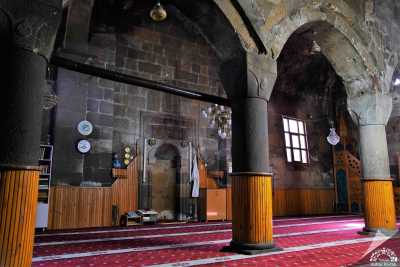
Istlada is among the “Ancient Cities of the Lycian Civilization” (2009) recommended to the UNESCO World Heritage List.
Source: “Istlada”, Antalya from Past to Today [II. Volume], Antalya Provincial Directorate of Culture and Tourism (2012)
Places to Visit in Antalya
Source: Antalya Provincial Culture and Tourism Directorate