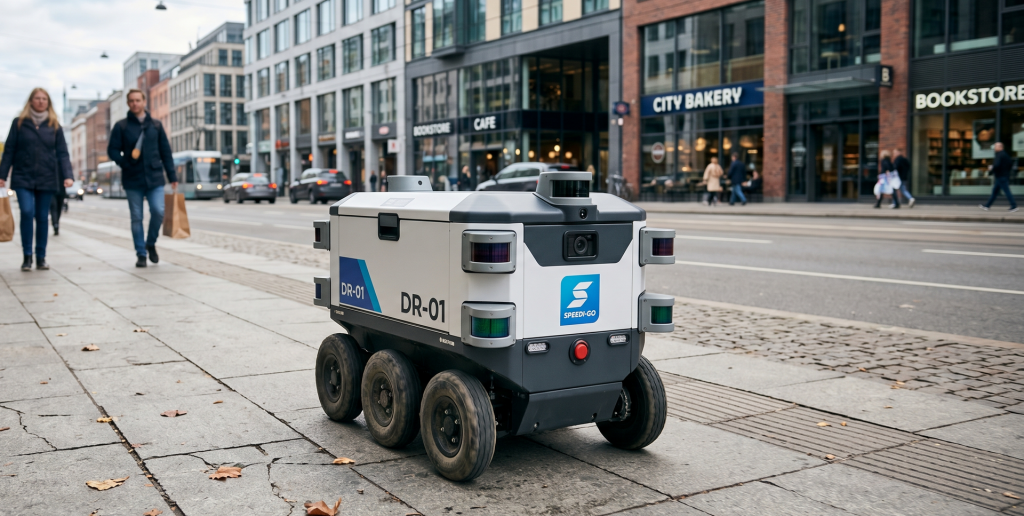
Delivery Robots Are Taking Over Pavements — And Not Everyone Is Happy About It
They looked futuristic at first. Small, wheeled, quietly humming along the pavement. But the novelty of autonomous delivery robots is wearing off fast in several cities, and a growing number of residents, councils and trade unions are pushing back.
The machines — used by companies like Starship Technologies and Uber Eats to transport groceries and fast food — navigate using cameras, sensors and GPS. Their operators say they are safe, polite and environmentally friendlier than delivery vans. Critics say they are an uninvited guest on public footpaths, and nobody asked permission.
The Pavement Problem
The core complaint is simple: pedestrians are being asked to share already narrow footpaths with robots that can weigh up to 50kg when loaded. In cities like Chicago, San Francisco and Glendale, California, residents report having to step into the road to avoid them. There are accounts of robots causing standoffs with elderly pedestrians, blocking crosswalks and in some cases striking people with their safety flags.
Chicago resident Josh Robertson started a petition calling for a citywide suspension of the robots pending proper safety testing. It has gathered thousands of signatures. Two Chicago neighbourhoods have already banned them outright. San Francisco restricts them to quieter streets. Toronto banned them from pavements entirely back in 2021.
In Glendale, city councillors discovered the robots operating in their downtown area without any prior notice or permission request. They are now drawing up a regulatory framework covering insurance, accessibility standards, operating limits in busy areas and accountability requirements — things that arguably should have been in place before the first robot ever rolled out.
Vandalised in Sheffield, Celebrated in Seoul
In the UK, pilots are underway in several cities. In Sheffield, some Uber Eats robots have been vandalised — a blunt signal of local sentiment. Starship Technologies, which supplies the machines, says the technology is safe and that public familiarity will come with time.
The picture internationally is mixed. South Korea and Japan have adopted relatively liberal frameworks for autonomous delivery vehicles. Much of Europe and North America is still working out the rules, resulting in a patchwork of local decisions and bans.
The Jobs Question
Beyond pavement congestion, there is a larger concern that tends to get less attention in the tech coverage: what happens to delivery workers. The Independent Workers Union of Great Britain has flagged the risk explicitly, warning that large-scale deployment could devastate communities where precarious delivery work is a primary income source. The union says it is watching closely and is prepared to pressure government and transport authorities if the rollout accelerates.
Where This Is Heading
Analysts expect the sector to grow sharply. One forecast puts the global fleet at over two million units by 2034, up from a few thousand today. If that projection holds, the regulatory gaps that currently allow robots to appear unannounced on city streets will need to close quickly.
The technology may well be here to stay. The question being asked in Chicago, Glendale and Sheffield is not whether robots can navigate a pavement, but who gets to decide what public space is for — and whether that decision should be made by a logistics company or by the people who actually use the street.