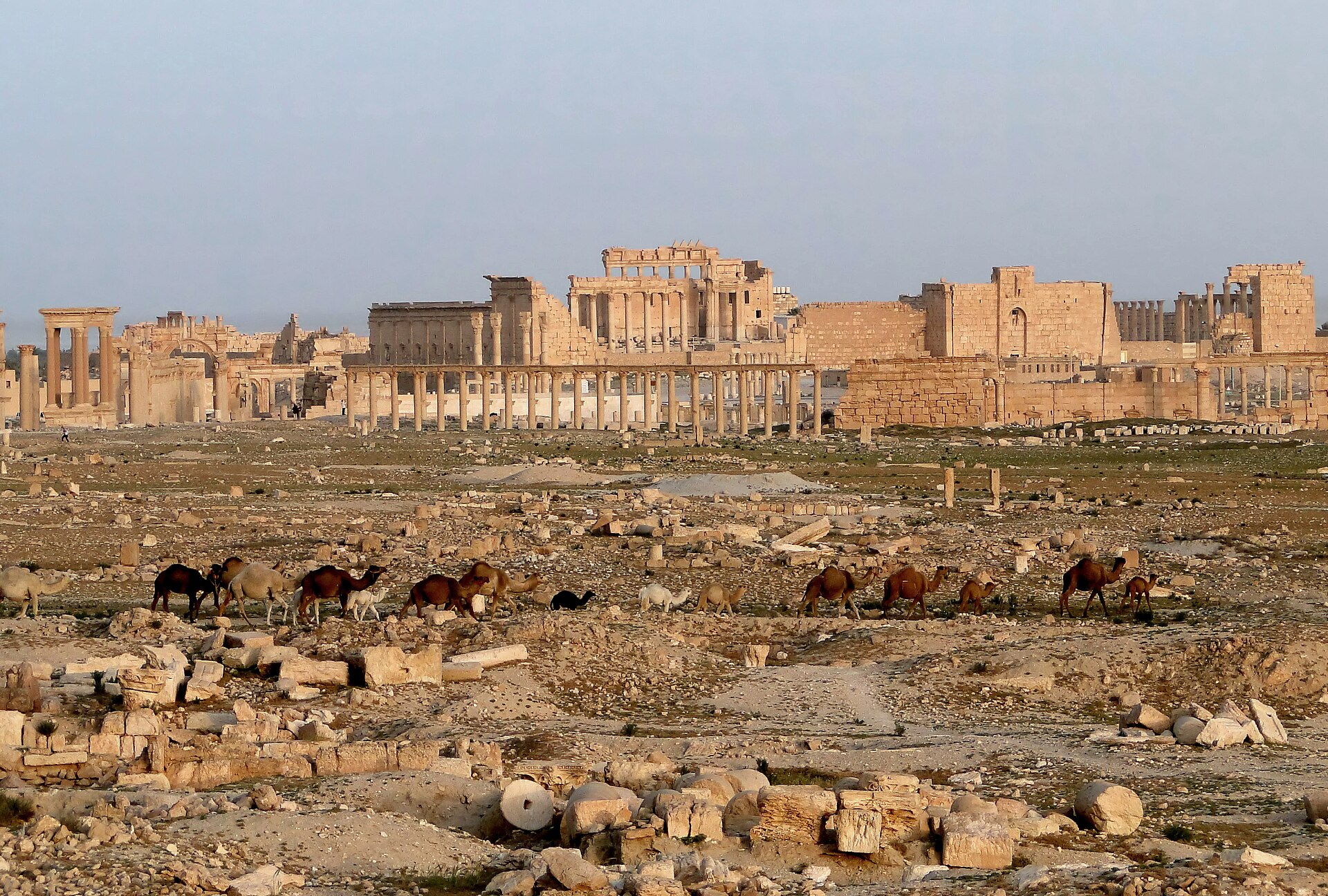
In the middle of the Syrian desert, far from any coast, a forest of stone columns rises from the sand. This is Palmyra, an ancient caravan city that grew fabulously wealthy as a bridge between the Roman world and the East, and whose ruins remain among the most striking in the Middle East.
Palmyra blended Greek, Roman and Persian influences with its own Semitic culture into a style found nowhere else. Its story reaches a dramatic climax in the third century, when a rebel queen led the city in open defiance of Rome itself.

Table of Contents
- An Oasis City in the Syrian Desert
- The Caravan Trade and Palmyrene Wealth
- The Great Colonnade and Monumental Arch
- The Temple of Bel and Palmyrene Religion
- The Theatre, Tetrapylon, and Civic Life
- A Culture of Blended Worlds
- The Valley of the Tombs
- Queen Zenobia’s Revolt Against Rome
- Decline and the Fading of Palmyra
- Modern Damage, UNESCO, and Palmyra’s Future
- Nearby Places
- Closing Thoughts
An Oasis City in the Syrian Desert
Palmyra owed its existence to water. A natural oasis in an otherwise harsh desert, it offered a vital resting place for the caravans that crossed between the Mediterranean and Mesopotamia, and around this spring a great city grew.
Known in antiquity as Tadmor, it lay roughly halfway along the desert route linking the Roman provinces to the trade of the Persian Gulf and beyond. Its position turned a desert waypoint into one of the richest cities of the ancient Near East.

The Caravan Trade and Palmyrene Wealth
Palmyra’s fortune came from the long-distance trade in silk, spices, incense and other luxuries. Palmyrene merchants organised and protected the caravans, and grew wealthy enough to fund temples, colonnades and lavish tombs.
The city effectively acted as a middleman between two great civilisations, Rome and Persia, profiting from both while belonging fully to neither. Inscriptions record the honours heaped on merchants who led successful caravans across the dangerous desert.
The Great Colonnade and Monumental Arch
The spine of Palmyra was its Great Colonnade, a broad avenue more than a kilometre long lined with hundreds of columns. Many bore brackets that once held statues of leading citizens, turning the street into a gallery of the city’s elite.
At one end a monumental arch, richly carved, marked a change in the street’s direction and served as a triumphal gateway. Together they gave Palmyra one of the grandest processional avenues of the Roman East.


The Temple of Bel and Palmyrene Religion
The greatest building in Palmyra was the Temple of Bel, a vast sanctuary dedicated to the chief god of the city. Standing within a great walled courtyard, it combined a classical exterior with distinctly eastern features and rituals.
The Palmyrenes worshipped a rich mixture of Mesopotamian, Syrian and Arab gods alongside Greco-Roman ones, reflecting the crossroads nature of their city. The temple was the spiritual heart of Palmyra for centuries.

The Theatre, Tetrapylon, and Civic Life
Like other cities of the Roman East, Palmyra had a theatre for performances and public gatherings, its stage backed by an ornate facade. Around it clustered the public spaces where the business of the city was conducted.
At a major crossroads stood the tetrapylon, a set of four columned platforms marking the junction of the main avenues. Such monuments show how thoroughly Palmyra embraced the architecture of the classical world while keeping its own character.

A Culture of Blended Worlds
Palmyra was strikingly cosmopolitan. Its people spoke Aramaic and used Greek for official inscriptions, dressed in a mix of Parthian and Roman styles, and worshipped a pantheon drawn from across the region.
This blending is visible in its art, where funerary portraits combine Roman realism with eastern ornament and frontality. Palmyrene sculpture is instantly recognisable and gives us vivid faces of the city’s long-dead merchants and their families.
The Valley of the Tombs
Outside the city walls stretched a great necropolis, including the distinctive tower tombs that rise several storeys high. Inside, the dead were laid in tiers of niches, each sealed with a carved portrait bust of the deceased.
There were also underground tombs and later temple tombs, all richly decorated. These monuments, and the thousands of portraits they held, are among the most important sources for understanding Palmyrene society.

Queen Zenobia’s Revolt Against Rome
Palmyra’s most famous moment came in the third century, when the city rose under Queen Zenobia. Regent for her young son, this bold and ambitious ruler took advantage of Rome’s weakness to carve out an empire that briefly stretched across Syria, Egypt and Anatolia.
For a few years Palmyra challenged Rome directly, until the emperor Aurelian marched east, defeated Zenobia’s forces and captured the queen herself. Her revolt made Palmyra legendary but also sealed its fate.

Decline and the Fading of Palmyra
After Zenobia’s defeat Palmyra was punished and its walls reduced, and a later revolt led to further destruction. The great caravan city never recovered its former wealth and gradually shrank to a garrison town and then a village among the ruins.
As trade routes shifted and the Roman East changed, the once-glittering oasis faded from importance, leaving its columns and temples slowly to the sand and to the Bedouin who camped among them.
Modern Damage, UNESCO, and Palmyra’s Future
Palmyra was inscribed on the UNESCO World Heritage List in 1980 as one of the most important cultural sites of the ancient world. In the twenty-first century it suffered severe deliberate destruction during the Syrian conflict, when several of its greatest monuments were damaged or demolished.
The losses shocked the world and turned Palmyra into a symbol of the threat facing cultural heritage in wartime. Efforts to document, protect and one day restore the site continue, so that the desert city may yet endure.
Nearby Places
- Petra — the other great desert caravan city of the Roman East, grown rich, like Palmyra, on the incense and spice trade.
- The Roman Forum and the Colosseum — the heart of the empire that Zenobia of Palmyra dared to challenge.
- Carthage — another wealthy trading power that rose to defy Rome and paid a terrible price for it.
Closing Thoughts
Palmyra stands as a monument to the meeting of worlds: a place where Roman columns framed eastern gods, and where a desert oasis briefly produced a queen bold enough to defy an empire.
Its recent wounds have made Palmyra a symbol not only of ancient splendour but of the fragility of heritage itself. Even damaged, the columns rising from the Syrian sand remind us of a city that once turned the empty desert into a crossroads of civilisations.


3 thoughts on “Palmyra: The Desert Caravan City Whose Queen Dared to Defy Rome”