In the granite hills of southern Africa stand the ruins of a great city built entirely of stone, its curving walls raised without mortar and rising in places to more than nine metres. This is Great Zimbabwe, the largest ancient stone structure south of the Sahara and the capital of a powerful African kingdom.
For centuries its builders were denied their due, as colonial thinkers refused to believe that Africans could have raised such a city. Modern scholarship has firmly established the truth: Great Zimbabwe was the work of the ancestors of the region’s own people, and it gave a nation its name.

Table of Contents
- The Great Stone City of Southern Africa
- An African Civilisation of Stone
- Who Built Great Zimbabwe
- The Hill Complex
- The Great Enclosure
- The Conical Tower
- Dry-Stone Masonry Without Mortar
- The Zimbabwe Birds
- Gold, Trade, and the Indian Ocean
- Decline, Colonial Myths, and UNESCO
- Nearby Places
- Closing Thoughts
The Great Stone City of Southern Africa
Great Zimbabwe flourished between roughly the eleventh and fifteenth centuries AD, at its height home to perhaps eighteen thousand people. It was the centre of a wealthy kingdom that controlled trade and cattle across a wide region.
The name Zimbabwe comes from a local term meaning houses of stone, and it is from this great ruin that the modern nation takes its name. The site covers a large area of walls, enclosures and terraces spread across hills and a valley.

An African Civilisation of Stone
The city was built by a Bantu-speaking people, ancestors of the modern Shona, who developed a sophisticated society based on cattle, farming, gold and long-distance trade. Their skill in stone building was matched by few of their contemporaries anywhere.
Great Zimbabwe was not unique but the greatest of many stone-walled settlements across the region. It represents the peak of a distinctly African architectural tradition, adapted to the granite landscape in which it stands.

Who Built Great Zimbabwe
When Europeans first encountered the ruins, many refused to accept an African origin, inventing theories that credited the city to Phoenicians, Arabs or the biblical Queen of Sheba. These ideas were driven by racial prejudice, not evidence.
Careful archaeology has long since settled the question. The materials, techniques and objects found at the site are unmistakably African and local, and Great Zimbabwe is now recognised as the achievement of the region’s own ancestral peoples.
The Hill Complex
The oldest part of the city is the Hill Complex, perched on a steep granite outcrop overlooking the valley. Its walls weave among the natural boulders, blending built stone with the living rock in a striking way.
This commanding position is thought to have been a royal and religious centre, perhaps the residence of the king or a place of ritual. From here the rulers of Great Zimbabwe looked out over their city and lands.

The Great Enclosure
The most famous structure is the Great Enclosure, a huge oval ring of walls in the valley below the hill. Its outer wall, hundreds of metres in circumference, is the largest single ancient structure in sub-Saharan Africa.
Within and around it lie further walls and enclosures, once filled with the clay houses of the city’s inhabitants. The scale and craftsmanship of the Great Enclosure make it the centrepiece of the entire site.

The Conical Tower
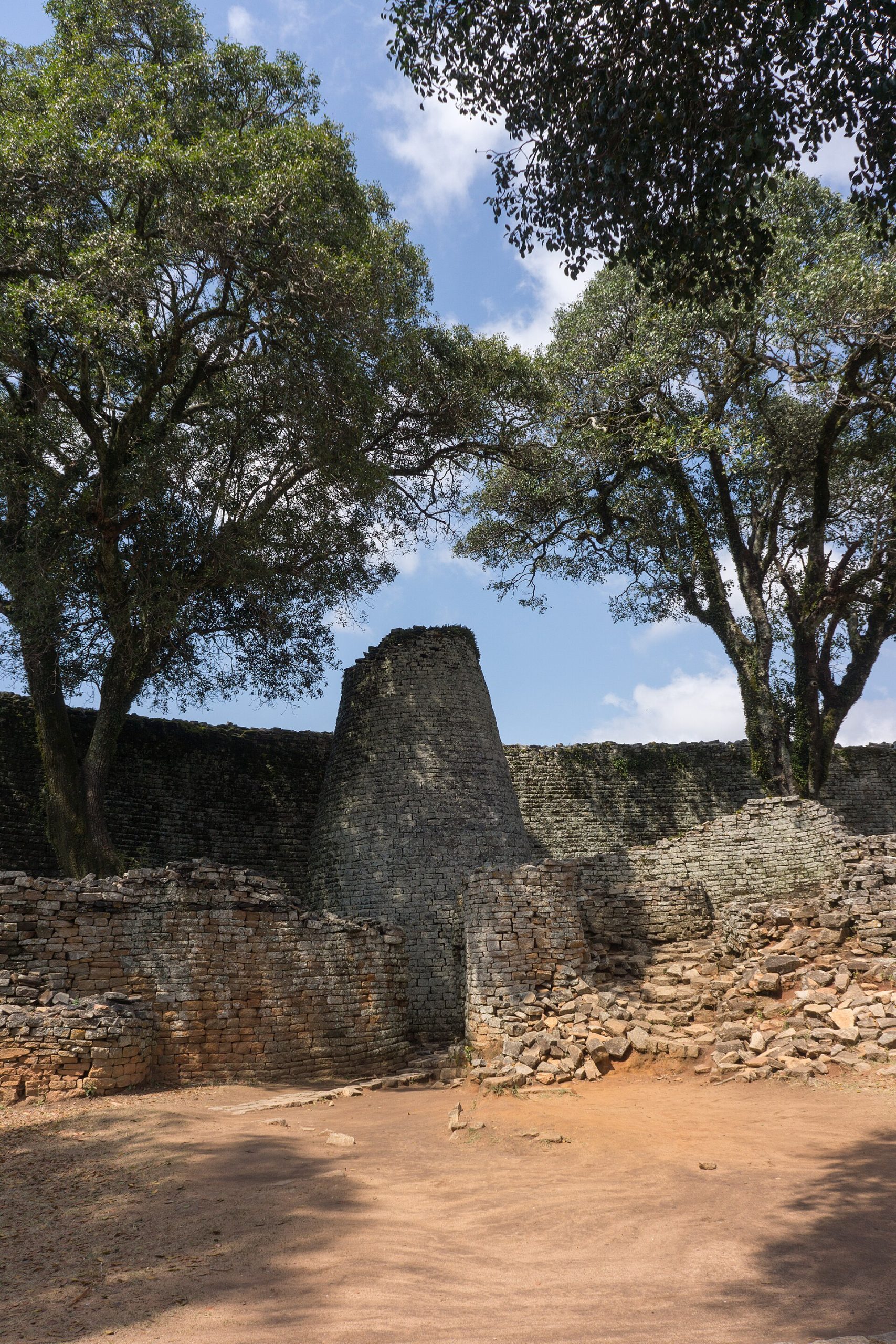
Inside the Great Enclosure stands its most enigmatic feature, a solid conical tower of stone, some ten metres high, built like a giant grain bin. It has no doorway, chamber or obvious practical function.
Most scholars believe it was a symbolic structure, perhaps representing prosperity, fertility or the authority of the king. Whatever its meaning, it remains one of the most memorable and mysterious monuments in Africa.
Dry-Stone Masonry Without Mortar
The walls of Great Zimbabwe were built entirely of granite blocks, carefully shaped and fitted together without any mortar to bind them. That they have stood for centuries is a testament to the skill of their builders.
The finest walls are gently curved and topped with decorative patterns, and narrow passages run between them. This dry-stone technique, developed to a high art, is the hallmark of Great Zimbabwe and its related sites.


The Zimbabwe Birds
Among the most precious finds at the site are the carved soapstone birds, each perched on a column, that once stood in the city. Combining features of birds and perhaps human elements, they seem to have had a sacred, ancestral meaning.
These Zimbabwe Birds have become the national emblem of modern Zimbabwe, appearing on its flag and coat of arms. They are a powerful link between the ancient city and the country that bears its name.

Gold, Trade, and the Indian Ocean
Great Zimbabwe grew rich in part from gold, mined in the region and traded along routes that reached the ports of the East African coast and, through them, the wider Indian Ocean world.
Excavations have uncovered goods from far away, including glass beads and Chinese and Persian ceramics, proof that this inland African city was connected to a vast network of long-distance commerce.
Decline, Colonial Myths, and UNESCO
By the fifteenth century Great Zimbabwe was in decline, probably as trade shifted and the surrounding land was exhausted, and the centre of power moved elsewhere. The great city was gradually abandoned.
In the colonial era its history was distorted to deny its African builders, and looting damaged the site. Since independence Great Zimbabwe has been reclaimed as a source of national pride, and it was inscribed on the UNESCO World Heritage List in 1986.
Nearby Places
- Carthage — an earlier great African city that, like Great Zimbabwe, grew wealthy through wide-ranging trade.
- Kerma — another powerful African civilisation whose achievements were long overlooked by outsiders.
- Leptis Magna — a magnificent city on the northern coast of the same continent, in the Roman age.
Closing Thoughts
Great Zimbabwe stands as proof of the sophistication of pre-colonial African civilisation: a great city of finely built stone, rich in gold and trade, raised by the ancestors of the people who live in the region today.
Long misrepresented and only recently given its rightful place in history, it now lends its name to a nation and its birds to a flag. The silent granite walls remain one of Africa’s greatest and most eloquent monuments.


2 thoughts on “Great Zimbabwe: The Mortarless Stone City That Gave a Nation Its Name”